

Interventions to improve team effectiveness within health care: a systematic review of the past decade
Open accessThe DOI matches its Crossref record; 332 of the 336 references it cites were found in a registry or an index.
Abstract
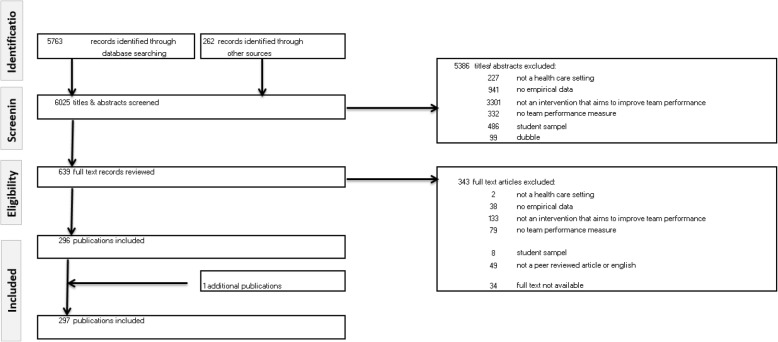
Background: A high variety of team interventions aims to improve team performance outcomes. In 2008, we conducted a systematic review to provide an overview of the scientific studies focused on these interventions. However, over the past decade, the literature on team interventions has rapidly evolved. An updated overview is therefore required, and it will focus on all possible team interventions without restrictions to a type of intervention, setting, or research design. Objectives: To review the literature from the past decade on interventions with the goal of improving team effectiveness within healthcare organizations and identify the “evidence base” levels of the research. Methods: Seven major databases were systematically searched for relevant articles published between 2008 and July 2018. Of the original search yield of 6025 studies, 297 studies met the inclusion criteria according to three independent authors and were subsequently included for analysis. The Grading of Recommendations, Assessment, Development, and Evaluation Scale was used to assess the level of empirical evidence. Results: Three types of interventions were distinguished: (1) Training , which is sub-divided into training that is based on predefined principles (i.e. CRM: crew resource management and TeamSTEPPS: Team Strategies and Tools to Enhance Performance and Patient Safety), on a specific method (i.e. simulation), or on general team training. (2) Tools covers tools that structure (i.e. SBAR: Situation, Background, Assessment, and Recommendation, (de)briefing checklists, and rounds), facilitate (through communication technology), or trigger (through monitoring and feedback) teamwork. (3) Organizational (re)design is about (re)designing structures to stimulate team processes and team functioning . (4) A programme is a combination of the previous types. The majority of studies evaluated a training focused on the (acute) hospital care setting. Most of the evaluated interventions focused on improving non-technical skills and provided evidence of improvements. Conclusion: Over the last decade, the number of studies on team interventions has increased exponentially. At the same time, research tends to focus on certain interventions, settings, and/or outcomes. Principle-based training (i.e. CRM and TeamSTEPPS) and simulation-based training seem to provide the greatest opportunities for reaching the improvement goals in team functioning.
Overview
The claims and statistics of this paper haven’t been checked yet.
Free: it reads the open-access text and checks the first 5 claims that cite a source we can check. Create a free account to check every claim.
Integrity signals
Registry
Cites
Statistics
Figures
Verification
Claims the paper makes
The claims and statistics of this paper haven’t been checked yet.
Free: it reads the open-access text and checks the first 5 claims that cite a source we can check. Create a free account to check every claim.
Self-check
Percentages, sums and reported differences re-computed from the paper’s own numbers.
The self-check needs the paper’s full text.
Citations
Cites
Audit and feedback: effects on professional practice and healthcare outcomes
Ivers, N., Jamtvedt, G., Flottorp, S., Young, J. M., Odgaard-Jensen, J., French, S. D., O'Brien, M. A., Johansen, M., Grimshaw, J., & Oxman, A. D. (2012) · Cochrane Database of Systematic Reviews · doi:10.1002/14651858.cd000259.pub3 · Cited by 5,485
Interprofessional education: effects on professional practice and healthcare outcomes
Reeves, S., Perrier, L., Goldman, J., Freeth, D., & Zwarenstein, M. (2013) · Cochrane Database of Systematic Reviews · doi:10.1002/14651858.cd002213.pub3 · Cited by 1,946
Teamwork and patient safety in dynamic domains of healthcare: A review of the literature
MANSER, T. (2009) · Acta Anaesthesiologica Scandinavica · doi:10.1111/j.1399-6576.2008.01717.x · Cited by 1,322 · cited 1×
“A lack of teamwork is often identified as a primary point of vulnerability for quality and safety of care [1, 2].”
BackgroundThe Evolution of Crew Resource Management Training in Commercial Aviation
Helmreich, R. L., Merritt, A. C., & Wilhelm, J. A. (1999) · The International Journal of Aviation Psychology · doi:10.1207/s15327108ijap0901_2 · Cited by 1,111 · cited 1×
“CRM aims to prevent and manage errors through avoiding errors, trapping errors before they are committed, and mitigating the consequences of errors that are not trapped [325].”
BackgroundAssociation Between Implementation of a Medical Team Training Program and Surgical Mortality
Neily, J., Mills, P. D., Young-Xu, Y., Carney, B. T., West, P., Berger, D. H., Mazzia, L. M., Paull, D. E., & Bagian, J. P. (2010) · JAMA · doi:10.1001/jama.2010.1506 · Cited by 1,040 · cited 4×
“MTT combines training, implementation of tools (briefings, debriefing, and other projects), and follow-up coaching [5, 304, 305, 316].”
BackgroundMethodInfluentialWhat Do We Know about Health Care Team Effectiveness? A Review of the Literature
Lemieux-Charles, L., & McGuire, W. L. (2006) · Medical Care Research and Review · doi:10.1177/1077558706287003 · Cited by 844 · cited 1×
“healthcare settings vary significantly, which challenges the generalizability [327].”
BackgroundTraining and simulation for patient safety
Aggarwal, R., Mytton, O. T., Derbrew, M., Hananel, D., Heydenburg, M., Issenberg, B., MacAulay, C., Mancini, M. E., Morimoto, T., Soper, N., et al. (2010) · Quality and Safety in Health Care · doi:10.1136/qshc.2009.038562 · Cited by 739 · cited 1×
“Simulation-based training uses a specific method as its core, namely, simulation, which refers to “a technique to replace or amplify real-patient experiences with guided experiences, artificially contrived, that evokes or replicates substantial aspects of the real world in a fully interactive manner” [326].”
Introduction of surgical safety checklists in Ontario, Canada
Urbach, D. R., Govindarajan, A., Saskin, R., Wilton, A. S., & Baxter, N. N. (2014) · New England Journal of Medicine · doi:10.1056/nejmsa1308261 · Cited by 627 · cited 1×
“…Anaesthesiology Improvement in information exchange, knowledge of critical information, perception of safety in anaesthesia teams, perceived teamwork A Urbach et al. 2014 [242] Surgical safety checklist Operating room Implementation is not associated with significant reductions in operative…”
Lingard, L. (2008) · Archives of Surgery · doi:10.1001/archsurg.2007.21 · Cited by 596 · cited 2×
“Improvement in unplanned admission rates and number of wound complications D Lingard et al. 2008 [251] Team briefing structured by a checklist General surgery Improvement in number of communication failures and proactive and collaborative team communication C Low et al. 2013 [232] “Flow checklists”…”
BackgroundMethodTeam-training in healthcare: a narrative synthesis of the literature
Weaver, S. J., Dy, S. M., & Rosen, M. A. (2014) · BMJ Quality & Safety · doi:10.1136/bmjqs-2013-001848 · Cited by 535
Research works printed but not linked: 2
- Donaldson MS, Corrigan JM, Kohn LT. To err is human: building a safer health system: National Academies Press; 2000.
- Fernandez R, Pearce M, Grand JA, Rench TA, Jones KA, Chao GT, et al. A randomized comparison study to evaluate the effectiveness of a computer-based teamwork training intervention on medical teamwork and patient care performance. Acad Emerg Med. 2013;20:S125.
Cited by
European Resuscitation Council Guidelines 2021: Adult advanced life support
Soar, J., Böttiger, B. W., Carli, P., Couper, K., Deakin, C. D., Djärv, T., Lott, C., Olasveengen, T., Paal, P., Pellis, T., et al. (2021) · Resuscitation · doi:10.1016/j.resuscitation.2021.02.010 · Cited by 1,225
Opportunities and challenges for contactless healthcare services in the post-COVID-19 Era
Lee, S. M., & Lee, D. (2021) · Technological Forecasting and Social Change · doi:10.1016/j.techfore.2021.120712 · Cited by 282
“For example, in the case of healthcare collaboration, a variety of operational strategies are required for value co-creation between patients and medical staff based on a oneto-many rather than a one-to-one approach (Buljac-Samardzic et al., 2020; Lee, 2019).”
BackgroundImproving Patient Outcomes Through Effective Hospital Administration: A Comprehensive Review
Bhati, D., Deogade, M. S., & Kanyal, D. (2023) · Cureus · doi:10.7759/cureus.47731 · Cited by 179
“Strategies for improving patient outcomes are in Table 1 [23-28].”
European Resuscitation Council Guidelines 2025 Adult Advanced Life Support
Soar, J., Böttiger, B. W., Carli, P. A., Carmona, F., Cimpoesu, D. C., Cole, G., Couper, K., D’Arrigo, S., Deakin, C. D., Ek, J. E., et al. (2025) · Resuscitation · doi:10.1016/j.resuscitation.2025.110769 · Cited by 337
Abildgren, L., Lebahn-Hadidi, M., Mogensen, C. B., Toft, P., Nielsen, A. B., Frandsen, T. F., Steffensen, S. V., & Hounsgaard, L. (2022) · Advances in Simulation · doi:10.1186/s41077-022-00207-2 · Cited by 162
“[33] explored interventions that improved team effectiveness and concluded that SBT enhances teamwork, though interventions studies were limited to specific situations, settings and outcomes.”
BackgroundQasim, Z. A., Sjoholm, L. O., Volgraf, J., Sailes, S., Nance, M. L., Perks, D. H., Grewal, H., Meyer, L. K., Walker, J., Koenig, G. J., et al. (2020) · The Journal of Trauma: Injury, Infection, and Critical Care · doi:10.1097/ta.0000000000002859 · Cited by 75
van den Brink, G. T. W. J., Hooker, R. S., van Vught, A., Vermeulen, H., & Laurant, M. G. H. (2021) · PLoS ONE · doi:10.1371/journal.pone.0259183 · Cited by 81
“Their contemporary activity is viewed as an integrated member of a medical team [59].”
BackgroundSoar, J., Böttiger, B. W., Carli, P. A., Couper, K., Deakin, C. D., Djärv, T., Lott, C., Olasveengen, T. M., Paal, P., Pellis, T., et al. (2021) · Notfall + Rettungsmedizin · doi:10.1007/s10049-021-00893-x · Cited by 71
Mahmood, L. S., Mohammed, C. A., & GILBERT, J. H. V. (2021) · Medical Journal Armed Forces India · doi:10.1016/j.mjafi.2020.10.026 · Cited by 65
The Relationship of Nursing Teamwork and Job Satisfaction in Hospitals
Bragadóttir, H., Kalisch, B. J., Flygenring, B. G., & Tryggvadottir, G. B. (2023) · SAGE Open Nursing · doi:10.1177/23779608231175027 · Cited by 77
“Looking at the two influential variables, staffing and teamwork, it may be equally important for nursing and health care leaders to strengthen their teams through effective interventions (Buljac-Samardzic et al., 2020), as it is to secure adequate staffing (WHO, 2020).”
BackgroundSaavedra, M. P., Vallejos, M. A., Huancahuire‐Vega, S., Morales-García, W. C., & Campos, L. A. G. (2024) · Administrative Sciences · doi:10.3390/admsci14110280 · Cited by 188
Agbar, F., Zhang, S., Wu, Y. X., & Tia, M. M. G. (2023) · Nurse Education in Practice · doi:10.1016/j.nepr.2023.103565 · Cited by 85
Simulation-based summative assessment in healthcare: an overview of key principles for practice
Buléon, C., Mattatia, L., Minehart, R. D., Rudolph, J. W., Lois, F. J., Guillouët, E., Philippon, A., Brissaud, O., Lefevre-Scelles, A., Benhamou, D., et al. (2022) · Advances in Simulation · doi:10.1186/s41077-022-00238-9 · Cited by 68
Social distancing: implications for the operating room in the face of COVID-19
Prin, M., & Bartels, K. (2020) · Canadian Journal of Anesthesia/Journal canadien d anesthésie · doi:10.1007/s12630-020-01651-2 · Cited by 63
Patient Safety Culture: The Impact on Workplace Violence and Health Worker Burnout
Kim, S., Kitzmiller, R. R., Baernholdt, M., Lynn, M. R., & Jones, C. B. (2022) · Workplace Health & Safety · doi:10.1177/21650799221126364 · Cited by 70
“Effective teams also create work environments that are more constructive, engaging, and resilient (Buljac-Samardzic et al., 2020).”
Ajam, A. A., Tahir, S., Makary, M. S., Longworth, S., Lang, E. V., Krishna, N. G., Mayr, N. A., & Nguyen, X. V. (2020) · Topics in Magnetic Resonance Imaging · doi:10.1097/rmr.0000000000000242 · Cited by 52
“This section discusses a few examples of staff training options studied in radiology settings, but training in communication or other team-based skills has also been described by other investigators in radiotherapy planning sessions(33,34) and numerous other healthcare settings.(35) In addition, there are some general…”
BackgroundSchilling, S., Armaou, M., Morrison, Z., Carding, P. N., Bricknell, M. C. M., & Connelly, V. J. (2022) · PLoS ONE · doi:10.1371/journal.pone.0272942 · Cited by 65
Sirimsi, M. M., Loof, H. D., den Broeck, K. V., Vliegher, K. D., Pype, P. F., Remmen, R., & Bogaert, P. V. (2022) · BMJ Open · doi:10.1136/bmjopen-2022-062111 · Cited by 74
Gómez‐Ríos, M. Á., Sastre, J. A., Onrubia-Fuertes, X., López, T., Gurumeta, A. A., Casans‐Francés, R., Gómez-Ríos, D., Garzón, J. C., Martínez-Pons, V., Casalderrey-Rivas, M., et al. (2024) · Revista Española de Anestesiología y Reanimación (English Edition) · doi:10.1016/j.redare.2024.02.002 · Cited by 78
Effect of simulation‐based team training in airway management: a systematic review
Nielsen, R. P., Nikolajsen, L., Paltved, C., & Aagaard, R. (2021) · Anaesthesia · doi:10.1111/anae.15375 · Cited by 47
“A recent systematic review evaluating interventions to improve team effectiveness within healthcare in general pointed towards a positive effect of simulation-based team training on behavioural skills, while results regarding technical skills were equivocal [11].”
BackgroundGreilich, P. E., Kilcullen, M., Paquette, S. L., Lazzara, E. H., Scielzo, S. A., Hernandez, J., Preble, R. G., Michael, M. M., Sadighi, M., Tannenbaum, S. I., et al. (2023) · Journal of Clinical and Translational Science · doi:10.1017/cts.2023.27 · Cited by 59
“Although there is evidence that team knowledge, skills, and attitudes are important and training is beneficial, consensus on the optimal training content, methods, and evaluation is lacking [1,4,6].”
BackgroundGómez‐Ríos, M. Á., Sastre, J. A., Onrubia-Fuertes, X., López, T., Gurumeta, A. A., Casans‐Francés, R., Gómez-Ríos, D., Garzón, J. C., Martínez-Pons, V., Casalderrey-Rivas, M., et al. (2023) · Revista Española de Anestesiología y Reanimación · doi:10.1016/j.redar.2023.08.001 · Cited by 56
Kilpatrick, K., Paquette, L., Jabbour, M., Nguemeleu, E. T., Fernández, N., Hakim, G. A., Landry, V., Gauthier, N., Beaulieu, M., & Dubois, C. (2020) · PLoS ONE · doi:10.1371/journal.pone.0234416 · Cited by 64
“Team training is seen as essential to improve team performance [16, 17].”
BackgroundThe Anatomy and Physiology of Teaming in Cancer Care Delivery: A Conceptual Framework
Verhoeven, D. C., Chollette, V. Y., Lazzara, E. H., Shuffler, M. L., Osarogiagbon, R. U., & Weaver, S. J. (2020) · JNCI Journal of the National Cancer Institute · doi:10.1093/jnci/djaa166 · Cited by 47
Tate, K., Penconek, T., Dias, B. M., Cummings, G. G., & Bernardes, A. (2023) · Journal of Advanced Nursing · doi:10.1111/jan.15663 · Cited by 76
Roberts, A. P. J., Webster, L. V., Salmon, P. M., Flin, R. H., Salas, E., Cooke, N. J., Read, G. J. M., & Stanton, N. A. (2021) · Ergonomics · doi:10.1080/00140139.2021.2000043 · Cited by 67
New horizons in hospital-associated deconditioning: a global condition of body and mind
Welch, C., Chen, Y. S., Hartley, P., Naughton, C., Martínez‐Velilla, N., Stein, D. F., & Romero‐Ortuño, R. (2024) · Age and Ageing · doi:10.1093/ageing/afae241 · Cited by 48
Cultural diversity in health care teams: A systematic integrative review and research agenda
Schmidt, M., Steigenberger, N., Berndtzon, M., & Umans, T. (2023) · Health Care Management Review · doi:10.1097/hmr.0000000000000379 · Cited by 49
Qualitative Analysis of Effective Teamwork in the Operating Room (OR)
Paige, J. T., Garbee, D. D., Bonanno, L. S., & Kerdolff, K. (2020) · Journal of surgical education · doi:10.1016/j.jsurg.2020.09.019 · Cited by 57
McGuier, E. A., Kolko, D. J., Stadnick, N. A., Brookman-Frazee, L., Wolk, C. B., Yuan, C. T., Burke, C. S., & Aarons, G. A. (2023) · Implementation Research and Practice · doi:10.1177/26334895231190855 · Cited by 34
“In healthcare settings, interventions that improve teamwork improve clinical outcomes (Buljac-Samardzic et al., 2020; Hughes et al., 2016; Weaver et al., 2014).”
BackgroundTandan, M., Dunlea, S., Cullen, W., & Bury, G. (2024) · Public Health · doi:10.1016/j.puhe.2024.01.019 · Cited by 50
What’s age got to do with it? The effect of board member age diversity: a systematic review
Gardiner, E. (2022) · Management Review Quarterly · doi:10.1007/s11301-022-00294-5 · Cited by 60
Laco, R. B., & Stuart, W. P. (2021) · Military Medicine · doi:10.1093/milmed/usab198 · Cited by 34
Team Belonging: Integrating Teamwork and Diversity Training Through Emotions
Davis, A. S., Kafka, A. M., González‐Morales, M. G., & Feitosa, J. (2021) · Small Group Research · doi:10.1177/10464964211044813 · Cited by 53
“An example of these types of trainings includes TeamSTEPPS, which aims to improve these behavioral skills such as monitoring and communication to achieve better team performance (Buljac-Samardzic et al., 2020).”
BackgroundChen, H., O'Donnell, J. M., Chiu, Y.-J., Chen, Y., Kang, Y., Tuan, Y.-T., Kuo, S., & Wu, J.-C. (2022) · BMC Medical Education · doi:10.1186/s12909-022-03640-z · Cited by 45
“A 2020 systematic review [24] of 17 IPE training studies that used single-arm pretest–posttest designs reported that IPE is an effective intervention [25–38]; however, none of these studies compared the learning outcomes of IPE with SPE models for multiple activities or directly compared the outcomes of IPE and SPE si…”
BackgroundSnowdon, A. W., Hussein, A. A., Danforth, M., Wright, A., & Oakes, R. (2024) · Journal of Medical Internet Research · doi:10.2196/56316 · Cited by 48
“…[29,30], prevention of central line–associated blood infections (CLABSI) [31-33], use of hand hygiene practices to prevent infections [34,35], quality and safety training, established leadership priorities that focus on quality and safety [36], and improvements in clinical pathways [26,37,38].”
Kohanová, D., Solgajová, A., & Cubelo, F. (2024) · Journal of Clinical Nursing · doi:10.1111/jocn.17182 · Cited by 53
THE ROLE OF AGILE PROJECT MANAGEMENT IN DRIVING INNOVATION IN ENERGY-EFFICIENT HVAC SOLUTIONS
Ebirim, W., Montero, D. J. P., Ani, E. C., Ninduwezuor-Ehiobu, N., Usman, F. O., & Olu-lawal, K. A. (2024) · Engineering Science & Technology Journal · doi:10.51594/estj.v5i3.864 · Cited by 48
Golinelli, D., Pecoraro, V., Tedesco, D., Negro, A., Berti, E., Camerlingo, M. D., Alberghini, L., Lippi Bruni, M., Rolli, M., & Grilli, R. (2025) · BMC Health Services Research · doi:10.1186/s12913-025-12690-0 · Cited by 30
“In this context, timely identifying, managing, and monitoring high-risk patients becomes crucial for improving outcomes and optimizing resource allocation [5, 6].”
The Effect of the Electronic Health Record on Interprofessional Practice: A Systematic Review
Robertson, S. T., Rosbergen, I. C. M., Burton‐Jones, A., Grimley, R., & Brauer, S. (2022) · Applied Clinical Informatics · doi:10.1055/s-0042-1748855 · Cited by 51
Bijani, M., Rakhshan, M., Fararouei, M., & Torabizadeh, C. (2020) · BMC Nursing · doi:10.1186/s12912-020-00476-0 · Cited by 31
“(2020), teamwork skills as an important component of emergency nurses’ clinical competency [29].”
BackgroundPatient safety culture in resource-limited healthcare settings: A multicentre survey
Fekadu, G., Muir, R., Tobiano, G., Bime, A. E., Ireland, M. J., & Marshall, A. P. (2025) · PLoS ONE · doi:10.1371/journal.pone.0326320 · Cited by 32
Skoogh, A., Bååth, C., & Hall‐Lord, M. (2022) · BMC Health Services Research · doi:10.1186/s12913-022-08145-5 · Cited by 39
“Team training can improve the effectiveness of interprofessional teams [31, 57] in terms of teamwork performance [58] and has positive effects on patient safety culture [57], clinical processes and a reduction in adverse events [59].”
BackgroundDisaster Collaborative Exercises for Healthcare Teamwork in a Saudi Context
Sultan, M. A. S., Khorram‐Manesh, A., Sørensen, J. L., Berlin, J. M., & Carlström, E. (2023) · International Journal of Disaster Risk Science · doi:10.1007/s13753-023-00484-z · Cited by 37
“Continuous training allows HCWs to share ideas, knowledge, and skills in disaster management (Buljac-Samardzic et al. 2020).”
BackgroundCrookall, D. (2023) · Springer texts in education · doi:10.1007/978-3-031-21011-2_6 · Cited by 39
Simou, E. (2025) · International Medical Education · doi:10.3390/ime4040050 · Cited by 35
“…reviews highlight interventions such as crisis resource management, structured communication protocols, and organizational redesign as drivers of team effectiveness [128,129] and demonstrate the value of briefings, debriefings, and checklists to reduce errors and foster shared mental models [130].”
Lauck, S., Bains, V., Nordby, D., Iacoe, E., Forman, J. M., Polderman, J., & Farina, L. (2021) · Australian Critical Care · doi:10.1016/j.aucc.2021.02.009 · Cited by 34
Improving teamwork in maternity services: A rapid review of interventions
Harris, J., Beck, S., Ayers, N., Bick, D., Lamb, B. W., Aref‐Adib, M., Kelly, T., Green, J. S. A., & Taylor, C. (2022) · Midwifery · doi:10.1016/j.midw.2022.103285 · Cited by 33
Neher, A. N., Wespi, R., Rapphold, B. D., Sauter, T. C., Kämmer, J. E., & Birrenbach, T. (2024) · JMIR Serious Games · doi:10.2196/57117 · Cited by 39
“One way to counteract this is to integrate interprofessional education (IPE) into the curriculum of health professionals [2,5-7].”
BackgroundElcokany, N. M., Abdelhafez, A. I., Sharaby, V. M. S., & Belal, S. (2021) · Healthcare · doi:10.3390/healthcare9091228 · Cited by 34
Exploring patient safety culture in emergency departments: A Tunisian perspective
Aouicha, W., Tlili, M. A., Sahli, J., Dhiab, M. B., Chelbi, S., Mtiraoui, A., Latiri, H. S., Ajmi, T. N., Zedini, C., Rejeb, M. B., et al. (2020) · International Emergency Nursing · doi:10.1016/j.ienj.2020.100941 · Cited by 24
Adverse events experienced with intrahospital transfer of critically ill patients
Temsah, M.-H. A., Alsohime, F., Alhaboob, A. A. N., Al-Eyadhy, A. A., Aljamaan, F., Hasan, G., Ali, S., Ashri, A. M., Nahass, A. A., Al-Barrak, R., et al. (2021) · Medicine · doi:10.1097/md.0000000000025810 · Cited by 24
“5 Although our self-reported study did not indicate the impact of using the SBAR technique for handover on the frequency of adverse events, this remains one of the main team interventions to improve performance and outcomes.([19]) In their systematic review of articles published between 2008 and July 2018, BuljacSamar…”
MethodSudeshika, T., Naunton, M., Peterson, G. M., Deeks, L. S., Guénette, L., Sharma, R. K., Freeman, C. R., Niyonsenga, T., & Kosari, S. (2022) · International Journal of Environmental Research and Public Health · doi:10.3390/ijerph20010394 · Cited by 31
Redjem, I. D., Huaulmé, A., Jannin, P., & Michinov, E. (2025) · Nurse Education Today · doi:10.1016/j.nedt.2025.106583 · Cited by 37
Buchanan, C., Burt, A., Moureau, N., Murray, D., & Nizum, N. (2023) · The Journal of Vascular Access · doi:10.1177/11297298231169468 · Cited by 31
“194 197 Acute care organizations should consider implementation of a multi-component PVAD care protocol.”
Paige, J. T., Kerdolff, K. E., Rogers, C. L., Garbee, D. D., Yu, Q., Cao, W., Rusnak, S., & Bonanno, L. S. (2021) · Surgery · doi:10.1016/j.surg.2021.06.014 · Cited by 22
Developing local crisis leadership – A research and training agenda
Eid, J., Hansen, A. L., Andreassen, N., Espevik, R., Brattebø, G., & Johnsen, B. H. (2023) · Frontiers in Psychology · doi:10.3389/fpsyg.2023.1041387 · Cited by 35
Sánchez‐Marco, M., Escribano, S., Rubio‐Aparicio, M., Juliá‐Sanchis, R., & Cabañero‐Martínez, M. J. (2023) · Australian Critical Care · doi:10.1016/j.aucc.2023.01.007 · Cited by 33
“With respect to the funnel plots using the trim-and-fill method, for most of the analysed outcomes, the effect sizes were imputed on nical skills educational interventions in the context of emergencies: A .org/10.1016/j.aucc.2023.01.007 Table 2 Quality of studies measured by MERSQI.27 Article Study design Sampling Typ…”
InfluentialHunter, J., Majd, I., Kowalski, M., & Harnett, J. (2021) · Global Advances in Health and Medicine · doi:10.1177/21649561211014107 · Cited by 21
“Multiple studies have evaluated and recommend interprofessional training programs that employ standardized tools and simulation exercises to improve interprofessional communication skills, professional cultural competency, and practitioners’ and patients’ experiences.(5,6) For the most part, however, these educational…”
BackgroundMethodJepkosgei, J., English, M., Adam, M. B., & Nzinga, J. (2022) · BMC Health Services Research · doi:10.1186/s12913-022-08039-6 · Cited by 40
“As such, there have been a variety of interventions aimed at improving team effectiveness, such as simulation training and crew resource management training (CRM) which are focused on improving non-technical skills of teams including communication, leadership and team behaviours [22].”
BackgroundInterprofessional learning in practice-based settings: AMEE Guide No. 169
Hosny, S., Thistlethwaite, J. E., El-Wazir, Y. M., & GILBERT, J. H. V. (2024) · Medical Teacher · doi:10.1080/0142159x.2024.2352162 · Cited by 27
“Simulation-based training is a popular team-based activity, and frequently includes non-technical skills such as team working and management, communication, situational awareness, leadership, and decision making (Buljac-Samardzic, Doekhie, and van Wijngaarden 2020).”
Rabkin, S. W., & Frein, M. (2021) · Healthcare · doi:10.3390/healthcare9091136 · Cited by 34
“This approach leads to an improvement in some non-technical skills (teamwork, communication, safety culture) and some improvement in outcome—reduction in medical errors, as reduction in patient errors was the objective of this kind of training [88].”
BackgroundMethodInfluentialManaging a team in the operating room: The science of teamwork and non-technical skills for surgeons
Sinyard, R. D., Rentas, C., Gunn, E., Etheridge, J. C., Robertson, J. M., Gleason, A. M., Riley, M. S., Yule, S., & Smink, D. S. (2022) · Current Problems in Surgery · doi:10.1016/j.cpsurg.2022.101172 · Cited by 18
Schlembach, D., Annecke, T., Girard, T., Helmer, H., Kainer, F., Kehl, S., Korte, W. C., Kühnert, M., Lier, H., Mader, S., et al. (2023) · Geburtshilfe und Frauenheilkunde · doi:10.1055/a-2073-9615 · Cited by 23
Modeling the Transformation of Configuration Management Processes in a Multi-Project Environment
Dotsenko, N. V., Chumachenkо, I., Galkin, A., Kuchuk, H., & Chumachenko, D. (2023) · Sustainability · doi:10.3390/su151914308 · Cited by 20
Teamwork and Surgical Team–Based Training
Kawaguchi, A. L., & Kao, L. S. (2020) · Surgical Clinics of North America · doi:10.1016/j.suc.2020.09.001 · Cited by 24
Seguridad del paciente, ¿qué aportan la simulación clínica y la innovación docente?
Porcar, M. J. B., & Castellanos-Ortega, Á. (2024) · Medicina Intensiva · doi:10.1016/j.medin.2024.03.017 · Cited by 29
Stuermer, N., Gani, S. M. D., Beese, A.-S., Evack, J. G., Jaks, R., & Nicca, D. (2022) · International Journal of Environmental Research and Public Health · doi:10.3390/ijerph192315916 · Cited by 20
“As with any aspect of quality improvement, though, organizational managers and leaders need both to recognize the importance of teamwork as a means of promoting concepts such as OHL and to allocate the necessary resources, which may include implementing effective structures and strategies to support teams [9,24,41].”
BackgroundGuidelines on human factors in critical situations 2023
Bijok, B., Jaulin, F., Picard, J., Michelet, D., Fuzier, R., Arzalier-Daret, S., Basquin, C., Blanié, A., Chauveau, L., Cros, J., et al. (2023) · Anaesthesia Critical Care & Pain Medicine · doi:10.1016/j.accpm.2023.101262 · Cited by 32
Baste, J., Bottet, B., Selim, J., Sarsam, M., Lefevre-Scelles, A., Dusseaux, M.-M., Franchina, S., Palenzuela, A.-S., Chagraoui, A., Peillon, C., et al. (2021) · Journal of Thoracic Disease · doi:10.21037/jtd-2020-epts-03 · Cited by 19
“We have followed the guidelines and best practices of simulation (15) and have integrated all the different concepts to improve team effectiveness (training, checklists, human factors awareness, organizational design, stress awareness), presented in a recent review (16).”
MethodMoussa, F. L., Moussa, M. L., Sofyani, H. A., Alblowi, B. H., Oqdi, Y. A., Khallaf, S. A., Alharbi, H. S., & Albarqi, A. (2022) · Healthcare · doi:10.3390/healthcare10101866 · Cited by 33
“For example, information-dependent approaches such as interactive workshops, simulation exercises, and role-playing are strategies that can be helpful tools to improve teamwork among healthcare providers [23,33].”
BackgroundBreathett, K. K., Yee, R., Pool, N. M., Hebdon, M., Knapp, S. M., Herrera‐Theut, K., GROOT, E. D., Yee, E., Allen, L. A., Hasan, A., et al. (2023) · Journal of the American Heart Association · doi:10.1161/jaha.122.027701 · Cited by 18
Laur, C. V., Sribaskaran, T., Simeoni, M., Desveaux, L., Daneman, N., Mulhall, C. L., Lam, J. M. C., & Ivers, N. M. (2021) · BMJ Open Quality · doi:10.1136/bmjoq-2020-001088 · Cited by 17
Dijkstra, F. S., Renden, P. G., Meeter, M., Schoonmade, L. J., Krage, R., van Schuppen, H., & de la Croix, A. (2021) · Scandinavian Journal of Trauma Resuscitation and Emergency Medicine · doi:10.1186/s13049-021-00865-7 · Cited by 18
“Different reviews show a tremendous amount of knowledge on these specific training methodologies [17, 19, 20].”
BackgroundEmploying Kirkpatrick’s framework to evaluate nurse training: an integrative review
de Miranda, F. M., dos Santos, B. V., Kristman, V. L., & Mininel, V. A. (2025) · Revista Latino-Americana de Enfermagem · doi:10.1590/1518-8345.7250.4431 · Cited by 26
Toumi, D., Dhouib, W., Zouari, I., Ghadhab, I., Gara, M., & Zoukar, O. (2024) · BMC Medical Education · doi:10.1186/s12909-024-05210-x · Cited by 28
“This approach allows us to draw connections between our findings and the existing body of knowledge on interventions aimed at enhancing teamwork within healthcare settings [17].”
BackgroundShaban, M., Shaban, M. M., Mohammed, H. H., Alanazi, M. A., & Elkest, H. R. A. (2025) · BMC Nursing · doi:10.1186/s12912-025-03071-3 · Cited by 28
Simulation-Based Education of Endovascular Scrub Nurses Reduces Stress and Improves Team Performance
Skov, R. A. C., Lawaetz, J., Konge, L., Westerlin, L., Aasvang, E. K., Meyhoff, C. S., Vogt, K., Ohrlander, T., Resch, T. A., & Eiberg, J. (2022) · Journal of Surgical Research · doi:10.1016/j.jss.2022.07.030 · Cited by 15
Wang, X., Shao, J., Lian, J., Weng, A., Chang, J., Ji, M., Wang, C., Fang, Q., Ye, Z., & Hu, Y. (2024) · Journal of Nursing Management · doi:10.1155/2024/9910079 · Cited by 18
TEAMs go VR—validating the TEAM in a virtual reality (VR) medical team training
Wespi, R., Schwendimann, L., Neher, A. N., Birrenbach, T., Schauber, S. K., Manser, T., Sauter, T. C., & Kämmer, J. E. (2024) · Advances in Simulation · doi:10.1186/s41077-024-00309-z · Cited by 22
Saunders, R., Wood, E., Coleman, A., Gullick, K., Graham, R., & Seaman, K. L. (2020) · Australasian Emergency Care · doi:10.1016/j.auec.2020.07.003 · Cited by 15
“[27] In this study participants highlighted the need for teams to be situationally aware of not only the emergency but of family members who may be present, as this was at times overlooked.”
BackgroundSubordination by Design: Rethinking Power, Policy, and Autonomy in Perioperative Nursing
Dunn, J. T. (2025) · Nursing Inquiry · doi:10.1111/nin.70043 · Cited by 17
The Impact of Pandemic-Driven Care Redesign on Hospital Efficiency
Jakovljević, M., Timofeyev, Y., & Zhuravleva, T. (2024) · Risk Management and Healthcare Policy · doi:10.2147/rmhp.s465167 · Cited by 17
“29 Blakeney et al provided a scoping review of new implementations of interprofessional bedside rounding models aimed at improving teamwork, care, and outcomes in hospitals.”
Backgroundvan Meurs, J., Wichmann, A., van Mierlo, P., van Dongen, R. T. M., van de Geer, J., Vissers, K. C. P., Leget, C. J. W., & Engels, Y. (2022) · Palliative Medicine · doi:10.1177/02692163221122367 · Cited by 22
Patient safety, what does clinical simulation and teaching innovation contribute?
Porcar, M. J. B., & Castellanos-Ortega, Á. (2024) · Medicina Intensiva (English Edition) · doi:10.1016/j.medine.2024.04.012 · Cited by 21
Smith, K., & Tchanturia, K. (2020) · Frontiers in Psychiatry · doi:10.3389/fpsyt.2020.593720 · Cited by 15
“Huddles are different to other types of teammeetings, such as rounds which take place with the patient (2), briefings and debriefings which take place before and after specific events (2).”
BackgroundHamilton, A. L., Layden, E., Storrar, N., Skinner, J., Harden, J., & Wood, M. (2023) · Academic Medicine · doi:10.1097/acm.0000000000005320 · Cited by 15
Enhancing team dynamics through digital coaching: the role of managerial and peer support
Pietrantoni, L., Mazzetti, G., Román-Niaves, M. S., Kubík, R., Giusino, D., & Angelis, M. D. (2024) · European journal of training and development · doi:10.1108/ejtd-12-2023-0193 · Cited by 21
Neonatal simulation training decreases the incidence of chest compressions in term newborns
Schwindt, E. M., Stockenhuber, R., Kainz, T., Stumptner, N., Henkel, M., Hefler, L., & Schwindt, J. C. (2022) · Resuscitation · doi:10.1016/j.resuscitation.2022.06.006 · Cited by 14
Jamshed, S., & Majeed, N. (2023) · Team Performance Management · doi:10.1108/tpm-06-2022-0052 · Cited by 19
Integrating Lean Management and Circular Economy for Sustainable Dentistry
Αντωνιάδου, Μ. (2024) · Sustainability · doi:10.3390/su162210047 · Cited by 19
Virtual 3D Simulation Technology for Interprofessional Team Training
Rash, I., Shi, K. X., Sussel, R., Smith, R., Thompson, S., Cai, E., Nguyen, T. D., Cheng, J.-B., Gong, W., Farahmand, S., et al. (2023) · Simulation & Gaming · doi:10.1177/10468781231222969 · Cited by 15
“It further covers most aspects of Davies classi fi cation:(Buljac-Samardzic et al., 2020) Safe –”
BackgroundResultInfluentialMyhr, K., Ballangrud, R., Aase, K., & Vifladt, A. (2024) · BMC Emergency Medicine · doi:10.1186/s12873-024-01018-6 · Cited by 22
“A great deal of evidence has indicated that team training can improve teamwork in the context of health care [6]; however, efforts to improve teamwork in the ambulance service have mostly been limited to specific training scenarios such as cardiopulmonary resuscitation [7] and trauma [8] rather…”
BackgroundEscape room design in training crew resource management in acute care: a scoping review
Jaspers, G. J., Borsci, S., van der Hoeven, J. G., Kuijer‐Siebelink, W., & Lemson, J. (2024) · BMC Medical Education · doi:10.1186/s12909-024-05753-z · Cited by 13
“Crew (or Crisis) Resource Management (CRM) principles are frequently used for structuring, improving and training teamwork and communication in these settings [1].”
BackgroundOncology Nursing Telephone Triage Workshop
Ciccolini, K. T., Spaulding, E. M., Boyde, T., Berizzi, D., & Hansen, B. R. (2021) · Cancer Nursing · doi:10.1097/ncc.0000000000000978 · Cited by 11
Keller, S., Jelsma, J. G. M., Tschan, F., Sevdalis, N., Löllgen, R., Creutzfeldt, J., Kennedy-Metz, L. R., Eppich, W., Semmer, N. K., HERZEELE, I. V., et al. (2024) · BMC Health Services Research · doi:10.1186/s12913-024-10555-6 · Cited by 14
“…medicine, followed by principle-based training (i.e. CRM and Strategies and Tools to Enhance Performance and Patient Safety (TeamSTEPPS)) [108] as well as general team trainings that contain multiple educational forms (e.g. team building, coaching, and communication skills training) [26, 109, 110].”
BackgroundTeamwork among nursing staff: a cross-sectional study
Kohanová, D., Hrbková, Ž., & Žiaková, K. (2024) · Central European Journal of Nursing and Midwifery · doi:10.15452/cejnm.2023.14.0020 · Cited by 10
Burtscher, M. J., Koch, A., & Weigl, M. (2024) · Applied Ergonomics · doi:10.1016/j.apergo.2024.104368 · Cited by 12
Interprofessional education in cardiothoracic surgery: a narrative review
Lampridis, S., Scarci, M., & Cerfolio, R. J. (2024) · Frontiers in Surgery · doi:10.3389/fsurg.2024.1467940 · Cited by 13
“This statistic illustrates the urgent need for continuous professional development and error management training within interprofessional frameworks that improve team dynamics and operational safety (63, 64).”
BackgroundEnhancing primary care through integrated care pathways: a convergence of theory and practice
Jerjes, W., & Harding, D. (2024) · Frontiers in Health Services · doi:10.3389/frhs.2024.1432901 · Cited by 15
Metadata
- Authors
- Buljac-Samardzic, M., Doekhie, K. D., & van Wijngaarden, J. D. H.
- Affiliations
- Erasmus University Rotterdam (NL)
- ORCID
- Doekhie, Kirti D.
- Venue
- Human Resources for Health
- Published
- 2020-01-08
- Volume
- 18
- Issue
- 1
- Pages
- 2-2
- ISSN
- 1478-4491 (ISSN-L)
- PMC
- PMC6950792
- OpenAlex
- W2999221681
- Cited by
- 515
- References
- 336
- Citations by year
- 2026: 84 · 2025: 103 · 2024: 108 · 2023: 67 · 2022: 68 · 2021: 61 · 2020: 23
- FWCI
- 8.80
- Type
- journal article
- Language
- en
- Open access
- gold
- doi.org
- Licence
- cc-by
- creativecommons.org/licenses/by/4.0/ (tdm)
- creativecommons.org/licenses/by/4.0/ (vor)
- Locations
- Human Resources for Health (publishedVersion, cc-by)
- PubMed Central (publishedVersion, cc-by)
- PubMed (publishedVersion)
- EUR Research Repository (Erasmus University Rotterdam) (publishedVersion, other-oa)
- EUR Research Repository (Erasmus University Rotterdam) (submittedVersion, other-oa)
- RePub (Erasmus University Rotterdam) (submittedVersion, other-oa)
- DOAJ (DOAJ: Directory of Open Access Journals) (submittedVersion, cc-by-sa)
- EUR Research Repository (Erasmus University Rotterdam) (submittedVersion, cc-by)
- Funders
- Erasmus Medisch Centrum
- Topics
- Social Sciences › Psychology › Social Psychology › Team Dynamics and Performance
- Health Sciences › Medicine › Public Health, Environmental and Occupational Health › Patient Safety and Medication Errors
- Health Sciences › Health Professions › General Health Professions › Interprofessional Education and Collaboration
- Keywords
- team-based intervention, team effectiveness, healthcare teamwork, team training, crew resource management, TeamSTEPPS, simulation-based training, SBAR, organizational redesign, non-technical skills, patient safety, communication technology, monitoring and feedback, acute hospital care
- MeSH terms
- Delivery of Health Care, Humans, Patient Care Team, Quality Improvement
About these checks
Registry, retraction, Cites and statistics results are computed, not judged, with one exception: a printed reference that no index lists is read once by a model before it counts as a citation error. Claims are extracted by a model and kept only when their quote appears verbatim in the text; each cited source is then checked, with a model’s help, for whether it says what the claim relies on. Those verdicts can be wrong — read the claim’s quote and the cited source before relying on one.
Statistics and arithmetic are recomputed, not judged.
Confidence bands are shown only for fields calibrated on our annotated test set. None is calibrated yet, so no band is shown.
What counts as a claim ›How we measure confidence ›How we check this ›
Are you an author, or do you see a problem with this page? Request a review
Data sources
Bibliographic data: Semantic Scholar, OpenAlex, Crossref.
Contains information from the Semantic Scholar Academic Graph Datasets, made available under the ODC Attribution License (ODC-BY 1.0).
Semantic Scholar’s data is described in: Kinney, R., et al. (2023). The Semantic Scholar Open Data Platform. arXiv:2301.10140.
