

A systematic review of implementation frameworks of innovations in healthcare and resulting generic implementation framework
Open accessThe DOI matches its Crossref record; 83 of the 84 references it cites were found in a registry or an index; 27 of the 62 sources its claims cite were checked for support.
Abstract
BACKGROUND: Implementation science and knowledge translation have developed across multiple disciplines with the common aim of bringing innovations to practice. Numerous implementation frameworks, models, and theories have been developed to target a diverse array of innovations. As such, it is plausible that not all frameworks include the full range of concepts now thought to be involved in implementation. Users face the decision of selecting a single or combining multiple implementation frameworks. To aid this decision, the aim of this review was to assess the comprehensiveness of existing frameworks. METHODS: A systematic search was undertaken in PubMed to identify implementation frameworks of innovations in healthcare published from 2004 to May 2013. Additionally, titles and abstracts from Implementation Science journal and references from identified papers were reviewed. The orientation, type, and presence of stages and domains, along with the degree of inclusion and depth of analysis of factors, strategies, and evaluations of implementation of included frameworks were analysed. RESULTS: Frameworks were assessed individually and grouped according to their targeted innovation. Frameworks for particular innovations had similar settings, end-users, and 'type' (descriptive, prescriptive, explanatory, or predictive). On the whole, frameworks were descriptive and explanatory more often than prescriptive and predictive. A small number of the reviewed frameworks covered an implementation concept(s) in detail, however, overall, there was limited degree and depth of analysis of implementation concepts. The core implementation concepts across the frameworks were collated to form a Generic Implementation Framework, which includes the process of implementation (often portrayed as a series of stages and/or steps), the innovation to be implemented, the context in which the implementation is to occur (divided into a range of domains), and influencing factors, strategies, and evaluations. CONCLUSIONS: The selection of implementation framework(s) should be based not solely on the healthcare innovation to be implemented, but include other aspects of the framework's orientation, e.g., the setting and end-user, as well as the degree of inclusion and depth of analysis of the implementation concepts. The resulting generic structure provides researchers, policy-makers, health administrators, and practitioners a base that can be used as guidance for their implementation efforts.
Overview
CoChat Summary
TL;DR
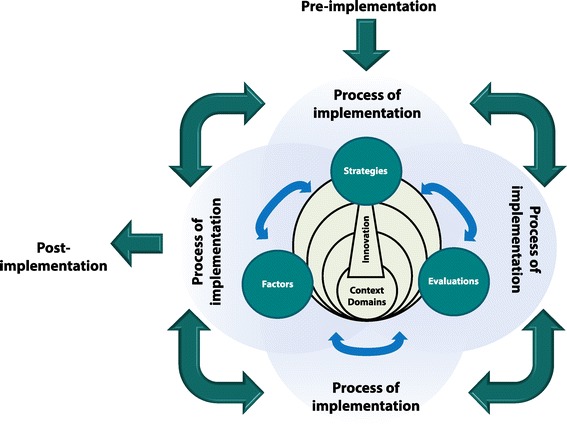
This systematic review assessed 49 implementation frameworks for healthcare innovations published 2004–May 2013 and found limited comprehensiveness across core implementation concepts. The authors collated core concepts into a Generic Implementation Framework (GIF) covering implementation process, innovation, context domains, influencing factors, strategies, and evaluations.
Key findings
- Of 49 included frameworks, most were descriptive (27, 55%) or explanatory (24, 49%), while fewer were prescriptive (13, 24%) or predictive (9, 18%).
- The operation stage was included in 49 frameworks (94%), sustainability in 31 (63%), installation in 31 (63%), exploration in 22 (45%), communication in 18 (37%), and development in 12 (24%).
- Domains covered were organisation (43, 88%), individuals (37, 76%), innovation (36, 73%), local environment (27, 55%), and external system (22, 45%).
- Only 6% of frameworks covered the degree of any one element comprehensively (+++); depth was covered for factors in 20%, strategies in 29%, and evaluations in 14% of frameworks.
Methods
- Systematic search in PubMed for implementation frameworks of innovations in healthcare published 2004 to May 2013, plus titles/abstracts from Implementation Science journal (Feb 2006–May 2013) and references from identified papers.
- Included papers proposed an implementation framework, model, or theory of an innovation in healthcare and included concepts related to operation and/or sustainability stages; excluded frameworks focused on one specific domain/factor/strategy, validation studies without framework change, single case studies, quality improvement frameworks, and others.
- Data extraction by a single reviewer assessed framework orientation, type (descriptive, prescriptive, explanatory, predictive), stages, domains, and degree/depth of factors, strategies, and evaluations; results were synthesised into tables and a Generic Implementation Framework.
Limitations
- The paper states that studies applying frameworks were excluded unless a new framework was proposed, only the original reference per framework was included unless subsequent changes were made, and influential pre-2004 frameworks were omitted.
- The paper states that classifying innovations based on definitions could have impacted groupings and overall analysis, though it argues this does not reduce validity.
- The paper states that article inclusion and data extraction were performed by a single reviewer (JCM), with assistance from a second member when doubts arose (SIB), which may have influenced coding of framework comprehensiveness; evident from the text, the search was primarily PubMed plus Implementation Science and reference screening, without other databases.
Model-written summary. Check it against the paper before relying on it.
Integrity signals
Registry
Cites
Statistics
Figures
Verification
Claims the paper makes
7 Valid · 2 Not valid · 10 Not checked · 86 Own results and interpretations
At least one cited source doesn’t support this claim or points to a different paper, and none confirmed it — see the verdicts below.
In the paper
“There seems to be no literature review covering the comprehensiveness of the frameworks [26].”
§ A systematic review of implementation frameworks of innovations in healthcare and resulting generic implementation framework > Background
What the sources say
- Disputedcites [26] Tabak RG Khoong EC Chambers DA Brownson RC Bridging research and practice: models for dissemination and implementation research Am J Prev Med 2012 43 337 50 10.1016/j.amepre.2012.05.024 22898128 PMC3592983 sourceExperimental — accuracy not yet measured
Our copy of Tabak et al. (2012) nowhere says that no literature review covers the comprehensiveness of D&I frameworks; on the contrary, it identifies itself as such a review, stating in Evidence Acquisition that 'The search was not exhaustive but did attempt to identify every model. To ensure comprehensiveness...' and that snowball sampling drew on 'existing reviews, reference lists, and presentations' (Evidence Acquisition), which presupposes prior reviews of frameworks exist. The Abstract Context frames the work as 'developing an inventory of models used in D&I research' and synthesizing it, and the Discussion (p. Limitations) treats comprehensiveness explicitly, conceding 'it is impossible to ensure all available models were included' and 'some D&I models are likely missing from this review.' So the cited source contradicts, rather than supports, the assertion that no review addresses the frameworks' comprehensiveness. (LLM, conf=0.65)
Checked by a reasoning model — may be wrong.
hedged- Asserted: passes — The authors put it forward as true.
- Checkable: passes — It can be checked against evidence.
- Load-bearing: passes — The paper’s conclusions depend on it.
- Based: passes — The paper gives a reason why it holds.
- Disputed
The cited sources support only part of this claim — read each source’s verdict below.
In the paper
“Implementation and knowledge translation frameworks have predominantly developed within disciplines.”
§ A systematic review of implementation frameworks of innovations in healthcare and resulting generic implementation framework > Background
What the sources say
- Partly supportedcites [4] Kitson A Harvey G McCormack B Enabling the implementation of evidence based practice: a conceptual framework Qual Health Care 1998 7 149 58 10.1136/qshc.7.3.149 10185141 PMC2483604 sourceExperimental — accuracy not yet measured
The Distillation section says this framework grew from work with clinicians, mostly nurses, and invites colleagues from other disciplines to assess it. That supports an example of a framework developed in a disciplinary setting, but neither Distillation nor the Introduction establishes that implementation and knowledge translation frameworks have predominantly developed within disciplines. (LLM, conf=0.78)
- Not checked yetcites [6] Rogers EM Diffusion of innovations 2003 5 New York Free Press
- Could not verifycites [7] Lavis JN Robertson D Woodside JM McLeod CB Abelson J How can research organizations more effectively transfer research knowledge to decision makers? Milbank Q 2003 81 221 48 10.1111/1468-0009.t01-1-00052 12841049 PMC2690219 sourceExperimental — accuracy not yet measured
The ‘A Framework for Knowledge Transfer’ section presents the authors’ framework and says their review spans a range of disciplinary perspectives. It does not say that implementation or knowledge-translation frameworks have predominantly developed within disciplines; searches for that assertion found no supporting passage in our copy. (LLM, conf=0.70)
- Not checked yetcites [8] Klein KJ Sorra JS The Challenge of Innovation Implementation Acad Manage Rev 1996 21 1055 80 source
- Not checked yetcites [9] Fixsen DL Naoom SF Blase KA Friedman RM Wallace F Implementation research: a synthesis of the literature 2005 Tampa, FL University of South Florida, Louis de la Parte Florida Mental Health Institute, The National Implementation Research Network
- Partly supportedcites [10] Michie S Johnston M Abraham C Lawton R Parker D Walker A Making psychological theory useful for implementing evidence based practice: a consensus approach Qual Saf Health Care 2005 14 26 33 10.1136/qshc.2004.011155 15692000 PMC1743963 sourceExperimental — accuracy not yet measured
The introduction (section R; page unavailable) describes theories developed within the social and behavioural sciences and a prior framework published for a psychology readership. These support the idea that some relevant approaches were discipline-based, but the paper does not establish that implementation and knowledge translation frameworks predominantly developed within disciplines. (LLM, conf=0.76)
- Not checked yetcites [11] Lomas J Diffusion, dissemination, and implementation: who should do what? Ann N Y Acad Sci 2006 703 226 37 10.1111/j.1749-6632.1993.tb26351.x 8192299 source
- Not checked yetcites [12] Graham ID Logan J Harrison MB Straus SE Tetroe J Caswell W Lost in knowledge translation: Time for a map? J Contin Educ Health Prof 2006 26 13 24 10.1002/chp.47 16557505 source
plain- Asserted: passes — The authors put it forward as true.
- Checkable: passes — It can be checked against evidence.
- Load-bearing: passes — The paper’s conclusions depend on it.
- Based: passes — The paper gives a reason why it holds.
- Partly supported
The cited sources support only part of this claim — read each source’s verdict below.
In the paper
“In the ensuing 9 years, the field has expanded considerably and further taxonomies, checklists, conceptual frameworks, theories, and models of implementation have been developed [10,13,14,17,18].”
§ A systematic review of implementation frameworks of innovations in healthcare and resulting generic implementation framework > Background
What the sources say
- Supportedcites [10] Michie S Johnston M Abraham C Lawton R Parker D Walker A Making psychological theory useful for implementing evidence based practice: a consensus approach Qual Saf Health Care 2005 14 26 33 10.1136/qshc.2004.011155 15692000 PMC1743963 source
The Abstract reports the development of a theoretical framework for implementation research, and the Discussion describes its 12 theoretical domains. In this multi-citation sentence, the paper supports the claim as an example of a framework developed in the field; it need not itself be a taxonomy, checklist, theory, and model. (LLM, conf=0.90)
- Partly supportedcites [13] Damschroder LJ Aron DC Keith RE Kirsh SR Alexander JA Lowery JC Fostering implementation of health services research findings into practice: a consolidated framework for advancing implementation science Implement Sci 2009 4 50 10.1186/1748-5908-4-50 19664226 PMC2736161 sourceExperimental — accuracy not yet measured
The Background and Methods describe the development of the CFIR and identify existing implementation theories, models, and a taxonomy. As a 2009 paper, this source does not support the claim that the field expanded or that further approaches were developed in the ensuing nine years. (LLM, conf=0.84)
- Not checked yetcites [14] Rabin BA Brownson RC Haire-Joshu D Kreuter MW Weaver NL A glossary for dissemination and implementation research in health J Public Health Manag Pract 2008 14 117 23 10.1097/01.PHH.0000311888.06252.bb 18287916 source
- Supportedcites [17] Flottorp S Oxman A Krause J Musila N Wensing M Godycki-Cwirko M A checklist for identifying determinants of practice: a systematic review and synthesis of frameworks and taxonomies of factors that prevent or enable improvements in healthcare professional practice Implement Sci 2013 8 35 10.1186/1748-5908-8-35 23522377 PMC3617095 source
The Methods (Study design) state that the authors reviewed frameworks and taxonomies and developed the TICD checklist. The Results (Study selection) also report 12 included checklists. Among the sentence’s several citations, this paper supports the development of a further implementation checklist, rather than every type of resource listed. (LLM, conf=0.88)
- Supportedcites [18] Cane J O’Connor D Michie S Validation of the theoretical domains framework for use in behaviour change and implementation research Implement Sci 2012 7 37 10.1186/1748-5908-7-37 22530986 PMC3483008 source
This is one of several citations offered for the development of implementation-related tools. The Background describes the development of the Theoretical Domains Framework, and the Conclusions describe this paper’s refined version. The paper therefore supports the framework example, without needing to establish that it developed every type of tool listed. (LLM, conf=0.88)
plain- Asserted: passes — The authors put it forward as true.
- Checkable: passes — It can be checked against evidence.
- Load-bearing: passes — The paper’s conclusions depend on it.
- Based: passes — The paper gives a reason why it holds.
- Supported
Every source the paper cites for this claim was checked and supports it.
In the paper
“In 2004, Greenhalgh et al. [16] conducted a comprehensive literature review of implementation studies for innovations in service delivery and organisation.”
§ A systematic review of implementation frameworks of innovations in healthcare and resulting generic implementation framework > Background
What the sources say
- Supportedcites [16] Greenhalgh T Robert G Macfarlane F Bate P Kyriakidou O Diffusion of innovations in service organizations: systematic review and recommendations Milbank Q 2004 82 581 629 10.1111/j.0887-378X.2004.00325.x 15595944 PMC2690184 source
The Abstract (p. 1) states the article 'summarizes the findings of a systematic literature review of the diffusion of service innovations' and defines 'innovation in service delivery and organization,' matching the claim's scope and the 2004 attribution. The same section lists inclusion criteria covering studies that 'addressed innovation in service delivery and organization' and 'looked specifically at the diffusion, dissemination, implementation, and/or routinization of these innovations,' and the methods passage describes dividing primary studies' findings into six categories including 'the implementation process,' supporting 'comprehensive literature review of implementation studies.' The Conclusion (p. 1) further characterizes it as 'this extensive systematic review.' (LLM, conf=0.87)
plain- Asserted: passes — The authors put it forward as true.
- Checkable: passes — It can be checked against evidence.
- Load-bearing: passes — The paper’s conclusions depend on it.
- Based: passes — The paper gives a reason why it holds.
- Supported
The cited sources support only part of this claim — read each source’s verdict below.
In the paper
“For example, eight frameworks did not explicitly mention stages [13,15,42,44,46,49,50,64,74]”
§ A systematic review of implementation frameworks of innovations in healthcare and resulting generic implementation framework > Results
What the sources say
- Partly supportedcites [13] Damschroder LJ Aron DC Keith RE Kirsh SR Alexander JA Lowery JC Fostering implementation of health services research findings into practice: a consolidated framework for advancing implementation science Implement Sci 2009 4 50 10.1186/1748-5908-4-50 19664226 PMC2736161 sourceExperimental — accuracy not yet measured
The Results > Process section describes four implementation activities that can occur in any order, rather than a sequence of implementation stages. But Results > Characteristics of individuals explicitly includes an ‘Individual stage of change’ construct, and the paper does not establish the citing sentence’s count of eight frameworks. No page numbers are available in our copy. (LLM, conf=0.78)
- Not checked yetcites [15] May C Finch T Implementing, embedding, and integrating practices: an outline of normalization process theory Sociology 2009 43 535 54 10.1177/0038038509103208 source
- Supportedcites [42] Schell S Luke D Schooley M Elliott M Herbers S Mueller N Public health program capacity for sustainability: a new framework Implement Sci 2013 8 15 10.1186/1748-5908-8-15 23375082 PMC3599102 source
The Results (Development of capacity for sustainability framework; page unavailable) describe this framework as nine domains arranged in a circular pattern, not as stages. The Methods list eight steps for developing the framework, but those are not stages within it. This citation supports identifying Schell et al.’s framework as one that does not explicitly specify stages; it does not independently establish the citing paper’s count of eight frameworks. (LLM, conf=0.88)
- Not checked yetcites [44] Racine DP Reliable effectiveness: a theory on sustaining and replicating worthwhile innovations Adm Policy Ment Health 2006 33 356 87 10.1007/s10488-006-0047-1 16755396 source
- Not checked yetcites [46] Bradley EH Fund C Translating research into practice: speeding the adoption of innovative health care programs Issue Brief (Commonw Fund) 2004 724 1 12 15270051
- Supportedcites [49] May C Towards a general theory of implementation Implement Sci 2013 8 18 10.1186/1748-5908-8-18 23406398 PMC3602092 source
In “Theory-building as a journey” (page unavailable), May describes the framework’s four constructs as “not linear or sequential” and says they interact continuously, rather than presenting them as stages. This supports citing the paper as an example of a framework that does not explicitly specify stages; the count of eight is the citing authors’ classification across multiple sources. (LLM, conf=0.88)
- Could not verifycites [50] May C Agency and implementation: understanding the embedding of healthcare innovations in practice Soc Sci Med 2013 78 26 33 10.1016/j.socscimed.2012.11.021 23246396 sourceExperimental — accuracy not yet measured
Our copy of May (2013) is a theory paper extending Normalization Process Theory; it contains no comparative audit or enumeration of implementation frameworks and no statement that 'eight frameworks did not explicitly mention stages' (searched: stages, phases, framework comparison, 'eight frameworks'). The Introduction and 'Contingency and embedding' sections describe NPT as characterizing implementation/embedding as 'agentic, dynamic... unevenly distributed across social space and time' and set out sixteen analytic propositions rather than stages, but this is only this paper's own framework, not the counted claim. The References sections show the paper cites framework literature (e.g. Greenhalgh et al. 2004; Légaré et al. on the Ottawa Decision Support Framework) without tabulating or counting them, so nothing in our copy supports or contradicts the specific count attributed here. (LLM, conf=0.70)
- Not checked yetcites [64] Edgar L Herbert R Lambert S MacDonald JA Dubois S Latimer M The joint venture model of knowledge utilization: a guide for change in nursing Nurs Leadersh (Tor Ont) 2006 19 41 55 10.12927/cjnl.2006.18172 16761801 source
- Not checked yetcites [74] Vratny A Shriver D A conceptual model for growing evidence-based practice Nurs Adm Q 2007 31 162 70 10.1097/01.NAQ.0000264866.79711.08 17413511 source
plain- Asserted: passes — The authors put it forward as true.
- Checkable: passes — It can be checked against evidence.
- Load-bearing: unclear — It is unclear whether the paper’s conclusions depend on it.
- Based: passes — The paper gives a reason why it holds.
- Partly supported
48 more claims · 3 with their cited sources checked
Create a free account to see all 105 claims and to verify the 35 references still open.
- Probably not a substantial claim. 33
- It may state two separate claims as one. 28
Claims other papers make about this one
Each is checked against this paper’s own text: does it say what the citing paper says it does?
The cited source says what the claim attributes to it.
In the citing paper
“Expansion of the Outer Setting also brings the updated CFIR into closer alignment with other implementation and policy frameworks [18, 78–80].”
From The updated consolidated framework for implementation research based on user feedback (2022) · cites this paper as [78]
The cited source says what the claim attributes to it.
In the citing paper
“While there are aforementioned specific evaluation frameworks, other frameworks also include evaluation elements to varying degrees [7].”
From Ten recommendations for using implementation frameworks in research and practice (2020) · cites this paper as [7]
Self-check
Percentages, sums and reported differences re-computed from the paper’s own numbers.
Each contradiction between two passages listed here was confirmed by an independent check.
Rated minor: it would not touch a result — a value no result rests on, a p-value that stays on the same side of the significance level, or a conflict that is clerical, resolved elsewhere in the paper, or outside its own findings.
In the paper
§ A systematic review of implementation frameworks of innovations in healthcare and resulting generic implementation framework > Results
“eight frameworks did not explicitly mention stages”
§ A systematic review of implementation frameworks of innovations in healthcare and resulting generic implementation framework > Results
“[13,15,42,44,46,49,50,64,74]”
Rated minor: it would not touch a result — a value no result rests on, a p-value that stays on the same side of the significance level, or a conflict that is clerical, resolved elsewhere in the paper, or outside its own findings.
In the paper
“| TOTAL (n = 49) | 12 (24%) | 18 (37%) | 22 (45%) | 31 (63%) | 49 (94%) | 31 (63%) |”
§ A systematic review of implementation frameworks of innovations in healthcare and resulting generic implementation framework > Results
Reported 49 · recomputed 46
Rated minor: it would not touch a result — a value no result rests on, a p-value that stays on the same side of the significance level, or a conflict that is clerical, resolved elsewhere in the paper, or outside its own findings.
In the paper
§ A systematic review of implementation frameworks of innovations in healthcare and resulting generic implementation framework > Results
“Out of the 49 implementation frameworks five comprehensively included the range of items within any one element with justification for their inclusion (as indicated by +++) and provided descriptions which included the relationships between or within the elements or mechanisms for operationalization (as indicated by ^^^) (Table 4).”
§ A systematic review of implementation frameworks of innovations in healthcare and resulting generic implementation framework > Results
“These frameworks were Damschroder et al. [13] covering factors, Kilbourne et al. [76] and Stetler et al. [55] for strategies, and Stetler et al. [55] and Lehman et al. [53] on evaluations.”
Rated minor: it would not touch a result — a value no result rests on, a p-value that stays on the same side of the significance level, or a conflict that is clerical, resolved elsewhere in the paper, or outside its own findings.
In the paper
“| TOTAL (n = 49) | 27 (55%) | 13 (24%) | 24 (49%) | 9 (18%) |”
§ A systematic review of implementation frameworks of innovations in healthcare and resulting generic implementation framework > Results
Reported 24 · recomputed 26.530612
Citations
Cites
Preferred Reporting Items for Systematic Reviews and Meta-Analyses: the PRISMA statement
Moher, D., Liberati, A., Tetzlaff, J., Altman, D. G., & for the PRISMA Group (2009) · BMJ · doi:10.1136/bmj.b2535 · Cited by 83,823
Preferred Reporting Items for Systematic Reviews and Meta-Analyses: The PRISMA Statement
Moher, D., Liberati, A., Tetzlaff, J., Altman, D. G., & The PRISMA Group (2009) · PLoS Medicine · doi:10.1371/journal.pmed.1000097 · Cited by 64,042 · cited 1×
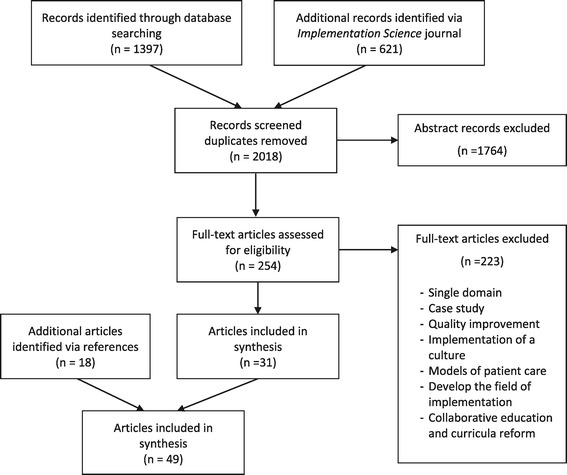
“Figure 1 PRISMA flow chart of framework selection [38].”
Preferred reporting items for systematic reviews and meta-analyses: the PRISMA Statement.
(2009) · PubMed Central · Cited by 44,859
Rogers, E. M., Singhal, A., & Quinlan, M. M. (2019) · An Integrated Approach to Communication Theory and Research · doi:10.4324/9780203710753-35 · Cited by 37,322
Wang, G., Ma, R., Qiao, G., Wada, K., Aizawa, Y., & Satoh, T. (2015) · Integrative Medicine International · doi:10.1159/000368408 · Cited by 18,657
Damschroder, L. J., Aron, D. C., Keith, R. E., Kirsh, S. R., Alexander, J. A., & Lowery, J. C. (2009) · Implementation Science · doi:10.1186/1748-5908-4-50 · Cited by 14,496 · cited 8×
“In the ensuing 9 years, the field has expanded considerably and further taxonomies, checklists, conceptual frameworks, theories, and models of implementation have been developed [10,13,14,17,18].”
InfluentialValente, T. W. (2003) · Genetics in Medicine · doi:10.1097/01.gim.0000061743.67794.c4 · Cited by 13,723
Developing and evaluating complex interventions: the new Medical Research Council guidance
Craig, P., Dieppe, P., Macintyre, S., Michie, S., Nazareth, I., & Petticrew, M. (2008) · BMJ · doi:10.1136/bmj.a1655 · Cited by 10,995 · cited 1×
“Background Implementation of innovations into practice is a complex process [1].”
Diffusion of Innovations in Service Organizations: Systematic Review and Recommendations
GREENHALGH, T., ROBERT, G., MACFARLANE, F., BATE, P., & KYRIAKIDOU, O. (2004) · The Milbank Quarterly · doi:10.1111/j.0887-378x.2004.00325.x · Cited by 7,448 · cited 5×
“conceptual framework (diffusion and dissemination, adoption/ assimilation, and implementation) [16].”
InfluentialEvaluating the public health impact of health promotion interventions: the RE-AIM framework.
Glasgow, R. E., Vogt, T. M., & Boles, S. M. (1999) · American Journal of Public Health · doi:10.2105/ajph.89.9.1322 · Cited by 7,217 · cited 1×
“Moreover, it means that influential frameworks within implementation science published prior to 2004 are omitted, but these have been analysed in previously published literature reviews [79-81].”
Research works printed but not linked: 2
- Lomas J Improving research dissemination and uptake in the health sector: beyond the sound of one hand clapping 1997 Ontario Centre for Health Economics and Policy Analysis Hamilton
- Green L Kreuter M The PRECEDE–PROCEED model Health promotion planning: an educational approach 1999 3 Mountain View (CA) Mayfield Publishing Company 32 43
Cited by
The updated consolidated framework for implementation research based on user feedback
Damschroder, L. J., Reardon, C. M., Widerquist, M. A. O., & Lowery, J. (2022) · Implementation Science · doi:10.1186/s13012-022-01245-0 · Cited by 4,452
Systematic review of the Exploration, Preparation, Implementation, Sustainment (EPIS) framework
Moullin, J. C., Dickson, K. S., Stadnick, N. A., Rabin, B., & Aarons, G. A. (2019) · Implementation Science · doi:10.1186/s13012-018-0842-6 · Cited by 1,223
Self-citationTen recommendations for using implementation frameworks in research and practice
Moullin, J. C., Dickson, K. S., Stadnick, N. A., Albers, B., Nilsen, P., Broder-Fingert, S., Mukasa, B., & Aarons, G. A. (2020) · Implementation Science Communications · doi:10.1186/s43058-020-00023-7 · Cited by 488
Self-citationStover, A. M., Haverman, L., van Oers, H. A., Greenhalgh, J., Potter, C. M., On behalf of the ISOQOL PROMs/PREMs in Clinical Practice Implementation Science Work Group, Ahmed, S., Greenhalgh, J., Gibbons, E., Haverman, L., et al. (2021) · Quality of Life Research · doi:10.1007/s11136-020-02564-9 · Cited by 308
Lustberg, M. B., Kuderer, N. M., Desai, A., Bergerot, C., & Lyman, G. H. (2023) · Nature Reviews Clinical Oncology · doi:10.1038/s41571-023-00776-9 · Cited by 306
Implementation Research: Finding Common Ground on What, How, Why, Where, and Who
Century, J., & Cassata, A. (2016) · Review of Research in Education · doi:10.3102/0091732x16665332 · Cited by 220
“Moulin et al. (2015) recently located, reviewed, and compared 49 such frameworks across disciplines.”
BackgroundPetticrew, M., Knai, C., Thomas, J., Rehfuess, E. A., Noyes, J., Gerhardus, A., Grimshaw, J. M., Rutter, H., & McGill, E. (2019) · BMJ Global Health · doi:10.1136/bmjgh-2018-000899 · Cited by 204
“31 32 Context often acts as a moderator of the effects of complex interventions; however it can also be part of the intervention itself.”
Raine, R., Fitzpatrick, R., Barratt, H., Bevan, G., Black, N., Boaden, R., Bower, P., Campbell, M., Denis, J.-L., Devers, K., et al. (2016) · Health Services and Delivery Research · doi:10.3310/hsdr04160 · Cited by 186
Bullock, H. L., Lavis, J. N., Wilson, M. G., Mulvale, G., & Miatello, A. (2021) · Implementation Science · doi:10.1186/s13012-021-01082-7 · Cited by 166
Using implementation science theories and frameworks in global health
Ridde, V., Pérez, D., & Robert, E. (2020) · BMJ Global Health · doi:10.1136/bmjgh-2019-002269 · Cited by 169
Arundell, L.-L., Barnett, P., Buckman, J. E. J., Saunders, R., & Pilling, S. (2021) · Clinical Psychology Review · doi:10.1016/j.cpr.2021.102063 · Cited by 134
Wang, D. Y., Wong, E. L., Nilsén, P., Chung, V. C., Tian, Y., & Yeoh, E. (2023) · Implementation Science · doi:10.1186/s13012-023-01296-x · Cited by 175
“Furthermore, a systematic review by Moullin et al. was conducted to assess the comprehensiveness of 49 TMFs by examining the degree and depth of analysis; however, the criteria were relatively arbitrary [13].”
BackgroundMethodResultInfluentialWaldén, M., Mountjoy, M. L., McCall, A., Serner, A., Massey, A., Tol, J. L., Bahr, R., D’Hooghe, M., Bittencourt, N. F. N., Villa, F. D., et al. (2023) · British Journal of Sports Medicine · doi:10.1136/bjsports-2022-106405 · Cited by 160
Leveraging Implementation Science to Improve Cancer Care Delivery and Patient Outcomes
Mitchell, S. A., & Chambers, D. (2017) · Journal of Oncology Practice · doi:10.1200/jop.2017.024729 · Cited by 122
Eldh, A. C., Almost, J., DeCorby-Watson, K., Gifford, W., Harvey, G., Hasson, H., Kenny, D. J., Moodie, S., Wallin, L., & Yost, J. (2017) · BMC Health Services Research · doi:10.1186/s12913-016-1958-5 · Cited by 126
“Frameworks and models related to clinical intervention and implementation research have some key differences that can be used to address various variables [43, 44].”
BackgroundInfluentialMoullin, J. C., Sabater-Hernández, D., & Benrimoj, S. I. (2016) · BMC Health Services Research · doi:10.1186/s12913-016-1689-7 · Cited by 108
“The structure and questions of the interview guide were derived from a systematic review of implementation frameworks and the resulting GIF concepts [20].”
InfluentialSelf-citationImplementation Science: Application of Evidence‐Based Practice Models to Improve Healthcare Quality
Tucker, S., McNett, M., Melnyk, B. M., Hanrahan, K., Hunter, S. C., Kim, B., Cullen, L., & Kitson, A. A. (2021) · Worldviews on Evidence-Based Nursing · doi:10.1111/wvn.12495 · Cited by 124
Livet, M., Haines, S. T., Curran, G. M., Seaton, T., Ward, C. S., Sorensen, T. D., & McClurg, M. R. (2018) · Pharmacotherapy The Journal of Human Pharmacology and Drug Therapy · doi:10.1002/phar.2114 · Cited by 91
Model for the evaluation of implementation programs and professional pharmacy services
Moullin, J. C., Sabater‐Hernández, D., & Benrimoj, S. I. (2015) · Research in Social and Administrative Pharmacy · doi:10.1016/j.sapharm.2015.08.003 · Cited by 100
Self-citationImplementing Immediate Postpartum Long-Acting Reversible Contraception Programs
Hofler, L. G., Cordes, S., Cwiak, C. A., Goedken, P., Jamieson, D. J., & Kottke, M. (2016) · Obstetrics and Gynecology · doi:10.1097/aog.0000000000001798 · Cited by 87
Silumbwe, A., Zulu, J. M., Halwiindi, H., Jacobs, C. N., Zgambo, J., Dambe, R., Chola, M., Chongwe, G., & Michelo, C. (2017) · BMC Public Health · doi:10.1186/s12889-017-4414-5 · Cited by 99
“Studies were included if they assessed the following implementation outcomes; (i) Treatment coverage/compliance, defined as the proportion of individuals, expressed as percentage of the target population who received and swallowed a drug or combination of drugs [26]; (ii) Program sustainability, referred to the proces…”
BackgroundCompetences for implementation science: what trainees need to learn and where they learn it
Schultes, M.-T., Aijaz, M., Klug, J., & Fixsen, D. L. (2020) · Advances in Health Sciences Education · doi:10.1007/s10459-020-09969-8 · Cited by 94
Emerging Technologies for Identifying Atrial Fibrillation
Ding, E., Marcus, G. M., & McManus, D. D. (2020) · Circulation Research · doi:10.1161/circresaha.119.316342 · Cited by 87
Implementation frameworks in child, youth and family services – Results from a scoping review
Albers, B., Mildon, R. L., Lyon, A. R., & Shlonsky, A. (2017) · Children and Youth Services Review · doi:10.1016/j.childyouth.2017.07.003 · Cited by 89
“, 2012) or focus only on other sectors such as health (Moullin, 2015; Prihodova, Guerin, & Kernohan, 2015).”
BackgroundA synthesis of implementation science frameworks and application to global health gaps
Dintrans, P. V., Bossert, T. J., Sherry, J., & Kruk, M. E. (2019) · Global Health Research and Policy · doi:10.1186/s41256-019-0115-1 · Cited by 83
Quality 4.0 transition framework for Tanzanian manufacturing industries
Maganga, D. P., & Taifa, I. W. R. (2022) · The TQM Journal · doi:10.1108/tqm-01-2022-0036 · Cited by 69
Seward, K., Wolfenden, L., Wiggers, J., Finch, M., Wyse, R., Oldmeadow, C. J., Presseau, J., Clinton‐McHarg, T., & Yoong, S. L. (2017) · International Journal of Behavioral Nutrition and Physical Activity · doi:10.1186/s12966-017-0499-6 · Cited by 71
“While such frameworks exist [16] few have comprehensive psychometrically evaluated measures to assess their constructs, limiting their utility.”
BackgroundScaling Up Kangaroo Mother Care in Ethiopia and India: A Multi-Site Implementation Research Study
Mony, P. K., Tadele, H., Gebremariam, A., Chan, G. J., Kumar, A., Mazumder, S., Beyene, S. A., Jayanna, K., Kassa, D. H., Mohammed, H., et al. (2020) · BMJ Global Health · doi:10.1136/bmjgh-2021-005905 · Cited by 74
Value-based healthcare translated: a complementary view of implementation
Colldén, C., & Hellström, A. (2018) · BMC Health Services Research · doi:10.1186/s12913-018-3488-9 · Cited by 80
“Background Over the past few decades, interest in the implementation of various innovations within the health care sector has grown rapidly [1].”
BackgroundColon-Emeric, C. S., Toles, M., Cary, M. P., Batchelor‐Murphy, M., Yap, T. L., Song, Y., Hall, R. K., Anderson, A. L., Burd, A., & Anderson, R. A. (2015) · Implementation Science · doi:10.1186/s13012-016-0454-y · Cited by 77
Knudsen, H. K., Drainoni, M., Gilbert, L., Huerta, T. R., Oser, C. B., Aldrich, A. M., Campbell, A. N. C., Crable, E. L., Garner, B. R., Glasgow, L., et al. (2020) · Drug and Alcohol Dependence · doi:10.1016/j.drugalcdep.2020.108330 · Cited by 65
“elements and integrate different approaches to framing implementation evaluation (Damschroder et al., 2009; Davies et al., 2010; Flottorp et al., 2013; Greenhalgh et al., 2004; Li et al., 2018; Moullin et al., 2015; Nilsen and Bernhardsson, 2019; Tabak et al., 2012).”
Lennox, L., Doyle, C., Reed, J. E., & Bell, D. (2017) · BMJ Open · doi:10.1136/bmjopen-2016-014417 · Cited by 59
“8–10 It has been noted that over 60% of implementation frameworks include sustainability stages.(11) Factors contributing to sustainability of improvement initiatives often relate to how the improvement initiative is planned and conducted from the outset, suggesting an interdependent relationship between factors that…”
BackgroundTerlouw, G., Kuipers, D., Veer, J. V. ‘., Prins, J., & Pierie, J.-P. E. N. (2021) · JMIR Serious Games · doi:10.2196/19765 · Cited by 75
“Many frameworks on implementation in health have been developed within disciplines [81].”
BackgroundParmar, J., Sacrey, L. A., Anderson, S., Charles, L., Dobbs, B., McGhan, G., Shapkin, K., Tian, P., & Triscott, J. (2022) · Health & Social Care in the Community · doi:10.1111/hsc.13578 · Cited by 58
Development of the COMIC Model for the comprehensive evaluation of integrated care interventions
Busetto, L., Luijkx, K. G., & Vrijhoef, H. J. (2016) · International Journal of Care Coordination · doi:10.1177/2053434516661700 · Cited by 66
“One of the distinctive features of the IM is that it encompasses a whole range of factors from inner local/organisational factors to outer national/regulatory factors.(46,47) The IM was chosen because various previous studies have shown it to be a useful framework for the classification of barriers and facilitators to…”
BackgroundMethodTrinkley, K. E., Kahn, M. G., Bennett, T. D., Glasgow, R. E., Haugen, H., Kao, D. P., Kroehl, M. E., Lin, C.-T., Malone, D. C., & Matlock, D. D. (2020) · Journal of Medical Internet Research · doi:10.2196/19676 · Cited by 57
“Although there are many IS frameworks [26], we selected the Practical Robust Implementation and Sustainability Model (PRISM) because it: (1) is a process, evaluation and”
BackgroundMethodAkin, B. A., Strolin-Goltzman, J., & Collins‐Camargo, C. (2017) · Children and Youth Services Review · doi:10.1016/j.childyouth.2017.09.007 · Cited by 69
A Framework for Evaluating Dashboards in Healthcare
Zhuang, M., Concannon, D., & Manley, E. (2022) · IEEE Transactions on Visualization and Computer Graphics · doi:10.1109/tvcg.2022.3147154 · Cited by 84
“[81], [82]), which is above the scope of this work.”
BackgroundŁobczowska, K., Banik, A., Brukało, K., Forberger, S., Kubiak, T., Romaniuk, P., Scheidmeir, M., Scheller, D. A., Steinacker, J. M., Wendt, J., et al. (2022) · Implementation Science · doi:10.1186/s13012-021-01176-2 · Cited by 65
“Policy implementation may be defined as the process of putting to use or integrating a policy within a setting or a system, or the process of maintaining the use and capacity of a policy [7].”
BackgroundSeppey, M., Ridde, V., Touré, L., & Coulibaly, A. (2017) · Globalization and Health · doi:10.1186/s12992-017-0307-8 · Cited by 65
“Since all those contexts are vital for the implementation of the project, they must be taken into account in a systematic way so as to sustain the project [23, 41, 42].”
BackgroundZielinski, M. J., Allison, M. K., Brinkley‐Rubinstein, L., Curran, G. M., Zaller, N. D., & Kirchner, J. A. E. (2020) · Health & Justice · doi:10.1186/s40352-020-00122-6 · Cited by 56
Briggs, A. M., Jordan, J. E., Jennings, M., Speerin, R., Bragge, P., Chua, J., Woolf, A. D., & Slater, H. (2017) · Arthritis Care & Research · doi:10.1002/acr.22948 · Cited by 50
“works for health innovation implementation (35,36), behav-”
Moullin, J. C., Ehrhart, M. G., & Aarons, G. A. (2018) · Implementation Science · doi:10.1186/s13012-018-0782-1 · Cited by 52
Self-citationCrespo-González, C., Benrimoj, S. I., Scerri, M., & García‐Cárdenas, V. (2020) · Research in Social and Administrative Pharmacy · doi:10.1016/j.sapharm.2020.01.015 · Cited by 63
Self-citationMelder, A., Robinson, T., McLoughlin, I. P., Iedema, R. A. M., & Teede, H. J. (2020) · Internal Medicine Journal · doi:10.1111/imj.14876 · Cited by 57
Trane, K. A. R., Aasbrenn, K., Rønningen, M., Odden, S., Lexén, A., & Landheim, A. S. (2021) · International Journal of Mental Health Systems · doi:10.1186/s13033-021-00463-1 · Cited by 56
“Identifying influential factors is central when implementing innovations [1, 20], and the findings of our study might contribute to future adjustments of innovation processes and service systems.”
BackgroundSuhrheinrich, J., Melgarejo, M., Root, B. V., Aarons, G. A., & Brookman-Frazee, L. I. (2021) · Autism · doi:10.1177/13623613211016729 · Cited by 60
“With regard to school services specifically, evidence suggests that district location may account for differences in organizational structure, services available, and personnel factors (Jung & Bradley, 2006; Murphy & Ruble, 2012; Pennington et al., 2009).”
BackgroundMielke, J., Leppla, L., Valenta, S., Zullig, L. L., Zúñiga, F., Staudacher, S., Teynor, A., & Geest, S. D. (2022) · Implementation Science Communications · doi:10.1186/s43058-022-00354-7 · Cited by 56
Shore, C. B., Maben, J., Mold, F., Winkley, K., Cook, A., & Stenner, K. L. (2021) · International Journal of Nursing Studies · doi:10.1016/j.ijnurstu.2021.104121 · Cited by 62
“The Consolidated Framework for Implementation Research could be considered ( Damschroder et al., 2009 ), although it is important to find the right framework to suit the healthcare innovation being implemented ( Moullin et al., 2015 ).”
MethodAdherence to Vitamin D Intake Guidelines in the United States
Simon, A. E., & Ahrens, K. A. (2020) · PEDIATRICS · doi:10.1542/peds.2019-3574 · Cited by 51
Lorthios-Guilledroit, A., Richard, L., & Filiatrault, J. (2018) · Evaluation and Program Planning · doi:10.1016/j.evalprogplan.2018.01.008 · Cited by 50
Holdford, D. A. (2018) · Pharmacy Practice · doi:10.18549/pharmpract.2018.03.1351 · Cited by 85
“A significant body of research about pharmacy practice innovations has been developed over the years using a variety of conceptual frameworks, theories, and models of implementation.(48) Other studies have offered no explicit theoretical rationale for evaluating their practice interventions.”
BackgroundBoudewijns, E. A., Trucchi, M., van der Kleij, R., Vermond, D., Hoffman, C. M., Chavannes, N. H., van Schayck, O. C. P., Kirenga, B., & Brakema, E. A. (2022) · The Lancet Planetary Health · doi:10.1016/s2542-5196(22)00094-8 · Cited by 57
The Updated Consolidated Framework for Implementation Research: CFIR 2.0Preprint
Damschroder, L. J., Reardon, C. M., Widerquist, M. A. O., & Lowery, J. C. (2022) · Research Square · doi:10.21203/rs.3.rs-1581880/v1 · Cited by 42
Tian, K., Zhu, Z., Mbachu, J., Ghanbaripour, A. N., & Moorhead, M. (2025) · Journal of Innovation & Knowledge · doi:10.1016/j.jik.2025.100711 · Cited by 89
The implementation of change model adds value to value-based healthcare: a qualitative study
Zipfel, N., van der Nat, P. B., Rensing, B. J. W. M., Daeter, E. J., Westert, G. P., & Groenewoud, S. (2019) · BMC Health Services Research · doi:10.1186/s12913-019-4498-y · Cited by 53
“However, depending on the context and needs a combination of frameworks is necessary [44].”
BackgroundMethodThe Building Blocks of Implementation Frameworks and Models in Primary Care: A Narrative Review
Huybrechts, I., Declercq, A., Verté, E., Raeymaeckers, P., & Anthierens, S. (2021) · Frontiers in Public Health · doi:10.3389/fpubh.2021.675171 · Cited by 53
“This is referred to as (characteristics of) an intervention (3, 26, 52), innovation (19, 30, 48, 60), change (40), program (36) or issue (34), or involves an evidence based practice (20, 30, 33, 41) or guidelines (20, 35).”
BackgroundMethodInfluentialDaniels, K., van der Voort, M. B. V. R., Biesma, D. H., & van der Nat, P. B. (2022) · BMC Health Services Research · doi:10.1186/s12913-022-08563-5 · Cited by 45
“Domains found in the present study are consistent with domains that are described in many other innovation implementation studies [19].”
MethodResultMichel, D. E., Iqbal, A., Faehrmann, L., Tadić, I., Paulino, E., Chen, T. F., & Moullin, J. C. (2021) · International Journal of Clinical Pharmacy · doi:10.1007/s11096-021-01335-x · Cited by 46
Self-citationMielke, J., Brunkert, T., Zúñiga, F., Simon, M., Zullig, L. L., & Geest, S. D. (2022) · BMC Medical Research Methodology · doi:10.1186/s12874-022-01772-w · Cited by 57
Etheridge, J. C., Sinyard, R. D., & Brindle, M. E. (2023) · Elsevier eBooks · doi:10.1016/b978-0-323-90300-4.00043-4 · Cited by 62
Green, A. E., Willging, C. E., Ramos, M. M., Shattuck, D. G., & Gunderson, L. M. (2018) · Journal of Adolescent Health · doi:10.1016/j.jadohealth.2018.06.004 · Cited by 44
Kien, C., Schultes, M.-T., Szeląg, M., Schoberberger, R., & Gartlehner, G. (2018) · Implementation Science · doi:10.1186/s13012-018-0837-3 · Cited by 40
Lake, J. K., Tablon Modica, P., Chan, V., & Weiss, J. A. (2020) · Autism · doi:10.1177/1362361320918754 · Cited by 35
“…(e.g. the Framework of Dissemination in Health Services Intervention Research), while others are broadly framed around social and behavioral change (e.g. NIRN, EPIS) (see Bauer et al., 2015; Chaudoir et al., 2013; or Moullin et al., 2015, for a more detailed comparison of the different frameworks).”
BackgroundFontaine, G., Mooney, M., Porat‐Dahlerbruch, J., Cahir, K., Ellen, M., Spinewine, A., Taylor, N., Laritz, R., Bourbeau-Allard, È., & Grimshaw, J. (2025) · Implementation Science · doi:10.1186/s13012-025-01436-5 · Cited by 56
“[24, 25, 48, 55, 63] Acceptability • Do all team members find the TMF suitable and acceptable for the project?”
The Role of Leadership in Organizational Implementation and Sustainment in Service Agencies
Moullin, J. C., Ehrhart, M. G., & Aarons, G. A. (2017) · Research on Social Work Practice · doi:10.1177/1049731517718361 · Cited by 48
Self-citationMoussa, L., Benrimoj, S. I., Musiał, K., Kocbek, S., & García‐Cárdenas, V. (2021) · Implementation Science · doi:10.1186/s13012-021-01138-8 · Cited by 41
“A participant observation guide was designed based on previous research [1, 25] and was used by all facilitators.”
MethodSelf-citationThe value of implementation science in bridging the evidence gap in bereavement care
Breen, L. J., & Moullin, J. C. (2020) · Death Studies · doi:10.1080/07481187.2020.1747572 · Cited by 43
“factors or determinants that influence implementation (both positively as enablers and negatively as barriers), strategies to assist the implementation process, and the evaluation of indicators of implementation success (Moullin et al., 2015).”
BackgroundSelf-citationImportant Factors for Evidence-Based Implementation in Child Welfare Settings: A Systematic Review
Weeks, A. (2020) · Journal of Evidence-Based Social Work · doi:10.1080/26408066.2020.1807433 · Cited by 40
Cremers, H., Theunissen, L., Hiddink, J., Kemps, H., Dekker, L., van de Ven, R., Monroy, M., van Waes, L., Scheele, K., & van Veghel, D. (2021) · Health Services Management Research · doi:10.1177/0951484821994421 · Cited by 33
“This may be due to the lack of successful implementation strategies and/or the inefficacy of the instruments.(9,10) Previous research concluded that personal factors (i.”
BackgroundDonenberg, G. R., Cohen, M. H., Ingabire, C., Fabri, M. R., Emerson, E. M., Kendall, A. D., Remera, E., Manzi, O., & Nsanzimana, S. (2019) · JAIDS Journal of Acquired Immune Deficiency Syndromes · doi:10.1097/qai.0000000000002204 · Cited by 35
Ziam, S., Lanoue, S., Sween-Cadieux, E. M., Gervais, M.-J., Lane, J., Gaid, D., Chouinard, L. J., Dagenais, C., Ridde, V., Jean, E., et al. (2024) · Health Research Policy and Systems · doi:10.1186/s12961-023-01090-7 · Cited by 50
“We also searched reference lists of included articles and previous systematic reviews [11, 12, 15, 41].”
Mosch, L. K., Poncette, A.-S., Spies, C., Weber‐Carstens, S., Schieler, M., Krampe, H., & Balzer, F. (2022) · JMIR Formative Research · doi:10.2196/22866 · Cited by 47
“Nonetheless, numerous implementation frameworks, either for specific health care settings or for general guidelines, have been published during this period [26,64,86-88].”
BackgroundJolliffe, L. J., Hoffmann, T., & Lannin, N. A. (2019) · Australian Occupational Therapy Journal · doi:10.1111/1440-1630.12599 · Cited by 29
Brakema, E. A., Vermond, D., Pinnock, H., Lionis, C. D., Kirenga, B., An, P. L., Sooronbaev, T., Chavannes, N. H., & van der Kleij, R. (2020) · European Respiratory Journal · doi:10.1183/13993003.00127-2020 · Cited by 28
Houle, S. K. D., Charrois, T. L., Faruquee, C. F., Tsuyuki, R. T., & Rosenthal, M. (2016) · Research in Social and Administrative Pharmacy · doi:10.1016/j.sapharm.2016.02.013 · Cited by 37
Tumuhimbise, W., Theuring, S., Kaggwa, F., Atukunda, E. C., Rubaihayo, J., Atwine, D., Sekandi, J. N., & Musiimenta, A. (2024) · Implementation Science · doi:10.1186/s13012-024-01400-9 · Cited by 37
“We excluded studies that solely applied existing frameworks unless they presented a novel framework within the discussed intervention [28].”
MethodMcKillop, A., Shaw, J., Sheridan, N., Gray, C. S., Carswell, P., Wodchis, W. P., Connolly, M. J., Denis, J., Baker, G. R., & Kenealy, T. W. (2017) · International Journal of Integrated Care · doi:10.5334/ijic.2516 · Cited by 32
“More nuanced representations of the layers of context that influence implementation led some authors to acknowledge “the non-linear and recursive nature of the implementation process” [25].”
BackgroundBradford, V. A., Walkinshaw, L. P., Steinman, L. E., Otten, J. J., Fisher, K., Ellings, A., O’Leary, J., & Johnson, D. B. (2017) · Maternal and Child Health Journal · doi:10.1007/s10995-017-2338-4 · Cited by 36
Allanson, E., Tunçalp, Ö., Vogel, J. P., Khan, D. N., Oladapo, O. T., Long, Q., & Gülmezoglu, A. M. (2017) · BMJ Global Health · doi:10.1136/bmjgh-2016-000266 · Cited by 32
Willging, C. E., Gunderson, L. M., Green, A. E., Jaramillo, E. T., Garrison, L., Ehrhart, M. G., & Aarons, G. A. (2018) · Human Services Organizations Management Leadership & Governance · doi:10.1080/23303131.2018.1495673 · Cited by 35
“Most approach implementation as a multiphasic process involving diverse stakeholders and influential factors at three levels: system, organization, and practitioner (Moullin et al., 2015).”
BackgroundGrazioli, V. S., Moullin, J. C., Kasztura, M., Allen, M. C., Hügli, O., Griffin, J., Vu, F., Hudon, C., Jackson, Y., Wolff, H. J., et al. (2019) · BMC Health Services Research · doi:10.1186/s12913-018-3852-9 · Cited by 34
Self-citationFactors Associated with Effective Implementation: Research and Practical Implications
Barwick, M. A., Dubrowski, R., & Damschroder, L. J. (2020) · Springer eBooks · doi:10.1007/978-3-030-03874-8_4 · Cited by 36
Duong, B. Q., Arwood, M. J., Hicks, J. K., Beitelshees, A. L., Franchi, F., Houder, J. T., Limdi, N. A., Cook, K. J., Obeng, A. O., Petry, N., et al. (2020) · Pharmacogenomics and Personalized Medicine · doi:10.2147/pgpm.s241599 · Cited by 28
Łobczowska, K., Banik, A., Romaniuk, P., Forberger, S., Kubiak, T., Meshkovska, B., Neumann‐Podczaska, A., Kaczmarek, K., Scheidmeir, M., Wendt, J., et al. (2022) · International Journal of Behavioral Nutrition and Physical Activity · doi:10.1186/s12966-021-01242-4 · Cited by 34
“• Framework is defined as “a graphical or narrative representation of the key factors, concepts, or variables to explain the phenomenon of implementation” [4].”
BackgroundInfluentialVincenten, J. A., MacKay, J. M., Schröder‐Bäck, P., Schloemer, T., & Brand, H. (2019) · Central European Journal of Public Health · doi:10.21101/cejph.a5234 · Cited by 25
“implementation, such as setting agreed upon targets, early and sustained engagement of diverse actors and addressing context specific barriers and facilitators identified within this model (5, 8, 10, 16, 27, 32, 33).”
BackgroundInfluentialSchaller, A., Stassen, G., Baulig, L., & Lange, M. (2024) · Frontiers in Public Health · doi:10.3389/fpubh.2024.1353119 · Cited by 38
Ko, C. Y., Shah, T., Nelson, H., & Nathens, A. B. (2022) · JAMA Surgery · doi:10.1001/jamasurg.2022.1826 · Cited by 25
Parascandola, M. J., Neta, G. I., Salloum, R. G., Shelley, D., & Rositch, A. F. (2022) · JCO Global Oncology · doi:10.1200/go.22.00054 · Cited by 28
“Local evidence can be relevant at multiple points along the stages of implementation research, moving from the preimplementation phase, through the process of implementation, to the postimplementation phase.(33) Theobald”
BackgroundMulliez, A.-P. E., Pomey, M., Bordeleau, J., Desbiens, F., & Pelletier, J. (2018) · PLoS ONE · doi:10.1371/journal.pone.0205173 · Cited by 33
Sabater‐Hernández, D., Moullin, J. C., Hossain, L. N., Durks, D., Franco-Trigo, L., Fernández-Llimós, F., Martínez‐Martínez, F., Sáez‐Benito, L., de la Sierra, A., & Benrimoj, S. I. (2016) · American Journal of Health-System Pharmacy · doi:10.2146/ajhp150245 · Cited by 23
Self-citationImplementation of the HEART Pathway: Using the Consolidated Framework for Implementation Research
Gesell, S. B., Golden, S. L., Limkakeng, A. T., Carr, C. M., Matuskowitz, A. J., Smith, L. M., & Mahler, S. A. (2018) · Critical Pathways in Cardiology A Journal of Evidence-Based Medicine · doi:10.1097/hpc.0000000000000154 · Cited by 23
Franco-Trigo, L., Hossain, L. N., Durks, D., Fam, D., Inglis, S. C., Benrimoj, S. I., & Sabater‐Hernández, D. (2016) · Research in Social and Administrative Pharmacy · doi:10.1016/j.sapharm.2016.06.009 · Cited by 26
“targeting different organizations, settings, processes and individuals across the health care system to be suitably addressed.(53,54) Limitations.”
BackgroundSelf-citationChesak, S. S., Rhudy, L. M., Tofthagen, C. S., & Chlan, L. L. (2021) · Journal of Clinical Nursing · doi:10.1111/jocn.15837 · Cited by 23
“Systematic reviews show variability in their scope and application so selection of an implementation framework according to the context of change is key (Dintrans et al., 2019; Moullin et al., 2015).”
BackgroundA Framework for Evaluating Dashboards in Healthcare
Zhuang, M., Concannon, D., & Manley, E. (2022) · White Rose Research Online (University of Leeds, The University of Sheffield, University of York) · Cited by 21
Nursing Home Staff Intentions for Learned Communication Skills: Knowledge to Practice
Williams, K. N., Perkhounkova, Y., Bossen, A., & Hein, M. (2016) · Journal of Gerontological Nursing · doi:10.3928/00989134-20160212-06 · Cited by 27
Mutamba, B. B., Kohrt, B. A., Okello, J., Nakigudde, J., Opar, B. T., Musisi, S., Bazeyo, W., & de Jong, J. T. V. M. (2018) · Implementation Science · doi:10.1186/s13012-018-0785-y · Cited by 23
Implementing and Evaluating an Older Adult Physical Activity Model at Scale: Framework for Action
McKay, H. A., Sims‐Gould, J., Nettlefold, L., Hoy, C. L., & Bauman, A. E. (2017) · Translational Journal of the American College of Sports Medicine · doi:10.1249/tjx.0000000000000026 · Cited by 23
Jolliffe, L. J., Hoffmann, T., Churilov, L. P., & Lannin, N. A. (2020) · BMJ Open Quality · doi:10.1136/bmjoq-2020-000954 · Cited by 20
Seljelid, B., Varsi, C., Nes, L. S., Øystese, K. A., & Børøsund, E. (2021) · Journal of Medical Internet Research · doi:10.2196/22399 · Cited by 25
“Applying a structured and comprehensive framework such as CFIR within the field of implementation is considered to be a strength guiding data collection and analysis [59].”
Metadata
- Authors
- Moullin, J. C., Sabater-Hernández, D., Fernandez-Llimos, F., & Benrimoj, S. I.
- Affiliations
- University of Technology Sydney (AU)
- Corresponding author
- Moullin, Joanna C
- Venue
- Health Research Policy and Systems
- Published
- 2015-03-14
- Volume
- 13
- Issue
- 1
- Pages
- 16-16
- ISSN
- 1478-4505 (ISSN-L)
- PMC
- PMC4364490
- OpenAlex
- W1989327107
- Semantic Scholar
- 60e91bccd6b6630c9ae7042264448d6209c88022
- Cited by
- 392
- References
- 84
- Citations by year
- 2026: 18 · 2025: 30 · 2024: 52 · 2023: 46 · 2022: 45 · 2021: 49 · 2020: 53 · 2019: 22 · 2018: 23 · 2017: 27 · 2016: 20 · 2015: 6
- FWCI
- 4.55
- Type
- journal article
- Language
- en
- Open access
- gold
- doi.org
- Locations
- Health Research Policy and Systems (publishedVersion, cc-by)
- PubMed Central (publishedVersion, cc-by)
- PubMed (publishedVersion)
- Institutional Repository of the University of Granada (University of Granada) (submittedVersion, cc-by-nc-nd)
- LA Referencia (Red Federada de Repositorios Institucionales de Publicaciones Científicas) (submittedVersion, cc-by-nc-nd)
- eSpace (Curtin University) (submittedVersion)
- UTS ePRESS (University of Technology Sydney) (submittedVersion)
- Topics
- Health Sciences › Health Professions › General Health Professions › Health Policy Implementation Science
- Health Sciences › Health Professions › General Health Professions › Health Sciences Research and Education
- Health Sciences › Medicine › Public Health, Environmental and Occupational Health › Clinical practice guidelines implementation
- Keywords
- implementation framework, healthcare innovation, implementation science, knowledge translation, implementation stages, implementation factors, implementation strategies, implementation evaluation
- MeSH terms
- Delivery of Health Care, Diffusion of Innovation
About these checks
Registry, retraction, Cites and statistics results are computed, not judged, with one exception: a printed reference that no index lists is read once by a model before it counts as a citation error. Claims are extracted by a model and kept only when their quote appears verbatim in the text; each cited source is then checked, with a model’s help, for whether it says what the claim relies on. Those verdicts can be wrong — read the claim’s quote and the cited source before relying on one.
The claim verdicts this report counts are experimental: their accuracy is not yet measured.
A language model drew the claims from the paper on 2026-10-04, under version 3 of the claim definition (model deepseek-v4.1-flash, prompt extract-v3).
A second model labelled each claim on 2026-10-04 (model jev-1.13-20260917, definition revision gold-guideline-v0.2).
Cited sources are checked with a language model’s help (qwen3.8-omni-flash and gpt-6-sol).
Statistics and arithmetic are recomputed, not judged.
Confidence bands are shown only for fields calibrated on our annotated test set. None is calibrated yet, so no band is shown.
What counts as a claim ›How we measure confidence ›How we check this ›
Are you an author, or do you see a problem with this page? Request a review
Data sources
Bibliographic data: Semantic Scholar, OpenAlex, Crossref.
Contains information from the Semantic Scholar Academic Graph Datasets, made available under the ODC Attribution License (ODC-BY 1.0).
Semantic Scholar’s data is described in: Kinney, R., et al. (2023). The Semantic Scholar Open Data Platform. arXiv:2301.10140.
