

The DOI matches its Crossref record; 44 of the 48 references it cites were found in a registry or an index.
A systematic review of just-in-time adaptive interventions (JITAIs) to promote physical activity
Open accessAbstract
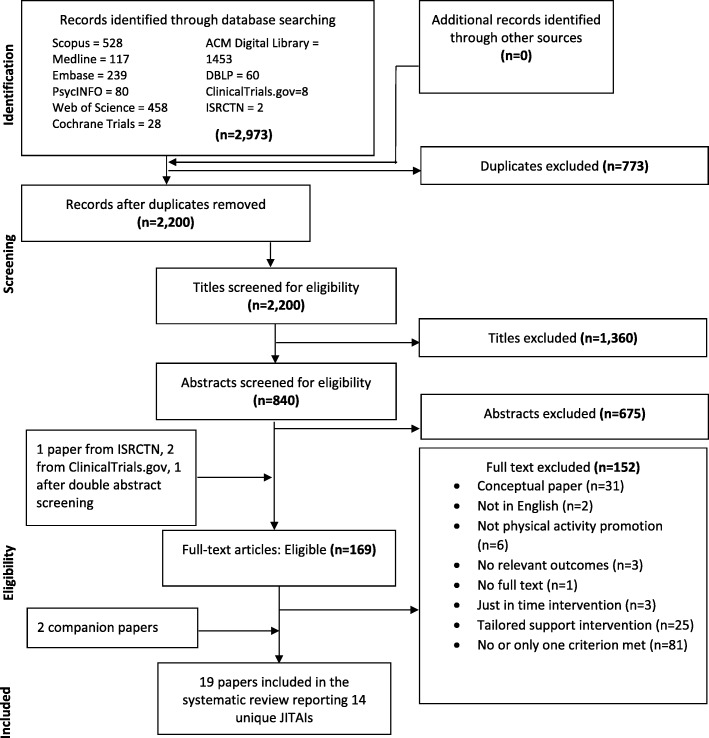
BACKGROUND: Progress in mobile health (mHealth) technology has enabled the design of just-in-time adaptive interventions (JITAIs). We define JITAIs as having three features: behavioural support that directly corresponds to a need in real-time; content or timing of support is adapted or tailored according to input collected by the system since support was initiated; support is system-triggered. We conducted a systematic review of JITAIs for physical activity to identify their features, feasibility, acceptability and effectiveness. METHODS: We searched Scopus, Medline, Embase, PsycINFO, Web of Science, DBLP, ACM Digital Library, Cochrane Central Register of Controlled Trials, ClinicalTrials.gov and the ISRCTN register using terms related to physical activity, mHealth interventions and JITAIs. We included primary studies of any design reporting data about JITAIs, irrespective of population, age and setting. Outcomes included physical activity, engagement, uptake, feasibility and acceptability. Paper screening and data extraction were independently validated. Synthesis was narrative. We used the mHealth Evidence Reporting and Assessment checklist to assess quality of intervention descriptions. RESULTS: We screened 2200 titles, 840 abstracts, 169 full-text papers, and included 19 papers reporting 14 unique JITAIs, including six randomised studies. Five JITAIs targeted both physical activity and sedentary behaviour, five sedentary behaviour only, and four physical activity only. JITAIs prompted breaks following sedentary periods and/or suggested physical activities during opportunistic moments, typically over three to four weeks. Feasibility challenges related to the technology, sensor reliability and timeliness of just-in-time messages. Overall, participants found JITAIs acceptable. We found mixed evidence for intervention effects on behaviour, but no study was sufficiently powered to detect any effects. Common behaviour change techniques were goal setting (behaviour), prompts/cues, feedback on behaviour and action planning. Five studies reported a theory-base. We found lack of evidence about cost-effectiveness, uptake, reach, impact on health inequalities, and sustained engagement. CONCLUSIONS: Research into JITAIs to increase physical activity and reduce sedentary behaviour is in its early stages. Consistent use and a shared definition of the term 'JITAI' will aid evidence synthesis. We recommend robust evaluation of theory and evidence-based JITAIs in representative populations. Decision makers and health professionals need to be cautious in signposting patients to JITAIs until such evidence is available, although they are unlikely to cause health-related harm. REFERENCE: PROSPERO 2017 CRD42017070849.
Overview
The claims and statistics of this paper haven’t been checked yet.
Run the check — free, no account needed. It reads the open-access text and checks the sources it cites.
Integrity signals
Registry
Cites
Statistics
Figures
Verification
Claims the paper makes
The claims and statistics of this paper haven’t been checked yet.
Run the check — free, no account needed. It reads the open-access text and checks the sources it cites.
Claims other papers make about this one
Each is checked against this paper’s own text: does it say what the citing paper says it does?
In the citing paper
“Beyond connectivity and feasibility, the advantages of AI chatbot programs lie essentially in the computational power to develop and deliver personalized interventions [22-24].”
In the citing paper
“Furthermore, rapid progress in mobile health technologies and functions has enabled the design of just-in-time adaptive interventions (JITAIs) [24].”
Self-check
Percentages, sums and reported differences re-computed from the paper’s own numbers.
The self-check needs the paper’s full text.
Citations
Cites
Preferred Reporting Items for Systematic Reviews and Meta-Analyses: the PRISMA statement
Moher, D., Liberati, A., Tetzlaff, J., Altman, D. G., & for the PRISMA Group (2009) · BMJ · doi:10.1136/bmj.b2535 · Cited by 83,823
Preferred reporting items for systematic reviews and meta-analyses: the PRISMA Statement.
(2009) · PubMed Central · Cited by 44,859
(1985) · Europe PMC (PubMed Central) · Cited by 9,143
Michie, S., Richardson, M., Johnston, M., Abraham, C., Francis, J., Hardeman, W., Eccles, M. P., Cane, J., & Wood, C. E. (2013) · Annals of Behavioral Medicine · doi:10.1007/s12160-013-9486-6 · Cited by 7,629 · cited 3×
“This was independently validated by four reviewers (FN, AJ, KL and JH) and FN independently validated the extraction of behaviour change techniques (BCTs) [16].”
BackgroundMethodInfluentialSelf-citationA behavior model for persuasive design
Fogg, B. (2009) · Proceedings of the 4th International Conference on Persuasive Technology · doi:10.1145/1541948.1541999 · Cited by 2,328
Nahum-Shani, I., Smith, S. N., Spring, B. J., Collins, L. M., Witkiewitz, K., Tewari, A., & Murphy, S. A. (2018) · Annals of Behavioral Medicine · doi:10.1007/s12160-016-9830-8 · Cited by 2,171
Perski, O., Blandford, A., West, R., & Michie, S. (2017) · Translational Behavioral Medicine · doi:10.1007/s13142-016-0453-1 · Cited by 1,193 · cited 1×
“Finally, we extracted data about the following outcomes: feasibility, acceptability, engagement [17], effectiveness and health-economic outcomes.”
MethodConsolvo, S., McDonald, D. W., Toscos, T., Chen, M. Y., Froehlich, J. E., Harrison, B. L., Klasnja, P., LaMarca, A., LeGrand, L., Libby, R., et al. (2008) · CHI Conference on Human Factors in Computing Systems · doi:10.1145/1357054.1357335 · Cited by 1,133 · cited 2×
“On this basis, we excluded some studies [22, 23, 40] which others described as JITAIs.”
BackgroundResultA meta-analysis of computer-tailored interventions for health behavior change
Krebs, P., Prochaska, J. O., & Rossi, J. S. (2010) · Preventive Medicine · doi:10.1016/j.ypmed.2010.06.004 · Cited by 854 · cited 1×
“We adopt the Naughton [9] definition and define behavioural JITAIs as having three key features: 1) The intervention aims to provide behavioural support that directly corresponds to a need in real time when the user is at risk of engaging in a negative health behaviour or has an opportunity to engage in a positive beh…”
MethodAgarwal, S., LeFevre, A. E., Lee, J., L’Engle, K., Mehl, G., Sinha, C., & Labrique, A. (2016) · BMJ · doi:10.1136/bmj.i1174 · Cited by 639 · cited 3×
“Table 5 Quality of intervention descriptions, assessed with the mERA checklist [18](1)”
BackgroundMethodInfluential
Research works printed but not linked: 2
- Nahum-Shani S, Smith S, Tewari A, Witkiewitz K, Collins LM, Spring B, et al. Just-in-time adaptive interventions (JITAIs): An organizing framework for ongoing health behavior support. (Technical Report No. 14–126). University Park, PA: The Methodology Center, Penn State; 2014.
- Lin Y. Evaluation user study of motivate final version. Motivate : a context-aware mobile application for physical activity promotion. Eindhoven: Technische Universiteit Eindhoven. https://doi.org/IR750185201/IR7501852013. p. 95-126.
Cited by
Sorted by citations
Items 201–300 of 395
Preventing type 2 diabetes: A research agenda for behavioural science
French, D., Ahern, A. L., Greaves, C. J., Hawkes, R. E., Higgs, S., Pechey, R., & Sniehotta, F. F. (2023) · Diabetic Medicine · doi:10.1111/dme.15147 · Cited by 5
Sanal‐Hayes, N. E. M., Mclaughlin, M., Hayes, L. D., Mair, J. L., Ormerod, J. A., Carless, D., Hilliard, N., Meach, R., Ingram, J., & Sculthorpe, N. F. (2023) · medRxiv · doi:10.1101/2023.08.10.23293935 · Cited by 5
Hietbrink, E. A. G., Middelweerd, A., Nijeweme-d’Hollosy, W. O., Schrijver, L. K., Laverman, G. D., & Vollenbroek-Hutten, M. M. R. (2025) · JMIR Formative Research · doi:10.2196/65026 · Cited by 4
“Evidence on the effectiveness of JITAIs for behavior change is mixed, and there is insufficient data to draw well-founded conclusions [28,29,32].”
InfluentialLeppin, C., Okpako, T., Garnett, C. V., Perski, O., & Brown, J. (2025) · PLOS Digital Health · doi:10.1371/journal.pdig.0000705 · Cited by 4
“JITAIs may address this problem by prompting engagement with intervention strategies at detected moments of need [11,12].”
Cheng, A. L., Abraham, J., Hartz, S. M., Laber, E. B., & Miller, J. P. (2025) · JMIR Research Protocols · doi:10.2196/77532 · Cited by 4
“In academic studies, JITAIs have shown promise in driving engagement and improving effectiveness to increase emotional regulation, exercise, and other healthy behaviors; however, the use of JITAIs in commercial digital mental health interventions is relatively novel [39-42].”
Fiedler, J., Wunsch, K., Hubenschmid, S., Reiterer, H., Renner, B., & Wöll, A. (2025) · JMIR mhealth and uhealth · doi:10.2196/65558 · Cited by 6
“Moreover, many studies do not provide a theoretical foundation or incorporate just-in-time adaptive interventions (JITAIs) [65-67].”
Metcalf, O., Forbes, D., Henry, L. M., Qian, T., Varker, T., Brotman, M. A., Cowlishaw, S., Lamb, K. E., & O'Donnell, M. L. (2025) · JMIR Human Factors · doi:10.2196/62960 · Cited by 4
“Efforts to develop such interventions in physical activity [15], depression [16], substance use [17], and adolescent mental health [18] have shown promise in improving affect, cognition, and behavior.”
Compernolle, S., de Velde, L. V., Cardon, G., Kastrinou, M., Větrovský, T., Backere, F. D., & Dyck, D. V. (2025) · Journal of Physical Activity and Health · doi:10.1123/jpah.2025-0118 · Cited by 4
Bridging fair-aware artificial intelligence and co-creation for equitable mental healthcare
Timmons, A. C., Duong, J. B., Walters, S. N., Carta, K. E., Jumonville, G. A., Carrasco, A. S., Romero, D., Ahle, M. W., Comer, J. S., Khurd, I. P., et al. (2025) · Nature Reviews Psychology · doi:10.1038/s44159-025-00491-5 · Cited by 7
AIoT-Driven Health Behavioral Security: Vision and Challenges
Nakamura, Y. (2025) · ACM Transactions on Computing for Healthcare · doi:10.1145/3771551 · Cited by 4
Hilbert, A., Juarascio, A. S., Prettin, C., Petroff, D., Schlögl, H., & Hübner, C. (2023) · BMJ Open · doi:10.1136/bmjopen-2022-064394 · Cited by 7
Nurmi, J., Knittle, K. P., Naughton, F., Sutton, S. R., Ginchev, T., Khattak, F., Castellano‐Tejedor, C., Lusilla, P., Ravaja, N., & Haukkala, A. (2023) · JMIR Formative Research · doi:10.2196/34232 · Cited by 6
“Sensor technology in smartphones provides many advantages for physical activity interventions, such as the automatic measurement of activity and individually tailored support messages [6,7].”
BackgroundSelf-citationHaider, Z. F., Smith, S. G., Walwyn, R. E. A., Lally, P. J., Fisher, A., & Beeken, R. J. (2024) · Journal of Cancer Survivorship · doi:10.1007/s11764-024-01700-5 · Cited by 4
“Future research could explore further, cost-effective ways of tailoring PA for this population, for example by using adaptive intervention designs [65, 66].”
Yaraghi, N., Ramesh, R., & Tayi, G. K. (2024) · Management Science · doi:10.1287/mnsc.2023.02603 · Cited by 4
An Ecological Momentary Intervention for people with social anxiety: A descriptive case study
Gee, B. L., Batterham, P. J., Gulliver, A., Reynolds, J., & Griffiths, K. M. (2021) · Informatics for Health and Social Care · doi:10.1080/17538157.2021.1896525 · Cited by 4
“Multiple terms have been used for these types of interventions: Just-In-Time Adaptative Interventions (JITAIs),(13) and intelligent real-time therapy.(14) EMIs can be delivered as an adjunct to other forms of evidence-based psychotherapy content, such as exposure therapy, with a clinician or implemented as a stand-alo…”
MethodHankonen, N. E. (2018) · PsyArXiv (OSF Preprints) · doi:10.31234/osf.io/pa4wg · Cited by 5
Cox, D. J., Javed, A., Sosine, J., Cordeiro, C., & Sotomayor, J. (2023) · Elsevier eBooks · doi:10.1016/b978-0-323-99594-8.00009-x · Cited by 4
Exploring Strategies to Promote Exercise as a Viable Obesity and Chronic Disease Treatment
Flack, K. D., Stults‐Kolehmainen, M., Anderson, R. E., Handlery, R., Creasy, S. A., & Catenacci, V. A. (2025) · Nutrients · doi:10.3390/nu17121997 · Cited by 5
Ross, V., Brijs, K., Dirix, H., Wets, G., Neven, A., Vanrompay, Y., Claes, N., & Jacobs, N. (2023) · Journal of Evidence-Based Psychotherapies · doi:10.24193/jebp.2023.1.5 · Cited by 3
Kroesen, S. H., van Bakel, B. M. A., de Bruin, M., Pisters, M. F., Ortega, F. B., Hopman, M. T. E., Thijssen, D. H. J., Bakker, E. A., & Eijsvogels, T. M. H. (2025) · European Journal of Preventive Cardiology · doi:10.1093/eurjpc/zwaf162 · Cited by 4
Ikegaya, M., Foo, J. C., Murata, T., Oshima, K., & Kim, J. (2025) · JMIR Human Factors · doi:10.2196/66750 · Cited by 5
“Previous studies incorporating mHealth interventions have shown beneficial effects in promoting health behaviors and support for behavioral change (eg, increasing physical activity [9,11,12]).”
Phase-sensitive individualized pharmacotherapy for alcohol use disorder
Müller, C. P., Lenz, B., Kornhuber, J., Ebner‐Priemer, U., Schwarz, E., Ersche, K. D., Kiefer, F., & Spanagel, R. (2025) · Neuropharmacology · doi:10.1016/j.neuropharm.2025.110745 · Cited by 4
“New and different aspects can be pointed out according to the criteria defined that have been accepted in previous concept papers, studies, and first reviews (Nahum-Shani et al., 2018; Hardeman et al., 2019; Perski et al., 2024).”
Sportel, E. T., Movig, K. L. L., Thio, B. J., van der Kamp, M. R., van der Palen, J. A. M., & Brusse-Keizer, M. G. J. (2025) · JMIR Pediatrics and Parenting · doi:10.2196/78526 · Cited by 3
“This resembles a just-in-time approach, in which the device is delivering when the need is high and receptiveness is likely [41,42], thereby empowering patients to take greater ownership of their condition [43,44].”
Phillips, S. M., Bourke, M., Inniss, B., Ahluwalia, M., & Tucker, P. (2026) · PLoS ONE · doi:10.1371/journal.pone.0340687 · Cited by 3
“Although the effectiveness of JITAIs for PA in adult populations is apparent [43–45], the effectiveness and acceptability among parent-child dyads is less clear [46].”
Effect of text messages designed to change contact lens compliance: A randomised controlled trial
Samuels, A., Keay, L. J., Faasse, K., & Carnt, N. A. (2024) · Contact Lens and Anterior Eye · doi:10.1016/j.clae.2024.102341 · Cited by 3
“Some messages were sent at specific times such as evenings when much contact lens hygiene activity typically occurs [29].”
The impact of momentary stress on autobiographical memory recall in a self-efficacy intervention
Rohde, J., Meine, L. E., Brown, A. D., & Kleim, B. (2024) · Scientific Reports · doi:10.1038/s41598-024-80896-z · Cited by 6
Trim, C., Gopalan, S. S., & Rhodes, R. E. (2025) · Psychology Health & Medicine · doi:10.1080/13548506.2025.2539937 · Cited by 3
“…just-Figure in-time adaptive interventions across all domains have shown greater effectiveness in changing behaviour over waitlist controls (L. Wang & Miller, 2020), though physical activity change requires more sufficiently powered trials to conclude their effectiveness (Hardeman et al., 2019).”
Feasibility and acceptability of collecting passive phone usage and sensor data via Apple SensorKit
Funk, C., Zhao, Z., Horwitz, A. G., Fang, Y., Pereira‐Lima, K., Kheterpal, V., Sen, S., & Frank, E. (2025) · PLoS ONE · doi:10.1371/journal.pone.0329707 · Cited by 4
“The availability of this data has enabled just-in-time adaptive interventions, which use conditions (e.g., location, physical activity, phone use) detected by passive sensors to deliver an intervention when it is expected to have the greatest impact [4,5].”
Hays, C. C., Moore, A. A., Allison, M., Patrick, K., Bondi, M. W., Nebeker, C., Liu, T. T., Wing, D., Higgins, M., Hartman, S. J., et al. (2022) · JMIR Research Protocols · doi:10.2196/42980 · Cited by 3
“Although more research is needed to determine the efficacy of JIT interventions to improve PA in older age, these interventions have the potential to be a powerful tool to help older adults lead healthier lifestyles [18,19,68].”
BackgroundPerspectives of telemedicine technologies in the treatment of overweight and obesity
Дадаева, В. А., Stolyar, V. L., & Drapkina, O. M. (2023) · Russian Journal of Preventive Medicine · doi:10.17116/profmed2023260217 · Cited by 3
Using Contextual Bandits for Maintaining Driver’s Alertness via Personalized Interventions
Ponomarev, A. (2022) · International Conference on Machine Learning and Applications · doi:10.1109/icmla55696.2022.00197 · Cited by 3
“Another relevant research line is just-in-time adaptive interventions (JTAI), a collection of methods, typically aimed at influencing human behavior (e.g., via notifications) in order to reach some wellbeing and/or health goals [8].”
BackgroundUnlocking the Potential of mHealth for Smoking Cessation: An Expert Viewpoint
Kashefi, A., Bosschaerts, K., Murphy, S. L., Hoecke, S. V., Abeele, M. V., Marez, L. D., Ongenae, F., & Conradie, P. D. (2024) · Lecture notes in computer science · doi:10.1007/978-3-031-60458-4_5 · Cited by 3
Chung, K., Youngblood, S. M., Clingan, C. L., Deighton, D. C., Jump, V. A., Manuweera, T., McGeorge, N., Renn, C. L., Rosenblatt, P., Winder, A. T., et al. (2024) · JMIR Research Protocols · doi:10.2196/59222 · Cited by 3
Moore, K., Hatzinger, L. A., Crosley‐Lyons, R., Do, B., Wang, S. D., McAlister, K. L., Chapman, T. M., Hewus, M., & Dunton, G. F. (2024) · Journal of Physical Activity and Health · doi:10.1123/jpah.2024-0269 · Cited by 3
Self-Tracking Technology for mHealth: A Systematic Review and the PAST SELF Framework.Preprint
Yfantidou, S., Sermpezis, P., & Vakali, A. I. (2021) · arXiv (Cornell University) · Cited by 3
Delobelle, J., Lebuf, E., Dyck, D. V., Compernolle, S., Janek, M., Backere, F. D., & Větrovský, T. (2022) · doi:10.2196/preprints.44858 · Cited by 3
Warren, J. L., Clancy, C., Brady, C. F., Rump, K., & New-Oglesby, T. (2021) · Journal of Communication Pedagogy · doi:10.31446/jcp.2021.1.02 · Cited by 2
“Other studies found that mHealth technology affected health behavior change related to physical activity (Hardeman et al., 2019).”
BackgroundHuman Digital Twins for Pervasive Healthcare: A Scoping Review (Preprint)
Park, J., Park, E., Lee, D., Kang, S., Lee, T., Lee, S.-J., Hong, H., Kim, H., Park, Y. R., & Lee, U. (2023) · Interactive Journal of Medical Research · doi:10.2196/46012 · Cited by 3
Palacz-Poborczyk, I., Naughton, F., Łuszczyńska, A., Januszewicz, A., Quested, E., Hagger, M. S., Pagoto, S., Verboon, P., Robinson, S., & Kwaśnicka, D. (2024) · Translational Behavioral Medicine · doi:10.1093/tbm/ibae023 · Cited by 2
Self-citationDi, C., Wang, G., Wu, S., Evenson, K. R., LaMonte, M. J., & LaCroix, A. Z. (2024) · ICSA book series in statistics · doi:10.1007/978-3-031-50690-1_3 · Cited by 2
Han, Y., Wang, S., Zhang, Z., & Fan, J. (2025) · Frontiers in Sports and Active Living · doi:10.3389/fspor.2025.1691032 · Cited by 2
Herold, F., Giurgiu, M., Ebner‐Priemer, U., Brakenridge, C. J., Hallgren, M. Å., Owen, N. G., & Gronwald, T. (2025) · Exercise and Sport Sciences Reviews · doi:10.1249/jes.0000000000000377 · Cited by 2
Carlos, J., Nguyen, P. H., & Lipman, S. (2025) · JMIR Research Protocols · doi:10.2196/73766 · Cited by 2
“Adaptive interventions using CB algorithms have become popular in the public health domain, with promising results [16,23,32].”
Höhener, P. S., Tobias, R. M., Allen, J. M., Küng, P., & Scholz, U. (2025) · JMIR mhealth and uhealth · doi:10.2196/67136 · Cited by 2
“Technological advancements and the widespread use of devices, such as smartphones and smartwatches, have opened up new possibilities for enhancing the design and implementation of interventions [37].”
Fundoiano-Hershcovitz, ., ASHER, I. B., Ritholz, M. D., Horwitz, D. L., Manejwala, O., Levi, C., & Goldstein, P. (2025) · JMIR Cardio · doi:10.2196/76275 · Cited by 3
“Despite the significant advancements in technology and the appeal of JITAIs, many programs have been developed with little empirical evidence, and research has been limited by a lack of evidence regarding effectiveness and sustained engagement [25,26].”
InfluentialShankar, R. P., Saloner, R., Chen, C., Cadwallader, C. J., VandeBunte, A. M., Diaz, V., Callies, L. S., Lo, C., Licata, S., Buxton, J., et al. (2026) · Neurobiology of Aging · doi:10.1016/j.neurobiolaging.2026.01.004 · Cited by 2
Wang, L., Guan, H., Fu, J., & Yu, W. (2026) · The Journal of Psychology · doi:10.1080/00223980.2026.2616286 · Cited by 2
“For instance, fitness apps could incorporate just-in-time adaptive interventions (JITAIs), delivering a brief mindfulness or self-compassion exercise when a user logs an unusually long or intense workout session, which might signal obsessive patterns (Hardeman et al., 2019; Vogel et al., 2025).”
Prakash, A., Tummers, M., Segur-Ferrer, J., Vivanco‐Hidalgo, R. M., Bidino, R. D., Tsiasiotis, E., Sacchini, D., Cicchetti, A., & Oortwijn, W. (2026) · Value in Health · doi:10.1016/j.jval.2026.03.009 · Cited by 2
Towards Multi-level Modeling of Just-in-Time Adaptive Interventions (JITAIs) in Mobile Health
Gruber, S., Neumayr, B., Schrefl, M., & Niebauer, J. (2021) · ACM/IEEE International Conference on Model Driven Engineering Languages and Systems Companion (MODELS-C) · doi:10.1109/models-c53483.2021.00084 · Cited by 2
“JITAIs have already been applied in different research areas, for example, to increase physical activity [4].”
MethodBrazeau, B. W., & Hodgins, D. C. (2022) · BMJ Open · doi:10.1136/bmjopen-2022-064324 · Cited by 2
Thivel, D., Corteval, A., Favreau, J.-M., Bergeret, E., Samalin, L., Costes, F., Toumani, F., Dualé, C., Pereira, B., Eschalier, A., et al. (2022) · Journal of Medical Internet Research · doi:10.2196/32362 · Cited by 3
“On application to movement behaviors, the early anticipation of imminent body motion disruption or early detection of the first signs of fluctuations might represent a potentially reliable signal for delivering “just-in-time” interventions [13].”
BackgroundMessage Reminders Encouraging Brisk Walking by Considering the Dynamic Factor of Cognitive Fatigue
Symons, M., Vandebosch, H., Cutello, C. A., & Poels, K. (2022) · European Journal of Health Communication · doi:10.47368/ejhc.2022.303 · Cited by 2
“Therefore, being able to tailor to states is of crucial importance in mobile health interventions (Hardeman et al., 2019; Nahum-Shani et al., 2015).”
BackgroundInfluentialPark, J.-H., Norman, G. J., Klasnja, P., Rivera, D. E., & Hekler, E. B. (2023) · JMIR mhealth and uhealth · doi:10.2196/44296 · Cited by 3
“This new, promising type of intervention is called a just-in-time adaptive intervention (JITAI) [8].”
Howard, M. C. (2023) · European Journal of Cancer Prevention · doi:10.1097/cej.0000000000000846 · Cited by 1
“Adaptive interventions, which present components based on participant characteristics, may be fruitful (Hardeman et al. , 2019).”
BackgroundSymons, M., Vandebosch, H., & Poels, K. (2024) · BMC Public Health · doi:10.1186/s12889-023-17464-z · Cited by 2
“Further, current smartphone-based interventions that try to increase physical activity levels by focussing on brisk walking behaviours (e.g., measuring steps) mostly rely exclusively on external data points, such as location, in combination with predetermined activity goals, like steps [6].”
BackgroundSpencer, T. D., Moran, M., Petersen, D. B., Thompson, M. S., & Restrepo, M. A. (2024) · Journal for the Study of Education and Development Infancia y Aprendizaje · doi:10.1177/02103702231225381 · Cited by 1
“…de este videomanual estuvo motivada por el concepto de apoyo oportuno y puntual ( just in time ), generalmente mediante el uso de tecnología (Hardeman et al., 2019; Nahum-Shani et al., 2018), al que el encargado de implementar la intervención puede acceder en el preciso momento en el que lo…”
BackgroundEffectiveness of a Just-In-Time Adaptive App to Increase Daily Steps: An RCT
Vos, A. L., de Bruijn, G., Klein, M. C. A., Boerman, S. C., Stuber, J. M., & Smit, E. G. (2024) · American Journal of Preventive Medicine · doi:10.1016/j.amepre.2024.09.010 · Cited by 1
Dammas, S., Weyde, T., Tapper, K., Spanakis, G., Roefs, A., & Pothos, E. M. (2025) · JMIR Medical Informatics · doi:10.2196/57530 · Cited by 2
“There is increasing research into the use of JITAIs (eg, [17,18]).”
Ramón, T., Álvarez, C. B. G., Carmona, J. U., & Prades, M. (2025) · Journal of Equine Rehabilitation · doi:10.1016/j.eqre.2025.100037 · Cited by 1
Leppin, C., Brown, J., Garnett, C. V., Kale, D., Okpako, T., Simons, D., & Perski, O. (2026) · PLoS ONE · doi:10.1371/journal.pone.0349028 · Cited by 1
“Just-in-time adaptive interventions (JITAIs) aim to address this gap by delivering timely, tailored support during high-risk moments [12,13].”
Zohar, S., Yuval, K., Gebremariam, S. G., Goldberg, S. B., Aviad, N., Baldwin, S. A., & Bernstein, A. (2025) · Mindfulness · doi:10.1007/s12671-025-02675-9 · Cited by 1
“This knowledge is important for BITs adherence and engagement, optimization and personalization (Perski et al., 2017; Yardley et al., 2016), or for more temporally and contextually sensitive intervention delivery (Hardeman et al., 2019; Nahum-Shani et al., 2015, 2022).”
Firkin, C. J., Vemuri, A. K., Rahman, T., Bodt, B., Orsega-Smith, E. M., Decker, K., & Dominick, G. M. (2025) · JMIR Research Protocols · doi:10.2196/79022 · Cited by 1
“Thus, user-specific receptiveness is a key feature of a JITAI [24].”
InfluentialWillms, A., Sui, A., Jantzen, R. R., Chester, S., Vanderloo, L. M., Rhodes, R. E., & Liu, S. (2025) · Applied Psychology Health and Well-Being · doi:10.1111/aphw.70096 · Cited by 1
“In particular, just-in-time adaptive interventions (JITAIs) delivered through mobile applications (apps) can use real-time data and algorithms to provide personalized support to parents in promoting their children's PA (Hardeman et al., 2019; Wang & Miller, 2020).”
Oba, T., Moriishi, C., Takano, K., Katahira, K., & Kimura, K. (2025) · JMIR Formative Research · doi:10.2196/79360 · Cited by 1
“Regardless of its theoretical advantages, mixed evidence has been found for the efficacy of EMI for PA [15].”
Thal, S. B., Ntoumanis, N., Bright, S. J., MYERS, B. J., Kwaśnicka, D., Verboon, P., Clarke, J., & Quested, E. (2026) · Psychology and Health · doi:10.1080/08870446.2025.2610270 · Cited by 1
Emotion regulation variability and chronic pain: An ecological momentary assessment study
Rogers, A. H., Zvolensky, M. J., Aaron, R. V., Lackner, J. M., Smit, T., Bakhshaie, J., & Gerhart, J. I. (2026) · Behaviour Research and Therapy · doi:10.1016/j.brat.2026.104977 · Cited by 1
Chen, M., Movia, M., Chua, X. H., Tan, S. Y. X., Zheng, S., Jin, K., Topothai, T., Padmapriya, N., Müller‐Riemenschneider, F., & Edney, S. M. (2026) · Journal of Activity Sedentary and Sleep Behaviors · doi:10.1186/s44167-026-00097-z · Cited by 1
Shah, A., Hooshyar, D., & Tomberg, V. (2026) · ACM Transactions on Computing for Healthcare · doi:10.1145/3797877 · Cited by 3
“Such limitations underscore the need for more objective, continuous, and scalable methods to measure psychosocial factors (Hardeman et al., 2019).”
Kuru, O. (2026) · Public Opinion Quarterly · doi:10.1093/poq/nfag006 · Cited by 1
Chen, J., Nie, K., Zhang, M., Yu, C., Gao, Z., Yue, K., Shi, Y., & Liang, C. (2026) · CHI Conference on Human Factors in Computing Systems · doi:10.1145/3772318.3791020 · Cited by 1
“While JITAIs have been widely applied in health domains [18, 25, 50, 67, 72, 89], their use for addressing SVIs remains largely unexplored.”
Ulloa, M., Kamali, N., Fernandes, G. J., Soyemi, E., Beltzer, M., Alshurafa, N. I., & Jacobs, M. L. (2026) · ACM Transactions on Computing for Healthcare · doi:10.1145/3808695 · Cited by 1
Baretta, D., Mazéas, A., Chalabaëv, A., Inauen, J., & Chevance, G. (2026) · npj Exercise Medicine and Health · doi:10.1038/s44437-026-00003-4 · Cited by 1
“Anticipating these vulnerable periods of reduced activity is therefore a key challenge in designing timely and adaptive physical activity promotion strategies 9,10 .”
Yang, S., Li, M., Li, Y., Chang, Y., Hu, S., Kou, X., & Liu, X. (2026) · Frontiers in Public Health · doi:10.3389/fpubh.2026.1934024 · Cited by 1
“Hardeman et al. conducted the first systematic review of JITAIs for physical activity, including 19 studies up to 2018, and concluded that the field was in its early stages, characterized by a weak evidence base and heterogeneous study quality (16).”
Valuing the role of educators in practice: Greater Manchester's framework
Williams, C., Leigh, J., Burns, D., Halse, J., Haydri, S., Collins, S., McManus, E., Grundy, J., Sutcliffe, K., Bowler, H., et al. (2022) · British Journal of Nursing · doi:10.12968/bjon.2022.31.3.174 · Cited by 1
Mitra, S., Kroeger, C. M., Xu, J., Avery, L., Masedunskas, A., Cassidy, S., Wang, T., Hunyor, I., Wilcox, I., Huang, R., et al. (2023) · JMIR Research Protocols · doi:10.2196/46082 · Cited by 1
“A unique feature of an MRT is that an individual can be repeatedly randomized multiple times throughout the duration of the study [14,15].”
BackgroundDigitale und technische Unterstützungssysteme zur Gesundheitsförderung in der Pflege
Argubi‐Wollesen, A., & Wollesen, B. (2023) · Springer eBooks · doi:10.1007/978-3-662-67020-0_8 · Cited by 1
Eckert, T., Wunsch, K., Fiedler, J., & Wöll, A. (2021) · Prävention und Gesundheitsförderung · doi:10.1007/s11553-021-00873-6 · Cited by 1
“Um die Wirksamkeit von SF und SF 2.0 zu überprüfen, werden zwei clusterrandomisierte, kontrollierte Studien (RCT) mit Interventions- (IG) und Kontrollgruppe (KG) durchgeführt.”
BackgroundInfluentialSmit, E. S., & Hoving, C. (2022) · The International Encyclopedia of Health Communication · doi:10.1002/9781119678816.iehc0727 · Cited by 1
Leenaerts, N., Soyster, P. D., Ceccarini, J., Sunaert, S. G., Fisher, A. J., & Vrieze, E. (2023) · doi:10.31234/osf.io/9utrv · Cited by 1
Exploring boundary conditions of sustained physical activity: implications for theory and practice.Preprint
Baretta, D., Chevance, G., Costello, V. L., Mansour-Assi, S., Wing, D., Hekler, E. B., Inauen, J., Godino, J., & Nigg, C. R. (2024) · doi:10.31219/osf.io/nkcea · Cited by 1
Jekauc, D. (2024) · PsyArXiv (OSF Preprints) · doi:10.31234/osf.io/tf9k3 · Cited by 2
Goal-Directed Self-Tracking in the Management of Chronic Health Conditions
Schroeder, J. (2020) · ResearchWorks at the University of Washington (University of Washington)
Thorpe, D., Fouyaxis, J., Lipschitz, J. M., Nielson, A., Li, W., Murphy, S. A., & Bidargaddi, N. P. (2022) · JMIR Formative Research · doi:10.2196/29988
“A newer, but equally growing area of research involves Just-In-Time Adaptive Interventions (JITAIs) [2], which use data collected via mobile/wearable devices, such as symptoms and behaviors, to identify opportune moments for delivering personalized interventional content in real time.”
BackgroundDynamical Outcome Modeling of Fragmented Intensive Longitudinal DataPreprint
Lagoa, C. M., Hojjatinia, S., & Conroy, D. E. (2021) · OSF Preprints (OSF Preprints) · doi:10.31219/osf.io/3d5n9
Purpose and Social Relationships in Later Life: An Intraindividual Variability Approach
Hooker, K. A. (2022) · American Journal of Geriatric Psychiatry · doi:10.1016/j.jagp.2022.01.008
Kanning, M. K., Bollenbach, L., Schmitz, J., Niermann, C. Y. N., & Fina, S. (2022) · doi:10.2196/preprints.39322
Mobile Health, Behavior Change
de Bruijn, G., Liu, S., & Rhodes, R. E. (2022) · The International Encyclopedia of Health Communication · doi:10.1002/9781119678816.iehc0788
Delobelle, J., Lebuf, E., Dyck, D. V., Compernolle, S., Janek, M., Backere, F. D., & Větrovský, T. (2022) · doi:10.2196/preprints.44568
Maintaining Driver’s Alertness with Linear Contextual Bandits
Ponomarev, A. (2022) · International Multi-Conference on Engineering, Computer and Information Sciences (SIBIRCON) · doi:10.1109/sibircon56155.2022.10016924
“Recently, the research on JTAI receives growing attention, mostly in the area of mobile health [8].”
BackgroundDigital Health Research Methods and Global Public Health
Tan, R. K. J., Neo, P. H. M., Lim, J. M., & Ong, S. E. (2023) · Springer eBooks · doi:10.1007/978-3-030-96778-9_54-1
Human Digital Twins for Pervasive Mental Healthcare: A Scoping Review and Perspectives (Preprint)Preprint
Lee, U., Park, E., Park, J., Lee, D., Kang, S., Lee, T., Hong, H., Lee, S.-J., Kim, H., & Park, Y. R. (2023) · doi:10.2196/preprints.46012
Küchler, A., Ebert, D. D., & Baumeister, H. (2023) · Springer eBooks · doi:10.1007/978-3-662-65816-1_12
Bauereiß, N., Ebert, D. D., & Baumeister, H. (2023) · Springer eBooks · doi:10.1007/978-3-662-65816-1_18
هل من العدل استخدام اختبار الذكاء لقياس ذكاء الأشخاص: مراجعة أدبيات
المويزري, ف., & الجدي, ع. (2022) · مجلة التربية الخاصة · doi:10.21608/mtkh.2022.295094
Karine, K., Klasnja, P., Murphy, S. A., & Marlin, B. M. (2023) · PubMed · doi:10.48550/arxiv.2305.09913
“JITAI’s and related adaptive study design have been applied in multiple critical health domains including physical activity [Hardeman et al., 2019], smoking cessation [Battalio et al., 2021, Yang et al., 2023] and addiction [Per-ski et al., 2022].”
Varol, T. (2023) · doi:10.26481/dis.20230629tv · Cited by 1
Digital Health Research Methods and Global Public Health
Tan, R. K. J., Neo, P. H. M., Lim, J. M., & Ong, S. E. (2023) · Springer eBooks · doi:10.1007/978-3-031-25110-8_54
Kumar, D., Haag, D., Jens Blechert, A., Niebauer, J., & Smeddinck, J. D. (2024) · doi:10.2196/preprints.57255
Metadata
- Authors
- Hardeman, W., Houghton, J., Lane, K., Jones, A., & Naughton, F.
- Affiliations
- University of East Anglia (GB)
- Corresponding author
- Hardeman, Wendy
- Venue
- International Journal of Behavioral Nutrition and Physical Activity
- Published
- 2019-04-03
- Volume
- 16
- Issue
- 1
- Pages
- 31-31
- ISSN
- 1479-5868 (ISSN-L)
- PMC
- PMC6448257
- OpenAlex
- W2924472360
- Cited by
- 396
- References
- 48
- Citations by year
- 2026: 70 · 2025: 79 · 2024: 72 · 2023: 61 · 2022: 41 · 2021: 45 · 2020: 22 · 2019: 4
- FWCI
- 5.13
- Type
- journal article
- Language
- en
- Open access
- gold
- doi.org
- Licence
- Locations
- International Journal of Behavioral Nutrition and Physical Activity (publishedVersion, cc-by)
- Europe PMC (PubMed Central) (publishedVersion, cc-by)
- PubMed Central (publishedVersion, cc-by)
- PubMed (publishedVersion)
- UEA Digital Repository (University of East Anglia) (acceptedVersion)
- DOAJ (DOAJ: Directory of Open Access Journals) (submittedVersion)
- Apollo (University of Cambridge) (submittedVersion)
- Apollo
- Funders
- Wellcome Trust
- United Kingdom Clinical Research Collaboration
- Cancer Research UK
- National Institute for Health and Care Research
- British Heart Foundation
- Centre for Diet and Activity Research
- Medical Research Council (MR/K023187/1)
- Economic and Social Research Council
- Topics
- Health Sciences › Health Professions › General Health Professions › Mobile Health and mHealth Applications
- Health Sciences › Medicine › Public Health, Environmental and Occupational Health › Physical Activity and Health
- Social Sciences › Psychology › Applied Psychology › Digital Mental Health Interventions
- Keywords
- just-in-time adaptive interventions, physical activity promotion, mobile health, sedentary behavior, behaviour change techniques, intervention feasibility and acceptability, sensor reliability, theory-based intervention, health disparities, cost-effectiveness, sustained engagement, goal setting, action planning
- MeSH terms
- Behavior Therapy, Cost-Benefit Analysis, Health Promotion, Humans, Exercise, Sedentary Behavior
About these checks
Registry, retraction, Cites and statistics results are computed, not judged, with one exception: a printed reference that no index lists is read once by a model before it counts as a citation error. Claims are extracted by a model and kept only when their quote appears verbatim in the text; each cited source is then checked, with a model’s help, for whether it says what the claim relies on. Those verdicts can be wrong — read the claim’s quote and the cited source before relying on one.
Statistics and arithmetic are recomputed, not judged.
Confidence bands are shown only for fields calibrated on our annotated test set. None is calibrated yet, so no band is shown.
What counts as a claim ›How we measure confidence ›How we check this ›
Are you an author, or do you see a problem with this page? Request a review
