

The DOI matches its Crossref record; 44 of the 48 references it cites were found in a registry or an index.
A systematic review of just-in-time adaptive interventions (JITAIs) to promote physical activity
Open accessAbstract
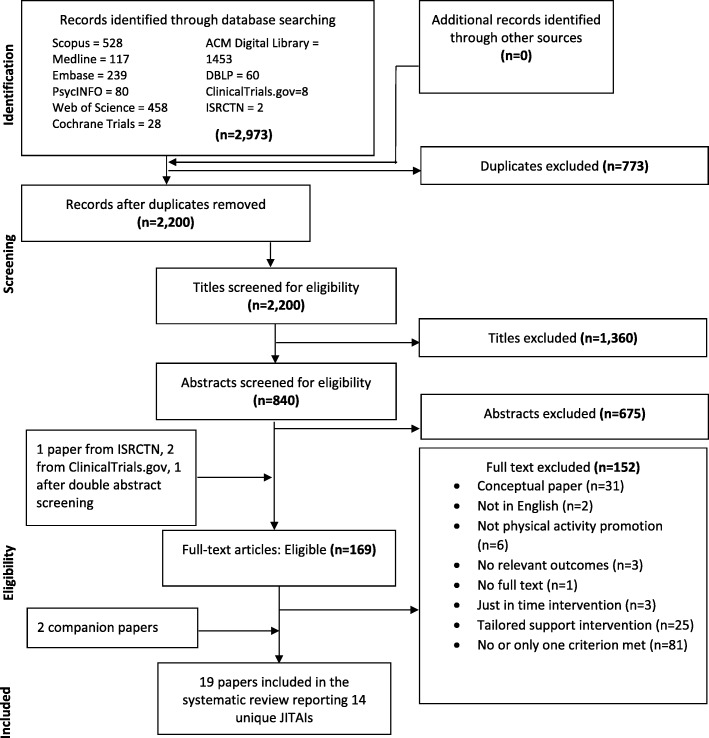
BACKGROUND: Progress in mobile health (mHealth) technology has enabled the design of just-in-time adaptive interventions (JITAIs). We define JITAIs as having three features: behavioural support that directly corresponds to a need in real-time; content or timing of support is adapted or tailored according to input collected by the system since support was initiated; support is system-triggered. We conducted a systematic review of JITAIs for physical activity to identify their features, feasibility, acceptability and effectiveness. METHODS: We searched Scopus, Medline, Embase, PsycINFO, Web of Science, DBLP, ACM Digital Library, Cochrane Central Register of Controlled Trials, ClinicalTrials.gov and the ISRCTN register using terms related to physical activity, mHealth interventions and JITAIs. We included primary studies of any design reporting data about JITAIs, irrespective of population, age and setting. Outcomes included physical activity, engagement, uptake, feasibility and acceptability. Paper screening and data extraction were independently validated. Synthesis was narrative. We used the mHealth Evidence Reporting and Assessment checklist to assess quality of intervention descriptions. RESULTS: We screened 2200 titles, 840 abstracts, 169 full-text papers, and included 19 papers reporting 14 unique JITAIs, including six randomised studies. Five JITAIs targeted both physical activity and sedentary behaviour, five sedentary behaviour only, and four physical activity only. JITAIs prompted breaks following sedentary periods and/or suggested physical activities during opportunistic moments, typically over three to four weeks. Feasibility challenges related to the technology, sensor reliability and timeliness of just-in-time messages. Overall, participants found JITAIs acceptable. We found mixed evidence for intervention effects on behaviour, but no study was sufficiently powered to detect any effects. Common behaviour change techniques were goal setting (behaviour), prompts/cues, feedback on behaviour and action planning. Five studies reported a theory-base. We found lack of evidence about cost-effectiveness, uptake, reach, impact on health inequalities, and sustained engagement. CONCLUSIONS: Research into JITAIs to increase physical activity and reduce sedentary behaviour is in its early stages. Consistent use and a shared definition of the term 'JITAI' will aid evidence synthesis. We recommend robust evaluation of theory and evidence-based JITAIs in representative populations. Decision makers and health professionals need to be cautious in signposting patients to JITAIs until such evidence is available, although they are unlikely to cause health-related harm. REFERENCE: PROSPERO 2017 CRD42017070849.
Overview
The claims and statistics of this paper haven’t been checked yet.
Run the check — free, no account needed. It reads the open-access text and checks the sources it cites.
Integrity signals
Registry
Cites
Statistics
Figures
Verification
Claims the paper makes
The claims and statistics of this paper haven’t been checked yet.
Run the check — free, no account needed. It reads the open-access text and checks the sources it cites.
Claims other papers make about this one
Each is checked against this paper’s own text: does it say what the citing paper says it does?
In the citing paper
“Beyond connectivity and feasibility, the advantages of AI chatbot programs lie essentially in the computational power to develop and deliver personalized interventions [22-24].”
In the citing paper
“Furthermore, rapid progress in mobile health technologies and functions has enabled the design of just-in-time adaptive interventions (JITAIs) [24].”
Self-check
Percentages, sums and reported differences re-computed from the paper’s own numbers.
The self-check needs the paper’s full text.
Citations
Cites
Preferred Reporting Items for Systematic Reviews and Meta-Analyses: the PRISMA statement
Moher, D., Liberati, A., Tetzlaff, J., Altman, D. G., & for the PRISMA Group (2009) · BMJ · doi:10.1136/bmj.b2535 · Cited by 83,823
Preferred reporting items for systematic reviews and meta-analyses: the PRISMA Statement.
(2009) · PubMed Central · Cited by 44,859
(1985) · Europe PMC (PubMed Central) · Cited by 9,143
Michie, S., Richardson, M., Johnston, M., Abraham, C., Francis, J., Hardeman, W., Eccles, M. P., Cane, J., & Wood, C. E. (2013) · Annals of Behavioral Medicine · doi:10.1007/s12160-013-9486-6 · Cited by 7,629 · cited 3×
“This was independently validated by four reviewers (FN, AJ, KL and JH) and FN independently validated the extraction of behaviour change techniques (BCTs) [16].”
BackgroundMethodInfluentialSelf-citationA behavior model for persuasive design
Fogg, B. (2009) · Proceedings of the 4th International Conference on Persuasive Technology · doi:10.1145/1541948.1541999 · Cited by 2,328
Nahum-Shani, I., Smith, S. N., Spring, B. J., Collins, L. M., Witkiewitz, K., Tewari, A., & Murphy, S. A. (2018) · Annals of Behavioral Medicine · doi:10.1007/s12160-016-9830-8 · Cited by 2,171
Perski, O., Blandford, A., West, R., & Michie, S. (2017) · Translational Behavioral Medicine · doi:10.1007/s13142-016-0453-1 · Cited by 1,193 · cited 1×
“Finally, we extracted data about the following outcomes: feasibility, acceptability, engagement [17], effectiveness and health-economic outcomes.”
MethodConsolvo, S., McDonald, D. W., Toscos, T., Chen, M. Y., Froehlich, J. E., Harrison, B. L., Klasnja, P., LaMarca, A., LeGrand, L., Libby, R., et al. (2008) · CHI Conference on Human Factors in Computing Systems · doi:10.1145/1357054.1357335 · Cited by 1,133 · cited 2×
“On this basis, we excluded some studies [22, 23, 40] which others described as JITAIs.”
BackgroundResultA meta-analysis of computer-tailored interventions for health behavior change
Krebs, P., Prochaska, J. O., & Rossi, J. S. (2010) · Preventive Medicine · doi:10.1016/j.ypmed.2010.06.004 · Cited by 854 · cited 1×
“We adopt the Naughton [9] definition and define behavioural JITAIs as having three key features: 1) The intervention aims to provide behavioural support that directly corresponds to a need in real time when the user is at risk of engaging in a negative health behaviour or has an opportunity to engage in a positive beh…”
MethodAgarwal, S., LeFevre, A. E., Lee, J., L’Engle, K., Mehl, G., Sinha, C., & Labrique, A. (2016) · BMJ · doi:10.1136/bmj.i1174 · Cited by 639 · cited 3×
“Table 5 Quality of intervention descriptions, assessed with the mERA checklist [18](1)”
BackgroundMethodInfluential
Research works printed but not linked: 2
- Nahum-Shani S, Smith S, Tewari A, Witkiewitz K, Collins LM, Spring B, et al. Just-in-time adaptive interventions (JITAIs): An organizing framework for ongoing health behavior support. (Technical Report No. 14–126). University Park, PA: The Methodology Center, Penn State; 2014.
- Lin Y. Evaluation user study of motivate final version. Motivate : a context-aware mobile application for physical activity promotion. Eindhoven: Technische Universiteit Eindhoven. https://doi.org/IR750185201/IR7501852013. p. 95-126.
Cited by
Sorted by citations
Items 301–395 of 395
Bondaronek, P., Slee, A. E., & Hamilton, F. L. (2024) · doi:10.2196/preprints.57492
Designing Novel Approaches to Personalise Behaviour Change in Intelligent Systems
Scott, D. (2024) · Cronfa (Swansea University) · doi:10.23889/suthesis.65829
Henry, L. M., Blay-Tofey, M., Haeffner, C. E., Raymond, C. N., Tandilashvili, E., Terry, N. L., Kiderman, M., Brotman, M. A., & López-Guzmán, S. (2024) · doi:10.2196/preprints.58917
Personalized Just-in-Time Adaptive Intervention for Increasing Physical Activity (Preprint)Preprint
Ikegaya, M., Foo, J. C., Murata, T., Oshima, K., & Kim, J. (2024) · doi:10.2196/preprints.66750
Symons, M., Rahmani, M. H., Rudnicki, K., Cutello, C. A., Poels, K., & Vandebosch, H. (2024) · Health Communication · doi:10.1080/10410236.2024.2427336 · Cited by 1
“For this reason, several smartphone health interventions exist to increase physical activity (PA) behaviors, such as walking (Hardeman et al., 2019).”
Dantas, L. A. (2024) · Digital Library of Theses and Dissertations (Universidade de São Paulo) · doi:10.11606/t.55.2024.tde-15012025-155856
Digital Health Technology and Advanced Analytics in Lifestyle Medicine
Thomas, J. G., Panza, E. A., Perski, O., & Goldstein, S. P. (2025) · Springer eBooks · doi:10.1007/978-3-031-82888-1_31
Łobczowska, K., Kuliś, E., Banik, A., Siwa, M., Boberska, M., Szczuka, Z., Zaleskiewicz, H., Wietrzykowska, D., Krzywicka, P., Misiakowska, J., et al. (2025) · Psychology and Health · doi:10.1080/08870446.2025.2496239
“…separately from the behavioural or health outcomes of interventions, without testing the associations between implementation indicators and effectiveness indicators, such as behaviour change (see e.g. systematic reviews by Devereux-Fitzgerald et al., 2016; Han et al., 2023; Hardeman et al., 2019).”
Maes, I., Latomme, J., Větrovský, T., Kühnová, J., Mertens, L., Cardon, G., & Dyck, D. V. (2025) · Applied Psychology Health and Well-Being · doi:10.1111/aphw.70040
Bondaronek, P., Slee, A. E., & Hamilton, F. L. (2025) · Qeios · doi:10.32388/pgu6li
Olfermann, R., & Reichert, M. (2025) · Springer eBooks · doi:10.1007/978-3-662-68241-8_29-1
Maierhofer, C., & Polz, E.-M. (2025) · Springer eBooks · doi:10.1007/978-3-658-47828-5_16
Oba, T., Moriishi, C., Takano, K., Katahira, K., & Kimura, K. (2025) · doi:10.2196/preprints.79360
Kowalski, L., Finnes, A., Koch, S., & Bujacz, A. (2025) · doi:10.2196/preprints.83753
Shah, A., & Tomberg, V. (2025) · European Conference on Cognitive Ergonomics · doi:10.1145/3746175.3746214
Shi, Y., Kim, J., Mizushima, R., Mizuno, S., Yanagisawa, T., & Nakata, Y. (2025) · doi:10.2196/preprints.85390
Olfermann, R., & Reichert, M. (2025) · Springer eBooks · doi:10.1007/978-3-662-70475-2_29
Vemuri, A. K., Rahimi, Y., Sadr, A. V., Hejazian, S. S., Zhou, S., Hakun, J. G., Sciamanna, C., Abedi, V., & Zand, R. (2025) · medRxiv · doi:10.1101/2025.11.05.25339609
Byun, W., Kwon, S., Burns, R. D., Ertin, E., & Wan, N. (2025) · doi:10.2196/preprints.86607
Anis, L., Benzies, K., Ewashen, C., Hart, M. J., & Letourneau, N. L. (2025) · Children · doi:10.3390/children12121605
“…intervention technologies (CEEBIT) [94], fast-fail trials [87], the IDEAS method [106], just-in-time adaptive interventions (JITAIs) [69,89,95,96], novel methods and technologies for 21st-century clinical trials [70], pragmatic trials [74,78,80], rapid-cycle research methods [90], realist…”
Pettersson, B., Lundell, S., Audulv, Å., Lundin‐Olsson, L., & Sandlund, M. (2025) · BMC Geriatrics · doi:10.1186/s12877-025-06776-x
“However, a systematic literature review has shown that JITAI interventions for physical activity and reducing sedentary behavior are in their early stages and are most commonly designed for people between 20 and 60 years of age [44].”
Abusamaan, M. S., Ballreich, J. M., Dobs, A. S., Kane, B., Maruthur, N., McGready, J., Riekert, K. A., Wanigatunga, A. A., Alderfer, M. E., Alver, D., et al. (2024) · Figshare · doi:10.6084/m9.figshare.26721714
Fiedler, J., Eckert, T., Wunsch, K., & Wöll, A. (2020) · Figshare · doi:10.6084/m9.figshare.13141862
Nicholas, J. C., Ntoumanis, N., Smith, B. J., Quested, E., Stamatakis, E., & Thøgersen‐Ntoumani, C. (2021) · Figshare · doi:10.6084/m9.figshare.13627502
Thøgersen‐Ntoumani, C., Kritz, M., Grunseit, A., Chau, J., Ahmadi, M., Holtermann, A., Koster, A., Tudor‐Locke, C., Johnson, N., Sherrington, C., et al. (2024) · Figshare · doi:10.6084/m9.figshare.26602000
Thøgersen‐Ntoumani, C., Kritz, M., Grunseit, A., Chau, J., Ahmadi, M., Holtermann, A., Koster, A., Tudor‐Locke, C., Johnson, N., Sherrington, C., et al. (2024) · Figshare · doi:10.6084/m9.figshare.26602003
Novak, J., Jurková, K., Lojkaskova, A., Jaklova, A., Kühnová, J., Pfeiferová, M., Král, N., Janek, M., Omcirk, D., Malisova, K., et al. (2024) · Figshare · doi:10.6084/m9.figshare.26699894
Sanal-Hayes, N. E. M., Mclaughlin, M., Hayes, L. D., Mair, J. L., Ormerod, J. A., Carless, D., Hilliard, N., Meach, R., Ingram, J., & Sculthorpe, N. F. (2024) · Figshare · doi:10.6084/m9.figshare.26627107
Větrovský, T., Král, N., Pfeiferová, M., Kühnová, J., Novak, J., Wahlich, C., Jaklova, A., Jurková, K., Janek, M., Omcirk, D., et al. (2024) · Figshare · doi:10.6084/m9.figshare.26579444
Nicholas, J. C., Ntoumanis, N., Smith, B. J., Quested, E., Stamatakis, E., & Thøgersen‐Ntoumani, C. (2021) · Figshare · doi:10.6084/m9.figshare.13627505
Větrovský, T., Král, N., Pfeiferová, M., Kühnová, J., Novak, J., Wahlich, C., Jaklova, A., Jurková, K., Janek, M., Omcirk, D., et al. (2024) · Figshare · doi:10.6084/m9.figshare.26579450
Novak, J., Jurková, K., Lojkaskova, A., Jaklova, A., Kühnová, J., Pfeiferová, M., Král, N., Janek, M., Omcirk, D., Malisova, K., et al. (2024) · Figshare · doi:10.6084/m9.figshare.26699891
Abusamaan, M. S., Ballreich, J. M., Dobs, A. S., Kane, B., Maruthur, N., McGready, J., Riekert, K. A., Wanigatunga, A. A., Alderfer, M. E., Alver, D., et al. (2024) · Figshare · doi:10.6084/m9.figshare.26721711
Větrovský, T., Král, N., Pfeiferová, M., Kühnová, J., Novak, J., Wahlich, C., Jaklova, A., Jurková, K., Janek, M., Omcirk, D., et al. (2024) · Figshare · doi:10.6084/m9.figshare.26579447
Thøgersen‐Ntoumani, C., Kritz, M., Grunseit, A., Chau, J., Ahmadi, M., Holtermann, A., Koster, A., Tudor‐Locke, C., Johnson, N., Sherrington, C., et al. (2024) · Figshare · doi:10.6084/m9.figshare.26602006
Abusamaan, M. S., Ballreich, J. M., Dobs, A. S., Kane, B., Maruthur, N., McGready, J., Riekert, K. A., Wanigatunga, A. A., Alderfer, M. E., Alver, D., et al. (2024) · Figshare · doi:10.6084/m9.figshare.26721708
Větrovský, T., Král, N., Pfeiferová, M., Kühnová, J., Novak, J., Wahlich, C., Jaklova, A., Jurková, K., Janek, M., Omcirk, D., et al. (2024) · Figshare · doi:10.6084/m9.figshare.26579453
van Zwieten, N., Aalbers, G., Lamers, F., Giltay, E. J., Hillegers, M. H. J., & Penninx, B. W. J. H. (2026) · Brain Behavior and Immunity · doi:10.1016/j.bbi.2026.106282
Głaz, M., Deska, Ł., Zysiak, S., Głaz, D., Kamińska, N., Zaguła, J., Sołtys, W., Kosmecki, C., Stronczyński, M., & Wicha, K. (2026) · International Journal of Innovative Technologies in Social Science · doi:10.31435/ijitss.1(49).2026.4653
Shi, Y., Kim, J., Mizushima, R., Mizuno, S., Yanagisawa, T., & Nakata, Y. (2026) · JMIR Formative Research · doi:10.2196/85390
SmartWalkCoach: An AI Companion for End-to-End Walking Guidance, Motivation, and Reflection
Zhang, X., Hu, M., Xue, B., Purwanto, E., Selig, T., & Yonto, D. (2026) · ACM International Conference on Intelligent User Interfaces (IUI) · doi:10.1145/3742413.3789170
“We incorporate positive reinforcement messages and real-time progress updates as part of our adaptive intervention language, intended to motivate continued walking and support sustained engagement [32].”
Howard, M. C. (2026) · Journal of Small Business & Entrepreneurship · doi:10.1080/08276331.2026.2633859
“Many authors have suggested that adaptive interventions are beneficial for multidimensional individual differences (Hardeman et al. 2019; Wang & Miller, 2020).”
Bashar, A., Sakib, M. N., & Islam, M. M. (2026) · Quality Management Journal · doi:10.1080/10686967.2026.2630153 · Cited by 1
Chen, J., Meng, Y., & Nie, K. (2026) · Proceedings of the ACM on Human-Computer Interaction · doi:10.1145/3816978 · Cited by 4
“One promising approach to address this challenge is the implementation of Just-In-Time Adaptive Interventions (JITAIs)[41, 48, 71 ?”
Improving physical activity: Just-In-Time-Adaptive-Interventions
Pedersen, K. (2026) · Procedia Computer Science · doi:10.1016/j.procs.2026.03.089
Improving Context-Aware Personalized Nudging
Rahman, T., Vemuri, A. K., Firkin, C. J., Bodt, B., Orsega-Smith, E. M., Dominick, G. M., & Decker, K. (2026) · Delaware Journal of Public Health · doi:10.32481/djph.2026.03.14
Willingness to adopt digital behavior change interventions in people with chronic conditions
Oikonomidi, T. (2021) · theses.fr (ABES) · doi:10.70675/1c55ba23zaa2az4f6ez987fz81d53ee22274
Dulaud, P. (2022) · theses.fr (ABES) · doi:10.70675/92f27dc3zdcf2z45a9za3cdza6a78f0fe99a
Wang, J. P., Cai, R., Xu, S., Hu, T., Qu, H., Zhao, S., & Yuan, L.-P. (2026) · CHI Conference on Human Factors in Computing Systems · doi:10.1145/3772318.3791348
“While some systems use behavioral or physiological cues to time prompts more precisely [26], they still struggle to integrate deeper under-standings of user needs, and rarely account for the motivational gap between knowing a break is needed and wanting to do some-thing restorative [55].”
Everyday Disruptions to Goals: Implications for Wellbeing Technology
Agnihotri, M., Masood, M., & Agapie, E. (2026) · CHI Conference on Human Factors in Computing Systems · doi:10.1145/3772318.3790446
“Increasingly, adaptive technologies, such as just-in-time interventions, also leverage real-time sensed user context (such as time of day, weather, location, etc.) to tailor when to encourage people to engage in an activity [46].”
InfluentialLai, T., Park, J.-H., Hung, Y.-C., Shin, M., Song, S., Huh, U., Choi, H., Lee, J.-I., & Liao, Y. (2026) · European Journal of Preventive Cardiology · doi:10.1093/eurjpc/zwag209
Chen, M., Movia, M., Chua, X. H., Tan, S. Y. X., Zheng, S., Jin, K., Topothai, T., Padmapriya, N., Edney, S., & Müller‐Riemenschneider, F. (2026) · medRxiv · doi:10.64898/2026.04.28.26351917
Ali, M. Z., Zafar, A., Masood, H., Dong, J. J., & Lee, S. H. (. (2026) · Computer Science Review · doi:10.1016/j.cosrev.2026.100994 · Cited by 1
Step into action: how reminders shape engagement in fitness apps
Braut, B., Mollier, C., & Zaccagni, S. (2026) · Economica · doi:10.1111/ecca.70053
Shah, A., & Tomberg, V. (2026) · Lecture notes in computer science · doi:10.1007/978-981-95-7141-3_5
Rabet, A., Khandan, A., Rabet, A., Rouzi, M. D., Rodriguez, F., Garibay, A., Armstrong, D. G., & Najafi, B. (2026) · Diabetology · doi:10.3390/diabetology7050096 · Cited by 1
“Rather than assessing wound healing or therapeutic efficacy, this work emphasizes upstream behavioral data, positioning context-aware feedback as a foundational component of adherence support strategies [25,38,39,41].”
Morouço, P., & Ramadas, E. (2026) · International Journal of Environmental Research and Public Health · doi:10.3390/ijerph23060703 · Cited by 1
“The synthesis literature on JITAI in mobile interventions for physical activity reinforces the need to make explicit tailoring variables, decision rules, and implementation fidelity [16,18,21].”
InfluentialMantena, S., Johnson, A., Schütz, N., Tolas, A., Montalvo, S., Delgado-SanMartin, J., Ramírez‐Posada, M., Du, L., Zhang, S., Huynh, A. D., et al. (2026) · medRxiv · doi:10.64898/2026.05.26.26354165
Application of Just-in-Time Adaptive Interventions in Dietary Health Management: Systematic Review
Changying, L., jiao, Z., zhang, L., (123039), H. L., Wang, M., guo, W., wang, Y., & (5921), Y. W. (2026) · Journal of Medical Internet Research · doi:10.2196/92139
“To date, several reviews have focused on areas such as weight management [17], physical activity [18], and substance use [19], summarizing the application forms and preliminary effects of JITAIs in behavior change while also highlighting persistent challenges, including inconsistent terminology,…”
Gurumurthy, N. P., Hurley, L., Nezami, B. T., & Gottfredson, N. C. (2026) · Digital Health · doi:10.1177/20552076261458891
Carlson, J., Materia, F. T., Moon, M., Ryu, S., Yeager, C., Steel, C., Shields, K., Gill, H. S., Berkley‐Patton, J., & Catley, D. (2026) · JMIR mhealth and uhealth · doi:10.2196/76991
Winkens, L. H. H., Sonneveld, N., Ligtenberg, A., Schwarz, A. F., & Simons, M. (2026) · Current Developments in Nutrition · doi:10.1016/j.cdnut.2026.109391
“Although JIT support has shown promise in areas such as physical activity and smoking cessation [8,9], applications to dietary intake remain limited [10,11].”
Alhasani, M., & Orji, R. (2026) · International Journal of Human-Computer Interaction · doi:10.1080/10447318.2026.2659301
Vemuri, A. K., Rahimi, Y., Sadr, A. V., Hejazian, S. S., Zhou, S., Hakun, J. G., Sciamanna, C., Abedi, V., & Zand, R. (2026) · Journal of the American Heart Association · doi:10.1161/jaha.125.044985
“This finding is comparable to previous meta-analyses measuring steps per day in various other chronic disease populations, including CVD. 16,35,36 Although there is no established evidence of the clinical significance of this increase in steps per day among CVD patients, a similar increase in 350 to 1100 steps among o…”
InfluentialLim, Y. K., & Fernando, O. N. N. (2026) · Research Square · doi:10.21203/rs.3.rs-10052608/v1
Dell’Acqua, C., Mastromatteo, L. Y., Degasperi, G., Cellini, N., Soliman, L., Oppioli, L., Palomba, D., Scrimin, S., & Benvenuti, S. M. (2026) · Journal of Affective Disorders · doi:10.1016/j.jad.2026.122148
Zakaria, L. (2026) · American Journal of Lifestyle Medicine · doi:10.1177/15598276261450511 · Cited by 1
“49,50”
Designing for Health Goal Disengagement and Prioritization
Agnihotri, M. (2026) · ACM Interactive Health Conference · doi:10.1145/3786579.3801803
“They can personalize daily goals based on recent actions, such as meals [20], sedentary behavior and physical activity sessions [23].”
AI for Primary Prevention and Longevity: From Reactive to Proactive Healthcare Model
Iaccarino, K., Ongaro, F., Palma, L. D., Fouladi, S., Castiglioni, I., & Alì, M. (2026) · Applied Sciences · doi:10.3390/app16157375
Hughes, C. D. (2026) · Oxford University Press eBooks · doi:10.1093/9780197851449.003.0520
Crochiere, R. J., Goel, D., Dang, I., Kim, A., Schumacher, L. M., Zhang, F., & Arigo, D. (2026) · Annals of Behavioral Medicine · doi:10.1093/abm/kaag043
Devices and strategies to facilitate moderate alcohol consumption
Wilson, S. E., Yuan, S., Martinez, J., Walters, E. J., Mishra, V., & Leeman, R. F. (2026) · Elsevier eBooks · doi:10.1016/b978-0-443-22332-7.00041-6
Technology-Driven Continuous Self-Care Model for Diabetes Remission in Primary Care
Tu, X., Chernbumroong, S., Sureephong, P., Sakarinkhul, P., & Wu, J. (2026) · Communications in computer and information science · doi:10.1007/978-981-92-4305-1_26
Guo, J., Chen, F., Chen, C., Dai, Y., Xu, X., Yongyi, C., & Mengying, H. (2026) · JMIR mhealth and uhealth · doi:10.2196/81378
“In practice, JITAIs commonly use data from wearable sensors, mobile apps, ecological momentary assessment (EMA), or contextual information, such as time of day, location, and recent activity patterns, to determine when and how support should be delivered [15,16].”
InfluentialDesigning Proactive Behaviors in LLM-Based Systems: A Scoping Review
Chen, M., Zhou, X., & Liang Ma, A. (2026) · International Journal of Human-Computer Interaction · doi:10.1080/10447318.2026.2721909
Sühs, E., Atkins, L. A., Koeppen, L., Schmigalle, P., Scholz, C., Liegl, G., Pryss, R. C., Kraft, R., Vogel, C., Idrees, A. R., et al. (2026) · BMJ Open · doi:10.1136/bmjopen-2025-110437
Development across days: where are we now in the study of daily life experiences?
Neupert, S. D., Zhou, S., Castle, J. E., & Scott, S. (2026) · Elsevier eBooks · doi:10.1016/b978-0-443-27490-9.00010-5
Hegarty‐Craver, M., Chang, C., Ridenour, T. A., Preble, E. A., Stevens, J., Benjamin, K., Wenger, M., Chung, A., Qian, T., Jenness, J. L., et al. (2026) · doi:10.2196/preprints.108371
Malaikah, S. (2026) · Frontiers in Digital Health · doi:10.3389/fdgth.2026.1871670
Olfermann, R., & Reichert, M. (2026) · Springer eBooks · doi:10.1007/978-3-662-73013-3_23
Ramuscak, A. V., Braganza, N., Mager, D. R., Haines, J., & Walton, K. (2026) · doi:10.2196/preprints.109926
Yan, X., Hassett, A. L., Waljee, J. F., Newman, M., Park, S. Y., Bei, R., & Carlozzi, N. E. (2026) · JMIR mhealth and uhealth · doi:10.2196/64278
“Prior literature shows that the timing of intervention delivery affects user receptivity and engagement with intervention content [12,25,26].”
Adaptive just-in-time training supports skill retention in virtual reality simulations
Putman, E. J., Sherman, S., Bonarrigo, L., Clark, T. K., & Anderson, A. P. (2026) · Frontiers in Virtual Reality · doi:10.3389/frvir.2026.1866989
Jegminat, J., Shahnawaz, S., Rodrigues, J., Danieletto, M., Landell, K., Campanella, G. S. V., Garber, C. E., Fayad, Z. A., & Ensari, I. (2026) · npj Women s Health · doi:10.1038/s44294-026-00156-5
“These technologies can typically be leveraged in just-in-time adaptive interventions (JITAIs) 16 – 18 and N-of-1 personalized trials 19 .”
Gruber, S., Neumayr, B., Schuetz, C. G., & Smeddinck, J. D. (2026) · ACM/IEEE International Conference on Model Driven Engineering Languages and Systems (MODELS) · doi:10.1145/3837062.3840558
“A large and rapidly growing body of literature has investigated their design, deployment, and evaluation [10].”
Li, Y., Xiao, G., & Xue, H. (2026) · Frontiers in Psychology · doi:10.3389/fpsyg.2026.1862494
“…scores as priority candidates for the more intensive intervention tier described above (Non-Responders/Worsening), while directing lower-com-bined-risk high-severity students toward lighter-touch monitoring (Hardeman et al., 2019; Nahum-Shani et al., 2018; Suh et al., 2024; Bell et al., 2023).”
KI in der Sportpsychologie: Chancen und Herausforderungen
Bieleke, M., Güldenpenning, I., Klatt, S., Schüler, J., Weigelt, M., & Memmert, D. (2026) · Psychologische Rundschau · doi:10.1026/0033-3042/a000787
Li, X., Jiang, Y., Wang, Y., Wang, Y., & Liu, Y. (2026) · Frontiers in Public Health · doi:10.3389/fpubh.2026.1945553
“The adaptive timing of support also shares features with just-in-time adaptive approaches, in which intervention content or timing is modified in response to information collected about an individual’s changing context or behaviour (15, 16).”
Holfelder, A. F., de Montleau, A. D. T., Vinay, R., Nißen, M., Klöppel, S., Kowatsch, T., & Brill, E. (2026) · JMIR Formative Research · doi:10.2196/105520
Wan, X., & Fu, L. (2026) · International Journal of Mobile and Blended Learning · doi:10.4018/ijmbl.424747
Sedentary behavior as a gut-brain metabolic state
Yu, Q., Zhang, Z., Tian, Z., Kuang, J., Corbin, K. D., Oberlin, L. E., Collins, A. M., Goodpaster, B. H., Erickson, K. I., Owen, N. G., et al. (2026) · Brain Behavior and Immunity · doi:10.1016/j.bbi.2026.107068
Krastins, D., Stonehouse, W., Polman, R. C. J., Miller, E., & van der Pols, J. C. (2026) · doi:10.2196/preprints.114752
Kraft, C. A., Luhanga, E. T., Xiao, M., Mani, G., & Gopalakrishnan, V. (2026) · Emerald Group Publishing Limited eBooks · doi:10.1108/978-1-83742-484-920261010
Khattak, M. W., Ross, V., Dirix, H., Gruden, C., Brijs, T., Adnan, M., & Brijs, K. (2026) · Accident Analysis & Prevention · doi:10.1016/j.aap.2026.108841
Metadata
- Authors
- Hardeman, W., Houghton, J., Lane, K., Jones, A., & Naughton, F.
- Affiliations
- University of East Anglia (GB)
- Corresponding author
- Hardeman, Wendy
- Venue
- International Journal of Behavioral Nutrition and Physical Activity
- Published
- 2019-04-03
- Volume
- 16
- Issue
- 1
- Pages
- 31-31
- ISSN
- 1479-5868 (ISSN-L)
- PMC
- PMC6448257
- OpenAlex
- W2924472360
- Cited by
- 396
- References
- 48
- Citations by year
- 2026: 70 · 2025: 79 · 2024: 72 · 2023: 61 · 2022: 41 · 2021: 45 · 2020: 22 · 2019: 4
- FWCI
- 5.13
- Type
- journal article
- Language
- en
- Open access
- gold
- doi.org
- Licence
- Locations
- International Journal of Behavioral Nutrition and Physical Activity (publishedVersion, cc-by)
- Europe PMC (PubMed Central) (publishedVersion, cc-by)
- PubMed Central (publishedVersion, cc-by)
- PubMed (publishedVersion)
- UEA Digital Repository (University of East Anglia) (acceptedVersion)
- DOAJ (DOAJ: Directory of Open Access Journals) (submittedVersion)
- Apollo (University of Cambridge) (submittedVersion)
- Apollo
- Funders
- Wellcome Trust
- United Kingdom Clinical Research Collaboration
- Cancer Research UK
- National Institute for Health and Care Research
- British Heart Foundation
- Centre for Diet and Activity Research
- Medical Research Council (MR/K023187/1)
- Economic and Social Research Council
- Topics
- Health Sciences › Health Professions › General Health Professions › Mobile Health and mHealth Applications
- Health Sciences › Medicine › Public Health, Environmental and Occupational Health › Physical Activity and Health
- Social Sciences › Psychology › Applied Psychology › Digital Mental Health Interventions
- Keywords
- just-in-time adaptive interventions, physical activity promotion, mobile health, sedentary behavior, behaviour change techniques, intervention feasibility and acceptability, sensor reliability, theory-based intervention, health disparities, cost-effectiveness, sustained engagement, goal setting, action planning
- MeSH terms
- Behavior Therapy, Cost-Benefit Analysis, Health Promotion, Humans, Exercise, Sedentary Behavior
About these checks
Registry, retraction, Cites and statistics results are computed, not judged, with one exception: a printed reference that no index lists is read once by a model before it counts as a citation error. Claims are extracted by a model and kept only when their quote appears verbatim in the text; each cited source is then checked, with a model’s help, for whether it says what the claim relies on. Those verdicts can be wrong — read the claim’s quote and the cited source before relying on one.
Statistics and arithmetic are recomputed, not judged.
Confidence bands are shown only for fields calibrated on our annotated test set. None is calibrated yet, so no band is shown.
What counts as a claim ›How we measure confidence ›How we check this ›
Are you an author, or do you see a problem with this page? Request a review
