

Effects of physical activity on depressive and anxiety symptoms of women in the menopausal transition and menopause: a comprehensive systematic review and meta-analysis of randomized controlled trials
Open accessThe DOI matches its Crossref record; 55 of the 56 references it cites were found in a registry or an index.
Abstract
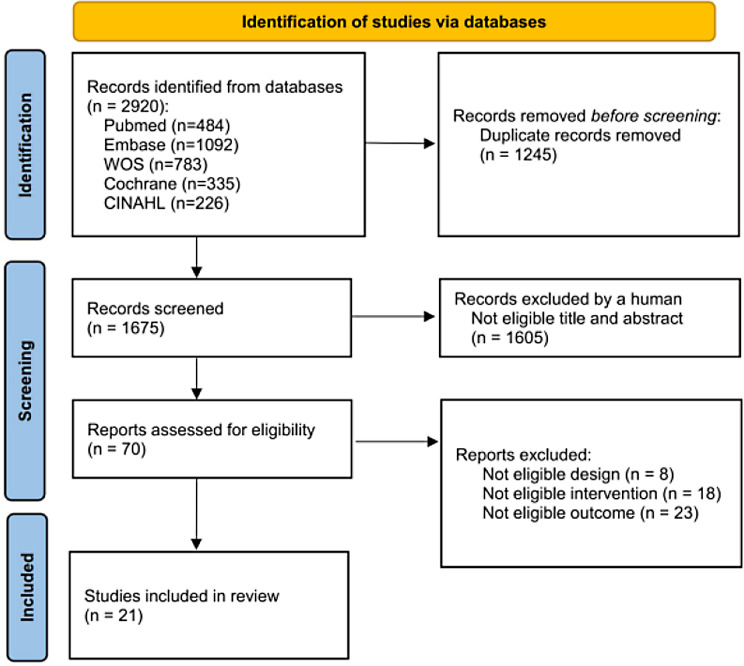
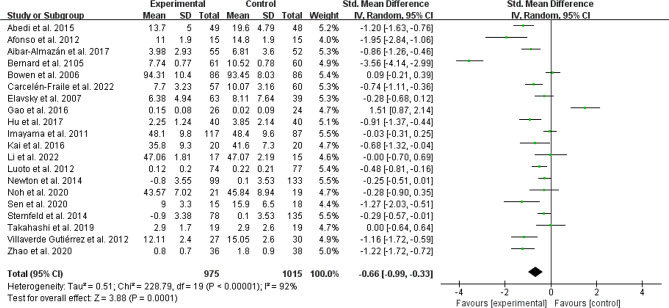
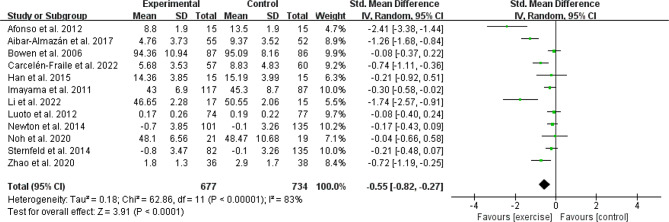
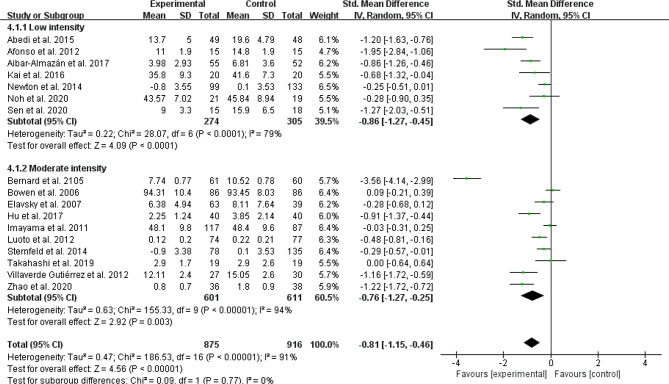
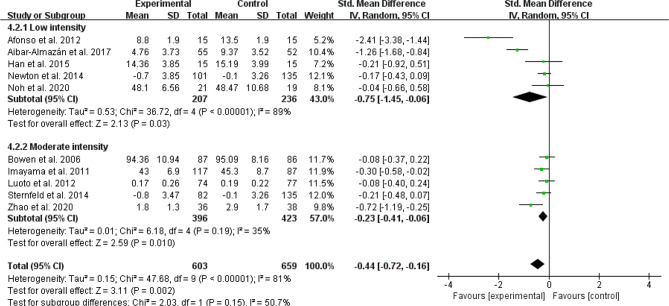
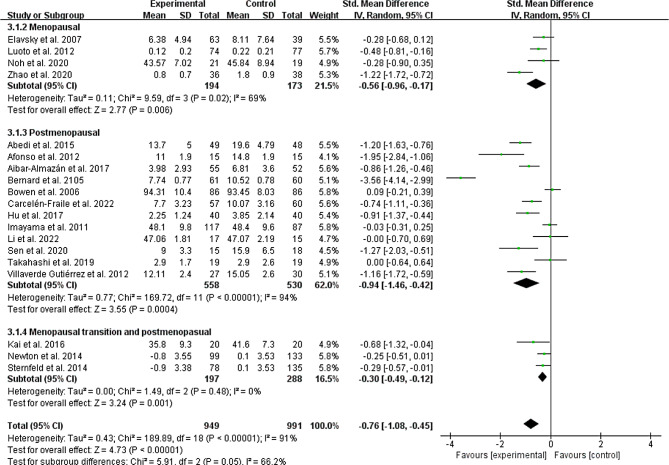
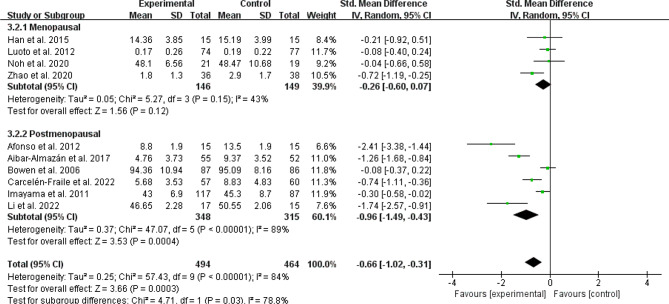
Background: Depression and anxiety may significantly affect women in the menopausal transition and menopause. In addition to traditional treatment strategies such as hormone therapy, antidepressants, and psychotherapy, physical activity (PA) have been increasingly studied, but there is no consensus about their role in menopausal women with depression and anxiety. Objective: The current study aimed to evaluate the effect of PA on the severity of depressive (DS) and anxiety (AS) symptoms in women during the menopausal transition and menopause. Methods: We searched for relevant published studies in PubMed, Embase, Web of Science, Cochrane Library, and CINAHL prior to 8 April 2024, focusing on randomized controlled trials documenting the effect of physical activity on DS and AS, and assessed study quality using the Newcastle–Ottawa Scale. Results: The data used for meta-analysis were derived from 21 studies (DS, n = 9; AS, n = 1; DS and AS combined, n = 11) involving 2020 participants. The results showed that PA groups demonstrated a statistically significant effect of depressive symptoms versus controls (DS [SMD: -0.66, 95% CI: -0.99 to -0.33; P < 0.001]; AS [SMD: -0.55, 95% CI: -0.82 to -0.27; P < 0.001]). As subgroup analyses demonstrated, physical exercise also reduced depressive symptom of women in menopausal status (SMD =-0.56, 95% CI: −0.96 to − 0.17, p = 0.006, I 2 = 69%), postmenopausal status (SMD =-0.94, 95% CI: −1.46 to − 0.42, p = 0.0004, I 2 = 94%), and both in menopausal transition and postmenopausal status (SMD =-0.30, 95% CI: −0.49 to − 0.12, p = 0.001, I 2 = 0%), while it only reduced anxiety symptom of postmenopausal women (SMD =-0.96, 95% CI: −1.49 to − 0.43, p = 0.0004, I 2 = 89%). Low-intensity and moderate-intensity exercise both produced increasingly benefits over depressive and anxiety symptoms. However, there is no statistically significant effect of exercise intensity on both depressive symptom and anxiety symptom. Conclusion: Physical activities with low to moderate intensity can impart remarkable improvements for managing menopausal women with depression and anxiety.
Overview
The claims and statistics of this paper haven’t been checked yet.
Free: it reads the open-access text and checks the first 5 claims that cite a source we can check. Create a free account to check every claim.
Integrity signals
Registry
Cites
Statistics
Figures
Verification
Claims the paper makes
The claims and statistics of this paper haven’t been checked yet.
Free: it reads the open-access text and checks the first 5 claims that cite a source we can check. Create a free account to check every claim.
Claims other papers make about this one
Each is checked against this paper’s own text: does it say what the citing paper says it does?
The cited source doesn’t support the claim as written.
In the citing paper
“moderate-intensity exercise with SMD of -0.06 (95% CI: -0.22 to 0.09) reported from the same two studies 72 112 (2 meta-analyses, 13 component studies, 2,069 participants)”
From Effect of exercise on depression and anxiety symptoms: systematic umbrella review with meta-meta-analysis (2026) · cites this paper as [72]
Checked by a reasoning model — may be wrong.
Experimental — accuracy not yet measuredThe source backs part of the claim, not all of it — or backs it for a different population, condition or comparison.
In the citing paper
“mixed exercise SMD of -0.45 (95% CI: -0.60 to -0.30) from twelve reviews 58 72 81 83 99 103 107 114 119-122 (13 meta-analyses, 170 component studies, 14,208 participants)”
From Effect of exercise on depression and anxiety symptoms: systematic umbrella review with meta-meta-analysis (2026) · cites this paper as [72]
Experimental — accuracy not yet measuredThe source backs part of the claim, not all of it — or backs it for a different population, condition or comparison.
In the citing paper
“Low-intensity exercise demonstrated a more substantial impact with SMD of -0.68 (95% CI: 1.21 to -0.14) from two studies 72 112 (2 meta-analyses, 9 component studies, 903 participants), compared to the effect of moderate-intensity exercise with SMD of -0.06 (95% CI: -0.22 to 0.09) reported from the same two studies 72 112 (2 meta-analyses, 13 component studies, 2,069 participants).”
From Effect of exercise on depression and anxiety symptoms: systematic umbrella review with meta-meta-analysis (2026) · cites this paper as [72]
Experimental — accuracy not yet measuredThe source backs part of the claim, not all of it — or backs it for a different population, condition or comparison.
In the citing paper
“Low-intensity exercise demonstrated a more substantial impact with SMD of -0.68 (95% CI: 1.21 to -0.14) from two studies 72 112 (2 meta-analyses, 9 component studies, 903 participants)”
From Effect of exercise on depression and anxiety symptoms: systematic umbrella review with meta-meta-analysis (2026) · cites this paper as [72]
Experimental — accuracy not yet measuredIn the citing paper
“Despite evidence in support of exercise for improving menopausal symptoms in the general female population [47–50]”
From Frequency and perceived influence of menopausal symptoms on training and performance in female endurance athletes (2025) · cites this paper as [50]
Self-check
Percentages, sums and reported differences re-computed from the paper’s own numbers.
The self-check needs the paper’s full text.
Citations
Cites
Measuring inconsistency in meta-analyses
Higgins, J. P. T., Thompson, S. G., Deeks, J. J., & Altman, D. G. (2003) · BMJ · doi:10.1136/bmj.327.7414.557 · Cited by 63,139
Garber, C. E., Blissmer, B., Deschenes, M. R., Franklin, B. A., Lamonte, M. J., Lee, I.-M., Nieman, D. C., & Swain, D. P. (2011) · Medicine & Science in Sports & Exercise · doi:10.1249/mss.0b013e318213fefb · Cited by 9,319 · cited 1×
“The intensity of PA was based on heart rate max, VO 2 max, heart rate reserve or estimated metabolic equivalent of task (METs) [44, 45].”
Compendium of physical activities: an update of activity codes and MET intensities
AINSWORTH, B. E., HASKELL, W. L., WHITT, M. C., IRWIN, M. L., SWARTZ, A. M., STRATH, S. J., O???BRIEN, W. L., BASSETT, D. R., SCHMITZ, K. H., EMPLAINCOURT, P. O., et al. (2000) · Medicine & Science in Sports & Exercise · doi:10.1097/00005768-200009001-00009 · Cited by 8,497
Cumpston, M., Li, T., Page, M. J., Chandler, J., Welch, V. A., Higgins, J. P., & Thomas, J. (2019) · Cochrane Database of Systematic Reviews · doi:10.1002/14651858.ed000142 · Cited by 7,218
Physical Activity and Mental Health: Current Concepts
Paluska, S. A., & Schwenk, T. L. (2000) · Sports Medicine · doi:10.2165/00007256-200029030-00003 · Cited by 1,722
Singh, B., Olds, T., Curtis, R., Dumuid, D., Virgara, R., Watson, A., Szeto, K., O'Connor, E., Ferguson, T., Eglitis, E., et al. (2023) · British Journal of Sports Medicine · doi:10.1136/bjsports-2022-106195 · Cited by 1,049 · cited 1×
“The results of our study are consistent with previous systematic review and meta-analyses, indicating that participation in PA may result in decreased depression and anxiety levels in adults, regardless of exercise intensity [46].”
Cohen, L. S., Soares, C. N., Vitonis, A. F., Otto, M. W., & Harlow, B. L. (2006) · Archives of General Psychiatry · doi:10.1001/archpsyc.63.4.385 · Cited by 831
Page, M. J., & Moher, D. (2017) · Systematic Reviews · doi:10.1186/s13643-017-0663-8 · Cited by 769 · cited 1×
“The Preferred Reporting Items for Systematic Reviews and Meta-Analyses (PRISMA) [19] was rigorously adhered to in this systematic review and meta-analysis.”
The Menopause Transition: Signs, Symptoms, and Management Options
Santoro, N., Roeca, C., Peters, B. A., & Neal-Perry, G. (2021) · The Journal of Clinical Endocrinology & Metabolism · doi:10.1210/clinem/dgaa764 · Cited by 631
Takahashi, T. A., & Johnson, K. M. (2015) · Medical Clinics of North America · doi:10.1016/j.mcna.2015.01.006 · Cited by 355
Research works printed but not linked: 1
- 37. Zhao J. Effects of Tai Chi Chuan on the changes of bone mineral density of perimenopausal women. Chin J Tissue Eng Res. 2020;24(2):176–80.
Cited by
Munro, N. R., Teague, S., Somoray, K., Simpson, A., Budden, T., Jackson, B., Rebar, A., & Dimmock, J. (2026) · British Journal of Sports Medicine · doi:10.1136/bjsports-2025-110301 · Cited by 23
Wang, H., Li, S., Zhang, X., Zhu, Y., Huang, Q., Guo, K., & Li, D. (2025) · BMC Public Health · doi:10.1186/s12889-025-24398-1 · Cited by 17
Self-citationFIGO best practice recommendations for the mental health of women at menopausal age
Khadilkar, S. S., Divakar, H., Benedetto, C., Genazzani, A., Ramos, D. E., Argale, E., Deshpande, G., Hicky, M., Filho, A. L. D. S., Castañeda, E. H., et al. (2026) · International Journal of Gynecology & Obstetrics · doi:10.1002/ijgo.70943 · Cited by 9
Li, S., Dou, Y., & Li, Y. (2025) · Frontiers in Psychiatry · doi:10.3389/fpsyt.2025.1641082 · Cited by 7
Self-citationHamilton, H. M., Yarish, N. M., & Heron, K. E. (2025) · PLOS One · doi:10.1371/journal.pone.0335738 · Cited by 6
“Despite evidence in support of exercise for improving menopausal symptoms in the general female population [47–50], reported MRS scores in our sample of highly physically active participants are similar to a range of total MRS scores reported in the general population [4,24,51].”
Bourvellec, M. L., Bois, J. E., Solana, A. A., Bosquet, L., Delpech, N., & Enéa, C. (2025) · Lifestyle Medicine · doi:10.1002/lim2.70037 · Cited by 6
Manaenkova, Z., & Santanna, E. A. (2025) · Journal of Behavioral and Brain Science · doi:10.4236/jbbs.2025.159011 · Cited by 3
Perimenopause and Lifestyle Medicine: A Window of Opportunity
Pangalangan, J. M. L., & Tollefson, M. (2026) · American Journal of Lifestyle Medicine · doi:10.1177/15598276261449751 · Cited by 3
Ruiz-Cerezo, Á., Láiz, N. M., & Romero, C. (2026) · European Journal of Obstetrics & Gynecology and Reproductive Biology · doi:10.1016/j.ejogrb.2026.115338 · Cited by 3
Menopausal hormone therapy and exercise on psychosocial well-being and stress in menopausal women
Kuck, M. J., & Hogervorst, E. (2025) · Frontiers in Reproductive Health · doi:10.3389/frph.2025.1582406 · Cited by 3
Ayala-Peralta, F., Blümel, J. E., Vallejo, M. S., Chedraui, P., Gutiérrez-Crespo, H. F., López, M., Matzumura-Kasana, J., Meza, P., Monterrosa-Castro, Á. D. J., Ñañez, M., et al. (2026) · Maturitas · doi:10.1016/j.maturitas.2026.108855 · Cited by 2
Wang, H., Li, S., Cui, S., Wang, Y., Zhu, Y., Zhou, R., Zhong, Z., Zhang, X., Xiao, Z., Qin, Q., et al. (2026) · Frontiers in Psychology · doi:10.3389/fpsyg.2026.1727315 · Cited by 2
Self-citationChugh, K., Sheinbein, D. H., & Riddle, J. N. (2026) · Psychiatric Annals · doi:10.3928/00485713-20260730-01 · Cited by 1
(2026) · Obstetrics and Gynecology · doi:10.1097/aog.0000000000006428 · Cited by 1
Symptômes de la ménopause : le rôle clé des interventions non médicamenteuses en rééducation
Bourvellec, M. L., Delpech, N., & Enéa, C. (2025) · Kinésithérapie la Revue · doi:10.1016/j.kine.2025.11.019 · Cited by 1
Kocamer, M. Y., & Atılgan, E. (2026) · Scientific Reports · doi:10.1038/s41598-026-69442-1 · Cited by 1
Nurse-Led Yoga and Brain Gym for Reducing Anxiety and Improving Sleep Quality in Menopausal Women
Fadlilah, M., Wisuda, A. C., Rashid, N. A., & Tan, C. H. (2026) · The Malaysian Journal of Nursing · doi:10.31674/mjn.2026.v17i03.001 · Cited by 1
Arslan, E. G. B., Tüfekçi, B., Manolya, A. C. A. R., Çetindağ, E. N., & Sahin, E. (2026) · International Urogynecology Journal · doi:10.1007/s00192-026-06713-5 · Cited by 1
Liu, Y., He, Y., Zhang, Q., & Lu, Q. (2025) · Biological Research For Nursing · doi:10.1177/10998004251377748
Martins, J. B. B., Silva, E. D., da Rocha, A. R. A., Dominski, F. H., & de Azevedo, A. C. (2026) · International Journal of Sport and Exercise Psychology · doi:10.1080/1612197x.2026.2687395
Wang, W., Wei, X., Wu, M., Fu, Y., & Wu, S. (2026) · Scientific Reports · doi:10.1038/s41598-026-48806-7
Manaenkova, Z., & Santanna, E. A. (2025) · Journal of Sports and Exercise Medicine · doi:10.14302/issn.2694-2283.jsem-25-5827
Costa, J. G., Mariano, I. M., Cunha, A. C. R., Silva, J. C., Gonçalves, L. F., Rodrigues, M. D. L., Tavares, J. B., Carrijo, V. H. V., Amaral, A. L., & Puga, G. M. (2026) · International Journal of Environmental Research and Public Health · doi:10.3390/ijerph23091120
Exercise during perimenopause: a window of opportunity for cardiometabolic disease prevention
Salvadores, C. R., Kupraty, A. E., Rahmani, R., Kirkham, A. A., & Gillen, J. B. (2026) · Translational Exercise Biomedicine · doi:10.1515/teb-2026-0010
Megías-Puertas, J., Rey, R. R.-D., Requena, M., Segura, G. L., Alarcón, R., & García‐González, J. (2026) · Menopause The Journal of The North American Menopause Society · doi:10.1097/gme.0000000000002731
Dong, S., Chan, T., & Wen, Y. (2026) · Frontiers in Psychology · doi:10.3389/fpsyg.2026.1848514
Lesmes, I. B., García, C. M. A., Díaz‐Perales, A., Gil‐Izquierdo, Á., Nieto, G., Velasco, A. M. R., García‐Molina, V. A. A., & Chillerón, M. Á. C. (2026) · Food Risk Assess Europe · doi:10.2903/fr.efsa.2026.fr-00102
Systematic Reviews to Inform Practice, September/October 2026
Harris, N. R., Howe‐Heyman, A., & McManis, B. G. (2026) · Journal of Midwifery & Women s Health · doi:10.1111/jmwh.70182
王, 婷. (2026) · Journal of Clinical Personalized Medicine · doi:10.12677/jcpm.2026.54271
Campbell, R., Shephard, E., Kempton, J., & Knight, L. (2026) · The Obstetrician & Gynaecologist · doi:10.1111/tog.70046
Saidel, S., Hardy, R., He, L., Desai, R., Robinson, K., & Spector, A. (2026) · Menopause The Journal of The North American Menopause Society · doi:10.1097/gme.0000000000002827
Hormone replacement therapy – Estrogens
Roni, M. A. (2026) · Elsevier eBooks · doi:10.1016/b978-0-443-44037-3.00002-6
ŞİMŞEK, Y., & Civan, A. (2026) · Turkish Journal of Sport and Exercise · doi:10.15314/tsed.1720729
SCHOLASTICA, I. I., Akpobasa, O. B., AVEDAOYA, O. R., & Ali, A. M. (2026) · International Journal of Research and Innovation in Applied Science · doi:10.51584/ijrias.2026.11060038
HARMONY in Midlife: A Framework for Lifestyle Approach to Women’s Health and Well-Being
Ang, S. B., Zhang, M., & Lee, E. S. (2026) · Journal of Menopausal Medicine · doi:10.6118/jmm.26100
HAYIRLIOĞLU, N., & Ilhan, C. (2026) · Journal of obstetrics and gynaecology research · doi:10.1111/jog.70317
The role of physical activity in managing menopausal symptoms: a narrative review
Kleiber, M., Klincewicz, J., Klincewicz, J., Niedziela, N., Denisewicz, N., Fornalski, E., Woźnicka, A., Trzeciak, Z., Filippoto, O., Nowak, F., et al. (2026) · Quality in Sport · doi:10.12775/qs.2026.70.74707
Shakya, S., Shrestha, A., & Shrestha, B. (2026) · Zenodo (CERN European Organization for Nuclear Research) · doi:10.5281/zenodo.23341732
Voimaharjoittelu ahdistuneisuusoireissa ja -häiriöissä : integroiva kirjallisuuskatsaus
Kara, V. (2025) · Theseus (Ammattikorkeakoulujen)
Comorbid anxiety in women with menopause of various etiology
Yureneva, Y. S. V., & Averkova, A. V. G. (2025) · Akusherstvo i ginekologiia · doi:10.18565/aig.2025.368
Education material on menopause self-care for women in Makongeni, Kenya
Li, R., & Ukoh, M. V. (2026) · Theseus (Ammattikorkeakoulujen)
Women's Mental Health During the Menopausal Transition
Pisk, S. V. (2026) · University of Zagreb University Computing Centre (SRCE)
Metadata
- Authors
- Yue, H., Yang, Y., Xie, F., Cui, J., Li, Y., Si, M., Li, S., & Yao, F.
- Affiliations
- Shanghai University of Traditional Chinese Medicine (CN)
- Corresponding author
- Li, Shanshan
- Yao, Fei
- Venue
- International Journal of Behavioral Nutrition and Physical Activity
- Published
- 2025-01-24
- Volume
- 22
- Issue
- 1
- Pages
- 13-13
- ISSN
- 1479-5868 (ISSN-L)
- PMC
- PMC11762881
- OpenAlex
- W4406801676
- Semantic Scholar
- a5eb369c676807ab3473c4cd8707b03fa87929a3
- Cited by
- 28
- References
- 56
- Citations by year
- 2026: 19 · 2025: 9
- FWCI
- 3.81
- Type
- journal article
- Language
- en
- Open access
- gold
- doi.org
- Licence
- cc-by
- creativecommons.org/licenses/by/4.0 (tdm)
- creativecommons.org/licenses/by/4.0 (vor)
- Locations
- International Journal of Behavioral Nutrition and Physical Activity (publishedVersion, cc-by)
- PubMed Central (publishedVersion, cc-by)
- PubMed (publishedVersion)
- DOAJ (DOAJ: Directory of Open Access Journals) (submittedVersion, cc-by-sa)
- Funders
- National Natural Science Foundation of China (82374610, 82305366)
- Science and Technology Commission of Shanghai Municipality (21YF1444600)
- Topics
- Health Sciences › Medicine › Endocrinology, Diabetes and Metabolism › Menopause: Health Impacts and Treatments
- Health Sciences › Medicine › Public Health, Environmental and Occupational Health › Physical Activity and Health
- Health Sciences › Medicine › Oncology › Cancer survivorship and care
- Keywords
- physical activity, depressive symptoms, anxiety symptoms, menopause, perimenopause, postmenopausal women, mental health, women's health, hormone therapy alternatives, quality of life, sleep quality, sexual dysfunction, menopausal symptoms, hormone replacement therapy
- MeSH terms
- Anxiety, Depression, Female, Humans, Menopause, Middle Aged, Exercise, Randomized Controlled Trials as Topic
About these checks
Registry, retraction, Cites and statistics results are computed, not judged, with one exception: a printed reference that no index lists is read once by a model before it counts as a citation error. Claims are extracted by a model and kept only when their quote appears verbatim in the text; each cited source is then checked, with a model’s help, for whether it says what the claim relies on. Those verdicts can be wrong — read the claim’s quote and the cited source before relying on one.
Statistics and arithmetic are recomputed, not judged.
Confidence bands are shown only for fields calibrated on our annotated test set. None is calibrated yet, so no band is shown.
What counts as a claim ›How we measure confidence ›How we check this ›
Are you an author, or do you see a problem with this page? Request a review
Data sources
Bibliographic data: Semantic Scholar, OpenAlex, Crossref.
Contains information from the Semantic Scholar Academic Graph Datasets, made available under the ODC Attribution License (ODC-BY 1.0).
Semantic Scholar’s data is described in: Kinney, R., et al. (2023). The Semantic Scholar Open Data Platform. arXiv:2301.10140.
