

Effects of physical activity on depressive and anxiety symptoms of women in the menopausal transition and menopause: a comprehensive systematic review and meta-analysis of randomized controlled trials
Open accessThe DOI matches its Crossref record; 55 of the 56 references it cites were found in a registry or an index.
Abstract
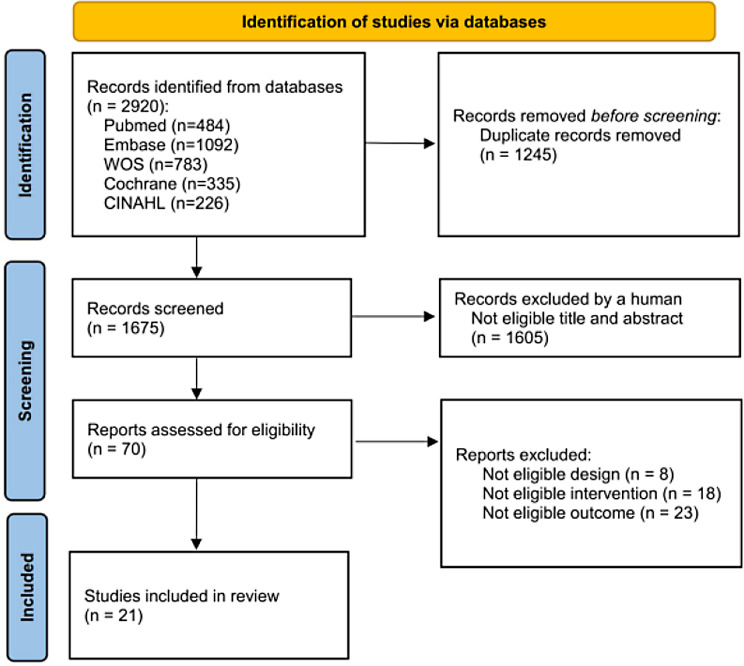
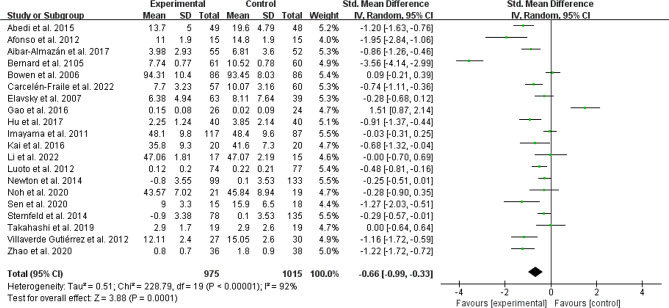
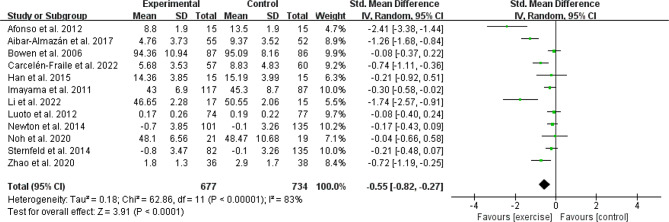
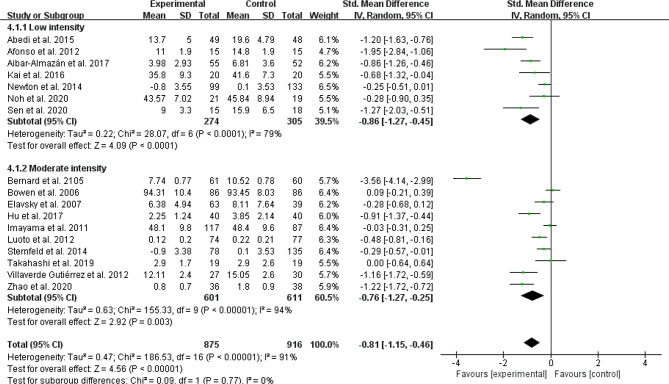
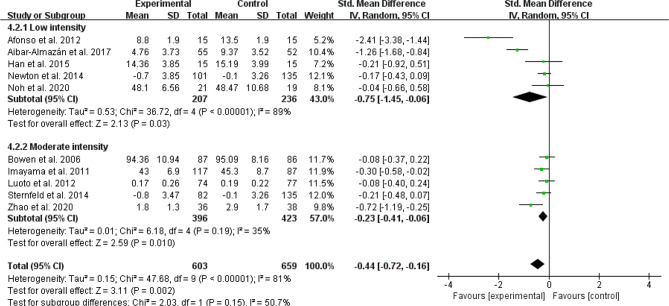
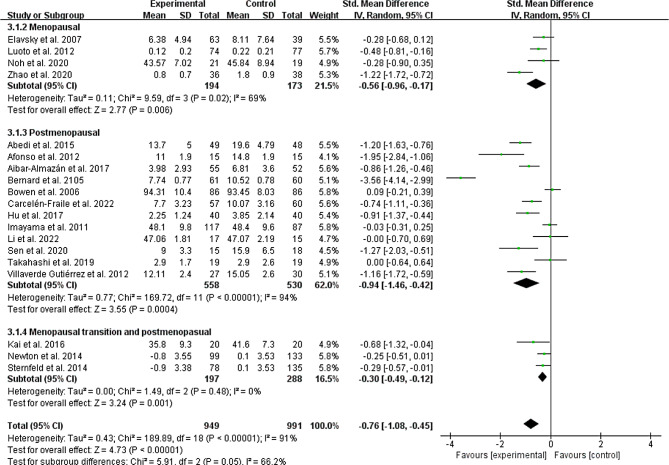
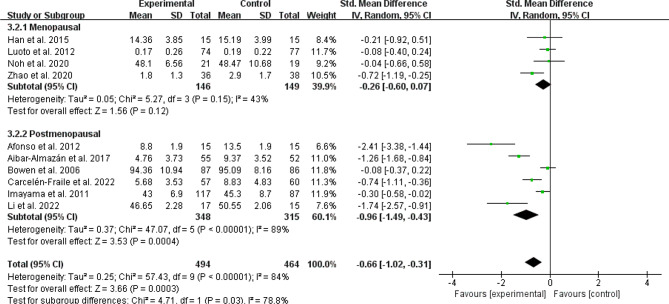
Background: Depression and anxiety may significantly affect women in the menopausal transition and menopause. In addition to traditional treatment strategies such as hormone therapy, antidepressants, and psychotherapy, physical activity (PA) have been increasingly studied, but there is no consensus about their role in menopausal women with depression and anxiety. Objective: The current study aimed to evaluate the effect of PA on the severity of depressive (DS) and anxiety (AS) symptoms in women during the menopausal transition and menopause. Methods: We searched for relevant published studies in PubMed, Embase, Web of Science, Cochrane Library, and CINAHL prior to 8 April 2024, focusing on randomized controlled trials documenting the effect of physical activity on DS and AS, and assessed study quality using the Newcastle–Ottawa Scale. Results: The data used for meta-analysis were derived from 21 studies (DS, n = 9; AS, n = 1; DS and AS combined, n = 11) involving 2020 participants. The results showed that PA groups demonstrated a statistically significant effect of depressive symptoms versus controls (DS [SMD: -0.66, 95% CI: -0.99 to -0.33; P < 0.001]; AS [SMD: -0.55, 95% CI: -0.82 to -0.27; P < 0.001]). As subgroup analyses demonstrated, physical exercise also reduced depressive symptom of women in menopausal status (SMD =-0.56, 95% CI: −0.96 to − 0.17, p = 0.006, I 2 = 69%), postmenopausal status (SMD =-0.94, 95% CI: −1.46 to − 0.42, p = 0.0004, I 2 = 94%), and both in menopausal transition and postmenopausal status (SMD =-0.30, 95% CI: −0.49 to − 0.12, p = 0.001, I 2 = 0%), while it only reduced anxiety symptom of postmenopausal women (SMD =-0.96, 95% CI: −1.49 to − 0.43, p = 0.0004, I 2 = 89%). Low-intensity and moderate-intensity exercise both produced increasingly benefits over depressive and anxiety symptoms. However, there is no statistically significant effect of exercise intensity on both depressive symptom and anxiety symptom. Conclusion: Physical activities with low to moderate intensity can impart remarkable improvements for managing menopausal women with depression and anxiety.
Overview
The claims and statistics of this paper haven’t been checked yet.
Free: it reads the open-access text and checks the first 5 claims that cite a source we can check. Create a free account to check every claim.
Integrity signals
Registry
Cites
Statistics
Figures
Verification
Claims the paper makes
The claims and statistics of this paper haven’t been checked yet.
Free: it reads the open-access text and checks the first 5 claims that cite a source we can check. Create a free account to check every claim.
Claims other papers make about this one
Each is checked against this paper’s own text: does it say what the citing paper says it does?
The cited source doesn’t support the claim as written.
In the citing paper
“moderate-intensity exercise with SMD of -0.06 (95% CI: -0.22 to 0.09) reported from the same two studies 72 112 (2 meta-analyses, 13 component studies, 2,069 participants)”
From Effect of exercise on depression and anxiety symptoms: systematic umbrella review with meta-meta-analysis (2026) · cites this paper as [72]
Checked by a reasoning model — may be wrong.
Experimental — accuracy not yet measuredThe source backs part of the claim, not all of it — or backs it for a different population, condition or comparison.
In the citing paper
“mixed exercise SMD of -0.45 (95% CI: -0.60 to -0.30) from twelve reviews 58 72 81 83 99 103 107 114 119-122 (13 meta-analyses, 170 component studies, 14,208 participants)”
From Effect of exercise on depression and anxiety symptoms: systematic umbrella review with meta-meta-analysis (2026) · cites this paper as [72]
Experimental — accuracy not yet measuredThe source backs part of the claim, not all of it — or backs it for a different population, condition or comparison.
In the citing paper
“Low-intensity exercise demonstrated a more substantial impact with SMD of -0.68 (95% CI: 1.21 to -0.14) from two studies 72 112 (2 meta-analyses, 9 component studies, 903 participants), compared to the effect of moderate-intensity exercise with SMD of -0.06 (95% CI: -0.22 to 0.09) reported from the same two studies 72 112 (2 meta-analyses, 13 component studies, 2,069 participants).”
From Effect of exercise on depression and anxiety symptoms: systematic umbrella review with meta-meta-analysis (2026) · cites this paper as [72]
Experimental — accuracy not yet measuredThe source backs part of the claim, not all of it — or backs it for a different population, condition or comparison.
In the citing paper
“Low-intensity exercise demonstrated a more substantial impact with SMD of -0.68 (95% CI: 1.21 to -0.14) from two studies 72 112 (2 meta-analyses, 9 component studies, 903 participants)”
From Effect of exercise on depression and anxiety symptoms: systematic umbrella review with meta-meta-analysis (2026) · cites this paper as [72]
Experimental — accuracy not yet measuredIn the citing paper
“Despite evidence in support of exercise for improving menopausal symptoms in the general female population [47–50]”
From Frequency and perceived influence of menopausal symptoms on training and performance in female endurance athletes (2025) · cites this paper as [50]
Self-check
Percentages, sums and reported differences re-computed from the paper’s own numbers.
The self-check needs the paper’s full text.
Citations
Cites
Measuring inconsistency in meta-analyses
Higgins, J. P. T., Thompson, S. G., Deeks, J. J., & Altman, D. G. (2003) · BMJ · doi:10.1136/bmj.327.7414.557 · Cited by 63,139
Garber, C. E., Blissmer, B., Deschenes, M. R., Franklin, B. A., Lamonte, M. J., Lee, I.-M., Nieman, D. C., & Swain, D. P. (2011) · Medicine & Science in Sports & Exercise · doi:10.1249/mss.0b013e318213fefb · Cited by 9,319 · cited 1×
“The intensity of PA was based on heart rate max, VO 2 max, heart rate reserve or estimated metabolic equivalent of task (METs) [44, 45].”
Compendium of physical activities: an update of activity codes and MET intensities
AINSWORTH, B. E., HASKELL, W. L., WHITT, M. C., IRWIN, M. L., SWARTZ, A. M., STRATH, S. J., O???BRIEN, W. L., BASSETT, D. R., SCHMITZ, K. H., EMPLAINCOURT, P. O., et al. (2000) · Medicine & Science in Sports & Exercise · doi:10.1097/00005768-200009001-00009 · Cited by 8,497
Cumpston, M., Li, T., Page, M. J., Chandler, J., Welch, V. A., Higgins, J. P., & Thomas, J. (2019) · Cochrane Database of Systematic Reviews · doi:10.1002/14651858.ed000142 · Cited by 7,218
Physical Activity and Mental Health: Current Concepts
Paluska, S. A., & Schwenk, T. L. (2000) · Sports Medicine · doi:10.2165/00007256-200029030-00003 · Cited by 1,722
Singh, B., Olds, T., Curtis, R., Dumuid, D., Virgara, R., Watson, A., Szeto, K., O'Connor, E., Ferguson, T., Eglitis, E., et al. (2023) · British Journal of Sports Medicine · doi:10.1136/bjsports-2022-106195 · Cited by 1,049 · cited 1×
“The results of our study are consistent with previous systematic review and meta-analyses, indicating that participation in PA may result in decreased depression and anxiety levels in adults, regardless of exercise intensity [46].”
Cohen, L. S., Soares, C. N., Vitonis, A. F., Otto, M. W., & Harlow, B. L. (2006) · Archives of General Psychiatry · doi:10.1001/archpsyc.63.4.385 · Cited by 831
Page, M. J., & Moher, D. (2017) · Systematic Reviews · doi:10.1186/s13643-017-0663-8 · Cited by 769 · cited 1×
“The Preferred Reporting Items for Systematic Reviews and Meta-Analyses (PRISMA) [19] was rigorously adhered to in this systematic review and meta-analysis.”
The Menopause Transition: Signs, Symptoms, and Management Options
Santoro, N., Roeca, C., Peters, B. A., & Neal-Perry, G. (2021) · The Journal of Clinical Endocrinology & Metabolism · doi:10.1210/clinem/dgaa764 · Cited by 631
Takahashi, T. A., & Johnson, K. M. (2015) · Medical Clinics of North America · doi:10.1016/j.mcna.2015.01.006 · Cited by 355
Associations of depression with the transition to menopause
Freeman, E. W. (2010) · Menopause · doi:10.1097/gme.0b013e3181db9f8b · Cited by 331 · cited 1×
“…during menopausal stages may be influenced by various disrupting factors such as ovarian failure [52], estrogen withdrawal [53], increased levels of follicle-stimulating hormone [54], heightened neuroticism [55], and alterations in hormonal levels impacting serotonin and GABA signaling [40, 56].”
Yoga for anxiety: A systematic review and meta-analysis of randomized controlled trials
Cramer, H., Lauche, R., Anheyer, D., Pilkington, K., de Manincor, M., Dobos, G., & Ward, L. (2018) · Depression and Anxiety · doi:10.1002/da.22762 · Cited by 329 · cited 1×
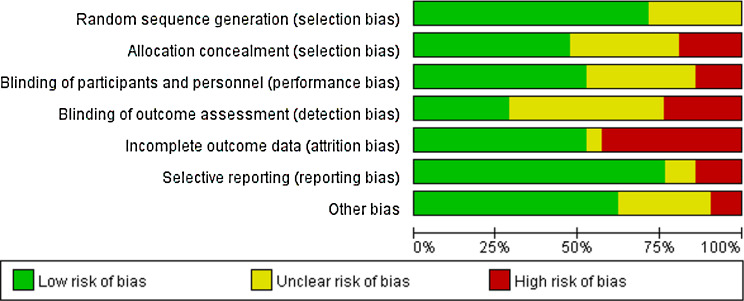
“2 Risk of bias graph [48].”
(2019) · PubMed · Cited by 300
Physical activity and mental health outcomes during menopause: A randomized controlled trial
Elavsky, S., & McAuley, E. (2007) · Annals of Behavioral Medicine · doi:10.1007/bf02879894 · Cited by 233
Philippot, A., Dubois, V., Lambrechts, K., Grogna, D., Robert, A., Jonckheer, U., Chakib, W., Beine, A., Bleyenheuft, Y., & De Volder, A. G. (2022) · Journal of Affective Disorders · doi:10.1016/j.jad.2022.01.011 · Cited by 216
Imayama, I., Alfano, C. M., Kong, A., Foster-Schubert, K. E., Bain, C. E., Xiao, L., Duggan, C., Wang, C.-Y., Campbell, K. L., Blackburn, G. L., et al. (2011) · International Journal of Behavioral Nutrition and Physical Activity · doi:10.1186/1479-5868-8-118 · Cited by 204
Efficacy of exercise for menopausal symptoms: a randomized controlled trial
Sternfeld, B., Guthrie, K. A., Ensrud, K. E., LaCroix, A. Z., Larson, J. C., Dunn, A. L., Anderson, G. L., Seguin, R. A., Carpenter, J. S., Newton, K. M., et al. (2014) · Menopause · doi:10.1097/gme.0b013e31829e4089 · Cited by 184
Alblooshi, S., Taylor, M., & Gill, N. (2023) · Australasian Psychiatry · doi:10.1177/10398562231165439 · Cited by 178
Yoga decreases insomnia in postmenopausal women: a randomized clinical trial
Afonso, R. F., Hachul, H., Kozasa, E. H., de Souza Oliveira, D., Goto, V., Rodrigues, D., Tufik, S., & Leite, J. R. (2012) · Menopause · doi:10.1097/gme.0b013e318228225f · Cited by 174 · cited 5×
“Depressive symptoms were assessed with the BDI [24, 25, 29, 31, 35, 43], the BSI [30, 32], the GDS [28, 40], the HADS [26, 27], SCL-95-R [42], the PHQ [17, 33], the Kupperman Scale [37], the WHQ [41] and the SDS [34, 36, 39].”
InfluentialEfficacy of yoga for vasomotor symptoms: a randomized controlled trial
Newton, K. M., Reed, S. D., Guthrie, K. A., Sherman, K. J., Booth-LaForce, C., Caan, B., Sternfeld, B., Carpenter, J. S., Learman, L. A., Freeman, E. W., et al. (2014) · Menopause · doi:10.1097/gme.0b013e31829e4baa · Cited by 150
Aibar-Almazán, A., Hita-Contreras, F., Cruz-Díaz, D., de la Torre-Cruz, M., Jiménez-García, J. D., & Martínez-Amat, A. (2019) · Maturitas · doi:10.1016/j.maturitas.2019.03.019 · Cited by 148
Li, R., Min, M., Xiao, X.-R., Xu, Y., Chen, X., & Li, B. (2016) · Medicine · doi:10.1097/md.0000000000004466 · Cited by 142
Tang, R., Luo, M., Li, J., Peng, Y., Wang, Y., Liu, B., Liu, G., Wang, Y., Lin, S., & Chen, R. (2019) · Fertility and Sterility · doi:10.1016/j.fertnstert.2019.08.005 · Cited by 129
Hormonal Agents for the Treatment of Depression Associated with the Menopause
Herson, M., & Kulkarni, J. (2022) · Drugs & Aging · doi:10.1007/s40266-022-00962-x · Cited by 123
Depression and anxiety through the climacteric period: An epidemiological study (HUNT-II)
Tangen, T., & Mykletun, A. (2008) · Journal of Psychosomatic Obstetrics & Gynecology · doi:10.1080/01674820701733945 · Cited by 114
Effect of aerobic training on hot flushes and quality of life—a randomized controlled trial
Luoto, R., Moilanen, J., Heinonen, R., Mikkola, T., Raitanen, J., Tomas, E., Ojala, K., Mansikkamäki, K., & Nygård, C.-H. (2012) · Annals of Medicine · doi:10.3109/07853890.2011.583674 · Cited by 107
Associations between anxiety, depression and insomnia in peri- and post-menopausal women
Terauchi, M., Hiramitsu, S., Akiyoshi, M., Owa, Y., Kato, K., Obayashi, S., Matsushima, E., & Kubota, T. (2012) · Maturitas · doi:10.1016/j.maturitas.2012.01.014 · Cited by 105
Şen, E. İ., Esmaeilzadeh, S., & Eskiyurt, N. (2020) · Journal of Bone and Mineral Metabolism · doi:10.1007/s00774-019-01072-2 · Cited by 93
Effect of pedometer-based walking on depression, anxiety and insomnia among postmenopausal women
Abedi, P., Nikkhah, P., & Najar, S. (2015) · Climacteric · doi:10.3109/13697137.2015.1065246 · Cited by 92
Detrimental Changes in Health during Menopause: The Role of Physical Activity
Hulteen, R. M., Marlatt, K. L., Allerton, T. D., & Lovre, D. (2023) · International Journal of Sports Medicine · doi:10.1055/a-2003-9406 · Cited by 84
Dong, Y., Zhang, X., Zhao, R., Cao, L., Kuang, X., & Yao, J. (2024) · Frontiers in Psychiatry · doi:10.3389/fpsyt.2024.1305295 · Cited by 84
Hu, L., Zhu, L., Lyu, J., Zhu, W., Xu, Y., & Yang, L. (2017) · International journal of gerontology · doi:10.1016/j.ijge.2016.08.002 · Cited by 74
Qigong for mental health and sleep quality in postmenopausal women: A randomized controlled trial
Carcelén‐Fraile, M. D. C., Aibar‐Almazán, A., Martínez‐Amat, A., Jiménez‐García, J. D., Loureiro, V., García-Garro, P. A., Fábrega‐Cuadros, R., Rivas-Campo, Y., & Hita‐Contreras, F. (2022) · Medicine · doi:10.1097/md.0000000000030897 · Cited by 72
Bernard, P., Ninot, G., Bernard, P. L., Picot, M. C., Jaussent, A., Tallon, G., & Blain, H. (2015) · Aging & Mental Health · doi:10.1080/13607863.2014.948806 · Cited by 69
Randomized trial of exercise in sedentary middle aged women: effects on quality of life
Bowen, D. J., Fesinmeyer, M. D., Yasui, Y., Tworoger, S., Ulrich, C. M., Irwin, M. L., Rudolph, R. E., LaCroix, K. L., Schwartz, R. R., & McTiernan, A. (2006) · International Journal of Behavioral Nutrition and Physical Activity · doi:10.1186/1479-5868-3-34 · Cited by 61
DiBonaventura, M., Wagner, J.-S., Alvir, J., & Whiteley, J. (2012) · The Primary Care Companion For CNS Disorders · doi:10.4088/pcc.12m01410 · Cited by 59
Association between Physical Activity and Depressive Symptoms: Midlife Women in SWAN
DUGAN, S. A., BROMBERGER, J. T., SEGAWA, E., AVERY, E., & STERNFELD, B. (2015) · Medicine & Science in Sports & Exercise · doi:10.1249/mss.0000000000000407 · Cited by 59
Hedges, V. L., Heaton, E. C., Amaral, C., Benedetto, L. E., Bodie, C. L., D’Antonio, B. I., Portillo, D. R. D., Lee, R. H., Levine, M., O’Sullivan, E. C., et al. (2020) · Biological Psychiatry · doi:10.1016/j.biopsych.2020.11.016 · Cited by 59
Kai, Y., Nagamatsu, T., Kitabatake, Y., & Sensui, H. (2016) · Menopause The Journal of The North American Menopause Society · doi:10.1097/gme.0000000000000651 · Cited by 56
Middle-aged Female Depression in Perimenopausal Period and Square Dance Intervention.
Gao, L., Zhang, L., Qi, H., & Petridis, L. (2016) · PubMed · Cited by 56
Influence of exercise on mood in postmenopausal women
Villaverde Gutiérrez, C., Torres Luque, G., Ábalos Medina, G. M., Argente del Castillo, M. J., Guisado, I. M., Guisado Barrilao, R., & Ramírez Rodrigo, J. (2012) · Journal of Clinical Nursing · doi:10.1111/j.1365-2702.2011.03972.x · Cited by 55
Xu, H., Liu, J., Li, P.-S., & Liang, Y. (2024) · Menopause · doi:10.1097/gme.0000000000002336 · Cited by 55
Mehrnoush, V., Darsareh, F., Roozbeh, N., & Ziraeie, A. (2021) · Journal of Menopausal Medicine · doi:10.6118/jmm.21022 · Cited by 53
Effect of aerobic training on menopausal symptoms—a randomized controlled trial
Moilanen, J. M., Mikkola, T. S., Raitanen, J. A., Heinonen, R. H., Tomas, E. I., Nygård, C.-H., & Luoto, R. M. (2012) · Menopause · doi:10.1097/gme.0b013e31823cc5f7 · Cited by 51
Gabriel, K. P., Mason, J. M., & Sternfeld, B. (2015) · Women s Midlife Health · doi:10.1186/s40695-015-0004-9 · Cited by 46
Martínez‐Domínguez, S. J., Lajusticia, H., Chedraui, P. A., Pérez-López, F. R., & for the Health Outcomes and Systematic Analyses (HOUSSAY) Project (2018) · Climacteric · doi:10.1080/13697137.2017.1415321 · Cited by 37
Chou, C., Ko, H., Wu, J. Y., Chang, F., & Tung, Y.-Y. (2015) · Taiwanese Journal of Obstetrics and Gynecology · doi:10.1016/j.tjog.2015.03.004 · Cited by 34
Health maintenance for postmenopausal women.
Rao, S., Singh, M., Parkar, M., & Sugumaran, R. (2008) · PubMed · Cited by 31
Mental health aspect of quality of life in the menopausal transition
Dotlić, J., Radovanović, S., Rancic, B., Milošević, B., Nicevic, S., Kurtagić, I., Markovic, N., & Gazibara, T. M. (2020) · Journal of Psychosomatic Obstetrics & Gynecology · doi:10.1080/0167482x.2020.1734789 · Cited by 31
Elavsky, S., Molenaar, P. C. M., Gold, C. H., Williams, N. I., & Aronson, K. R. (2012) · Maturitas · doi:10.1016/j.maturitas.2011.12.011 · Cited by 29
Takahashi, M., Lim, P. J., Tsubosaka, M., Kim, H., Miyashita, M., Suzuki, K., Tan, E. L., & Shibata, S. (2019) · Journal of Physical Therapy Science · doi:10.1589/jpts.31.408 · Cited by 29
Sleep, depression, anxiety and fatigue in women with premature ovarian insufficiency
Ateş, S., Aydın, S., Özcan, P., Bakar, R. Z., & Çetin, Ç. (2022) · Journal of Psychosomatic Obstetrics & Gynecology · doi:10.1080/0167482x.2022.2069008 · Cited by 29
Keqiang, L. I., Yu, H., Lin, X.-J., Su, Y., Gao, L., Song, M., Fan, H., Krokosz, D., Yang, H., & Lipowski, M. (2022) · Evidence-based Complementary and Alternative Medicine · doi:10.1155/2022/8602753 · Cited by 27
Noh, E., Kim, J., Kim, M., & Yi, E.-S. (2020) · International Journal of Environmental Research and Public Health · doi:10.3390/ijerph17186935 · Cited by 26
Han, Y., Duan, F., Xu, R.-M., Wang, Y., & Zhang, H. (2015) · PubMed Central · Cited by 2
Research works printed but not linked: 1
- 37. Zhao J. Effects of Tai Chi Chuan on the changes of bone mineral density of perimenopausal women. Chin J Tissue Eng Res. 2020;24(2):176–80.
Cited by
Munro, N. R., Teague, S., Somoray, K., Simpson, A., Budden, T., Jackson, B., Rebar, A., & Dimmock, J. (2026) · British Journal of Sports Medicine · doi:10.1136/bjsports-2025-110301 · Cited by 23
Wang, H., Li, S., Zhang, X., Zhu, Y., Huang, Q., Guo, K., & Li, D. (2025) · BMC Public Health · doi:10.1186/s12889-025-24398-1 · Cited by 17
Self-citationFIGO best practice recommendations for the mental health of women at menopausal age
Khadilkar, S. S., Divakar, H., Benedetto, C., Genazzani, A., Ramos, D. E., Argale, E., Deshpande, G., Hicky, M., Filho, A. L. D. S., Castañeda, E. H., et al. (2026) · International Journal of Gynecology & Obstetrics · doi:10.1002/ijgo.70943 · Cited by 9
Li, S., Dou, Y., & Li, Y. (2025) · Frontiers in Psychiatry · doi:10.3389/fpsyt.2025.1641082 · Cited by 7
Self-citationHamilton, H. M., Yarish, N. M., & Heron, K. E. (2025) · PLOS One · doi:10.1371/journal.pone.0335738 · Cited by 6
“Despite evidence in support of exercise for improving menopausal symptoms in the general female population [47–50], reported MRS scores in our sample of highly physically active participants are similar to a range of total MRS scores reported in the general population [4,24,51].”
Metadata
- Authors
- Yue, H., Yang, Y., Xie, F., Cui, J., Li, Y., Si, M., Li, S., & Yao, F.
- Affiliations
- Shanghai University of Traditional Chinese Medicine (CN)
- Corresponding author
- Li, Shanshan
- Yao, Fei
- Venue
- International Journal of Behavioral Nutrition and Physical Activity
- Published
- 2025-01-24
- Volume
- 22
- Issue
- 1
- Pages
- 13-13
- ISSN
- 1479-5868 (ISSN-L)
- PMC
- PMC11762881
- OpenAlex
- W4406801676
- Semantic Scholar
- a5eb369c676807ab3473c4cd8707b03fa87929a3
- Cited by
- 28
- References
- 56
- Citations by year
- 2026: 19 · 2025: 9
- FWCI
- 3.81
- Type
- journal article
- Language
- en
- Open access
- gold
- doi.org
- Licence
- cc-by
- creativecommons.org/licenses/by/4.0 (tdm)
- creativecommons.org/licenses/by/4.0 (vor)
- Locations
- International Journal of Behavioral Nutrition and Physical Activity (publishedVersion, cc-by)
- PubMed Central (publishedVersion, cc-by)
- PubMed (publishedVersion)
- DOAJ (DOAJ: Directory of Open Access Journals) (submittedVersion, cc-by-sa)
- Funders
- National Natural Science Foundation of China (82374610, 82305366)
- Science and Technology Commission of Shanghai Municipality (21YF1444600)
- Topics
- Health Sciences › Medicine › Endocrinology, Diabetes and Metabolism › Menopause: Health Impacts and Treatments
- Health Sciences › Medicine › Public Health, Environmental and Occupational Health › Physical Activity and Health
- Health Sciences › Medicine › Oncology › Cancer survivorship and care
- Keywords
- physical activity, depressive symptoms, anxiety symptoms, menopause, perimenopause, postmenopausal women, mental health, women's health, hormone therapy alternatives, quality of life, sleep quality, sexual dysfunction, menopausal symptoms, hormone replacement therapy
- MeSH terms
- Anxiety, Depression, Female, Humans, Menopause, Middle Aged, Exercise, Randomized Controlled Trials as Topic
About these checks
Registry, retraction, Cites and statistics results are computed, not judged, with one exception: a printed reference that no index lists is read once by a model before it counts as a citation error. Claims are extracted by a model and kept only when their quote appears verbatim in the text; each cited source is then checked, with a model’s help, for whether it says what the claim relies on. Those verdicts can be wrong — read the claim’s quote and the cited source before relying on one.
Statistics and arithmetic are recomputed, not judged.
Confidence bands are shown only for fields calibrated on our annotated test set. None is calibrated yet, so no band is shown.
What counts as a claim ›How we measure confidence ›How we check this ›
Are you an author, or do you see a problem with this page? Request a review
Data sources
Bibliographic data: Semantic Scholar, OpenAlex, Crossref.
Contains information from the Semantic Scholar Academic Graph Datasets, made available under the ODC Attribution License (ODC-BY 1.0).
Semantic Scholar’s data is described in: Kinney, R., et al. (2023). The Semantic Scholar Open Data Platform. arXiv:2301.10140.
