

The GLP-1 receptor agonists exenatide and liraglutide activate Glucose transport by an AMPK-dependent mechanism
Open accessThe DOI matches its Crossref record; 56 of the 57 references it cites were found in a registry or an index.
Abstract
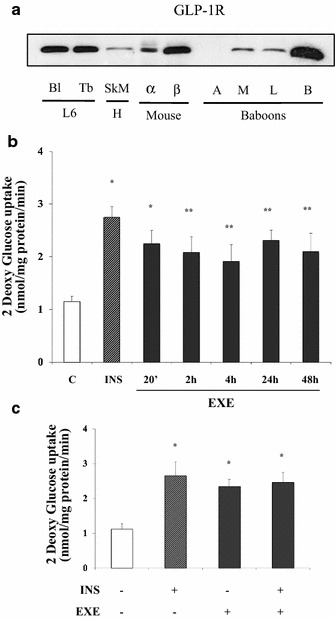
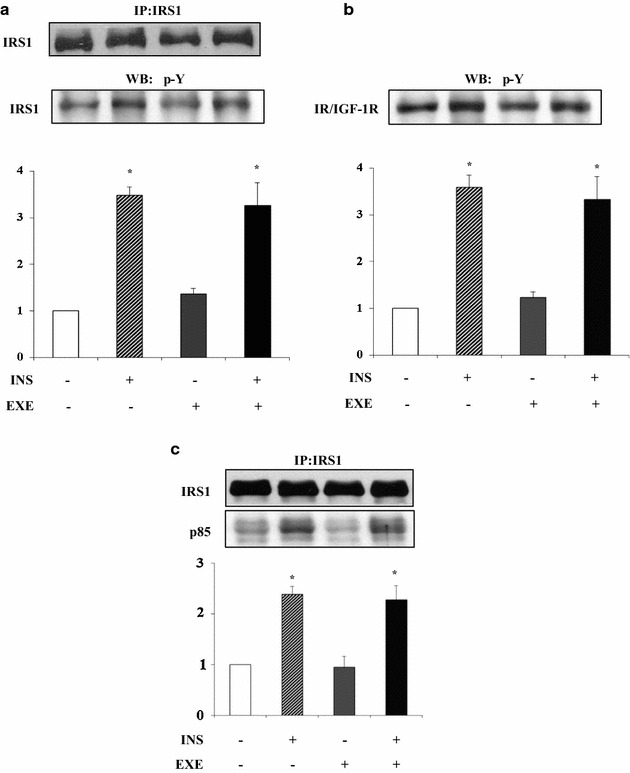
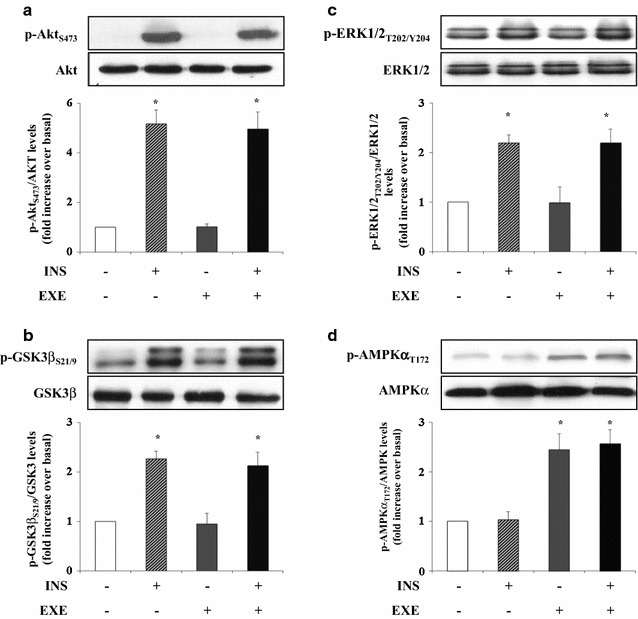
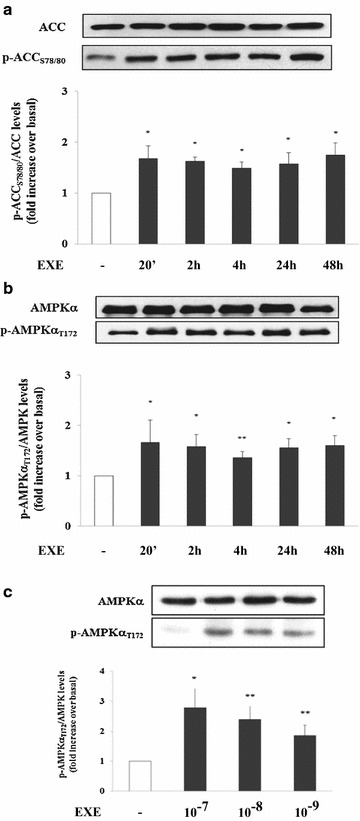
AIMS/HYPOTHESIS: Potentiation of glucose-induced insulin secretion is the main mechanism of exenatide (EXE) antidiabetic action, however, increased glucose utilization by peripheral tissues has been also reported. We here studied the effect of EXE on glucose uptake by skeletal muscle cells. METHODS: 2-deoxy-glucose (2DG) uptake and intracellular signal pathways were measured in rat L6 skeletal muscle myotubes exposed to 100 nmol/l EXE for up to 48 h. Mechanisms of EXE action were explored by inhibiting AMPK activity with compound C (CC, 40 μmol/l) or siRNAs (2 μmol/l). RESULTS: Time course experiments show that EXE increases glucose uptake up to 48 h achieving its maximal effect, similar to that induced by insulin, after 20 min (2- vs 2.5-fold-increase, respectively). Differently from insulin, EXE does not stimulate: (i) IR β-subunit- and IRS1 tyrosine phosphorylation and binding to p85 regulatory subunit of PI-3kinase; (ii) AKT activation; and (iii) ERK1/2 and JNK1/2 phosphorylation. Conversely, EXE increases phosphorylation of α-subunit of AMPK at Thr172 by 2.5-fold (p < 0.01). Co-incubation of EXE and insulin does not induce additive effects on 2DG-uptake. Inhibition of AMPK with CC, and reduction of AMPK protein expression by siRNA, completely abolish EXE-induced 2DG-uptake. Liraglutide, another GLP-1 receptor agonist, also stimulates AMPK phosphorylation and 2DG-uptake. Moreover, EXE stimulates 2DG-uptake also by L6 myotubes rendered insulin-resistant with methylglyoxal. Finally, EXE also induces glucose transporter Glut-4 translocation to the plasma membrane. CONCLUSIONS/INTERPRETATION: In L6 myotubes, EXE and liraglutide increase glucose uptake in an insulin-independent manner by activating AMPK.
Overview
The claims and statistics of this paper haven’t been checked yet.
Free: it reads the open-access text and checks the first 5 claims that cite a source we can check. Create a free account to check every claim.
Integrity signals
Registry
Cites
Statistics
Figures
Verification
Claims the paper makes
The claims and statistics of this paper haven’t been checked yet.
Free: it reads the open-access text and checks the first 5 claims that cite a source we can check. Create a free account to check every claim.
Claims other papers make about this one
Each is checked against this paper’s own text: does it say what the citing paper says it does?
The cited source says what the claim attributes to it.
In the citing paper
“GLP-1 can also enhance the uptake and utilization of glucose in muscle and adipose tissues.207–209”
From Glucagon-like peptide-1 receptor: mechanisms and advances in therapy (2024) · cites this paper as [208]
In the citing paper
“On the other hand, studies in rodents showed that GLP1 receptor agonists may increase microvascular blood volume and glucose transport in skeletal muscle cells, leading to increased delivery of oxygen, nutrients and hormones, such as insulin, to myocytes207,208.”
From Sarcopenic obesity in older adults: a clinical overview (2024) · cites this paper as [207]
Self-check
Percentages, sums and reported differences re-computed from the paper’s own numbers.
The self-check needs the paper’s full text.
Citations
Cites
1 retracted
Condorelli, G., Vigliotta, G., Trencia, A., Maitan, M. A., Caruso, M., Miele, C., Oriente, F., Santopietro, S., Formisano, P., & Beguinot, F. (2001) · Diabetes · doi:10.2337/diabetes.50.6.1244 · Cited by 72
Self-citationRetractedAMPK: a nutrient and energy sensor that maintains energy homeostasis
Hardie, D. G., Ross, F. A., & Hawley, S. A. (2012) · Nature Reviews Molecular Cell Biology · doi:10.1038/nrm3311 · Cited by 4,602 · cited 2×
“The heterotrimeric protein AMPK, consisting of a catalytic α and regulatory β and γ subunits, is ubiquitously expressed and it is regulated by a variety of physiological stimuli and drugs such as metformin and thiazolidinediones and plays a pivotal role in the regulation of mitochondrial biogenesis, fatty acid synthes…”
Watterson, K. R., Bestow, D., Gallagher, J., Hamilton, D. L., Ashford, F. B., Meakin, P. J., & Ashford, M. L. J. (2013) · Neurosignals · doi:10.1159/000334144 · Cited by 3,389
The selectivity of protein kinase inhibitors: a further update
Bain, J., Plater, L., Elliott, M., Shpiro, N., Hastie, C. J., Mclauchlan, H., Klevernic, I., Arthur, J. S. C., Alessi, D. R., & Cohen, P. (2007) · Biochemical Journal · doi:10.1042/bj20070797 · Cited by 2,520
Pharmacology, physiology, and mechanisms of incretin hormone action.
Campbell, J. E., & Drucker, D. J. (2013) · Cell Metabolism · doi:10.1016/j.cmet.2013.04.008 · Cited by 1,500 · cited 8×
“Exenatide (EXE) is the synthetic analog of exendin-4, a GLP-1 homologous originally purified from the salivary glands of the lizard Heloderma suspectum, and it is currently employed in the treatment of type 2 diabetes (T2D) [3, 4].”
InfluentialBuse, J. B., Henry, R. R., Han, J., Kim, D. D., Fineman, M. S., Baron, A. D., & for the Exenatide-113 Clinical Study Group (2004) · Diabetes Care · doi:10.2337/diacare.27.11.2628 · Cited by 1,346
Thorens, B. (1992) · Proceedings of the National Academy of Sciences · doi:10.1073/pnas.89.18.8641 · Cited by 906 · cited 2×
“The antibodies used were: anti-GLP-1 receptor (kind gift of Drs. Wanda Dolci and Bernard Thorens [10, 23], anti-insulin receptor (IR), anti-p-tyrosine (Biosource, Camarillo, CA), anti-IRS-1 (Millipore, Billerica, MA, USA), anti-p85 subunit of PI3-kinase, antiAkt, anti-p-Akt S473, anti-p-AMPK T172, anti-AMPK, anti-p-AC…”
Mojsov, S., Weir, G. C., & Habener, J. F. (1987) · Journal of Clinical Investigation · doi:10.1172/jci112855 · Cited by 882
Gutniak, M., Ørkov, C., Holst, J. J., Ahrén, B., & Efendić, S. (1992) · New England Journal of Medicine · doi:10.1056/nejm199205143262003 · Cited by 868 · cited 1×
“Generally recognized mechanisms of GLP-1 and GLP1R agonists action are potentiation of glucose-induced insulin secretion, reduction of glucagon secretion, inhibition of gastric emptying and decreased appetite [3, 4, 8, 9], however, insulin sensitizing effects have been also described.”
Young, A. A., Gedulin, B. R., Bhavsar, S., Bodkin, N., Jodka, C., Hansen, B., & Denaro, M. (1999) · Diabetes · doi:10.2337/diabetes.48.5.1026 · Cited by 440
High Glucose Causes Apoptosis in Cultured Human Pancreatic Islets of Langerhans
Federici, M., Hribal, M., Perego, L., Ranalli, M., Caradonna, Z., Perego, C., Usellini, L., Nano, R., Bonini, P., Bertuzzi, F., et al. (2001) · Diabetes · doi:10.2337/diabetes.50.6.1290 · Cited by 333
Self-citationSchmidt, W. E., Siegel, E. G., & Creutzfeldt, W. (1985) · Diabetologia · doi:10.1007/bf00291980 · Cited by 319
Fehse, F., Trautmann, M., Holst, J. J., Halseth, A. E., Nanayakkara, N., Nielsen, L. L., Fineman, M. S., Kim, D. D., & Nauck, M. A. (2005) · The Journal of Clinical Endocrinology & Metabolism · doi:10.1210/jc.2005-1093 · Cited by 297 · cited 7×
“Exenatide (EXE) is the synthetic analog of exendin-4, a GLP-1 homologous originally purified from the salivary glands of the lizard Heloderma suspectum, and it is currently employed in the treatment of type 2 diabetes (T2D) [3, 4].”
InfluentialRole of AMP-activated protein kinase in adipose tissue metabolism and inflammation
Bijland, S., Mancini, S. J., & Salt, I. P. (2013) · Clinical Science · doi:10.1042/cs20120536 · Cited by 284
Taylor, E. B., An, D., Kramer, H. F., Yu, H., Fujii, N. L., Roeckl, K. S. C., Bowles, N., Hirshman, M. F., Xie, J., Feener, E. P., et al. (2008) · Journal of Biological Chemistry · doi:10.1074/jbc.m708839200 · Cited by 269
Koistinen, H. A., Galuska, D., Chibalin, A. V., Yang, J., Zierath, J. R., Holman, G. D., & Wallberg-Henriksson, H. (2003) · Diabetes · doi:10.2337/diabetes.52.5.1066 · Cited by 232
Oben, J., Morgan, L., Fletcher, J., & Marks, V. (1991) · Journal of Endocrinology · doi:10.1677/joe.0.1300267 · Cited by 188
Huang, C., Thirone, A. C. P., Huang, X., & Klip, A. (2005) · Journal of Biological Chemistry · doi:10.1074/jbc.m412317200 · Cited by 180
Koska, J., Sands, M., Burciu, C., D’Souza, K. M., Raravikar, K., Liu, J., Truran, S., Franco, D. A., Schwartz, E. A., Schwenke, D. C., et al. (2015) · Diabetes · doi:10.2337/db14-0976 · Cited by 174
Differential Activation Mechanisms of Erk-1/2 and p70S6K by Glucose in Pancreatic β-Cells
Briaud, I., Lingohr, M. K., Dickson, L. M., Wrede, C. E., & Rhodes, C. J. (2003) · Diabetes · doi:10.2337/diabetes.52.4.974 · Cited by 168
Guardado-Mendoza, R., Davalli, A. M., Chavez, A. O., Hubbard, G. B., Dick, E. J., Majluf-Cruz, A., Tene-Perez, C. E., Goldschmidt, L., Hart, J., Perego, C., et al. (2009) · Proceedings of the National Academy of Sciences · doi:10.1073/pnas.0906471106 · Cited by 166
Self-citationMechanism of action of exenatide to reduce postprandial hyperglycemia in type 2 diabetes
Cervera, A., Wajcberg, E., Sriwijitkamol, A., Fernandez, M., Zuo, P., Triplitt, C., Musi, N., DeFronzo, R. A., & Cersosimo, E. (2008) · American Journal of Physiology-Endocrinology and Metabolism · doi:10.1152/ajpendo.00030.2008 · Cited by 157
Lee, J. O., Lee, S. K., Kim, J. H., Kim, N., You, G. Y., Moon, J. W., Kim, S. J., Park, S. H., & Kim, H. S. (2012) · Journal of Biological Chemistry · doi:10.1074/jbc.m112.361386 · Cited by 139
GLP-1 action in L6 myotubes is via a receptor different from the pancreatic GLP-1 receptor
Yang, H., Egan, J. M., Wang, Y., Moyes, C. D., Roth, J., Montrose, M. H., & Montrose-Rafizadeh, C. (1998) · American Journal of Physiology-Cell Physiology · doi:10.1152/ajpcell.1998.275.3.c675 · Cited by 136
Regulation of ERK1 and ERK2 by Glucose and Peptide Hormones in Pancreatic β Cells
Arnette, D., Gibson, T. B., Lawrence, M. C., January, B., Khoo, S., McGlynn, K., Vanderbilt, C. A., & Cobb, M. H. (2003) · Journal of Biological Chemistry · doi:10.1074/jbc.m301174200 · Cited by 126
Egan, J. M. (1994) · Endocrinology · doi:10.1210/en.135.5.2070 · Cited by 121
Funai, K., Schweitzer, G. G., Sharma, N., Kanzaki, M., & Cartee, G. D. (2009) · American Journal of Physiology-Endocrinology and Metabolism · doi:10.1152/ajpendo.00194.2009 · Cited by 119 · cited 3×
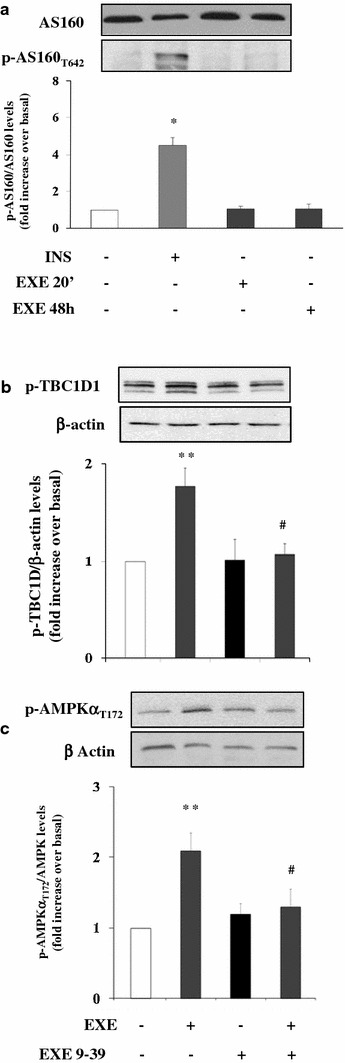
“Interestingly however, EXE increased by ~70 % the phosphorylation of TBC1D1, a AS160 paralog, which is more abundantly expressed in skeletal muscle and more strongly phosphorylated by AMPK, as compared to AKT, downstream insulin signaling [19–21].”
Cassese, A., Esposito, I., Fiory, F., Barbagallo, A. P. M., Paturzo, F., Mirra, P., Ulianich, L., Giacco, F., Iadicicco, C., Lombardi, A., et al. (2008) · Journal of Biological Chemistry · doi:10.1074/jbc.m801698200 · Cited by 116
Self-citationAyala, J. E., Bracy, D. P., James, F. D., Julien, B. M., Wasserman, D. H., & Drucker, D. J. (2009) · Endocrinology · doi:10.1210/en.2008-0945 · Cited by 114
Effect of GLP-1 Treatment on GLUT2 and GLUT4 Expression in Type 1 and Type 2 Rat Diabetic Models
Villanueva‐Peñacarrillo, M. L., Puente, J., Redondo, A., Clemente, F., & Valverde, I. (2001) · Endocrine · doi:10.1385/endo:15:2:241 · Cited by 104
Proliferation, senescence, and neoplastic progression of ? cells in hyperplasic pancreatic islets
Teitelman, G. (1988) · Cell · doi:10.1016/0092-8674(88)90534-x · Cited by 97
IDRIS, I. R., Patiag, D., Gray, S., & Donnelly, R. (2002) · Biochemical Pharmacology · doi:10.1016/s0006-2952(01)00924-8 · Cited by 95
Jensen, T. E., Schjerling, P., Viollet, B., Wojtaszewski, J. F. P., & Richter, E. A. (2008) · PLoS ONE · doi:10.1371/journal.pone.0002102 · Cited by 90
Hribal, M. L., Federici, M., Porzio, O., Lauro, D., Borboni, P., Accili, D., Lauro, R., & Sesti, G. (2000) · The Journal of Clinical Endocrinology & Metabolism · doi:10.1210/jcem.85.5.6608 · Cited by 88
Self-citationTripathy, D., Daniele, G., Fiorentino, T. V., Perez-Cadena, Z., Chavez-Velasquez, A., Kamath, S., Fanti, P., Jenkinson, C. P., Andreozzi, F., Federici, M., et al. (2013) · Diabetologia · doi:10.1007/s00125-013-2976-z · Cited by 87
Self-citationAlcántara, A., Morales, M., Delgado, E., López-Delgado, M. I., Clemente, F., Luque, M., Malaisse, W. J., Valverde, I., & Villanueva-Peñacarrillo, M. (1997) · Archives of Biochemistry and Biophysics · doi:10.1006/abbi.1997.9951 · Cited by 86
Effect of GLP-1 on glucose transport and its cell signalling in human myocytes
González, N., Acitores, A., Sancho, V., Valverde, I., & Villanueva-Peñacarrillo, M. L. (2005) · Regulatory Peptides · doi:10.1016/j.regpep.2004.10.002 · Cited by 85
Green, C. J., Henriksen, T. I., Pedersen, B. K., & Solomon, T. P. J. (2012) · PLoS ONE · doi:10.1371/journal.pone.0044284 · Cited by 80
Methylglyoxal impairs endothelial insulin sensitivity both in vitro and in vivo
Nigro, C., Raciti, G. A., Leone, A., Fleming, T. H., Longo, M., Prevenzano, I., Fiory, F., Mirra, P., D’Esposito, V., Ulianich, L., et al. (2014) · Diabetologia · doi:10.1007/s00125-014-3243-7 · Cited by 80
Self-citationWidmann, C., Bürki, E., Dolci, W., & Thorens, B. (1994) · Molecular Pharmacology · doi:10.1016/s0026-895x(25)10177-6 · Cited by 77
Physiological and Molecular Determinants of Insulin Action in the Baboon
Chavez, A. O., Lopez-Alvarenga, J. C., Tejero, M. E., Triplitt, C., Bastarrachea, R. A., Sriwijitkamol, A., Tantiwong, P., Voruganti, V. S., Musi, N., Comuzzie, A. G., et al. (2008) · Diabetes · doi:10.2337/db07-0790 · Cited by 75
Self-citationExenatide treatment for 6 months improves insulin sensitivity in adults with type 1 diabetes
Sarkar, G., Alattar, M., Brown, R. J., Quon, M. J., Harlan, D. M., & Rother, K. I. (2014) · Diabetes Care · doi:10.2337/dc13-1473 · Cited by 74
Procopio, C., Andreozzi, F., Laratta, E., Cassese, A., Beguinot, F., Arturi, F., Hribal, M. L., Perticone, F., & Sesti, G. (2009) · Endocrinology · doi:10.1210/en.2008-0921 · Cited by 70
Self-citationExercise increases TBC1D1 phosphorylation in human skeletal muscle
Jessen, N., An, D., Lihn, A. S., Nygren, J., Hirshman, M. F., Thorell, A., & Goodyear, L. J. (2011) · American Journal of Physiology-Endocrinology and Metabolism · doi:10.1152/ajpendo.00042.2011 · Cited by 67 · cited 3×
“Interestingly however, EXE increased by ~70 % the phosphorylation of TBC1D1, a AS160 paralog, which is more abundantly expressed in skeletal muscle and more strongly phosphorylated by AMPK, as compared to AKT, downstream insulin signaling [19–21].”
Dokas, J., Chadt, A., Nolden, T., Himmelbauer, H., Zierath, J. R., Joost, H.-G., & Al-Hasani, H. (2013) · Endocrinology · doi:10.1210/en.2012-2147 · Cited by 65
Han, L., Yu, Y., Sun, X., & Wang, B. (2012) · Diabetes Research and Clinical Practice · doi:10.1016/j.diabres.2012.04.001 · Cited by 60
Vyas, A. K., Yang, K.-C., Woo, D., Tzekov, A., Kovacs, A., Jay, P. Y., & Hruz, P. W. (2011) · PLoS ONE · doi:10.1371/journal.pone.0017178 · Cited by 57
Li, Z., Ni, C.-L., Yao, Z., Chen, L.-M., & Niu, W.-Y. (2014) · Metabolism · doi:10.1016/j.metabol.2014.05.008 · Cited by 56
Yamazaki, S., Satoh, H., & Watanabe, T. (2014) · Endocrinology · doi:10.1210/en.2013-2157 · Cited by 49
Miki, H., Namba, M., Nishimura, T., Mineo, I., Matsumura, T., Miyagawa, J., Nakajima, H., Kuwajima, M., Hanafusa, T., & Matsuzawa, Y. (1996) · Biochimica et Biophysica Acta (BBA) - Molecular Cell Research · doi:10.1016/0167-4889(96)00032-8 · Cited by 44
Effects of AMPK Activation on Insulin Sensitivity and Metabolism in Leptin-Deficient ob/ob Mice
Tom, R. Z., García-Rovés, P. M., Sjögren, R. J. O., Jiang, L. Q., Holmström, M., Deshmukh, A. S., Vieira, E. C., Chibalin, A., Björnholm, M., & Zierath, J. R. (2014) · Diabetes · doi:10.2337/db13-0670 · Cited by 43
Moreno, P., Nuche‐Berenguer, B., Gutiérrez-Rojas, I., Acitores, A., Sancho, V., Valverde, I., González, N., & Villanueva‐Peñacarrillo, M. L. (2011) · Journal of Molecular Endocrinology · doi:10.1530/jme-11-0127 · Cited by 29
Galera, C., Clemente, F., Alcántara, A., Trapote, M. A., Perea, A., López‐Delgado, M. I., Villanueva‐Peñacarrillo, M. L., & Valverde, I. (1996) · Cell Biochemistry and Function · doi:10.1002/(sici)1099-0844(199603)14:1<43::aid-cbf639>3.0.co;2-w · Cited by 28
Wu, H., Sui, C., Xu, H., Xia, F., Zhai, H., Zhang, H., Weng, P., Han, B., Du, S., & Lu, Y. (2014) · Journal of Diabetes Research · doi:10.1155/2014/524517 · Cited by 25
GLP-1 receptor agonists in type 1 diabetes: a proof-of-concept approach
Crisci, I., Aragona, M., Politi, K. S., Daniele, G., & Prato, S. D. (2015) · Acta Diabetologica · doi:10.1007/s00592-015-0800-6 · Cited by 19
Smits, M. M., Tonneijck, L., Muskiet, M. H. A., Kramer, M. H. H., Diamant, M., den Bos, I. C. P.-V., van Raalte, D. H., & Cahen, D. L. (2015) · Diabetes Obesity and Metabolism · doi:10.1111/dom.12612 · Cited by 7
Cited by
Glucagon-like peptide-1 receptor: mechanisms and advances in therapy
Zheng, Z., Zong, Y., Ma, Y., Tian, Y., Pang, Y., Zhang, C., & Gao, J. (2024) · Signal Transduction and Targeted Therapy · doi:10.1038/s41392-024-01931-z · Cited by 1,036
Sarcopenic obesity in older adults: a clinical overview
Prado, C. M., Batsis, J. A., Donini, L. M., Gonzalez, M. C., & Siervo, M. (2024) · Nature Reviews Endocrinology · doi:10.1038/s41574-023-00943-z · Cited by 355
“On the other hand, studies in rodents showed that GLP1 receptor agonists may increase microvascular blood volume and glucose transport in skeletal muscle cells, leading to increased delivery of oxygen, nutrients and hormones, such as insulin, to myocytes 207,208 .”
Pleiotropic Effects of GLP-1 and Analogs on Cell Signaling, Metabolism, and Function
Rowlands, J., Heng, J., Newsholme, P., & Carlessi, R. (2018) · Frontiers in Endocrinology · doi:10.3389/fendo.2018.00672 · Cited by 302
“Although, it should be noted that the difference in signaling pathways from these latest studies may result from the extended duration of exposure to the GLP-1R agonist (122, 123).”
BackgroundKarakasis, P., Patoulias, D., Fragakis, N., & Mantzoros, C. S. (2025) · Metabolism · doi:10.1016/j.metabol.2024.156113 · Cited by 242
Longo, S., Rizza, S., & Federici, M. (2023) · Acta Diabetologica · doi:10.1007/s00592-023-02088-x · Cited by 194
“Chronic administration of exenatide increases cell replication, reduces apoptosis and cellular stress, and increases insulin sensitivity in a nonhuman primate [25].”
Background
Metadata
- Authors
- Andreozzi, F., Raciti, G. A., Nigro, C., Mannino, G. C., Procopio, T., Davalli, A. M., Beguinot, F., Sesti, G., Miele, C., & Folli, F.
- Affiliations
- The University of Texas at San Antonio Health Science Center (US)
- Institute for Experimental Endocrinology and Oncology (IT)
- Magna Graecia University (IT)
- IRCCS Ospedale San Raffaele (IT)
- Corresponding author
- Andreozzi, Francesco
- Folli, Franco
- ORCID
- Venue
- Journal of Translational Medicine
- Published
- 2016-07-30
- Volume
- 14
- Issue
- 1
- Pages
- 229-229
- ISSN
- 1479-5876 (ISSN-L)
- PMC
- PMC4967343
- OpenAlex
- W2496216273
- Cited by
- 102
- References
- 57
- Citations by year
- 2026: 3 · 2025: 24 · 2024: 20 · 2023: 10 · 2022: 8 · 2021: 7 · 2020: 6 · 2019: 11 · 2018: 9 · 2017: 4
- FWCI
- 4.16
- Type
- journal article
- Language
- en
- Open access
- gold
- doi.org
- Licence
- cc-by
- Locations
- Journal of Translational Medicine (publishedVersion, cc-by)
- Europe PMC (PubMed Central) (publishedVersion, cc-by)
- PubMed Central (publishedVersion, cc-by)
- PubMed (publishedVersion)
- LA Referencia (Red Federada de Repositorios Institucionales de Publicaciones Científicas) (publishedVersion, other-oa)
- Archivio Istituzionale della Ricerca (Universita Degli Studi Di Milano) (submittedVersion, other-oa)
- Americanae (AECID Library) (submittedVersion, other-oa)
- IRIS Research product catalog (Sapienza University of Rome) (submittedVersion)
- Funders
- Ministero dell’Istruzione, dell’Università e della Ricerca (FIRB-MERIT)
- Società Italiana di Diabetologia (Scholarship by FO.DI.RI. and MSD 2014)
- Topics
- Life Sciences › Biochemistry, Genetics and Molecular Biology › Molecular Biology › Metabolism, Diabetes, and Cancer
- Health Sciences › Medicine › Endocrinology, Diabetes and Metabolism › Diabetes Treatment and Management
- Health Sciences › Medicine › Endocrinology, Diabetes and Metabolism › Natural Antidiabetic Agents Studies
- Keywords
- exenatide, liraglutide, GLP-1 receptor agonists, AMPK, glucose uptake, skeletal muscle, insulin-independent glucose transport, GLUT4 translocation, insulin resistance, methylglyoxal, insulin signaling, L6 myotubes
- MeSH terms
- Glucagon-Like Peptide-1 Receptor, Liraglutide, Exenatide, Glucagon-Like Peptide-1 Receptor Agonists, Animals, Biological Transport, Cell Line, Deoxyglucose, Enzyme Activation, Glucose, Humans, Insulin Resistance, Papio, Peptides, Phosphorylation, Pyruvaldehyde, Time Factors, Venoms, Signal Transduction, Muscle Fibers, Skeletal, Gene Silencing, Gene Expression Profiling, Proto-Oncogene Proteins c-akt, Mice, Rats, AMP-Activated Protein Kinases
About these checks
Registry, retraction, Cites and statistics results are computed, not judged, with one exception: a printed reference that no index lists is read once by a model before it counts as a citation error. Claims are extracted by a model and kept only when their quote appears verbatim in the text; each cited source is then checked, with a model’s help, for whether it says what the claim relies on. Those verdicts can be wrong — read the claim’s quote and the cited source before relying on one.
Statistics and arithmetic are recomputed, not judged.
Confidence bands are shown only for fields calibrated on our annotated test set. None is calibrated yet, so no band is shown.
What counts as a claim ›How we measure confidence ›How we check this ›
Are you an author, or do you see a problem with this page? Request a review
Data sources
Bibliographic data: Semantic Scholar, OpenAlex, Crossref.
Contains information from the Semantic Scholar Academic Graph Datasets, made available under the ODC Attribution License (ODC-BY 1.0).
Semantic Scholar’s data is described in: Kinney, R., et al. (2023). The Semantic Scholar Open Data Platform. arXiv:2301.10140.
