

Regulatory T cells and M2 macrophages present diverse prognostic value in gastric cancer patients with different clinicopathologic characteristics and chemotherapy strategies
Open accessThe DOI matches its Crossref record; 45 of the 45 references it cites were found in a registry or an index.
Abstract
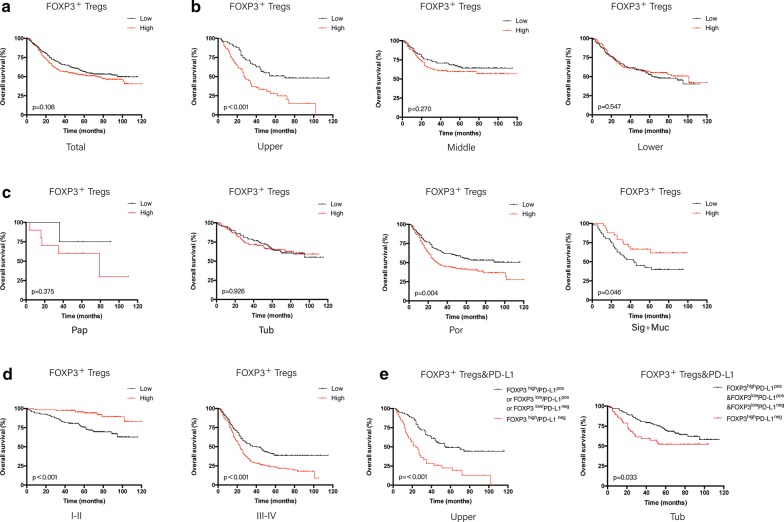
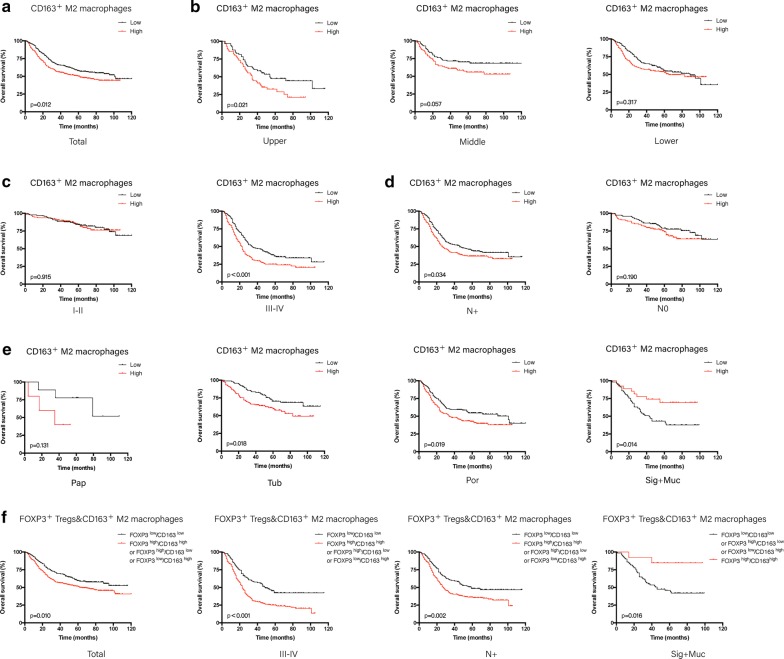
BACKGROUND: Gastric cancer (GC) remains a refractory cancer worldwide. Currently, exploring the differences of the immune status in GC patients with different subgroups might provide promising immunotherapeutic approaches for the treatment of GC. METHODS: In this study, a total of 598 surgically resected FFPE primary gastric cancer samples were assessed for FOXP3, CD163, CD3, CD8, and PD-L1 markers. The correlations between the immune markers expression and clinicopathological features and prognosis were investigated retrospectively. RESULTS: Treg indicates better prognosis in stage I-II patients, while the converse outcome was noted in stage III-IV patients. Our data also confirmed different prognostic value in different pathological classifications, chemotherapy strategies, and locations, with or without lymph node metastasis. Also, M2 macrophages indicated poor prognosis in general. However, high M2 macrophage infiltration suggests a favorable prognosis in signet ring cell carcinoma and mucinous adenocarcinoma. Moreover, the prognostic value of the two indices when they are combined is reported. CONCLUSIONS: These results suggested that different immune statuses are exhibited in different subgroups of GC, which may direct further understanding of the immune status of GC as well as provide a further theoretical basis and potential targets for GC immunotherapy.
Overview
The claims and statistics of this paper haven’t been checked yet.
Free: it reads the open-access text and checks the first 5 claims that cite a source we can check. Create a free account to check every claim.
Integrity signals
Registry
Cites
Statistics
Figures
Verification
Claims the paper makes
The claims and statistics of this paper haven’t been checked yet.
Free: it reads the open-access text and checks the first 5 claims that cite a source we can check. Create a free account to check every claim.
Claims other papers make about this one
Each is checked against this paper’s own text: does it say what the citing paper says it does?
The cited source says what the claim attributes to it.
In the citing paper
“In a retrospective study of gastric cancer, tumors were categorized by TNM staging. Researchers discovered that patients with high FoxP3+ Tregs infiltration during the early stages (I–II) had a greater chance of surviving for 5 years, while those in stages III–IV had a worse prognosis [148].”
From Potential anti-tumor effects of regulatory T cells in the tumor microenvironment: a review (2024) · cites this paper as [148]
The cited source says what the claim attributes to it.
In the citing paper
“This study showed that FoxP3+ Tregs is an independent and favorable prognostic factor in early stages of gastric cancer.”
From Potential anti-tumor effects of regulatory T cells in the tumor microenvironment: a review (2024) · cites this paper as [148]
Self-check
Percentages, sums and reported differences re-computed from the paper’s own numbers.
The self-check needs the paper’s full text.
Citations
Cites
Bray, F., Ferlay, J., Soerjomataram, I., Siegel, R. L., Torre, L. A., & Jemal, A. (2018) · CA: A Cancer Journal for Clinicians · doi:10.3322/caac.21492 · Cited by 84,109 · cited 1×
“Background Gastric cancer (GC) remains a refractory cancer worldwide, and it still ranks the fifth most common cancer and the third leading cause of cancer death [1].”
BackgroundPD-1 and PD-L1 Immune Checkpoint Blockade to Treat Breast Cancer
Hartkopf, A. D., Taran, F.-A., Wallwiener, M., Walter, C. B., Krämer, B., Grischke, E.-M., & Brucker, S. Y. (2016) · Breast Care · doi:10.1159/000453569 · Cited by 30,845
The blockade of immune checkpoints in cancer immunotherapy
Pardoll, D. M. (2012) · Nature Reviews Cancer · doi:10.1038/nrc3239 · Cited by 13,838
Control of Regulatory T Cell Development by the Transcription Factor Foxp3
Hori, S., Nomura, T., & Sakaguchi, S. (2003) · Science · doi:10.1126/science.1079490 · Cited by 8,187
Allemani, C., Matsuda, T., Di Carlo, V., Harewood, R., Matz, M., Nikšić, M., Bonaventure, A., Valkov, M., Johnson, C. J., Estève, J., et al. (2018) · The Lancet · doi:10.1016/s0140-6736(17)33326-3 · Cited by 6,145
Regulatory T Cells and Immune Tolerance
Sakaguchi, S., Yamaguchi, T., Nomura, T., & Ono, M. (2008) · Cell · doi:10.1016/j.cell.2008.05.009 · Cited by 5,325
The Role of Tumoral FOXP3 on Cell Proliferation, Migration, and Invasion in Gastric Cancer
Zhang, L., Xu, J., Zhang, X., Zhang, Y., Wang, L., Huang, X., & Xu, Z. (2017) · Cellular Physiology and Biochemistry · doi:10.1159/000479442 · Cited by 4,088
Self-citationJapanese classification of gastric carcinoma: 3rd English edition
Japanese Gastric Cancer Association (2011) · Gastric Cancer · doi:10.1007/s10120-011-0041-5 · Cited by 3,455
Mechanism-driven biomarkers to guide immune checkpoint blockade in cancer therapy
Topalian, S. L., Taube, J. M., Anders, R. A., & Pardoll, D. M. (2016) · Nature Reviews Cancer · doi:10.1038/nrc.2016.36 · Cited by 2,733
Kang, Y.-K., Boku, N., Satoh, T., Ryu, M.-H., Chao, Y., Kato, K., Chung, H. C., Chen, J.-S., Muro, K., Kang, W. K., et al. (2017) · The Lancet · doi:10.1016/s0140-6736(17)31827-5 · Cited by 2,252
Distinct role of macrophages in different tumor microenvironments
Lewis, C. E., & Pollard, J. W. (2006) · Cancer Research · doi:10.1158/0008-5472.can-05-4005 · Cited by 2,225 · cited 1×
“CD163, a member of the scavenger receptor cysteine-rich family, is a M2 macrophage marker [26, 27].”
BackgroundRegulatory T cells in cancer immunotherapy
Tanaka, A., & Sakaguchi, S. (2017) · Cell Research · doi:10.1038/cr.2016.151 · Cited by 1,860 · cited 1×
“Discussion Immune cells in the tumor microenvironment have a crucial influence on tumor occurrence and development [35].”
BackgroundREporting recommendations for tumour MARKer prognostic studies (REMARK).
for the Statistics Subcommittee of the NCI-EORTC Working Group on Cancer Diagnostics, McShane, L. M., Altman, D. G., Sauerbrei, W., Taube, S. E., Gion, M., & Clark, G. M. (2005) · British Journal of Cancer · doi:10.1038/sj.bjc.6602678 · Cited by 1,394
Shitara, K., Özgüroğlu, M., Bang, Y.-J., Di Bartolomeo, M., Mandalà, M., Ryu, M.-H., Fornaro, L., Olesiński, T., Caglevic, C., Chung, H. C., et al. (2018) · The Lancet · doi:10.1016/s0140-6736(18)31257-1 · Cited by 1,296
Muro, K., Chung, H. C., Shankaran, V., Geva, R., Catenacci, D., Gupta, S., Eder, J. P., Golan, T., Le, D. T., Burtness, B., et al. (2016) · The Lancet Oncology · doi:10.1016/s1470-2045(16)00175-3 · Cited by 1,121 · cited 1×
“Blockade of the PD-L1/PD-1 pathway remains ineffective in GC [15, 16].”
BackgroundGao, Q., Qiu, S.-J., Fan, J., Zhou, J., Wang, X.-Y., Xiao, Y.-S., Xu, Y., Li, Y.-W., & Tang, Z.-Y. (2007) · Journal of Clinical Oncology · doi:10.1200/jco.2006.09.4565 · Cited by 1,110 · cited 1×
“A high frequency of tumor-infiltrating FOXP3+ Tregs was often significantly negatively correlated with patient survival [36, 37].”
BackgroundMlecnik, B., Tosolini, M., Kirilovsky, A., Berger, A., Bindea, G., Meatchi, T., Bruneval, P., Trajanoski, Z., Fridman, W.-H., Pagès, F., et al. (2011) · Journal of Clinical Oncology · doi:10.1200/jco.2010.30.5425 · Cited by 1,009 · cited 1×
“A high frequency of tumor-infiltrating FOXP3+ Tregs was often significantly negatively correlated with patient survival [36, 37].”
BackgroundNomi, T., Sho, M., Akahori, T., Hamada, K., Kubo, A., Kanehiro, H., Nakamura, S., Enomoto, K., Yagita, H., Azuma, M., et al. (2007) · Clinical Cancer Research · doi:10.1158/1078-0432.ccr-06-2746 · Cited by 889
Two FOXP3+CD4+ T cell subpopulations distinctly control the prognosis of colorectal cancers
Saito, T., Nishikawa, H., Wada, H., Nagano, Y., Sugiyama, D., Atarashi, K., Maeda, Y., Hamaguchi, M., Ohkura, N., Sato, E., et al. (2016) · Nature Medicine · doi:10.1038/nm.4086 · Cited by 871
Progress in tumor-associated macrophage (TAM)-targeted therapeutics
Ngambenjawong, C., Gustafson, H. H., & Pun, S. H. (2017) · Advanced Drug Delivery Reviews · doi:10.1016/j.addr.2017.04.010 · Cited by 840 · cited 1×
“TAMs display high plasticity and perform diverse, supportive functions which were specialized for different tissue compartments [24, 25].”
BackgroundKang, Y.-K., Kang, W.-K., Shin, D.-B., Chen, J., Xiong, J., Wang, J., Lichinitser, M., Guan, Z., Khasanov, R., Zheng, L., et al. (2009) · Annals of Oncology · doi:10.1093/annonc/mdn717 · Cited by 764 · cited 1×
“Chemotherapy with platinum and fluoro-pyrimidine is currently the recommended first-line therapy for patients with advanced or metastatic GC who have good performance status [11].”
BackgroundPrognostic implications of type and density of tumour-infiltrating lymphocytes in gastric cancer
Lee, H. E., Chae, S. W., Lee, Y. J., Kim, M. A., Lee, H. S., Lee, B. L., & Kim, W. H. (2008) · British Journal of Cancer · doi:10.1038/sj.bjc.6604738 · Cited by 302 · cited 1×
“High infiltration of CD3+ and CD8+ T lymphocytes is associated with better outcome in GC, demonstrating the critical role of T cell-mediated host immunity in repressing tumor progression [17, 18].”
BackgroundFOXP3+ regulatory T cells and their functional regulation
Li, Z., Li, D., Tsun, A., & Li, B. (2015) · Cellular & Molecular Immunology · doi:10.1038/cmi.2015.10 · Cited by 290
PD-L1 and gastric cancer prognosis: A systematic review and meta-analysis
Gu, L., Chen, M., Guo, D., Zhu, H., Zhang, W., Pan, J., Zhong, X., Li, X., Qian, H., & Wang, X. (2017) · PLOS ONE · doi:10.1371/journal.pone.0182692 · Cited by 280
Perrone, G., Ruffini, P. A., Catalano, V., Spino, C., Santini, D., Muretto, P., Spoto, C., Zingaretti, C., Sisti, V., Alessandroni, P., et al. (2008) · European Journal of Cancer · doi:10.1016/j.ejca.2008.05.017 · Cited by 210 · cited 2×
“However, these studies do not distinguish the pathological stages of GC, which is only discussed in general terms [22, 23].”
BackgroundBerlth, F. (2014) · World Journal of Gastroenterology · doi:10.3748/wjg.v20.i19.5679 · Cited by 190 · cited 1×
“gastric adenocarcinoma into additional subtypes, which is widely used [6, 7].”
BackgroundHaas, M., Dimmler, A., Hohenberger, W., Grabenbauer, G. G., Niedobitek, G., & Distel, L. V. (2009) · BMC Gastroenterology · doi:10.1186/1471-230x-9-65 · Cited by 154 · cited 2×
“However, these studies do not distinguish the pathological stages of GC, which is only discussed in general terms [22, 23].”
BackgroundNagase, H., Takeoka, T., Urakawa, S., Morimoto-Okazawa, A., Kawashima, A., Iwahori, K., Takiguchi, S., Nishikawa, H., Sato, E., Sakaguchi, S., et al. (2016) · International Journal of Cancer · doi:10.1002/ijc.30475 · Cited by 146
Analysis of PD1, PDL1, PDL2 expression and T cells infiltration in 1014 gastric cancer patients
Xing, X., Guo, J., Ding, G., Li, B., Dong, B., Feng, Q., Li, S., Zhang, J., Ying, X., Cheng, X., et al. (2018) · OncoImmunology · doi:10.1080/2162402x.2017.1356144 · Cited by 145 · cited 1×
“In this research, the positive expression of PD-L1 indicates better prognosis, which is consistent with the tendency reported [29].”
ResultTumor-associated macrophage (TAM) infiltration in gastric cancer.
Ishigami, S., Natsugoe, S., Tokuda, K., Nakajo, A., Okumura, H., Matsumoto, M., Miyazono, F., Hokita, S., & Aikou, T. (2003) · PubMed · Cited by 138
Tumor-Infiltrating Immune Cells Are Associated With Prognosis of Gastric Cancer
Liu, K., Yang, K., Wu, B., Chen, H., Chen, X., Chen, X., Jiang, L., Ye, F., He, D., Lu, Z., et al. (2015) · Medicine · doi:10.1097/md.0000000000001631 · Cited by 111 · cited 2×
“Recently, a positive correlation between the presence of tumor-infiltrating lymphocytes (TILs) and survival of patients with malignancies was reported [5].”
BackgroundAlvarado-Vazquez, P. A., Bernal, L., Paige, C. A., Grosick, R. L., Moracho Vilrriales, C., Ferreira, D. W., Ulecia-Morón, C., & Romero-Sandoval, E. A. (2017) · Immunobiology · doi:10.1016/j.imbio.2017.05.011 · Cited by 108 · cited 1×
“CD163, a member of the scavenger receptor cysteine-rich family, is a M2 macrophage marker [26, 27].”
BackgroundPrognostic role of tumor-infiltrating lymphocytes in gastric cancer: a meta-analysis
Zheng, X. W., Song, X., Shao, Y., Xu, B., Chen, L., Zhou, Q., Hu, W., Zhang, D., Wu, C., Tao, M., et al. (2017) · Oncotarget · doi:10.18632/oncotarget.18065 · Cited by 91 · cited 1×
“High infiltration of CD3+ and CD8+ T lymphocytes is associated with better outcome in GC, demonstrating the critical role of T cell-mediated host immunity in repressing tumor progression [17, 18].”
BackgroundWang, Y., Zhu, C., Song, W., Li, J., Zhao, G., & Cao, H. (2018) · Journal of Immunology Research · doi:10.1155/2018/4180517 · Cited by 85
Self-citationGenomic and epigenomic heterogeneity in molecular subtypes of gastric cancer
Lim, B., Kim, J.-H., Kim, M., & Kim, S.-Y. (2016) · World Journal of Gastroenterology · doi:10.3748/wjg.v22.i3.1190 · Cited by 78 · cited 1×
“Given that GC is a complex disease with heterogeneity [10], subgroup analysis is necessary to further improve the accuracy of immune indicators for the prognosis of GC patients.”
BackgroundWang, X. L., Jiang, J. T., & Wu, C. P. (2016) · Genetics and Molecular Research · doi:10.4238/gmr15049040 · Cited by 71
Kerkar, S. P., Kemp, C. D., Duffy, A. G., Kammula, U. S., Schrump, D. S., Kwong, K. F., Quezado, M., Goldspiel, B. R., Venkatesan, A. M., Berger, A., et al. (2009) · Trials · doi:10.1186/1745-6215-10-121 · Cited by 68 · cited 1×
“At the time of diagnosis, 35% of GC patients exhibit evidence of distant metastases, and distant metastasis is commonly considered to be a invariably fatal situation in GC [4].”
BackgroundIzuishi, K., & Mori, H. (2016) · Journal of Gastrointestinal and Liver Diseases · doi:10.15403/jgld.2014.1121.251.rv2 · Cited by 67 · cited 1×
“Stage I GC patients did not receive chemotherapy, and stage IV GC patients had distant metastases and were unable to undergo radical resection [34].”
BackgroundA clinicopathologic study of mucinous adenocarcinoma of the stomach
Kawamura, H., Kondo, Y., Osawa, S., Nisida, Y., 岡田, 邦., Isizu, H., Uebayasi, T., Takahasi, M., & Hata, T. (2001) · Gastric Cancer · doi:10.1007/pl00011728 · Cited by 61 · cited 1×
“Some studies have described poor prognosis for the signet ring cell carcinoma and mucinous adenocarcinoma compared with other subtypes of GC [8, 9].”
BackgroundHass, H. G., Smith, U., Jäger, C., Schäffer, M. R., Wellhäußer, U., Hehr, T., Markmann, H.-U., Nehls, O., & Denzlinger, C. (2011) · Onkologie · doi:10.1159/000334545 · Cited by 56
Takada, K., Kashiwagi, S., Goto, W., Asano, Y., Takahashi, K., Takashima, T., Tomita, S., Ohsawa, M., Hirakawa, K., & Ohira, M. (2018) · Journal of Translational Medicine · doi:10.1186/s12967-018-1460-4 · Cited by 54
Molecular background of the regional lymph node metastasis of gastric cancer (Review)
Zhu, T., Hu, X., Wei, P., & Shan, G. (2018) · Oncology Letters · doi:10.3892/ol.2018.7813 · Cited by 43 · cited 1×
“The typical malignant behavior of GC involves lymph node (LN) metastasis [3].”
BackgroundYing, L., Yan, F., Meng, Q., Yu, L., Yuan, X., Gantier, M. P., Williams, B. R. G., Chan, D. W., Shi, L., Tu, Y., et al. (2018) · OncoImmunology · doi:10.1080/2162402x.2018.1433520 · Cited by 42
Self-citationYi, G., Guo, S., Liu, W., Wang, H., Liu, R., Tsun, A., Jin, G. Y., & Li, B. (2018) · Science Bulletin · doi:10.1016/j.scib.2018.05.028 · Cited by 31
The Emerging Role of Immunotherapy in Gastric and Esophageal Adenocarcinoma
Bockorny, B., & Pectasides, E. (2016) · Future Oncology · doi:10.2217/fon-2016-0103 · Cited by 19
Cited by
Gambardella, V., Castillo, J., Tarazona, N., Gimeno-Valiente, F., Martínez-Ciarpaglini, C., Cabeza-Segura, M., Roselló, S., Roda, D., Huerta, M., Cervantes, A., et al. (2020) · Cancer Treatment Reviews · doi:10.1016/j.ctrv.2020.102015 · Cited by 335
Rihawi, K., Ricci, A. D., Rizzo, A., Brocchi, S., Marasco, G., Pastore, L. V., Llimpe, F. L. R., Golfieri, R., & Renzulli, M. (2021) · International Journal of Molecular Sciences · doi:10.3390/ijms22083805 · Cited by 166
“demonstrated that M2 macrophage infiltration was found to be lower in signet ring cell carcinoma and mucinous adenocarcinoma, suggesting a potential positive prognostic factor [50].”
BackgroundPotential anti-tumor effects of regulatory T cells in the tumor microenvironment: a review
Li, Y., Zhang, C., Jiang, A., Lin, A., Liu, Z., Cheng, X., Wang, W., Cheng, Q., Zhang, J., Wei, T., et al. (2024) · Journal of Translational Medicine · doi:10.1186/s12967-024-05104-y · Cited by 105
Wang, Y., Li, J., Nakahata, S., & Iha, H. (2024) · International Journal of Molecular Sciences · doi:10.3390/ijms25137346 · Cited by 98
“A retrospective analysis in gastric cancer reveals that high Foxp3 + Treg infiltration in stages I–II is associated with higher five-year survival rates, contrasting with poorer outcomes in stages III–IV [255].”
ResultChen, Y., Zhang, C., Peng, Z., Qi, C., Gong, J., Zhang, X., Li, J., & Shen, L. (2021) · Frontiers in Oncology · doi:10.3389/fonc.2021.589022 · Cited by 53
“CD163+ M2 macrophages are also independent significant poor prognostic factors in GC (43).”
Background
Metadata
- Authors
- Liu, X., Xu, D., Huang, C., Guo, Y., Wang, S., Zhu, C., Xu, J., Zhang, Z., Shen, Y., Zhao, W., & Zhao, G.
- Affiliations
- Shanghai Jiao Tong University (CN)
- Corresponding author
- Zhao, Wenyi
- Zhao, Gang
- Venue
- Journal of Translational Medicine
- Published
- 2019-06-07
- Volume
- 17
- Issue
- 1
- Pages
- 192-192
- ISSN
- 1479-5876 (ISSN-L)
- PMC
- PMC6554965
- OpenAlex
- W2948260356
- Cited by
- 53
- References
- 45
- Citations by year
- 2026: 3 · 2025: 6 · 2024: 7 · 2023: 8 · 2022: 6 · 2021: 12 · 2020: 10 · 2019: 1
- FWCI
- 5.33
- Type
- journal article
- Language
- en
- Open access
- gold
- doi.org
- Licence
- cc-by
- creativecommons.org/licenses/by/4.0/ (tdm)
- creativecommons.org/licenses/by/4.0/ (vor)
- Locations
- Journal of Translational Medicine (publishedVersion, cc-by)
- PubMed Central (publishedVersion, cc-by)
- PubMed (publishedVersion)
- DOAJ (DOAJ: Directory of Open Access Journals) (submittedVersion, cc-by-sa)
- Funders
- Science and Technology Commission of Shanghai Municipality (17ZR1416800)
- Foundation of Shanghai Municipal Commission of Health and Family Planning (2017BR043, 201740049)
- Shanghai Hospital Development Center (SHDC12016236)
- Health and Family Planning Committee of Pudong New Area (PW2017D-1)
- School of Medicine, Shanghai Jiao Tong University (YG2016QN48)
- National Natural Science Foundation of China (31872740)
- Topics
- Health Sciences › Medicine › Oncology › Gastric Cancer Management and Outcomes
- Health Sciences › Medicine › Oncology › Cancer Immunotherapy and Biomarkers
- Life Sciences › Immunology and Microbiology › Immunology › Immune cells in cancer
- Keywords
- gastric cancer, regulatory T cells, M2 macrophages, tumor immune microenvironment, prognostic factors, Foxp3, CD163, PD-L1, signet ring cell carcinoma, mucinous adenocarcinoma, lymph node metastasis, tumor stage, chemotherapy response, immunotherapy targets
- MeSH terms
- Adenocarcinoma, Adult, Aged, Aged, 80 and over, Female, Humans, Lymphatic Metastasis, Macrophages, Male, Middle Aged, Predictive Value of Tests, Prognosis, Retrospective Studies, Stomach Neoplasms, Biomarkers, Tumor, Survival Analysis, Lymphocytes, Tumor-Infiltrating, T-Lymphocytes, Regulatory, Tumor Microenvironment
About these checks
Registry, retraction, Cites and statistics results are computed, not judged, with one exception: a printed reference that no index lists is read once by a model before it counts as a citation error. Claims are extracted by a model and kept only when their quote appears verbatim in the text; each cited source is then checked, with a model’s help, for whether it says what the claim relies on. Those verdicts can be wrong — read the claim’s quote and the cited source before relying on one.
Statistics and arithmetic are recomputed, not judged.
Confidence bands are shown only for fields calibrated on our annotated test set. None is calibrated yet, so no band is shown.
What counts as a claim ›How we measure confidence ›How we check this ›
Are you an author, or do you see a problem with this page? Request a review
Data sources
Bibliographic data: Semantic Scholar, OpenAlex, Crossref.
Contains information from the Semantic Scholar Academic Graph Datasets, made available under the ODC Attribution License (ODC-BY 1.0).
Semantic Scholar’s data is described in: Kinney, R., et al. (2023). The Semantic Scholar Open Data Platform. arXiv:2301.10140.
