

Caffeine increases maximal fat oxidation during a graded exercise test: is there a diurnal variation?
Open accessThe DOI matches its Crossref record; 44 of the 44 references it cites were found in a registry or an index.
Abstract
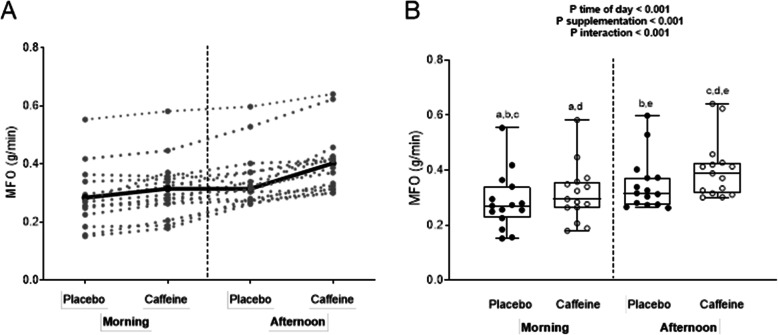
Background There is evidence that caffeine increases the maximal fat oxidation rate (MFO) and aerobic capacity, which are known to be lower in the morning than in the afternoon. This paper examines the effect of caffeine intake on the diurnal variation of MFO during a graded exercise test in active men.Methods Using a triple-blind, placebo-controlled, crossover experimental design, 15 active caffeine-naïve men (age: 32 ± 7 years) completed a graded exercise test four times at seven-day intervals. The subjects ingested 3 mg/kg of caffeine or a placebo at 8 am in the morning and 5 pm in the afternoon (each subject completed tests under all four conditions in a random order). A graded cycling test was performed. MFO and maximum oxygen uptake (VO2max) were measured by indirect calorimetry, and the intensity of exercise that elicited MFO (Fatmax) calculated.Results MFO, Fatmax and VO2max were significantly higher in the afternoon than in the morning (all P < 0.05). Compared to the placebo, caffeine increased mean MFO by 10.7% (0.28 ± 0.10 vs. 0.31 ± 0.09 g/min respectively, P < 0.001) in the morning, and by a mean 29.0% (0.31 ± 0.09 vs. 0.40 ± 0.10 g/min, P < 0.001) in the afternoon. Caffeine also increased mean Fatmax by 11.1% (36.9 ± 14.4 [placebo] vs. 41.0 ± 13.1%, P = 0.005) in the morning, and by 13.1% (42.0 ± 11.6 vs. 47.5 ± 10.8%, P = 0.008) in the afternoon.Conclusion These findings confirm the previously reported diurnal variation in the whole-body fat oxidation rate during graded exercise in active caffeine-naïve men, and indicate that the acute ingestion of 3 mg/kg of caffeine increases MFO, Fatmax and VO2max independent of the time of day.Trial registration NCT04320446. Registered 25 March 2020 - Retrospectively registered
Overview
The claims and statistics of this paper haven’t been checked yet.
Free: it reads the open-access text and checks the first 5 claims that cite a source we can check. Create a free account to check every claim.
Integrity signals
Registry
Cites
Statistics
Figures



Verification
Claims the paper makes
The claims and statistics of this paper haven’t been checked yet.
Free: it reads the open-access text and checks the first 5 claims that cite a source we can check. Create a free account to check every claim.
Claims other papers make about this one
Each is checked against this paper’s own text: does it say what the citing paper says it does?
The cited source says what the claim attributes to it.
In the citing paper
“Ramírez-Maldonado et al. [76] further supported these findings during incremental exercise, showing that the same dose increased both maximal fat oxidation and the exercise intensity at which Fatmax occurred.”
From Pre-Exercise Caffeine as a Modulator of Exercise-Induced Acute Cardiometabolic Responses: A Narrative Review (2026) · cites this paper as [76]
Self-check
Percentages, sums and reported differences re-computed from the paper’s own numbers.
The self-check needs the paper’s full text.
Citations
Cites
A self-assessment questionnaire to determine morningness- eveningness in human circadian rhythms
Home, J. K. (1976) · Medical Entomology and Zoology · Cited by 4,783
(1976) · PubMed · Cited by 3,979
Age-predicted maximal heart rate revisited
Tanaka, H., Monahan, K. D., & Seals, D. R. (2001) · Journal of the American College of Cardiology · doi:10.1016/s0735-1097(00)01054-8 · Cited by 3,775 · cited 1×
“The criteria for deeming VO2max to have been reached were: (i) attaining a steady (increase < 2ml/kg/min) in VO2 despite a further increase in workload, (ii) showing a maximal heart rate between 10 bpm above and below the age-predicted maximum [33], and (iii) reaching a re-”
MethodCalculation of substrate oxidation rates in vivo from gaseous exchange.
Frayn, K. N. (1983) · Journal of Applied Physiology · doi:10.1152/jappl.1983.55.2.628 · Cited by 2,365
Common Genetic Variation In Cellular Transport Genes and Epithelial Ovarian Cancer (EOC) Risk
Chornokur, G., Lin, H.-Y., Tyrer, J. P., Lawrenson, K., Dennis, J., Amankwah, E. K., Qu, X., Tsai, Y.-Y., Jim, H. S. L., Chen, Z., et al. (2015) · PLOS ONE · doi:10.1371/journal.pone.0128106 · Cited by 902
International society of sports nutrition position stand: caffeine and performance
Goldstein, E. R., Ziegenfuss, T., Kalman, D., Kreider, R., Campbell, B., Wilborn, C., Taylor, L., Willoughby, D., Stout, J., Graves, B. S., et al. (2010) · Journal of the International Society of Sports Nutrition · doi:10.1186/1550-2783-7-5 · Cited by 686
Circadian Rhythms in Sports Performance—an Update
Drust, B., Waterhouse, J., Atkinson, G., Edwards, B., & Reilly, T. (2005) · Chronobiology International · doi:10.1081/cbi-200041039 · Cited by 636
Doherty, M., & Smith, P. M. (2005) · Scandinavian Journal of Medicine & Science in Sports · doi:10.1111/j.1600-0838.2005.00445.x · Cited by 513
Grgic, J., Grgic, I., Pickering, C., Schoenfeld, B. J., Bishop, D. J., & Pedisic, Z. (2020) · British Journal of Sports Medicine · doi:10.1136/bjsports-2018-100278 · Cited by 375 · cited 1×
“Certainly, low-to-moderate doses of caffeine (~ 3–9mg/kg) [15] can increase endurance performance [16] via the induction of significant increases in VO2max, peak pulmonary ventilation, and muscle oxygen saturation during submaximal workloads [17, 18].”
BackgroundEffect of Caffeine on Sport-Specific Endurance Performance: A Systematic Review
Ganio, M. S., Klau, J. F., Casa, D. J., Armstrong, L. E., & Maresh, C. M. (2009) · Journal of Strength and Conditioning Research · doi:10.1519/jsc.0b013e31818b979a · Cited by 310
Research works printed but not linked: 3
- Darvakh H, 2014, Zahedan J Res Med Sci, 16, 8
- Teo W, 2011, J Sport Sci Med, 10, 600
- Kim HK, 2015, PLoS One, 10, 1
Cited by
Uti, D. E., Alum, E. U., Atangwho, I. J., Ugwu, O. P.-C., Egbung, G. E., & Aja, P. M. (2025) · Journal of Nanobiotechnology · doi:10.1186/s12951-025-03412-z · Cited by 115
António, J., Newmire, D. E., Stout, J. R., Antonio, B. B., Gibbons, M., Lowery, L. M., Harper, J., Willoughby, D. S., Evans, C., Anderson, D., et al. (2024) · Journal of the International Society of Sports Nutrition · doi:10.1080/15502783.2024.2323919 · Cited by 62
Larsson, S. C., Woolf, B. A. R., & Gill, D. (2023) · BMJ Medicine · doi:10.1136/bmjmed-2022-000335 · Cited by 48
Li, Y., Zhang, Z., Jiang, S., Xu, F., Tulum, L., Li, K., Liu, S., Li, S., Chang, L., Liddell, M., et al. (2022) · Chemosphere · doi:10.1016/j.chemosphere.2022.137359 · Cited by 47
Yin, M., Chen, Z., Nassis, G. P., Liu, H., Li, H., Deng, J., & Li, Y. (2023) · Journal of Exercise Science & Fitness · doi:10.1016/j.jesf.2023.08.001 · Cited by 39
Metadata
- Authors
- Ramírez-Maldonado, M., Jurado-Fasoli, L., del Coso, J., R. Ruiz, J., & Amaro-Gahete, F. J.
- Affiliations
- PROFITH “PROmoting FITness and Health Through Physical Activity” Research Group, Department of Physical Education and Sport, Faculty of Sport SciencesUniversity of Granada Granada Spain
- Department of Physiology. Faculty of MedicineUniversity of Granada Av. Conocimiento S/n 18011 Granada Spain
- Centre for Sport StudiesRey Juan Carlos University Madrid Spain
- Venue
- Journal of the International Society of Sports Nutrition
- Publisher
- Informa UK Limited
- Published
- 2021-01-02
- Volume
- 18
- Issue
- 1
- Pages
- 5-5
- ISSN
- 1550-2783 (ISSN-L)
- PMC
- PMC7792284
- OpenAlex
- W3120267642
- Cited by
- 36
- References
- 44
- Citations by year
- 2026: 7 · 2025: 4 · 2024: 6 · 2023: 7 · 2022: 11 · 2021: 1
- FWCI
- 3.65
- Type
- journal article
- Language
- en
- Open access
- gold
- doi.org
- Licence
- Locations
- Journal of the International Society of Sports Nutrition (publishedVersion, cc-by)
- Europe PMC (PubMed Central) (publishedVersion, other-oa)
- PubMed Central (publishedVersion, cc-by)
- PubMed (publishedVersion)
- Institutional Repository of the University of Granada (University of Granada) (publishedVersion, cc-by)
- Institutional Repository of the University of Granada (University of Granada) (submittedVersion, cc-by)
- LA Referencia (Red Federada de Repositorios Institucionales de Publicaciones Científicas) (submittedVersion, cc-by)
- DOAJ (DOAJ: Directory of Open Access Journals) (submittedVersion, cc-by-sa)
- Funders
- Universidad de Granada (Excellence actions: Unit of Excellence on Exercise and Health (UCEES)—and Plan Propio de Investigación 2018)
- Topics
- Health Sciences › Medicine › Pharmacology (medical) › Coffee research and impacts
- Health Sciences › Medicine › Physiology (medical) › Cardiovascular and exercise physiology
- Health Sciences › Nursing › Nutrition and Dietetics › Muscle metabolism and nutrition
- Keywords
- caffeine, maximal fat oxidation, diurnal variation, incremental exercise test, VO2max, Fatmax, cardiorespiratory fitness, time of day, acute caffeine ingestion
- MeSH terms
- Adipose Tissue, Adult, Caffeine, Calorimetry, Indirect, Exercise Test, Humans, Male, Oxidation-Reduction, Oxygen Consumption, Physical Endurance, Placebos, Time Factors, Epidemiologic Research Design, Exercise, Cross-Over Studies, Performance-Enhancing Substances
About these checks
Registry, retraction, Cites and statistics results are computed, not judged, with one exception: a printed reference that no index lists is read once by a model before it counts as a citation error. Claims are extracted by a model and kept only when their quote appears verbatim in the text; each cited source is then checked, with a model’s help, for whether it says what the claim relies on. Those verdicts can be wrong — read the claim’s quote and the cited source before relying on one.
Statistics and arithmetic are recomputed, not judged.
Confidence bands are shown only for fields calibrated on our annotated test set. None is calibrated yet, so no band is shown.
What counts as a claim ›How we measure confidence ›How we check this ›
Are you an author, or do you see a problem with this page? Request a review
How to cite
Cite CoChat for the checks on this page, and the paper for its own findings.
- This page
- CoChat. (2026). Citation check: Caffeine increases maximal fat oxidation during a graded exercise test: is there a diurnal variation? https://app.cochat.ai/papers/10.1186/s12970-020-00400-6
- The paper
- Ramírez-Maldonado, M., Jurado-Fasoli, L., del Coso, J., R. Ruiz, J., & Amaro-Gahete, F. J. (2021). Caffeine increases maximal fat oxidation during a graded exercise test: is there a diurnal variation? Journal of the International Society of Sports Nutrition. https://doi.org/10.1186/s12970-020-00400-6
Data sources
Bibliographic data: Semantic Scholar, OpenAlex, Crossref.
Contains information from the Semantic Scholar Academic Graph Datasets, made available under the ODC Attribution License (ODC-BY 1.0).
Semantic Scholar’s data is described in: Kinney, R., et al. (2023). The Semantic Scholar Open Data Platform. arXiv:2301.10140.
