

Caffeine increases maximal fat oxidation during a graded exercise test: is there a diurnal variation?
Open accessThe DOI matches its Crossref record; 44 of the 44 references it cites were found in a registry or an index.
Abstract
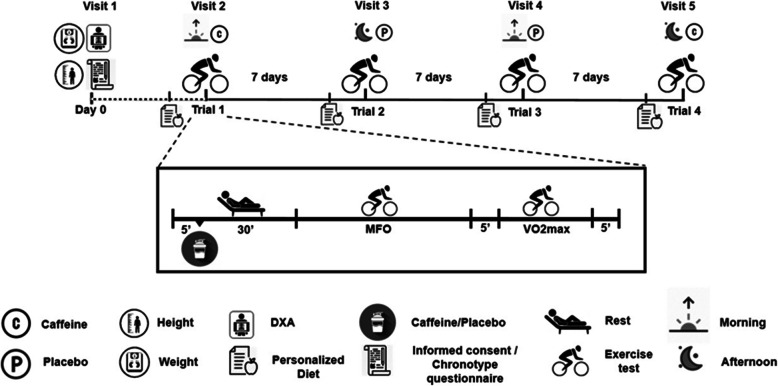
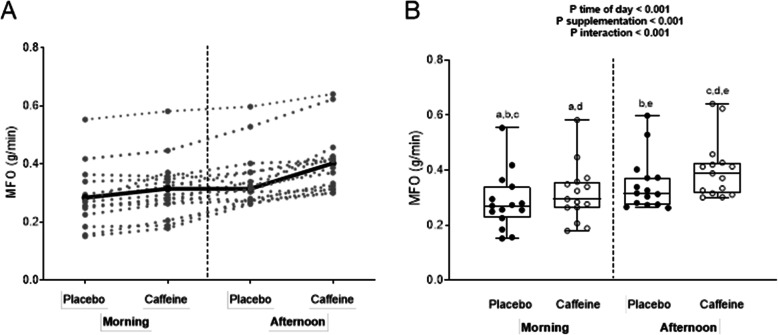
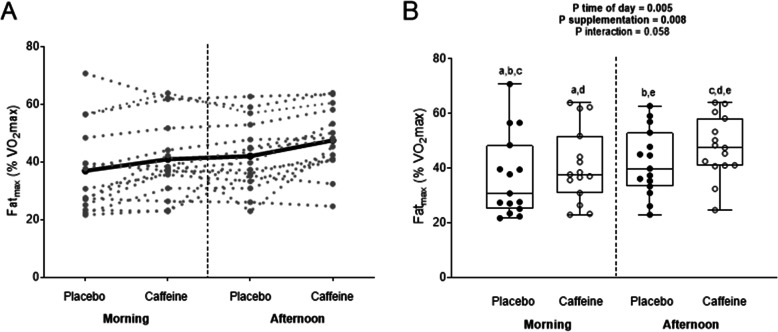
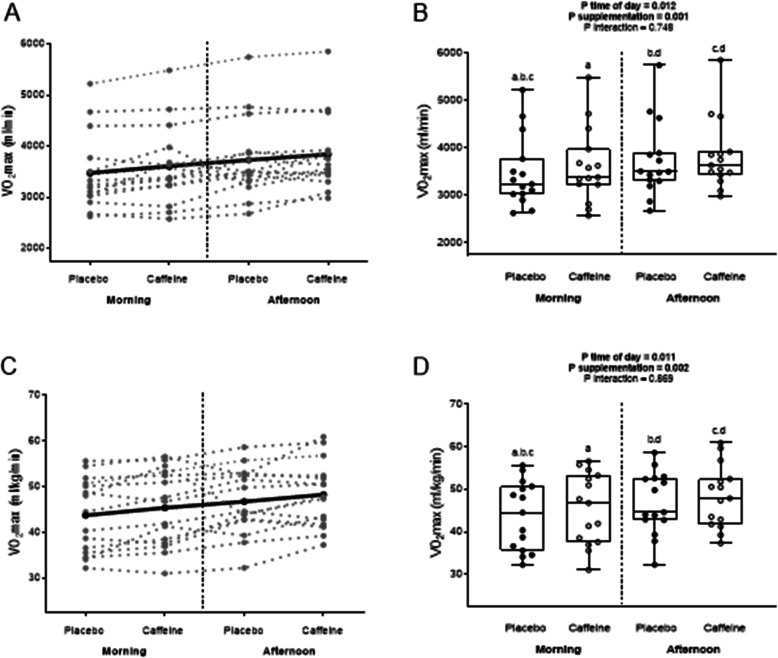
Background There is evidence that caffeine increases the maximal fat oxidation rate (MFO) and aerobic capacity, which are known to be lower in the morning than in the afternoon. This paper examines the effect of caffeine intake on the diurnal variation of MFO during a graded exercise test in active men.Methods Using a triple-blind, placebo-controlled, crossover experimental design, 15 active caffeine-naïve men (age: 32 ± 7 years) completed a graded exercise test four times at seven-day intervals. The subjects ingested 3 mg/kg of caffeine or a placebo at 8 am in the morning and 5 pm in the afternoon (each subject completed tests under all four conditions in a random order). A graded cycling test was performed. MFO and maximum oxygen uptake (VO2max) were measured by indirect calorimetry, and the intensity of exercise that elicited MFO (Fatmax) calculated.Results MFO, Fatmax and VO2max were significantly higher in the afternoon than in the morning (all P < 0.05). Compared to the placebo, caffeine increased mean MFO by 10.7% (0.28 ± 0.10 vs. 0.31 ± 0.09 g/min respectively, P < 0.001) in the morning, and by a mean 29.0% (0.31 ± 0.09 vs. 0.40 ± 0.10 g/min, P < 0.001) in the afternoon. Caffeine also increased mean Fatmax by 11.1% (36.9 ± 14.4 [placebo] vs. 41.0 ± 13.1%, P = 0.005) in the morning, and by 13.1% (42.0 ± 11.6 vs. 47.5 ± 10.8%, P = 0.008) in the afternoon.Conclusion These findings confirm the previously reported diurnal variation in the whole-body fat oxidation rate during graded exercise in active caffeine-naïve men, and indicate that the acute ingestion of 3 mg/kg of caffeine increases MFO, Fatmax and VO2max independent of the time of day.Trial registration NCT04320446. Registered 25 March 2020 - Retrospectively registered
Overview
The claims and statistics of this paper haven’t been checked yet.
Free: it reads the open-access text and checks the first 5 claims that cite a source we can check. Create a free account to check every claim.
Integrity signals
Registry
Cites
Statistics
Figures
Verification
Claims the paper makes
The claims and statistics of this paper haven’t been checked yet.
Free: it reads the open-access text and checks the first 5 claims that cite a source we can check. Create a free account to check every claim.
Claims other papers make about this one
Each is checked against this paper’s own text: does it say what the citing paper says it does?
The cited source says what the claim attributes to it.
In the citing paper
“Ramírez-Maldonado et al. [76] further supported these findings during incremental exercise, showing that the same dose increased both maximal fat oxidation and the exercise intensity at which Fatmax occurred.”
From Pre-Exercise Caffeine as a Modulator of Exercise-Induced Acute Cardiometabolic Responses: A Narrative Review (2026) · cites this paper as [76]
Self-check
Percentages, sums and reported differences re-computed from the paper’s own numbers.
The self-check needs the paper’s full text.
Citations
Cites
A self-assessment questionnaire to determine morningness- eveningness in human circadian rhythms
Home, J. K. (1976) · Medical Entomology and Zoology · Cited by 4,783
(1976) · PubMed · Cited by 3,979
Age-predicted maximal heart rate revisited
Tanaka, H., Monahan, K. D., & Seals, D. R. (2001) · Journal of the American College of Cardiology · doi:10.1016/s0735-1097(00)01054-8 · Cited by 3,775 · cited 1×
“The criteria for deeming VO2max to have been reached were: (i) attaining a steady (increase < 2ml/kg/min) in VO2 despite a further increase in workload, (ii) showing a maximal heart rate between 10 bpm above and below the age-predicted maximum [33], and (iii) reaching a re-”
MethodCalculation of substrate oxidation rates in vivo from gaseous exchange.
Frayn, K. N. (1983) · Journal of Applied Physiology · doi:10.1152/jappl.1983.55.2.628 · Cited by 2,365 · cited 1×
“Fat oxidation rates were estimated from the stoichiometric equation of Frayn, assuming urinary nitrogen excretion to be negligible [31].”
MethodCommon Genetic Variation In Cellular Transport Genes and Epithelial Ovarian Cancer (EOC) Risk
Chornokur, G., Lin, H.-Y., Tyrer, J. P., Lawrenson, K., Dennis, J., Amankwah, E. K., Qu, X., Tsai, Y.-Y., Jim, H. S. L., Chen, Z., et al. (2015) · PLOS ONE · doi:10.1371/journal.pone.0128106 · Cited by 902
International society of sports nutrition position stand: caffeine and performance
Goldstein, E. R., Ziegenfuss, T., Kalman, D., Kreider, R., Campbell, B., Wilborn, C., Taylor, L., Willoughby, D., Stout, J., Graves, B. S., et al. (2010) · Journal of the International Society of Sports Nutrition · doi:10.1186/1550-2783-7-5 · Cited by 686
Circadian Rhythms in Sports Performance—an Update
Drust, B., Waterhouse, J., Atkinson, G., Edwards, B., & Reilly, T. (2005) · Chronobiology International · doi:10.1081/cbi-200041039 · Cited by 636 · cited 3×
“Moreover, the exercise-induced catecholamine peak is higher in the afternoon than in the morning [10, 11].”
BackgroundResultDoherty, M., & Smith, P. M. (2005) · Scandinavian Journal of Medicine & Science in Sports · doi:10.1111/j.1600-0838.2005.00445.x · Cited by 513
Grgic, J., Grgic, I., Pickering, C., Schoenfeld, B. J., Bishop, D. J., & Pedisic, Z. (2020) · British Journal of Sports Medicine · doi:10.1136/bjsports-2018-100278 · Cited by 375 · cited 1×
“Certainly, low-to-moderate doses of caffeine (~ 3–9mg/kg) [15] can increase endurance performance [16] via the induction of significant increases in VO2max, peak pulmonary ventilation, and muscle oxygen saturation during submaximal workloads [17, 18].”
BackgroundEffect of Caffeine on Sport-Specific Endurance Performance: A Systematic Review
Ganio, M. S., Klau, J. F., Casa, D. J., Armstrong, L. E., & Maresh, C. M. (2009) · Journal of Strength and Conditioning Research · doi:10.1519/jsc.0b013e31818b979a · Cited by 310
Beltz, N. M., Gibson, A. L., Janot, J. M., Kravitz, L., Mermier, C. M., & Dalleck, L. C. (2016) · Journal of Sports Medicine · doi:10.1155/2016/3968393 · Cited by 306
Southward, K., Rutherfurd-Markwick, K. J., & Ali, A. (2018) · Sports Medicine · doi:10.1007/s40279-018-0939-8 · Cited by 254 · cited 1×
“Caffeine is a natural alkaloid used by both endurance and resistance athletes as an ergogenic aid [12, 13].”
BackgroundHearris, M., Hammond, K., Fell, J., & Morton, J. (2018) · Nutrients · doi:10.3390/nu10030298 · Cited by 252
Strategies to Improve Running Economy
Barnes, K. R., & Kilding, A. E. (2015) · Sports Medicine · doi:10.1007/s40279-014-0246-y · Cited by 245 · cited 1×
“stood as a multifactorial concept in which maximal oxygen uptake (VO2max), ventilatory thresholds and muscular efficiency play important roles [1].”
BackgroundCircadian rhythms in exercise performance: implications for hormonal and muscular adaptation.
Teo, W., Newton, M. J., & McGuigan, M. R. (2011) · Europe PMC (PubMed Central) · Cited by 238
Morningness-Eveningness Questionnaire
Horne, J. A., & Östberg, O. (2016) · PsycTESTS Dataset · doi:10.1037/t02254-000 · Cited by 209
Endurance Training and Obesity: Effect on Substrate Metabolism and Insulin Sensitivity
VENABLES, M. C., & JEUKENDRUP, A. E. (2008) · Medicine & Science in Sports & Exercise · doi:10.1249/mss.0b013e31815f256f · Cited by 188 · cited 1×
“MFO (Fatmax), have been recognized as potential determinants of metabolic flexibility during exercise [3, 4], it seems plausible that both MFO and Fatmax strongly influence endurance performance.”
BackgroundContextualising Maximal Fat Oxidation During Exercise: Determinants and Normative Values
Maunder, E., Plews, D. J., & Kilding, A. E. (2018) · Frontiers in Physiology · doi:10.3389/fphys.2018.00599 · Cited by 158 · cited 1×
“MFO (Fatmax), have been recognized as potential determinants of metabolic flexibility during exercise [3, 4], it seems plausible that both MFO and Fatmax strongly influence endurance performance.”
BackgroundDiurnal variation in cycling performance: Influence of warm-up
Atkinson, G., Todd, C., Reilly, T., & Waterhouse, J. (2005) · Journal of Sports Sciences · doi:10.1080/02640410410001729919 · Cited by 155 · cited 2×
“morning and late evening [10, 35], a finding with which the present results agree.”
BackgroundResultThe influence of caffeine supplementation on resistance exercise: a review
Grgic, J., Mikulic, P., Schoenfeld, B. J., Bishop, D. J., & Pedisic, Z. (2019) · Sports Medicine · doi:10.1007/s40279-018-0997-y · Cited by 153 · cited 2×
“Caffeine ingestion, MFO, Fatmax and VO2max The results of the current study support the use of caffeine as an ergogenic aid to raise fat oxidation during exercise, as well as to increase VO2max, and agree with the findings of previous investigations showing that caffeine improves fuel oxidation during prolonged exerci…”
BackgroundResultEffect of Time of Day on Aerobic Contribution to the 30‐s Wingate Test Performance
Souissi, N., Bessot, N., Chamari, K., Gauthier, A., Sesboüé, B., & Davenne, D. (2007) · Chronobiology International · doi:10.1080/07420520701535811 · Cited by 152 · cited 1×
“In athletes, it is known that endurance performance is poorer early in the morning and late at night compared with the afternoon [6], and that MFO and Fatmax are higher in the afternoon compared to the morning whether in non-athlete male students [7], in untrained normalweight and obese individuals [8], or in enduranc…”
BackgroundUrine Caffeine Concentration in Doping Control Samples from 2004 to 2015
Aguilar-Navarro, M., Muñoz, G., Salinero, J. J., Muñoz-Guerra, J., Fernández-Álvarez, M., Plata, M. D. M., & Del Coso, J. (2019) · Nutrients · doi:10.3390/nu11020286 · Cited by 147
Swifter, higher, stronger: What’s on the menu?
Burke, L. M., & Hawley, J. A. (2018) · Science · doi:10.1126/science.aau2093 · Cited by 122
The effects of caffeine on graded exercise performance in caffeine naive versus habituated subjects
Dodd, S. L., Brooks, E., Powers, S. K., & Tulley, R. (1991) · European Journal of Applied Physiology and Occupational Physiology · doi:10.1007/bf00626615 · Cited by 105 · cited 1×
“[37] who indicate that 5 mg/kg of caffeine improved VO2max in naive caffeine consumers.”
BackgroundAssessment of maximal fat oxidation during exercise: A systematic review
Amaro‐Gahete, F. J., Sanchez‐Delgado, G., Jurado‐Fasoli, L., De‐la‐O, A., Castillo, M. J., Helge, J. W., & Ruiz, J. R. (2019) · Scandinavian Journal of Medicine & Science in Sports · doi:10.1111/sms.13424 · Cited by 93
Self-citationMora-Rodríguez, R., Pallarés, J. G., López-Samanes, Á., Ortega, J. F., & Fernández-Elías, V. E. (2012) · PLoS ONE · doi:10.1371/journal.pone.0033807 · Cited by 89 · cited 2×
“[24] reported the acute ingestion of caffeine (3mg/kg) to reverse the morning reduction in muscle performance - in fact to allow comparable muscle performance to those seen in the afternoon.”
BackgroundEnhanced metabolic response to caffeine in exercise-trained human subjects
LeBlanc, J., Jobin, M., Cote, J., Samson, P., & Labrie, A. (1985) · Journal of Applied Physiology · doi:10.1152/jappl.1985.59.3.832 · Cited by 85
Effects of alfa-hydroxy-isocaproic acid on body composition, DOMS and performance in athletes
Mero, A. A., Ojala, T., Hulmi, J. J., Puurtinen, R., Karila, T. A., & Seppälä, T. (2010) · Journal of the International Society of Sports Nutrition · doi:10.1186/1550-2783-7-1 · Cited by 73
Kim, H.-K., Konishi, M., Takahashi, M., Tabata, H., Endo, N., Numao, S., Lee, S.-K., Kim, Y.-H., Suzuki, K., & Sakamoto, S. (2015) · PLOS ONE · doi:10.1371/journal.pone.0137567 · Cited by 61 · cited 1×
“Endurance performance peaks in the afternoon usually coinciding with the highest core body temperature reached during the day [36].”
BackgroundSouissi, Y., Souissi, M., & Chtourou, H. (2019) · Pharmacology Biochemistry and Behavior · doi:10.1016/j.pbb.2019.01.001 · Cited by 54
Boyett, J., Giersch, G., Womack, C., Saunders, M., Hughey, C., Daley, H., & Luden, N. (2016) · Nutrients · doi:10.3390/nu8100639 · Cited by 53
Acute caffeine intake increases muscle oxygen saturation during a maximal incremental exercise test
Ruíz‐Moreno, C., Lara, B., Brito de Souza, D., Gutiérrez‐Hellín, J., Romero‐Moraleda, B., Cuéllar‐Rayo, Á., & Del Coso, J. (2020) · British Journal of Clinical Pharmacology · doi:10.1111/bcp.14189 · Cited by 53 · cited 2×
“Certainly, low-to-moderate doses of caffeine (~ 3–9mg/kg) [15] can increase endurance performance [16] via the induction of significant increases in VO2max, peak pulmonary ventilation, and muscle oxygen saturation during submaximal workloads [17, 18].”
BackgroundFrandsen, J., Pistoljevic, N., Quesada, J. P., Amaro-Gahete, F. J., Ritz, C., Larsen, S., Dela, F., & Helge, J. W. (2020) · Journal of Applied Physiology · doi:10.1152/japplphysiol.00774.2019 · Cited by 52
Self-citationSouissi, M., Chtourou, H., Abedelmalek, S., Ghozlane, I. B., & Sahnoun, Z. (2014) · Physiology & Behavior · doi:10.1016/j.physbeh.2014.04.012 · Cited by 46
Schubert, M. M., Hall, S., Leveritt, M., Grant, G., Sabapathy, S., & Desbrow, B. (2014) · Journal of Applied Physiology · doi:10.1152/japplphysiol.00570.2014 · Cited by 46
Diurnal Variation of Maximal Fat-Oxidation Rate in Trained Male Athletes
Amaro‐Gahete, F. J., Jurado‐Fasoli, L., Trivino, A. R., Sánchez‐Delgado, G., De‐la‐O, A., Helge, J. W., & Ruiz, J. R. (2019) · International Journal of Sports Physiology and Performance · doi:10.1123/ijspp.2018-0854 · Cited by 41 · cited 3×
“However, in one study conducted in trained male athletes, no differences in VO2max were seen between the morning and the afternoon [9].”
BackgroundMethodSelf-citationAmaro‐Gahete, F. J., Sanchez‐Delgado, G., Alcantara, J. M. A., Martinez‐Tellez, B., Acosta, F. M., Helge, J. W., & Ruiz, J. R. (2019) · European Journal of Sport Science · doi:10.1080/17461391.2019.1595160 · Cited by 38 · cited 1×
“The VO2 and VCO2 data derived from the last 60 s of each graded exercise stage were taken into account [30].”
MethodSelf-citationMohebbi, H., & Azizi, M. (2011) · Journal of Human Sport and Exercise · doi:10.4100/jhse.2011.61.06 · Cited by 37 · cited 1×
“In athletes, it is known that endurance performance is poorer early in the morning and late at night compared with the afternoon [6], and that MFO and Fatmax are higher in the afternoon compared to the morning whether in non-athlete male students [7], in untrained normalweight and obese individuals [8], or in enduranc…”
BackgroundEffects of p-Synephrine and Caffeine Ingestion on Substrate Oxidation during Exercise
GUTIÉRREZ-HELLÍN, J., & DEL COSO, J. (2018) · Medicine & Science in Sports & Exercise · doi:10.1249/mss.0000000000001653 · Cited by 35 · cited 3×
“[19] who reported 3 mg/kg caffeine to increase MFO in healthy active young men, as well as those reported by Dodd et al.”
BackgroundInfluentialFernández-Verdejo, R., Bajpeyi, S., Ravussin, E., & Galgani, J. E. (2018) · American Journal of Physiology-Endocrinology and Metabolism · doi:10.1152/ajpendo.00126.2018 · Cited by 34 · cited 1×
“tor affecting performance in endurance disciplines [2].”
Cruz, R., De Aguiar, R., Turnes, T., Guglielmo, L., Beneke, R., & Caputo, F. (2015) · Nutrients · doi:10.3390/nu7075219 · Cited by 29
Effects of caffeine on the metabolic and catecholamine responses to exercise in 5 and 28??C
ANDERSON, D. E., & HICKEY, M. S. (1994) · Medicine & Science in Sports & Exercise · doi:10.1249/00005768-199404000-00009 · Cited by 26
Amaro‐Gahete, F. J., Sánchez‐Delgado, G., Helge, J. W., & Ruiz, J. R. (2019) · Frontiers in Physiology · doi:10.3389/fphys.2019.00909 · Cited by 22 · cited 1×
“MFO and Fatmax were determined by plotting fat oxidation values (dependent variable) against the relative exercise intensity (independent variable) to construct a third degree polynomial regression curve for each subject (0,0) from a graphical depiction of fat oxidation values as a function of exercise intensity [32].”
MethodSelf-citationEffect of Circadian Rhythm on Peak of Maximal Fat Oxidation on Non-Athletic Men
Mousavian, A. S., Shakeria, S., Nikbakht, M., & Darvakh, H. (2014) · DOAJ (DOAJ: Directory of Open Access Journals) · Cited by 6
Cited by
Uti, D. E., Alum, E. U., Atangwho, I. J., Ugwu, O. P.-C., Egbung, G. E., & Aja, P. M. (2025) · Journal of Nanobiotechnology · doi:10.1186/s12951-025-03412-z · Cited by 115
António, J., Newmire, D. E., Stout, J. R., Antonio, B. B., Gibbons, M., Lowery, L. M., Harper, J., Willoughby, D. S., Evans, C., Anderson, D., et al. (2024) · Journal of the International Society of Sports Nutrition · doi:10.1080/15502783.2024.2323919 · Cited by 63
“Regardless of the time of day, caffeine was shown to significantly increase the estimated value for fat oxidation [43].”
BackgroundLarsson, S. C., Woolf, B. A. R., & Gill, D. (2023) · BMJ Medicine · doi:10.1136/bmjmed-2022-000335 · Cited by 49
Li, Y., Zhang, Z., Jiang, S., Xu, F., Tulum, L., Li, K., Liu, S., Li, S., Chang, L., Liddell, M., et al. (2022) · Chemosphere · doi:10.1016/j.chemosphere.2022.137359 · Cited by 47
Yin, M., Chen, Z., Nassis, G. P., Liu, H., Li, H., Deng, J., & Li, Y. (2023) · Journal of Exercise Science & Fitness · doi:10.1016/j.jesf.2023.08.001 · Cited by 40
Metadata
- Authors
- Ramírez-Maldonado, M., Jurado-Fasoli, L., del Coso, J., R. Ruiz, J., & Amaro-Gahete, F. J.
- Affiliations
- PROFITH “PROmoting FITness and Health Through Physical Activity” Research Group, Department of Physical Education and Sport, Faculty of Sport SciencesUniversity of Granada Granada Spain
- Department of Physiology. Faculty of MedicineUniversity of Granada Av. Conocimiento S/n 18011 Granada Spain
- Centre for Sport StudiesRey Juan Carlos University Madrid Spain
- Venue
- Journal of the International Society of Sports Nutrition
- Publisher
- Informa UK Limited
- Published
- 2021-01-02
- Volume
- 18
- Issue
- 1
- Pages
- 5-5
- ISSN
- 1550-2783 (ISSN-L)
- PMC
- PMC7792284
- OpenAlex
- W3120267642
- Cited by
- 36
- References
- 44
- Citations by year
- 2026: 7 · 2025: 4 · 2024: 6 · 2023: 7 · 2022: 11 · 2021: 1
- FWCI
- 3.65
- Type
- journal article
- Language
- en
- Open access
- gold
- doi.org
- Licence
- Locations
- Journal of the International Society of Sports Nutrition (publishedVersion, cc-by)
- Europe PMC (PubMed Central) (publishedVersion, other-oa)
- PubMed Central (publishedVersion, cc-by)
- PubMed (publishedVersion)
- Institutional Repository of the University of Granada (University of Granada) (publishedVersion, cc-by)
- Institutional Repository of the University of Granada (University of Granada) (submittedVersion, cc-by)
- LA Referencia (Red Federada de Repositorios Institucionales de Publicaciones Científicas) (submittedVersion, cc-by)
- DOAJ (DOAJ: Directory of Open Access Journals) (submittedVersion, cc-by-sa)
- Funders
- Universidad de Granada (Excellence actions: Unit of Excellence on Exercise and Health (UCEES)—and Plan Propio de Investigación 2018)
- Topics
- Health Sciences › Medicine › Pharmacology (medical) › Coffee research and impacts
- Health Sciences › Medicine › Physiology (medical) › Cardiovascular and exercise physiology
- Health Sciences › Nursing › Nutrition and Dietetics › Muscle metabolism and nutrition
- Keywords
- caffeine, maximal fat oxidation, diurnal variation, incremental exercise test, VO2max, Fatmax, cardiorespiratory fitness, time of day, acute caffeine ingestion
- MeSH terms
- Adipose Tissue, Adult, Caffeine, Calorimetry, Indirect, Exercise Test, Humans, Male, Oxidation-Reduction, Oxygen Consumption, Physical Endurance, Placebos, Time Factors, Epidemiologic Research Design, Exercise, Cross-Over Studies, Performance-Enhancing Substances
About these checks
Registry, retraction, Cites and statistics results are computed, not judged, with one exception: a printed reference that no index lists is read once by a model before it counts as a citation error. Claims are extracted by a model and kept only when their quote appears verbatim in the text; each cited source is then checked, with a model’s help, for whether it says what the claim relies on. Those verdicts can be wrong — read the claim’s quote and the cited source before relying on one.
Statistics and arithmetic are recomputed, not judged.
Confidence bands are shown only for fields calibrated on our annotated test set. None is calibrated yet, so no band is shown.
What counts as a claim ›How we measure confidence ›How we check this ›
Are you an author, or do you see a problem with this page? Request a review
Data sources
Bibliographic data: Semantic Scholar, OpenAlex, Crossref.
Contains information from the Semantic Scholar Academic Graph Datasets, made available under the ODC Attribution License (ODC-BY 1.0).
Semantic Scholar’s data is described in: Kinney, R., et al. (2023). The Semantic Scholar Open Data Platform. arXiv:2301.10140.
