

The DOI matches its Crossref record; 261 of the 261 references it cites were found in a registry or an index.
The semantics of microglia activation: neuroinflammation, homeostasis, and stress
Open accessAbstract
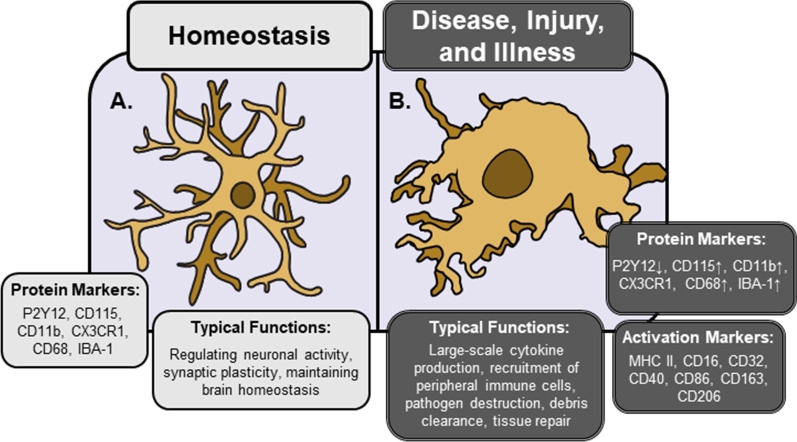
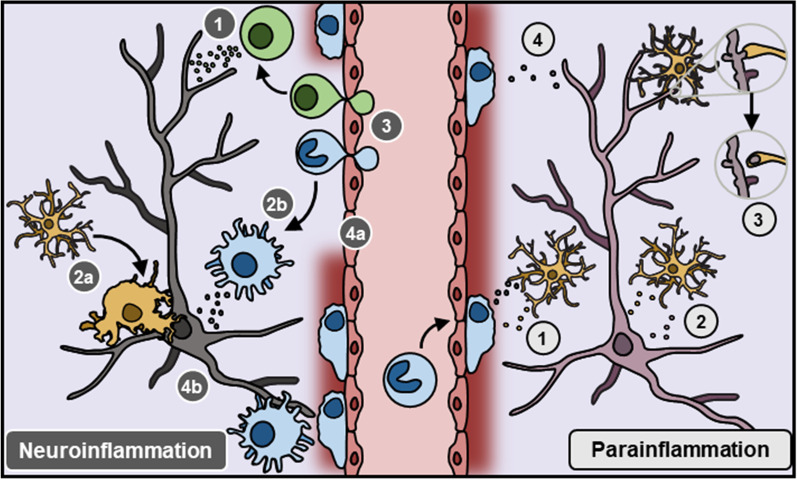
Microglia are emerging as critical regulators of neuronal function and behavior in nearly every area of neuroscience. Initial reports focused on classical immune functions of microglia in pathological contexts, however, immunological concepts from these studies have been applied to describe neuro-immune interactions in the absence of disease, injury, or infection. Indeed, terms such as 'microglia activation' or 'neuroinflammation' are used ubiquitously to describe changes in neuro-immune function in disparate contexts; particularly in stress research, where these terms prompt undue comparisons to pathological conditions. This creates a barrier for investigators new to neuro-immunology and ultimately hinders our understanding of stress effects on microglia. As more studies seek to understand the role of microglia in neurobiology and behavior, it is increasingly important to develop standard methods to study and define microglial phenotype and function. In this review, we summarize primary research on the role of microglia in pathological and physiological contexts. Further, we propose a framework to better describe changes in microglia1 phenotype and function in chronic stress. This approach will enable more precise characterization of microglia in different contexts, which should facilitate development of microglia-directed therapeutics in psychiatric and neurological disease.
Overview
The claims and statistics of this paper haven’t been checked yet.
Run the check — free, no account needed. It reads the open-access text and checks the sources it cites.
Integrity signals
Registry
Cites
Statistics
Figures
Verification
Claims the paper makes
The claims and statistics of this paper haven’t been checked yet.
Run the check — free, no account needed. It reads the open-access text and checks the sources it cites.
Claims other papers make about this one
Each is checked against this paper’s own text: does it say what the citing paper says it does?
In the citing paper
“The role of activated microglial cells is crucial in neuroinflammation since they can exert both neurotoxic and neuroprotective effects depending on the phenotype they acquire upon activation (Woodburn et al., 2021).”
From Exploring the Therapeutic Potential of Phytochemicals in Alzheimer’s Disease: Focus on Polyphenols and Monoterpenes (2022) · cites this paper as Woodburn et al., 2021
Self-check
Percentages, sums and reported differences re-computed from the paper’s own numbers.
The self-check needs the paper’s full text.
Citations
Cites
Items 201–261 of 261
Woodburn, S. C., Bollinger, J. L., & Wohleb, E. S. (2021) · Neurobiology of Stress · doi:10.1016/j.ynstr.2021.100312 · Cited by 100
Self-citationDifferential microglial activation between acute stress and lipopolysaccharide treatment
Sugama, S., Takenouchi, T., Fujita, M., Conti, B., & Hashimoto, M. (2008) · Journal of Neuroimmunology · doi:10.1016/j.jneuroim.2008.11.007 · Cited by 98
Portelli, G., Barrett, J. M., Hilgen, G., Masquelier, T., Maccione, A., Marco, S. D., Berdondini, L., Kornprobst, P., & Sernagor, E. (2016) · eNeuro · doi:10.1523/eneuro.0134-15.2016 · Cited by 97
A murine model of inflammation-induced cerebral microbleeds
Sumbria, R. K., Grigoryan, M. M., Vasilevko, V., Krasieva, T. B., Scadeng, M., Dvornikova, A., Paganini‐Hill, A., Kim, R., Cribbs, D. H., & Fisher, M. (2016) · Journal of Neuroinflammation · doi:10.1186/s12974-016-0693-5 · Cited by 97
Lehmann, M. L., Weigel, T. K., Cooper, H. A., Elkahloun, A. G., Kigar, S. L., & Herkenham, M. A. (2018) · Scientific Reports · doi:10.1038/s41598-018-28737-8 · Cited by 97
Nutma, E., Gebro, E., Marzin, M. C., van der Valk, P., Matthews, P. M., Owen, D. R., & Amor, S. (2021) · Glia · doi:10.1002/glia.24052 · Cited by 95
Böttcher, C., Fernández‐Zapata, C., Snijders, G. J. L., Schlickeiser, S., Sneeboer, M. A. M., Kunkel, D., de Witte, L. D., & Priller, J. (2020) · Translational Psychiatry · doi:10.1038/s41398-020-00992-2 · Cited by 92
Partial reduction of microglia does not affect tau pathology in aged mice
Bennett, R. E., Bryant, A., Hu, M., Robbins, A. B., Hopp, S. C., & Hyman, B. T. (2018) · Journal of Neuroinflammation · doi:10.1186/s12974-018-1348-5 · Cited by 91
Sariol, A., Mackin, S., Allred, M.-G., Ma, C., Zhou, Y., Zhang, Q., Zou, X., Abrahante, J. E., Meyerholz, D. K., & Perlman, S. (2020) · Proceedings of the National Academy of Sciences · doi:10.1073/pnas.2007814117 · Cited by 91 · cited 1×
“This is consistent with other studies reporting greater demyelination at peak disease and less remyelination during recovery in mice lacking microglia [47, 49, 50].”
ResultKim, Y. S., & Täuber, M. G. (1996) · Infection and Immunity · doi:10.1128/iai.64.8.3148-3153.1996 · Cited by 87
Mao, X. O., Bruneau, N., Gao, Q., Becq, H., Jia, Z., Xi, H., Shu, L., Wang, H., Szepetowski, P., & Aniksztejn, L. (2020) · Frontiers in Cellular Neuroscience · doi:10.3389/fncel.2020.00001 · Cited by 86
Maggi, L., Trettel, F., Scianni, M., Bertollini, C., Eusebi, F., Fredholm, B. B., & Limatola, C. (2009) · Journal of Neuroimmunology · doi:10.1016/j.jneuroim.2009.07.016 · Cited by 84
Kopp, B., Wick, D., & Herman, J. P. (2013) · Physiology & Behavior · doi:10.1016/j.physbeh.2013.05.030 · Cited by 84
Fractalkine/CX3CL1 depresses central synaptic transmission in mouse hippocampal slices
Bertollini, C., Ragozzino, D., Gross, C. T., Limatola, C., & Eusebi, F. (2006) · Neuropharmacology · doi:10.1016/j.neuropharm.2006.05.027 · Cited by 82
CSF1R Stimulation Promotes Increased Neuroprotection by CD11c+ Microglia in EAE
Wlodarczyk, A., Benmamar-Badel, A., Cédile, O., Jensen, K. N., Kramer, I., Elsborg, N. B., & Owens, T. (2019) · Frontiers in Cellular Neuroscience · doi:10.3389/fncel.2018.00523 · Cited by 81
Pfeiffer, T., Avignone, E., & Nägerl, U. V. (2016) · Scientific Reports · doi:10.1038/srep32422 · Cited by 79
Swiatkowski, P., Murugan, M., Eyo, U. B., Wāng, Y., Rangaraju, S., Oh, S. B., & Wu, L. (2016) · Neuroscience · doi:10.1016/j.neuroscience.2016.01.008 · Cited by 75
Yang, J., Cao, L.-L., Wang, X.-P., Guo, W., Guo, R.-B., Sun, Y.-Q., Xue, T.-F., Cai, Z.-Y., Ji, J., Cheng, H., et al. (2021) · Cell Death & Disease · doi:10.1038/s41419-020-03310-2 · Cited by 73
Barichello, T., dos Santos, I., Savi, G. D., Simões, L. R., Silvestre, T., Comim, C. M., Sachs, D., Teixeira, M. M., Teixeira, A. L., & Quevedo, J. (2010) · Journal of Neuroimmunology · doi:10.1016/j.jneuroim.2010.02.009 · Cited by 72
Glucocorticoids, stress and exacerbation of excitotoxic neuron death
Sapolsky, R. M. (1994) · Seminars in Neuroscience · doi:10.1006/smns.1994.1041 · Cited by 72
Dieterich, A., Srivastava, P., Sharif, A., Stech, K., Floeder, J. R., Yohn, S. E., & Samuels, B. A. (2019) · Translational Psychiatry · doi:10.1038/s41398-019-0674-4 · Cited by 72
Mangale, V., Syage, A. R., Ekiz, H. A., Skinner, D. D., Cheng, Y., Stone, C. L., Brown, R. M., O'Connell, R. M., Green, K. N., & Lane, T. E. (2020) · Glia · doi:10.1002/glia.23844 · Cited by 71
Spulber, S. D., Mateos, L., Oprica, M., Cedazo-Mı́nguez, Á., Bartfai, T., Winblad, B. G., & Schultzberg, M. (2009) · Journal of Neuroimmunology · doi:10.1016/j.jneuroim.2009.01.010 · Cited by 70
Walker, A. K., Nakamura, T., & Hodgson, D. M. (2010) · Stress · doi:10.3109/10253890.2010.489977 · Cited by 69
Huang, Z., Zhang, Y., Li, H., Zhou, Y., Zhang, Q., Chen, R., Jin, T., Hu, K., Li, S., Wang, Y., et al. (2020) · Cell Death and Disease · doi:10.1038/s41419-020-2389-0 · Cited by 69
Fine Tuning the Cytokine Storm by IFN and IL-10 Following Neurotropic Coronavirus Encephalomyelitis
Savarin, C., & Bergmann, C. C. (2018) · Frontiers in Immunology · doi:10.3389/fimmu.2018.03022 · Cited by 68
Plasma amino acids: screening, quantitation, and interpretation
Scriver, C. R., Clow, C., & Lamm, P. (1971) · American Journal of Clinical Nutrition · doi:10.1093/ajcn/24.7.876 · Cited by 67
Peripheral Surgical Wounding and Age-Dependent Neuroinflammation in Mice
Xu, Z., Dong, Y., Wang, H., Culley, D. J., Marcantonio, E. R., Crosby, G. J., Tanzi, R. E., Zhang, Y., & Xie, Z. (2014) · PLoS ONE · doi:10.1371/journal.pone.0096752 · Cited by 64
Zhang, Y., Li, H., Li, X., Wu, J., Xue, T., Wu, J., Shen, H., Li, X., Shen, M., & Chen, G. (2020) · Frontiers in Immunology · doi:10.3389/fimmu.2020.01144 · Cited by 58
Morphological studies on neuroglia
Murabe, Y., & Sano, Y. (1983) · Cell and Tissue Research · doi:10.1007/bf00217882 · Cited by 58
The GluN2A Subunit Regulates Neuronal NMDA receptor-Induced Microglia-Neuron Physical Interactions
Eyo, U. B., Bispo, A., Liu, J., Sabu, S., Wu, R., DiBona, V. L., Zheng, J., Murugan, M., Zhang, H., Tang, Y., et al. (2018) · Scientific Reports · doi:10.1038/s41598-018-19205-4 · Cited by 57
Generalization of endothelial modelling of TSPO PET imaging: Considerations on tracer affinities
Rizzo, G., Veronese, M., Tonietto, M., Bodini, B., Stankoff, B., Wimberley, C., Lavisse, S., Bottlaender, M., Bloomfield, P. S., Howes, O. D., et al. (2017) · Journal of Cerebral Blood Flow & Metabolism · doi:10.1177/0271678x17742004 · Cited by 54
Alves-dos-Santos, L., Resende, L. D. S., & Chiavegatto, S. (2020) · Neurobiology of Stress · doi:10.1016/j.ynstr.2020.100221 · Cited by 54
Bollinger, J. L., & Wohleb, E. S. (2019) · Neuroscience Letters · doi:10.1016/j.neulet.2019.134369 · Cited by 51
Self-citationBarichello, T., dos Santos, I., Savi, G. D., Florentino, A. F., Silvestre, C., Comim, C. M., Feier, G., Sachs, D., Teixeira, M. M., Teixeira, A. L., et al. (2009) · Neuroscience Letters · doi:10.1016/j.neulet.2009.10.039 · Cited by 50
Analysis of cerebrovascular dysfunction caused by chronic social defeat in mice
Lehmann, M. L., Poffenberger, C. N., Elkahloun, A. G., & Herkenham, M. A. (2020) · Brain Behavior and Immunity · doi:10.1016/j.bbi.2020.05.030 · Cited by 49
Ayash, S., Schmitt, U., & Müller, M. B. (2019) · Journal of Psychiatric Research · doi:10.1016/j.jpsychires.2019.10.001 · Cited by 46
The chemokine CXCL16 modulates neurotransmitter release in hippocampal CA1 area
Castro, M. A. D., Trettel, F., Milior, G., Maggi, L., Ragozzino, D., & Limatola, C. (2016) · Scientific Reports · doi:10.1038/srep34633 · Cited by 45
Bollinger, J. L., Horchar, M. J., & Wohleb, E. S. (2020) · Neuropsychopharmacology · doi:10.1038/s41386-020-0720-1 · Cited by 44
Self-citationSocial defeat-induced anhedonia: effects on operant sucrose-seeking behavior
Riga, D., Theijs, J. T., Vries, T. J. D., Smit, A. B., & Spijker, S. (2015) · Frontiers in Behavioral Neuroscience · doi:10.3389/fnbeh.2015.00195 · Cited by 41
Chronic corticosterone shifts effort-related choice behavior in male mice
Dieterich, A., Stech, K., Srivastava, P., Lee, J., Sharif, A., & Samuels, B. A. (2020) · Psychopharmacology · doi:10.1007/s00213-020-05521-z · Cited by 39
Hatton, C. F., & Duncan, C. J. A. (2019) · Frontiers in Immunology · doi:10.3389/fimmu.2019.02656 · Cited by 37
Pío del Río‐Hortega: The Revolution of Glia
Bereciartu, J. D. R. (2019) · The Anatomical Record · doi:10.1002/ar.24266 · Cited by 34
Pearson, T., Sahl, J. W., Hepp, C. M., Handady, K., Hornstra, H., Vazquez, A. J., Settles, E. W., Mayo, M. J., Kaestli, M., Williamson, C. H. D., et al. (2020) · PLoS Pathogens · doi:10.1371/journal.ppat.1008298 · Cited by 34
Sarma, J. D., Burrows, A. C., Rayman, P. A., Hwang, M., Kundu, S., Sharma, N., Bergmann, C. C., & Sen, G. C. (2020) · PLoS Pathogens · doi:10.1371/journal.ppat.1009034 · Cited by 34
Luczynski, P., Moquin, L., & Gratton, A. P. (2015) · Stress · doi:10.3109/10253890.2015.1073256 · Cited by 33
The adaptor protein shc is involved in the negative regulation of NK cell-mediated cytotoxicity
Galandrini, R., Tassi, I., Morrone, S., Lanfrancone, L., Pelicci, P. G., Piccoli, M., Frati, L., & Santoni, A. (2001) · European Journal of Immunology · doi:10.1002/1521-4141(200107)31:7 · Cited by 32
Liu, T., Lu, J., Łukasiewicz, K., Pan, B., & Zuo, Y. (2021) · Neurobiology of Stress · doi:10.1016/j.ynstr.2021.100342 · Cited by 32
Molecular imaging of Alzheimer’s disease–related gamma-secretase in mice and nonhuman primates
Xu, Y., Wang, C., Wey, H., Liang, Y., Chen, Z., Choi, S. H., Ran, C., Rynearson, K. D., Bernales, D. R., Koegel, R. E., et al. (2020) · The Journal of Experimental Medicine · doi:10.1084/jem.20182266 · Cited by 31
Sardari, M., Škuljec, J., Yin, D., Zec, K., de Carvalho, T. S., Albers, D., Wang, C., Pul, R., Popa‐Wagner, A., Doeppner, T. R., et al. (2020) · Brain Behavior and Immunity · doi:10.1016/j.bbi.2020.10.015 · Cited by 30
Savarin, C., Dutta, R., & Bergmann, C. C. (2018) · Frontiers in Immunology · doi:10.3389/fimmu.2018.01325 · Cited by 26
Hazen, E., Carlisle, A., Wilson, S., Ganong, J., Castleton, M., Schallert, R., Stokesbury, M., Bograd, S., & Block, B. (2016) · Scientific Reports · doi:10.1038/srep36689 · Cited by 24
Uranium-series dating of insular phosphorite from Ebon atoll, Micronesia
Veeh, H. H., & Burnett, W. C. (1978) · Nature · doi:10.1038/274460a0 · Cited by 23
Fasting promotes acute hypoxic adaptation by suppressing mTOR-mediated pathways
Zhao, R., Zhao, X., Wang, X., Liu, Y., Yang, J., Jiang, S., Zhou, X., Jiao, B., Zhang, L., Liu, Y., et al. (2021) · Cell Death and Disease · doi:10.1038/s41419-021-04351-x · Cited by 21
Erratum: Pure-quartic solitons
Blanco‐Redondo, A., de Sterke, C. M., Sipe, J. E., et al. (2016) · Nature Communications · doi:10.1038/ncomms11048 · Cited by 17
Grundy, R. I., Rothwell, N. J., & Allan, S. M. (1999) · Brain Research · doi:10.1016/s0006-8993(99)01377-3 · Cited by 16
Boullerne, A. I., & Feinstein, D. L. (2020) · ASN NEURO · doi:10.1177/1759091420953259 · Cited by 16
Koch, R. M., Kox, M., Thijs, E. J. M., Rahamat-Langendoen, J. C., van de Veerdonk, F. L., Gerretsen, J., Schloesser, J. E. L., Diavatopoulos, D. A., Rimmelzwaan, G. F., Netea, M. G., et al. (2017) · Frontiers in Immunology · doi:10.3389/fimmu.2017.01600 · Cited by 15
Zeng, J., Zhào, H., Liu, Z., Zhang, W., & Huang, Y. (2018) · Journal of Stroke and Cerebrovascular Diseases · doi:10.1016/j.jstrokecerebrovasdis.2018.02.044 · Cited by 11
Caspers, H. (1962) · Internationale Revue der gesamten Hydrobiologie und Hydrographie · doi:10.1002/iroh.19620470121 · Cited by 6
van der Linden, M. A., & Borsboom, D. (2019) · Behavioral and Brain Sciences · doi:10.1017/s0140525x19000190 · Cited by 3
Cited by
Sorted by citations
Zeng, J., Bao, T., Yang, K., Zhu, X., Wang, S., Xiang, W., Ge, A., Zeng, L., & Ge, J. (2023) · Frontiers in Immunology · doi:10.3389/fimmu.2022.1047550 · Cited by 175
Martins-Ferreira, R., Calafell-Segura, J., Leal, B., Rodríguez-Ubreva, J., Martínez-Saez, E., Mereu, E., Pinho E Costa, P., Laguna, A., & Ballestar, E. (2025) · Nature Communications · doi:10.1038/s41467-025-56124-1 · Cited by 123
Piccialli, I., Tedeschi, V., Caputo, L., D’Errico, S., Ciccone, R., De Feo, V., Secondo, A., & Pannaccione, A. (2022) · Frontiers in Pharmacology · doi:10.3389/fphar.2022.876614 · Cited by 73
Zhao, Q., Chen, J., Wu, M., Yin, X., Jiang, Q., Gao, H., & Zheng, H. (2023) · Chemico-Biological Interactions · doi:10.1016/j.cbi.2023.110638 · Cited by 49
Gut Microbiota Restores Central Neuropeptide Deficits in Germ-Free Mice
Hamamah, S., & Covasa, M. (2022) · International Journal of Molecular Sciences · doi:10.3390/ijms231911756 · Cited by 25
Metadata
- Authors
- Woodburn, S. C., Bollinger, J. L., & Wohleb, E. S.
- Affiliations
- University of Cincinnati (US)
- Corresponding author
- Wohleb, Eric S.
- Venue
- Journal of Neuroinflammation
- Published
- 2021-11-06
- Volume
- 18
- Issue
- 1
- Pages
- 258-258
- ISSN
- 1742-2094 (ISSN-L)
- PMC
- PMC8571840
- OpenAlex
- W3211761706
- Cited by
- 783
- References
- 261
- Citations by year
- 2026: 138 · 2025: 244 · 2024: 204 · 2023: 142 · 2022: 53 · 2021: 1
- FWCI
- 11.80
- Type
- journal article
- Language
- en
- Open access
- gold
- doi.org
- Locations
- Journal of Neuroinflammation (publishedVersion, cc-by)
- Europe PMC (PubMed Central) (publishedVersion, other-oa)
- PubMed Central (publishedVersion, cc-by)
- PubMed (publishedVersion)
- DOAJ (DOAJ: Directory of Open Access Journals) (submittedVersion, cc-by-sa)
- Funders
- foundation for the national institutes of health (R21-MH120614, R01-MH-123545)
- brain and behavior research foundation (NARSAD Young Investigator Grant, 25488)
- college of medicine, university of cincinnati (University of Cincinnati Neurobiology Research Center Pilot Award)
- Topics
- Life Sciences › Neuroscience › Neurology › Neuroinflammation and Neurodegeneration Mechanisms
- Life Sciences › Neuroscience › Biological Psychiatry › Tryptophan and brain disorders
- Life Sciences › Neuroscience › Behavioral Neuroscience › Stress Responses and Cortisol
- Keywords
- microglial activation, neuroinflammation, neuroimmune interactions, chronic stress, microglial phenotype, homeostasis, stress-related psychiatric disorders, terminology standardization
- MeSH terms
- Neuroinflammatory Diseases, Animals, Homeostasis, Humans, Terminology as Topic, Semantics, Stress, Physiological, Microglia
About these checks
Registry, retraction, Cites and statistics results are computed, not judged, with one exception: a printed reference that no index lists is read once by a model before it counts as a citation error. Claims are extracted by a model and kept only when their quote appears verbatim in the text; each cited source is then checked, with a model’s help, for whether it says what the claim relies on. Those verdicts can be wrong — read the claim’s quote and the cited source before relying on one.
Statistics and arithmetic are recomputed, not judged.
Confidence bands are shown only for fields calibrated on our annotated test set. None is calibrated yet, so no band is shown.
What counts as a claim ›How we measure confidence ›How we check this ›
Are you an author, or do you see a problem with this page? Request a review
