

Chlorinative stress in age-related diseases: a literature review
Open accessThe DOI matches its Crossref record; 52 of the 52 references it cites were found in a registry or an index.
Abstract
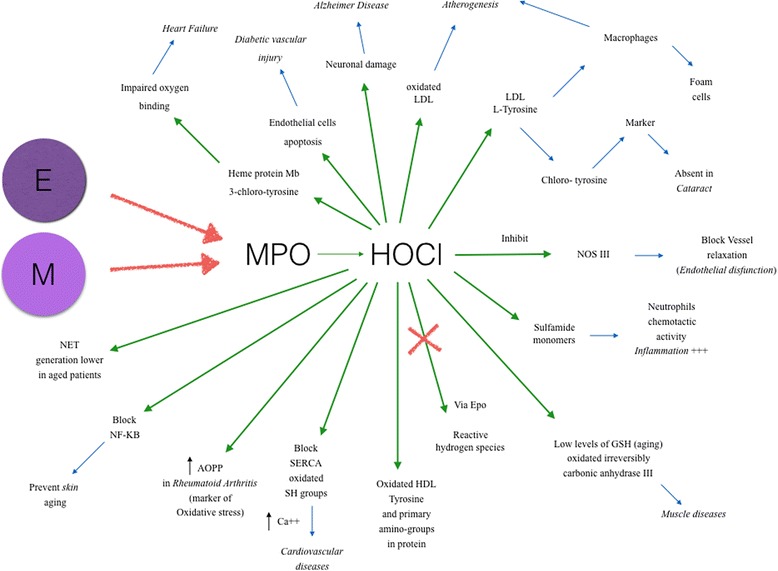
Aging is an agglomerate of biological long-lasting processes that result being inevitable. Main actors in this scenario are both long-term inflammation and oxidative stress. It has been proved that oxidative stress induce alteration in proteins and this fact itself is critically important in the pathophysiological mechanisms leading to diseases typical of aging. Among reactive species, chlorine ones such as hypochlorous acid (HOCl) are cytotoxic oxidants produced by activated neutrophils during chronic inflammation processes. HOCl can also cause damages by reacting with biological molecules. HOCl is generated by myeloperoxidase (MPO) and augmented serum levels of MPO have been described in acute and chronic inflammatory conditions in cardiovascular patients and has been implicated in many inflammatory diseases such as atherosclerosis, neurodegenerative conditions, and some cancers. Due to these data, we decided to conduct an up-to-date review evaluating chlorinative stress effects on every age-related disease linked; potential anti-oxidant countermeasures were also assessed. Results obtained associated HOCl generation to the aging processes and confirmed its connection with diseases like neurodegenerative and cardiovascular pathologies, atherosclerosis and cancer; chlorination was mainly linked to diseases where molecular (protein) alteration constitute the major suspected cause: i.e. inflammation, tissue lesions, DNA damages, apoptosis and oxidative stress itself. According data collected, a healthy lifestyle together with some dietary suggestion and/or the administration of nutracetical antioxidant integrators could balance the effects of chlorinative stress and, in some cases, slow down or prevent the onset of age-releated diseases.
Overview
The claims and statistics of this paper haven’t been checked yet.
Free: it reads the open-access text and checks the first 5 claims that cite a source we can check. Create a free account to check every claim.
Integrity signals
Registry
Cites
Statistics
Figures
Verification
Claims the paper makes
The claims and statistics of this paper haven’t been checked yet.
Free: it reads the open-access text and checks the first 5 claims that cite a source we can check. Create a free account to check every claim.
Claims other papers make about this one
Each is checked against this paper’s own text: does it say what the citing paper says it does?
In the citing paper
“endogenous hypohalous acids, even though serving innate host defense functions, may also induce tissue damage at sites of inflammation, an area of active research in the context of neurodegenerative disease (M. Alzheimer; M. Parkinson), metabolic and cardiovascular dysfunction (atherosclerosis; diabetes), autoimmune dysregulation, cancer, and chronological aging, among others (47, 49, 50).”
From Hypochlorous Acid: From Innate Immune Factor and Environmental Toxicant to Chemopreventive Agent Targeting Solar UV-Induced Skin Cancer (2022) · cites this paper as [49]
In the citing paper
“Importantly, human organ dysfunction may occur as a result of chlorination stress originating from exogenous (environmental) and endogenous (innate) sources (47, 49).”
From Hypochlorous Acid: From Innate Immune Factor and Environmental Toxicant to Chemopreventive Agent Targeting Solar UV-Induced Skin Cancer (2022) · cites this paper as [49]
Self-check
Percentages, sums and reported differences re-computed from the paper’s own numbers.
The self-check needs the paper’s full text.
Citations
Cites
ROS as signalling molecules: Mechanisms that generate specificity in ROS homeostasis
D'Autréaux, B., & Toledano, M. B. (2007) · Nature Reviews Molecular Cell Biology · doi:10.1038/nrm2256 · Cited by 3,642
Daugherty, A., Dunn, J. L., Rateri, D. L., & Heinecke, J. W. (1994) · Journal of Clinical Investigation · doi:10.1172/jci117342 · Cited by 1,269 · cited 3×
“studied atherosclerotic lesions where they detected the enzyme MPO; their data sustained that MPO induced LDL oxidation by pathways involving HOCl and promoting atherogenesis [21].”
Falk, R. J., Terrell, R. S., Charles, L. A., & Jennette, J. C. (1990) · Proceedings of the National Academy of Sciences · doi:10.1073/pnas.87.11.4115 · Cited by 1,261
Reactive oxygen species: from health to disease
Brieger, K., Schiavone, S., Miller Jr., F. J., & Krause, K.-H. (2012) · Swiss Medical Weekly · doi:10.4414/smw.2012.13659 · Cited by 1,133 · cited 3×
“Proteins are the most common targets of HOCl and for this reason changes induced in their sub-elements (peptides and amino acids) have been largely examined [5, 6, 13].”
Hazen, S. L., & Heinecke, J. W. (1997) · Journal of Clinical Investigation · doi:10.1172/jci119379 · Cited by 842 · cited 2×
“The generation of HOCl was demonstrated to interfere with lipoproteins with a consequent oxidation resulting in the conversion of macrophages in foam cells and in the acceleration of the atherosclerotic process [7, 14, 21, 22].”
Inflammaging and Anti-Inflammaging: The Role of Cytokines in Extreme Longevity
Minciullo, P. L., Catalano, A., Mandraffino, G., Casciaro, M., Crucitti, A., Maltese, G., Morabito, N., Lasco, A., Gangemi, S., & Basile, G. (2016) · Archivum Immunologiae et Therapiae Experimentalis · doi:10.1007/s00005-015-0377-3 · Cited by 433 · cited 1×
“DNA repair, apoptosis, immune response, oxidative stress and inflammation contribute to this dynamic process [2].”
Self-citationCellular stress responses, hormetic phytochemicals and vitagenes in aging and longevity
Calabrese, V., Cornelius, C., Dinkova-Kostova, A. T., Iavicoli, I., Di Paola, R., Koverech, A., Cuzzocrea, S., Rizzarelli, E., & Calabrese, E. J. (2012) · Biochimica et Biophysica Acta (BBA) - Molecular Basis of Disease · doi:10.1016/j.bbadis.2011.11.002 · Cited by 420 · cited 1×
“The maintenance of optimal conditions in an organism in order to contrast aging is accomplished by a complex network of longevity assurance processes that are controlled by Vitagenes, a group of genes aimed at preserving cellular homeostasis during stressful conditions; in particular Vitagenes encode the genes for the…”
Hazeldine, J., Harris, P., Chapple, I. L., Grant, M., Greenwood, H., Livesey, A., Sapey, E., & Lord, J. M. (2014) · Aging Cell · doi:10.1111/acel.12222 · Cited by 292
Assessment of chlorination by human neutrophils
Foote, C. S., Goyne, T. E., & Lehrer, R. I. (1983) · Nature · doi:10.1038/301715a0 · Cited by 279
Eosinophil peroxidase nitrates protein tyrosyl residues
Wu, W., Chen, Y., & Hazen, S. L. (1999) · Journal of Biological Chemistry · doi:10.1074/jbc.274.36.25933 · Cited by 265 · cited 5×
“Also the eosinophil peroxidase (EPO) was thought being implicated in provoking oxidative tissue damage in many conditions (i.e. asthma, allergic inflammatory disorders, cancer, infections).”
Influential
Cited by
Effects and Mechanisms of Resveratrol on Aging and Age‐Related Diseases
Zhou, D.-D., Luo, M., Huang, S.-Y., Saimaiti, A., Shang, A., Gan, R.-Y., & Li, H.-B. (2021) · Oxidative Medicine and Cellular Longevity · doi:10.1155/2021/9932218 · Cited by 363
The Role of Myeloperoxidase in Biomolecule Modification, Chronic Inflammation, and Disease
Davies, M. J., & Hawkins, C. L. (2020) · Antioxidants & Redox Signaling · doi:10.1089/ars.2020.8030 · Cited by 332
Andrés, C. M. C., Pérez de la Lastra, J. M., Juan, C. A., Plou, F. J., & Pérez-Lebeña, E. (2022) · Stresses · doi:10.3390/stresses2030019 · Cited by 218
“important in the progression of a number of diseases including atherosclerosis, chronic inflammation and some cancers [49].”
BackgroundAndrés, C. M. C., Pérez de la Lastra, J. M., Juan, C. A., Plou, F. J., & Pérez-Lebeña, E. (2022) · International Journal of Molecular Sciences · doi:10.3390/ijms231810735 · Cited by 166
Gonos, E. S., Kapetanou, M., Sereikaite, J., Bartosz, G., Naparło, K., Grzesik, M., & Sadowska-Bartosz, I. (2018) · Aging · doi:10.18632/aging.101450 · Cited by 129
“Furthermore, MPO was reported to be expressed with increased levels in the cerebral tissue of patients affected by AD [156] and 3-chlorotyrosine as a biomarker of HOCl production was detected in proteins from AD hippocampus.”
Ratiometric fluorescent probes for capturing endogenous hypochlorous acid in the lungs of mice
Zhang, X., Zhao, W., Li, B., Li, W., Zhang, C., Hou, X., Jiang, J., & Dong, Y. (2018) · Chemical Science · doi:10.1039/c8sc03226b · Cited by 118
Morris, G., Puri, B. K., Bortolasci, C. C., Carvalho, A., Berk, M., Walder, K., Moreira, E. G., & Maes, M. (2021) · Neuroscience & Biobehavioral Reviews · doi:10.1016/j.neubiorev.2021.02.037 · Cited by 84
Nantachai, G., Vasupanrajit, A., Tunvirachaisakul, C., Solmi, M., & Maes, M. H. J. (2022) · Ageing Research Reviews · doi:10.1016/j.arr.2022.101639 · Cited by 74
Oxidative Modification of Proteins: From Damage to Catalysis, Signaling, and Beyond
Demasi, M., Augusto, O., Bechara, E. J. H., Bicev, R. N., Cerqueira, F. M., da Cunha, F. M., Denicola, A., Gomes, F., Miyamoto, S., Netto, L. E. S., et al. (2021) · Antioxidants and Redox Signaling · doi:10.1089/ars.2020.8176 · Cited by 75
Nutraceuticals against Oxidative Stress in Autoimmune Disorders
Mannucci, C., Casciaro, M., Sorbara, E. E., Calapai, F., Salvo, E. D., Pioggia, G., Navarra, M., Calapai, G., & Gangemi, S. (2021) · Antioxidants · doi:10.3390/antiox10020261 · Cited by 77
Self-citationFan, G., Zhang, B., Wang, J., Wang, N., Qin, S., Zhao, W., & Zhang, J. (2023) · Talanta · doi:10.1016/j.talanta.2023.125298 · Cited by 68
Moradi, S., Tapak, L., & Afshar, S. (2022) · BioMed Research International · doi:10.1155/2022/5009892 · Cited by 66
“A glycosylated heme-enzyme MPO was found in the azurophilic granules of neutrophils and macrophages [24].”
Maki, R. A., Holzer, M., Motamedchaboki, K., Malle, E., Masliah, E., Marsche, G., & Reynolds, W. F. (2019) · Free Radical Biology and Medicine · doi:10.1016/j.freeradbiomed.2019.05.033 · Cited by 58
“As MPO is the only enzyme able to generate HOCl by oxidizing Cl−, staining for HOClmodified proteins/epitopes is indicative of oxidative damage caused by the MPO-H2O2-Cl system [93].”
BackgroundMaes, M. H. J., Sirivichayakul, S., Matsumoto, A. K., Michelin, A. P., Semeão, L. D. O., Pedrão, J. V. D. L., Moreira, E. G., Barbosa, D. S., Carvalho, A. F., Solmi, M., et al. (2020) · Molecular Neurobiology · doi:10.1007/s12035-020-02047-5 · Cited by 54
Xue, M., Wang, H., Chen, J., Ren, J., Chen, S., Yang, H., Zeng, R., Long, Y., & Zhang, P. (2018) · Sensors and Actuators B Chemical · doi:10.1016/j.snb.2018.11.027 · Cited by 51
Body fluid diagnostics using activatable optical probes
Zhan, J., Cai, Y., Cheng, P., Zheng, L., & Pu, K. (2025) · Chemical Society Reviews · doi:10.1039/d4cs01315h · Cited by 47
He, L., Zhang, Y., Xiong, H., Wang, J., Geng, Y., Wang, B., Wang, Y., Yang, Z., & Song, X. (2019) · Dyes and Pigments · doi:10.1016/j.dyepig.2019.03.029 · Cited by 40
Chemiluminescence molecular sensor for endogenous HOCl in vivo
Wang, C., Wang, T., Zhang, M., Li, N., Fan, M., & Cui, X. (2021) · Sensors and Actuators B Chemical · doi:10.1016/j.snb.2021.129927 · Cited by 39
Snell, J. A., Jandova, J., & Wondrak, G. T. (2022) · Frontiers in Oncology · doi:10.3389/fonc.2022.887220 · Cited by 37
“Human Target Organs of Environmental Chlorination Stress Importantly, human organ dysfunction may occur as a result of chlorination stress originating from exogenous (environmental) and endogenous (innate) sources (47, 49).”
BackgroundKhan, A., Murad, W., Salahuddin, Ali, S., Shah, S. S., Halim, S. A., Khalid, A., Kashtoh, H., Khan, A., & Al-Harrasi, A. (2024) · Heliyon · doi:10.1016/j.heliyon.2024.e40362 · Cited by 45
“A. Khan et al. Heliyon 10 (2024) e40362 cancer [73].”
Li, S., Yang, K. L., Liu, Y., Wang, P., Cheng, D., & He, L. (2022) · Sensors and Actuators B Chemical · doi:10.1016/j.snb.2022.133253 · Cited by 36
Yang, M., Lee, S. C., Kim, M., Lim, M. H., & Kim, C. (2020) · Spectrochimica Acta Part A Molecular and Biomolecular Spectroscopy · doi:10.1016/j.saa.2020.118899 · Cited by 36
Derke, R. M., Barron, A. J., Billiot, C. E., Chaple, I. F., Lapi, S. E., Broderick, N. A., & Gray, M. J. (2020) · mBio · doi:10.1128/mbio.01905-20 · Cited by 35
A fluorescent turn-on probe for detection of hypochlorus acid and its bioimaging in living cells
Chu, C.-J., Wu, G.-S., Ma, H.-I., Venkatesan, P., Thirumalaivasan, N., & Wu, S. (2020) · Spectrochimica Acta Part A Molecular and Biomolecular Spectroscopy · doi:10.1016/j.saa.2020.118234 · Cited by 41
He, N., Wang, Y. D., Huang, Y. L., Chen, L., Wang, X., Lv, C., & Yue, S. (2020) · Journal of Materials Chemistry B · doi:10.1039/d0tb01969k · Cited by 34
Sulfur-based fluorescent probes for biological analysis: A review
Hu, G., Xu, H.-D., & Fang, J. (2024) · Talanta · doi:10.1016/j.talanta.2024.126515 · Cited by 32
Li, L., Hou, Y., Liu, X., Tian, M., Ma, Q., Zhu, N., & Liu, S. (2022) · New Journal of Chemistry · doi:10.1039/d2nj00491g · Cited by 32
Boecker, D., Zhang, Z., Breves, R., Herth, F. J. F., Krämer, A., & Bulitta, C. (2023) · GMS. Hygiene and infection control · doi:10.3205/dgkh000433 · Cited by 77
“Nevertheless, some of the studies attribute the negative effect to HOCl [108], which the present authors could not verify.”
InfluentialJandova, J., Snell, J., Hua, A., Dickinson, S., Fimbres, J., & Wondrak, G. T. (2021) · Redox Biology · doi:10.1016/j.redox.2021.102042 · Cited by 30
Xiong, K., Huo, F., Zhang, Y., Wen, Y., & Yin, C. (2019) · Analytical Methods · doi:10.1039/c9ay00011a · Cited by 25
Chupel, M. U., Minuzzi, L. G., Furtado, G. E., Santos, M. L. A. S., Ferreira, J. P., Filaire, E., & Teixeira, A. M. A. J. (2021) · Amino Acids · doi:10.1007/s00726-021-02952-6 · Cited by 28
Jiang, C., Xu, X., & Yao, C. (2022) · Spectrochimica Acta Part A Molecular and Biomolecular Spectroscopy · doi:10.1016/j.saa.2022.121075 · Cited by 23
Modulation of Cellular Redox Parameters for Improving Therapeutic Responses in Multiple Myeloma
Allegra, A., Petrarca, C., Gioacchino, M. D., Casciaro, M., Musolino, C., & Gangemi, S. (2022) · Antioxidants · doi:10.3390/antiox11030455 · Cited by 22
“The damaging consequences of ROS are compensated by a complex system including enzymatic antioxidants such as glutathione peroxidase (GPX), superoxide dismutase (SOD), catalase, thioredoxin reductase, and peroxiredoxin, and non-enzymatic antioxidants such as vitamin C, glutathione (GSH), thioredoxin, vitamin E, and me…”
BackgroundSelf-citationWang, H., He, Y., Li, Y., Zhang, C., Zhang, P., Cui, J., Long, Y., Chen, S., Zeng, R., & Chen, J. (2019) · Analytical and Bioanalytical Chemistry · doi:10.1007/s00216-019-01653-0 · Cited by 22
Salim, R., Kapur, S., Schervish, M., Gerritz, L., Edwards, K. C., Ruis-Armenta, L., Varghese, E., Ravikrishna, R., Nizkorodov, S. A., Gunthe, S. S., et al. (2025) · npj Clean Air · doi:10.1038/s44407-025-00015-8 · Cited by 24
“HOClisacytotoxic oxidantthatcaninducechlorinativestressthatislinkedtoin fl ammation, disruption of antioxidant systems, tissue lesions, DNA damages, and apoptosis, which may lead to development of diseases like asthma, chronic obstructive pulmonary disease (COPD), and acute respiratory distress syndrome (ARDS) 61 .”
Haldar, U., Sharma, R., Ruidas, B., & Lee, H. (2019) · Dyes and Pigments · doi:10.1016/j.dyepig.2019.107858 · Cited by 20
HClO imaging in vivo and drug-damaged liver tissues by a large Stokes shift fluorescent probe
Liu, X., He, C., Li, Q., Li, Z., Liu, L., Chen, S., & Hou, P. (2023) · Spectrochimica Acta Part A Molecular and Biomolecular Spectroscopy · doi:10.1016/j.saa.2023.123081 · Cited by 20
Lamela, P. A., Navoni, J. A., Perez, R. D., Perez, C. A., Vodopivez, C. L., Curtosi, A., & Bongiovanni, G. A. (2019) · The Science of The Total Environment · doi:10.1016/j.scitotenv.2019.05.096 · Cited by 18
Lan, Y., Zhang, K., Wang, F., Zhang, Y., Yan, M., & Zuo, Y. (2023) · Spectrochimica Acta Part A Molecular and Biomolecular Spectroscopy · doi:10.1016/j.saa.2023.122527 · Cited by 15
Wu, G.-S., Thirumalaivasan, N., Lin, T., & Wu, S. (2020) · Journal of Pharmaceutical and Biomedical Analysis · doi:10.1016/j.jpba.2020.113545 · Cited by 15
Allegra, A., Tonacci, A., Giordano, L., Musolino, C., & Gangemi, S. (2022) · Antioxidants · doi:10.3390/antiox11091696 · Cited by 15
Self-citationIwai, H., Inaba, M., Bui, D. V., Suzuki, K., Sakagami, T., Yun, Y., Mitani, A., Kobayashi, Y., & Kanda, A. (2021) · Journal of Neuroimmunology · doi:10.1016/j.jneuroim.2021.577628 · Cited by 16
“Aging and oxidative stress are closely associated, because inextricable microbiota, damaged macromolecules, and cells (self-debris) accumulate under immunosenescence, and induce inflammaging, leading to the production of NO (Casciaro et al., 2017; Franceschi and Campisi, 2014; Watson et al., 2017), which causes tissue…”
Bai, X., Yang, B., Chen, H., Shen, J., & Yang, D. (2020) · Organic Chemistry Frontiers · doi:10.1039/d0qo00081g · Cited by 13
Ilyich, T. V., Коваленя, Т. А., Lapshina, E. A., Stępniak, A., Palecz, B., & Zavodnik, I. B. (2020) · Journal of Molecular Liquids · doi:10.1016/j.molliq.2020.115184 · Cited by 13
Association between serum myeloperoxidase enzyme activity and Parkinson’s disease status
Fernández‐Espejo, E., Guerra, M.-D.-M., & Castellano, S. (2025) · npj Parkinson s Disease · doi:10.1038/s41531-025-00941-0 · Cited by 15
“Age and sex are important PD risk and MPO-modifying factors 24,27,41,44,46 .”
Advanced glycation end-products and advanced oxidation protein products in schizophrenia
Pandolfo, G., Genovese, G., Bruno, A., Campolo, D., Tigano, V., Cristani, M., Casciaro, M., Pioggia, G., & Gangemi, S. (2022) · Psychiatry Research · doi:10.1016/j.psychres.2022.114527 · Cited by 12
Self-citationLi, H., Knight, W. C., Yang, P., Guo, Y., Perlmutter, J. S., Morris, J. C., Bateman, R. J., Benzinger, T. L. S., & Xu, J. (2020) · International Journal of Molecular Sciences · doi:10.3390/ijms21176047 · Cited by 12
“After the release, MPO catalyzes the reactions between hydrogen peroxide (H2O2) and halides (Cl−, Br−, I−) or pseudohalides (SCN−), yielding the corresponding hypohalous acids-potential oxidants [55,56].”
BackgroundZhang, Z., Li, C., Qu, J., Zhang, H., Liu, K., & Wang, J. (2022) · Spectrochimica Acta Part A Molecular and Biomolecular Spectroscopy · doi:10.1016/j.saa.2022.121361 · Cited by 10
van Eijk, L. E., Offringa, A. K., Bernal, M.-E., Bourgonje, A. R., van Goor, H., & Hillebrands, J. (2022) · Advances in experimental medicine and biology · doi:10.1007/978-3-030-93337-1_1 · Cited by 11
Mitani, A., Iwai, H., Inaba, M., Bui, D. V., Miwa, T., Nguyen, L. M., Hanh, C. H., Sakagami, T., Suzuki, K., Kobayashi, Y., et al. (2023) · Experimental Gerontology · doi:10.1016/j.exger.2023.112184 · Cited by 11
Haghmorad, D., Razavi, F. T., Eivazzadeh, Y., Yazdanpanah, E., & Orooji, N. (2025) · Biomedicine & Pharmacotherapy · doi:10.1016/j.biopha.2025.118364 · Cited by 13
Exposure to chlorinated drinking water alters the murine fecal microbiota
Jandová, J., Schiro, G., Duca, F. A., Laubitz, D., & Wondrak, G. T. (2024) · The Science of The Total Environment · doi:10.1016/j.scitotenv.2024.169933 · Cited by 11
Plant-derived compounds, vitagens, vitagenes and mitochondrial function
Franco, R., Navarro, G., & Martínez‐Pinilla, E. (2022) · PharmaNutrition · doi:10.1016/j.phanu.2021.100287 · Cited by 8
Snell, J. A., Vaishampayan, P., Dickinson, S. E., Jandová, J., & Wondrak, G. T. (2022) · Photochemistry and Photobiology · doi:10.1111/php.13675 · Cited by 8
HOCl-Activated Reactive Organic Selenium Delivery Platform for Alleviation of Inflammation
Peng, H., Shi, S., Lu, Z., Liu, L., Peng, S., Wei, P., & Yi, T. (2022) · Bioconjugate Chemistry · doi:10.1021/acs.bioconjchem.2c00349 · Cited by 8
Endoplasmic reticulum-targetable fluorescent probe for visualizing HClO in EC1 cells
Liu, J., Zhai, Z., Niu, H., Zhang, Y., Song, X., Zhang, P., & Ye, Y. (2020) · Tetrahedron Letters · doi:10.1016/j.tetlet.2020.152301 · Cited by 8
Hamzi, I., Datoussaid, Y., & Oukebdane, N. (2025) · ChemistrySelect · doi:10.1002/slct.202501691 · Cited by 7
Age-Related Diseases and Foods Generating Chlorinative Stress
Salvo, E. D., Casciaro, M., Giorgianni, C. M., Cicero, N., & Gangemi, S. (2023) · Antioxidants · doi:10.3390/antiox12020249 · Cited by 8
Self-citationMartins, T. S., Silva, V. L. M., Silva, A. M. S., Lima, J. L. F. C., Fernandes, E. G. R., & Ribeiro, D. (2020) · Medicinal Chemistry · doi:10.2174/1573406417666201230093207 · Cited by 7
Liu, X., Zhou, G., Wang, Y., & Zhang, W. (2023) · Biosensors · doi:10.3390/bios13090883 · Cited by 7
“More importantly, ClO − is linked to diverse physiological and pathological functions, especially in the immune defense system [5–7].”
BackgroundNair, R. R., Cha, B. S., Park, J., Kim, Y. H., Kim, H. I., & Kim, D. (2025) · Coordination Chemistry Reviews · doi:10.1016/j.ccr.2025.217335 · Cited by 7
Li, H., Zhao, B., Wang, W., 宋燕西, Jiang, L., Chu, L., Shi, J., & Wu, C. (2023) · Coloration Technology · doi:10.1111/cote.12728 · Cited by 5
A sample fluorescent probe based on DNA aptamer mimic of GFP for “turn-on” sensing of ClO−
Liu, H., Wang, H., Liu, J., Zhao, Y., & Lu, W. (2025) · Spectrochimica Acta Part A Molecular and Biomolecular Spectroscopy · doi:10.1016/j.saa.2025.126941 · Cited by 4
Yan, W., Zhang, Y., Li, J., Yang, X., Xia, W., Zhang, G., Shi, L., Zhang, C., & Shuang, S. (2025) · Talanta · doi:10.1016/j.talanta.2025.129010 · Cited by 5
Pinatto-Botelho, M. F., da Silva, R. P., Archilha, M. V. L. R., Giroldo, L., Kuznetsov, A. E., Meotti, F. C., & Santos, A. A. D. (2020) · Journal of the Brazilian Chemical Society · doi:10.21577/0103-5053.20200009 · Cited by 7
Nantachai, G., Vasupanrajit, A., Tunvirachaisakul, C., Solmi, M., & Maes, M. H. J. (2021) · medRxiv · doi:10.1101/2021.11.22.21266698 · Cited by 5
Shi, Y., Zhao, B., Fan, J., Zhao, Y. L., Song, Y., Li, H., Shao, Z., & Li, H. (2024) · Chemical Papers · doi:10.1007/s11696-024-03331-7 · Cited by 3
“…of organisms thus can protect the body against infectious agents and other harmful substances (Prokopowicz et al. 2010), but may also cause gastrointestinal mucosa damage, contact dermatitis, severe herpes, and even chronic liver and kidney failure (Casciaro et al. 2017; Cheshchevik et al. 2021).”
Chen, X., Chen, J., Wang, S., Yu, S., Liu, Z., & Zeng, X. (2024) · Journal of Fluorescence · doi:10.1007/s10895-024-03642-8 · Cited by 3
“Many diseases, including inflammatory diseases, neurodegenerative diseases, and cardiovascular diseases, are believed to related to the unregulated discharge of HOCl [7–9].”
Kabanda, M. M., & Bahadur, I. (2021) · Journal of Molecular Liquids · doi:10.1016/j.molliq.2021.118191 · Cited by 3
Unveiling a simple thiomorpholine AIE probe for HClO detection: Off-on-off from theory to bioassays
Wang, X., Zhang, Z., Zeng, X., Liu, P., Chen, Z. X., Fan, B., He, Y., Li, Y. X., & Zhang, F. (2026) · Journal of Molecular Structure · doi:10.1016/j.molstruc.2026.146866 · Cited by 2
Wang, T., Yang, J., Yang, T., Zhou, F., Tu, S., Yan, L., Le, Y., & Liu, L. (2025) · Dyes and Pigments · doi:10.1016/j.dyepig.2025.113441 · Cited by 1
Unlocking HClO detection via an AIE “off-on-off” fluorescent switch
Zhang, Z., Wang, X., Zeng, X., Zhu, Y., Chen, Y., Fan, B., He, Y., Li, Y. X., Zhang, F., & Ye, L. (2026) · Spectrochimica Acta Part A Molecular and Biomolecular Spectroscopy · doi:10.1016/j.saa.2026.128322 · Cited by 1
Biomarkers of early cardiovascular aging
Groznova, O. S., Miklashevich, I. M., Voinova, V. Y., Shkolnikova, M. A., Tkacheva, O. N., Dudinskaya, Е. N., & Александрович, К. И. (2019) · Rossiyskiy Vestnik Perinatologii i Pediatrii (Russian Bulletin of Perinatology and Pediatrics) · doi:10.21508/1027-4065-2019-64-4-11-18 · Cited by 3
Maxime, A. D., Boko, A. C. E., & Sansan, K. (2022) · Journal of Food and Nutrition Sciences · doi:10.11648/j.jfns.20221001.11 · Cited by 1
“It provides bone accretion, nerve conduction, muscle contraction and hemostasis [18].”
BackgroundChen, Z., Hu, Y. W., Ma, L., Zhang, Z., & Liu, C. (2023) · Chinese Journal of Organic Chemistry · doi:10.6023/cjoc202205019 · Cited by 1
Leveraging Chlorination-Based Mechanism for Resolving Subcellular Hypochlorous AcidPreprint
Tang, F. K., Tucker, L., Nadiveedhi, M. R., Hladun, C., Morse, J., Ali, M., Payne, N., Schmidt, M., & Leung, K. (2024) · bioRxiv (Cold Spring Harbor Laboratory) · doi:10.1101/2024.08.22.609247 · Cited by 1
“35 This highlights the importance of studying chlorinative stress to better understand its impact on cellular function and disease progression.”
BackgroundMorphological changes of mitochondria and mammalian cells, induced by hypochlorous acid
Zavodnik, I. B., Кравчук, Р. И., Ilyich, T. V., Lapshina, E. A., Vejko, A. G., Zavodnik, L. B., Astrowskaja, O. B., & Курбат, М. Н. (2019) · Proceedings of the National Academy of Sciences of Belarus Biological Series · doi:10.29235/1029-8940-2019-64-2-156-168
“HOCl путем диффузии проникает внутрь клеток, вызывая в них необратимую неферментативную химическую модификацию белков (путем образования долгоживущих хлораминов и хлортирозинов), нуклеиновых кислот, липидов [1, 2].”
Nantachai, G., Vasupanrajit, A., Tunvirachaisakul, C., Solmi, M., & Maes, M. H. J. (2021) · Preprints.org · doi:10.20944/preprints202111.0432.v1
Jarisarapurin, W., Puksasook, T., Kumphune, S., Chaiya, N., Pongwan, P., Pholsin, R., Sramala, I., & Tapaneeyakorn, S. (2025) · Antioxidants · doi:10.3390/antiox14091043
“The HOCl is synthesized by myeloperoxidase and H 2 O 2 , inducing chlorinative stress, by the chlorination of cellular components, impairing their function and causing chronic inflammation and tissue damage [57].”
Zhang, J., Wang, Q., Ren, Y., Xiang, H., Cao, L., Li, Y., Li, D., Gao, F., Xiao, S., Tang, Y., et al. (2026) · Tetrahedron Letters · doi:10.1016/j.tetlet.2026.156199
Murashevych, B. V., Абраімова, О., Netronina, O., Girenko, D., Herhel, T., & Sergiivna, M. H. (2026) · Advances in Redox Research · doi:10.1016/j.arres.2026.100182
Diao, H., Ye, C., Deng, L., Li, Y., Zheng, Q., Wang, Z., Du, Z., Ouyang, C., Huang, S., & Jin, C. (2026) · Chemical & Biomedical Imaging · doi:10.1021/cbmi.6c00136
Liu, J., Pan, R., Gu, B., & Tang, S. (2026) · Spectrochimica Acta Part A Molecular and Biomolecular Spectroscopy · doi:10.1016/j.saa.2026.128876
Leveraging In Situ Chlorination for Resolving Subcellular Chlorinative Stress
Tang, F. K., Tucker, L., Nadiveedhi, M. R., Hladun, C., Morse, J., Ali, M., Payne, N., Schmidt, M., & Leung, K. (2026) · ACS Sensors · doi:10.1021/acssensors.6c02932 · Cited by 1
Liu, H., Zhao, Y., Liu, Q., Zhang, L., Chen, C., Shao, M., & Yu, J. (2026) · Analytica Chimica Acta · doi:10.1016/j.aca.2026.346412
Metadata
- Authors
- Casciaro, M., Di Salvo, E., Pace, E., Ventura-Spagnolo, E., Navarra, M., & Gangemi, S.
- Affiliations
- University of Messina (IT)
- Istituto di Biomedicina e di Immunologia Molecolare Alberto Monroy (IT)
- University of Palermo (IT)
- Corresponding author
- Gangemi, Sebastiano
- Venue
- Immunity & Ageing
- Published
- 2017-11-14
- Volume
- 14
- Issue
- 1
- Pages
- 21-21
- ISSN
- 1742-4933 (ISSN-L)
- PMC
- PMC5686828
- OpenAlex
- W2769805355
- Cited by
- 85
- References
- 52
- Citations by year
- 2026: 8 · 2025: 10 · 2024: 6 · 2023: 9 · 2022: 17 · 2021: 11 · 2020: 13 · 2019: 8 · 2018: 3
- FWCI
- 0.67
- Type
- journal article
- Language
- en
- Open access
- gold
- doi.org
- Licence
- cc-by
- Locations
- Immunity & Ageing (publishedVersion, cc-by)
- Europe PMC (PubMed Central) (publishedVersion, cc-by)
- PubMed Central (publishedVersion, cc-by)
- PubMed (publishedVersion)
- DOAJ (DOAJ: Directory of Open Access Journals) (submittedVersion, cc-by-sa)
- Nova Science Publishers (Nova Science Publishers, Inc.) (submittedVersion, other-oa)
- Topics
- Life Sciences › Immunology and Microbiology › Immunology › Neutrophil, Myeloperoxidase and Oxidative Mechanisms
- Health Sciences › Medicine › Biochemistry (medical) › Antioxidant Activity and Oxidative Stress
- Life Sciences › Biochemistry, Genetics and Molecular Biology › Molecular Biology › Redox biology and oxidative stress
- Keywords
- hypochlorous acid, myeloperoxidase, oxidative stress, chronic inflammation, aging, age-related diseases, neurodegenerative diseases, atherosclerosis, cardiovascular disease, cancer, protein oxidation, DNA damage, apoptosis, antioxidants, nutraceuticals, healthy lifestyle
About these checks
Registry, retraction, Cites and statistics results are computed, not judged, with one exception: a printed reference that no index lists is read once by a model before it counts as a citation error. Claims are extracted by a model and kept only when their quote appears verbatim in the text; each cited source is then checked, with a model’s help, for whether it says what the claim relies on. Those verdicts can be wrong — read the claim’s quote and the cited source before relying on one.
Statistics and arithmetic are recomputed, not judged.
Confidence bands are shown only for fields calibrated on our annotated test set. None is calibrated yet, so no band is shown.
What counts as a claim ›How we measure confidence ›How we check this ›
Are you an author, or do you see a problem with this page? Request a review
Data sources
Bibliographic data: Semantic Scholar, OpenAlex, Crossref.
Contains information from the Semantic Scholar Academic Graph Datasets, made available under the ODC Attribution License (ODC-BY 1.0).
Semantic Scholar’s data is described in: Kinney, R., et al. (2023). The Semantic Scholar Open Data Platform. arXiv:2301.10140.
