

Chlorinative stress in age-related diseases: a literature review
Open accessThe DOI matches its Crossref record; 52 of the 52 references it cites were found in a registry or an index.
Abstract
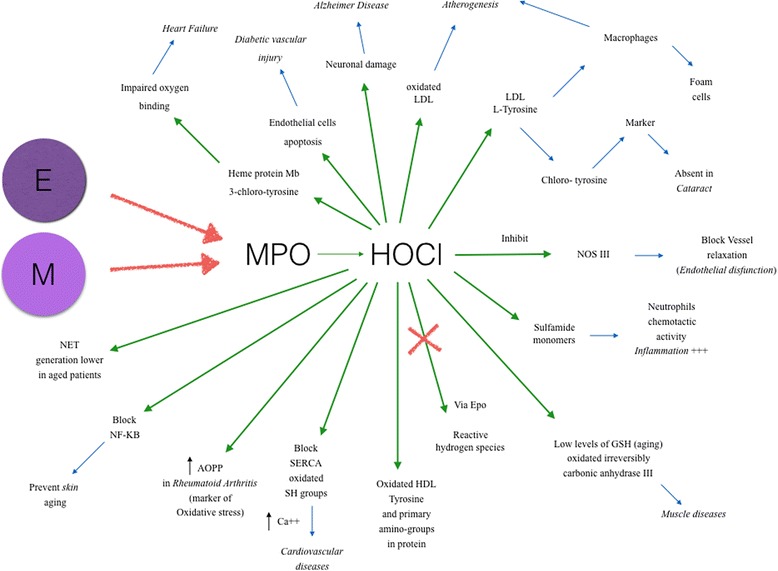
Aging is an agglomerate of biological long-lasting processes that result being inevitable. Main actors in this scenario are both long-term inflammation and oxidative stress. It has been proved that oxidative stress induce alteration in proteins and this fact itself is critically important in the pathophysiological mechanisms leading to diseases typical of aging. Among reactive species, chlorine ones such as hypochlorous acid (HOCl) are cytotoxic oxidants produced by activated neutrophils during chronic inflammation processes. HOCl can also cause damages by reacting with biological molecules. HOCl is generated by myeloperoxidase (MPO) and augmented serum levels of MPO have been described in acute and chronic inflammatory conditions in cardiovascular patients and has been implicated in many inflammatory diseases such as atherosclerosis, neurodegenerative conditions, and some cancers. Due to these data, we decided to conduct an up-to-date review evaluating chlorinative stress effects on every age-related disease linked; potential anti-oxidant countermeasures were also assessed. Results obtained associated HOCl generation to the aging processes and confirmed its connection with diseases like neurodegenerative and cardiovascular pathologies, atherosclerosis and cancer; chlorination was mainly linked to diseases where molecular (protein) alteration constitute the major suspected cause: i.e. inflammation, tissue lesions, DNA damages, apoptosis and oxidative stress itself. According data collected, a healthy lifestyle together with some dietary suggestion and/or the administration of nutracetical antioxidant integrators could balance the effects of chlorinative stress and, in some cases, slow down or prevent the onset of age-releated diseases.
Overview
The claims and statistics of this paper haven’t been checked yet.
Free: it reads the open-access text and checks the first 5 claims that cite a source we can check. Create a free account to check every claim.
Integrity signals
Registry
Cites
Statistics
Figures
Verification
Claims the paper makes
The claims and statistics of this paper haven’t been checked yet.
Free: it reads the open-access text and checks the first 5 claims that cite a source we can check. Create a free account to check every claim.
Claims other papers make about this one
Each is checked against this paper’s own text: does it say what the citing paper says it does?
In the citing paper
“endogenous hypohalous acids, even though serving innate host defense functions, may also induce tissue damage at sites of inflammation, an area of active research in the context of neurodegenerative disease (M. Alzheimer; M. Parkinson), metabolic and cardiovascular dysfunction (atherosclerosis; diabetes), autoimmune dysregulation, cancer, and chronological aging, among others (47, 49, 50).”
From Hypochlorous Acid: From Innate Immune Factor and Environmental Toxicant to Chemopreventive Agent Targeting Solar UV-Induced Skin Cancer (2022) · cites this paper as [49]
In the citing paper
“Importantly, human organ dysfunction may occur as a result of chlorination stress originating from exogenous (environmental) and endogenous (innate) sources (47, 49).”
From Hypochlorous Acid: From Innate Immune Factor and Environmental Toxicant to Chemopreventive Agent Targeting Solar UV-Induced Skin Cancer (2022) · cites this paper as [49]
Self-check
Percentages, sums and reported differences re-computed from the paper’s own numbers.
The self-check needs the paper’s full text.
Citations
Cites
ROS as signalling molecules: Mechanisms that generate specificity in ROS homeostasis
D'Autréaux, B., & Toledano, M. B. (2007) · Nature Reviews Molecular Cell Biology · doi:10.1038/nrm2256 · Cited by 3,642
Daugherty, A., Dunn, J. L., Rateri, D. L., & Heinecke, J. W. (1994) · Journal of Clinical Investigation · doi:10.1172/jci117342 · Cited by 1,269 · cited 3×
“studied atherosclerotic lesions where they detected the enzyme MPO; their data sustained that MPO induced LDL oxidation by pathways involving HOCl and promoting atherogenesis [21].”
Falk, R. J., Terrell, R. S., Charles, L. A., & Jennette, J. C. (1990) · Proceedings of the National Academy of Sciences · doi:10.1073/pnas.87.11.4115 · Cited by 1,261
Reactive oxygen species: from health to disease
Brieger, K., Schiavone, S., Miller Jr., F. J., & Krause, K.-H. (2012) · Swiss Medical Weekly · doi:10.4414/smw.2012.13659 · Cited by 1,133 · cited 3×
“Proteins are the most common targets of HOCl and for this reason changes induced in their sub-elements (peptides and amino acids) have been largely examined [5, 6, 13].”
Hazen, S. L., & Heinecke, J. W. (1997) · Journal of Clinical Investigation · doi:10.1172/jci119379 · Cited by 842 · cited 2×
“The generation of HOCl was demonstrated to interfere with lipoproteins with a consequent oxidation resulting in the conversion of macrophages in foam cells and in the acceleration of the atherosclerotic process [7, 14, 21, 22].”
Inflammaging and Anti-Inflammaging: The Role of Cytokines in Extreme Longevity
Minciullo, P. L., Catalano, A., Mandraffino, G., Casciaro, M., Crucitti, A., Maltese, G., Morabito, N., Lasco, A., Gangemi, S., & Basile, G. (2016) · Archivum Immunologiae et Therapiae Experimentalis · doi:10.1007/s00005-015-0377-3 · Cited by 433 · cited 1×
“DNA repair, apoptosis, immune response, oxidative stress and inflammation contribute to this dynamic process [2].”
Self-citationCellular stress responses, hormetic phytochemicals and vitagenes in aging and longevity
Calabrese, V., Cornelius, C., Dinkova-Kostova, A. T., Iavicoli, I., Di Paola, R., Koverech, A., Cuzzocrea, S., Rizzarelli, E., & Calabrese, E. J. (2012) · Biochimica et Biophysica Acta (BBA) - Molecular Basis of Disease · doi:10.1016/j.bbadis.2011.11.002 · Cited by 420 · cited 1×
“The maintenance of optimal conditions in an organism in order to contrast aging is accomplished by a complex network of longevity assurance processes that are controlled by Vitagenes, a group of genes aimed at preserving cellular homeostasis during stressful conditions; in particular Vitagenes encode the genes for the…”
Hazeldine, J., Harris, P., Chapple, I. L., Grant, M., Greenwood, H., Livesey, A., Sapey, E., & Lord, J. M. (2014) · Aging Cell · doi:10.1111/acel.12222 · Cited by 292
Assessment of chlorination by human neutrophils
Foote, C. S., Goyne, T. E., & Lehrer, R. I. (1983) · Nature · doi:10.1038/301715a0 · Cited by 279
Eosinophil peroxidase nitrates protein tyrosyl residues
Wu, W., Chen, Y., & Hazen, S. L. (1999) · Journal of Biological Chemistry · doi:10.1074/jbc.274.36.25933 · Cited by 265 · cited 5×
“Also the eosinophil peroxidase (EPO) was thought being implicated in provoking oxidative tissue damage in many conditions (i.e. asthma, allergic inflammatory disorders, cancer, infections).”
InfluentialYu, Y., Cui, Y., Niedernhofer, L. J., & Wang, Y. (2016) · Chemical Research in Toxicology · doi:10.1021/acs.chemrestox.6b00265 · Cited by 199 · cited 4×
“Proteins are the most common targets of HOCl and for this reason changes induced in their sub-elements (peptides and amino acids) have been largely examined [5, 6, 13].”
InfluentialAging: A revisited theory based on free radicals generated by NOX family NADPH oxidases
Krause, K.-H. (2007) · Experimental Gerontology · doi:10.1016/j.exger.2006.10.011 · Cited by 196
The Hormetic Role of Dietary Antioxidants in Free Radical-Related Diseases
Calabrese, V., Cornelius, C., Trovato-Salinaro, A., Cambria, M., Locascio, M., Rienzo, L., Condorelli, D., Mancuso, C., De Lorenzo, A., & Calabrese, E. (2010) · Current Pharmaceutical Design · doi:10.2174/138161210790883615 · Cited by 166
Calabrese, V., Giordano, J., Signorile, A., Laura Ontario, M., Castorina, S., De Pasquale, C., Eckert, G., & Calabrese, E. J. (2016) · Journal of Neuroscience Research · doi:10.1002/jnr.23925 · Cited by 157 · cited 1×
“Vitagens have also been studied in diseases typical of the old age such as neurodegenerative ones [11].”
Mass Spectrometric Quantification of 3-Chlorotyrosine in Human Tissues with Attomole Sensitivity
Hazen, S. L., Crowley, J. R., Mueller, D. M., & Heinecke, J. W. (1997) · Free Radical Biology and Medicine · doi:10.1016/s0891-5849(97)00084-1 · Cited by 150 · cited 3×
“In a successive paper, they also demonstrated that 3-chlorotyrosine was a marker of chlorination at sites of inflammation [7].”
Myeloperoxidase: Bridging the gap in neurodegeneration
Ray, R. S., & Katyal, A. (2016) · Neuroscience & Biobehavioral Reviews · doi:10.1016/j.neubiorev.2016.06.031 · Cited by 130
Novel Intra- and Inter-molecular Sulfinamide Bonds in S100A8 Produced by Hypochlorite Oxidation
Raftery, M. J., Yang, Z., Valenzuela, S. M., & Geczy, C. L. (2001) · Journal of Biological Chemistry · doi:10.1074/jbc.m101566200 · Cited by 125 · cited 1×
“potentially play a critical role in physiological and pathological processes fundamental in aging and age-related diseases [32].”
Maki, R. A., Tyurin, V. A., Lyon, R. C., Hamilton, R. L., DeKosky, S. T., Kagan, V. E., & Reynolds, W. F. (2009) · Journal of Biological Chemistry · doi:10.1074/jbc.m807731200 · Cited by 124 · cited 2×
“It was speculated a model where MPO expression in astrocytes promoted a HOCl related damage, contributing to neuronal damage and cognitive impairment [40, 41].”
Bergt, C., Fu, X., Huq, N. P., Kao, J., & Heinecke, J. W. (2004) · Journal of Biological Chemistry · doi:10.1074/jbc.m309046200 · Cited by 123 · cited 3×
“Other reactive species could generate oxygenated sulfur products too, but they are useless as biomarkers for HOCl-induced damage [14].”
Jaimes, E. A., Sweeney, C., & Raij, L. (2001) · Hypertension · doi:10.1161/hyp.38.4.877 · Cited by 112
Topical hypochlorite ameliorates NF-κB–mediated skin diseases in mice
Leung, T. H., Zhang, L. F., Wang, J., Ning, S., Knox, S. J., & Kim, S. K. (2013) · Journal of Clinical Investigation · doi:10.1172/jci70895 · Cited by 107 · cited 2×
“HOCl topic application could even prevent skin aging [37].”
Investigation of protein oxidation and lipid peroxidation in patients with rheumatoid arthritis
Baskol, G., Demir, H., Baskol, M., Kilic, E., Ates, F., Karakukcu, C., & Ustdal, M. (2006) · Cell Biochemistry and Function · doi:10.1002/cbf.1257 · Cited by 94 · cited 2×
“According their data, neutrophils, which produce great quantities of chlorinated oxidants by MPO, could augment serum AOPP levels and play a fundamental role in the pathogenesis of RA by generating pro-inflammatory mediators [36].”
Mallis, R. J., Hamann, M. J., Zhao, W., Zhang, T., Hendrich, S., & Thomas, J. A. (2002) · Biological Chemistry · doi:10.1515/bc.2002.067 · Cited by 94 · cited 1×
“As it is known that there is a physiological reduction of glutathione in aged animals, these condition may together with other mechanisms favourite a higher irreversible protein oxidation [33].”
Antimicrobial and cytotoxic activity of hypochlorous acid: interactions with taurine and nitrite
Marcinkiewicz, J., Chain, B., Nowak, B., Grabowska, A. K., Bryniarski, K., & Baran, J. (2000) · Inflammation Research · doi:10.1007/pl00000208 · Cited by 88 · cited 1×
“HOCl is generated by the heme enzyme myeloperoxidase [15].”
Significance of metallothioneins in aging brain
SHARMA, S. K., & Ebadi, M. (2014) · Neurochemistry International · doi:10.1016/j.neuint.2013.12.009 · Cited by 73 · cited 1×
“The key players in this scenario are both long-term inflammation and oxidative stress [1].”
Endothelial dysfunction is induced by proinflammatory oxidant hypochlorous acid
Zhang, C., Patel, R., Eiserich, J. P., Zhou, F., Kelpke, S., Ma, W., Parks, D. A., Darley-Usmar, V., & White, C. R. (2001) · American Journal of Physiology-Heart and Circulatory Physiology · doi:10.1152/ajpheart.2001.281.4.h1469 · Cited by 73 · cited 2×
“ported a complete inversion of HOCl inhibitory effect vessel relaxation [24].”
Role of the diet as a link between oxidative stress and liver diseases
Arrigo, T., Leonardi, S., Cuppari, C., Manti, S., Lanzafame, A., D'Angelo, G., Gitto, E., Marseglia, L., & Salpietro, C. (2015) · World Journal of Gastroenterology · doi:10.3748/wjg.v21.i2.384 · Cited by 60 · cited 1×
“A specific low chlorine diet, rich in natural and endogenous antioxidant foods could favourite this prevention [48].”
Tian, R., Ding, Y., Peng, Y., & Lu, N. (2017) · Biochemical and Biophysical Research Communications · doi:10.1016/j.bbrc.2017.01.132 · Cited by 58 · cited 2×
“Novel data supported outdated results and confirmed the hypothesis of a serious endothelial damage induced by chlorinative stress; above all, authors deepened the detrimental effects induced by hyperglycaemia and by neutrophils intervention immediately after an acute myocardial injury [26, 39].”
Cook, N. L., Viola, H. M., Sharov, V. S., Hool, L. C., Schöneich, C., & Davies, M. J. (2012) · Free Radical Biology and Medicine · doi:10.1016/j.freeradbiomed.2011.12.001 · Cited by 56 · cited 2×
“They speculated that HOCl could inhibit SERCA activity by thiol oxidation and generated cytosolic Ca2+ augmented levels in artery endothelial cells [17].”
Enhancement of immunogenic properties of ovalbumin as a result of its chlorination
Marcinkiewicz, J., Chain, B., Olszowska, E., Olszowski, S., & Zgliczyński, J. M. (1991) · International Journal of Biochemistry · doi:10.1016/0020-711x(91)90280-z · Cited by 51 · cited 1×
“The word “chlorination” was used to describe the modification induced in molecules by HOCl intervention; “chlorinative stress” expression was chosen to define the sum of HOCl pathological interaction in a physiological organism [14, 21, 42, 43].”
Calabrese, V., Giordano, J., Crupi, R., Paola, R. D., Ruggieri, M., Bianchini, R., Ontario, M. L., Cuzzocrea, S., & Calabrese, E. J. (2016) · Journal of Neuroscience Research · doi:10.1002/jnr.23967 · Cited by 51
Yamori, Y., Murakami, S., Ikeda, K., & Nara, Y. (2004) · Clinical and Experimental Pharmacology and Physiology · doi:10.1111/j.1440-1681.2004.04122.x · Cited by 49 · cited 1×
“For example, Taurine was demonstrated to be a physiological primary scavenger of HOCl; since serum and urine taurine levels in elderly patients with chronic inflammatory disorders were found to be reduced, an adequate level of the amino acid inside the body may be useful in order to prevent age-related diseases [49].”
Whiteman, M., Spencer, J. P. E., Szeto, H. H., & Armstrong, J. S. (2008) · Antioxidants & Redox Signaling · doi:10.1089/ars.2007.1879 · Cited by 44 · cited 2×
“Among the above cited reactive species, chlorine ones such as hypochlorous acid (HOCl) are cytotoxic oxidants produced by activated neutrophils during chronic inflammation processes [13].”
Does Oxidative Stress Play a Critical Role in Cardiovascular Complications of Kawasaki Disease?
Straface, E., Marchesi, A., Gambardella, L., Metere, A., Jacobis, I. T. D., Viora, M., Giordani, L., Villani, A., Principe, D. D., Malorni, W., et al. (2012) · Antioxidants and Redox Signaling · doi:10.1089/ars.2012.4660 · Cited by 42
Calabrese, V., Dattilo, S., Petralia, A., Parenti, R., Pennisi, M., Koverech, G., Calabrese, V., Graziano, A., Monte, I., Maiolino, L., et al. (2015) · Free Radical Research · doi:10.3109/10715762.2015.1020799 · Cited by 38 · cited 1×
“In recent years, many scientific researches were aimed to refine new techniques based on proteomics, which lead to the discovery of new proteins and molecules having a key role in oxidative stress and aging processes, and for the identification of selected proteins to be used in a specific therapeutic targets [12].”
Capó, X., Martorell, M., Sureda, A., Riera, J., Drobnic, F., Tur, J. A., & Pons, A. (2016) · Nutrients · doi:10.3390/nu8100619 · Cited by 38
Mian, K. B., & Martin, W. (1997) · British Journal of Pharmacology · doi:10.1038/sj.bjp.0701187 · Cited by 33
Raschke, P., Becker, B. F., Leipert, B., Schwartz, L. M., Stefan Zahler, A., & Gerlach, E. (1993) · Basic Research in Cardiology · doi:10.1007/bf00800639 · Cited by 32
Sand, C., Peters, S. L. M., Pfaffendorf, M., & van Zwieten, P. A. (2003) · Clinical and Experimental Pharmacology and Physiology · doi:10.1046/j.1440-1681.2003.03822.x · Cited by 27 · cited 1×
“of inflammation-associated pathologies in the cardiovascular system [31].”
Chlorinated drinking water, cancers and adverse health outcomes in Gangtok, Sikkim, India.
Sharma, R. N., & Goel, S. (2007) · PubMed · Cited by 24
Oxidative stress markers are increased in patients with mastocytosis
Gangemi, S., Minciullo, P. L., Magliacane, D., Saitta, S., Loffredo, S., Saija, A., Cristani, M., Marone, G., & Triggiani, M. (2015) · Allergy · doi:10.1111/all.12571 · Cited by 23 · cited 1×
“diseases typical of aging, extending from atherosclerosis to neurodegenerative disorders [7] as well as other inflammatory and immunological diseases [8, 9].”
Self-citationWang, X., Kim, H. B., Szuchman-Sapir, A. J., McMahon, A., Dennis, J. M., & Witting, P. K. (2016) · Archives of Biochemistry and Biophysics · doi:10.1016/j.abb.2016.10.013 · Cited by 23 · cited 3×
“in vivo studies demonstrated that damaged LV-tissue by the induction of an acute myocardial infarction lead to the recruitment and activation of neutrophils and concomitant increase in MPOactivity and consequently of the HOCl; the 3-Cl-Tyr formed by the HOCl modification of the heme protein Mb impaired the protein’s a…”
Lorenzo, G. D., Minciullo, P. L., Leto‐Barone, M. S., La Piana, S., La Porta, G., Saija, A., & Gangemi, S. (2013) · PubMed · Cited by 19
Self-citationHOCl effects on tracheal epithelium: conductance and permeability measurements
Guo, Y.-Q., Schneider, L. A., & Wangensteen, O. D. (1995) · Journal of Applied Physiology · doi:10.1152/jappl.1995.78.4.1330 · Cited by 19
Štrosová, M., Škuciová, M., & Horáková, Ľ. (2005) · BioFactors · doi:10.1002/biof.5520240113 · Cited by 16 · cited 2×
“Strosovà et al. 2005., studied the effects of HOCl in rabbit skeletal sarcoplasmic reticulum (SR) speculating an aging model.”
Cabassi, A., Binno, S. M., Tedeschi, S., Graiani, G., Galizia, C., Bianconcini, M., Coghi, P., Fellini, F., Ruffini, L., Govoni, P., et al. (2015) · BioMed Research International · doi:10.1155/2015/691693 · Cited by 16
Lu, N., Ding, Y., Tian, R., & Peng, Y. (2016) · European Journal of Pharmacology · doi:10.1016/j.ejphar.2016.03.042 · Cited by 16 · cited 3×
“It was speculated a model where MPO expression in astrocytes promoted a HOCl related damage, contributing to neuronal damage and cognitive impairment [40, 41].”
Ismael, F. O., Barrett, T. J., Sheipouri, D., Brown, B. E., Davies, M. J., & Hawkins, C. L. (2016) · PLoS ONE · doi:10.1371/journal.pone.0168844 · Cited by 15 · cited 1×
“shown that exposure of macrophages to HOCl and HOSCN or to LDL already modified by these chlorinative stress agents caused a compromised lysosomal enzyme function reducing both proteolytic capacity and decrease cholesteryl ester hydrolysis; according the authors these events could conduct to the accumulation of protei…”
Okabe, E., Takahashi, S., Norisue, M., Manson, N. H., Kukreja, R. C., Heß, M., & Ito, H. (1993) · European Journal of Pharmacology Environmental Toxicology and Pharmacology · doi:10.1016/0926-6917(93)90022-i · Cited by 10
Deglycosylation influences the oxidation activity and antigenicity of myeloperoxidase
Wang, J., Li, J., Cui, Z., & Zhao, M. (2016) · Nephrology · doi:10.1111/nep.12926 · Cited by 10
Xu, P., Hao, J., Chen, M., Cui, Z., & Zhao, M. (2012) · Human Immunology · doi:10.1016/j.humimm.2012.02.004 · Cited by 5
Is hypochlorous acid (HOCl) involved in age‐related nuclear cataract?
Hazell, L., Fu, H., Dean, R. T., Stacker, R., & Truscott, R. J. W. (2002) · Clinical and Experimental Optometry · doi:10.1111/j.1444-0938.2002.tb03015.x · Cited by 2
Cited by
Effects and Mechanisms of Resveratrol on Aging and Age‐Related Diseases
Zhou, D.-D., Luo, M., Huang, S.-Y., Saimaiti, A., Shang, A., Gan, R.-Y., & Li, H.-B. (2021) · Oxidative Medicine and Cellular Longevity · doi:10.1155/2021/9932218 · Cited by 363
The Role of Myeloperoxidase in Biomolecule Modification, Chronic Inflammation, and Disease
Davies, M. J., & Hawkins, C. L. (2020) · Antioxidants & Redox Signaling · doi:10.1089/ars.2020.8030 · Cited by 332
Andrés, C. M. C., Pérez de la Lastra, J. M., Juan, C. A., Plou, F. J., & Pérez-Lebeña, E. (2022) · Stresses · doi:10.3390/stresses2030019 · Cited by 218
“important in the progression of a number of diseases including atherosclerosis, chronic inflammation and some cancers [49].”
BackgroundAndrés, C. M. C., Pérez de la Lastra, J. M., Juan, C. A., Plou, F. J., & Pérez-Lebeña, E. (2022) · International Journal of Molecular Sciences · doi:10.3390/ijms231810735 · Cited by 166
Gonos, E. S., Kapetanou, M., Sereikaite, J., Bartosz, G., Naparło, K., Grzesik, M., & Sadowska-Bartosz, I. (2018) · Aging · doi:10.18632/aging.101450 · Cited by 129
“Furthermore, MPO was reported to be expressed with increased levels in the cerebral tissue of patients affected by AD [156] and 3-chlorotyrosine as a biomarker of HOCl production was detected in proteins from AD hippocampus.”
Metadata
- Authors
- Casciaro, M., Di Salvo, E., Pace, E., Ventura-Spagnolo, E., Navarra, M., & Gangemi, S.
- Affiliations
- University of Messina (IT)
- Istituto di Biomedicina e di Immunologia Molecolare Alberto Monroy (IT)
- University of Palermo (IT)
- Corresponding author
- Gangemi, Sebastiano
- Venue
- Immunity & Ageing
- Published
- 2017-11-14
- Volume
- 14
- Issue
- 1
- Pages
- 21-21
- ISSN
- 1742-4933 (ISSN-L)
- PMC
- PMC5686828
- OpenAlex
- W2769805355
- Cited by
- 85
- References
- 52
- Citations by year
- 2026: 8 · 2025: 10 · 2024: 6 · 2023: 9 · 2022: 17 · 2021: 11 · 2020: 13 · 2019: 8 · 2018: 3
- FWCI
- 0.67
- Type
- journal article
- Language
- en
- Open access
- gold
- doi.org
- Licence
- cc-by
- Locations
- Immunity & Ageing (publishedVersion, cc-by)
- Europe PMC (PubMed Central) (publishedVersion, cc-by)
- PubMed Central (publishedVersion, cc-by)
- PubMed (publishedVersion)
- DOAJ (DOAJ: Directory of Open Access Journals) (submittedVersion, cc-by-sa)
- Nova Science Publishers (Nova Science Publishers, Inc.) (submittedVersion, other-oa)
- Topics
- Life Sciences › Immunology and Microbiology › Immunology › Neutrophil, Myeloperoxidase and Oxidative Mechanisms
- Health Sciences › Medicine › Biochemistry (medical) › Antioxidant Activity and Oxidative Stress
- Life Sciences › Biochemistry, Genetics and Molecular Biology › Molecular Biology › Redox biology and oxidative stress
- Keywords
- hypochlorous acid, myeloperoxidase, oxidative stress, chronic inflammation, aging, age-related diseases, neurodegenerative diseases, atherosclerosis, cardiovascular disease, cancer, protein oxidation, DNA damage, apoptosis, antioxidants, nutraceuticals, healthy lifestyle
About these checks
Registry, retraction, Cites and statistics results are computed, not judged, with one exception: a printed reference that no index lists is read once by a model before it counts as a citation error. Claims are extracted by a model and kept only when their quote appears verbatim in the text; each cited source is then checked, with a model’s help, for whether it says what the claim relies on. Those verdicts can be wrong — read the claim’s quote and the cited source before relying on one.
Statistics and arithmetic are recomputed, not judged.
Confidence bands are shown only for fields calibrated on our annotated test set. None is calibrated yet, so no band is shown.
What counts as a claim ›How we measure confidence ›How we check this ›
Are you an author, or do you see a problem with this page? Request a review
Data sources
Bibliographic data: Semantic Scholar, OpenAlex, Crossref.
Contains information from the Semantic Scholar Academic Graph Datasets, made available under the ODC Attribution License (ODC-BY 1.0).
Semantic Scholar’s data is described in: Kinney, R., et al. (2023). The Semantic Scholar Open Data Platform. arXiv:2301.10140.
