

The DOI matches its Crossref record; 208 of the 208 references it cites were found in a registry or an index.
Mobility related physical and functional losses due to aging and disease - a motivation for lower limb exoskeletons
Open accessAbstract
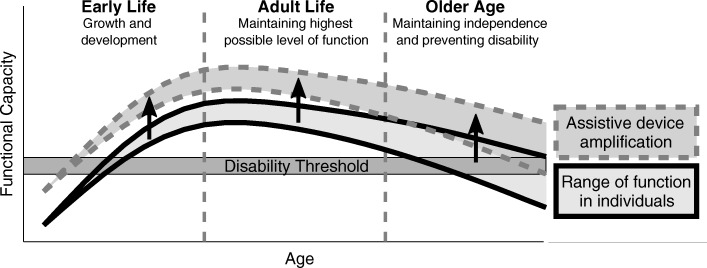
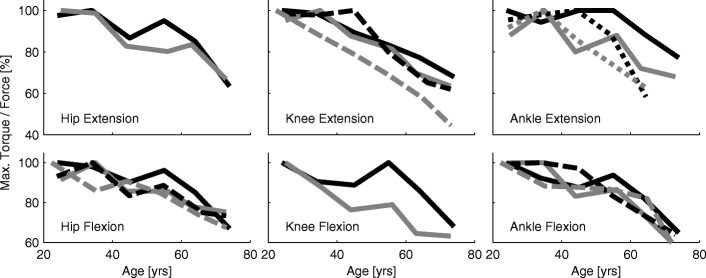
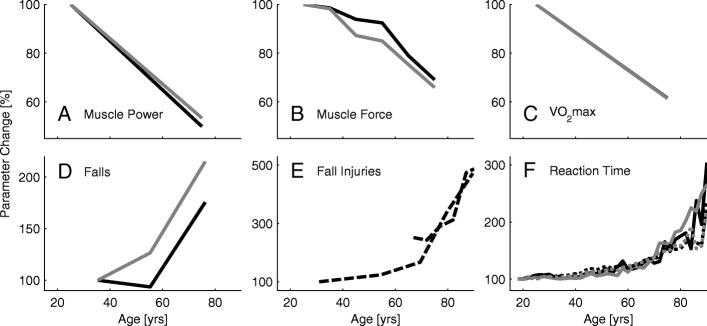
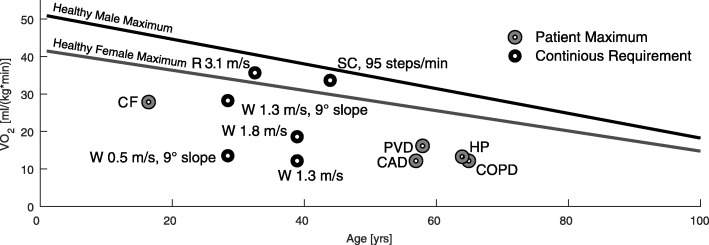
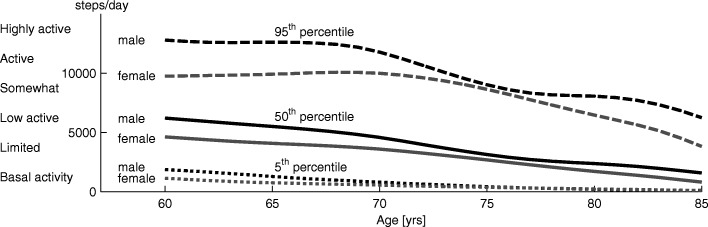
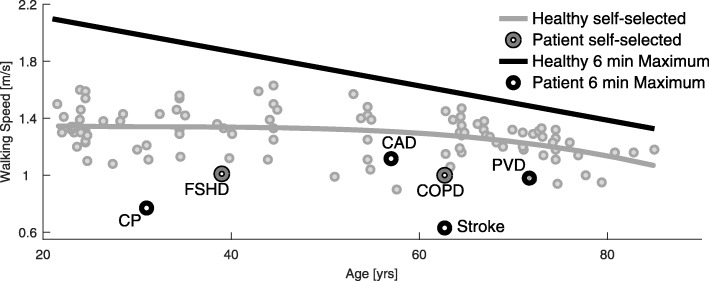
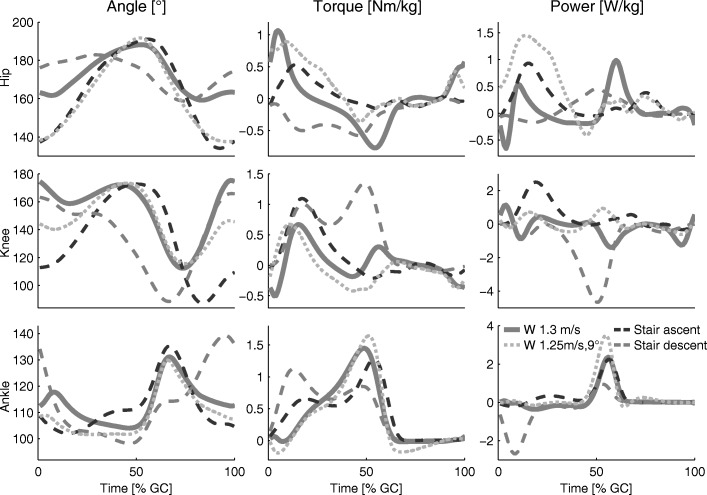
Background: Physical and functional losses due to aging and diseases decrease human mobility, independence, and quality of life. This study is aimed at summarizing and quantifying these losses in order to motivate solutions to overcome them with a special focus on the possibilities by using lower limb exoskeletons. Methods: A narrative literature review was performed to determine a broad range of mobility-related physical and functional measures that are affected by aging and selected cardiovascular, respiratory, musculoskeletal, and neurological diseases. Results: The study identified that decreases in limb maximum muscle force and power (33% and 49%, respectively, 25–75 yrs) and in maximum oxygen consumption (40%, 20–80 yrs) occur for older adults compared to young adults. Reaction times more than double (18–90 yrs) and losses in the visual, vestibular, and somatosensory systems were reported. Additionally, we found decreases in steps per day (75%, 60–85 yrs), maximum walking speed (24% 25–75 yrs), and maximum six-minute and self-selected walking speed (38% and 21%, respectively, 20–85 yrs), while we found increases in the number of falls relative to the number of steps per day (800%), injuries due to falls (472%, 30–90 yrs) and deaths caused by fall (4000%, 65–90 yrs). Measures were identified to be worse for individuals with impaired mobility. Additional detrimental effects identified for them were the loss of upright standing and locomotion, freezing in movement, joint stress, pain, and changes in gait patterns. Discussion: This review shows that aging and chronic conditions result in wide-ranging losses in physical and sensory capabilities. While the impact of these losses are relatively modest for level walking, they become limiting during more demanding tasks such as walking on inclined ground, climbing stairs, or walking over longer periods, and especially when coupled with a debilitating disease. As the physical and functional parameters are closely related, we believe that lost functional capabilities can be indirectly improved by training of the physical capabilities. However, assistive devices can supplement the lost functional capabilities directly by compensating for losses with propulsion, weight support, and balance support. Conclusions: Exoskeletons are a new generation of assistive devices that have the potential to provide both, training capabilities and functional compensation, to enhance human mobility.
Overview
The claims and statistics of this paper haven’t been checked yet.
Run the check — free, no account needed. It reads the open-access text and checks the sources it cites.
Integrity signals
Registry
Cites
Statistics
Figures
Verification
Claims the paper makes
The claims and statistics of this paper haven’t been checked yet.
Run the check — free, no account needed. It reads the open-access text and checks the sources it cites.
Claims other papers make about this one
Each is checked against this paper’s own text: does it say what the citing paper says it does?
In the citing paper
“In general, COVID-19 is acquired by transmission of a respiratory virus via close contact, droplet spray or aerosol, with the duration of viral stability and viability maintained depending on various objects or surfaces [16].”
Self-check
Percentages, sums and reported differences re-computed from the paper’s own numbers.
The self-check needs the paper’s full text.
Citations
Cites
Vos, T., Abajobir, A. A., Abate, K. H., Abbafati, C., Abbas, K. M., Abd-Allah, F., Abdulkader, R. S., Abdulle, A. M., Abebo, T. A., Abera, S. F., et al. (2017) · The Lancet · doi:10.1016/s0140-6736(17)32154-2 · Cited by 13,220
‘Small Changes' to Diet and Physical Activity Behaviors for Weight Management
Hills, A. P., Byrne, N. M., Lindstrom, R. C., & Hill, J. O. (2013) · Obesity Facts · doi:10.1159/000345030 · Cited by 9,526
Vos, T., Barber, R. M., Bell, B., Bertozzi-Villa, A., Biryukov, S., Bolliger, I., Charlson, F., Davis, A., Degenhardt, L., Dicker, D., et al. (2015) · The Lancet · doi:10.1016/s0140-6736(15)60692-4 · Cited by 6,414
(1992) · Applied Ergonomics · doi:10.1016/0003-6870(92)90318-p · Cited by 5,774
Parkinson's disease: clinical features and diagnosis
Jankovic, J. (2008) · Journal of Neurology, Neurosurgery & Psychiatry · doi:10.1136/jnnp.2007.131045 · Cited by 5,720
Human balance and posture control during standing and walking
Winter, D. (1995) · Gait & Posture · doi:10.1016/0966-6362(96)82849-9 · Cited by 3,638
Fowkes, F. G. R., Rudan, D., Rudan, I., Aboyans, V., Denenberg, J. O., McDermott, M. M., Norman, P. E., Sampson, U. K., Williams, L. J., Mensah, G. A., et al. (2013) · The Lancet · doi:10.1016/s0140-6736(13)61249-0 · Cited by 3,508
Sarcopenia: origins and clinical relevance
Rosenberg, I. H. (1997) · The Journal of Nutrition · doi:10.1093/jn/127.5.990s · Cited by 2,399
Comfortable and maximum walking speed of adults aged 20—79 years: reference values and determinants
Bohannon, R. W. (1997) · Age and Ageing · doi:10.1093/ageing/26.1.15 · Cited by 2,346
Using Pedometers to Increase Physical Activity and Improve Health: A Systematic Review
Bravata, D. M., Smith-Spangler, C., Sundaram, V., Gienger, A. L., Lin, N., Lewis, R., Stave, C. D., Olkin, I., & Sirard, J. R. (2007) · JAMA · doi:10.1001/jama.298.19.2296 · Cited by 2,064
Research works printed but not linked: 1
- Lipfert SW. Kinematic and Dynamic Similarities Between Walking and Running. Hamburg: Verlag Dr. Kovac; 2010. ISBN: 978-3-8300-5030-8.
Cited by
Sorted by citations
Reducing the metabolic rate of walking and running with a versatile, portable exosuit
Kim, J., Lee, G., Heimgartner, R., Revi, D. A., Karavas, N. C., Nathanson, D., Galiana, I., Eckert-Erdheim, A. M., Murphy, P., Perry, D., et al. (2019) · Science · doi:10.1126/science.aav7536 · Cited by 504
Self-citationReview of control strategies for lower-limb exoskeletons to assist gait
Baud, R., Manzoori, A. R., Ijspeert, A. J., & Bouri, M. (2021) · Journal of NeuroEngineering and Rehabilitation · doi:10.1186/s12984-021-00906-3 · Cited by 394
Wang, J., Li, Y., Yang, G.-Y., & Jin, K. (2024) · Aging and Disease · doi:10.14336/ad.2024.0124-1 · Cited by 193
Age and sex differences in normative gait patterns
Rowe, E., Beauchamp, M. K., & Wilson, J. L. A. (2021) · Gait & Posture · doi:10.1016/j.gaitpost.2021.05.014 · Cited by 89
Stance and Swing Detection Based on the Angular Velocity of Lower Limb Segments During Walking
Grimmer, M., Schmidt, K., Duarte, J. E., Neuner, L., Koginov, G., & Riener, R. (2019) · Frontiers in Neurorobotics · doi:10.3389/fnbot.2019.00057 · Cited by 87
Self-citation
Metadata
- Authors
- Grimmer, M., Riener, R., Walsh, C. J., & Seyfarth, A.
- Affiliations
- Technische Universität Darmstadt (DE)
- ETH Zurich (CH)
- Harvard University (US)
- Corresponding author
- Grimmer, Martin
- Venue
- Journal of NeuroEngineering and Rehabilitation
- Published
- 2019-01-03
- Volume
- 16
- Issue
- 1
- Pages
- 2-2
- ISSN
- 1743-0003 (ISSN-L)
- PMC
- PMC6318939
- OpenAlex
- W2945684207
- Cited by
- 249
- References
- 206
- Citations by year
- 2026: 33 · 2025: 61 · 2024: 43 · 2023: 25 · 2022: 30 · 2021: 35 · 2020: 14 · 2019: 8
- FWCI
- 1.75
- Type
- journal article
- Language
- en
- Update notices
- correction (2020-02-19)
- Open access
- gold
- doi.org
- Locations
- Journal of NeuroEngineering and Rehabilitation (publishedVersion, cc-by)
- Europe PMC (PubMed Central) (publishedVersion, cc-by)
- PubMed Central (publishedVersion, cc-by)
- PubMed (publishedVersion)
- Technischen Universität Darmstadt (acceptedVersion, cc-by)
- DOAJ (DOAJ: Directory of Open Access Journals) (submittedVersion)
- Infoscience (Ecole Polytechnique Fédérale de Lausanne) (submittedVersion, cc-by-nc-nd)
- TUbilio (Technical University of Darmstadt) (submittedVersion)
- Repository for Publications and Research Data (ETH Zurich) (submittedVersion, cc-by)
- Technischen Universität Darmstadt (cc-by)
- ETH Zürich Research Collection (cc-by)
- Funders
- H2020 European Research Council (601003)
- Robert Bosch Stiftung (32.5.G412.0003.0)
- Deutsche Forschungsgemeinschaft (GR 4689/2-1)
- Schweizerischer Nationalfonds zur Förderung der Wissenschaftlichen Forschung
- Topics
- Physical Sciences › Engineering › Biomedical Engineering › Prosthetics and Rehabilitation Robotics
- Health Sciences › Health Professions › Physical Therapy, Sports Therapy and Rehabilitation › Balance, Gait, and Falls Prevention
- Health Sciences › Health Professions › Occupational Therapy › Assistive Technology in Communication and Mobility
- Keywords
- aging, mobility loss, lower limb exoskeleton, assistive devices, VO2max, reaction time, sensory impairment, falls, walking speed, gait, cardiovascular disease, musculoskeletal disorders, neurological disorders, respiratory diseases, functional compensation, mobility training
- MeSH terms
- Exoskeleton Device, Adult, Aged, Aged, 80 and over, Aging, Cardiovascular Diseases, Female, Humans, Lung Diseases, Male, Middle Aged, Motor Activity, Neuromuscular Diseases, Quality of Life, Lower Extremity, Young Adult
About these checks
Registry, retraction, Cites and statistics results are computed, not judged, with one exception: a printed reference that no index lists is read once by a model before it counts as a citation error. Claims are extracted by a model and kept only when their quote appears verbatim in the text; each cited source is then checked, with a model’s help, for whether it says what the claim relies on. Those verdicts can be wrong — read the claim’s quote and the cited source before relying on one.
Statistics and arithmetic are recomputed, not judged.
Confidence bands are shown only for fields calibrated on our annotated test set. None is calibrated yet, so no band is shown.
What counts as a claim ›How we measure confidence ›How we check this ›
Are you an author, or do you see a problem with this page? Request a review
