

The DOI matches its Crossref record; 208 of the 208 references it cites were found in a registry or an index.
Mobility related physical and functional losses due to aging and disease - a motivation for lower limb exoskeletons
Open accessAbstract
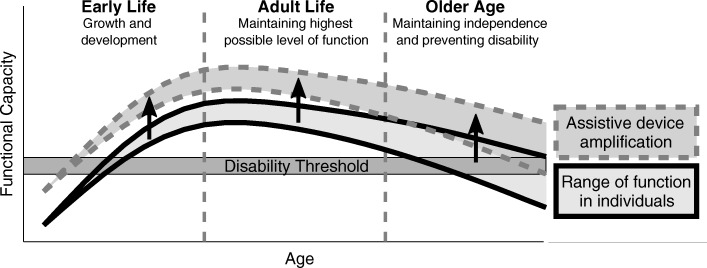
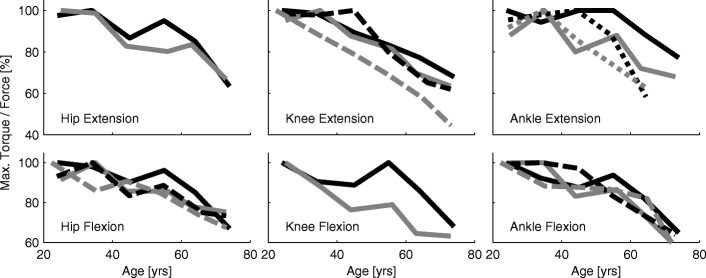
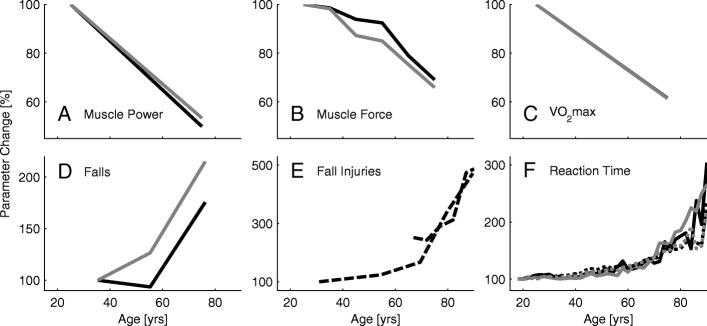
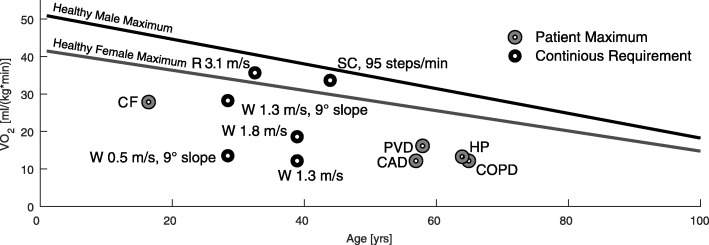
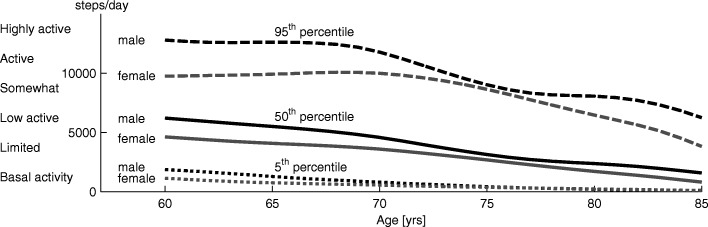
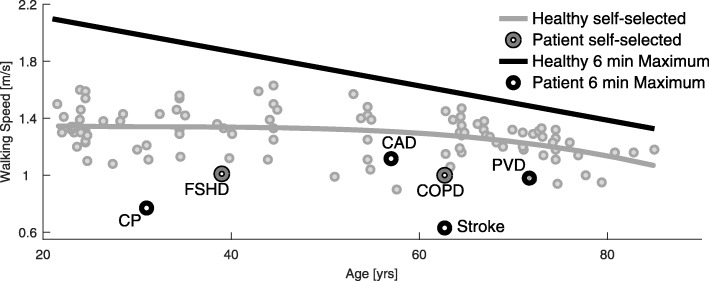
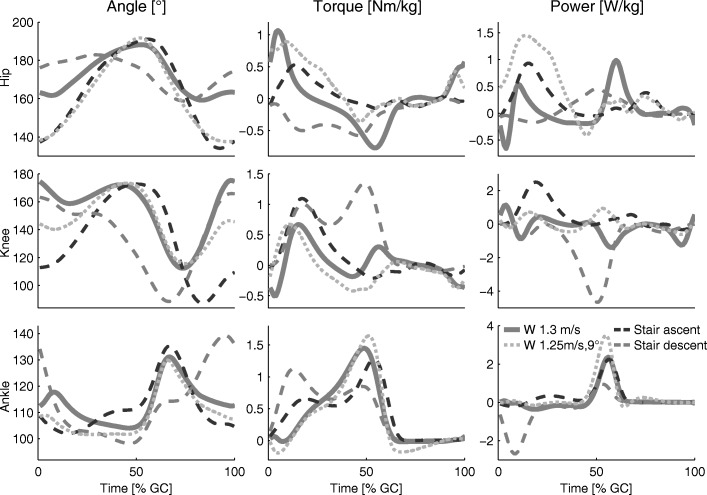
Background: Physical and functional losses due to aging and diseases decrease human mobility, independence, and quality of life. This study is aimed at summarizing and quantifying these losses in order to motivate solutions to overcome them with a special focus on the possibilities by using lower limb exoskeletons. Methods: A narrative literature review was performed to determine a broad range of mobility-related physical and functional measures that are affected by aging and selected cardiovascular, respiratory, musculoskeletal, and neurological diseases. Results: The study identified that decreases in limb maximum muscle force and power (33% and 49%, respectively, 25–75 yrs) and in maximum oxygen consumption (40%, 20–80 yrs) occur for older adults compared to young adults. Reaction times more than double (18–90 yrs) and losses in the visual, vestibular, and somatosensory systems were reported. Additionally, we found decreases in steps per day (75%, 60–85 yrs), maximum walking speed (24% 25–75 yrs), and maximum six-minute and self-selected walking speed (38% and 21%, respectively, 20–85 yrs), while we found increases in the number of falls relative to the number of steps per day (800%), injuries due to falls (472%, 30–90 yrs) and deaths caused by fall (4000%, 65–90 yrs). Measures were identified to be worse for individuals with impaired mobility. Additional detrimental effects identified for them were the loss of upright standing and locomotion, freezing in movement, joint stress, pain, and changes in gait patterns. Discussion: This review shows that aging and chronic conditions result in wide-ranging losses in physical and sensory capabilities. While the impact of these losses are relatively modest for level walking, they become limiting during more demanding tasks such as walking on inclined ground, climbing stairs, or walking over longer periods, and especially when coupled with a debilitating disease. As the physical and functional parameters are closely related, we believe that lost functional capabilities can be indirectly improved by training of the physical capabilities. However, assistive devices can supplement the lost functional capabilities directly by compensating for losses with propulsion, weight support, and balance support. Conclusions: Exoskeletons are a new generation of assistive devices that have the potential to provide both, training capabilities and functional compensation, to enhance human mobility.
Overview
The claims and statistics of this paper haven’t been checked yet.
Run the check — free, no account needed. It reads the open-access text and checks the sources it cites.
Integrity signals
Registry
Cites
Statistics
Figures
Verification
Claims the paper makes
The claims and statistics of this paper haven’t been checked yet.
Run the check — free, no account needed. It reads the open-access text and checks the sources it cites.
Claims other papers make about this one
Each is checked against this paper’s own text: does it say what the citing paper says it does?
In the citing paper
“In general, COVID-19 is acquired by transmission of a respiratory virus via close contact, droplet spray or aerosol, with the duration of viral stability and viability maintained depending on various objects or surfaces [16].”
Self-check
Percentages, sums and reported differences re-computed from the paper’s own numbers.
The self-check needs the paper’s full text.
Citations
Cites
Vos, T., Abajobir, A. A., Abate, K. H., Abbafati, C., Abbas, K. M., Abd-Allah, F., Abdulkader, R. S., Abdulle, A. M., Abebo, T. A., Abera, S. F., et al. (2017) · The Lancet · doi:10.1016/s0140-6736(17)32154-2 · Cited by 13,220
‘Small Changes' to Diet and Physical Activity Behaviors for Weight Management
Hills, A. P., Byrne, N. M., Lindstrom, R. C., & Hill, J. O. (2013) · Obesity Facts · doi:10.1159/000345030 · Cited by 9,526
Vos, T., Barber, R. M., Bell, B., Bertozzi-Villa, A., Biryukov, S., Bolliger, I., Charlson, F., Davis, A., Degenhardt, L., Dicker, D., et al. (2015) · The Lancet · doi:10.1016/s0140-6736(15)60692-4 · Cited by 6,414
(1992) · Applied Ergonomics · doi:10.1016/0003-6870(92)90318-p · Cited by 5,774
Parkinson's disease: clinical features and diagnosis
Jankovic, J. (2008) · Journal of Neurology, Neurosurgery & Psychiatry · doi:10.1136/jnnp.2007.131045 · Cited by 5,720
Human balance and posture control during standing and walking
Winter, D. (1995) · Gait & Posture · doi:10.1016/0966-6362(96)82849-9 · Cited by 3,638
Fowkes, F. G. R., Rudan, D., Rudan, I., Aboyans, V., Denenberg, J. O., McDermott, M. M., Norman, P. E., Sampson, U. K., Williams, L. J., Mensah, G. A., et al. (2013) · The Lancet · doi:10.1016/s0140-6736(13)61249-0 · Cited by 3,508
Sarcopenia: origins and clinical relevance
Rosenberg, I. H. (1997) · The Journal of Nutrition · doi:10.1093/jn/127.5.990s · Cited by 2,399
Comfortable and maximum walking speed of adults aged 20—79 years: reference values and determinants
Bohannon, R. W. (1997) · Age and Ageing · doi:10.1093/ageing/26.1.15 · Cited by 2,346
Using Pedometers to Increase Physical Activity and Improve Health: A Systematic Review
Bravata, D. M., Smith-Spangler, C., Sundaram, V., Gienger, A. L., Lin, N., Lewis, R., Stave, C. D., Olkin, I., & Sirard, J. R. (2007) · JAMA · doi:10.1001/jama.298.19.2296 · Cited by 2,064
Research works printed but not linked: 1
- Lipfert SW. Kinematic and Dynamic Similarities Between Walking and Running. Hamburg: Verlag Dr. Kovac; 2010. ISBN: 978-3-8300-5030-8.
Cited by
Sorted by citations
Reducing the metabolic rate of walking and running with a versatile, portable exosuit
Kim, J., Lee, G., Heimgartner, R., Revi, D. A., Karavas, N. C., Nathanson, D., Galiana, I., Eckert-Erdheim, A. M., Murphy, P., Perry, D., et al. (2019) · Science · doi:10.1126/science.aav7536 · Cited by 504
Self-citationReview of control strategies for lower-limb exoskeletons to assist gait
Baud, R., Manzoori, A. R., Ijspeert, A. J., & Bouri, M. (2021) · Journal of NeuroEngineering and Rehabilitation · doi:10.1186/s12984-021-00906-3 · Cited by 394
Wang, J., Li, Y., Yang, G.-Y., & Jin, K. (2024) · Aging and Disease · doi:10.14336/ad.2024.0124-1 · Cited by 193
Age and sex differences in normative gait patterns
Rowe, E., Beauchamp, M. K., & Wilson, J. L. A. (2021) · Gait & Posture · doi:10.1016/j.gaitpost.2021.05.014 · Cited by 89
Stance and Swing Detection Based on the Angular Velocity of Lower Limb Segments During Walking
Grimmer, M., Schmidt, K., Duarte, J. E., Neuner, L., Koginov, G., & Riener, R. (2019) · Frontiers in Neurorobotics · doi:10.3389/fnbot.2019.00057 · Cited by 87
Self-citationNassour, J., Zhao, G., & Grimmer, M. (2021) · Scientific Reports · doi:10.1038/s41598-021-91702-5 · Cited by 92
Self-citationDoppler Radar for the Extraction of Biomechanical Parameters in Gait Analysis
Seifert, A.-K., Grimmer, M., & Zoubir, A. M. (2020) · IEEE Journal of Biomedical and Health Informatics · doi:10.1109/jbhi.2020.2994471 · Cited by 82
Self-citationLaschowski, B., McNally, W., Wong, A. K. C., & McPhee, J. (2022) · Frontiers in Neurorobotics · doi:10.3389/fnbot.2021.730965 · Cited by 86
Battisti, N. M. L., Mislang, A. R., Cooper, L., O'Donovan, A., Audisio, R. A., Cheung, K.-L., Sarrió, R. G., Stauder, R., Soto-Perez-de-Celis, E., Jaklitsch, M., et al. (2020) · Journal of Geriatric Oncology · doi:10.1016/j.jgo.2020.07.008 · Cited by 79
“In addition, social restrictions and shielding can lead to significant decrease in physical activity which, in turn, can contribute to or accelerate loss of muscle mass and bone density, as well as mobility and functional impairment in older adults; [18,19] and 6) institutionalized patients, such as those in a nursing…”
Optimizing exoskeleton assistance to improve walking speed and energy economy for older adults
Lakmazaheri, A., Song, S., Vuong, B. B., Biskner, B., Kado, D. M., & Collins, S. H. (2024) · Journal of NeuroEngineering and Rehabilitation · doi:10.1186/s12984-023-01287-5 · Cited by 77
Review of balance recovery in response to external perturbations during daily activities
Tokur, D. S., Grimmer, M., & Andre Seyfarth, A. (2019) · Human Movement Science · doi:10.1016/j.humov.2019.102546 · Cited by 66
Self-citationA Proprioceptive Bellows (PB) Actuator With Position Feedback and Force Estimation
Zhou, J., Chen, Y., Chen, X., Wang, Z., Li, Y., & Liu, Y. (2020) · IEEE Robotics and Automation Letters · doi:10.1109/lra.2020.2969920 · Cited by 65
Enhancing Voluntary Motion With Modular, Backdrivable, Powered Hip and Knee Orthoses
Nesler, C., Thomas, G. C., Divekar, N., Rouse, E. J., & Gregg, R. D. (2022) · IEEE Robotics and Automation Letters · doi:10.1109/lra.2022.3145580 · Cited by 64
Osteoarthritis, mobility-related comorbidities and mortality: an overview of meta-analyses
de Campos, G. C., Mundi, R., Whittington, C. J., Toutounji, M.-J., Ngai, W., & Sheehan, B. (2020) · Therapeutic Advances in Musculoskeletal Disease · doi:10.1177/1759720x20981219 · Cited by 62
Biarticular muscles in light of template models, experiments and robotics: a review
Schumacher, C., Sharbafi, M. A., Andre Seyfarth, A., & Rode, C. (2020) · Journal of The Royal Society Interface · doi:10.1098/rsif.2018.0413 · Cited by 57
Lower limb rehabilitation robotics: The current understanding and technology
Bhardwaj, S., Khan, A. A., & Muzammil, M. (2021) · Work · doi:10.3233/wor-205012 · Cited by 49
Grimmer, M., Elshamanhory, A., & Beckerle, P. (2020) · Frontiers in Robotics and AI · doi:10.3389/frobt.2020.00013 · Cited by 49
Self-citationda Silva, L. D., Shiel, A., & McIntosh, C. D. (2022) · Journal of Bodywork and Movement Therapies · doi:10.1016/j.jbmt.2022.02.020 · Cited by 42
Bio-Inspired Balance Control Assistance Can Reduce Metabolic Energy Consumption in Human Walking
Zhao, G., Sharbafi, M. A., Vlutters, M., van Asseldonk, E. H. F., & Andre Seyfarth, A. (2019) · IEEE Transactions on Neural Systems and Rehabilitation Engineering · doi:10.1109/tnsre.2019.2929544 · Cited by 40
Lencioni, T., Carpinella, I., Rabuffetti, M., Cattaneo, D., & Ferrarin, M. (2019) · Proceedings of the Institution of Mechanical Engineers Part H Journal of Engineering in Medicine · doi:10.1177/0954411919889237 · Cited by 38
Grimmer, M., Zeiss, J., Weigand, F., Zhao, G., Lamm, S., Steil, M. J., & Heller, A. (2020) · PLoS ONE · doi:10.1371/journal.pone.0239148 · Cited by 37
Self-citationRondão, C., Mota, M. P., Oliveira, M. M., Peixoto, F., & Esteves, D. (2022) · Frontiers in Aging Neuroscience · doi:10.3389/fnagi.2022.950937 · Cited by 37
Park, H., Jung, W., Kim, S.-W., & Lim, K. (2021) · Frontiers in Physiology · doi:10.3389/fphys.2021.706259 · Cited by 37
ExoNet Database: Wearable Camera Images of Human Locomotion Environments
Laschowski, B., McNally, W., Wong, A. K. C., & McPhee, J. (2020) · Frontiers in Robotics and AI · doi:10.3389/frobt.2020.562061 · Cited by 37
Srour, B., Kaaks, R., Johnson, T., Hynes, L. C., Kuhn, T. E., & Katzke, V. A. (2021) · European Journal of Epidemiology · doi:10.1007/s10654-021-00828-3 · Cited by 34
Laschowski, B., & McPhee, J. (2023) · Journal of Computational and Nonlinear Dynamics · doi:10.1115/1.4056919 · Cited by 33
From a biological template model to gait assistance with an exosuit
Firouzi, V., Davoodi, A., Bahrami, F., & Sharbafi, M. A. (2021) · Bioinspiration & Biomimetics · doi:10.1088/1748-3190/ac2e0d · Cited by 32
Laschowski, B., Razavian, R. S., & McPhee, J. (2021) · IEEE Transactions on Medical Robotics and Bionics · doi:10.1109/tmrb.2021.3058323 · Cited by 31
Bustos, A. S. O., Belluscio, V., Camomilla, V., Lucangeli, L., Rizzo, F., Sciarra, T., Martelli, F., & Giacomozzi, C. (2021) · Sensors · doi:10.3390/s21072438 · Cited by 31
Trends in Telecare Use among Community-Dwelling Older Adults: A Scoping Review
Yaylagül, N. K., Kirisik, H., Bernardo, J., Dantas, C., van Staalduinen, W. H., Illario, M., Luca, V. D., Apóstolo, J., & da Silva, R. C. G. (2022) · International Journal of Environmental Research and Public Health · doi:10.3390/ijerph192416672 · Cited by 30
Mian, S. H., Nasr, E. A., Moiduddin, K., Saleh, M., & Alkhalefah, H. (2024) · Polymers · doi:10.3390/polym16030403 · Cited by 28
Stair Recognition for Robotic Exoskeleton Control using Computer Vision and Deep Learning
Kurbis, A. G., Laschowski, B., & Mihailidis, A. (2022) · International Conference on Rehabilitation Robotics · doi:10.1109/icorr55369.2022.9896501 · Cited by 29
Lu, V., Tennyson, M., Zhou, A., Patel, R., Fortune, M. D., Thahir, A., & Krkovič, M. (2022) · EFORT Open Reviews · doi:10.1530/eor-22-0017 · Cited by 26
Laic, R. A. G., Firouzi, M., Claeys, R., Bautmans, I., Swinnen, E., & Beckwée, D. (2024) · Sensors · doi:10.3390/s24072230 · Cited by 25
Assisted Walking Program on Walking Ability in In‐Hospital Geriatric Patients: A Randomized Trial
Gazineo, D., Godino, L., Decaro, R., Calogero, P., Pinto, D., Chiari, P., Zoli, M., & Ambrosi, E. (2020) · Journal of the American Geriatrics Society · doi:10.1111/jgs.16922 · Cited by 25
Zhao, G., Grimmer, M., & Andre Seyfarth, A. (2021) · Scientific Reports · doi:10.1038/s41598-021-01694-5 · Cited by 23
Self-citationDoes a Passive Unilateral Lower Limb Exoskeleton Affect Human Static and Dynamic Balance Control?
Ringhof, S., Patzer, I., Beil, J., Asfour, T., & Stein, T. (2019) · Frontiers in Sports and Active Living · doi:10.3389/fspor.2019.00022 · Cited by 23
Neuromechanical force-based control of a powered prosthetic foot
Naseri, A., Grimmer, M., Andre Seyfarth, A., & Sharbafi, M. A. (2020) · Wearable Technologies · doi:10.1017/wtc.2020.6 · Cited by 22
Self-citationFurtado, G. E., Letieri, R. V., Caldo‐Silva, A., Trombeta, J. C. D. S., Monteiro, C. I., Rodrigues, R. N., Pedrosa, A., Barros, M. P., Cavaglieri, C. R., Hogervorst, E., et al. (2021) · Frontiers in Psychology · doi:10.3389/fpsyg.2021.564490 · Cited by 25
Raitor, M., Ruggles, S. W., Delp, S. L., Liu, C. K., & Collins, S. H. (2024) · IEEE Transactions on Neural Systems and Rehabilitation Engineering · doi:10.1109/tnsre.2024.3381979 · Cited by 23
Tissue-integrated bionic knee restores versatile legged movement after amputation
Shu, T., Levine, D., Yeon, S. H., Chun, E., Shallal, C., McCullough, J., Brånemark, R., Carty, M. J., Ferrone, M. L., Boerhout, S., et al. (2025) · Science · doi:10.1126/science.adv3223 · Cited by 21
Grimmer, M., Zeiss, J., Weigand, F., & Zhao, G. (2022) · Frontiers in Neurorobotics · doi:10.3389/fnbot.2022.948093 · Cited by 21
Self-citationA Review of Gait Analysis Using Gyroscopes and Inertial Measurement Units
Lin, S., Evans, K. A., Hartley, D., Morrison, S., McDonald, S., Veidt, M., & Wang, G. (2025) · Sensors · doi:10.3390/s25113481 · Cited by 20
Kim, B., Youm, C., Park, H., Lee, M., & Noh, B. (2021) · International Journal of Environmental Research and Public Health · doi:10.3390/ijerph18094704 · Cited by 19
Moon, S., Oh, E., Chung, D., & Hong, G. S. (2024) · PLoS ONE · doi:10.1371/journal.pone.0296796 · Cited by 19
Porras, D. C., Jacobs, J. V., Inzelberg, R., Bahat, Y., Zeilig, G., & Plotnik, M. (2021) · Journal of NeuroEngineering and Rehabilitation · doi:10.1186/s12984-021-00836-0 · Cited by 19
Force Myography for Motion Intention Detection Based on 3D-Printed Piezoelectric Sensors
Schaumann, S., Latsch, B., Schäfer, N., Dali, O. B., Seiler, J., Raynaud, J., Grimmer, M., Flor, H., Beckerle, P., & Kupnik, M. (2024) · IEEE Sensors Letters · doi:10.1109/lsens.2024.3417278 · Cited by 18
Self-citationGrimmer, M., Zeiss, J., Weigand, F., & Zhao, G. (2023) · PLoS ONE · doi:10.1371/journal.pone.0294161 · Cited by 17
Self-citationCarral, M. D. R., Bourqui, V., Vuilleumier, N., Ortieb, A., & Bouri, M. (2021) · International Journal of Social Robotics · doi:10.1007/s12369-021-00810-9 · Cited by 17
Manzoori, A. R., Malatesta, D., Mortier, A., Garcia, J., Ijspeert, A. J., & Bouri, M. (2025) · Scientific Reports · doi:10.1038/s41598-024-84253-y · Cited by 16
Ferreira, S. D. P., Raimundo, A. M. D. M., del Pozo-Cruz, J., & Marmeleira, J. (2021) · Experimental Gerontology · doi:10.1016/j.exger.2021.111271 · Cited by 15
Casas, J., Chang, C.-H., & Duenas, V. H. (2023) · IEEE Transactions on Control Systems Technology · doi:10.1109/tcst.2023.3305913 · Cited by 15
Development and Mobile Deployment of a Stair Recognition System for Human–Robot Locomotion
Kurbis, A. G., Mihailidis, A., & Laschowski, B. (2024) · IEEE Transactions on Medical Robotics and Bionics · doi:10.1109/tmrb.2024.3349602 · Cited by 18
Buitrago-Restrepo, C. M., Villada, F. A. P., & Arango-Paternina, C. M. (2024) · Journal of Aging and Physical Activity · doi:10.1123/japa.2023-0192 · Cited by 14
Yao, J., Sado, T., Wang, W., Gao, J., Zhao, Y., Qi, Q., & Mukherjee, M. (2021) · Journal of NeuroEngineering and Rehabilitation · doi:10.1186/s12984-020-00795-y · Cited by 14
Dong, S., Hespe, P., & Monagas, K. (2022) · Journal of Applied Rehabilitation Counseling · doi:10.1891/jarc-d-21-00005 · Cited by 14
Gomes, I. C., Neto, L. D. O., Tavares, V. D. D. O., & Duarte, Y. A. O. (2022) · Ciência & Saúde Coletiva · doi:10.1590/1413-81232022273.02402021 · Cited by 14
Preliminary Biomechanical Evaluation of a Novel Exoskeleton Robotic System to Assist Stair Climbing
Böhme, M., Köhler, H.-P., Thiel, R., Jäkel, J., Zentner, J., & Witt, M. (2022) · Applied Sciences · doi:10.3390/app12178835 · Cited by 13
Weigand, F., Höhl, A., Zeiss, J., Konigorski, U., & Grimmer, M. (2022) · IEEE/RSJ International Conference on Intelligent Robots and Systems (IROS) · doi:10.1109/iros47612.2022.9981154 · Cited by 13
Self-citationAutomated vehicles for older adults with cognitive impairment: a survey study
Park, J., Zahabi, M., Zheng, X., Ory, M. G., Benden, M. E., McDonald, A. D., & Li, W. (2024) · Ergonomics · doi:10.1080/00140139.2024.2302020 · Cited by 13
Zhang, Q., Si, J., Tu, X., Li, M., Lewek, M. D., & Huang, H. (2024) · IEEE Transactions on Systems Man and Cybernetics Systems · doi:10.1109/tsmc.2024.3454556 · Cited by 12
The role of lower limb exoskeletons in rehabilitation: a scoping review
Abery, P., Canetti, E. F. D., & Hing, W. A. (2025) · Physical Therapy Reviews · doi:10.1080/10833196.2025.2465937 · Cited by 15
Wilson, E. B., Bergquist, J. S., Wright, W. G., & Jacobs, D. A. (2025) · Journal of NeuroEngineering and Rehabilitation · doi:10.1186/s12984-025-01558-3 · Cited by 12
Pilates Reducing Falls Risk Factors in Healthy Older Adults: A Systematic Review and Meta-Analysis
da Silva, L. D., Shiel, A., & McIntosh, C. D. (2021) · Frontiers in Medicine · doi:10.3389/fmed.2021.708883 · Cited by 12
Interlimb coordination is not strictly controlled during walking
Arai, T., Ota, K., Funato, T., Tsuchiya, K., Aoyagi, T., & Aoi, S. (2024) · Communications Biology · doi:10.1038/s42003-024-06843-w · Cited by 11
Sequential Image Classification of Human-Robot Walking Environments Using Temporal Neural Networks
Ivanyuk-Skulskiy, B., Kurbis, A. G., Mihailidis, A., & Laschowski, B. (2024) · IEEE/RAS-EMBS International Conference on Biomedical Robotics and Biomechatronics (BioRob) · doi:10.1109/biorob60516.2024.10719798 · Cited by 11
Pereira, J. P. D. C., Prado, C. M. M., González, M. C., de Sousa, I. M., Ferreira, A. M., Cabral, P. C., Costa, E. C., Pinho, C. P. S., & Fayh, A. P. T. (2025) · Clinical Nutrition · doi:10.1016/j.clnu.2025.03.015 · Cited by 11
Harnessing robot experimentation to optimize the regulatory framing of emerging robot technologies
Calleja, C., Drukarch, H., & Fosch‐Villaronga, E. (2022) · Data & Policy · doi:10.1017/dap.2022.12 · Cited by 11
Segi, N., Nakashima, H., Machino, M., Ito, S., Yokogawa, N., Sasagawa, T., Funayama, T., Eto, F., Watanabe, K., Nori, S., et al. (2023) · Global Spine Journal · doi:10.1177/21925682231151643 · Cited by 11
Handgrip strength in older adults with chronic diseases from 27 European countries and Israel
Mey, R., Calatayud, J., Casaña, J., Cuenca‐Martínez, F., Suso‐Martí, L., Andersen, L. L., & López‐Bueno, R. (2022) · European Journal of Clinical Nutrition · doi:10.1038/s41430-022-01233-z · Cited by 11
Relationship between inspiratory muscle strength and balance in women: A cross-sectional study
Azevedo, I. G., da Câmara, S. M. A., Maciel, Á. C. C., Vieira, E. R., Espinoza, C. F. L., Pichún, S. M. M., Viana, E. D. S. R., & de Oliveira-Sousa, S. L. (2023) · PLoS ONE · doi:10.1371/journal.pone.0280465 · Cited by 10
Machado, F. S. V., Loureiro, M., Bezerra, M., Zimerer, C., de Mello, R. C., & Frizera, A. (2024) · Sensors · doi:10.3390/s24196212 · Cited by 9
Human-Exoskeleton Interaction Force Estimation Based on Quasi-Direct Drive Actuators
Seiler, J., Schäfer, N., Zhao, G., Latsch, B., Grimmer, M., Beckerle, P., & Kupnik, M. (2024) · IEEE/RAS-EMBS International Conference on Biomedical Robotics and Biomechatronics (BioRob) · doi:10.1109/biorob60516.2024.10719722 · Cited by 9
Self-citationDeep learning for motion classification in ankle exoskeletons using surface EMG and IMU signals
Estévez, S. R., Mallah, J., Kazieczko, D., Tang, C., & Occhipinti, L. G. (2025) · Scientific Reports · doi:10.1038/s41598-025-22103-1 · Cited by 9
Exercise Physiology From 1980 to 2020: Application of the Natural Sciences
Kent, J. A., & Hayes, K. L. (2021) · Kinesiology Review · doi:10.1123/kr.2021-0024 · Cited by 11
Exo skeleton pertinence and control techniques: A state-of-the-art review
Rangan, R. P., & Ramesh Babu, S. (2024) · Proceedings of the Institution of Mechanical Engineers Part C Journal of Mechanical Engineering Science · doi:10.1177/09544062241226842 · Cited by 9
Vijayan, V., Fang, S., Reissman, T., Reissman, M. E., & Kinney, A. L. (2022) · Sensors · doi:10.3390/s22166154 · Cited by 9
Singha, S., & Singha, R. (2024) · Advances in healthcare information systems and administration book series · doi:10.4018/979-8-3693-1463-0.ch004 · Cited by 8
Claeys, R., Embrechts, E., Bourazeri, A., Debeuf, R., Firouzi, M., Eggermont, M., Lieten, S., Filtjens, B., Verstraten, T., Swinnen, E., et al. (2025) · Wearable Technologies · doi:10.1017/wtc.2025.10015 · Cited by 11
Latsch, B., Herbst, F., Suppelt, M., Seiler, J., Schaumann, S., Suppelt, S., Altmann, A. A., Grimmer, M., & Kupnik, M. (2025) · IEEE Sensors Journal · doi:10.1109/jsen.2025.3638124 · Cited by 11
Self-citationSiddiqui, H. U. R., Nawaz, S., Saeed, M. N., Saleem, A. A., Raza, M. A., Raza, A., Aslam, M. A., & Dudley, S. (2023) · Engineering Applications of Artificial Intelligence · doi:10.1016/j.engappai.2023.107205 · Cited by 8
Schmucker, M., Küpper, A., Mahler, C., & Elsbernd, A. (2024) · Disability and Rehabilitation Assistive Technology · doi:10.1080/17483107.2024.2368651 · Cited by 8
Jung, H., Miki, Y., Tanaka, R., & Yamasaki, M. (2020) · Gerontology and Geriatric Medicine · doi:10.1177/2333721420935702 · Cited by 8
Nerz, C., Kramer-Gmeiner, F., Jansen, C.-P., Labudek, S. E., Klenk, J., Becker, C., & Schwenk, M. (2022) · Clinical Interventions in Aging · doi:10.2147/cia.s359150 · Cited by 8
Cheng, H., Wang, Z., Gu, W., Yang, X., Song, S., Huang, T., & Lyu, J. (2022) · Clinical Interventions in Aging · doi:10.2147/cia.s387148 · Cited by 8
Change in physical and mental health due to aging: future perspective
Baig, S. (2023) · Futurity Medicine. · doi:10.57125/fem.2023.03.30.02 · Cited by 10
(2023) · International Journal of Exercise Science · doi:10.70252/soqt4818 · Cited by 8
Wang, X., Xu, J., Sun, X., Chen, Y., Pang, C., & Zang, S. (2024) · Geriatric Nursing · doi:10.1016/j.gerinurse.2024.06.025 · Cited by 9
Problems and Design for a Cable-Driven Device for Elbow-Wrist Assistance
Ceccarelli, M., Cruz, C. M., & Ofonaike, E. U. (2025) · IEEE International Conference on Mechatronics (ICM) · doi:10.1109/icm62621.2025.10934835 · Cited by 7
An sEMG-Controlled Prosthetic Hand Featuring a Tiny CNN-Transformer Model and Force Feedback
Blade, S., Yao, Z., Hou, Y., Li, Y., Zhou, S., Wang, Y., & Liu, X. (2023) · IEEE Biomedical Circuits and Systems Conference (BioCAS) · doi:10.1109/biocas58349.2023.10389021 · Cited by 7
A Critical Review and Systematic Design Approach for Linkage-Based Gait Rehabilitation Devices
de Paiva, T. S., Gonçalves, R. S., & Carbone, G. (2024) · Robotics · doi:10.3390/robotics13010011 · Cited by 7
Grimmer, M., Riener, R., Walsh, C. J., & Andre Seyfarth, A. (2020) · Journal of NeuroEngineering and Rehabilitation · doi:10.1186/s12984-020-0648-z · Cited by 7
Self-citationMallah, J., Kazieczko, D., Zhu, Y., VIRK, G. S., Muscato, G., Bai, S., & Occhipinti, L. G. (2025) · IEEE Sensors Reviews · doi:10.1109/sr.2025.3588140 · Cited by 6
Risso, G., Bieri, M., Bertoni, T., Martinelli, I., Mastria, G., Catinari, L., Allet, L., Serino, A., & Bassolino, M. (2025) · iScience · doi:10.1016/j.isci.2025.113481 · Cited by 9
Hip Exoskeleton for Cycling Assistance
Grimmer, M., & Zhao, G. (2024) · Bioengineering · doi:10.3390/bioengineering11070683 · Cited by 6
Self-citationThe mechanical energetics of walking across the adult lifespan
Liew, B. X. W., Rügamer, D., Duffy, K. R., Taylor, M. J. D., & Jackson, J. (2021) · PLoS ONE · doi:10.1371/journal.pone.0259817 · Cited by 6
Lee, H., & Lee, S. H. (2021) · International Journal of Environmental Research and Public Health · doi:10.3390/ijerph18147632 · Cited by 6
Wang, F. “., Qin, W., & Yu, J. (2021) · The International Journal of Aging and Human Development · doi:10.1177/00914150211037657 · Cited by 6
A Kalman Filter based Approach for Markerless Pose Tracking and Assessment
Zhu, X., Boukhennoufa, I., Liew, B. X. W., McDonald-Maier, K. D., & Zhai, X. (2022) · International Conference on Automation and Computing (ICAC) · doi:10.1109/icac55051.2022.9911152 · Cited by 6
Laschowski, B., Razavian, R. S., & McPhee, J. (2019) · bioRxiv (Cold Spring Harbor Laboratory) · doi:10.1101/801258 · Cited by 6
Metadata
- Authors
- Grimmer, M., Riener, R., Walsh, C. J., & Seyfarth, A.
- Affiliations
- Technische Universität Darmstadt (DE)
- ETH Zurich (CH)
- Harvard University (US)
- Corresponding author
- Grimmer, Martin
- Venue
- Journal of NeuroEngineering and Rehabilitation
- Published
- 2019-01-03
- Volume
- 16
- Issue
- 1
- Pages
- 2-2
- ISSN
- 1743-0003 (ISSN-L)
- PMC
- PMC6318939
- OpenAlex
- W2945684207
- Cited by
- 249
- References
- 206
- Citations by year
- 2026: 33 · 2025: 61 · 2024: 43 · 2023: 25 · 2022: 30 · 2021: 35 · 2020: 14 · 2019: 8
- FWCI
- 1.75
- Type
- journal article
- Language
- en
- Update notices
- correction (2020-02-19)
- Open access
- gold
- doi.org
- Locations
- Journal of NeuroEngineering and Rehabilitation (publishedVersion, cc-by)
- Europe PMC (PubMed Central) (publishedVersion, cc-by)
- PubMed Central (publishedVersion, cc-by)
- PubMed (publishedVersion)
- Technischen Universität Darmstadt (acceptedVersion, cc-by)
- DOAJ (DOAJ: Directory of Open Access Journals) (submittedVersion)
- Infoscience (Ecole Polytechnique Fédérale de Lausanne) (submittedVersion, cc-by-nc-nd)
- TUbilio (Technical University of Darmstadt) (submittedVersion)
- Repository for Publications and Research Data (ETH Zurich) (submittedVersion, cc-by)
- Technischen Universität Darmstadt (cc-by)
- ETH Zürich Research Collection (cc-by)
- Funders
- H2020 European Research Council (601003)
- Robert Bosch Stiftung (32.5.G412.0003.0)
- Deutsche Forschungsgemeinschaft (GR 4689/2-1)
- Schweizerischer Nationalfonds zur Förderung der Wissenschaftlichen Forschung
- Topics
- Physical Sciences › Engineering › Biomedical Engineering › Prosthetics and Rehabilitation Robotics
- Health Sciences › Health Professions › Physical Therapy, Sports Therapy and Rehabilitation › Balance, Gait, and Falls Prevention
- Health Sciences › Health Professions › Occupational Therapy › Assistive Technology in Communication and Mobility
- Keywords
- aging, mobility loss, lower limb exoskeleton, assistive devices, VO2max, reaction time, sensory impairment, falls, walking speed, gait, cardiovascular disease, musculoskeletal disorders, neurological disorders, respiratory diseases, functional compensation, mobility training
- MeSH terms
- Exoskeleton Device, Adult, Aged, Aged, 80 and over, Aging, Cardiovascular Diseases, Female, Humans, Lung Diseases, Male, Middle Aged, Motor Activity, Neuromuscular Diseases, Quality of Life, Lower Extremity, Young Adult
About these checks
Registry, retraction, Cites and statistics results are computed, not judged, with one exception: a printed reference that no index lists is read once by a model before it counts as a citation error. Claims are extracted by a model and kept only when their quote appears verbatim in the text; each cited source is then checked, with a model’s help, for whether it says what the claim relies on. Those verdicts can be wrong — read the claim’s quote and the cited source before relying on one.
Statistics and arithmetic are recomputed, not judged.
Confidence bands are shown only for fields calibrated on our annotated test set. None is calibrated yet, so no band is shown.
What counts as a claim ›How we measure confidence ›How we check this ›
Are you an author, or do you see a problem with this page? Request a review
