

An analysis of usability evaluation practices and contexts of use in wearable robotics
Open accessPublished version of a preprint
The DOI matches its Crossref record; 38 of the 38 references it cites were found in a registry or an index.
Abstract
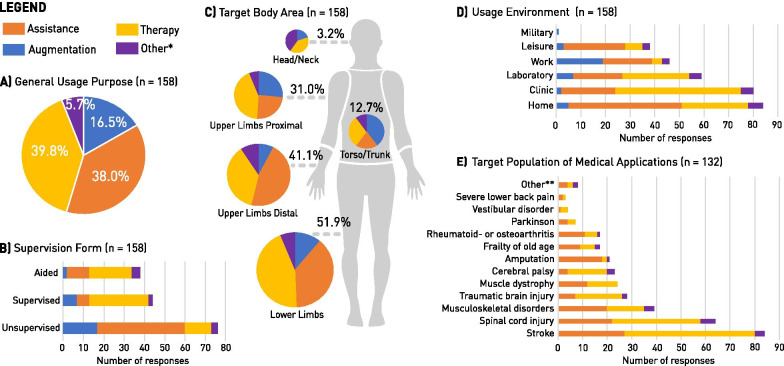
Background: User-centered design approaches have gained attention over the past decade, aiming to tackle the technology acceptance issues of wearable robotic devices to assist, support or augment human capabilities. While there is a consensus that usability is key to user-centered design, dedicated usability evaluation studies are scarce and clear evaluation guidelines are missing. However, the careful consideration and integration of user needs appears to be essential to successfully develop an effective, efficient, and satisfactory human-robot interaction. It is primarily the responsibility of the developer, to ensure that this users involvement takes place throughout the design process. Methods: Through an online survey for developers of wearable robotics, we wanted to understand how the design and evaluation in actual daily practice compares to what is reported in literature. With a total of 31 questions, we analyzed the most common wearable robotic device applications and their technology maturity, and how these influence usability evaluation practices. Results: A total of 158 responses from a heterogeneous population were collected and analyzed. The dataset representing contexts of use for augmentation (16.5%), assistance (38.0%), therapy (39.8%), as well as few other specific applications (5.7%), allowed for an insightful analysis of the influence of technology maturity on user involvement and usability evaluation. We identified functionality, ease of use, and performance as the most evaluated usability attributes and could specify which measures are used to assess them. Also, we could underline the frequent use of qualitative measures alongside the expected high prevalence of performance-metrics. In conclusion of the analysis, we derived evaluation recommendations to foster user-centered design and usability evaluation. Conclusion: This analysis might serve as state-of-the-art comparison and recommendation for usability studies in wearable robotics. We believe that by motivating for more balanced, comparable and user-oriented evaluation practices, we may support the wearable robotics field in tackling the technology acceptance limitations.
Overview
The claims and statistics of this paper haven’t been checked yet.
Free: it reads the open-access text and checks the first 5 claims that cite a source we can check. Create a free account to check every claim.
Integrity signals
Registry
Cites
Statistics
Figures
Verification
Claims the paper makes
The claims and statistics of this paper haven’t been checked yet.
Free: it reads the open-access text and checks the first 5 claims that cite a source we can check. Create a free account to check every claim.
Claims other papers make about this one
Each is checked against this paper’s own text: does it say what the citing paper says it does?
The cited source says what the claim attributes to it.
In the citing paper
“This dissonance makes the results in the reviewed literature difficult to contextualize and compare against related work in the field (e.g., as discussed in [103]).”
From A Review of Design and Evaluation Practices in Mobile Text Entry for Visually Impaired and Blind Persons (2023) · cites this paper as [103]
Self-check
Percentages, sums and reported differences re-computed from the paper’s own numbers.
The self-check needs the paper’s full text.
Citations
Cites
Internet, Phone, Mail, and Mixed‐Mode Surveys: The Tailored Design Method
Dillman, D. A., Smyth, J. D., & Christian, L. M. (2014) · Wiley eBooks · doi:10.1002/9781394260645 · Cited by 4,460
Upper limb prosthesis use and abandonment: A survey of the last 25 years
Biddiss, E. A., & Chau, T. T. (2007) · Prosthetics & Orthotics International · doi:10.1080/03093640600994581 · Cited by 1,111
Consumer design priorities for upper limb prosthetics
Biddiss, E., Beaton, D., & Chau, T. (2007) · Disability and Rehabilitation: Assistive Technology · doi:10.1080/17483100701714733 · Cited by 519 · cited 1×
“Such user-oriented evaluation from early on is expected to enhance stakeholder involvement and may help meeting user needs right from the start [37, 41, 42].”
BackgroundWearable Robots: Biomechatronic Exoskeletons
(2008) · Wiley eBooks · doi:10.1002/9780470987667 · Cited by 517
Benefits of and barriers to involving users in medical device technology development and evaluation
Shah, S. G. S., & Robinson, I. (2007) · International Journal of Technology Assessment in Health Care · doi:10.1017/s0266462307051677 · Cited by 299 · cited 1×
“A solution to tackle and minimize usability limitations is user-centered design (UCD), which aims to involve the technology stakeholders throughout the device development to more successfully address and meet user needs [11–13].”
BackgroundPredictors of assistive technology use: The importance of personal and psychosocial factors
Scherer, M. J., Sax, C., Vanbiervliet, A., Cushman, L. A., & Scherer, J. V. (2005) · Disability and Rehabilitation · doi:10.1080/09638280500164800 · Cited by 283 · cited 3×
“Particularly, devices for medical applications such as robot-aided therapy or advanced assistive technologies often struggle to comply with the complex contexts of use, as users with health issues have more specific and personalized needs [7–10].”
BackgroundExoskeleton and End‐Effector Robots for Upper and Lower Limbs Rehabilitation: Narrative Review
Molteni, F., Gasperini, G., Cannaviello, G., & Guanziroli, E. (2018) · PM&R · doi:10.1016/j.pmrj.2018.06.005 · Cited by 274 · cited 2×
“Nonetheless, the number of WRD in daily use is still very low due to missing availability on the market, as well as technology acceptance limitations [1, 4, 5].”
BackgroundFischer, B., Peine, A., & Östlund, B. (2020) · The Gerontologist · doi:10.1093/geront/gnz163 · Cited by 253 · cited 1×
“A solution to tackle and minimize usability limitations is user-centered design (UCD), which aims to involve the technology stakeholders throughout the device development to more successfully address and meet user needs [11–13].”
BackgroundShah, S. G. S., Robinson, I., & AlShawi, S. (2009) · International Journal of Technology Assessment in Health Care · doi:10.1017/s0266462309990328 · Cited by 237 · cited 2×
“While the user-perspective remains the key element of WRD usability and technology acceptance [15, 26], it is also crucial to understand how the developers of the technology make the decision of when and how to involve end-users in the design process.”
BackgroundSoft Robotic Suits: State of the Art, Core Technologies, and Open Challenges
Xiloyannis, M., Alicea, R., Georgarakis, A.-M., Haufe, F. L., Wolf, P., Masia, L., & Riener, R. (2022) · IEEE Transactions on Robotics · doi:10.1109/tro.2021.3084466 · Cited by 225 · cited 4×
“A great diversity from fully wearable and soft, to stationary and rigid devices has been developed over the past decades, showing promising ranges of functionalities [1–3].”
BackgroundInfluentialPerformance Evaluation of Lower Limb Exoskeletons: A Systematic Review
Pinto-Fernandez, D., Torricelli, D., Sanchez-Villamanan, M. D. C., Aller, F., Mombaur, K., Conti, R., Vitiello, N., Moreno, J. C., & Pons, J. L. (2020) · IEEE Transactions on Neural Systems and Rehabilitation Engineering · doi:10.1109/tnsre.2020.2989481 · Cited by 220 · cited 3×
“…of device-oriented development and evaluation has been previously highlighted by works of Contreras-Vidal et al. and Pinto-Fernandez et al. [22, 40] who both summarized that in lower limb exoskeletons studies, evaluation outcomes on comfort, ergonomics, satisfaction, and/or mental demand…”
BackgroundPowered exoskeletons for bipedal locomotion after spinal cord injury
Contreras-Vidal, J. L., A Bhagat, N., Brantley, J., Cruz-Garza, J. G., He, Y., Manley, Q., Nakagome, S., Nathan, K., Tan, S. H., Zhu, F., et al. (2016) · Journal of Neural Engineering · doi:10.1088/1741-2560/13/3/031001 · Cited by 216 · cited 1×
“comes on comfort, ergonomics, satisfaction, and/or mental demand are drastically 378 scarce compared to performance-related outcomes [22, 38].”
BackgroundAbandonment of assistive products: assessing abandonment levels and factors that impact on it
Sugawara, A. T., Ramos, V. D., Alfieri, F. M., & Battistella, L. R. (2018) · Disability and Rehabilitation: Assistive Technology · doi:10.1080/17483107.2018.1425748 · Cited by 178 · cited 1×
“Particularly, devices for medical applications such as robot-aided therapy or advanced assistive technologies often struggle to comply with the complex contexts of use, as users with health issues have more specific and personalized needs [7–10].”
BackgroundA survey of stakeholder perspectives on exoskeleton technology
Wolff, J., Parker, C., Borisoff, J., Mortenson, W. B., & Mattie, J. (2014) · Journal of NeuroEngineering and Rehabilitation · doi:10.1186/1743-0003-11-169 · Cited by 169 · cited 2×
“Such user-oriented evaluation from early on is expected to enhance stakeholder involvement and may help meeting user needs right from the start [37, 41, 42].”
BackgroundWHAT ARE USER PERSPECTIVES OF EXOSKELETON TECHNOLOGY? A LITERATURE REVIEW
Hill, D., Holloway, C., Ramírez, D. Z. M., Smitham, P. J., & Pappas, Y. (2017) · International Journal of Technology Assessment in Health Care · doi:10.1017/s0266462317000460 · Cited by 155 · cited 1×
“While the userperspective remains the key element of WRD usability and technology acceptance [15, 26], it is also crucial to understand how the developers of the technology make the decision of when and how to involve end-users in the design process.”
BackgroundAcademic Review and Perspectives on Robotic Exoskeletons
Bao, G., Pan, L., Fang, H., Wu, X., Yu, H., Cai, S., Yu, B., & Wan, Y. (2019) · IEEE Transactions on Neural Systems and Rehabilitation Engineering · doi:10.1109/tnsre.2019.2944655 · Cited by 147 · cited 4×
“A great diversity from fully wearable and soft, to stationary and rigid devices has been developed over the past decades, showing promising ranges of functionalities [1–3].”
BackgroundInfluentialMcFarland, T. C., & Fischer, S. L. (2019) · IISE Transactions on Occupational Ergonomics and Human Factors · doi:10.1080/24725838.2019.1684399 · Cited by 139 · cited 3×
“Nonetheless, the number of WRD in daily use is still very low due to missing availability on the market, as well as technology acceptance limitations [1, 4, 5].”
BackgroundExoskeleton home and community use in people with complete spinal cord injury
van Dijsseldonk, R. B., van Nes, I. J. W., Geurts, A. C. H., & Keijsers, N. (2020) · Scientific Reports · doi:10.1038/s41598-020-72397-6 · Cited by 104 · cited 1×
“Such user-oriented evaluation from early on is expected to enhance stakeholder involvement and may help meeting user needs right from the start [37, 41, 42].”
BackgroundAssistive Technology for the Upper Extremities After Stroke: Systematic Review of Users’ Needs
van Ommeren, A. L., Smulders, L. C., Prange-Lasonder, G. B., Buurke, J. H., Veltink, P. H., & Rietman, J. S. (2018) · JMIR Rehabilitation and Assistive Technologies · doi:10.2196/10510 · Cited by 103
Noronha, B., & Accoto, D. (2021) · IEEE Transactions on Medical Robotics and Bionics · doi:10.1109/tmrb.2021.3064412 · Cited by 99 · cited 1×
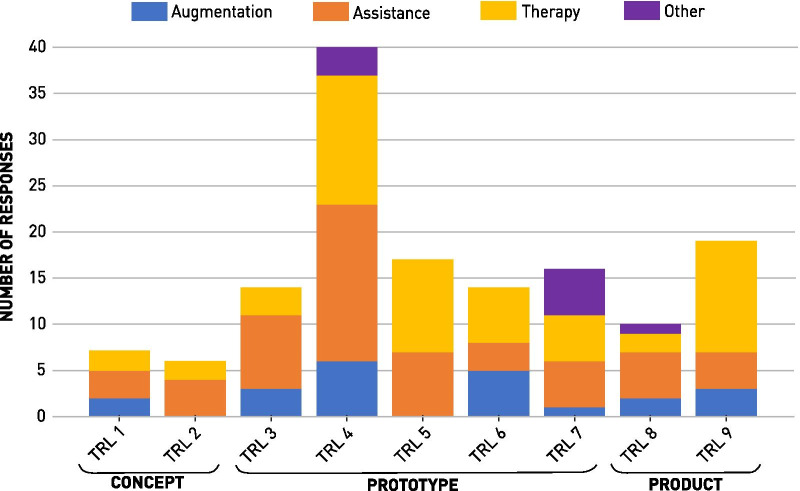
“Interestingly, a recent review on the technological maturity of such hand orthoses provided very similar insights in terms of TRL which indicates that our data might realistically represent the current WRD maturity state [34].”
BackgroundTorricelli, D., Rodriguez‐Guerrero, C., Veneman, J. F., Crea, S., Briem, K., Lenggenhager, B., & Beckerle, P. (2020) · Frontiers in Robotics and AI · doi:10.3389/frobt.2020.561774 · Cited by 96
Koumpouros, Y. (2016) · Journal of Healthcare Engineering · doi:10.1155/2016/1048964 · Cited by 86 · cited 3×
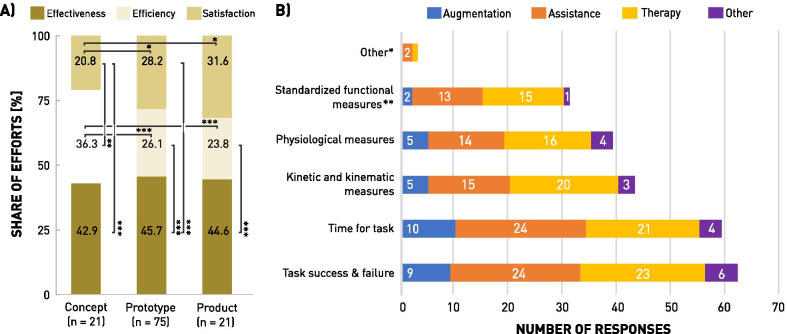
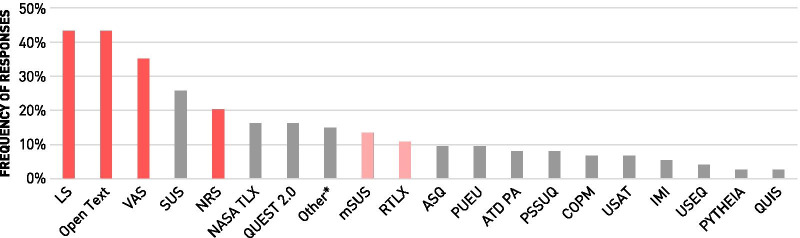
“These findings can be partially validated with recent works investigating robotic assistive technology evaluation, which comparably showed that custom-made usability measures are used in 60–70% of all reported studies [20, 21].”
BackgroundMethodInfluentialHall, A. K., Backonja, U., Painter, I., Cakmak, M., Sung, M., Lau, T., Thompson, H. J., & Demiris, G. (2019) · Assistive Technology · doi:10.1080/10400435.2017.1396565 · Cited by 76 · cited 1×
“Exoskeletons are robotic orthoses, which so far showed rather limited technology acceptance in unsupervised, assistive applications [36, 37].”
BackgroundDriven gait orthosis to do locomotor training of paraplegic patients
Colombo, G., Jorg, M., & Dietz, V. (2002) · Proceedings of the 22nd Annual International Conference of the IEEE Engineering in Medicine and Biology Society (Cat. No.00CH37143) · doi:10.1109/iembs.2000.901556 · Cited by 72 · cited 2×
“vices such as the robotic-driven gait orthosis Lokomat [31] have triggered a shift 303”
BackgroundÁrmannsdóttir, A. L., Beckerle, P., Moreno, J. C., van Asseldonk, E. H. F., Manrique-Sancho, M.-T., del‐Ama, A. J., Veneman, J. F., & Briem, K. (2020) · Human Factors The Journal of the Human Factors and Ergonomics Society · doi:10.1177/0018720819883500 · Cited by 67 · cited 3×
“These findings can be partially validated with recent works investigating robotic assistive technology evaluation, which comparably showed that custom-made usability measures are used in 60–70% of all reported studies [20, 21].”
BackgroundShore, L., Power, V., Hartigan, B., Schülein, S., Graf, E. S., de Eyto, A., & O'Sullivan, L. W. (2019) · Human Factors The Journal of the Human Factors and Ergonomics Society · doi:10.1177/0018720819868122 · Cited by 63
A taxonomy of ethical, legal and social implications of wearable robots: an expert perspective
Kapeller, A., Felzmann, H., Fosch-Villaronga, E., & Hughes, A.-M. (2020) · Science and Engineering Ethics · doi:10.1007/s11948-020-00268-4 · Cited by 58 · cited 1×
“On the other hand, the users themselves bring physical and psycho-social factors into play, such as varying skills, knowledge, prior experiences or expectations, which need to be investigated and valued as design criteria with equal importance [7, 18].”
BackgroundUSERfit – a framework for user centred design in assistive technology
Poulson, D., & Richardson, S. (1998) · Technology and Disability · doi:10.3233/tad-1998-9307 · Cited by 53 · cited 1×
“As 19 part of the iterative UCD process, a structured evaluation of the technical solu20 tion solving a specific human problem is considered essential [14, 15, 16, 17].”
MethodXassess: crossdisciplinary framework in user-centred design of assistive products
Blanco, T., Vázquez, A. B., Blasco, R., & Casas, R. (2016) · Journal of Engineering Design · doi:10.1080/09544828.2016.1200717 · Cited by 46
Celian, C., Swanson, V. A., Shah, M., Newman, C. A., King, B. F., Gallik, S., Reilly, K., Reinkensmeyer, D. J., Patton, J. L., & Rafferty, M. R. (2021) · Journal of NeuroEngineering and Rehabilitation · doi:10.1186/s12984-021-00911-6 · Cited by 42
Framework for Assessment of the Usability of Lower-Extremity Robotic Exoskeletal Orthoses
Bryce, T. N., Dijkers, M. P. J. M., & Kozlowski, A. J. (2015) · American Journal of Physical Medicine & Rehabilitation · doi:10.1097/phm.0000000000000321 · Cited by 40 · cited 1×
“Despite application-specific efforts to address these limitations with novel evaluation frameworks [23–25], there still is a need for more general guidelines on the best-practice for the development and usability evaluation of wearable robots.”
BackgroundEUROBENCH: Preparing Robots for the Real World
Torricelli, D., & Pons, J. L. (2018) · Biosystems & biorobotics · doi:10.1007/978-3-030-01887-0_72 · Cited by 39
Tolikas, M., Antoniou, A., & Ingber, D. E. (2017) · Bioengineering & Translational Medicine · doi:10.1002/btm2.10076 · Cited by 31 · cited 1×
“By supporting more application-oriented, translational research, academia could push WRD maturity towards TRL 6 or 7, and overcome the translational gap to materialize the potential of wearable robotics [35].”
BackgroundUser-Centered Prosthetic Development: Comprehension of Amputees’ Needs
Christ, O., Jokisch, M., Preller, J., Beckerle, P., Wojtusch, J., Rinderknecht, S., von Stryk, O., & Vogt, J. (2012) · Biomedizinische Technik/Biomedical Engineering · doi:10.1515/bmt-2012-4306 · Cited by 24
JNER at 15 years: analysis of the state of neuroengineering and rehabilitation
Reinkensmeyer, D. J. (2019) · Journal of NeuroEngineering and Rehabilitation · doi:10.1186/s12984-019-0610-0 · Cited by 21 · cited 1×
“As highlighted in a 15 years reflection on the papers published in the Journal of Neuroengineer-ing and Rehabilitation, only 2.4% of the works published included the term “usability” [2].”
BackgroundInfluentialToward a national system of assistive technology outcomes measurement
Lenker, J., Koester, H. H., & Smith, R. O. (2019) · Assistive Technology · doi:10.1080/10400435.2019.1567620 · Cited by 15
(2019) · Technology and Disability · doi:10.3233/tad-190014 · Cited by 4
Celian, C., Swanson, V. A., Shah, M., et al. (2021) · Research Square · doi:10.21203/rs.3.rs-444687/v1 · Cited by 3 · cited 1×
“Moreover, the complexity of WRDs appears to be among a strong limiting factors of technology adoption, even for a supervised use in therapeutic applications [39].”
Background
Cited by
Principles of human movement augmentation and the challenges in making it a reality
Eden, J., Bräcklein, M., Ibáñez, J., Barsakcioglu, D. Y., Pino, G. D., Farina, D., Burdet, E., & Mehring, C. (2022) · Nature Communications · doi:10.1038/s41467-022-28725-7 · Cited by 154
IMU-based human activity recognition and payload classification for low-back exoskeletons
Pesenti, M., Invernizzi, G., Mazzella, J., Bocciolone, M., Pedrocchi, A., & Gandolla, M. (2023) · Scientific Reports · doi:10.1038/s41598-023-28195-x · Cited by 70
Noronha, B., Ng, C. Y., Little, K., Xiloyannis, M., Kuah, C. W. K., Wee, S. K., Kulkarni, S. R., Masia, L., Chua, K. S. G., & Accoto, D. (2022) · IEEE Transactions on Neural Systems and Rehabilitation Engineering · doi:10.1109/tnsre.2022.3175224 · Cited by 69
Gantenbein, J., Dittli, J., Meyer, J. T., Gassert, R., & Lambercy, O. (2022) · Frontiers in Neurorobotics · doi:10.3389/fnbot.2022.815693 · Cited by 57
“The 12 usability attributes presumed to be relevant for IDS were selected based on the findings of a recent survey on common practices in usability evaluation of wearable robots (Meyer et al., 2021).”
MethodSelf-citationThe present and future of neural interfaces
Valeriani, D., Santoro, F., & Ienca, M. (2022) · Frontiers in Neurorobotics · doi:10.3389/fnbot.2022.953968 · Cited by 53
Metadata
- Authors
- Meyer, J. T., Gassert, R., & Lambercy, O.
- Affiliations
- ETH Zurich (CH)
- Corresponding author
- Meyer, Jan Thomas
- Venue
- Journal of NeuroEngineering and Rehabilitation
- Published
- 2021-12
- Volume
- 18
- Issue
- 1
- Pages
- 170-170
- ISSN
- 1743-0003 (ISSN-L)
- PMC
- PMC8656061
- OpenAlex
- W4226019611
- Cited by
- 58
- References
- 37
- Citations by year
- 2026: 12 · 2025: 10 · 2024: 18 · 2023: 8 · 2022: 10
- FWCI
- 5.82
- Type
- journal article
- Language
- en
- Open access
- gold
- doi.org
- Licence
- cc-by
- creativecommons.org/licenses/by/4.0 (tdm)
- creativecommons.org/licenses/by/4.0 (vor, 8 d)
- Locations
- Journal of NeuroEngineering and Rehabilitation (publishedVersion, cc-by)
- Research Square (acceptedVersion, cc-by)
- PubMed Central (publishedVersion, cc-by)
- PubMed (publishedVersion)
- DOAJ (DOAJ: Directory of Open Access Journals) (submittedVersion, cc-by-sa)
- Repository for Publications and Research Data (ETH Zurich) (submittedVersion, cc-by)
- ETH Zürich Research Collection (cc-by)
- Funders
- vontobel-stiftung
- national centre of competence in research robotics
- eth zürich foundation
- national research foundation, prime minister’s office, singapore under its campus for research excellence and technological enterprise (create) program
- Topics
- Physical Sciences › Computer Science › Human-Computer Interaction › Usability and User Interface Design
- Physical Sciences › Computer Science › Human-Computer Interaction › Innovative Human-Technology Interaction
- Physical Sciences › Engineering › Biomedical Engineering › Prosthetics and Rehabilitation Robotics
- Keywords
- wearable robotics, usability evaluation, user-centered design, context of use, technology maturity, human-robot interaction, assistive robotics, rehabilitation robotics, evaluation guidelines, user participation, technology acceptance
- MeSH terms
- Wearable Electronic Devices, Humans, Surveys and Questionnaires, Robotics
About these checks
Registry, retraction, Cites and statistics results are computed, not judged, with one exception: a printed reference that no index lists is read once by a model before it counts as a citation error. Claims are extracted by a model and kept only when their quote appears verbatim in the text; each cited source is then checked, with a model’s help, for whether it says what the claim relies on. Those verdicts can be wrong — read the claim’s quote and the cited source before relying on one.
Statistics and arithmetic are recomputed, not judged.
Confidence bands are shown only for fields calibrated on our annotated test set. None is calibrated yet, so no band is shown.
What counts as a claim ›How we measure confidence ›How we check this ›
Are you an author, or do you see a problem with this page? Request a review
Data sources
Bibliographic data: Semantic Scholar, OpenAlex, Crossref.
Contains information from the Semantic Scholar Academic Graph Datasets, made available under the ODC Attribution License (ODC-BY 1.0).
Semantic Scholar’s data is described in: Kinney, R., et al. (2023). The Semantic Scholar Open Data Platform. arXiv:2301.10140.
