

The deletion of glucagon-like peptide-1 receptors expressing neurons in the dorsomedial hypothalamic nucleus disrupts the diurnal feeding pattern and induces hyperphagia and obesity
Open accessThe DOI matches its Crossref record; 47 of the 47 references it cites were found in a registry or an index.
Abstract
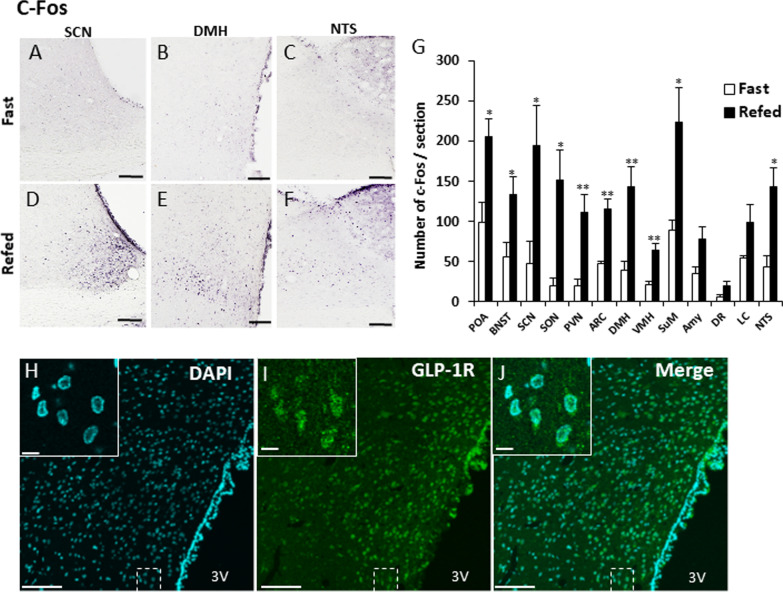
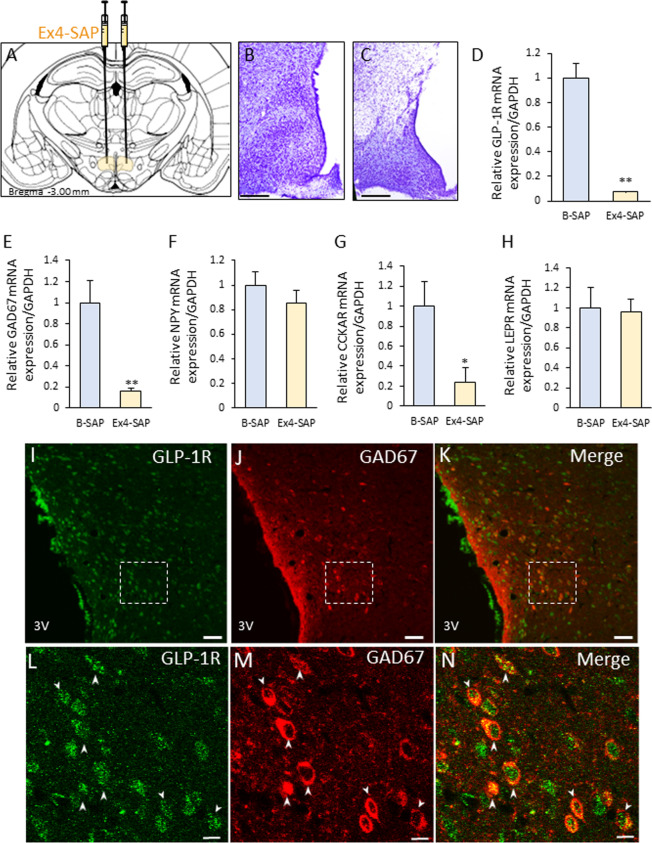
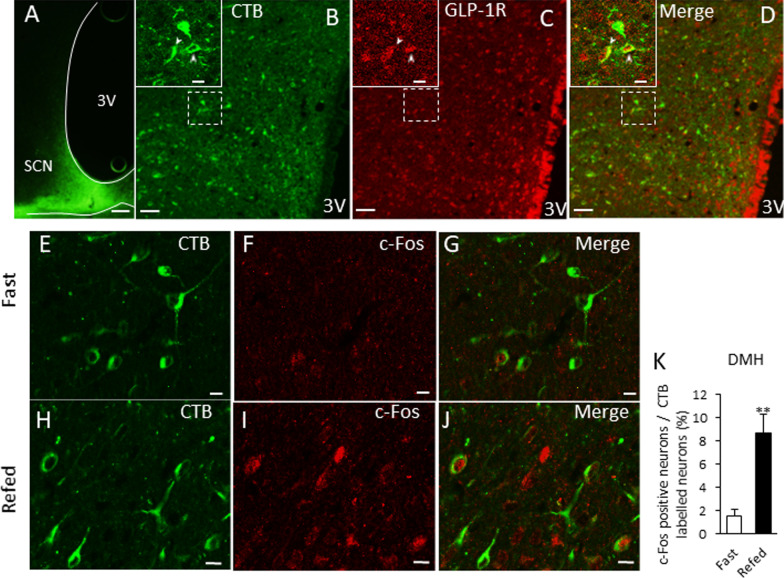
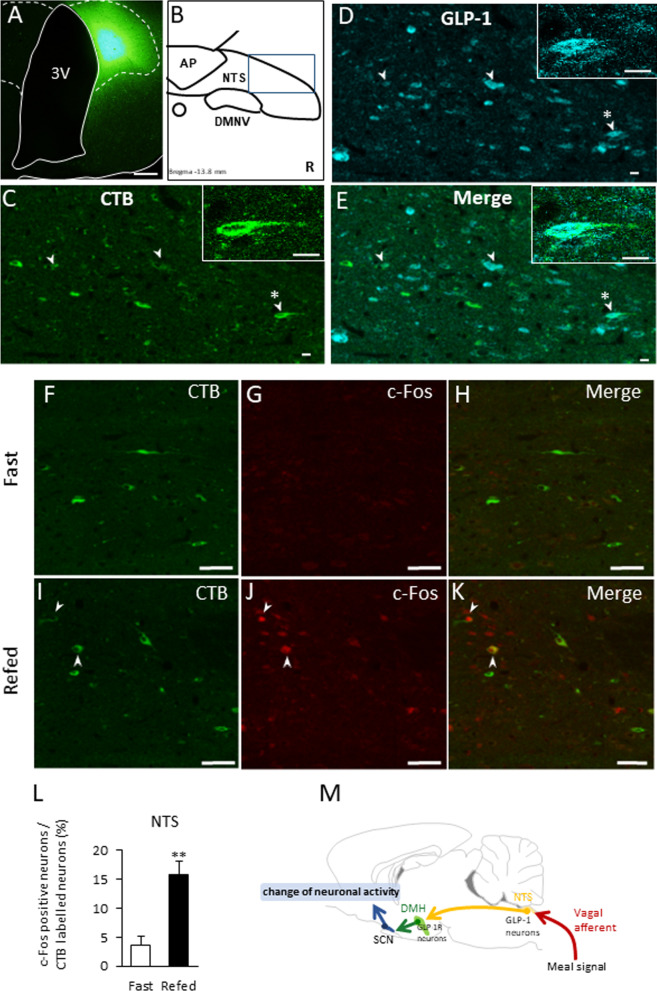
Background: Feeding rhythm disruption contributes to the development of obesity. The receptors of glucagon-like peptide-1 (GLP-1) are distributed in the wide regions of the brain. Among these regions, GLP-1 receptors (GLP-1R) are expressed in the dorsomedial hypothalamic nucleus (DMH) which are known to be associated with thermogenesis and circadian rhythm development. However, the physiological roles of GLP-1R expressing neurons in the DMH remain elusive. Methods: To examine the physiological role of GLP-1R expressing neurons in the DMH, saporin-conjugated exenatide4 was injected into rat brain DMH to delete GLP-1R-positive neurons. Subsequently, locomotor activity, diurnal feeding pattern, amount of food intake and body weight were measured. Results: This deletion of GLP-1R-positive neurons in the DMH induced hyperphagia, the disruption of diurnal feeding pattern, and obesity. The deletion of GLP-1R expressing neurons also reduced glutamic acid decarboxylase 67 and cholecystokinin A receptor mRNA levels in the DMH. Also, it reduced the c-fos expression after refeeding in the suprachiasmatic nucleus (SCN). Thirty percent of DMH neurons projecting to the SCN expressed GLP-1R. Functionally, refeeding after fasting induced c-fos expression in the SCN projecting neurons in the DMH. As for the projection to the DMH, neurons in the nucleus tractus solitarius (NTS) were found to be projecting to the DMH, with 33% of those neurons being GLP-1-positive. Refeeding induced c-fos expression in the DMH projecting neurons in the NTS. Conclusion: These findings suggest that GLP-1R expressing neurons in the DMH may mediate feeding termination. In addition, this meal signal may be transmitted to SCN neurons and change the neural activities.
Overview
The claims and statistics of this paper haven’t been checked yet.
Free: it reads the open-access text and checks the first 5 claims that cite a source we can check. Create a free account to check every claim.
Integrity signals
Registry
Cites
Statistics
Figures
Verification
Claims the paper makes
The claims and statistics of this paper haven’t been checked yet.
Free: it reads the open-access text and checks the first 5 claims that cite a source we can check. Create a free account to check every claim.
Claims other papers make about this one
Each is checked against this paper’s own text: does it say what the citing paper says it does?
The source backs part of the claim, not all of it — or backs it for a different population, condition or comparison.
In the citing paper
“The DMH plays a pivotal role in long-term metabolic regulation, including energy expenditure, thermogenesis, and circadian rhythm (27–29).”
From GLP-1 increases preingestive satiation via hypothalamic circuits in mice and humans (2024) · cites this paper as [28]
Experimental — accuracy not yet measured
Self-check
Percentages, sums and reported differences re-computed from the paper’s own numbers.
The self-check needs the paper’s full text.
Citations
Cites
Central nervous system control of food intake
Schwartz, M. W., Woods, S. C., Porte, D., Seeley, R. J., & Baskin, D. G. (2000) · Nature · doi:10.1038/35007534 · Cited by 6,451
Central nervous system control of food intake and body weight
Morton, G. J., Cummings, D. E., Baskin, D. G., Barsh, G. S., & Schwartz, M. W. (2006) · Nature · doi:10.1038/nature05026 · Cited by 2,503 · cited 2×
“The ARC receives prandial hormone information, which is induced by leptin, ghrelin and insulin [5], while the NTS receives neural prandial information induced by ghrelin, cholecystokinin (CCK), and glucagon-like peptide-1 (GLP-1) via the vagal afferent pathway [5].”
BackgroundObesity and Metabolic Syndrome in Circadian Clock Mutant Mice
Turek, F. W., Joshu, C., Kohsaka, A., Lin, E., Ivanova, G., McDearmon, E., Laposky, A., Losee-Olson, S., Easton, A., Jensen, D. R., et al. (2005) · Science · doi:10.1126/science.1108750 · Cited by 2,485
Anatomy and regulation of the central melanocortin system
Cone, R. D. (2005) · Nature Neuroscience · doi:10.1038/nn1455 · Cited by 1,583 · cited 3×
“types of neurons in the NTS that contain neural peptides, such as GLP-1, POMC, CART, and PrRP [7].”
BackgroundGöke, R., Fehmann, H. C., Linn, T., Schmidt, H., Krause, M., Eng, J., & Göke, B. (1993) · Journal of Biological Chemistry · doi:10.1016/s0021-9258(19)36565-2 · Cited by 837
Critical role of dorsomedial hypothalamic nucleus in a wide range of behavioral circadian rhythms
Chou, T. C., Scammell, T. E., Gooley, J. J., Gaus, S. E., Saper, C. B., & Lu, J. (2003) · The Journal of Neuroscience · doi:10.1523/jneurosci.23-33-10691.2003 · Cited by 576
Alhadeff, A. L., Rupprecht, L. E., & Hayes, M. R. (2012) · Endocrinology · doi:10.1210/en.2011-1443 · Cited by 515
Cork, S. C., Richards, J. E., Holt, M. K., Gribble, F. M., Reimann, F., & Trapp, S. (2015) · Molecular Metabolism · doi:10.1016/j.molmet.2015.07.008 · Cited by 478
Gooley, J. J., Schomer, A., & Saper, C. B. (2006) · Nature Neuroscience · doi:10.1038/nn1651 · Cited by 453 · cited 1×
“Previous articles have reported that the DMH play a key role as a food-entrainable oscillator in the feedingmediated regulation of the circadian rhythm [21, 33].”
BackgroundGhrelin Directly Interacts With Neuropeptide-Y-Containing Neurons in the Rat Arcuate Nucleus
Kohno, D., Gao, H.-Z., Muroya, S., Kikuyama, S., & Yada, T. (2003) · Diabetes · doi:10.2337/diabetes.52.4.948 · Cited by 386
The role of gut hormones and the hypothalamus in appetite regulation
Suzuki, K., Simpson, K. A., Minnion, J. S., Shillito, J. C., & Bloom, S. R. (2010) · Endocrine Journal · doi:10.1507/endocrj.k10e-077 · Cited by 319
Larsen, P. J. (1997) · Endocrinology · doi:10.1210/en.138.10.4445 · Cited by 316
The dorsomedial hypothalamic nucleus revisited: 1986 update
Bernardis, L. L., & Bellinger, L. L. (1987) · Brain Research Reviews · doi:10.1016/0165-0173(87)90004-x · Cited by 309
The dorsomedial hypothalamic nucleus as a putative food-entrainable circadian pacemaker
Mieda, M., Williams, S. C., Richardson, J. A., Tanaka, K., & Yanagisawa, M. (2006) · Proceedings of the National Academy of Sciences · doi:10.1073/pnas.0604189103 · Cited by 290
The relationship between nutrition and circadian rhythms in mammals
Froy, O. (2007) · Frontiers in Neuroendocrinology · doi:10.1016/j.yfrne.2007.03.001 · Cited by 283
Glucagon-Like Peptide 1 Receptors in Nucleus Accumbens Affect Food Intake
Dossat, A. M., Lilly, N., Kay, K., & Williams, D. L. (2011) · The Journal of Neuroscience · doi:10.1523/jneurosci.3262-11.2011 · Cited by 256
GLP-1 and energy balance: an integrated model of short-term and long-term control
Barrera, J. G., Sandoval, D. A., D'Alessio, D. A., & Seeley, R. J. (2011) · Nature Reviews Endocrinology · doi:10.1038/nrendo.2011.77 · Cited by 220
Glycinergic amacrine cells of the rat retina
Menger, N., Pow, D. V., & Wässle, H. (1998) · The Journal of Comparative Neurology · doi:10.1002/(sici)1096-9861(19981109)401:1<34::aid-cne3>3.0.co;2-p · Cited by 214
Holt, M. K., Richards, J. E., Cook, D. R., Brierley, D. I., Williams, D. L., Reimann, F., Gribble, F. M., & Trapp, S. (2019) · Diabetes · doi:10.2337/db18-0729 · Cited by 212 · cited 1×
“On the other hand, ablation of PPG neuron in the NTS or acute chemogenetic inhibition of PPG neurons does not affect ad libitum feeding, but increased refeeding intake after fasting [14].”
BackgroundMcMahon, L. R., & Wellman, P. J. (1998) · American Journal of Physiology-Regulatory, Integrative and Comparative Physiology · doi:10.1152/ajpregu.1998.274.1.r23 · Cited by 199
Preproglucagon neurons project widely to autonomic control areas in the mouse brain
Llewellyn-Smith, I. J., Reimann, F., Gribble, F. M., & Trapp, S. (2011) · Neuroscience · doi:10.1016/j.neuroscience.2011.02.023 · Cited by 194
Yi, C.-X., van der Vliet, J., Dai, J., Yin, G., Ru, L., & Buijs, R. M. (2006) · Endocrinology · doi:10.1210/en.2005-1051 · Cited by 184
Acosta-Galvan, G., Yi, C.-X., van der Vliet, J., Jhamandas, J. H., Panula, P., Angeles-Castellanos, M., del Carmen Basualdo, M., Escobar, C., & Buijs, R. M. (2011) · Proceedings of the National Academy of Sciences · doi:10.1073/pnas.1015551108 · Cited by 179
The Dorsomedial Hypothalamic Nucleus Revisited: 1998 Update
Bernardis, L. L., & Bellinger, L. L. (1998) · Experimental Biology and Medicine · doi:10.3181/00379727-218-44296 · Cited by 178
Vrang, N., Hansen, M. B., Larsen, P. J., & Tang‐Christensen, M. (2007) · Brain Research · doi:10.1016/j.brainres.2007.02.043 · Cited by 163
Barrera, J. G., Jones, K. R., Herman, J. P., D'Alessio, D. A., Woods, S. C., & Seeley, R. J. (2011) · The Journal of Neuroscience · doi:10.1523/jneurosci.2212-10.2011 · Cited by 154
Neuronal lesioning with axonally transported toxins
Wiley, R. G., & Kline, R. (2000) · Journal of Neuroscience Methods · doi:10.1016/s0165-0270(00)00297-1 · Cited by 142
Activation of murine pre-proglucagon–producing neurons reduces food intake and body weight
Gaykema, R. P., Newmyer, B. A., Ottolini, M., Raje, V., Warthen, D. M., Lambeth, P. S., Niccum, M., Yao, T., Huang, Y., Schulman, I. G., et al. (2017) · Journal of Clinical Investigation · doi:10.1172/jci81335 · Cited by 123 · cited 1×
“The chemogenetic stimulation of PPG neurons in the NTS and ventrolateral medulla reduces metabolic rate and food intake in fed and fasted state [12].”
BackgroundCircadian Clocks, Food Intake, and Metabolism
Challet, É. (2013) · Progress in molecular biology and translational science · doi:10.1016/b978-0-12-396971-2.00005-1 · Cited by 115
Integrative capacity of the caudal brainstem in the control of food intake
Schwartz, G. J. (2006) · Philosophical Transactions of the Royal Society B: Biological Sciences · doi:10.1098/rstb.2006.1862 · Cited by 100
Dorsomedial hypothalamic NPY and energy balance control
Bi, S., Kim, Y. J., & Zheng, F. (2012) · Neuropeptides · doi:10.1016/j.npep.2012.09.002 · Cited by 96
Loss of dorsomedial hypothalamic GLP-1 signaling reduces BAT thermogenesis and increases adiposity
Lee, S. J., Sanchez-Watts, G., Krieger, J.-P., Pignalosa, A., Norell, P. N., Cortella, A., Pettersen, K. G., Vrdoljak, D., Hayes, M. R., Kanoski, S. E., et al. (2018) · Molecular Metabolism · doi:10.1016/j.molmet.2018.03.008 · Cited by 95 · cited 6×
“It is reported that 16% of GLP-1R expressing neurons are glutamatergic neurons [19].”
BackgroundResultInfluentialSuprachiasmatic nuclei Lessions in the rat: Alterations in sleep circadian rhythms
Mouret, J., Coindet, J., Debilly, G., & Chouvet, G. (1978) · Electroencephalography and Clinical Neurophysiology · doi:10.1016/0013-4694(78)90191-8 · Cited by 85
Role of lateral septum glucagon-like peptide 1 receptors in food intake
Terrill, S. J., Jackson, C. M., Greene, H. E., Lilly, N., Maske, C. B., Vallejo, S., & Williams, D. L. (2016) · American Journal of Physiology-Regulatory, Integrative and Comparative Physiology · doi:10.1152/ajpregu.00460.2015 · Cited by 78
Noronha, S. I. S. R., Campos, G. V., de Abreu, A. R. R., de Souza, A. M. A., Chianca, D. A., & de Menezes, R. C. A. (2016) · Behavioural Brain Research · doi:10.1016/j.bbr.2016.08.042 · Cited by 76
Maniscalco, J. W., & Rinaman, L. (2013) · Physiology & Behavior · doi:10.1016/j.physbeh.2013.01.012 · Cited by 62
The GLP-1 agonist, liraglutide, as a pharmacotherapy for obesity
Crane, J., & McGowan, B. (2016) · Therapeutic Advances in Chronic Disease · doi:10.1177/2040622315620180 · Cited by 59
GLP-1 action in the mouse bed nucleus of the stria terminalis
Williams, D. L., Lilly, N. A., Edwards, I. J., Yao, P., Richards, J. E., & Trapp, S. (2018) · Neuropharmacology · doi:10.1016/j.neuropharm.2017.12.007 · Cited by 54
Leptin-sensitive neurons in the arcuate nuclei contribute to endogenous feeding rhythms
Li, A.-J., Wiater, M. F., Oostrom, M. T., Smith, B. R., Wang, Q., Dinh, T. T., Roberts, B. L., Jansen, H. T., & Ritter, S. (2012) · American Journal of Physiology-Regulatory, Integrative and Comparative Physiology · doi:10.1152/ajpregu.00086.2012 · Cited by 48
Chaar, L. J. E., Coelho, A., da Silva, N. M. F., Festuccia, W. T., & Antunes, V. R. (2016) · Physiological Reports · doi:10.14814/phy2.12811 · Cited by 48
Maejima, Y., Kohno, D., Iwasaki, Y., & Yada, T. (2011) · Aging · doi:10.18632/aging.100400 · Cited by 47
Self-citationRenner, É., Puškaš, N., Dobolyi, Á., & Palkovits, M. (2012) · Peptides · doi:10.1016/j.peptides.2012.02.018 · Cited by 44
Landry, G. J., Kent, B. A., Patton, D. F., Jaholkowski, M., Marchant, E. G., & Mistlberger, R. E. (2011) · PLoS ONE · doi:10.1371/journal.pone.0024187 · Cited by 44
Dai, J., Van Der Vliet, J., Swaab, D. F., & Buijs, R. M. (1998) · The Journal of Comparative Neurology · doi:10.1002/(sici)1096-9861(19981109)401:1<16::aid-cne2>3.0.co;2-o · Cited by 42
Light and food signals cooperate to entrain the rat pineal circadian system
Wu, T., Jin, Y., Kato, H., & Fu, Z. (2008) · Journal of Neuroscience Research · doi:10.1002/jnr.21769 · Cited by 34
Zhu, G., Yan, J., Smith, W. W., Moran, T. H., & Bi, S. (2011) · Physiology & Behavior · doi:10.1016/j.physbeh.2011.08.007 · Cited by 30
Nutrients and Circadian Rhythms in Mammals
Wu, T., Yao, C., Huang, L., Mao, Y., Zhang, W., Jiang, J., & Fu, Z. (2015) · Journal of Nutritional Science and Vitaminology · doi:10.3177/jnsv.61.s89 · Cited by 10
Cited by
GLP-1 increases preingestive satiation via hypothalamic circuits in mice and humans
Kim, K. S., Park, J. S., Hwang, E., Park, M. J., Shin, H. Y., Lee, Y. H., Kim, K. M., Gautron, L., Godschall, E., Portillo, B., et al. (2024) · Science · doi:10.1126/science.adj2537 · Cited by 148
Park, J. S., Kim, K. S., & Choi, H. J. (2025) · Diabetes & Metabolism Journal · doi:10.4093/dmj.2025.0106 · Cited by 61
Exercise-induced hypothalamic neuroplasticity: Implications for energy and glucose metabolism
Hwang, E., Portillo, B., Grose, K. C., Fujikawa, T., & Williams, K. W. (2023) · Molecular Metabolism · doi:10.1016/j.molmet.2023.101745 · Cited by 40
GLP-1 physiology and pharmacology along the gut-brain axis
Beutler, L. R. (2026) · Journal of Clinical Investigation · doi:10.1172/jci194744 · Cited by 36
Mechanism of Acupuncture in Treating Obesity: Advances and Prospects
Wang, M., Zhai, M.-X., Wang, Y.-T., Dai, Q.-F., Liu, L., Zhao, L., Xia, Q., Shen, L., & Li, B. (2024) · The American Journal of Chinese Medicine · doi:10.1142/s0192415x24500010 · Cited by 34
Metadata
- Authors
- Maejima, Y., Yokota, S., Shimizu, M., Horita, S., Kobayashi, D., Hazama, A., & Shimomura, K.
- Affiliations
- Fukushima Medical University (JP)
- Fukushima University (JP)
- Corresponding author
- Maejima, Yuko
- Venue
- Nutrition & Metabolism
- Published
- 2021-06-07
- Volume
- 18
- Issue
- 1
- Pages
- 58-58
- ISSN
- 1743-7075 (ISSN-L)
- PMC
- PMC8186199
- OpenAlex
- W3168133653
- Semantic Scholar
- 4ced8de501e9ca7f9d7fb2333d49daa507afc883
- Cited by
- 21
- References
- 46
- Citations by year
- 2026: 6 · 2025: 4 · 2024: 6 · 2023: 4 · 2022: 1
- FWCI
- 1.44
- Type
- journal article
- Language
- en
- Open access
- gold
- doi.org
- Licence
- cc-by
- creativecommons.org/licenses/by/4.0 (tdm)
- creativecommons.org/licenses/by/4.0 (vor)
- Locations
- Nutrition & Metabolism (publishedVersion, cc-by)
- PubMed Central (publishedVersion, cc-by)
- PubMed (publishedVersion)
- DOAJ (DOAJ: Directory of Open Access Journals) (submittedVersion, cc-by-sa)
- Funders
- Foundation Mishima Haeundae Memorial Foundation
- Japan Society for the Promotion of Scienc (18K08483)
- Japan Society for the Promotion of Science (26461366)
- Topics
- Life Sciences › Neuroscience › Endocrine and Autonomic Systems › Regulation of Appetite and Obesity
- Life Sciences › Neuroscience › Endocrine and Autonomic Systems › Circadian rhythm and melatonin
- Health Sciences › Medicine › Reproductive Medicine › Hypothalamic control of reproductive hormones
- Keywords
- GLP-1 receptor, dorsomedial hypothalamus, hyperphagia, obesity, diurnal feeding pattern, circadian rhythm, suprachiasmatic nucleus, nucleus tractus solitarius, glutamic acid decarboxylase 67, CCK-A receptor, Fos expression, refeeding
About these checks
Registry, retraction, Cites and statistics results are computed, not judged, with one exception: a printed reference that no index lists is read once by a model before it counts as a citation error. Claims are extracted by a model and kept only when their quote appears verbatim in the text; each cited source is then checked, with a model’s help, for whether it says what the claim relies on. Those verdicts can be wrong — read the claim’s quote and the cited source before relying on one.
Statistics and arithmetic are recomputed, not judged.
Confidence bands are shown only for fields calibrated on our annotated test set. None is calibrated yet, so no band is shown.
What counts as a claim ›How we measure confidence ›How we check this ›
Are you an author, or do you see a problem with this page? Request a review
Data sources
Bibliographic data: Semantic Scholar, OpenAlex, Crossref.
Contains information from the Semantic Scholar Academic Graph Datasets, made available under the ODC Attribution License (ODC-BY 1.0).
Semantic Scholar’s data is described in: Kinney, R., et al. (2023). The Semantic Scholar Open Data Platform. arXiv:2301.10140.
