

Exploring the effects of cell seeding density on the differentiation of human pluripotent stem cells to brain microvascular endothelial cells
Open accessThe DOI matches its Crossref record; 23 of the 23 references it cites were found in a registry or an index.
Abstract
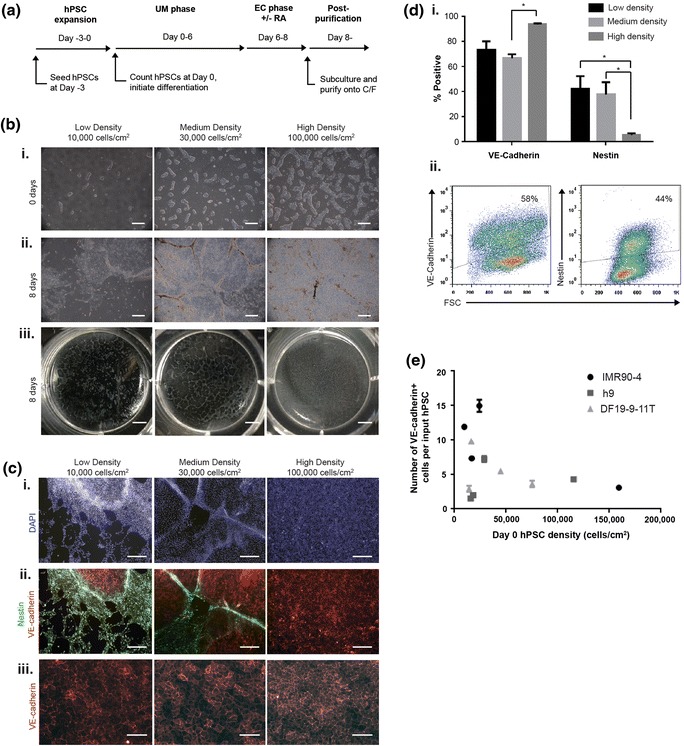
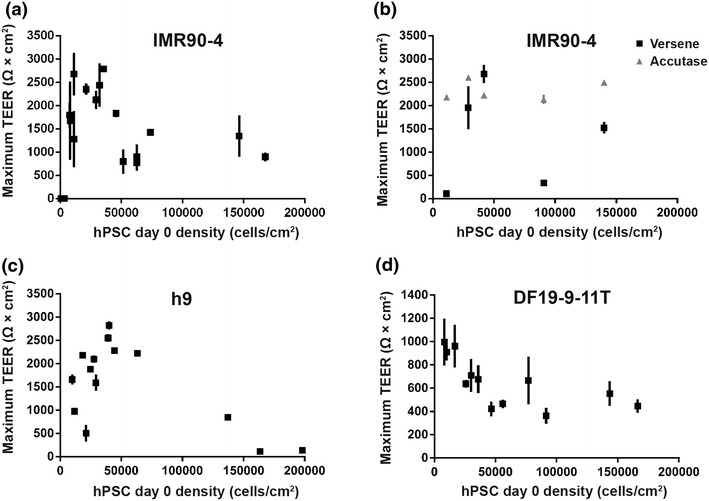
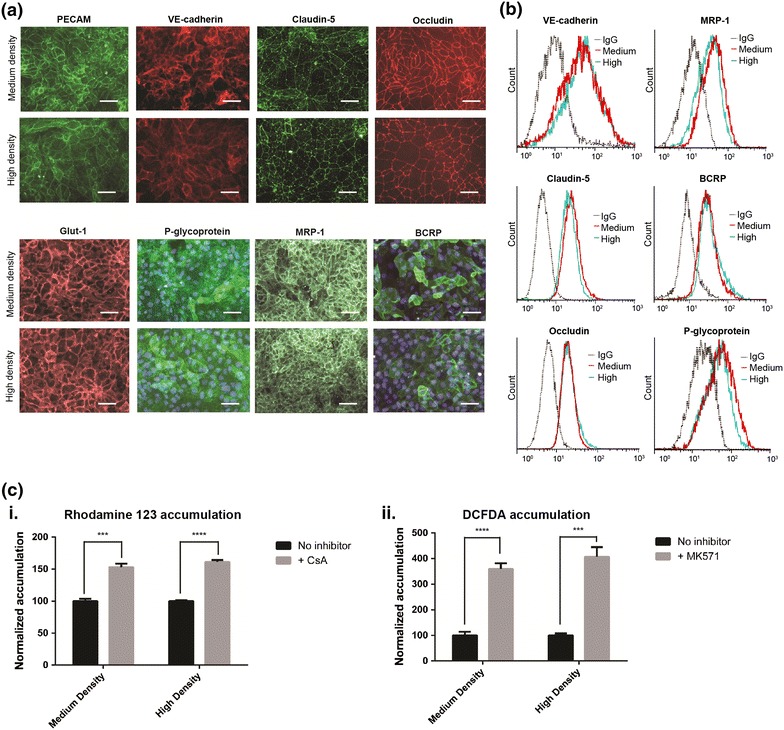
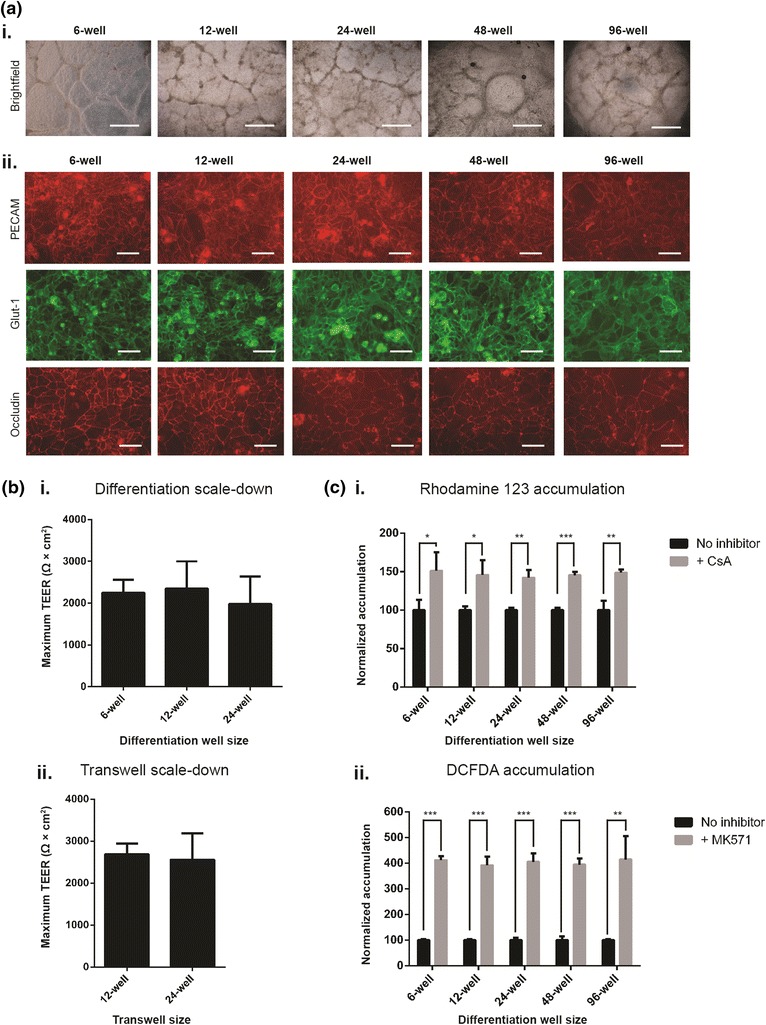
BACKGROUND: Brain microvascular-like endothelial cells (BMECs) derived from human pluripotent stem cells (hPSCs) have significant promise as tools for drug screening and studying the structure and function of the BBB in health and disease. The density of hPSCs is a key factor in regulating cell fate and yield during differentiation. Prior reports of hPSC differentiation to BMECs have seeded hPSCs in aggregates, leading to non-uniform cell densities that may result in differentiation heterogeneity. Here we report a singularized-cell seeding approach compatible with hPSC-derived BMEC differentiation protocols and evaluate the effects of initial hPSC seeding density on the subsequent differentiation, yield, and blood-brain barrier (BBB) phenotype. METHODS: A range of densities of hPSCs was seeded and differentiated, with the resultant endothelial cell yield quantified via VE-cadherin flow cytometry. Barrier phenotype of purified hPSC-derived BMECs was measured via transendothelial electrical resistance (TEER), and purification protocols were subsequently optimized to maximize TEER. Expression of characteristic vascular markers, tight junction proteins, and transporters was confirmed by immunocytochemistry and quantified by flow cytometry. P-glycoprotein and MRP-family transporter activity was assessed by intracellular accumulation assay. RESULTS: The initial hPSC seeding density of approximately 30,000 cells/cm(2) served to maximize the yield of VE-cadherin+ BMECs per input hPSC. BMECs displayed the highest TEER (>2,000 Ω × cm(2)) within this same range of initial seeding densities, although optimization of the BMEC purification method could minimize the seeding density dependence for some lines. Localization and expression levels of tight junction proteins as well as efflux transporter activity were largely independent of hPSC seeding density. Finally, the utility of the singularized-cell seeding approach was demonstrated by scaling the differentiation and purification process down from 6-well to 96-well culture without impacting BBB phenotype. CONCLUSIONS: Given the yield and barrier dependence on initial seeding density, the singularized-cell seeding approach reported here should enhance the reproducibility and scalability of hPSC-derived BBB models, particularly for the application to new pluripotent stem cell lines.
Overview
The claims and statistics of this paper haven’t been checked yet.
Free: it reads the open-access text and checks the first 5 claims that cite a source we can check. Create a free account to check every claim.
Integrity signals
Registry
Cites
Statistics
Figures
Verification
Claims the paper makes
The claims and statistics of this paper haven’t been checked yet.
Free: it reads the open-access text and checks the first 5 claims that cite a source we can check. Create a free account to check every claim.
Claims other papers make about this one
Each is checked against this paper’s own text: does it say what the citing paper says it does?
The source backs part of the claim, not all of it — or backs it for a different population, condition or comparison.
In the citing paper
“dhBMEC monolayers express a wide range of BBB markers, including tight junction (TJ) proteins (Fig. 1b), transporters, and efflux pumps, and typically attain transendothelial electrical resistance (TEER) > 1500 Ω cm2 [27, 28, 31, 34–37].”
From Role of iPSC-derived pericytes on barrier function of iPSC-derived brain microvascular endothelial cells in 2D and 3D (2019) · cites this paper as [34]
Experimental — accuracy not yet measured
Self-check
Percentages, sums and reported differences re-computed from the paper’s own numbers.
The self-check needs the paper’s full text.
Citations
Cites
Embryonic Stem Cell Lines Derived from Human Blastocysts
Thomson, J. A., Itskovitz-Eldor, J., Shapiro, S. S., Waknitz, M. A., Swiergiel, J. J., Marshall, V. S., & Jones, J. M. (1998) · Science · doi:10.1126/science.282.5391.1145 · Cited by 15,926 · cited 1×
“Distinct from such lineagerestricted stem cell populations, human pluripotent stem cells (hPSCs) can in principle be differentiated into any somatic cell type and exhibit unlimited expansion potential [13].”
BackgroundHighly efficient neural conversion of human ES and iPS cells by dual inhibition of SMAD signaling
Chambers, S. M., Fasano, C. A., Papapetrou, E. P., Tomishima, M., Sadelain, M., & Studer, L. (2009) · Nature Biotechnology · doi:10.1038/nbt.1529 · Cited by 3,620 · cited 1×
“In addition, initial hPSC seeding density affected the ratio of neural crest to central nervous system (CNS) neural cells in a neural differentiation study, with low densities favoring Pax6− neural crest cells and high densities favoring Pax6+ CNS neural cells [18].”
BackgroundThe Blood-Brain Barrier in Health and Chronic Neurodegenerative Disorders
Zlokovic, B. V. (2008) · Neuron · doi:10.1016/j.neuron.2008.01.003 · Cited by 3,280 · cited 1×
“At the same time, BBB dysfunction has been implicated in a variety of neurological disorders [2].”
BackgroundThe blood-brain barrier: Bottleneck in brain drug development
Pardridge, W. M. (2005) · NeuroRX · doi:10.1602/neurorx.2.1.3 · Cited by 2,798
A ROCK inhibitor permits survival of dissociated human embryonic stem cells
Watanabe, K., Ueno, M., Kamiya, D., Nishiyama, A., Matsumura, M., Wataya, T., Takahashi, J. B., Nishikawa, S., Nishikawa, S.-I., Muguruma, K., et al. (2007) · Nature Biotechnology · doi:10.1038/nbt1310 · Cited by 2,055 · cited 1×
“IMR90-4 iPSCs were treated with Accutase to promote the formation of a singularized cell suspension, counted, and seeded onto Matrigel at various densities in the presence of ROCK inhibitor Y27632 at day −3 (Figure 1a) to promote cell attachment and survival [21].”
MethodDerivation of blood-brain barrier endothelial cells from human pluripotent stem cells
Lippmann, E. S., Azarin, S. M., Kay, J. E., Nessler, R. A., Wilson, H. K., Al-Ahmad, A., Palecek, S. P., & Shusta, E. V. (2012) · Nature Biotechnology · doi:10.1038/nbt.2247 · Cited by 800
Self-citationElectrical resistance across the blood-brain barrier in anaesthetized rats: a developmental study.
Butt, A. M., Jones, H. C., & Abbott, N. J. (1990) · The Journal of Physiology · doi:10.1113/jphysiol.1990.sp018243 · Cited by 775 · cited 1×
“We further showed that addition of retinoic acid (RA) during the differentiation process could significantly increase TEER to nearly 3,000 Ω × cm2 in monoculture [15], approaching in vivo values [16].”
BackgroundLippmann, E. S., Al-Ahmad, A., Azarin, S. M., Palecek, S. P., & Shusta, E. V. (2014) · Scientific Reports · doi:10.1038/srep04160 · Cited by 508 · cited 9×
“For example, while H9 hESCs required an extended length of EC treatment phase of 4 days in order to achieve substantial TEER using Versene colony passage [15], controlling the day 0 hPSC seeding density using the singularizedcell seeding approach reported here allowed H9-generated BMECs to achieve high TEER using the…”
BackgroundMethodResultSelf-citationEigenmann, D. E., Xue, G., Kim, K. S., Moses, A. V., Hamburger, M., & Oufir, M. (2013) · Fluids and Barriers of the CNS · doi:10.1186/2045-8118-10-33 · Cited by 421
Niche‐mediated control of human embryonic stem cell self‐renewal and differentiation
Peerani, R., Rao, B. M., Bauwens, C., Yin, T., Wood, G. A., Nagy, A., Kumacheva, E., & Zandstra, P. W. (2007) · The EMBO Journal · doi:10.1038/sj.emboj.7601896 · Cited by 390 · cited 1×
“During differentiation, hPSC density can affect the strength of paracrine signaling and the degree of cell–cell contact, both of which can regulate differentiation fates [17].”
Background
Cited by
Items 101–129 of 129
An in vitro model for vitamin A transport across the human blood–brain barrier
Est, C. B., & Murphy, R. M. (2023) · eLife · doi:10.7554/elife.87863 · Cited by 5
“Cells were subsequently expanded for 48 hr with daily E8 media replacement until reaching the optimal density of 30,000 cells/cm 2 as described previously ( Wilson et al., 2015 ).”
MethodAlexander, N. G., Hathcock, S. F., & Kim, B. J. (2025) · Methods in molecular biology · doi:10.1007/978-1-0716-4674-8_1 · Cited by 1
Mruk, O. N., Musk, A. J., & Madsen, R. R. (2026) · STAR Protocols · doi:10.1016/j.xpro.2026.104668 · Cited by 1
In Vitro Blood-Brain Barrier Functional Assays in a Human iPSC-Based Model
Neal, E. H., Shi, Y., & Lippmann, E. S. (2019) · Neuromethods · doi:10.1007/978-1-4939-9228-7_1 · Cited by 1
Standardisation and accreditation bodies
OECD (2018) · OECD series on testing and assessment · doi:10.1787/9789264304796-20-en · Cited by 1
OECD (2018) · OECD series on testing and assessment · doi:10.1787/9789264304796-6-en · Cited by 1
Storage and retention of records and materials
OECD (2018) · OECD series on testing and assessment · doi:10.1787/9789264304796-15-en · Cited by 1
Linville, R. M., Nerenberg, R. F., Grifno, G. N., Arevalo, D., Guo, Z., & Searson, P. C. (2021) · Research Square · doi:10.21203/rs.3.rs-903286/v1 · Cited by 1
OECD (2018) · OECD series on testing and assessment · doi:10.1787/9789264304796-14-en
List of viability testing methods (non-inclusive) of cell cultures
OECD (2018) · OECD series on testing and assessment · doi:10.1787/9789264304796-24-en · Cited by 1
OECD (2018) · OECD series on testing and assessment · doi:10.1787/9789264304796-13-en
Apparatus, material and reagents
OECD (2018) · OECD series on testing and assessment · doi:10.1787/9789264304796-9-en
OECD GIVIMP meeting 23-24 March, 2017 - participating experts
OECD (2018) · OECD series on testing and assessment · doi:10.1787/9789264304796-19-en
OECD (2018) · OECD series on testing and assessment · doi:10.1787/9789264304796-8-en
An in vitro model for vitamin A transport across the human blood-brain barrierPreprint
Est, C. B., & Murphy, R. (2023) · bioRxiv · doi:10.1101/2023.04.11.536348 · Cited by 2
An in vitro model for vitamin A transport across the human blood-brain barrierPreprint
Est, C. B., & Murphy, R. M. (2023) · eLife · doi:10.7554/elife.87863.1
Exploring Environmental Neurotoxicity Assessment Using Human Stem Cell-Derived Models
Kebieche, N., Ali, F. L., Seungae, Y., Ali, M., Lambert, C., & Soulimani, R. (2024) · Journal of Stem Cell Therapy and Transplantation · doi:10.29328/journal.jsctt.1001044
Large-Scale Organoid Culture for High Throughput Drug Screening
Gautam, S., Singh, A. K., & Kadam, S. (2025) · BENTHAM SCIENCE PUBLISHERS eBooks · doi:10.2174/9789815238693125010012
Jezierski, A., Huang, J., Haqqani, A. S., Haukenfrers, J., Liu, Z., Baumann, E., Sodja, C., Charlebois, C., Delaney, C. E., Star, A. T., et al. (2024) · Figshare · doi:10.6084/m9.figshare.26592191
Linville, R. M., Nerenberg, R. F., Grifno, G. N., Arevalo, D., Guo, Z., & Searson, P. C. (2022) · Figshare · doi:10.6084/m9.figshare.20208314
Ozgür, B., Puris, E., Brachner, A., Appelt‐Menzel, A., Oerter, S., Balzer, V., Holst, M. R., Christiansen, R. F., Hyldig, K., Buckley, S. T., et al. (2023) · Figshare · doi:10.6084/m9.figshare.24872982
Additional file 1 of Commentary on human pluripotent stem cell-based blood–brain barrier models
Lippmann, E. S., Azarin, S. M., Palecek, S. P., & Shusta, E. V. (2020) · Figshare · doi:10.6084/m9.figshare.13115217
Self-citationAoki, H., Yamashita, M., Hashita, T., Iwao, T., & Matsunaga, T. (2020) · Figshare · doi:10.6084/m9.figshare.12050235
Jezierski, A., Huang, J., Haqqani, A. S., Haukenfrers, J., Liu, Z., Baumann, E., Sodja, C., Charlebois, C., Delaney, C. E., Star, A. T., et al. (2024) · Figshare · doi:10.6084/m9.figshare.26592188
Mruk, O. N., & Madsen, R. R. (2026) · bioRxiv (Cold Spring Harbor Laboratory) · doi:10.64898/2026.01.10.698801
“This finding aligns with previous reports demonstrating that higher seeding density and increased cell–cell contact promote optimal differentiation and functional properties in iPSC-derived brain microvascular endothelial cells (Wilson et al. 2015).”
In silico modeling of anterior foregut endoderm differentiation towards lung epithelial progenitors
Mostofinejad, A., Romero, D. A., Brinson, D., Waddell, T. K., Karoubi, G., & Amon, C. H. (2026) · npj Systems Biology and Applications · doi:10.1038/s41540-026-00650-1
Chung, T. D., Liang, L. R., Wang, L., Kim, E. G., Gupta, S., Pandey, I., & Searson, P. C. (2026) · Fluids and Barriers of the CNS · doi:10.1186/s12987-026-00773-x
Impact of Neurons on Group B Streptococcus Interactions at the Blood Brain BarrierPreprint
Seyfarth, L. M., Alexander, N. G., Arnett, A. S., Seely, K. N., Klemp, B. T., Keyzer, T. E., Vollmuth, N., Griffin, C., Burton, M. D., Sanchez, E. L., et al. (2026) · bioRxiv (Cold Spring Harbor Laboratory) · doi:10.64898/2026.07.31.741976
Hwang, R. W., Li, Y. B., Marcotte, R., Costain, W., & Jezierski, A. (2026) · Stem Cell Reports · doi:10.1016/j.stemcr.2026.103116
Metadata
- Authors
- Wilson, H. K., Canfield, S. G., Hjortness, M. K., Palecek, S. P., & Shusta, E. V.
- Affiliations
- University of Wisconsin–Madison (US)
- Corresponding author
- Shusta, Eric V
- Venue
- Fluids and Barriers of the CNS
- Published
- 2015-05-21
- Volume
- 12
- Issue
- 1
- Pages
- 13-13
- ISSN
- 2045-8118 (ISSN-L)
- PMC
- PMC4455681
- OpenAlex
- W1536883565
- Semantic Scholar
- 3c3526c6d8680c59a1426202c1ef8dc7e69ce7d4
- Cited by
- 130
- References
- 23
- Citations by year
- 2026: 6 · 2025: 4 · 2024: 6 · 2023: 16 · 2022: 14 · 2021: 9 · 2020: 18 · 2019: 9 · 2018: 28 · 2017: 10 · 2016: 7 · 2015: 3
- FWCI
- 8.53
- Type
- journal article
- Language
- en
- Open access
- gold
- doi.org
- Licence
- cc-by
- Locations
- Fluids and Barriers of the CNS (publishedVersion, cc-by)
- PubMed Central (publishedVersion, cc-by)
- PubMed (publishedVersion)
- Funders
- National Science Foundation (NS083688)
- National Institutes of Health
- National Institute of Neurological Disorders and Stroke (R01NS083688, NS085351, R21NS085351, NS083688)
- Topics
- Life Sciences › Neuroscience › Neurology › Barrier Structure and Function Studies
- Life Sciences › Biochemistry, Genetics and Molecular Biology › Molecular Biology › Pluripotent Stem Cells Research
- Health Sciences › Medicine › Oncology › Drug Transport and Resistance Mechanisms
- Keywords
- human pluripotent stem cells, brain microvascular endothelial cells, cell seeding density, blood-brain barrier, endothelial differentiation, transendothelial electrical resistance, tight junction proteins, P-glycoprotein, MRP transporters, efflux pumps, high-content screening
- MeSH terms
- Brain, Cell Count, Cell Differentiation, Cells, Cultured, Humans, Cell Culture Techniques, Pluripotent Stem Cells, Endothelial Cells, Microvessels
About these checks
Registry, retraction, Cites and statistics results are computed, not judged, with one exception: a printed reference that no index lists is read once by a model before it counts as a citation error. Claims are extracted by a model and kept only when their quote appears verbatim in the text; each cited source is then checked, with a model’s help, for whether it says what the claim relies on. Those verdicts can be wrong — read the claim’s quote and the cited source before relying on one.
Statistics and arithmetic are recomputed, not judged.
Confidence bands are shown only for fields calibrated on our annotated test set. None is calibrated yet, so no band is shown.
What counts as a claim ›How we measure confidence ›How we check this ›
Are you an author, or do you see a problem with this page? Request a review
Data sources
Bibliographic data: Semantic Scholar, OpenAlex, Crossref.
Contains information from the Semantic Scholar Academic Graph Datasets, made available under the ODC Attribution License (ODC-BY 1.0).
Semantic Scholar’s data is described in: Kinney, R., et al. (2023). The Semantic Scholar Open Data Platform. arXiv:2301.10140.
