

Psychosocial treatment and interventions for bipolar disorder: a systematic review
Open accessThe DOI matches its Crossref record; 108 of the 109 references it cites were found in a registry or an index.
Abstract
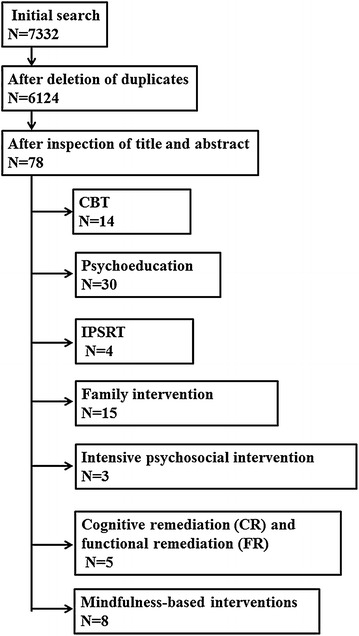
BACKGROUND: Bipolar disorder (BD) is a chronic disorder with a high relapse rate, significant general disability and burden and with a psychosocial impairment that often persists despite pharmacotherapy. This indicates the need for effective and affordable adjunctive psychosocial interventions, tailored to the individual patient. Several psychotherapeutic techniques have tried to fill this gap, but which intervention is suitable for each patient remains unknown and it depends on the phase of the illness. METHODS: The papers were located with searches in PubMed/MEDLINE through May 1st 2015 with a combination of key words. The review followed the recommendations of the Preferred Items for Reporting of Systematic Reviews and Meta-Analyses statement. RESULTS: The search returned 7,332 papers; after the deletion of duplicates, 6,124 remained and eventually 78 were included for the analysis. The literature supports the usefulness only of psychoeducation for the relapse prevention of mood episodes and only in a selected subgroup of patients at an early stage of the disease who have very good, if not complete remission, of the acute episode. Cognitive-behavioural therapy and interpersonal and social rhythms therapy could have some beneficial effect during the acute phase, but more data are needed. Mindfulness interventions could only decrease anxiety, while interventions to improve neurocognition seem to be rather ineffective. Family intervention seems to have benefits mainly for caregivers, but it is uncertain whether they have an effect on patient outcomes. CONCLUSION: The current review suggests that the literature supports the usefulness only of specific psychosocial interventions targeting specific aspects of BD in selected subgroups of patients.
Overview
The claims and statistics of this paper haven’t been checked yet.
Free: it reads the open-access text and checks the first 5 claims that cite a source we can check. Create a free account to check every claim.
Integrity signals
Registry
Cites
Statistics
Figures
Verification
Claims the paper makes
The claims and statistics of this paper haven’t been checked yet.
Free: it reads the open-access text and checks the first 5 claims that cite a source we can check. Create a free account to check every claim.
Claims other papers make about this one
Each is checked against this paper’s own text: does it say what the citing paper says it does?
The source backs part of the claim, not all of it — or backs it for a different population, condition or comparison.
In the citing paper
“Data suggests that psychosocial interventions appear beneficial for patients with a diagnosis within the psychosis continuum in a wide range of areas, namely regarding positive symptoms, functioning, relapse rates, affective symptoms, anxiety symptoms, social and vocational func-tioning (e.g., Huxley, Rendall, & Sederer, 2000;Miziou et al., 2015;Richardson, 2010;Wykes, Steel, Everitt, & Tarrier, 2”
From Contextual Cognitive-Behavioral Therapies Across the Psychosis Continuum: A Review of Evidence for Schizophrenia, Schizoaffective and Bipolar Disorders (2017) · cites this paper as Miziou et al., 2015
Experimental — accuracy not yet measured
Self-check
Percentages, sums and reported differences re-computed from the paper’s own numbers.
The self-check needs the paper’s full text.
Citations
Cites
Preferred Reporting Items for Systematic Reviews and Meta-Analyses: The PRISMA Statement
Moher, D., Liberati, A., Tetzlaff, J., & Altman, D. G. (2009) · Journal of Clinical Epidemiology · doi:10.1016/j.jclinepi.2009.06.005 · Cited by 19,575
Preferred reporting items for systematic reviews and meta-analyses: The PRISMA statement
Moher, D., Liberati, A., Tetzlaff, J., & Altman, D. G. (2010) · International Journal of Surgery · doi:10.1016/j.ijsu.2010.02.007 · Cited by 12,156
Murray, C. J. L., Vos, T., Lozano, R., Naghavi, M., Flaxman, A. D., Michaud, C., Ezzati, M., Shibuya, K., Salomon, J. A., Abdalla, S., et al. (2012) · The Lancet · doi:10.1016/s0140-6736(12)61689-4 · Cited by 8,888
Geddes, J. R., & Miklowitz, D. J. (2013) · The Lancet · doi:10.1016/s0140-6736(13)60857-0 · Cited by 848
Colom, F., Vieta, E., Martínez-Arán, A., Reinares, M., Goikolea, J. M., Benabarre, A., Torrent, C., Comes, M., Corbella, B., Parramon, G., et al. (2003) · Archives of General Psychiatry · doi:10.1001/archpsyc.60.4.402 · Cited by 791
Two-Year Outcomes for Interpersonal and Social Rhythm Therapy in Individuals With Bipolar I Disorder
Frank, E., Kupfer, D. J., Thase, M. E., Mallinger, A. G., Swartz, H. A., Fagiolini, A. M., Grochocinski, V., Houck, P., Scott, J., Thompson, W., et al. (2005) · Archives of General Psychiatry · doi:10.1001/archpsyc.62.9.996 · Cited by 770 · cited 3×
“It is unclear whether IPSRT and CBT are efficacious during the acute episodes, but there are some data in support [13, 60, 78].”
BackgroundMiklowitz, D. J., George, E. L., Richards, J. A., Simoneau, T. L., & Suddath, R. L. (2003) · Archives of General Psychiatry · doi:10.1001/archpsyc.60.9.904 · Cited by 641 · cited 1×
“It is important that the benefits extended to the 2-year follow-up were particularly useful for depressive symptoms, in families with high expressed emotion and for the improvement of medication adherence [66].”
BackgroundPerry, A., Tarrier, N., Morriss, R., McCarthy, E., & Limb, K. (1999) · BMJ · doi:10.1136/bmj.318.7177.149 · Cited by 586 · cited 2×
“Psychoeducation had no effect on depressive relapses [35].”
BackgroundScott, J., Paykel, E., Morriss, R., Bentall, R., Kinderman, P., Johnson, T., Abbott, R., & Hayhurst, H. (2006) · British Journal of Psychiatry · doi:10.1192/bjp.188.4.313 · Cited by 566
Miklowitz, D. J., Otto, M. W., Frank, E., Reilly-Harrington, N. A., Wisniewski, S. R., Kogan, J. N., Nierenberg, A. A., Calabrese, J. R., Marangell, L. B., Gyulai, L., et al. (2007) · Archives of General Psychiatry · doi:10.1001/archpsyc.64.4.419 · Cited by 537 · cited 2×
“It is unclear whether IPSRT and CBT are efficacious during the acute episodes, but there are some data in support [13, 60, 78].”
BackgroundResult
Research works printed but not linked: 2
- Gonzalez Isasi A, Echeburua E, Liminana JM, Gonzalez-Pinto A (2014) Psychoeducation and cognitive-behavioral therapy for patients with refractory bipolar disorder: a 5-year controlled clinical trial. Eur Psychiatry 29(3):134–141 23276524 · DOI · Paper page
- Fountoulakis KN Siamouli M Re: how well do psychosocial interventions work in bipolar disorder? Can J Psychiatry 2009 54 8 578 19743560 · DOI
Cited by
Vieta, E., Berk, M., Schulze, T. G., Carvalho, A. F., Suppes, T., Calabrese, J. R., Gao, K., Miskowiak, K. W., & Grande, I. (2018) · Nature Reviews Disease Primers · doi:10.1038/nrdp.2018.8 · Cited by 891
Fountoulakis, K. N., Yatham, L., Grunze, H., Vieta, E., Young, A., Blier, P., Kasper, S., & Moeller, H. J. (2016) · International Journal of Neuropsychopharmacology · doi:10.1093/ijnp/pyw100 · Cited by 116
“There are some but overall limited data concerning the usefulness of specific adjunctive psychotherapies (Reinares et al., 2014; Miziou et al., 2015).”
Self-citationInnovative approaches to bipolar disorder and its treatment
Harrison, P. J., Cipriani, A., Harmer, C. J., Nobre, A. C., Saunders, K., Goodwin, G. M., & Geddes, J. R. (2016) · Annals of the New York Academy of Sciences · doi:10.1111/nyas.13048 · Cited by 115
Chu, C.-S., Stubbs, B., Chen, T.-Y., Tang, C.-H., Li, D.-J., Yang, W.-C., Wu, C.-K., Carvalho, A. F., Vieta, E., Miklowitz, D. J., et al. (2018) · Journal of Affective Disorders · doi:10.1016/j.jad.2017.08.025 · Cited by 84
“stabilizing episodes, and reducing episode length (Miklowitz, 2008; Miziou et al., 2015; Oud et al., 2016).”
BackgroundMindfulness meditation for workplace wellness: An evidence map
Hilton, L. G., Marshall, N. J., Motala, A., Taylor, S. L., Miake-Lye, I. M., Baxi, S., Shanman, R. M., Solloway, M. R., Beroesand, J. M., & Hempel, S. (2019) · Work · doi:10.3233/wor-192922 · Cited by 77
Fountoulakis, K. N., Yatham, L. N., Grunze, H., Vieta, E., Young, A. H., Blier, P., Tohen, M., Kasper, S., & Moeller, H. J. (2020) · International Journal of Neuropsychopharmacology · doi:10.1093/ijnp/pyz064 · Cited by 77
“Psychological Treatments (n = 21) There are some but overall limited data of problematic quality concerning the usefulness of specific adjunctive psychotherapies (Reinares et al., 2014; Miziou et al., 2015).”
BackgroundSelf-citationCognitive impairment in manic bipolar patients: important, understated, significant aspects
Vrabie, M., Marinescu, V., Talasman, A., Tautu, O.-F., Drima, E. P., & Micluția, I. (2015) · Annals of General Psychiatry · doi:10.1186/s12991-015-0080-0 · Cited by 80
“These deficits often persist despite pharmacotherapy [1].”
Evidence-Based Psychotherapies for Bipolar Disorder
Novick, D. M., & Swartz, H. A. (2019) · FOCUS The Journal of Lifelong Learning in Psychiatry · doi:10.1176/appi.focus.20190004 · Cited by 85
“In aggregate, there is a strong level of evidence for psychoeducation as a maintenance treatment (4), and psycho-education may be one of the most effective psychotherapies for bipolar disorder, especially type I (36).”
Demissie, M., Hanlon, C., Birhane, R., Ng, L., Medhin, G., & Fekadu, A. (2018) · BJPsych Open · doi:10.1192/bjo.2018.46 · Cited by 43
Daus, H., Kislicyn, N., Heuer, S., & Backenstraß, M. (2018) · Journal of Affective Disorders · doi:10.1016/j.jad.2017.12.059 · Cited by 53
Ferentinos, P. P., Preti, A., Veroniki, A. A., Pitsalidis, K. G., Antonis, T., Antoniou, A., & Fountoulakis, K. Ν. (2019) · Journal of Affective Disorders · doi:10.1016/j.jad.2019.11.136 · Cited by 47
Self-citationClinical practice guidelines for bipolar affective disorder (BPAD) in children and adolescents
Gautam, S., Jain, A., Gautam, M., Gautam, A., & Jagawat, T. (2019) · Indian Journal of Psychiatry · doi:10.4103/psychiatry.indianjpsychiatry_570_18 · Cited by 30
Sachs, G., Berg, A. V., Jagsch, R., Lenz, G., & Erfurth, A. (2020) · Frontiers in Psychiatry · doi:10.3389/fpsyt.2020.530026 · Cited by 34
“supports the concept that specific psychosocial interventions targeting specific aspects of BD can be beneficial (72, 73).”
BackgroundLee, H., Lin, E. C., Chen, M.-B., Su, T., & Chiang, L. (2016) · International Journal of Mental Health Nursing · doi:10.1111/inm.12294 · Cited by 32
“Two recent reviews (Miziou et al. 2015; Reinares et al. 2016) concluded that family interventions ameliorated caregivers’ health risk behaviours, depression, TABLE 2: Participants’ characteristics Patients with bipolar disorder v2 P-value Family caregivers v2 P-value BFCC group (n = 16) TAU group…”
BackgroundBuizza, C., Candini, V., Ferrari, C., Ghilardi, A., Saviotti, F. M., Turrina, C., Nobili, G., Sabaudo, M., & de Girolamo, G. (2019) · Frontiers in Psychiatry · doi:10.3389/fpsyt.2019.00873 · Cited by 35
Shah, S. M., Sun, T., Xu, W. G., Jiang, W., & Yuan, Y. (2022) · General Psychiatry · doi:10.1136/gpsych-2022-100885 · Cited by 37
Weber, B., Sala, L., Gex‐Fabry, M., Docteur, A., Gorwood, P. A. P. M., Cordera, P., Bondolfi, G., Jermann, F., Aubry, J., & Mirabel-Sarron, C. (2017) · The Journal of Alternative and Complementary Medicine · doi:10.1089/acm.2016.0427 · Cited by 29
“8,9 Mindfulness-based cognitive therapy (MBCT) is an 8-week group program, which integrates mindfulness practice and cognitive therapy, initially developed with the objective to prevent depressive relapse in unipolar depression.”
Prevalence and treatment of panic disorder in bipolar disorder: systematic review and meta-analysis
Preti, A., Vrubļevska, J., Veroniki, A. A., Huedo-Medina, T. B., Kyriazis, O., & Fountoulakis, K. Ν. (2018) · Evidence-Based Mental Health · doi:10.1136/eb-2017-102858 · Cited by 56
Self-citationKallestad, H., Wullum, E., Scott, J. L., Stiles, T. C., & Morken, G. (2016) · Journal of Affective Disorders · doi:10.1016/j.jad.2016.05.043 · Cited by 29
“Such studies have demonstrated both the short-term and long-term benefits of group psychoeducation, not least the reduction in admission rates for all types of BD episodes, although the treatment seems to be less effective for patients in an advanced stage of illness (Bond and Anderson, 2015; Colom, 2014; Colom et al.…”
BackgroundZhang, X., Zhao, M., Li, J., Shi, L., Xu, X., Dai, Q., Zhang, Y., Liu, H., Liu, W., Zhang, X., et al. (2019) · Journal of International Medical Research · doi:10.1177/0300060519877030 · Cited by 21
“To tackle syndromes and other health outcomes in people with BD, studies have focused on different therapies, including psychoeducation, medication, occupational therapy, psychotherapy, and family therapy.(4,5) An important issue in treating people with BD is their family system, as family members are usually frontlin…”
BackgroundHarmancı, P., & Yıldız, E. (2023) · Archives of Psychiatric Nursing · doi:10.1016/j.apnu.2023.04.026 · Cited by 26
Zhang, Y., Ma, X., Liang, S., Yu, W., He, Q., Zhang, J., & Bian, Y. (2019) · Psychiatry Research · doi:10.1016/j.psychres.2019.03.002 · Cited by 18
Johansen, K. K., Hounsgaard, L., Frandsen, T. F., Fluttert, F., & Hansen, J. P. (2020) · Journal of Psychiatric and Mental Health Nursing · doi:10.1111/jpm.12716 · Cited by 26
Complex polypharmacy in bipolar disorder: Results from a real-world inpatient psychiatric unit
Aguglia, A., Natale, A., Fusar‐Poli, L., Amerio, A., Costanza, A., Fesce, F., Gnecco, G. B., Marino, M., Placenti, V., Serafini, G., et al. (2022) · Psychiatry Research · doi:10.1016/j.psychres.2022.114927 · Cited by 17
Tan, Y., Lattie, E. G., Qiu, Y., Teng, Z., Wu, C., Tang, H., & Chen, J. (2021) · Internet Interventions · doi:10.1016/j.invent.2021.100475 · Cited by 20
Luciano, M., Sampogna, G., Vecchio, V. D., Giallonardo, V., Cerbo, A. D., Palummo, C., Malangone, C., Lampis, D., Veltro, F., Bardicchia, F., et al. (2022) · Bipolar Disorders · doi:10.1111/bdi.13182 · Cited by 16
The management of bipolar disorder
Saunders, K., & Geddes, J. R. (2016) · British Journal of Hospital Medicine · doi:10.12968/hmed.2016.77.3.175 · Cited by 16
Cotton, S., Berk, M., Jackson, H. J., Murray, G., Filia, K., Hasty, M. K., Chanen, A. M., Davey, C. G., Nelson, B., Ratheesh, A., et al. (2019) · Early Intervention in Psychiatry · doi:10.1111/eip.12797 · Cited by 15
“First-line treatment for BD is pharmacotherapy with mood stabilizers such as lithium (Bauer & Mitchner, 2004) and other medications including antipsychotics, anti- depressants and anti-epileptics (Miziou et al., 2015).”
BackgroundPetzold, J., Mayer-Pelinski, R., Pilhatsch, M., Luthe, S., Barth, T. F. E., Bauer, M., & Severus, E. (2019) · International Journal of Bipolar Disorders · doi:10.1186/s40345-019-0158-8 · Cited by 17
Coping strategies used by poorly adherent patients for self-managing bipolar disorder
Blixen, C. E., Levin, J. B., Cassidy, K. A., Perzynski, A. T., & Sajatovic, M. (2016) · Patient Preference and Adherence · doi:10.2147/ppa.s110199 · Cited by 20
KIOS : A smartphone app for self‐monitoring for patients with bipolar disorder
Pahwa, M., McElroy, S. L., Priesmeyer, H. R., Siegel, G., Siegel, P., Nuss, S., Bowden, C. L., & El‐Mallakh, R. S. (2023) · Bipolar Disorders · doi:10.1111/bdi.13362 · Cited by 15
Milić, J., Zrnic, I., Vučurović, M., Grego, E., Djurdjevic, S., & Šapić, R. (2025) · Journal of Clinical Medicine · doi:10.3390/jcm14061857 · Cited by 14
“Mindfulness-based interventions have been shown to reduce anxiety, but their effectiveness in preventing mood episodes remains limited [22].”
InfluentialMartins, M. J. R. V., Castilho, P., Carvalho, C. B., Pereira, A. T., Santos, V., Gumley, A., & de Macedo, A. F. (2017) · European Psychologist · doi:10.1027/1016-9040/a000283 · Cited by 11
“…continuum in a wide range of areas, namely regarding positive symptoms, functioning, relapse rates, affective symptoms, anxiety symptoms, social and vocational functioning (e.g., Huxley, Rendall, & Sederer, 2000; Miziou et al., 2015; Richardson, 2010; Wykes, Steel, Everitt, & Tarrier, 2008).”
BackgroundBipolar patients and creative online practices: Sharing experiences of controversial treatments
Egher, C. (2019) · Health An Interdisciplinary Journal for the Social Study of Health Illness and Medicine · doi:10.1177/1363459319838315 · Cited by 13
“…stems from the number and types of medications people take (Post et al., 2010) in relation to time, such as the duration required for the effects of medicines to become manifest; or the span when they remain effective, taking into account age, or period since diagnosis (Miziou et al., 2015).”
BackgroundSánchez-Guarnido, A. J., Huertas, P., Garcia-Solier, R., Solano, M., Díez, B., de León, M. S.-M., & Herruzo, J. (2021) · Healthcare · doi:10.3390/healthcare10010064 · Cited by 14
Anona, K., Olaomi, O. A., Udegbe, E., Uwumiro, F. E., Tuaka, E.-B., Okafor, N., Adeyinka, A., Obijuru, C. N., Okpujie, V. O., Bojerenu, M. M., et al. (2023) · Journal of Affective Disorders · doi:10.1016/j.jad.2023.10.087 · Cited by 18
Hold on Tight: Coping Strategies of Persons With Bipolar Disorder and Their Partners
Granek, L., Danan, D., Bersudsky, Y., & Osher, Y. (2018) · Family Relations · doi:10.1111/fare.12328 · Cited by 15
Abbass, A. A., Town, J. M., Johansson, R., Lahti, M., & Kisely, S. R. (2019) · Psychodynamic Psychiatry · doi:10.1521/pdps.2019.47.1.99 · Cited by 11
Johansen, K. K., Marcussen, J., Hansen, J. P., Hounsgaard, L., & Fluttert, F. (2021) · Journal of Clinical Nursing · doi:10.1111/jocn.16181 · Cited by 17
“, 2016) and society in general, due to mood fluctuations, varying treatment needs and working capacity (Miziou et al., 2015; Okpokoro, Adams, & Sampson, 2014).”
BackgroundPersonal recovery in psychological interventions for bipolar disorder: a systematic review
Hancock, J., & Perich, T. (2022) · Australian Psychologist · doi:10.1080/00050067.2022.2083484 · Cited by 14
“A number of studies have systematically reviewed the effectiveness of adjunctive psychosocial interventions for bipolar disorder (Beynon et al., 2008; Fountoulakis & Vieta, 2008; Miklowitz et al., 2021; Miziou et al., 2015; Oud et al., 2016).”
BackgroundCognitive rehabilitation in bipolar spectrum disorder: A systematic review
Razavi, M. S., Fathi, M., Vahednia, E., Ardanı, A. R., Honari, S., Akbarzadeh, F., & Talaeı, A. (2024) · IBRO Neuroscience Reports · doi:10.1016/j.ibneur.2024.04.001 · Cited by 15
“Miziou et al. (2015) reviewed different psychosocial interventions in BD and reported no significant effects of CR. (Miziou et al. 2015).”
BackgroundBarbeito, S., Vega, P., de Azúa, S. R., González–Ortega, I., Alberich, S., & González-Pinto, A. M. (2021) · Revista de Psiquiatría y Salud Mental · doi:10.1016/j.rpsm.2021.07.002 · Cited by 12
Burgos‐Julián, F. A., Ruiz‐Íñiguez, R., Peña‐Ibáñez, F., Montero, A. C., & Santed‐Germán, M. A. (2022) · Clinical Psychology & Psychotherapy · doi:10.1002/cpp.2717 · Cited by 10
Lan, Y.-F. C., Zelman, D. C., & Chao, W.-T. (2018) · Transcultural Psychiatry · doi:10.1177/1363461518761924 · Cited by 13
“Several psychosocial treatments have been developed to help individuals with BD and their families (Miklowitz, 2006, 2010; Nemade & Dombeck, 2009), although at present, their efficacy is better established for caregivers than for patients (Miziou et al., 2015).”
BackgroundTremain, H., Fletcher, K., Scott, J. L., McEnery, C., Berk, M., & Murray, G. (2020) · Bipolar Disorders · doi:10.1111/bdi.12974 · Cited by 10
Awareness of and attitudes toward CBT, DBT, and ACT in an acute psychiatric sample
Kuckertz, J. M., Silverman, A. L., Bullis, J. R., Björgvinsson, Þ., & Beard, C. (2019) · Journal of Clinical Psychology · doi:10.1002/jclp.22908 · Cited by 10
Johansen, K. K., Hounsgaard, L., Hansen, J. P., & Fluttert, F. (2021) · Archives of Psychiatric Nursing · doi:10.1016/j.apnu.2021.08.004 · Cited by 10
Kavitha, R. R., Kamalam, S., & Rajkumar, R. P. (2022) · Indian Journal of Psychological Medicine · doi:10.1177/02537176211060557 · Cited by 11
Chan, S. H., Tse, S. S.-K., Chung, K., Yu, C. H., Chung, R. C. K., & Lo, H. H. M. (2019) · BMC Psychiatry · doi:10.1186/s12888-019-2242-0 · Cited by 14
Tremain, H., Fletcher, K., Scott, J. L., McEnery, C., Berk, M., & Murray, G. (2019) · Systematic Reviews · doi:10.1186/s13643-019-1042-4 · Cited by 9
Digital Healthcare and Expertise: Mental Health and New Knowledge Practices
Egher, C. (2022) · Health, technology and society · doi:10.1007/978-981-16-9178-2 · Cited by 21
Contemporary Treatment Approaches to Major Depression and Bipolar Disorders
John, R. L., & Antai-Otong, D. (2016) · Nursing Clinics of North America · doi:10.1016/j.cnur.2016.01.015 · Cited by 7
Treatment Resistance in Bipolar Disorders
Sanches, M., Quevedo, J., & Soares, J. C. (2018) · Springer eBooks · doi:10.1007/978-981-10-4358-1_9 · Cited by 8
Development of an Emotion-Sensitive mHealth Approach for Mood-State Recognition in Bipolar Disorder
Daus, H., Blocher, T., Egeler, R., Klerk, R. D., Stork, W., & Backenstraß, M. (2020) · JMIR Mental Health · doi:10.2196/14267 · Cited by 10
“In particular, the high relapse rates within bipolar disorder are unsettling for all parties concerned: Even with pharmacological treatment [4] and different psychological approaches [5,6], these relapses cannot completely be prevented in many cases.”
BackgroundDevelopment of a psychological intervention for people with bipolar disorder in rural Ethiopia
Demissie, M., Hanlon, C., Ng, L. C., Mayston, R., Abayneh, S., & Fekadu, A. (2021) · BJPsych Open · doi:10.1192/bjo.2021.999 · Cited by 7
Meditation for treating adults with bipolar disorder II: A multi‐city study
Pandya, S. P. (2018) · Clinical Psychology & Psychotherapy · doi:10.1002/cpp.2347 · Cited by 5
Friedman, R. H., Giampaolo, J., Vanhaecke, L., & Jarrett, R. B. (2021) · Journal of Affective Disorders · doi:10.1016/j.jad.2021.07.024 · Cited by 4
Feasibility and Acceptability of a Mobile-Based Emotion Recognition Approach for Bipolar Disorder.
Daus, H., & Backenstraß, M. (2021) · International Journal of Interactive Multimedia and Artificial Intelligence · doi:10.9781/ijimai.2021.08.015 · Cited by 4
Ngor, A., Steiner, A. J., Pakhdikian, S., Okikawa, D., Pizano, D. R., Younan, L., Cohen, S., & IsHak, W. W. (2023) · Springer eBooks · doi:10.1007/978-3-031-15401-0_16 · Cited by 10
Lin, E. C. L., Berk, M., Hsu, P.-C., & Lu, R. B. (2017) · Neuropsychiatry · doi:10.4172/neuropsychiatry.1000215 · Cited by 4
Coping with amplified emotionality among people with bipolar disorder: A longitudinal study
Chan, S. H., & Tse, S. S.-K. (2018) · Journal of Affective Disorders · doi:10.1016/j.jad.2018.07.025 · Cited by 3
Wah, A., Hodge, S., Jones, S. H., & Algorta, G. P. (2020) · Behavioural and Cognitive Psychotherapy · doi:10.1017/s1352465820000946 · Cited by 8
Elias, A. F. D., Fagueiro, C. D. O., da Silveira, E. A. A., Pinto, J. A. F., Júnior, J. A. D. A., & Machado, R. M. (2019) · Revista Enfermagem UERJ · doi:10.12957/reuerj.2019.43934 · Cited by 2
Elsayed, O. H., Cecil, J., Priesmeyer, H. R., Siegel, G., Siegel, P., & El‐Mallakh, R. S. (2025) · Journal of Family Medicine and Primary Care · doi:10.4103/jfmpc.jfmpc_483_24 · Cited by 2
The Effects of Mindfulness-Based Cognitive Therapy in Bipolar Disorder
Ives-Deliperi, V. L., Howells, F. M., & Horn, N. R. (2016) · Springer eBooks · doi:10.1007/978-3-319-29866-5_14 · Cited by 4
Atualização no tratamento do transtorno bipolar: o impacto da psicoeducação familiar
Almeida, B. R. D. S., de Almeida, C. G. S., de Oliveira, C. C. M., Machado, D. C. A., Rückl, S., & Andrade, V. A. (2018) · Revista Portuguesa de Psiquiatria e Saúde Mental · doi:10.51338/rppsm.2018.v1.i3.81 · Cited by 6
Psychopathy and Mood Disorders
Dargis, M. A. (2022) · Dangerous behavior in clinical and forensic psychology · doi:10.1007/978-3-030-83156-1_8 · Cited by 2
Evidence‐Based Psychological Interventions for Bipolar Disorder
Szentágotai‐Tătar, A., & David, D. O. (2017) · Wiley eBooks · doi:10.1002/9781119462996.ch3 · Cited by 3
Digital Diagnostic and Therapeutic Approaches in Bipolar Disorder
Faurholt‐Jepsen, M., & Kessing, L. V. (2025) · Springer eBooks · doi:10.1007/978-3-031-85519-1_38 · Cited by 1
Cantone, E., Urban, A., González, C. I. A., Perra, A., Lorrai, S., Atzeni, M., Stocchino, S., Ramírez, R. R., Restrepo, A. R., Carta, M. G., et al. (2026) · Clinical Practice and Epidemiology in Mental Health · doi:10.2174/0117450179449051260114063307 · Cited by 1
Landry, S., & Provencher, M. D. (2020) · Santé mentale au Québec · doi:10.7202/1070240ar · Cited by 2
Gregus, S. J., Failes, E. R., Ramírez, E., Harrington, R. V., Welcome, P., & Schwartz‐Mette, R. A. (2020) · Elsevier eBooks · doi:10.1016/b978-0-12-817752-5.00007-x · Cited by 1
Pacheco, A. E., Enes, C. D. L., Clementino, M. T. R., Belo, V. S., Duarte, S. J. H., & Machado, R. M. (2020) · Enfermagem em Foco · doi:10.21675/2357-707x.2020.v11.n3.2881 · Cited by 4
“Ensino Superior 6 (16,7) 7 (20,6) 10 (100)”
The Role of Social Workers in Suicide Prevention Among Military Veterans
Levine, J., & Sher, L. (2021) · Springer eBooks · doi:10.1007/978-3-030-41319-4_77-1 · Cited by 2
Design considerations for preparation, optimization, and evaluation of digital therapeutics
Smith, S. N., Seewald, N. J., & Klasnja, P. (2022) · Elsevier eBooks · doi:10.1016/b978-0-323-90045-4.00015-0 · Cited by 2
Chen, B.-F., Liu, L., Lin, F.-C., Zeng, H.-M., Huang, H., Zhang, C., Liu, C., Chen, X., Peng, J., Wang, Y.-F., et al. (2025) · World Journal of Psychiatry · doi:10.5498/wjp.v15.i1.100685 · Cited by 2
Problems Affecting a Person’s Mood
López-Cortacans, G., Ferré‐Grau, C., & Santos, J. C. (2017) · Principles of specialty nursing · doi:10.1007/978-3-319-31772-4_26 · Cited by 1
The Role of Social Workers in Suicide Prevention Among Military Veterans
Levine, J., & Sher, L. (2022) · Springer eBooks · doi:10.1007/978-3-030-42003-1_77 · Cited by 1
Fetal exposure to neurotropic drugs : neonatal effects and long-term outcome
Forsberg, L. (2016) · Figshare
Welton, R. S., & Roman, B. J. B. (2017) · Wiley eBooks · doi:10.1002/9781119152606.ch4
Lana, F., Martí-Bonany, J., Moreno, G., Pérez, V., & de la Cruz, M. Á. (2017)
Patel, R. (2018) · TSpace (University of Toronto)
Backenstraß, M., Schnell, K., & Schramm, E. (2016) · Elsevier eBooks · doi:10.1016/b978-3-437-23731-7.00021-1
Malehmir, B., Keyvanlo, S., Rafieerad, Z., Moazez, R., Sadri, M., & Zavarei, Z. (2021) · Shenakht Journal of Psychology and Psychiatry · doi:10.32598/shenakht.8.1.147
Bornamanesh, A., Mehryar, A., Javidi, H., & Ghasemi, N. (2021) · Journal of Multidisciplinary Care · doi:10.34172/jmdc.2021.23
“Introduction Bipolar disorder (BD) is a chronic disorder with high recurrence rate and significant disability (1).”
BackgroundNeto, P. R. N., Köhler, C. A., Berk, M., & Carvalho, A. F. (2017) · Oxford University Press eBooks · doi:10.1093/med/9780198746638.003.0011
Tactical Re-appraisals and Digitally Informed Hypotheses About the Treatment for Bipolar Disorder
Egher, C. (2022) · Health, technology and society · doi:10.1007/978-981-16-9178-2_4
Ayurvedic management of Bipolar affective disorder: A case report
Thasni, M., Madhavan, J., & Aparna, P. M. (2023) · Journal of Ayurveda Case Reports · doi:10.4103/jacr.jacr_132_22
Overview of bipolar research and future direction
Xu, W. (2023) · SHS Web of Conferences · doi:10.1051/shsconf/202318003016
BIPOLAR DISORDER MANIC EPISODE WITH PSYCHOSIS : A CASE REPORT
Amariannisa, H., & Hidayat, M. F. (2023) · Journal of Advance Research in Medical & Health Science · doi:10.61841/72sb0254
Assessment of Cognitive Functions in Bipolar Disorder Patients
Elbeh, K., Khalifa, H., & Salama, M. (2024) · Journal of Current Medical Research and Practice · doi:10.21608/jcmrp.2024.346793
Sexual Disorders in Females with Bipolar Disorder
El-Sorogy, S. E., El-Hamady, M. M., Mohamed, A. S., & Dahroug, M. M. M. (2024) · Benha Journal of Applied Sciences · doi:10.21608/bjas.2024.275914.1354 · Cited by 1
Domain specific Memory Impairments in Bipolar Mania: Insights from a Tertiary Care StudyPreprint
Kumar, M., Kumar, S., Khusboo, Maqbool, M., Singh, V. K., & Soni, A. K. (2024) · medRxiv · doi:10.1101/2024.09.26.24314411
“It is characterized by a spectrum of extreme mood states, which vary in severity and duration, posing significant challenges in both diagnosis and treatment 2 .”
BackgroundGroup Psychoeducation and Cognitive Behavioural Therapy for Bipolar Disorder
Newton, E. K., Kaufman, A., Carlish, M., Murden, R., Eaton, J., Hayes, A., & Rolfe, A. (2024) · Springer eBooks · doi:10.1007/978-3-031-63349-2_12
Psychological Therapies and Bipolar Disorder: A Review of the Evidence
Arnold, R. A., & Burlingame, G. M. (2024) · Springer eBooks · doi:10.1007/978-3-031-63349-2_4
Peng, C., & Zhang, Z. (2024) · Applied Mathematics and Nonlinear Sciences · doi:10.2478/amns-2024-3651
Domain-Specific Memory Impairments in Bipolar Mania: Insights from a Tertiary Care Hospital
Kumar, M., Kumar, S., Khusboo, Maqbool, M., Singh, V. K., & Soni, A. K. (2025) · Indian Journal of Psychological Medicine · doi:10.1177/02537176241312646
Potupchik, T. V., Evert, L. S., Seliverstov, P. V., Urazaev, K. A., Bitokova, F. B., Khezheva, A. A., Ashkhotova, A. A., Vanyushina, D. D., Zaeva, A. A., Ягудин, Д. Р., et al. (2025) · Vestnik nevrologii psihiatrii i nejrohirurgii (Bulletin of Neurology Psychiatry and Neurosurgery) · doi:10.33920/med-01-2503-03
Thérapies interpersonnelles avec aménagement des rythmes sociaux dans les troubles bipolaires
Lavigne, B., Sengelen, J.-M., Omay, O., & Bottaï, T. (2026) · Encyclopédie médico-chirurgicale. Psychiatrie · doi:10.1016/s0246-1072(25)63172-5
Lama, A., & Baruah, A. (2026) · Journal of Psychosocial Nursing and Mental Health Services · doi:10.3928/02793695-20260311-02 · Cited by 1
Metadata
- Authors
- Miziou, S., Tsitsipa, E., Moysidou, S., Karavelas, V., Dimelis, D., Polyzoidou, V., & Fountoulakis, K. N.
- Affiliations
- Aristotle University of Thessaloniki (GR)
- ORCID
- Polyzoidou, Vagia
- Venue
- Annals of General Psychiatry
- Published
- 2015-07-07
- Volume
- 14
- Issue
- 1
- Pages
- 19-19
- ISSN
- 1744-859X (ISSN-L)
- PMC
- PMC4493813
- OpenAlex
- W1510013835
- Semantic Scholar
- b9205b863caec03cc49295a16fea76799d3e7de5
- Cited by
- 102
- References
- 109
- Citations by year
- 2026: 4 · 2025: 5 · 2024: 8 · 2023: 7 · 2022: 11 · 2021: 11 · 2020: 9 · 2019: 16 · 2018: 11 · 2017: 9 · 2016: 10 · 2015: 1
- FWCI
- 1.42
- Type
- journal article
- Language
- en
- Open access
- gold
- doi.org
- Licence
- cc-by
- Locations
- Annals of General Psychiatry (publishedVersion, cc-by)
- PubMed Central (publishedVersion, cc-by)
- PubMed (publishedVersion)
- Topics
- Health Sciences › Medicine › Psychiatry and Mental health › Bipolar Disorder and Treatment
- Social Sciences › Psychology › Clinical Psychology › Personality Disorders and Psychopathology
- Health Sciences › Medicine › Psychiatry and Mental health › Schizophrenia research and treatment
- Keywords
- bipolar disorder, psychosocial interventions, psychoeducation, relapse prevention, cognitive behavioral therapy, interpersonal and social rhythm therapy, mindfulness-based interventions, neurocognitive interventions, family intervention, mood episodes, adjunctive therapy
About these checks
Registry, retraction, Cites and statistics results are computed, not judged, with one exception: a printed reference that no index lists is read once by a model before it counts as a citation error. Claims are extracted by a model and kept only when their quote appears verbatim in the text; each cited source is then checked, with a model’s help, for whether it says what the claim relies on. Those verdicts can be wrong — read the claim’s quote and the cited source before relying on one.
Statistics and arithmetic are recomputed, not judged.
Confidence bands are shown only for fields calibrated on our annotated test set. None is calibrated yet, so no band is shown.
What counts as a claim ›How we measure confidence ›How we check this ›
Are you an author, or do you see a problem with this page? Request a review
Data sources
Bibliographic data: Semantic Scholar, OpenAlex, Crossref.
Contains information from the Semantic Scholar Academic Graph Datasets, made available under the ODC Attribution License (ODC-BY 1.0).
Semantic Scholar’s data is described in: Kinney, R., et al. (2023). The Semantic Scholar Open Data Platform. arXiv:2301.10140.
