

Psychosocial treatment and interventions for bipolar disorder: a systematic review
Open accessThe DOI matches its Crossref record; 108 of the 109 references it cites were found in a registry or an index.
Abstract
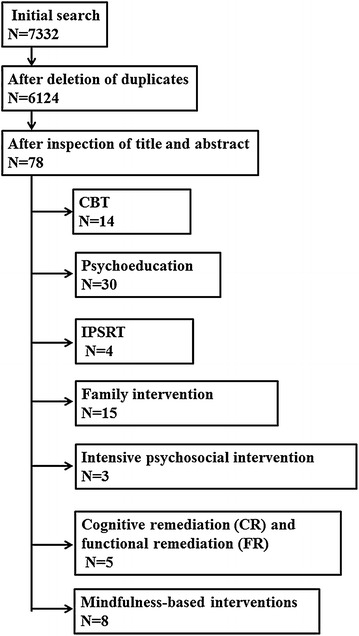
BACKGROUND: Bipolar disorder (BD) is a chronic disorder with a high relapse rate, significant general disability and burden and with a psychosocial impairment that often persists despite pharmacotherapy. This indicates the need for effective and affordable adjunctive psychosocial interventions, tailored to the individual patient. Several psychotherapeutic techniques have tried to fill this gap, but which intervention is suitable for each patient remains unknown and it depends on the phase of the illness. METHODS: The papers were located with searches in PubMed/MEDLINE through May 1st 2015 with a combination of key words. The review followed the recommendations of the Preferred Items for Reporting of Systematic Reviews and Meta-Analyses statement. RESULTS: The search returned 7,332 papers; after the deletion of duplicates, 6,124 remained and eventually 78 were included for the analysis. The literature supports the usefulness only of psychoeducation for the relapse prevention of mood episodes and only in a selected subgroup of patients at an early stage of the disease who have very good, if not complete remission, of the acute episode. Cognitive-behavioural therapy and interpersonal and social rhythms therapy could have some beneficial effect during the acute phase, but more data are needed. Mindfulness interventions could only decrease anxiety, while interventions to improve neurocognition seem to be rather ineffective. Family intervention seems to have benefits mainly for caregivers, but it is uncertain whether they have an effect on patient outcomes. CONCLUSION: The current review suggests that the literature supports the usefulness only of specific psychosocial interventions targeting specific aspects of BD in selected subgroups of patients.
Overview
The claims and statistics of this paper haven’t been checked yet.
Free: it reads the open-access text and checks the first 5 claims that cite a source we can check. Create a free account to check every claim.
Integrity signals
Registry
Cites
Statistics
Figures
Verification
Claims the paper makes
The claims and statistics of this paper haven’t been checked yet.
Free: it reads the open-access text and checks the first 5 claims that cite a source we can check. Create a free account to check every claim.
Claims other papers make about this one
Each is checked against this paper’s own text: does it say what the citing paper says it does?
The source backs part of the claim, not all of it — or backs it for a different population, condition or comparison.
In the citing paper
“Data suggests that psychosocial interventions appear beneficial for patients with a diagnosis within the psychosis continuum in a wide range of areas, namely regarding positive symptoms, functioning, relapse rates, affective symptoms, anxiety symptoms, social and vocational func-tioning (e.g., Huxley, Rendall, & Sederer, 2000;Miziou et al., 2015;Richardson, 2010;Wykes, Steel, Everitt, & Tarrier, 2”
From Contextual Cognitive-Behavioral Therapies Across the Psychosis Continuum: A Review of Evidence for Schizophrenia, Schizoaffective and Bipolar Disorders (2017) · cites this paper as Miziou et al., 2015
Experimental — accuracy not yet measured
Self-check
Percentages, sums and reported differences re-computed from the paper’s own numbers.
The self-check needs the paper’s full text.
Citations
Cites
Preferred Reporting Items for Systematic Reviews and Meta-Analyses: The PRISMA Statement
Moher, D., Liberati, A., Tetzlaff, J., & Altman, D. G. (2009) · Journal of Clinical Epidemiology · doi:10.1016/j.jclinepi.2009.06.005 · Cited by 19,575
Preferred reporting items for systematic reviews and meta-analyses: The PRISMA statement
Moher, D., Liberati, A., Tetzlaff, J., & Altman, D. G. (2010) · International Journal of Surgery · doi:10.1016/j.ijsu.2010.02.007 · Cited by 12,156
Murray, C. J. L., Vos, T., Lozano, R., Naghavi, M., Flaxman, A. D., Michaud, C., Ezzati, M., Shibuya, K., Salomon, J. A., Abdalla, S., et al. (2012) · The Lancet · doi:10.1016/s0140-6736(12)61689-4 · Cited by 8,888
Geddes, J. R., & Miklowitz, D. J. (2013) · The Lancet · doi:10.1016/s0140-6736(13)60857-0 · Cited by 848
Colom, F., Vieta, E., Martínez-Arán, A., Reinares, M., Goikolea, J. M., Benabarre, A., Torrent, C., Comes, M., Corbella, B., Parramon, G., et al. (2003) · Archives of General Psychiatry · doi:10.1001/archpsyc.60.4.402 · Cited by 791
Two-Year Outcomes for Interpersonal and Social Rhythm Therapy in Individuals With Bipolar I Disorder
Frank, E., Kupfer, D. J., Thase, M. E., Mallinger, A. G., Swartz, H. A., Fagiolini, A. M., Grochocinski, V., Houck, P., Scott, J., Thompson, W., et al. (2005) · Archives of General Psychiatry · doi:10.1001/archpsyc.62.9.996 · Cited by 770 · cited 3×
“It is unclear whether IPSRT and CBT are efficacious during the acute episodes, but there are some data in support [13, 60, 78].”
BackgroundMiklowitz, D. J., George, E. L., Richards, J. A., Simoneau, T. L., & Suddath, R. L. (2003) · Archives of General Psychiatry · doi:10.1001/archpsyc.60.9.904 · Cited by 641 · cited 1×
“It is important that the benefits extended to the 2-year follow-up were particularly useful for depressive symptoms, in families with high expressed emotion and for the improvement of medication adherence [66].”
BackgroundPerry, A., Tarrier, N., Morriss, R., McCarthy, E., & Limb, K. (1999) · BMJ · doi:10.1136/bmj.318.7177.149 · Cited by 586 · cited 2×
“Psychoeducation had no effect on depressive relapses [35].”
BackgroundScott, J., Paykel, E., Morriss, R., Bentall, R., Kinderman, P., Johnson, T., Abbott, R., & Hayhurst, H. (2006) · British Journal of Psychiatry · doi:10.1192/bjp.188.4.313 · Cited by 566
Miklowitz, D. J., Otto, M. W., Frank, E., Reilly-Harrington, N. A., Wisniewski, S. R., Kogan, J. N., Nierenberg, A. A., Calabrese, J. R., Marangell, L. B., Gyulai, L., et al. (2007) · Archives of General Psychiatry · doi:10.1001/archpsyc.64.4.419 · Cited by 537 · cited 2×
“It is unclear whether IPSRT and CBT are efficacious during the acute episodes, but there are some data in support [13, 60, 78].”
BackgroundResult
Research works printed but not linked: 2
- Gonzalez Isasi A, Echeburua E, Liminana JM, Gonzalez-Pinto A (2014) Psychoeducation and cognitive-behavioral therapy for patients with refractory bipolar disorder: a 5-year controlled clinical trial. Eur Psychiatry 29(3):134–141 23276524 · DOI · Paper page
- Fountoulakis KN Siamouli M Re: how well do psychosocial interventions work in bipolar disorder? Can J Psychiatry 2009 54 8 578 19743560 · DOI
Cited by
Items 101–102 of 102
Rainbow, C., Khanna, R., & Green, R. (2026) · Australian Psychologist · doi:10.1080/00050067.2026.2650144
“These approaches can include psychoeducation (Lyman et al., 2014), social support and rehabilitation (Webber & Fendt-Newlin, 2017), vocational skills training (Noyes et al., 2018), and structured psychological treatments such as cognitive-behavioural therapy [CBT] (Miziou et al., 2015).”
Metadata
- Authors
- Miziou, S., Tsitsipa, E., Moysidou, S., Karavelas, V., Dimelis, D., Polyzoidou, V., & Fountoulakis, K. N.
- Affiliations
- Aristotle University of Thessaloniki (GR)
- ORCID
- Polyzoidou, Vagia
- Venue
- Annals of General Psychiatry
- Published
- 2015-07-07
- Volume
- 14
- Issue
- 1
- Pages
- 19-19
- ISSN
- 1744-859X (ISSN-L)
- PMC
- PMC4493813
- OpenAlex
- W1510013835
- Semantic Scholar
- b9205b863caec03cc49295a16fea76799d3e7de5
- Cited by
- 102
- References
- 109
- Citations by year
- 2026: 4 · 2025: 5 · 2024: 8 · 2023: 7 · 2022: 11 · 2021: 11 · 2020: 9 · 2019: 16 · 2018: 11 · 2017: 9 · 2016: 10 · 2015: 1
- FWCI
- 1.42
- Type
- journal article
- Language
- en
- Open access
- gold
- doi.org
- Licence
- cc-by
- Locations
- Annals of General Psychiatry (publishedVersion, cc-by)
- PubMed Central (publishedVersion, cc-by)
- PubMed (publishedVersion)
- Topics
- Health Sciences › Medicine › Psychiatry and Mental health › Bipolar Disorder and Treatment
- Social Sciences › Psychology › Clinical Psychology › Personality Disorders and Psychopathology
- Health Sciences › Medicine › Psychiatry and Mental health › Schizophrenia research and treatment
- Keywords
- bipolar disorder, psychosocial interventions, psychoeducation, relapse prevention, cognitive behavioral therapy, interpersonal and social rhythm therapy, mindfulness-based interventions, neurocognitive interventions, family intervention, mood episodes, adjunctive therapy
About these checks
Registry, retraction, Cites and statistics results are computed, not judged, with one exception: a printed reference that no index lists is read once by a model before it counts as a citation error. Claims are extracted by a model and kept only when their quote appears verbatim in the text; each cited source is then checked, with a model’s help, for whether it says what the claim relies on. Those verdicts can be wrong — read the claim’s quote and the cited source before relying on one.
Statistics and arithmetic are recomputed, not judged.
Confidence bands are shown only for fields calibrated on our annotated test set. None is calibrated yet, so no band is shown.
What counts as a claim ›How we measure confidence ›How we check this ›
Are you an author, or do you see a problem with this page? Request a review
Data sources
Bibliographic data: Semantic Scholar, OpenAlex, Crossref.
Contains information from the Semantic Scholar Academic Graph Datasets, made available under the ODC Attribution License (ODC-BY 1.0).
Semantic Scholar’s data is described in: Kinney, R., et al. (2023). The Semantic Scholar Open Data Platform. arXiv:2301.10140.
