

The prevalence of depression among patients with tuberculosis: a systematic review and meta-analysis
Open accessThe DOI matches its Crossref record; 52 of the 52 references it cites were found in a registry or an index.
Abstract
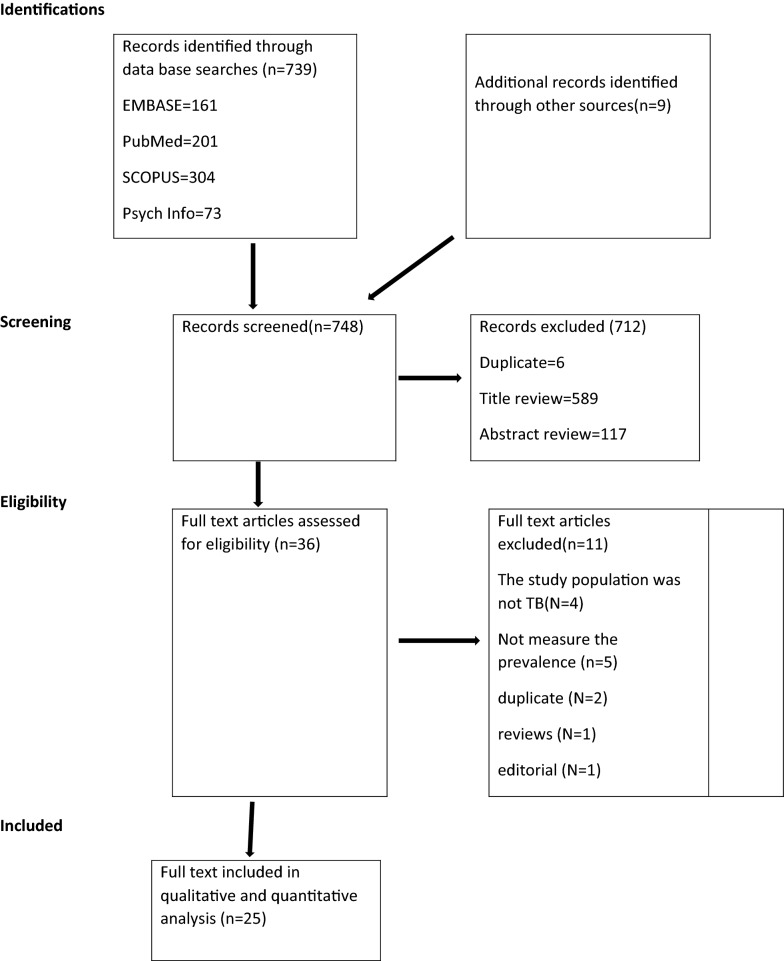
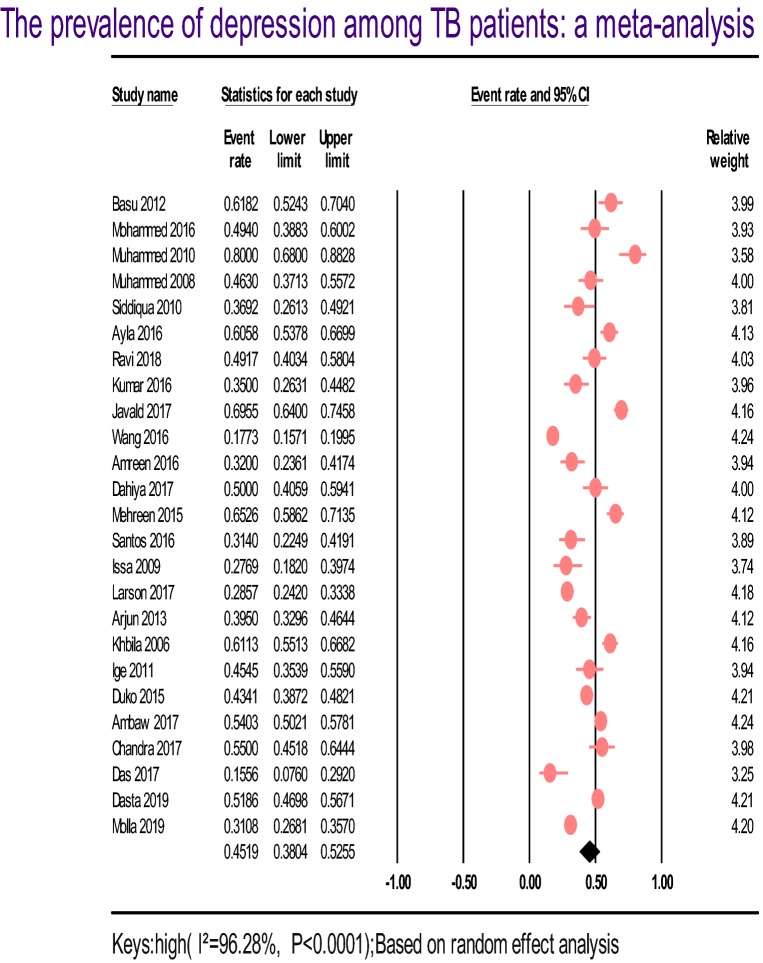
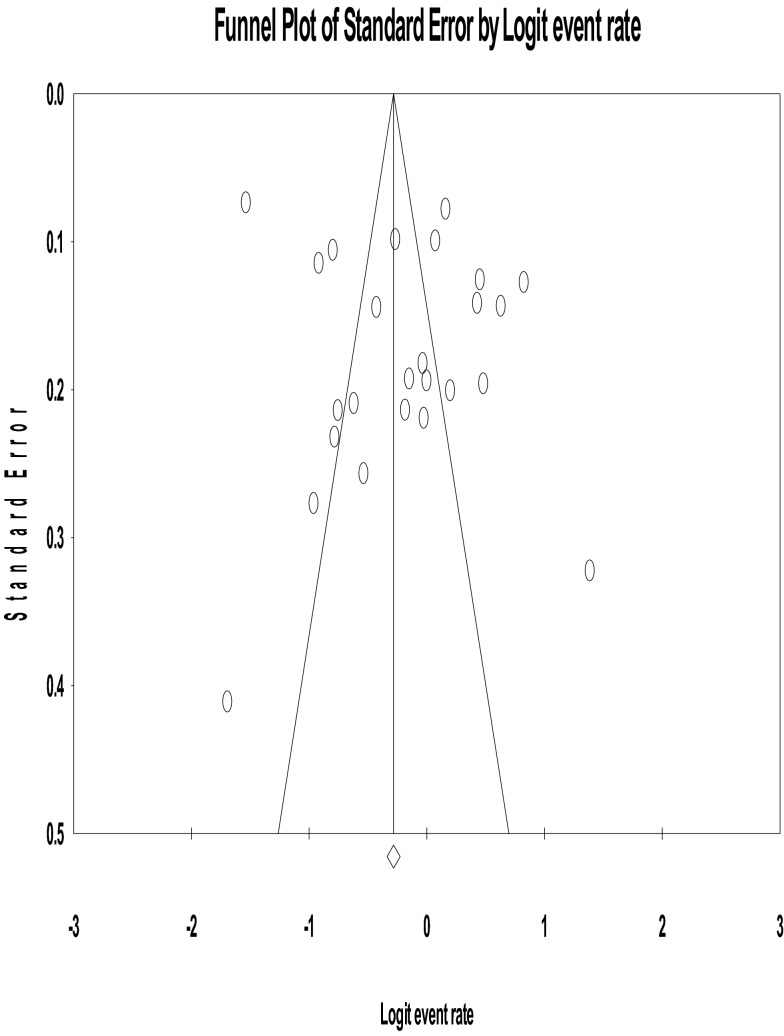
Background: Evidence has shown that the prevalence of depression is much higher among patients with tuberculosis (TB) and this, in turn, may adversely impact compliance with anti-TB medications. Therefore, this systematic review and meta-analysis aimed to quantitatively summarize epidemiologic evidence on the prevalence of depression among patients with TB and formulate a recommendation for future clinical practice as well as research. Methods: We followed the preferred reporting items for systematic reviews and meta-analyses (PRISMA) guidelines to conduct this review. We searched PubMed, EMBASE, SCOPUS and Psych INFO to identify relevant studies that investigated the prevalence of depression among TB patients. We also supplemented our electronic search with manual searching to include all pertinent studies in the analysis. We used a Comprehensive Meta-Analysis software version 3.0 (CMA 3.0) to conduct a meta-analysis. We conducted a subgroup and sensitivity analysis and Cochran’s Q- and the I2-statistics were used to assess heterogeneity. The evidence for the presence of publication bias was checked by using Egger’s test and visual inspection of the symmetry in funnel plots. Results: We identified a total of 25 studies that included 4903 participants across seven countries. In our analysis, the pooled estimated prevalence of depression among TB patients was found to be 45.19% (95% CI 38.04–52.55). The prevalence was higher in MDR-TB 52.34% (95% CI 38.09–66.22) than non-MDR-TB 43.47% (95% CI 35.88–51.37) patients. We also found that the pooled prevalence of depression was higher among females 51.54% (95% CI 40.34–62.60) when compared to males 45.25% (95% CI 35.19–55.71). The pooled prevalence of depression was 45.45% as measured by HRDS, and it was 55.62%, 45.52%, and 38.36% as measured by BDI, HADS and PHQ-9, respectively. Conclusion: Our finding suggested that the pooled estimated prevalence of depression among tuberculosis patients was relatively high. Screening and management of depression among TB patients were warranted to alleviate suffering. Moreover, the integration of tuberculosis program with regular psychiatry services may substantially reduce the burden.
Overview
The claims and statistics of this paper haven’t been checked yet.
Free: it reads the open-access text and checks the first 5 claims that cite a source we can check. Create a free account to check every claim.
Integrity signals
Registry
Cites
Statistics
Figures
Verification
Claims the paper makes
The claims and statistics of this paper haven’t been checked yet.
Free: it reads the open-access text and checks the first 5 claims that cite a source we can check. Create a free account to check every claim.
Claims other papers make about this one
Each is checked against this paper’s own text: does it say what the citing paper says it does?
The source backs part of the claim, not all of it — or backs it for a different population, condition or comparison.
In the citing paper
“There is growing evidence that common mental disorders, especially depression and anxiety, are highly prevalent among people with TB, with estimates often ranging from approximately 40% to 60%, and with an even greater burden among MDR-TB populations [7,8,9].”
From Psychosocial Interventions for Improving Treatment Adherence in Tuberculosis Patients: A Scoping Review of Evidence-Based Approaches. (2026) · cites this paper as [9]
Experimental — accuracy not yet measuredThe source backs part of the claim, not all of it — or backs it for a different population, condition or comparison.
In the citing paper
“This finding is consistent with the conceptualization of TB and depression as a syndemic, in which poverty, undernutrition, stigma, social isolation, medication side effects, and psychological distress may reinforce one another over time [6,7,9].”
From Psychosocial Interventions for Improving Treatment Adherence in Tuberculosis Patients: A Scoping Review of Evidence-Based Approaches. (2026) · cites this paper as [9]
Experimental — accuracy not yet measuredThe source backs part of the claim, not all of it — or backs it for a different population, condition or comparison.
In the citing paper
“and a somewhat higher prevalence in MDR-TB than in drug-susceptible TB (52.34% vs. 43.47%), although the latter difference was not statistically significant.”
From Psychosocial Interventions for Improving Treatment Adherence in Tuberculosis Patients: A Scoping Review of Evidence-Based Approaches. (2026) · cites this paper as [9]
Experimental — accuracy not yet measuredThe source backs part of the claim, not all of it — or backs it for a different population, condition or comparison.
In the citing paper
“Although Duko et al. [9] found a somewhat higher pooled prevalence of depression in MDR-TB than in drug-susceptible TB, that subgroup difference was not statistically significant.”
From Psychosocial Interventions for Improving Treatment Adherence in Tuberculosis Patients: A Scoping Review of Evidence-Based Approaches. (2026) · cites this paper as [9]
Experimental — accuracy not yet measuredThe cited source says what the claim attributes to it.
In the citing paper
“Duko et al. [9] estimated a pooled prevalence of 45.19% (95% CI [38.04, 52.55]) across 25 studies involving 4903 participants with TB.”
From Psychosocial Interventions for Improving Treatment Adherence in Tuberculosis Patients: A Scoping Review of Evidence-Based Approaches. (2026) · cites this paper as [9]
3 more claims about this paper
Create a free account to see every claim other papers make about this one.
Self-check
Percentages, sums and reported differences re-computed from the paper’s own numbers.
The self-check needs the paper’s full text.
Citations
Cites
The Measurement of Observer Agreement for Categorical Data
Landis, J. R., & Koch, G. G. (1977) · Biometrics · doi:10.2307/2529310 · Cited by 81,148
Measuring inconsistency in meta-analyses
Higgins, J. P. T., Thompson, S. G., Deeks, J. J., & Altman, D. G. (2003) · BMJ · doi:10.1136/bmj.327.7414.557 · Cited by 63,139
Stang, A. (2010) · European Journal of Epidemiology · doi:10.1007/s10654-010-9491-z · Cited by 17,396
A basic introduction to fixed-effect and random-effects models for meta-analysis
Borenstein, M., Hedges, L. V., Higgins, J. P. T., & Rothstein, H. R. (2010) · Research Synthesis Methods · doi:10.1002/jrsm.12 · Cited by 6,793
Whiteford, H. A., Degenhardt, L., Rehm, J., Baxter, A. J., Ferrari, A. J., Erskine, H. E., Charlson, F. J., Norman, R. E., Flaxman, A. D., Johns, N., et al. (2013) · The Lancet · doi:10.1016/s0140-6736(13)61611-6 · Cited by 6,006
Depression, chronic diseases, and decrements in health: results from the World Health Surveys
Moussavi, S., Chatterji, S., Verdes, E., Tandon, A., Patel, V., & Ustun, B. (2007) · The Lancet · doi:10.1016/s0140-6736(07)61415-9 · Cited by 4,070
Salk, R. H., Hyde, J. S., & Abramson, L. Y. (2017) · Psychological Bulletin · doi:10.1037/bul0000102 · Cited by 2,622
Cross-national epidemiology of DSM-IV major depressive episode
Bromet, E., Andrade, L. H., Hwang, I., Sampson, N. A., Alonso, J., de Girolamo, G., de Graaf, R., Demyttenaere, K., Hu, C., Iwata, N., et al. (2011) · BMC Medicine · doi:10.1186/1741-7015-9-90 · Cited by 2,221
Why is depression more prevalent in women?
Albert, P. R. (2015) · Journal of Psychiatry and Neuroscience · doi:10.1503/jpn.150205 · Cited by 1,785
Sex differences in anxiety and depression clinical perspectives
Altemus, M., Sarvaiya, N., & Neill Epperson, C. (2014) · Frontiers in Neuroendocrinology · doi:10.1016/j.yfrne.2014.05.004 · Cited by 1,413
Research works printed but not linked: 6
- American Psychiatric Association. Diagnostic and statistical manual of mental disorders, 5th ed. (DSM-5). Washington, DC: American Psychiatric Publishing; 2013. https://psycnet.apa.org/record/2013-14907-000. Accessed 28 Feb 2019.
- Ugarte-Gil C Ruiz P Zamudio C Canaza L Otero L Kruger H Seas C Association of major depressive episode with negative outcomes of tuberculosis treatment PLoS ONE 2013 8 7 e69514 10.1371/journal.pone.0069514 23922728 PMC3726639 · DOI · Paper page
- Manmilena A Octivluiza N Cosmina B Antigona T Dana A Depressive syndrome, anxiety and illness perception in tuberculosis patients Recent Res Mod Med. 2010 978 243 248
- Ahmed MM Mazhar M Zaidi A Depression in tuberculosis patients and its relationship to socio demographic factors J Rawalpindi Med Coll 2016 20 4 296 299
- Ravi CS Dinesh DS Neeraj K Manish KT Pankaj K Assessment of the frequency of depression and anxiety among tuberculosis patients at a tertiary care health centre. A cross sectional study Eur J Pharm Med Res 2018 5 4 496 499
- Basu G Chatterjee C Singh R Biswas S Prevalence of depression in tuberculosis patients: an experience from a DOTS clinic IJRRMS. 2012 2 4 14 17
Cited by
Items 101–155 of 155
Contreras, C. C. (2023) · Cambridge Prisms Global Mental Health · doi:10.1017/gmh.2024.21.pr4
Contreras, C. C., Cruz, J. S., Galea, J. T., et al. (2024) · Cambridge Prisms Global Mental Health · doi:10.1017/gmh.2024.21.pr6
Contreras, C. C., Cruz, J. S., Galea, J. T., et al. (2023) · Cambridge Prisms Global Mental Health · doi:10.1017/gmh.2024.21.pr3
Contreras, C., Cruz, J. S., Galea, J. T., et al. (2023) · Cambridge Prisms Global Mental Health · doi:10.1017/gmh.2024.21.pr2
Contreras, C., Cruz, J. S., Galea, J. T., et al. (2024) · Cambridge Prisms Global Mental Health · doi:10.1017/gmh.2024.21.pr9
Contreras, C. C., Cruz, J. S., Galea, J. T., et al. (2024) · Cambridge Prisms Global Mental Health · doi:10.1017/gmh.2024.21.pr8
Contreras, C. C. (2023) · Cambridge Prisms Global Mental Health · doi:10.1017/gmh.2024.21.pr1
Contreras, C. C. (2024) · Cambridge Prisms Global Mental Health · doi:10.1017/gmh.2024.21.pr7
Long-term neuropsychiatric sequels in Central nervous system tuberculosis in Mexican patients
Martínez, H. C., Gómez, E., Arroyo-Landín, M., & Cárdenas, G. (2024) · Infectio · doi:10.22354/24223794.1177
“The highly variable prevalence of cognitive impairment in these series is associated with the neuropsychological instrument used, the mean follow-up period, and sample characteristics 21 .”
BackgroundWidodo, M. R. A., Astuti, I. S. W., Kusumastuti, I., Raharjo, A. M., Supangat, S., Tyaswati, J. E., & Zulkifli, N. F. (2024) · Jurnal Respirasi · doi:10.20473/jr.v10-i.2.2024.107-113 · Cited by 1
Pratiwi, R. B. (2024) · Media Publikasi Promosi Kesehatan Indonesia (MPPKI) · doi:10.56338/mppki.v7i7.5337 · Cited by 1
“Comorbid depression and tuberculosis can result in poor quality of life, non-adherence to anti-TB medications, progression to Multi Drug Resistant TB, and even death from the disease (11).”
BackgroundTuberculosis-induced mood disorder
Ageel, R. H., Singal, A., Chauhan, V. S., & Agrawal, M. (2024) · Industrial Psychiatry Journal · doi:10.4103/ipj.ipj_49_24
Building a Gender-Responsive Tuberculosis Program in India
Srinivasan, A., Ananthakrishnan, R., Ranganathan, R., & Mattoo, S. K. (2024) · Springer eBooks · doi:10.1007/978-981-19-9265-0_46-1
(2024) · Elsevier eBooks · doi:10.1016/b978-0-443-23565-8.09996-8
Pathogenic Factors Related to Mental and Neurological Disorders
Anisman, H., Hayley, S. P., & Kusnecov, A. (2024) · Elsevier eBooks · doi:10.1016/b978-0-443-23565-8.00004-1
Vo, L. N. Q., Forse, R., Codlin, A. J., Huynh, H. B., Wiemers, A. M. C., Creswell, J., Garg, T., Dang, T. M. H., Nguyen, L. H., Nguyen, H. B., et al. (2024) · Research Square · doi:10.21203/rs.3.rs-5398094/v1
The Role of Physical Activity and Exercise in the Prevention and Treatment of Depression
ÇAKMAK, S. (2024) · International Journal of Computational and Experimental Science and Engineering · doi:10.22399/ijcesen.757
Building a Gender-Responsive Tuberculosis Program in India
Srinivasan, A., Ananthakrishnan, R., Ranganathan, R., & Mattoo, S. K. (2024) · Springer eBooks · doi:10.1007/978-981-97-2098-9_46
Markers of pulmonary TB in care-seeking patients with respiratory symptoms
Moreira, A. D. S. R., Dalvi, A. P. R., Bezerra, A. L. F., Soares, I. C., Gonçalves, L. I., Bhering, M., Lara, C. F. D. S., Dutra, T. C. P., Malaquias, T. D. S. S., Silva, E., et al. (2025) · Public Health Action · doi:10.5588/pha.24.0034
“28 Few studies on TB used MINI-Plus, and in our sample, the prevalence of current and past MDD was lower (20”
Tuberculosis and Mental Health
Doherty, A. M., Gunawardena, S. M., & McMahon, E. (2025) · Springer eBooks · doi:10.1007/978-3-031-81802-8_11 · Cited by 1
Jegadeeshwaran, R., Rajkumar, T. S., Bijulakshmi, P., & Ramasubramanian, V. (2025) · International Journal of Positivity & Well-Being · doi:10.61518/ijpw-59
“Yunxiang Yan, 2011; Duko et al., 2020; Jones et al., 2011).”
A Longitudinal Prospective Study of Active Tuberculosis Among Patients in Tétouan, Morocco
Ez-Zari, A., Farouk, L., Vilaplana, C., Mezzoug, N., Bouti, K., & Mtili, N. E. (2025) · Cureus · doi:10.7759/cureus.81838
“[30].”
Wu, S., Dai, F., Jiang, H., Yang, H., Zeng, W., Luo, C. S., Jiang, L., Gong, J., & Wu, C. (2025) · Research Square · doi:10.21203/rs.3.rs-6665607/v1
Tuberculosis and suicide: An overlooked association
Muhammed, J. K., & Kololichalil, A. (2025) · Tropical Doctor · doi:10.1177/00494755251370784
Qiu, X., Li, H., Huang, W., & Liu, X. H. (2025) · Tropical Medicine & International Health · doi:10.1111/tmi.70039
“%) reported in a systematic review and meta-analysis of 25 studies [3].”
Features of Pulmonary Tuberculosis (TB): Linking Biomarkers and Quality of Life Measures
Juárez, E., Carreto-Binaghi, L. E., Guzmán‐Beltrán, S., Muñoz-Torrico, M. V., & González, Y. (2025) · Springer eBooks · doi:10.1007/978-3-031-73363-5_175
Gschwenter, S., Garber, D., & Steininger, B. (2025) · medRxiv · doi:10.1101/2025.10.13.25337934
Ponnuchamy, L., Majhi, G., Shreedevi, A. U., Pandian, D. R., & Prakash, P. (2025) · Cureus · doi:10.7759/cureus.96064
“Without access to compassionate care and understanding, the internal battle against self-stigma becomes a silent epidemic, where depression and anxiety thrive in the shadows [11,14,15].”
Depression in adolescents on treatment for rifampicin-susceptible TB in Lima, Peru
Sanchez-Guzman, V., Tanzer, J. R., Sinche, B. R., Santacruz, J., Contreras, C., Desrosiers, A., Lecca, L. W., & Chiang, S. S. (2025) · IJTLD OPEN · doi:10.5588/ijtldopen.25.0305 · Cited by 10
Eyal, K. C., Wagner, R. G., & Geel, J. A. (2025) · BMJ Open · doi:10.1136/bmjopen-2025-102839
Galea, J., Chu, A. L., Sweetland, A. C., Jiménez, J., Yataco, R., Calderón, R., Zhang, Z., Huang, C.-C., Lecca, L., & Murray, M. B. (2022) · medRxiv · doi:10.1101/2022.11.15.22282271
Mainga, T., Gondwe, M., Stewart, R. C., Mactaggart, I., Shanaube, K., Ayles, H., & Bond, V. (2022) · Figshare · doi:10.6084/m9.figshare.20296242
Mainga, T., Gondwe, M., Mactaggart, I., Stewart, R. C., Shanaube, K., Ayles, H., & Bond, V. (2022) · London School of Hygiene & Tropical Medicine · doi:10.6084/m9.figshare.20342552
Mainga, T., Gondwe, M., Stewart, R. C., Mactaggart, I., Shanaube, K., Ayles, H., & Bond, V. (2022) · Figshare · doi:10.6084/m9.figshare.20296245
Ivanova, O., Sineke, T., Wenzel, R., Siyame, E., Lalashowi, J., Bakuli, A., Zekoll, F. C., Hoelscher, M., Rachow, A., Evans, D., et al. (2022) · Figshare · doi:10.6084/m9.figshare.19862526
Todowede, O. O., Afaq, S., Adhikary, A., Kanan, S., Shree, V., Jennings, H. M., Faisal, M. R., Nisar, Z., Khan, I., Desai, G., et al. (2023) · Figshare · doi:10.6084/m9.figshare.23812383
Olarewaju, S. O., Adeyemo, S. C., Ajayi, A., Are-Daniel, O., Santhosh, A. C., Olabode, E. D., Kayode, A. T., Ayinmodu, J. O., Oladeji, O. O., Odedele, J. T., et al. (2025) · Cureus · doi:10.7759/cureus.100472
“Tuberculosis (TB), an infectious disease caused by Mycobacterium tuberculosis , is still one of the leading public health problems despite advances in efforts to reduce its incidence, morbidity, and mortality [1].”
Shamla, F., Chaudhari, B., Chaudhury, S., & Saldanha, D. (2026) · Industrial Psychiatry Journal · doi:10.4103/ipj.ipj_419_24
Ahmad, F., Khalid, F., Khan, Z., Sanauddin, N., Rahim, M., Sultan, S., Rasool, S., Gul, M., Naeem, F., Khan, F., et al. (2026) · medRxiv · doi:10.64898/2026.02.12.26346137
Post-TB care in the UK: a national survey of existing practice
O’Reilly, A., Martin, C. A., Cox, S. E., Haldar, P., Zenner, D., Pareek, M., & Meghji, J. Z. (2026) · BMJ Open Respiratory Research · doi:10.1136/bmjresp-2025-004021
Байызбекова, Э. А. (2026) · Scientific and practical journal Healthcare of Kyrgyzstan · doi:10.51350/zdravkg2026.1.3.12.102.109
Sanauddin, N., Ahmad, F., Paracha, M., Rahim, M., Rasool, S., Khalid, F., Khan, Z., Kibria, Z., Sheikh, S., Gul, M., et al. (2026) · Global Public Health · doi:10.1080/17441692.2026.2657634
Samal, J., & Singh, H. (2026) · Annals of Indian Psychiatry · doi:10.4103/aip.aip_263_25
Quyen, B. T. T., Sáng, T. N., Tien, N. D., & Lan, V. T. H. (2026) · Discover Public Health · doi:10.1186/s12982-026-02341-y
“Systematic reviews report that the prevalence of depression among TB patients ranges from 40% to 70%, substantially higher than in the general population [4, 5].”
InfluentialHe, M., Sun, D., Wang, W. H., Xu, X., Xie, C., Xu, W., Chang, W., Zheng, D., & Zhang, Y. (2026) · Frontiers in Public Health · doi:10.3389/fpubh.2026.1804659
Samal, J., Behera, M. R., Dehury, R. K., Shree, N., Benson Thomas, M., Sichalwe, M. M., & Singh, H. (2026) · Journal of Epidemiology and Global Health · doi:10.1007/s44197-026-00610-2
“The association of the total sample size with that of the effect size is also graphically represented through a bubble plot [Figure 10].”
Idan, J. S., Yentariba, E. K.-M.-O., Cheabu, B. S. N., Amoah-Larbi, J., Osei, F., Benyah, G., & Mohammed, A. (2026) · SAGE Open Medicine · doi:10.1177/20503121261467893
Haile, G. B., Gu, J., Wang, P., Suo, S., Abul, K., Belay, K., & Wang, P. (2026) · Behavioral Medicine · doi:10.1080/08964289.2026.2702955
Madzgharashvili, T., Lomtadze, N., Chincharauli, M., Kipiani, M., Tukvadze, N., Avaliani, Z., Blumberg, H. M., Kempker, R. R., Imnadze, P., Salindri, A. D., et al. (2026) · The Pediatric Infectious Disease Journal · doi:10.1097/inf.0000000000005366
Methodologies for studying depression in persons with tuberculosis: A scoping review
Meyer, A. J., Turimumahoro, P., Salami, F., Brennan, A., Jacoby, D., Ibidunni, S., Lori, R., Golub, J. E., & Dowdy, D. W. (2026) · PLOS Global Public Health · doi:10.1371/journal.pgph.0007388
“While estimates vary, systematic reviews have estimated that between 30–45% of PWTB have comorbid depression [9–11].”
Shaluhiyah, Z., Handayani, S., Sriatmi, A., Agushybana, F., & Rimawati, E. (2026) · BMJ Open · doi:10.1136/bmjopen-2026-125850
Sun, L., Yang, Z., Leng, H., Wang, X., Wang, D., Wang, T., Wang, Z., Zhang, G., Yu, H., & Ren, C. (2026) · Journal of Affective Disorders · doi:10.1016/j.jad.2026.122573
Vannadil, A., Sobagaiah, R. T., Chandrashekar, S. S., Dineshan, I., Reddy, N. R., & Vaman, R. S. (2026) · Dialogues in Health · doi:10.1016/j.dialog.2026.100358
“Female gender was associated with moderate to severe depressive symptoms among PwTB. Duko et al. has estimated a higher pooled prevalence of depression among females 51.5% (95% CI 40.3 – 62.6) compared to males 45.2% (95% CI 35.2 – 55.7) [17].”
InfluentialAbate, A. W., Tedla, A., Wubet, G. M., Legas, G., Belete, A., Shiferaw, K., Beyene, G. M., Teshome, A. A., Addis, W. D., Agidew, M. M., et al. (2026) · PLoS ONE · doi:10.1371/journal.pone.0360738
“These discrepancies could be due to variations in depression tool used, study participants in the regions, and sample sizes across the studies [19,63].”
Motsi, H., & Chimbo, B. (2026) · Curationis · doi:10.4102/curationis.v49i1.2840
Metadata
- Authors
- Duko, B., Bedaso, A., & Ayano, G.
- Affiliations
- Hawassa University (ET)
- Curtin University (AU)
- Corresponding author
- Duko, Bereket
- Venue
- Annals of General Psychiatry
- Published
- 2020-05-07
- Volume
- 19
- Issue
- 1
- Pages
- 30-30
- ISSN
- 1744-859X (ISSN-L)
- PMC
- PMC7206806
- OpenAlex
- W3027771879
- Semantic Scholar
- bb0af0db0e6b0e2f7e5f054facf5c26e89aab8b5
- Cited by
- 154
- References
- 52
- Citations by year
- 2026: 24 · 2025: 26 · 2024: 39 · 2023: 26 · 2022: 30 · 2021: 9
- FWCI
- 0.78
- Type
- journal article
- Language
- en
- Open access
- gold
- doi.org
- Licence
- cc-by
- creativecommons.org/licenses/by/4.0/ (tdm)
- creativecommons.org/licenses/by/4.0/ (vor)
- Locations
- Annals of General Psychiatry (publishedVersion, cc-by)
- PubMed Central (publishedVersion, cc-by)
- PubMed (publishedVersion)
- UTS ePRESS (University of Technology Sydney) (submittedVersion, cc-by-nc-sa)
- DOAJ (DOAJ: Directory of Open Access Journals) (submittedVersion, cc-by-sa)
- UniSA Research Outputs Repository (University of South Australia) (submittedVersion, cc-by)
- Greater South Information System
- Topics
- Health Sciences › Medicine › Infectious Diseases › Tuberculosis Research and Epidemiology
- Health Sciences › Medicine › Psychiatry and Mental health › Mental Health Treatment and Access
- Social Sciences › Psychology › Clinical Psychology › COVID-19 and Mental Health
- Keywords
- depression, tuberculosis, depression prevalence, multidrug-resistant tuberculosis, sex differences, depression screening, psychiatric comorbidity, Beck Depression Inventory, Hospital Anxiety and Depression Scale, PHQ-9, Hamilton Depression Rating Scale
About these checks
Registry, retraction, Cites and statistics results are computed, not judged, with one exception: a printed reference that no index lists is read once by a model before it counts as a citation error. Claims are extracted by a model and kept only when their quote appears verbatim in the text; each cited source is then checked, with a model’s help, for whether it says what the claim relies on. Those verdicts can be wrong — read the claim’s quote and the cited source before relying on one.
Statistics and arithmetic are recomputed, not judged.
Confidence bands are shown only for fields calibrated on our annotated test set. None is calibrated yet, so no band is shown.
What counts as a claim ›How we measure confidence ›How we check this ›
Are you an author, or do you see a problem with this page? Request a review
Data sources
Bibliographic data: Semantic Scholar, OpenAlex, Crossref.
Contains information from the Semantic Scholar Academic Graph Datasets, made available under the ODC Attribution License (ODC-BY 1.0).
Semantic Scholar’s data is described in: Kinney, R., et al. (2023). The Semantic Scholar Open Data Platform. arXiv:2301.10140.
