

The DOI matches its Crossref record; 59 of the 59 references it cites were found in a registry or an index.
Mindfulness-based programs for substance use disorders: a systematic review of manualized treatments
Open accessAbstract
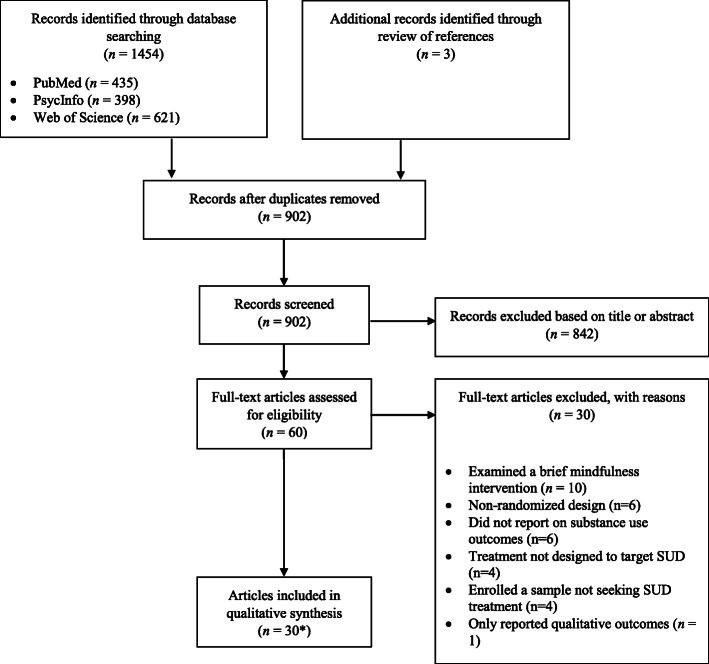
Background: Substance use disorders are prevalent and returning to substance use (i.e., relapse) following treatment is common, underscoring the need for effective treatments that will help individuals maintain long-term reductions in substance use. Mindfulness-based interventions (MBIs) have been increasingly developed and evaluated for the treatment of substance use disorders. The aim of this article was to update a systematic review conducted by Li et al. in 2017 on the outcomes of randomized control trials of MBIs for substance use disorders. In addition, we provided a session-by-session examination of the most widely used MBI protocols. Methods: We conducted a comprehensive literature search of the PubMed, PsycINFO, and Web of Science databases from January of 2016 through April of 2020. Studies were included based on the following criteria: 1) examined the effects of an MBI, 2) employed a randomized controlled trial design with repeated measures, including secondary data analyses of randomized controlled trials, and 3) enrolled participants seeking treatment for substance use disorders. Results: The search identified 902 publications and 30 studies were eligible for inclusion and data extraction. MBIs appear to be as effective as existing evidence-based treatments for substance use disorders at reducing the frequency and quantity of alcohol and drug use, substance-related problems, craving for substance use, and at increasing the rate of abstinence. Conclusions: Future directions include additional large scale randomized controlled trials, investigation of the most suitable settings and protocols, examination of patient populations that may benefit most from MBIs, and dissemination and implementation research.
Overview
The claims and statistics of this paper haven’t been checked yet.
Run the check — free, no account needed. It reads the open-access text and checks the sources it cites.
Integrity signals
Registry
Cites
Statistics
Figures
Verification
Claims the paper makes
The claims and statistics of this paper haven’t been checked yet.
Run the check — free, no account needed. It reads the open-access text and checks the sources it cites.
Claims other papers make about this one
Each is checked against this paper’s own text: does it say what the citing paper says it does?
The cited source says what the claim attributes to it.
In the citing paper
“This digital mindfulness intervention can contribute to the growing science and evidence surrounding the promise of mindfulness interventions as powerful nonpharmacologic approaches to substance use and related conditions [48].”
From Mindful moms: acceptability and impact of co-designed and digitally delivered video meditations for pregnant and parenting women with opioid use disorder (2025) · cites this paper as [48]
Self-check
Percentages, sums and reported differences re-computed from the paper’s own numbers.
The self-check needs the paper’s full text.
Citations
Cites
PRISMA-P Group, Moher, D., Shamseer, L., Clarke, M., Ghersi, D., Liberati, A., Petticrew, M., Shekelle, P., & Stewart, L. A. (2015) · Systematic Reviews · doi:10.1186/2046-4053-4-1 · Cited by 26,223
(1999) · Cited by 5,934
Kabat-Zinn, J. (1982) · General Hospital Psychiatry · doi:10.1016/0163-8343(82)90026-3 · Cited by 4,255
(2001) · Cited by 3,666
(2005) · Medical Entomology and Zoology · Cited by 3,197
Wherever you go, there you are: Mindfulness meditation in everyday life
Kwee, M. G. T. (1995) · Behaviour Research and Therapy · doi:10.1016/0005-7967(95)90133-7 · Cited by 2,912
The clinical use of mindfulness meditation for the self-regulation of chronic pain
Kabat-Zinn, J., Lipworth, L., & Burney, R. (1985) · Journal of Behavioral Medicine · doi:10.1007/bf00845519 · Cited by 1,745
Mindfulness-based interventions for psychiatric disorders: A systematic review and meta-analysis
Goldberg, S. B., Tucker, R. P., Greene, P. A., Davidson, R. J., Wampold, B. E., Kearney, D. J., & Simpson, T. L. (2018) · Clinical Psychology Review · doi:10.1016/j.cpr.2017.10.011 · Cited by 1,145
Critchley, H. D., & Garfinkel, S. N. (2017) · Current Opinion in Psychology · doi:10.1016/j.copsyc.2017.04.020 · Cited by 899 · cited 1×
“ate in the body and is broadly described as the overall sensations, or state, of the body [60].”
BackgroundMindfulness-Based Relapse Prevention for Substance Use Disorders: A Pilot Efficacy Trial
Bowen, S., Chawla, N., Collins, S. E., Witkiewitz, K., Hsu, S., Grow, J., Clifasefi, S., Garner, M., Douglass, A., Larimer, M. E., et al. (2009) · Substance Abuse · doi:10.1080/08897070903250084 · Cited by 715 · cited 4×
“In another sample [55], participants with high SUD severity and high anxiety/depression or high SUD severity and low anxiety/depression that received MBRP reported 99% fewer alcohol and other drug use days than TAU participants.”
BackgroundInfluentialSelf-citation
Research works printed but not linked: 3
- NIDA. Trends & statistics; 2020.
- Volkow ND. Principles of drug addiction treatment. Heal (San Fr)The Institute. 2009;12:1–80.
- Amaro H, Vallejo Z. Moment-by-moment in women’s recovery: a mindfulness-based approach to relapse preventionAn Educ Gr Curric women Recover. Boston: Inst Urban Heal Res Northeast Univ Bost Public Heal Comm; 2009.
Cited by
Sorted by citations
Mechanisms of Behavior Change in Substance Use Disorder With and Without Formal Treatment
Witkiewitz, K. A., Pfund, R. A., & Tucker, J. A. (2022) · Annual Review of Clinical Psychology · doi:10.1146/annurev-clinpsy-072720-014802 · Cited by 107
Self-citationVerdejo‐García, A., Rezapour, T., Giddens, E., Zonoozi, A. K., Rafei, P., Berry, J., Caracuel, A., Copersino, M. L., Field, M., Garland, E. L., et al. (2022) · Addiction · doi:10.1111/add.16109 · Cited by 74
Self-citationMindfulness in Treatment Approaches for Addiction — Underlying Mechanisms and Future Directions
Rosenthal, A., Levin, M. E., Garland, E. L., & Romanczuk-Seiferth, N. (2021) · Current Addiction Reports · doi:10.1007/s40429-021-00372-w · Cited by 54
Zamboni, L., Centoni, F., Fusina, F., Mantovani, E., Rubino, F., Lugoboni, F., & Federico, A. (2021) · The Journal of Nervous and Mental Disease · doi:10.1097/nmd.0000000000001381 · Cited by 54
Self-Efficacy as a Potential Mechanism of Behavior Change in Mindfulness-Based Relapse Prevention
Moniz-Lewis, D. I. K., Stein, E., Bowen, S. W., & Witkiewitz, K. A. (2022) · Mindfulness · doi:10.1007/s12671-022-01946-z · Cited by 35
Self-citation
Metadata
- Authors
- Korecki, J. R., Schwebel, F. J., Votaw, V. R., & Witkiewitz, K.
- Affiliations
- University of New Mexico (US)
- Corresponding author
- Witkiewitz, Katie
- Venue
- Substance Abuse Treatment, Prevention, and Policy
- Published
- 2020-07-29
- Volume
- 15
- Issue
- 1
- Pages
- 51-51
- ISSN
- 1747-597X (ISSN-L)
- PMC
- PMC7392831
- OpenAlex
- W3045643342
- Cited by
- 145
- References
- 59
- Citations by year
- 2026: 18 · 2025: 31 · 2024: 27 · 2023: 30 · 2022: 26 · 2021: 12 · 2020: 1
- FWCI
- 2.51
- Type
- journal article
- Language
- en
- Open access
- gold
- doi.org
- Locations
- Substance Abuse Treatment Prevention and Policy (publishedVersion, cc-by)
- PubMed Central (publishedVersion, cc-by)
- PubMed (publishedVersion)
- DOAJ (DOAJ: Directory of Open Access Journals) (submittedVersion, cc-by-sa)
- Funders
- National Institute on Alcohol Abuse and Alcoholism (T32AA018108, R01 AA025539)
- Topics
- Health Sciences › Medicine › Epidemiology › Substance Abuse Treatment and Outcomes
- Social Sciences › Psychology › Clinical Psychology › Mindfulness and Compassion Interventions
- Health Sciences › Medicine › Public Health, Environmental and Occupational Health › Opioid Use Disorder Treatment
- Keywords
- mindfulness-based interventions, substance use disorders, relapse prevention, abstinence, craving, alcohol consumption, drug use, manualized treatment, treatment effectiveness
- MeSH terms
- Humans, Impulsive Behavior, Stress, Psychological, Randomized Controlled Trials as Topic, Substance-Related Disorders, Secondary Prevention, Mindfulness, Craving
About these checks
Registry, retraction, Cites and statistics results are computed, not judged, with one exception: a printed reference that no index lists is read once by a model before it counts as a citation error. Claims are extracted by a model and kept only when their quote appears verbatim in the text; each cited source is then checked, with a model’s help, for whether it says what the claim relies on. Those verdicts can be wrong — read the claim’s quote and the cited source before relying on one.
Statistics and arithmetic are recomputed, not judged.
Confidence bands are shown only for fields calibrated on our annotated test set. None is calibrated yet, so no band is shown.
What counts as a claim ›How we measure confidence ›How we check this ›
Are you an author, or do you see a problem with this page? Request a review
