

Using the Knowledge to Action Framework in practice: a citation analysis and systematic review
Open accessThe DOI matches its Crossref record; 44 of the 45 references it cites were found in a registry or an index.
Abstract
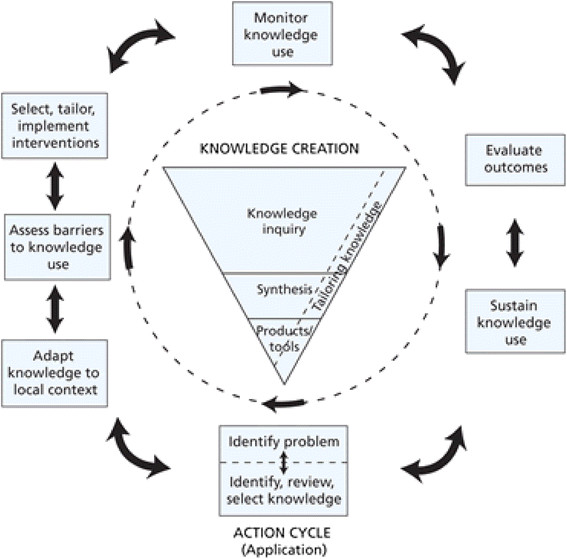
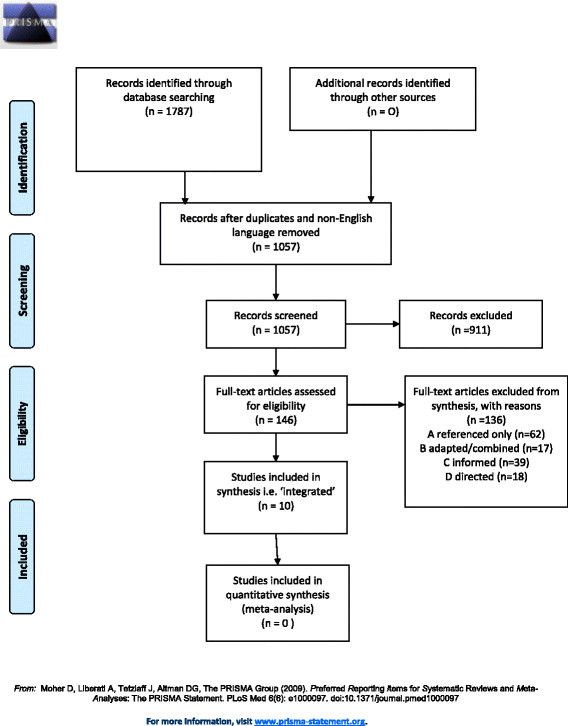
BACKGROUND: Conceptual frameworks are recommended as a way of applying theory to enhance implementation efforts. The Knowledge to Action (KTA) Framework was developed in Canada by Graham and colleagues in the 2000s, following a review of 31 planned action theories. The framework has two components: Knowledge Creation and an Action Cycle, each of which comprises multiple phases. This review sought to answer two questions: 'Is the KTA Framework used in practice? And if so, how?' METHODS: This study is a citation analysis and systematic review. The index citation for the original paper was identified on three databases-Web of Science, Scopus and Google Scholar-with the facility for citation searching. Limitations of English language and year of publication 2006-June 2013 were set. A taxonomy categorising the continuum of usage was developed. Only studies applying the framework to implementation projects were included. Data were extracted and mapped against each phase of the framework for studies where it was integral to the implementation project. RESULTS: The citation search yielded 1,787 records. A total of 1,057 titles and abstracts were screened. One hundred and forty-six studies described usage to varying degrees, ranging from referenced to integrated. In ten studies, the KTA Framework was integral to the design, delivery and evaluation of the implementation activities. All ten described using the Action Cycle and seven referred to Knowledge Creation. The KTA Framework was enacted in different health care and academic settings with projects targeted at patients, the public, and nursing and allied health professionals. CONCLUSIONS: The KTA Framework is being used in practice with varying degrees of completeness. It is frequently cited, with usage ranging from simple attribution via a reference, through informing planning, to making an intellectual contribution. When the framework was integral to knowledge translation, it guided action in idiosyncratic ways and there was theory fidelity. Prevailing wisdom encourages the use of theories, models and conceptual frameworks, yet their application is less evident in practice. This may be an artefact of reporting, indicating that prospective, primary research is needed to explore the real value of the KTA Framework and similar tools.
Overview
The claims and statistics of this paper haven’t been checked yet.
Free: it reads the open-access text and checks the first 5 claims that cite a source we can check. Create a free account to check every claim.
Integrity signals
Registry
Cites
Statistics
Figures
Verification
Claims the paper makes
The claims and statistics of this paper haven’t been checked yet.
Free: it reads the open-access text and checks the first 5 claims that cite a source we can check. Create a free account to check every claim.
Claims other papers make about this one
Each is checked against this paper’s own text: does it say what the citing paper says it does?
The cited source says what the claim attributes to it.
In the citing paper
“Out of 146 identified studies, the authors found that 101 studies either cited the model without explanation or used it to guide the project in a 'general, non-specified way', while only 10 studies used the model to inform 'the design, delivery, and evaluation of implementation activities' [32].”
From Scoping review identifies significant number of knowledge translation theories, models, and frameworks with limited use (2018) · cites this paper as [32]
In the citing paper
“Many of the action models mentioned here have been subjected to testing or evaluation, and some have been widely applied in empirical research, underscoring their usefulness [9,55].”
From Making sense of implementation theories, models and frameworks (2015) · cites this paper as [55]
Self-check
Percentages, sums and reported differences re-computed from the paper’s own numbers.
The self-check needs the paper’s full text.
Citations
Cites
Damschroder, L. J., Aron, D. C., Keith, R. E., Kirsh, S. R., Alexander, J. A., & Lowery, J. C. (2009) · Implementation Science · doi:10.1186/1748-5908-4-50 · Cited by 14,496 · cited 3×
“The importance of organisational or external factors and the ability to influence them is well recognised [1,3,33-35].”
Hoffmann, T. C., Glasziou, P. P., Boutron, I., Milne, R., Perera, R., Moher, D., Altman, D. G., Barbour, V., Macdonald, H., Johnston, M., et al. (2014) · BMJ · doi:10.1136/bmj.g1687 · Cited by 10,548 · cited 2×
“importance of reporting standards [8,36], such as the new TIDieR checklist [37] to facilitate more explicit”
Lost in knowledge translation: Time for a map?
Graham, I. D., Logan, J., Harrison, M. B., Straus, S. E., Tetroe, J., Caswell, W., & Robinson, N. (2006) · Journal of Continuing Education in the Health Professions · doi:10.1002/chp.47 · Cited by 4,705 · cited 9×
“The KTA Framework [1] is being used in practice with varying degrees of completeness and theory fidelity when the conceptual framework is integrated into the implementation project.”
InfluentialKnowledge translation of research findings
Grimshaw, J. M., Eccles, M. P., Lavis, J. N., Hill, S. J., & Squires, J. E. (2012) · Implementation Science · doi:10.1186/1748-5908-7-50 · Cited by 2,407 · cited 2×
“Our review, and similar studies [39,40,43-45], consistently comments on the limited, haphazard use of theory, even though theories can be applied in many different ways [41].”
Taylor, M. J., McNicholas, C., Nicolay, C., Darzi, A., Bell, D., & Reed, J. E. (2014) · BMJ Quality & Safety · doi:10.1136/bmjqs-2013-001862 · Cited by 1,871 · cited 1×
“The prevalence of the Action Cycle may simply reflect the cyclical nature of the change process evident in other common, quality improvement tools such as the ‘Plan, Do, Study, Act’ cycle [30].”
Bridging Research and Practice
Tabak, R. G., Khoong, E. C., Chambers, D. A., & Brownson, R. C. (2012) · American Journal of Preventive Medicine · doi:10.1016/j.amepre.2012.05.024 · Cited by 1,386 · cited 1×
“Potential benefits from applying a conceptual framework include making the process of knowledge translation more systematic, with greater likelihood of changed practice and spread of evidence [4,6-9].”
Kitson, A. L., Rycroft-Malone, J., Harvey, G., McCormack, B., Seers, K., & Titchen, A. (2008) · Implementation Science · doi:10.1186/1748-5908-3-1 · Cited by 1,314 · cited 1×
“The importance of organisational or external factors and the ability to influence them is well recognised [1,3,33-35].”
A compilation of strategies for implementing clinical innovations in health and mental health
Powell, B. J., McMillen, J. C., Proctor, E. K., Carpenter, C. R., Griffey, R. T., Bunger, A. C., Glass, J. E., & York, J. L. (2012) · Medical Care Research and Review · doi:10.1177/1077558711430690 · Cited by 1,069 · cited 1×
“more likely to be successful than a single strategy [27,46,47], as they target different barriers [40], which”
The PARIHS Framework—A Framework for Guiding the Implementation of Evidence-based Practice
Rycroft-Malone, J. (2004) · Journal of Nursing Care Quality · doi:10.1097/00001786-200410000-00002 · Cited by 923 · cited 5×
“Several conceptual frameworks are pertinent for implementation scientists, including Promoting Action on Research Implementation in Health Services (PARIHS) [5,10] the Consolidated Framework for Implementation Research (CFIR) [3] as well as the KTA Framework [1].”
InfluentialEccles, M., Grimshaw, J., Walker, A., Johnston, M., & Pitts, N. (2005) · Journal of Clinical Epidemiology · doi:10.1016/j.jclinepi.2004.09.002 · Cited by 917 · cited 2×
“Potential benefits from applying a conceptual framework include making the process of knowledge translation more systematic, with greater likelihood of changed practice and spread of evidence [4,6-9].”
Are interventions theory-based? Development of a theory coding scheme.
Michie, S., & Prestwich, A. (2010) · Health Psychology · doi:10.1037/a0016939 · Cited by 855 · cited 2×
“This reinforces the importance of theory fidelity and that authors refer to established taxonomies or reporting standards [36,37,40,41] so we can understand how conceptual frameworks, theories and models are really used to guide practice or inform research.”
Getting evidence into practice: the meaning of `context'
McCormack, B., Kitson, A., Harvey, G., Rycroft‐Malone, J., Titchen, A., & Seers, K. (2002) · Journal of Advanced Nursing · doi:10.1046/j.1365-2648.2002.02150.x · Cited by 765
Knowledge Translation in Health Care: Moving from Evidence to Practice
(2009) · International Journal of Health Care Quality Assurance · doi:10.1108/ijhcqa.2009.06222fae.002 · Cited by 694 · cited 2×
“Knowledge translation strategies can include elements such as linkage and exchange, audit and feedback, informatics and patient-mediated and organisational interventions [29].”
Davies, P., Walker, A. E., & Grimshaw, J. M. (2010) · Implementation Science · doi:10.1186/1748-5908-5-14 · Cited by 619 · cited 6×
“This reinforces the importance of theory fidelity and that authors refer to established taxonomies or reporting standards [36,37,40,41] so we can understand how conceptual frameworks, theories and models are really used to guide practice or inform research.”
InfluentialKnowledge Translation in Health Care
(2013) · Wiley eBooks · doi:10.1002/9781118413555 · Cited by 476
Carroll, C., Booth, A., & Cooper, K. (2011) · BMC Medical Research Methodology · doi:10.1186/1471-2288-11-29 · Cited by 461 · cited 2×
“Quality assessment of the integrated studies proved problematic given that many papers did not report research questions, traditional research designs or recruitment and selection of participants as required by the criteria [16].”
Self-citationMcEvoy, R., Ballini, L., Maltoni, S., O’Donnell, C. A., Mair, F. S., & MacFarlane, A. (2014) · Implementation Science · doi:10.1186/1748-5908-9-2 · Cited by 413 · cited 4×
“Conventional views support the use of theories, models and conceptual frameworks to underpin the process of change, yet in practice, their application seems more limited [40,43-45].”
InfluentialModels and Frameworks for Implementing Evidence-Based Practice: Linking Evidence to Action
Rycroft‐Malone, J., & Bucknall, T. K. (2010) · Cited by 358
Thomas, A., Menon, A., Boruff, J., Rodriguez, A. M., & Ahmed, S. (2014) · Implementation Science · doi:10.1186/1748-5908-9-54 · Cited by 325 · cited 3×
“Conventional views support the use of theories, models and conceptual frameworks to underpin the process of change, yet in practice, their application seems more limited [40,43-45].”
Some Theoretical Underpinnings of Knowledge Translation
Graham, I. D., Tetroe, J., & KT Theories Research Group (2007) · Academic Emergency Medicine · doi:10.1111/j.1553-2712.2007.tb02369.x · Cited by 323
Helfrich, C. D., Damschroder, L. J., Hagedorn, H. J., Daggett, G. S., Sahay, A., Ritchie, M., Damush, T., Guihan, M., Ullrich, P. M., & Stetler, C. B. (2010) · Implementation Science · doi:10.1186/1748-5908-5-82 · Cited by 306
Booth, A., Harris, J., Croot, E., Springett, J., Campbell, F., & Wilkins, E. (2013) · BMC Medical Research Methodology · doi:10.1186/1471-2288-13-118 · Cited by 285
Self-citationMenon, A., Korner-Bitensky, N., Kastner, M., McKibbon, K., & Straus, S. (2009) · Journal of Rehabilitation Medicine · doi:10.2340/16501977-0451 · Cited by 260 · cited 1×
“more likely to be successful than a single strategy [27,46,47], as they target different barriers [40], which”
Five roles for using theory and evidence in the design and testing of behavior change interventions
Bartholomew, L. K., & Mullen, P. D. (2011) · Journal of Public Health Dentistry · doi:10.1111/j.1752-7325.2011.00223.x · Cited by 251 · cited 3×
“Bartholomew LK, Mullen PD: Five roles for using theory and evidence in the design and testing of behaviour change interventions.”
InfluentialFinfgeld‐Connett, D., & Johnson, E. D. (2013) · Journal of Advanced Nursing · doi:10.1111/j.1365-2648.2012.06037.x · Cited by 215
Getting evidence into practice: ingredients for change
Rycroft-Malone, J., Harvey, G., Kitson, A., McCormack, B., Seers, K., & Titchen, A. (2002) · Nursing Standard · doi:10.7748/ns2002.05.16.37.38.c3201 · Cited by 189 · cited 4×
“Rycroft-Malone J: The PARIHS framework: a framework for guiding the implementation of evidence based practice.”
InfluentialDavidoff, F., Batalden, P., Stevens, D., Ogrinc, G., Mooney, S. E., & for the SQUIRE development group (2009) · BMJ · doi:10.1136/bmj.a3152 · Cited by 154
Russell, D. J., Rivard, L. M., Walter, S. D., Rosenbaum, P. L., Roxborough, L., Cameron, D., Darrah, J., Bartlett, D. J., Hanna, S. E., & Avery, L. M. (2010) · Implementation Science · doi:10.1186/1748-5908-5-92 · Cited by 141 · cited 7×
“Three studies illustrated each phase of the Action Cycle or explained their reasons for not doing so [18,23,25].”
InfluentialDavidoff, F., Batalden, P. B., Stevens, D., Ogrinc, G. S., Mooney, S. E., & for the SQUIRE development group (2008) · Journal of General Internal Medicine · doi:10.1007/s11606-008-0797-4 · Cited by 109 · cited 2×
“importance of reporting standards [8,36], such as the new TIDieR checklist [37] to facilitate more explicit”
Ilott, I., Gerrish, K., Booth, A., & Field, B. (2013) · Journal of Evaluation in Clinical Practice · doi:10.1111/j.1365-2753.2012.01876.x · Cited by 78 · cited 2×
“Interest in using systematic literature reviews to investigate theories, models and conceptual frameworks has increased in recent years [7,39].”
Self-citationFrom theoretical model to practical use: an example of knowledge translation
Bjørk, I. T., Lomborg, K. E., Nielsen, C. M., Brynildsen, G., Frederiksen, A. S., Larsén, K., Reierson, I. Å., Sommer, I., & Stenholt, B. V. (2013) · Journal of Advanced Nursing · doi:10.1111/jan.12091 · Cited by 76 · cited 11×
“Three studies illustrated each phase of the Action Cycle or explained their reasons for not doing so [18,23,25].”
InfluentialTheory development in health promotion: are we there yet?
Crosby, R. A., & Noar, S. M. (2010) · Journal of Behavioral Medicine · doi:10.1007/s10865-010-9260-1 · Cited by 64 · cited 1×
“A secondary concern was theory fidelity [13], which relates to how this conceptual framework was being used in practice, specifically whether the KTA Framework was articulated in a way that was true to the source paper [1].”
Knowledge Translation for Effective Consumers
Tugwell, P., Santesso, N. A., O'Connor, A. M. C., Wilson, A. J., & for the Effective Consumer Investigative Group (2007) · Physical Therapy · doi:10.2522/ptj.20070056 · Cited by 54 · cited 23×
“, 2007 [26] ✔ ✔ One page summaries of evidence; ‘bottom lines’ highlighting risk/benefits; decision aids ✔”
InfluentialDevelopment of a mentorship strategy: A knowledge translation case study
Straus, S. E., Graham, I. D., Taylor, M., & Lockyer, J. (2008) · Journal of Continuing Education in the Health Professions · doi:10.1002/chp.179 · Cited by 50 · cited 6×
“, 2008 [22] Canada Clinical/academicmentor scheme for clinician scientists Stakeholders of the mentor scheme Knowledge Creation and Action Cycle”
InfluentialUse of Implementation Theory: A Focus on PARIHS
Ullrich, P. M., Sahay, A., & Stetler, C. B. (2014) · Worldviews on Evidence-Based Nursing · doi:10.1111/wvn.12016 · Cited by 43
Selecting, Tailoring, and implementing knowledge translation interventions
Wensing, M., Bosch, M., & Grol, R. P. T. M. (2009) · Cited by 39
Stacey, D., Higuchi, K. A. S., Menard, P., Davies, B., Graham, I. D., & O'Connor, A. M. (2009) · International Journal of Nursing Education Scholarship · doi:10.2202/1548-923x.1741 · Cited by 38 · cited 8×
“, 2009 [21] − − Development of exam questions, problem-based scenarios, materials in French; newsletter profiling different resources available −”
InfluentialKennedy, C. C., Ioannidis, G., Giangregorio, L., Adachi, J. D., Thabane, L., Morin, S. N., Crilly, R. G., Marr, S., Josse, R. G., Lohfeld, L. H., et al. (2012) · Implementation Science · doi:10.1186/1748-5908-7-48 · Cited by 27 · cited 9×
“Seven described using both the Knowledge Creation and the Action Cycle components [18,20-24,27].”
InfluentialImplementing Evidence‐Based Practice in the Reality of Clinical Practice
Rycroft‐Malone, J. (2012) · Worldviews on Evidence-Based Nursing · doi:10.1111/j.1741-6787.2011.00240.x · Cited by 25 · cited 1×
“Framework, where it is probably impossible to control and isolate one strategy [48].”
Bridging the Gap: Innovative Knowledge Translation and the Canadian Hypertension Education Program
Hua, D., Carter, S., Bellerive, J., Allu, S. O., Reid, D., Tremblay, G. J. L., Lindsay, P., & Tobe, S. W. (2012) · Canadian Journal of Cardiology · doi:10.1016/j.cjca.2012.03.011 · Cited by 20 · cited 9×
“Five studies applied one or more phases [18,20,22,24,26].”
InfluentialUsing the knowledge to action process model to incite clinical change *
Petzold, A., Korner-Bitensky, N. A., & Menon, A. (2010) · Journal of Continuing Education in the Health Professions · doi:10.1002/chp.20077 · Cited by 16 · cited 10×
“Action Cycle were less often described, although three noted their plans for doing so [18,24,26].”
InfluentialMolfenter, S. M., Ammoury, A., Yeates, E. M., & Steele, C. M. (2009) · TSpace (University of Toronto) · Cited by 16
Applying a knowledge‐to‐action framework for primary prevention of spina bifida in tropical Africa
Claude, K. M., Juvenal, K. L., & Hawkes, M. (2010) · Maternal and Child Nutrition · doi:10.1111/j.1740-8709.2010.00271.x · Cited by 15 · cited 9×
“Characteristics of studies using the KTA Framework in an integrated way Eight of the ten studies were conducted in Canada, one in the Democratic Republic of Congo [17] and one in Denmark [18].”
InfluentialShould we feed back research results in the midst of a study?
Estabrooks, C. A., Teare, G. F., & Norton, P. (2012) · Implementation Science · doi:10.1186/1748-5908-7-87 · Cited by 13 · cited 1×
“Estabrooks and colleagues [28] comment that the Canadian research funding organisation had adopted the KTA Framework to guide knowledge translation, deploying specific grant mechanisms ‘to ensure involvement of knowledge users with researchers throughout the research process’ (p.”
Research works printed but not linked: 2
- Rycroft-Malone J Bucknall T Models and Frameworks for Implementing Evidence-Based Practice 2010 Chichester, UK Wiley Blackwell
- Keyser SE The Implementation of a Delirium Knowledge Translation Project for Families of the Elderly 2010 Ontario, Canada Dissertation for Masters of Science, School of Nursing, Queen’s University
Cited by
Making sense of implementation theories, models and frameworks
Nilsen, P. (2015) · Implementation Science · doi:10.1186/s13012-015-0242-0 · Cited by 4,447
“Many of the action models mentioned here have been subjected to testing or evaluation, and some have been widely applied in empirical research, underscoring their usefulness [9,55].”
Foster, A., Croot, L., Brazier, J., Harris, J., & O’Cathain, A. (2018) · Journal of Patient-Reported Outcomes · doi:10.1186/s41687-018-0072-3 · Cited by 386
Moore, J. L., Potter, K., Blankshain, K., Kaplan, S. L., O'Dwyer, L. C., & Sullivan, J. E. (2018) · Journal of Neurologic Physical Therapy · doi:10.1097/npt.0000000000000229 · Cited by 363
Making Sense of Implementation Theories, Models, and Frameworks
Nilsen, P. (2020) · Implementation Science 3.0 · doi:10.1007/978-3-030-03874-8_3 · Cited by 322
Stover, A. M., Haverman, L., van Oers, H. A., Greenhalgh, J., Potter, C. M., On behalf of the ISOQOL PROMs/PREMs in Clinical Practice Implementation Science Work Group, Ahmed, S., Greenhalgh, J., Gibbons, E., Haverman, L., et al. (2021) · Quality of Life Research · doi:10.1007/s11136-020-02564-9 · Cited by 308
Metadata
- Authors
- Field, B., Booth, A., Ilott, I., & Gerrish, K.
- Affiliations
- University of Sheffield (GB)
- Sheffield Teaching Hospitals NHS Foundation Trust (GB)
- Corresponding author
- Field, Becky
- Venue
- Implementation Science
- Published
- 2014-11-23
- Volume
- 9
- Issue
- 1
- Pages
- 172-172
- ISSN
- 1748-5908 (ISSN-L)
- PMC
- PMC4258036
- OpenAlex
- W2158985563
- Semantic Scholar
- c9e86a3c27ffe230645f343b1bc7cd1c57d7339e
- Cited by
- 454
- References
- 45
- Citations by year
- 2026: 49 · 2025: 67 · 2024: 46 · 2023: 48 · 2022: 44 · 2021: 51 · 2020: 37 · 2019: 24 · 2018: 39 · 2017: 23 · 2016: 19 · 2015: 7
- FWCI
- 2.78
- Type
- journal article
- Language
- en
- Open access
- gold
- doi.org
- Locations
- Implementation Science (publishedVersion, cc-by)
- Europe PMC (PubMed Central) (publishedVersion, cc-by)
- PubMed Central (publishedVersion, cc-by)
- PubMed (publishedVersion)
- White Rose Research Online (University of Leeds, The University of Sheffield, University of York) (acceptedVersion)
- Funders
- National Institute for Health and Care Research
- National Institute for Health Research Collaboration for Leadership in Applied Health Research and Care Yorkshire and Humber
- Topics
- Health Sciences › Health Professions › General Health Professions › Health Policy Implementation Science
- Health Sciences › Health Professions › General Health Professions › Health Sciences Research and Education
- Health Sciences › Medicine › Public Health, Environmental and Occupational Health › Clinical practice guidelines implementation
- Keywords
- knowledge-to-action framework, knowledge translation, implementation research, conceptual framework, theory application, knowledge production, healthcare implementation
- MeSH terms
- Canada, Delivery of Health Care, Denmark, Diffusion of Innovation, Democratic Republic of the Congo, Translational Research, Biomedical, Knowledge Management
About these checks
Registry, retraction, Cites and statistics results are computed, not judged, with one exception: a printed reference that no index lists is read once by a model before it counts as a citation error. Claims are extracted by a model and kept only when their quote appears verbatim in the text; each cited source is then checked, with a model’s help, for whether it says what the claim relies on. Those verdicts can be wrong — read the claim’s quote and the cited source before relying on one.
Statistics and arithmetic are recomputed, not judged.
Confidence bands are shown only for fields calibrated on our annotated test set. None is calibrated yet, so no band is shown.
What counts as a claim ›How we measure confidence ›How we check this ›
Are you an author, or do you see a problem with this page? Request a review
Data sources
Bibliographic data: Semantic Scholar, OpenAlex, Crossref.
Contains information from the Semantic Scholar Academic Graph Datasets, made available under the ODC Attribution License (ODC-BY 1.0).
Semantic Scholar’s data is described in: Kinney, R., et al. (2023). The Semantic Scholar Open Data Platform. arXiv:2301.10140.
