

Relationships between clinician-level attributes and fidelity-consistent and fidelity-inconsistent modifications to an evidence-based psychotherapy
Open accessThe DOI matches its Crossref record; 43 of the 43 references it cites were found in a registry or an index.
Abstract
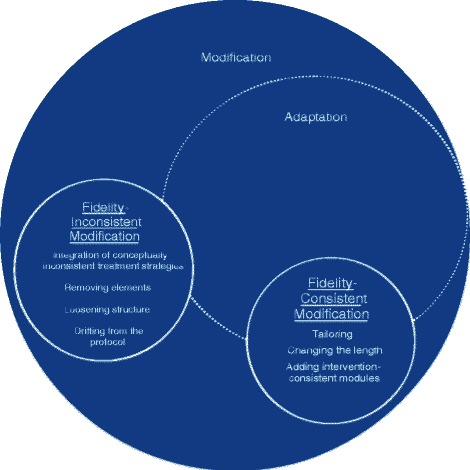
BACKGROUND: Clinicians often modify evidence-based psychotherapies (EBPs) when delivering them in routine care settings. There has been little study of factors associated with or implications of modifications to EBP protocols. This paper differentiates between fidelity-consistent and fidelity-inconsistent modifications and it examines the potential influence of two clinician characteristics, training outcomes, and attitudes toward EBPs on fidelity-consistent and fidelity-inconsistent modifications of cognitive behavioral therapy in a sample of clinicians who had been trained to deliver these treatments for children or adults. METHODS: Survey and coded interview data collected 2 years after completion of training programs in cognitive behavioral therapy were used to examine associations between successful or unsuccessful completion of training, clinician attitudes, and modifications. Modifications endorsed by clinicians were categorized as fidelity-consistent or fidelity-inconsistent and entered as outcomes into separate regression models, with training success and attitudes entered as independent variables. RESULTS: Successful completion of a training program was associated with subsequent fidelity-inconsistent modifications but not fidelity-consistent modifications. Therapists who reported greater openness to using EBPs prior to training reported more fidelity-consistent modifications at follow-up, and those who reported greater willingness to adopt EBPs if they found them appealing were more likely to make fidelity-inconsistent modifications. CONCLUSIONS: Implications of these findings for training, implementation, EBP sustainment, and future studies are discussed. Research on contextual and protocol-related factors that may impact decisions to modify EBPs will be an important future direction of study to complement to this research.
Overview
The claims and statistics of this paper haven’t been checked yet.
Free: it reads the open-access text and checks the first 5 claims that cite a source we can check. Create a free account to check every claim.
Integrity signals
Registry
Cites
Statistics
Figures
Verification
Claims the paper makes
The claims and statistics of this paper haven’t been checked yet.
Free: it reads the open-access text and checks the first 5 claims that cite a source we can check. Create a free account to check every claim.
Claims other papers make about this one
Each is checked against this paper’s own text: does it say what the citing paper says it does?
The source backs part of the claim, not all of it — or backs it for a different population, condition or comparison.
In the citing paper
“The frameworks also did not specify whether modifications were planned (i.e., adaptations) or unplanned (e.g., [2, 4, 27]), or allow investigators to consider modifications in conjunction with fidelity, a related but distinct implementation outcome [1].”
From The FRAME: an expanded framework for reporting adaptations and modifications to evidence-based interventions (2019) · cites this paper as [2]
Experimental — accuracy not yet measuredThe source backs part of the claim, not all of it — or backs it for a different population, condition or comparison.
In the citing paper
“Other practical constraints play a role in decisions to adapt or modify interventions [2, 15, 19, 23].”
From The FRAME: an expanded framework for reporting adaptations and modifications to evidence-based interventions (2019) · cites this paper as [2]
Experimental — accuracy not yet measuredThe cited source says what the claim attributes to it.
In the citing paper
“Without understanding forms of modification that occur, the systematic evaluation of processes and strategies that lead to more and less successful implementation may be hindered [2, 17–19].”
From The FRAME: an expanded framework for reporting adaptations and modifications to evidence-based interventions (2019) · cites this paper as [2]
The cited source says what the claim attributes to it.
In the citing paper
“This framework characterized different forms of modifications to interventions, and later work differentiated fidelity-consistent from fidelity-inconsistent modification [1, 2, 16].”
From The FRAME: an expanded framework for reporting adaptations and modifications to evidence-based interventions (2019) · cites this paper as [2]
Self-check
Percentages, sums and reported differences re-computed from the paper’s own numbers.
The self-check needs the paper’s full text.
Citations
Cites
Rogers, E. M., Singhal, A., & Quinlan, M. M. (2019) · An Integrated Approach to Communication Theory and Research · doi:10.4324/9780203710753-35 · Cited by 37,322
Damschroder, L. J., Aron, D. C., Keith, R. E., Kirsh, S. R., Alexander, J. A., & Lowery, J. C. (2009) · Implementation Science · doi:10.1186/1748-5908-4-50 · Cited by 14,496 · cited 3×
“Implementation frameworks suggest an important difference between modification of core elements of the intervention and changes made to less essential, peripheral components [7].”
BackgroundMethodValente, T. W. (2003) · Genetics in Medicine · doi:10.1097/01.gim.0000061743.67794.c4 · Cited by 13,723
Cicchetti, D. V. (1994) · Psychological Assessment · doi:10.1037/1040-3590.6.4.284 · Cited by 9,349
Advancing a Conceptual Model of Evidence-Based Practice Implementation in Public Service Sectors
Aarons, G. A., Hurlburt, M., & Horwitz, S. M. (2011) · Administration and Policy in Mental Health and Mental Health Services Research · doi:10.1007/s10488-010-0327-7 · Cited by 3,240 · cited 1×
“Considerable attention has been devoted to factors that influence the implementation and sustainability of EBPs [2–4].”
BackgroundThe dynamic sustainability framework: addressing the paradox of sustainment amid ongoing change
Chambers, D. A., Glasgow, R. E., & Stange, K. C. (2013) · Implementation Science · doi:10.1186/1748-5908-8-117 · Cited by 1,724 · cited 6×
“considerable debate in the literature [6, 35].”
BackgroundInfluentialWiltsey Stirman, S., Kimberly, J., Cook, N., Calloway, A., Castro, F., & Charns, M. (2012) · Implementation Science · doi:10.1186/1748-5908-7-17 · Cited by 1,355
Aarons, G. A. (2004) · Mental Health Services Research · doi:10.1023/b:mhsr.0000024351.12294.65 · Cited by 1,272 · cited 2×
“Evidence-Based Practice Attitude Scale [27]”
A Randomized Trial of Methods to Help Clinicians Learn Motivational Interviewing.
Miller, W. R., Yahne, C. E., Moyers, T. B., Martinez, J., & Pirritano, M. (2004) · Journal of Consulting and Clinical Psychology · doi:10.1037/0022-006x.72.6.1050 · Cited by 1,075 · cited 1×
“Little is known about the long-term use of EBPs after implementation, but the few studies that have examined the issue have found that fewer than 50 % of clinicians deliver them with fidelity following training [5, 6].”
BackgroundMcHugh, R. K., & Barlow, D. H. (2010) · American Psychologist · doi:10.1037/a0018121 · Cited by 909 · cited 1×
“The past decade has seen an increase in efforts to implement evidence-based psychotherapies (EBPs) and psychosocial interventions in public sector mental health settings [1].”
Background
Research works printed but not linked: 2
- Gamarra JM, Gutner CA, Calloway A, Joseph N, Stirman SW. Examining the impacts of modifications and adaptations of evidence-based psychotherapies. Conference on the Science of Dissemination and Implementation; Bethesda, MD2014.
- Creed TA, Stirman SW, Evans AC, Beck AT. A model for implementation of cognitive therapy in community mental health: The Beck Initiative. The Behavior Therapist. 2014;37(3):56–64.
Cited by
Items 101–189 of 189
Roulette, J. W., Hill, L. G., Diversi, M., & Overath, R. (2016) · Health Education Journal · doi:10.1177/0017896916654726 · Cited by 7
Thompson, R., Simiola, V., Schnurr, P. P., Stirman, S. W., & Cook, J. M. (2018) · Psychological Trauma Theory Research Practice and Policy · doi:10.1037/tra0000220 · Cited by 6
“, minor changes that do not interfere with core or key components of the protocol), or fidelity-inconsistent (altering or removing a central aspect of the protocol; Stirman et al., 2015).”
BackgroundInfluentialBaratta, J., Amano, A., Parsons, P., Vilendrer, S. M., Winter, S. G., Verano, M.-R., Pérez, C., Kalanithi, L. E. G., Asch, S. M., Heffernan, M. B., et al. (2021) · BMC Health Services Research · doi:10.1186/s12913-021-06922-2 · Cited by 5
Gorbenko, K. O., Mohammed, A. E., Ezenwafor, E. I. I., Phlegar, S. E., Healy, P. J., Solly, T., Nembhard, I. M., Xenophon, L., Smith, C. B., Freeman, R., et al. (2022) · Journal of the American Medical Informatics Association · doi:10.1093/jamia/ocac081 · Cited by 5
Blok, A. C., Drake, C., Decosimo, K. P., Zullig, L. L., Hughes, J. M., Sperber, N. R., Kota, S., Franzosa, E. C., Coffman, C. J., Shepherd‐Banigan, M. E., et al. (2024) · Health Services Research · doi:10.1111/1475-6773.14360 · Cited by 8
Kemp, A. M., & O’Brien, K. H. (2025) · American Journal of Speech-Language Pathology · doi:10.1044/2024_ajslp-24-00100 · Cited by 5
Shenberger-Trujillo, J. M., & Kurinec, C. A. (2016) · Military Behavioral Health · doi:10.1080/21635781.2016.1181580 · Cited by 5
“…to adhere to evidence-based procedures, such as sociopolitical influences, leadership and financial support for training and implementation, perceived effectiveness of the treatment, and workplace issues such as understaffing (Finley et al., 2014; Stirman et al., 2014; Stirman et al., 2015).”
BackgroundBooysen, D. D., & Kagee, A. (2020) · Clinical Case Studies · doi:10.1177/1534650120925918 · Cited by 6
“Treatment fidelity is an integral part of credible intervention research, and that it also ensures adequate implementation of ESTs (Wiltsey Stirman et al., 2015).”
BackgroundClinician-Reported Person-Centered Culturally Responsive Practices for Youth with OCD and Anxiety
Flowers, S. N., Sanchez, A. L., Siddiqui, A., Weiss, M., & Becker‐Haimes, E. M. (2025) · Children · doi:10.3390/children12081034 · Cited by 7
“An important consideration for future research on person-centered culturally responsive Ex-CBT is the field’s prevailing emphasis on “flexibility within fidelity” [71,72] in the implementation of Ex-CBT.”
Lebel, S., Chu, A. K., Gourgues, F., Kearns, E., Prudent, A., Sehabi, G., Sehabi, W. Y., Beattie, S., Garland, S. N., Harris, C. A., et al. (2025) · Psycho-Oncology · doi:10.1002/pon.70293 · Cited by 5
Naylor, M. D., Hirschman, K. B., Morgan, B. E., McHugh, M., Hanlon, A. L., Ahrens, M., McCauley, K. M., Shaid, E., & Pauly, M. V. (2023) · Archives of Gerontology and Geriatrics · doi:10.1016/j.archger.2023.104944 · Cited by 5
Ahuna, J. K., & Becker, K. D. (2024) · Journal of Cognitive Engineering and Decision Making · doi:10.1177/15553434241303806 · Cited by 6
“…or mental health professionals deviate from prescriptions to fl exibly adapt to client and context (Calinoiu & McClellan, 2004; Doran et al., 2019; Gilmore et al., 2024; Guan et al., 2019; Hart et al., 2017; Lau et al., 2017; Park et al., 2018; Reding et al., 2018; Wiltsey Stirman et al., 2015).”
Barber, M., Gardner, J., Liknaitzky, P., & Carter, A. (2024) · Psychology and Psychotherapy Theory Research and Practice · doi:10.1111/papt.12545 · Cited by 6
Zetterlund, J., Hasson, H., Schwarz, U. V. T., Neher, M., & Wahlström, E. (2025) · Implementation Research and Practice · doi:10.1177/26334895251334552 · Cited by 4
“It is also common for professionals to make adaptations without awareness of how the adaptations will affect the EBI ’ s core elements (Wiltsey Stirman et al., 2015), or client outcomes (Cooper et al., 2016) and without planning (Stirman et al., 2015), that is, they are made without re fl ection on…”
Accurso, E. C., Grange, D. L., & Graham, A. K. (2020) · Frontiers in Psychiatry · doi:10.3389/fpsyt.2020.00305 · Cited by 6
“Indeed, prior research indicates that participation in group consultation calls with an expert may improve attitudes toward evidence-based practice (24) and that more open attitudes toward evidencebased practice are associated with greater use of evidence-based treatment techniques (25) and more fidelity-consistent ad…”
BackgroundSchinckus, L., den Broucke, S. V., van der Zanden, G., Levin‐Zamir, D., Mueller, G., Riemenschneider, H., Hayter, V., Yardley, L., Schillinger, D., Doyle, G., et al. (2021) · International Journal of Environmental Research and Public Health · doi:10.3390/ijerph18084095 · Cited by 7
“[38] make a useful distinction between 100 fidelity-consistent and fidelity-inconsistent adaptations].”
Patel, S. R., Bello, I., Cabassa, L. J., Nossel, I. R., Wall, M. M., Montague, E., Rahim, R., Mathai, C. M., & Dixon, L. B. (2021) · Implementation Science Communications · doi:10.1186/s43058-021-00178-x · Cited by 4
Study Protocol: Multi-Level Determinants of Implementation and Sustainment in the Education Sector
McLeod, B. D., Sutherland, K. S., Conroy, M. A., Lyon, A. R., Chapman, J. E., Granger, K. L., & Saldana, L. (2022) · Journal of Emotional and Behavioral Disorders · doi:10.1177/10634266221090160 · Cited by 7
“To characterize modifications to EBPs in school settings requires comprehensive measurement of treatment integrity (Baumann et al., 2015; Glasziou et al., 2014; Proctor et al., 2011; Stirman et al., 2015).”
BackgroundEleven Reasons for Adaptation of Swedish Parenting Programs
Pettersson, K., Liedgren, P., Giannotta, F., & Schwarz, U. V. T. (2022) · Frontiers in Health Services · doi:10.3389/frhs.2022.923504 · Cited by 5
McGuire, A. B., Matthias, M. S., Kukla, M., Henry, N. H., Carter, J. L., Flanagan, M., Bair, M. J., & Murphy, J. L. (2021) · Professional Psychology Research and Practice · doi:10.1037/pro0000399 · Cited by 4
“Adapted from a CBT interview protocol utilized by Stirman and colleagues (Stirman et al., 2015), the survey included 28 closed-ended quantitative items and 10 open-ended qualitative items regarding therapist characteristics, CBT-CP modification, and completion and dropout rates.”
MethodKunkel, M. C., Talmage, A., Noble, M., Haitsma, K. S. V., & Abbott, K. H. (2024) · The Gerontologist · doi:10.1093/geront/gnae122 · Cited by 3
Fritz, J. M., Greene, T., Brennan, G. P., Minick, K. I., Lane, E., Wegener, S. T., & Skolasky, R. L. (2023) · Trials · doi:10.1186/s13063-023-07150-1 · Cited by 3
‘A Different Ball Game’: Adaptation of a men’s health program for implementation in rural Australia
McDonald, M., Hunt, K., Moullin, J. C., Kerr, D. A., Ntoumanis, N., & Quested, E. (2023) · BMC Public Health · doi:10.1186/s12889-023-16247-w · Cited by 3
Adaptability and Fidelity: Exploring the Relationship Between the Two When Implementing SC2.0
Jaouich, A., Carey, S., Saxton, K. G., Rash, J. A., & Brown, J. (2023) · Springer eBooks · doi:10.1007/978-3-031-45206-2_11 · Cited by 3
Boykin, D. M., Smith, T. L., Rakel, B. A., Rodrigues, M. M., Embree, J. L., Woods, K., Chaison, A. D., & Dindo, L. N. (2024) · Translational Behavioral Medicine · doi:10.1093/tbm/ibae027 · Cited by 3
Schwartz, A., Eisman, A. B., Gagliardi, L. J., & Hasson, R. E. (2024) · Journal of School Health · doi:10.1111/josh.13525 · Cited by 3
Tiwari, A., Smith, S., Wekerle, C., Kimber, M., Jack, S. M., MacMillan, H. L., & González, A. (2021) · Child Abuse & Neglect · doi:10.1016/j.chiabu.2020.104903 · Cited by 5
Barriers to Implementing Evidence-Based Treatments for Anxiety Disorders in Community Settings
Youn, S. J., Silvan, Y. A., Bartuska, A. D., & Marques, L. M. (2019) · Current clinical psychiatry · doi:10.1007/978-3-030-30687-8_18 · Cited by 6
What's new in childhood obesity and what do we still need to establish?
Flodmark, C. (2016) · Acta Paediatrica · doi:10.1111/apa.13545 · Cited by 4
Strategies for Expanding Learning Opportunities for NESB Adult Literacy Learners.
Radó, M. K., & Foster, L. (1995) · Cited by 3
Nguyen, M. X., Bartels, S. M., Akiba, C. F., Sripaipan, T., Nong, H. T. T., Dang, L. T., Hà, T. V., Hoang, V. T., Giang, L. M., Go, V. F.-L., et al. (2024) · BMC Medical Research Methodology · doi:10.1186/s12874-024-02367-3 · Cited by 2
Caplan, B., Chlebowski, C., Lind, T., Rangel, E., & Brookman-Frazee, L. I. (2024) · Journal of Autism and Developmental Disorders · doi:10.1007/s10803-024-06603-z · Cited by 2
“…adaptations to occur at the expense of fidel - ity, EBI adaptations are now often considered as necessary to increase participant engagement and relevance of the EBI to child, family, and service contexts (Anyon et al., 2019 ), though this may depend on the adaptation type (Stirman et al., 2015 ).”
Gibson, A., Mathur, M., Cavenaugh, S., Thornton, L. R., Nguyen, L. K., McKay, S., & Le, Y. L. (2025) · Academic Pediatrics · doi:10.1016/j.acap.2025.103193 · Cited by 3
Transfer of Learning for Evidence-Based Practice in Psychology
Pérez, A. L. J., & Contreras, E. V. (2020) · International Education Studies · doi:10.5539/ies.v13n5p72 · Cited by 3
“This could suggest that while therapists are aware of a protocol of intervention and they executed it correctly, to leave aside the basis of it can hinder its adaptation and subsequent adoption, thus altering the results in terms of the effectiveness of the intervention (Stirman et al., 2015).”
ResultKo, L. K., Vu, T. T., Bishop, S. K., Leeman, J., Escoffery, C., Winer, R. L., Duran, M. C., Masud, M., & Rait, Y. (2023) · Cancer Causes & Control · doi:10.1007/s10552-023-01743-6 · Cited by 2
Lyons, M. J., Whitaker, D. J., Self‐Brown, S., & Weeks, E. A. (2024) · Administration and Policy in Mental Health and Mental Health Services Research · doi:10.1007/s10488-023-01336-0 · Cited by 2
“…evidence-based practice have been shown to be associated with both fidelity-consistent and fidelity-inconsistent program modifications in practice (Wiltsey Stirman et al., 2015), and the requirements subscale of the EBPAS has been shown to relate to lower program adherence and provider skill in…”
Martin, M., Lachman, J. M., Calderón, F., Han, Q., Shenderovich, Y., Nydetabura, E., Manjengenja, N., Wamoyi, J., & Gardner, F. E. M. (2025) · Child Protection and Practice · doi:10.1016/j.chipro.2025.100161 · Cited by 5
“It may be that ‘fidelity-consistent ’ ad-aptations that maintain intended intervention ‘functions ’ produce similar program effects (Skivington et al., 2021; Stirman et al., 2015).”
Changes in provider Fidelity after introducing a new model of intervention
Flagg, A. M., Costello, A. H., Roben, C. K. P., & Dozier, M. (2020) · Current Psychology · doi:10.1007/s12144-020-00910-1 · Cited by 3
Balancing Access to Medications and Psychosocial Treatments
Areán, P. A., & Ratzliff, A. (2019) · Springer eBooks · doi:10.1007/978-3-030-11908-9_5 · Cited by 2
Siegle, A., zu Sayn-Wittgenstein-Hohenstein, F., & Roes, M. (2020) · Implementation Science · doi:10.1186/s13012-020-01033-8 · Cited by 2
Provider Adherence to Modular Cognitive Behavioral Therapy for Children and Adolescents
Bartuska, A. D., Eaton, E., Akinrimisi, P., Kim, R. Y., Cheron, D. M., & Park, A. L. (2024) · Administration and Policy in Mental Health and Mental Health Services Research · doi:10.1007/s10488-024-01353-7 · Cited by 1
“Prior research has shown that providers who receive EBP training and achieve acceptable competency were found to make more adaptations that jeopardize treat - ment integrity (Wiltsey Stirman et al., 2015 ).”
Applications of Cognitive Processing Therapy to Post-Injury PTSD: A Case Study
McBain, S. A., Mundle, R. S., & Held, P. (2024) · Cognitive and Behavioral Practice · doi:10.1016/j.cbpra.2024.01.006 · Cited by 2
Duru, C., Bearman, S. K., Rohde, P., Shaw, H. E., & Stice, E. M. (2025) · Eating Disorders · doi:10.1080/10640266.2025.2497638 · Cited by 1
Holmes, S. R., Santiago, R. T., Liu, C. L., Shaoli, S. S., Welland, J. B., Mitchell, A., & Owens, S. (2025) · School Mental Health · doi:10.1007/s12310-025-09792-9 · Cited by 1
Sustained Use of an Evidence-Based Parenting Program in Portugal’s Child Protection System
Pinto, R., Canário, C., López, M. J. R., & Cruz, O. (2025) · Global Implementation Research and Applications · doi:10.1007/s43477-025-00183-5 · Cited by 1
Zetterlund, J. (2025) · European Journal of Physiotherapy · doi:10.1080/21679169.2025.2549863 · Cited by 1
Sturesson, S. J., Bejerholm, U., Knutagård, M., Denvall, V., & Stylianides, K. C. (2026) · Implementation Science Communications · doi:10.1186/s43058-026-00875-5 · Cited by 2
“Deliberate and well-planned adaptations may lead to a better fit and effectiveness in a local context [22].”
Bogale, B., Tiruneh, G. T., Argaw, M. D., Semahegn, A., Fesseha, N., Tesfaye, C., Teferi, M., Tadesse, H., Belete, M., Girma, A., et al. (2026) · PLoS ONE · doi:10.1371/journal.pone.0353519 · Cited by 1
“Adaptations and scaling of HEP strategies enhanced accessibility, acceptability, and continuity of care, particularly benefiting MNH. Ensuring fidelity is critical for the successful implementation of evidence-based programs in a complex health system environment [13,36].”
Kemp, A. M., Love, K. R., & O’Brien, K. H. (2024) · Journal of Head Trauma Rehabilitation · doi:10.1097/htr.0000000000001006 · Cited by 1
“23 The core elements of MCII were outlined in a manualized protocol checklist of the 5 steps above and the opening prompts that the clinician followed during treatment (full protocol available in the feasibility manuscript.”
Trauma- and Stressor-Related Disorders
Sherrill, A. M., & Rauch, S. A. M. (2018) · Cambridge University Press eBooks · doi:10.1017/9781108140416.031 · Cited by 3
A global scoping review of adaptations in nurturing care interventions during the COVID-19 pandemic
Godoi, L. P. D. S., Schenkman, S., Baumann, A. A., Bousquat, A., & Buccini, G. (2024) · Frontiers in Public Health · doi:10.3389/fpubh.2024.1365763 · Cited by 1
Urban School-Based Behavioral Health Providers' Attitudes Towards Evidence Based Practices
Maki, E. D. (2016) · ProQuest Demo Repository
Lengnick‐Hall, R., Fenwick, K. M., & Henwood, B. F. (2018) · Community Mental Health Journal · doi:10.1007/s10597-018-0312-2 · Cited by 1
Overview of Intervention Delivery
(2021) · Wiley eBooks · doi:10.1002/9781119610113.ch6
Baratta, J., Amano, A., Parsons, P., Vilendrer, S. M., Winter, S. G., Verano, M.-R., Pérez, C., Kalanithi, L. E. G., Asch, S. M., Heffernan, M. B., et al. (2021) · Research Square · doi:10.21203/rs.3.rs-571731/v1
Effective Training and Delivery of ACT: The Dissemination and Implementation Issues
Walser, R. D., & Wharton, E. (2022) · Oxford University Press eBooks · doi:10.1093/oxfordhb/9780197550076.013.25 · Cited by 1
Saavedra, L. M., Cance, J. D., D’Amico, E. J., Dickerson, D., Saldana, L., Cruden, G., Yule, A. M., Walton, M. A., Bonar, E. E., Knight, D. K., et al. (2024) · doi:10.3768/rtipress.2024.op.0091.2405
“One benefit of the rapid uptake of adaptations caused by the pandemic is the increased capacity of prevention researchers, providers, and ancillary staff to work remotely (Stirman et al., 2017; Wiltsey Stirman et al., 2015), which dramatically increased virtual access.”
BackgroundAn Introduction to Evidence-based Psychotherapies
Khan, A., Madihie, A., & Khan, R. U. (2024) · BENTHAM SCIENCE PUBLISHERS eBooks · doi:10.2174/9789815274257124010005
Reporting Modifications from the IMPACT-FH Study Using the FRAME-IS
Klaczko, C. G., Walters, N., Brangan, A., McGowan, M. P., Sturm, A. C., Rahm, A. K., Campbell‐Salome, G., & Jones, L. K. (2025) · Public Health Genomics · doi:10.1159/000545974
Pinto, R., Canário, C., López, M. J. R., & Cruz, O. (2025) · Child Care in Practice · doi:10.1080/13575279.2025.2502421 · Cited by 1
Kemp, A. M., & O’Brien, K. H. (2025) · Journal of Head Trauma Rehabilitation · doi:10.1097/htr.0000000000001121
Brentani, A., Westgard, C. M., Chang-Lopez, S. M., Onofre, A. C., Peres, N. V., Bessa, L., Colagrossi, A. L. R., dos Santos, J. A., Cunha, D. F. S., Haidar, J., et al. (2026) · Implementation Science Communications · doi:10.1186/s43058-026-00994-z
“Adaptation is a process of thoughtful and deliberate alteration to the design or delivery of an intervention, with the goal of improving its fit or effectiveness in a given context [64].”
Chen, K.-L., & Huang, Y. (2025) · Critical Public Health · doi:10.1080/09581596.2025.2598701
“…to intentionally modifying an intervention design or delivery to improve its relevance, feasibility, or effectiveness within a particular context (Wiltsey stirman et al., 2015). this process is crucial for implementing evidence-based interventions (eBis), which are strategies validated through…”
Kirk, J. W., Nilsen, P., Andersen, O., Stefánsdóttir, N. Þ., Grønfeldt, B. M., Brødsgaard, R., Pedersen, B. S., Bandholm, T., Tjørnhøj-Thomsen, T., & Pedersen, M. M. (2021) · Figshare · doi:10.6084/m9.figshare.16822587
Kirk, J. W., Nilsen, P., Andersen, O., Stefánsdóttir, N. Þ., Grønfeldt, B. M., Brødsgaard, R., Pedersen, B. S., Bandholm, T., Tjørnhøj-Thomsen, T., & Pedersen, M. M. (2021) · Figshare · doi:10.6084/m9.figshare.16822584
Couturier, J. L., Pellegrini, D., Miller, C., Agar, P., Webb, C., Anderson, K., Barwick, M. A., Dimitropoulos, G., Findlay, S. M., Kimber, M., et al. (2021) · Figshare · doi:10.6084/m9.figshare.14391192
Brewer, S. K., Corbin, C. M., Baumann, A. A., Stirman, S. W., Jones, J. M., Pullmann, M. D., & Lyon, A. R. (2024) · Figshare · doi:10.6084/m9.figshare.26734956
Brewer, S. K., Corbin, C. M., Baumann, A. A., Stirman, S. W., Jones, J. M., Pullmann, M. D., & Lyon, A. R. (2024) · Figshare · doi:10.6084/m9.figshare.26734962
Meza, R. D., Triplett, N. S., Woodard, G. S., Martin, P., Khairuzzaman, A. N., Jamora, G., & Dorsey, S. (2021) · Figshare · doi:10.6084/m9.figshare.14920971
Santesson, A. H. E., Bäckström, M., Holmberg, R. G., Perrin, S. G., & Jarbin, H. (2020) · Figshare · doi:10.6084/m9.figshare.13093994
Couturier, J. L., Pellegrini, D., Grennan, L., Nicula, M., Miller, C., Agar, P., Webb, C., Anderson, K., Barwick, M. A., Dimitropoulous, G., et al. (2022) · Figshare · doi:10.6084/m9.figshare.20382070
Couturier, J. L., Pellegrini, D., Miller, C., Agar, P., Webb, C., Anderson, K., Barwick, M. A., Dimitropoulos, G., Findlay, S. M., Kimber, M., et al. (2021) · Figshare · doi:10.6084/m9.figshare.14391189
Brewer, S. K., Corbin, C. M., Baumann, A. A., Stirman, S. W., Jones, J. M., Pullmann, M. D., & Lyon, A. R. (2024) · Figshare · doi:10.6084/m9.figshare.26734959
Brewer, S. K., Corbin, C. M., Baumann, A. A., Stirman, S. W., Jones, J. M., Pullmann, M. D., & Lyon, A. R. (2024) · Figshare · doi:10.6084/m9.figshare.26734953
Meza, R. D., Triplett, N. S., Woodard, G. S., Martin, P., Khairuzzaman, A. N., Jamora, G., & Dorsey, S. (2021) · Figshare · doi:10.6084/m9.figshare.14920965
Beck, A. K., Baker, A. L., Carter, G., Robinson, L. D., McCarter, K. L., Wratten, C., Bauer, J. D., Wolfenden, L., & Britton, B. (2021) · Figshare · doi:10.6084/m9.figshare.14490547
Brewer, S. K., Corbin, C. M., Baumann, A. A., Stirman, S. W., Jones, J. M., Pullmann, M. D., & Lyon, A. R. (2024) · Figshare · doi:10.6084/m9.figshare.26734950
Beck, A. K., Baker, A. L., Carter, G., Robinson, L. D., McCarter, K. L., Wratten, C., Bauer, J. D., Wolfenden, L., & Britton, B. (2021) · Figshare · doi:10.6084/m9.figshare.14490550
Mangale, D. I., Onyango, A., Mugo, C., Mburu, C. W., Chhun, N., Wamalwa, D., Njuguna, I. N., Means, A. R., John-Stewart, G. C., Weiner, B. J., et al. (2024) · Figshare · doi:10.6084/m9.figshare.26610237
Meza, R. D., Triplett, N. S., Woodard, G. S., Martin, P., Khairuzzaman, A. N., Jamora, G., & Dorsey, S. (2021) · Figshare · doi:10.6084/m9.figshare.14920968
Couturier, J. L., Pellegrini, D., Grennan, L., Nicula, M., Miller, C., Agar, P., Webb, C., Anderson, K., Barwick, M. A., Dimitropoulous, G., et al. (2022) · Figshare · doi:10.6084/m9.figshare.20382073
Incorporating Online Evidence-Based Mental Health Resources in Therapy
Herman, A. M., Bordeaux, L., Kondo, E., & Park, A. L. (2026) · Springer eBooks · doi:10.1007/978-3-032-08980-9_27
Odawara, M., Saito, J., & Shimazu, T. (2026) · Frontiers in Health Services · doi:10.3389/frhs.2026.1730791
Bryant, B. E., Tolou‐Shams, M., Ezimora, I., Zapolski, T. C. B., DiClemente, R. J., Jordan, A., Becker, S. J., & Squeglia, L. M. (2026) · BMJ Open · doi:10.1136/bmjopen-2025-115193
“44 45 Phase 4: production Once adaptations are made, the first draft of the culturally adapted MET/CBT12 manual will be developed and shared through an iterative process with black YILS, parents and community members that provided input in previous focus groups.”
Arnahoutova, K., Goris, K., Geest, S. D., Leppla, L., Mielke, J., Croes, F., Zink, L., Houbracken, L., Bosmans, V., Maertens, J. A., et al. (2026) · European Journal of Oncology Nursing · doi:10.1016/j.ejon.2026.103167
Tabak, R. G., Kemner, A. L., Okpetu, E. I., Lindley, K. J., López, J. D., Marshall, T., Nwaozuru, U., Ojji, O. I., Ocholi, E. F., Orji, A. I., et al. (2026) · Translational Behavioral Medicine · doi:10.1093/tbm/ibag037
Tschida, J. E., Moore, L., Powell, A. C., Willar, K. S., Kalatturu, J., Kingstrom, A., Peeran, I., & Drahota, A. (2026) · Autism · doi:10.1177/13623613261484649
“Providers report systematically adapting MH-EBPs for autistic youth to improve fit or effectiveness when they are delivered in community-based settings (Drahota et al., 2020; Dyson et al., 2019; Stahmer et al., 2005; Wiltsey Stirman et al., 2015, 2017, 2019).”
Toste, J. R., Chandler, B. W., Hardeman, E. B., Maclay, M., & Price, A. D. (2026) · Scientific Studies of Reading · doi:10.1080/10888438.2026.2742872
Sayer, N. A., Sripada, R. K., & Grau, P. P. (2026) · Comprehensive Psychiatry · doi:10.1016/j.comppsych.2026.152751
Metadata
- Authors
- Wiltsey Stirman, S., A Gutner, C., Crits-Christoph, P., Edmunds, J., Evans, A. C., & Beidas, R. S.
- Affiliations
- University of Pennsylvania (US)
- Harvard University (US)
- Department of Behavioral Health and Intellectual Disability Services (US)
- Venue
- Implementation Science
- Published
- 2015-08-13
- Volume
- 10
- Issue
- 1
- Pages
- 115-115
- ISSN
- 1748-5908 (ISSN-L)
- PMC
- PMC4534152
- OpenAlex
- W2153708733
- Semantic Scholar
- e516779c2b243181eb27dfd5bc0a9510fdf6bc5e
- Cited by
- 188
- References
- 43
- Citations by year
- 2026: 11 · 2025: 17 · 2024: 26 · 2023: 15 · 2022: 17 · 2021: 31 · 2020: 22 · 2019: 16 · 2018: 17 · 2017: 6 · 2016: 7 · 2015: 2
- FWCI
- 19.50
- Type
- journal article
- Language
- en
- Open access
- gold
- doi.org
- Licence
- Locations
- Implementation Science (publishedVersion, cc-by)
- Europe PMC (PubMed Central) (publishedVersion, cc-by)
- PubMed Central (publishedVersion, cc-by)
- PubMed (publishedVersion)
- ScholarlyCommons (University of Pennsylvania) (submittedVersion)
- Funders
- National Institutes of Health (1f31mh010800-01)
- National Institute of Mental Health (MH010800, MH080916, MH083333, F31MH083333, MH099179, K23MH099179, R25MH080916)
- Topics
- Health Sciences › Health Professions › General Health Professions › Health Policy Implementation Science
- Social Sciences › Psychology › Clinical Psychology › Psychotherapy Techniques and Applications
- Social Sciences › Psychology › Clinical Psychology › Counseling Practices and Supervision
- Keywords
- evidence-based psychotherapy, intervention fidelity, cognitive behavioral therapy, treatment modification, evidence-based practice implementation
- MeSH terms
- Adult, Child, Clinical Competence, Clinical Protocols, Humans, Psychotherapy, Cognitive Behavioral Therapy, Evidence-Based Medicine
About these checks
Registry, retraction, Cites and statistics results are computed, not judged, with one exception: a printed reference that no index lists is read once by a model before it counts as a citation error. Claims are extracted by a model and kept only when their quote appears verbatim in the text; each cited source is then checked, with a model’s help, for whether it says what the claim relies on. Those verdicts can be wrong — read the claim’s quote and the cited source before relying on one.
Statistics and arithmetic are recomputed, not judged.
Confidence bands are shown only for fields calibrated on our annotated test set. None is calibrated yet, so no band is shown.
What counts as a claim ›How we measure confidence ›How we check this ›
Are you an author, or do you see a problem with this page? Request a review
Data sources
Bibliographic data: Semantic Scholar, OpenAlex, Crossref.
Contains information from the Semantic Scholar Academic Graph Datasets, made available under the ODC Attribution License (ODC-BY 1.0).
Semantic Scholar’s data is described in: Kinney, R., et al. (2023). The Semantic Scholar Open Data Platform. arXiv:2301.10140.
