

Relationships between clinician-level attributes and fidelity-consistent and fidelity-inconsistent modifications to an evidence-based psychotherapy
Open accessThe DOI matches its Crossref record; 43 of the 43 references it cites were found in a registry or an index.
Abstract
BACKGROUND: Clinicians often modify evidence-based psychotherapies (EBPs) when delivering them in routine care settings. There has been little study of factors associated with or implications of modifications to EBP protocols. This paper differentiates between fidelity-consistent and fidelity-inconsistent modifications and it examines the potential influence of two clinician characteristics, training outcomes, and attitudes toward EBPs on fidelity-consistent and fidelity-inconsistent modifications of cognitive behavioral therapy in a sample of clinicians who had been trained to deliver these treatments for children or adults. METHODS: Survey and coded interview data collected 2 years after completion of training programs in cognitive behavioral therapy were used to examine associations between successful or unsuccessful completion of training, clinician attitudes, and modifications. Modifications endorsed by clinicians were categorized as fidelity-consistent or fidelity-inconsistent and entered as outcomes into separate regression models, with training success and attitudes entered as independent variables. RESULTS: Successful completion of a training program was associated with subsequent fidelity-inconsistent modifications but not fidelity-consistent modifications. Therapists who reported greater openness to using EBPs prior to training reported more fidelity-consistent modifications at follow-up, and those who reported greater willingness to adopt EBPs if they found them appealing were more likely to make fidelity-inconsistent modifications. CONCLUSIONS: Implications of these findings for training, implementation, EBP sustainment, and future studies are discussed. Research on contextual and protocol-related factors that may impact decisions to modify EBPs will be an important future direction of study to complement to this research.
Overview
The claims and statistics of this paper haven’t been checked yet.
Free: it reads the open-access text and checks the first 5 claims that cite a source we can check. Create a free account to check every claim.
Integrity signals
Registry
Cites
Statistics
Figures
Verification
Claims the paper makes
The claims and statistics of this paper haven’t been checked yet.
Free: it reads the open-access text and checks the first 5 claims that cite a source we can check. Create a free account to check every claim.
Claims other papers make about this one
Each is checked against this paper’s own text: does it say what the citing paper says it does?
The source backs part of the claim, not all of it — or backs it for a different population, condition or comparison.
In the citing paper
“The frameworks also did not specify whether modifications were planned (i.e., adaptations) or unplanned (e.g., [2, 4, 27]), or allow investigators to consider modifications in conjunction with fidelity, a related but distinct implementation outcome [1].”
From The FRAME: an expanded framework for reporting adaptations and modifications to evidence-based interventions (2019) · cites this paper as [2]
Experimental — accuracy not yet measuredThe source backs part of the claim, not all of it — or backs it for a different population, condition or comparison.
In the citing paper
“Other practical constraints play a role in decisions to adapt or modify interventions [2, 15, 19, 23].”
From The FRAME: an expanded framework for reporting adaptations and modifications to evidence-based interventions (2019) · cites this paper as [2]
Experimental — accuracy not yet measuredThe cited source says what the claim attributes to it.
In the citing paper
“Without understanding forms of modification that occur, the systematic evaluation of processes and strategies that lead to more and less successful implementation may be hindered [2, 17–19].”
From The FRAME: an expanded framework for reporting adaptations and modifications to evidence-based interventions (2019) · cites this paper as [2]
The cited source says what the claim attributes to it.
In the citing paper
“This framework characterized different forms of modifications to interventions, and later work differentiated fidelity-consistent from fidelity-inconsistent modification [1, 2, 16].”
From The FRAME: an expanded framework for reporting adaptations and modifications to evidence-based interventions (2019) · cites this paper as [2]
Self-check
Percentages, sums and reported differences re-computed from the paper’s own numbers.
The self-check needs the paper’s full text.
Citations
Cites
Rogers, E. M., Singhal, A., & Quinlan, M. M. (2019) · An Integrated Approach to Communication Theory and Research · doi:10.4324/9780203710753-35 · Cited by 37,322
Damschroder, L. J., Aron, D. C., Keith, R. E., Kirsh, S. R., Alexander, J. A., & Lowery, J. C. (2009) · Implementation Science · doi:10.1186/1748-5908-4-50 · Cited by 14,496 · cited 3×
“Implementation frameworks suggest an important difference between modification of core elements of the intervention and changes made to less essential, peripheral components [7].”
BackgroundMethodValente, T. W. (2003) · Genetics in Medicine · doi:10.1097/01.gim.0000061743.67794.c4 · Cited by 13,723
Cicchetti, D. V. (1994) · Psychological Assessment · doi:10.1037/1040-3590.6.4.284 · Cited by 9,349
Advancing a Conceptual Model of Evidence-Based Practice Implementation in Public Service Sectors
Aarons, G. A., Hurlburt, M., & Horwitz, S. M. (2011) · Administration and Policy in Mental Health and Mental Health Services Research · doi:10.1007/s10488-010-0327-7 · Cited by 3,240 · cited 1×
“Considerable attention has been devoted to factors that influence the implementation and sustainability of EBPs [2–4].”
BackgroundThe dynamic sustainability framework: addressing the paradox of sustainment amid ongoing change
Chambers, D. A., Glasgow, R. E., & Stange, K. C. (2013) · Implementation Science · doi:10.1186/1748-5908-8-117 · Cited by 1,724 · cited 6×
“considerable debate in the literature [6, 35].”
BackgroundInfluentialWiltsey Stirman, S., Kimberly, J., Cook, N., Calloway, A., Castro, F., & Charns, M. (2012) · Implementation Science · doi:10.1186/1748-5908-7-17 · Cited by 1,355
Aarons, G. A. (2004) · Mental Health Services Research · doi:10.1023/b:mhsr.0000024351.12294.65 · Cited by 1,272 · cited 2×
“Evidence-Based Practice Attitude Scale [27]”
A Randomized Trial of Methods to Help Clinicians Learn Motivational Interviewing.
Miller, W. R., Yahne, C. E., Moyers, T. B., Martinez, J., & Pirritano, M. (2004) · Journal of Consulting and Clinical Psychology · doi:10.1037/0022-006x.72.6.1050 · Cited by 1,075 · cited 1×
“Little is known about the long-term use of EBPs after implementation, but the few studies that have examined the issue have found that fewer than 50 % of clinicians deliver them with fidelity following training [5, 6].”
BackgroundMcHugh, R. K., & Barlow, D. H. (2010) · American Psychologist · doi:10.1037/a0018121 · Cited by 909 · cited 1×
“The past decade has seen an increase in efforts to implement evidence-based psychotherapies (EBPs) and psychosocial interventions in public sector mental health settings [1].”
BackgroundWeisz, J. R. (2012) · Archives of General Psychiatry · doi:10.1001/archgenpsychiatry.2011.147 · Cited by 827
Treatment fidelity in outcome studies
Moncher, F. J., & Prinz, R. J. (1991) · Clinical Psychology Review · doi:10.1016/0272-7358(91)90103-2 · Cited by 797 · cited 2×
“Fidelity has been described as comprising adherence to the intervention components, competence with which the intervention is delivered, and differentiation from other treatments [14, 15].”
BackgroundStirman, S. W., Miller, C. J., Toder, K., & Calloway, A. (2013) · Implementation Science · doi:10.1186/1748-5908-8-65 · Cited by 691 · cited 2×
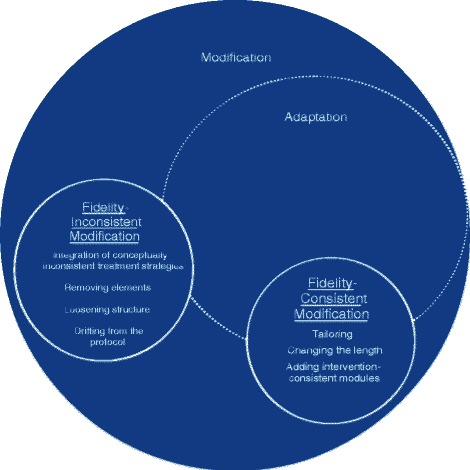
“A framework of modifications has been developed to further specify the types of changes that can be made to a protocol [16], including the following:”
MethodSelf-citationDynamic adaptation process to implement an evidence-based child maltreatment intervention
Aarons, G. A., Green, A. E., Palinkas, L. A., Self-Brown, S., Whitaker, D. J., Lutzker, J. R., Silovsky, J. F., Hecht, D. B., & Chaffin, M. J. (2012) · Implementation Science · doi:10.1186/1748-5908-7-32 · Cited by 449 · cited 3×
“improving its fit or effectiveness in a given context [12, 13].”
BackgroundLochman, J. E., & Wells, K. C. (2004) · Journal of Consulting and Clinical Psychology · doi:10.1037/0022-006x.72.4.571 · Cited by 426 · cited 1×
“around identification of modifiable predictors of fidelityinconsistent modifications, which have either been associated with poorer clinical outcomes in previous research or have not improved clinical outcomes [34, 35, 37–39].”
ResultToward the Effective and Efficient Measurement of Implementation Fidelity
Schoenwald, S. K., Garland, A. F., Chapman, J. E., Frazier, S. L., Sheidow, A. J., & Southam-Gerow, M. A. (2011) · Administration and Policy in Mental Health and Mental Health Services Research · doi:10.1007/s10488-010-0321-0 · Cited by 422
Beidas, R. S., Edmunds, J. M., Marcus, S. C., & Kendall, P. C. (2012) · Psychiatric Services · doi:10.1176/appi.ps.201100401 · Cited by 370 · cited 1×
“For each sample, clinician work samples were assessed using the fidelity rating systems that were developed to evaluate fidelity in clinical trials for the interventions [29, 30].”
MethodSelf-citationThe Cognitive Therapy Scale: Psychometric properties.
Vallis, T. M., Shaw, B. F., & Dobson, K. S. (1986) · Journal of Consulting and Clinical Psychology · doi:10.1037/0022-006x.54.3.381 · Cited by 331 · cited 1×
“For each sample, clinician work samples were assessed using the fidelity rating systems that were developed to evaluate fidelity in clinical trials for the interventions [29, 30].”
MethodMcHugh, R. K., Murray, H. W., & Barlow, D. H. (2009) · Behaviour Research and Therapy · doi:10.1016/j.brat.2009.07.005 · Cited by 320 · cited 1×
“For example, clinicians who work with particular patient populations might find that they need to tailor the intervention to accommodate differences in developmental stage or cognitive ability [19].”
BackgroundAarons, G. A., Research Network on Youth Mental Health, Glisson, C., Hoagwood, K., Kelleher, K., Landsverk, J., & Cafri, G. (2010) · Psychological Assessment · doi:10.1037/a0019188 · Cited by 316 · cited 1×
“91 for the subscales [28].”
Therapist competence ratings in relation to clinical outcome in cognitive therapy of depression.
Shaw, B. F., Elkin, I., Yamaguchi, J., Olmsted, M. P., Vallis, M., Dobson, K. S., Lowery, A., Sotsky, S. M., Watkins, J. T., & Imber, S. D. (1999) · Journal of Consulting and Clinical Psychology · doi:10.1037//0022-006x.67.6.837 · Cited by 308 · cited 1×
“The convention for CBT clinical trials (CTRS total score ≥40; [34]) was used as a threshold to indicate, and raters agreed about achievement of this standard for 93 % of the 15 sessions that they rated together.”
MethodThe fidelity‐adaptation debate: Implications for the implementation of public sector social programs
Blakely, C. H., Mayer, J. P., Gottschalk, R. G., Schmitt, N., Davidson, W. S., Roitman, D. B., & Emshoff, J. G. (1987) · American Journal of Community Psychology · doi:10.1007/bf00922697 · Cited by 297 · cited 1×
“for decreased fidelity to essential treatment elements and poorer treatment outcomes [42].”
BackgroundTailor-made versus standardized therapy of phobic patients
Schulte, D., Künzel, R., Pepping, G., & Schulte-Bahrenberg, T. (1992) · Advances in Behaviour Research and Therapy · doi:10.1016/0146-6402(92)90001-5 · Cited by 212 · cited 1×
“around identification of modifiable predictors of fidelityinconsistent modifications, which have either been associated with poorer clinical outcomes in previous research or have not improved clinical outcomes [34, 35, 37–39].”
ResultUsing Planned Adaptation to Implement Evidence‐Based Programs with New Populations
Lee, S. J., Altschul, I., & Mowbray, C. T. (2008) · American Journal of Community Psychology · doi:10.1007/s10464-008-9160-5 · Cited by 209 · cited 2×
“improving its fit or effectiveness in a given context [12, 13].”
BackgroundEdmunds, J. M., Beidas, R. S., & Kendall, P. C. (2013) · Clinical Psychology: Science and Practice · doi:10.1111/cpsp.12031 · Cited by 208 · cited 1×
“Consultation for both samples included discussion of application to specific cases, didactic topics (such as treating clients with comorbid diagnoses), practice with concepts and interventions, and assistance in implementation of the treatment within the practice setting [24, 25].”
BackgroundSelf-citationPredictors of Community Therapists’ Use of Therapy Techniques in a Large Public Mental Health System
Beidas, R. S., Marcus, S., Aarons, G. A., Hoagwood, K. E., Schoenwald, S., Evans, A. C., Hurford, M. O., Hadley, T., Barg, F. K., Walsh, L. M., et al. (2015) · JAMA Pediatrics · doi:10.1001/jamapediatrics.2014.3736 · Cited by 177 · cited 2×
“There is increasing evidence that clinician characteristics can uniquely influence the use of EBPs [18].”
BackgroundSelf-citationStirman, S. W., Crits-Christoph, P., & DeRubeis, R. J. (2004) · Clinical Psychology: Science and Practice · doi:10.1093/clipsy.bph091 · Cited by 148
Self-citationTherapist competence in cognitive therapy for depression: Predicting subsequent symptom change.
Strunk, D. R., Brotman, M. A., DeRubeis, R. J., & Hollon, S. D. (2010) · Journal of Consulting and Clinical Psychology · doi:10.1037/a0019631 · Cited by 128 · cited 1×
“around identification of modifiable predictors of fidelityinconsistent modifications, which have either been associated with poorer clinical outcomes in previous research or have not improved clinical outcomes [34, 35, 37–39].”
ResultFinley, E. P., Garcia, H. A., Ketchum, N. S., McGeary, D. D., McGeary, C. A., Stirman, S. W., & Peterson, A. L. (2015) · Psychological Services · doi:10.1037/ser0000014 · Cited by 102 · cited 1×
“Taken together, though, our results reinforce previous findings indicating that clinicians may need to have favorable attitudes toward EBPs to deliver them with fidelity [41].”
ResultBeidas, R. S., Edmunds, J., Ditty, M., Watkins, J., Walsh, L., Marcus, S., & Kendall, P. (2014) · Administration and Policy in Mental Health and Mental Health Services Research · doi:10.1007/s10488-013-0529-x · Cited by 95
Self-citationLim, A. J., Nakamura, B. J., Higa-McMillan, C. K., Shimabukuro, S. K., & Slavin, L. A. (2012) · Behaviour Research and Therapy · doi:10.1016/j.brat.2012.03.008 · Cited by 81 · cited 5×
“Table 1 contains descriptive statistics for modifications and the EBPAS scales, which were similar to those of a sample of community-based therapists who received training in a previous study [22].”
BackgroundMethodResultInfluentialChorpita, B. F., & Regan, J. (2009) · Behaviour Research and Therapy · doi:10.1016/j.brat.2009.07.002 · Cited by 75 · cited 1×
“Considerable attention has been devoted to factors that influence the implementation and sustainability of EBPs [2–4].”
BackgroundCook, J. M., Dinnen, S., Thompson, R., Simiola, V., & Schnurr, P. P. (2014) · Journal of Traumatic Stress · doi:10.1002/jts.21902 · Cited by 67 · cited 1×
“Similarly, clinicians on inpatient PTSD units endorsed a number of modifications, including tailoring the intervention, integration, and changing the length of the protocol [10].”
BackgroundCommunity Mental Health Provider Modifications to Cognitive Therapy: Implications for Sustainability
Wiltsey Stirman, S., Calloway, A., Toder, K., Miller, C. J., DeVito, A. K., Meisel, S. N., Xhezo, R., Evans, A. C., Beck, A. T., & Crits-Christoph, P. (2013) · Psychiatric Services · doi:10.1176/appi.ps.201200456 · Cited by 63 · cited 2×
“make modifications in the absence of a process that is consistent with planned adaptation [9, 11].”
BackgroundSelf-citationWard, A. M., Regan, J., Chorpita, B. F., Starace, N., Rodriguez, A., Okamura, K., Daleiden, E. L., Bearman, S. K., Weisz, J. R., & The Research Network on Youth Mental Health (2013) · Journal of Clinical Child & Adolescent Psychology · doi:10.1080/15374416.2012.700505 · Cited by 62 · cited 2×
“They may also be more able to identify instances in which they are delivering or deviating from EBPs [20].”
BackgroundHenggeler, S. W., Sheidow, A. J., Cunningham, P. B., Donohue, B. C., & Ford, J. D. (2008) · Journal of Clinical Child & Adolescent Psychology · doi:10.1080/15374410802148087 · Cited by 56 · cited 1×
“While these findings are not entirely consistent with other studies that have identified either no association [40], or a positive relationship between clinician attitudes and training outcomes [22], differences in strategies for assessing use of and fidelity to EBPs may account for these discrepancies.”
ResultAarons, G. A., Miller, E. A., Green, A. E., Perrott, J. A., & Bradway, R. (2012) · Journal of Children's Services · doi:10.1108/17466661211286463 · Cited by 51
Beidas, R. S., Barmish, A. J., & Kendall, P. C. (2009) · ScholarlyCommons (University of Pennsylvania) · Cited by 42
Self-citationIntegrity in mental health systems: An expanded framework for managing uncertainty in clinical care.
Regan, J., Daleiden, E. L., & Chorpita, B. F. (2013) · Clinical Psychology Science and Practice · doi:10.1111/cpsp.12024 · Cited by 34 · cited 1×
“Studies are underway to shed light on this important question, and practice-based research can further this goal [35, 43].”
BackgroundEdmunds, J. M., Read, K. L., Ringle, V. A., Brodman, D. M., Kendall, P. C., & Beidas, R. S. (2014) · Implementation Science · doi:10.1186/s13012-014-0089-9 · Cited by 31 · cited 3×
“Seventy-four percent (N = 37) of participants were Caucasian, 8 % (N = 4) were AfricanAmerican, 8 % (N = 4) were Asian American, 4 % (N = 2) identified as “other,” none identified as Hispanic/Latino, and ethnicity was missing for 6 % (N = 3) of the sample.”
BackgroundResultSelf-citationStirman, S. W. (2004) · Clinical Psychology Science and Practice · doi:10.1093/clipsy/bph091 · Cited by 22
Stirman, S. W., Miller, C. J., Toder, K., Calloway, A. L., Beck, A. T., Evans, A. C., & Crits-Christoph, P. F. (2012) · Depression Research and Treatment · doi:10.1155/2012/391084 · Cited by 15 · cited 1×
“In both samples, participation in training was intended to be voluntary, although in the adult sample, some clinicians indicated that they felt some pressure to participate by their agency administration [23].”
BackgroundSelf-citationDoing More with What We Know: Introduction to the Special Issue
Chorpita, B. F., & Daleiden, E. L. (2014) · Journal of Clinical Child & Adolescent Psychology · doi:10.1080/15374416.2013.869751 · Cited by 14 · cited 1×
“should be carefully considered and, if made in the absence of empirical support, that their impact should be measured [6, 12, 35, 36].”
Background
Research works printed but not linked: 2
- Gamarra JM, Gutner CA, Calloway A, Joseph N, Stirman SW. Examining the impacts of modifications and adaptations of evidence-based psychotherapies. Conference on the Science of Dissemination and Implementation; Bethesda, MD2014.
- Creed TA, Stirman SW, Evans AC, Beck AT. A model for implementation of cognitive therapy in community mental health: The Beck Initiative. The Behavior Therapist. 2014;37(3):56–64.
Cited by
Wiltsey Stirman, S., Baumann, A. A., & Miller, C. J. (2019) · Implementation Science · doi:10.1186/s13012-019-0898-y · Cited by 1,329
“, [2, 4, 27]), or allow investigators to consider modifications in conjunction with fidelity, a re-”
BackgroundResultInfluentialThe Sustainability of Evidence-Based Interventions and Practices in Public Health and Health Care
Shelton, R. C., Cooper, B. R., & Stirman, S. W. (2018) · Annual Review of Public Health · doi:10.1146/annurev-publhealth-040617-014731 · Cited by 806
Self-citationDiffusion Of Innovations Theory, Principles, And Practice
Dearing, J. W., & Cox, J. G. (2018) · Health Affairs · doi:10.1377/hlthaff.2017.1104 · Cited by 757
The FRAME-IS: a framework for documenting modifications to implementation strategies in healthcare
Miller, C. J., Barnett, M. L., Baumann, A. A., Gutner, C. A., & Wiltsey-Stirman, S. (2021) · Implementation Science · doi:10.1186/s13012-021-01105-3 · Cited by 490
“Adaptation of an EBP has been defined as the deliberate alteration of its design or delivery to improve its fit in a given context [1, 2].”
BackgroundSelf-citationReframing implementation science to address inequities in healthcare delivery
Baumann, A. A., & Cabassa, L. J. (2020) · BMC Health Services Research · doi:10.1186/s12913-020-4975-3 · Cited by 461
Metadata
- Authors
- Wiltsey Stirman, S., A Gutner, C., Crits-Christoph, P., Edmunds, J., Evans, A. C., & Beidas, R. S.
- Affiliations
- University of Pennsylvania (US)
- Harvard University (US)
- Department of Behavioral Health and Intellectual Disability Services (US)
- Venue
- Implementation Science
- Published
- 2015-08-13
- Volume
- 10
- Issue
- 1
- Pages
- 115-115
- ISSN
- 1748-5908 (ISSN-L)
- PMC
- PMC4534152
- OpenAlex
- W2153708733
- Semantic Scholar
- e516779c2b243181eb27dfd5bc0a9510fdf6bc5e
- Cited by
- 188
- References
- 43
- Citations by year
- 2026: 11 · 2025: 17 · 2024: 26 · 2023: 15 · 2022: 17 · 2021: 31 · 2020: 22 · 2019: 16 · 2018: 17 · 2017: 6 · 2016: 7 · 2015: 2
- FWCI
- 19.50
- Type
- journal article
- Language
- en
- Open access
- gold
- doi.org
- Licence
- Locations
- Implementation Science (publishedVersion, cc-by)
- Europe PMC (PubMed Central) (publishedVersion, cc-by)
- PubMed Central (publishedVersion, cc-by)
- PubMed (publishedVersion)
- ScholarlyCommons (University of Pennsylvania) (submittedVersion)
- Funders
- National Institutes of Health (1f31mh010800-01)
- National Institute of Mental Health (MH010800, MH080916, MH083333, F31MH083333, MH099179, K23MH099179, R25MH080916)
- Topics
- Health Sciences › Health Professions › General Health Professions › Health Policy Implementation Science
- Social Sciences › Psychology › Clinical Psychology › Psychotherapy Techniques and Applications
- Social Sciences › Psychology › Clinical Psychology › Counseling Practices and Supervision
- Keywords
- evidence-based psychotherapy, intervention fidelity, cognitive behavioral therapy, treatment modification, evidence-based practice implementation
- MeSH terms
- Adult, Child, Clinical Competence, Clinical Protocols, Humans, Psychotherapy, Cognitive Behavioral Therapy, Evidence-Based Medicine
About these checks
Registry, retraction, Cites and statistics results are computed, not judged, with one exception: a printed reference that no index lists is read once by a model before it counts as a citation error. Claims are extracted by a model and kept only when their quote appears verbatim in the text; each cited source is then checked, with a model’s help, for whether it says what the claim relies on. Those verdicts can be wrong — read the claim’s quote and the cited source before relying on one.
Statistics and arithmetic are recomputed, not judged.
Confidence bands are shown only for fields calibrated on our annotated test set. None is calibrated yet, so no band is shown.
What counts as a claim ›How we measure confidence ›How we check this ›
Are you an author, or do you see a problem with this page? Request a review
Data sources
Bibliographic data: Semantic Scholar, OpenAlex, Crossref.
Contains information from the Semantic Scholar Academic Graph Datasets, made available under the ODC Attribution License (ODC-BY 1.0).
Semantic Scholar’s data is described in: Kinney, R., et al. (2023). The Semantic Scholar Open Data Platform. arXiv:2301.10140.
