

The DOI matches its Crossref record; 62 of the 64 references it cites were found in a registry or an index; none of the 148 sources its claims cite is checked for support yet.
Factors that influence the implementation of e-health: a systematic review of systematic reviews (an update)
Open accessAbstract
BACKGROUND: There is a significant potential for e-health to deliver cost-effective, quality health care, and spending on e-health systems by governments and healthcare systems is increasing worldwide. However, there remains a tension between the use of e-health in this way and implementation. Furthermore, the large body of reviews in the e-health implementation field, often based on one particular technology, setting or health condition make it difficult to access a comprehensive and comprehensible summary of available evidence to help plan and undertake implementation. This review provides an update and re-analysis of a systematic review of the e-health implementation literature culminating in a set of accessible and usable recommendations for anyone involved or interested in the implementation of e-health. METHODS: MEDLINE, EMBASE, CINAHL, PsycINFO and The Cochrane Library were searched for studies published between 2009 and 2014. Studies were included if they were systematic reviews of the implementation of e-health. Data from included studies were synthesised using the principles of meta-ethnography, and categorisation of the data was informed by the Consolidated Framework for Implementation Research (CFIR). RESULTS: Forty-four reviews mainly from North America and Europe were included. A range of e-health technologies including electronic medical records and clinical decision support systems were represented. Healthcare settings included primary care, secondary care and home care. Factors important for implementation were identified at the levels of the following: the individual e-health technology, the outer setting, the inner setting and the individual health professionals as well as the process of implementation. CONCLUSION: This systematic review of reviews provides a synthesis of the literature that both acknowledges the multi-level complexity of e-health implementation and provides an accessible and useful guide for those planning implementation. New interpretations of a large amount of data across e-health systems and healthcare settings have been generated and synthesised into a set of useable recommendations for practice. This review provides a further empirical test of the CFIR and identifies areas where additional research is necessary. TRIAL REGISTRATION: PROSPERO, CRD42015017661.
Overview
AI snapshot
Written from the paper’s full text.
TL;DR
This updated systematic review of reviews synthesises 44 reviews on e-health implementation and finds that implementation is multi-level, involving the technology, outer setting, inner setting, individual health professionals, and implementation process. The findings are well described by the Consolidated Framework for Implementation Research (CFIR), with no data that could not be coded to its constructs.
Key findings
- From 2,812 unique citations, 118 full papers were assessed and 44 reviews published between 2003 and 2014 were included; 28 focused on one e-health domain, 16 covered multiple domains, 12 focused on one healthcare setting, and 21 covered two or more settings.
- Factors important for implementation were identified at the levels of the individual e-health technology, outer setting, inner setting, individual health professionals, and implementation process; no single factor was identified as the key barrier or facilitator.
- Cost was reported as an important implementation factor by the majority of studies across all e-health domains, and workflow compatibility/fit was discussed by the majority of studies.
- No data could not be coded to a CFIR construct; areas with no supporting data included peer pressure, tension for change, relative priority, learning climate, external change agents, and executing.
Methods
- Systematic review of reviews; MEDLINE, EMBASE, CINAHL, PsycINFO, and The Cochrane Library were searched, replicating the original review’s strategy, covering literature published between 1995 and 2014.
- Included studies were systematic reviews, narrative reviews, qualitative meta-syntheses, or meta-ethnographies of e-health implementation; data were extracted and synthesised using principles of meta-ethnography with CFIR as the organising framework.
- Methodological quality was described using ENTREQ guidelines but studies were not excluded based on quality assessment.
Limitations
- The paper states that systematic reviews and included studies may be subject to publication bias; reviews of reviews have a time-lag; the review depended on interpretations provided by authors of included reviews; it was often unclear whether data came from primary studies or review authors’ interpretations; many reviews did not specify whether data came from clinicians, nurses, other staff, or multidisciplinary teams; and synthesis was limited by what previous reviewers included, so unaddressed CFIR areas may be unimportant or merely unaddressed.
- Evident from the text: many included reviews were methodologically poor against ENTREQ, including three that did not give databases searched, seven that searched only one database or source, sixteen that did not specify inclusion/exclusion criteria, and five that did not detail the number of primary studies included.
Model-written summary. Check it against the paper before relying on it.
Integrity signals
Registry
Cites
Statistics
Figures
Verification
Claims the paper makes
81 Not checked yet · 21 Own result · 17 Own method · 11 Own interpretation · 8 No basis given
A result the paper reports from its own data — it cites no other source for it, so there is none to check. The quote shows it is in the paper.
In the paper
“Sixteen of the 44 studies did not specify the criteria for inclusion or exclusion [16, 17, 20, 22, 30, 32–36, 38–40, 48, 53, 56].”
§ Factors that influence the implementation of e-health: a systematic review of systematic reviews (an update) > Description of the included reviews
plain- Asserted: passes — The authors put it forward as true.
- Checkable: passes — It can be checked against evidence.
- Load-bearing: unclear — It is unclear whether the paper’s conclusions depend on it.
- Based: passes — The paper gives a reason why it holds.
None of the sources cited for this claim have been checked yet.
In the paper
“The cost of e-health system and costs associated with their implementation were reported as important implementation factors by the majority of studies across all e-health domains [15–19, 22–25, 27, 28, 30–33, 36, 38, 39, 41, 43, 47, 49, 51–54, 57]”
§ Factors that influence the implementation of e-health: a systematic review of systematic reviews (an update) > Innovation characteristics > Cost
plaincorrelational- Asserted: passes — The authors put it forward as true.
- Checkable: passes — It can be checked against evidence.
- Load-bearing: passes — The paper’s conclusions depend on it.
- Based: passes — The paper gives a reason why it holds.
A result the paper reports from its own data — it cites no other source for it, so there is none to check. The quote shows it is in the paper.
In the paper
“Factors important for implementation were identified at the levels of the following: the individual e-health technology, the outer setting, the inner setting and the individual health professionals as well as the process of implementation.”
§ Factors that influence the implementation of e-health: a systematic review of systematic reviews (an update) > Abstract > Results
plain- Asserted: passes — The authors put it forward as true.
- Checkable: passes — It can be checked against evidence.
- Load-bearing: passes — The paper’s conclusions depend on it.
- Based: passes — The paper gives a reason why it holds.
None of the sources cited for this claim have been checked yet.
In the paper
“with some studies citing cost-related factors as the main barrier to implementation [49, 54].”
§ Factors that influence the implementation of e-health: a systematic review of systematic reviews (an update) > Innovation characteristics > Cost
plaindirect- Asserted: passes — The authors put it forward as true.
- Checkable: passes — It can be checked against evidence.
- Load-bearing: unclear — It is unclear whether the paper’s conclusions depend on it.
- Based: passes — The paper gives a reason why it holds.
A result the paper reports from its own data — it cites no other source for it, so there is none to check. The quote shows it is in the paper.
In the paper
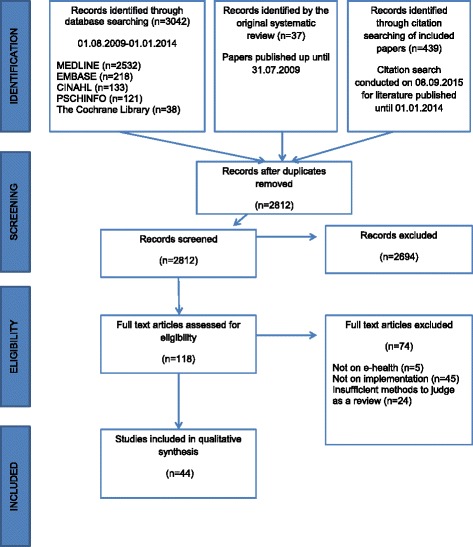
“Of the 118 full papers assessed, 44 [15–58] met the criteria for inclusion and were included in this review”
§ Factors that influence the implementation of e-health: a systematic review of systematic reviews (an update) > Results > Search results
plain- Asserted: passes — The authors put it forward as true.
- Checkable: passes — It can be checked against evidence.
- Load-bearing: unclear — It is unclear whether the paper’s conclusions depend on it.
- Based: passes — The paper gives a reason why it holds.
In the paper
“When judged against the ENTREQ statement [11], many studies were methodologically poor.”
§ Factors that influence the implementation of e-health: a systematic review of systematic reviews (an update) > Description of the included reviews
What the sources say
- Not checked yetcites [11] Tong A, Flemming K, McInnes E, Oliver S, Craig J. Enhancing transparency in reporting the synthesis of qualitative research: ENTREQ. BMC Med Res Methodol. 2012;12:181. source
plain- Asserted: passes — The authors put it forward as true.
- Checkable: passes — It can be checked against evidence.
- Load-bearing: unclear — It is unclear whether the paper’s conclusions depend on it.
- Based: passes — The paper gives a reason why it holds.
None of the sources cited for this claim have been checked yet.
In the paper
“Technologies that can have technical adjustments made to them to suit the constant modifications of the environment may have greater acceptance and adoption [18, 35, 41, 50, 58].”
§ Factors that influence the implementation of e-health: a systematic review of systematic reviews (an update) > Innovation characteristics > Adaptability
hedgedconditional- Asserted: passes — The authors put it forward as true.
- Checkable: passes — It can be checked against evidence.
- Load-bearing: unclear — It is unclear whether the paper’s conclusions depend on it.
- Based: passes — The paper gives a reason why it holds.
None of the sources cited for this claim have been checked yet.
In the paper
“Financial incentives to adopt e-health systems from insurers and government agencies facilitated adoption decisions in some case [24, 37, 49].”
§ Factors that influence the implementation of e-health: a systematic review of systematic reviews (an update) > Innovation characteristics > Cost
plaindirect- Asserted: passes — The authors put it forward as true.
- Checkable: passes — It can be checked against evidence.
- Load-bearing: unclear — It is unclear whether the paper’s conclusions depend on it.
- Based: passes — The paper gives a reason why it holds.
None of the sources cited for this claim have been checked yet.
In the paper
“The need for recognised standards for the provision of e-health systems was described by many studies [16, 18, 20, 28, 33, 36, 48, 49, 51].”
§ Factors that influence the implementation of e-health: a systematic review of systematic reviews (an update) > Outer setting > External policy and incentives
What the sources say
- Not checked yetcites [16] Archer N, Fevrier-Thomas U, Lokker C, McKibbon KA, Straus SE. Personal health records: a scoping review. J Am Med Inform Assoc. 2011;18(4):515–22. source
- Not checked yetcites [18] Boonstra A, Broekhuis M. Barriers to the acceptance of electronic medical records by physicians from systematic review to taxonomy and interventions. BMC Health Serv Res. 2010;10:231. source
- Not checked yetcites [20] Broens TH, Huis in't Veld RM, Vollenbroek-Hutten MM, Hermens HJ, van Halteren AT, Nieuwenhuis LJ. Determinants of successful telemedicine implementations: a literature study. J Telemed Telecare. 2007;13(6):303–9. source
plain- Asserted: passes — The authors put it forward as true.
- Checkable: passes — It can be checked against evidence.
- Load-bearing: unclear — It is unclear whether the paper’s conclusions depend on it.
- Based: passes — The paper gives a reason why it holds.
None of the sources cited for this claim have been checked yet.
In the paper
“For example, a major barrier to the adoption of Electronic Health Records (EHR) was the inability of new systems to exchange information with systems already in place, due to a lack of consistent data standards [18].”
§ Factors that influence the implementation of e-health: a systematic review of systematic reviews (an update) > Innovation characteristics > Adaptability
plaindirect- Asserted: passes — The authors put it forward as true.
- Checkable: passes — It can be checked against evidence.
- Load-bearing: unclear — It is unclear whether the paper’s conclusions depend on it.
- Based: passes — The paper gives a reason why it holds.
- Probably not a substantial claim. 46
- It may state two separate claims as one. 46
The paper states this without a source or data behind it here, so there is nothing to check it against. The quote shows it is in the paper.
In the paper
“Cost factors are related to start-up costs, ongoing costs, costs related to a loss of revenue and potential savings to put against these costs.”
§ Factors that influence the implementation of e-health: a systematic review of systematic reviews (an update) > Innovation characteristics > Cost
plaincorrelational- Asserted: passes — The authors put it forward as true.
- Checkable: passes — It can be checked against evidence.
- Load-bearing: fails — The paper’s conclusions may not depend on it.
- Based: passes — The paper gives a reason why it holds.
Probably not a substantial claim. The paper’s conclusions may not depend on it. It may state two separate claims as one.
A result the paper reports from its own data — it cites no other source for it, so there is none to check. The quote shows it is in the paper.
In the paper
“Sixteen studies focussed on e-health technologies from across a range of e-health domains [15, 23, 25, 26, 30, 35, 37, 46, 47, 49, 50, 52, 53, 56–58].”
§ Factors that influence the implementation of e-health: a systematic review of systematic reviews (an update) > Description of the included reviews
plain- Asserted: passes — The authors put it forward as true.
- Checkable: passes — It can be checked against evidence.
- Load-bearing: fails — The paper’s conclusions may not depend on it.
- Based: passes — The paper gives a reason why it holds.
Probably not a substantial claim. The paper’s conclusions may not depend on it.
A result the paper reports from its own data — it cites no other source for it, so there is none to check. The quote shows it is in the paper.
In the paper
“All studies were published between 2003 and 2014.”
§ Factors that influence the implementation of e-health: a systematic review of systematic reviews (an update) > Description of the included reviews
plain- Asserted: passes — The authors put it forward as true.
- Checkable: passes — It can be checked against evidence.
- Load-bearing: fails — The paper’s conclusions may not depend on it.
- Based: passes — The paper gives a reason why it holds.
Probably not a substantial claim. The paper’s conclusions may not depend on it.
A result the paper reports from its own data — it cites no other source for it, so there is none to check. The quote shows it is in the paper.
In the paper
“Twelve studies were focussed on one particular type of healthcare setting including primary care/ambulatory [15, 24, 27, 28, 36, 39], hospital/inpatient/acute care [22, 29, 40, 46] and home care [19, 53].”
§ Factors that influence the implementation of e-health: a systematic review of systematic reviews (an update) > Description of the included reviews
plain- Asserted: passes — The authors put it forward as true.
- Checkable: passes — It can be checked against evidence.
- Load-bearing: fails — The paper’s conclusions may not depend on it.
- Based: passes — The paper gives a reason why it holds.
Probably not a substantial claim. The paper’s conclusions may not depend on it.
None of the sources cited for this claim have been checked yet.
In the paper
“Financial incentives include the provision of initial funds to cover upfront costs [49], financial sponsorship [39], reimbursements for adoption [19, 30, 31, 36], and pay-for-performance initiatives [24, 36, 37, 49].”
§ Factors that influence the implementation of e-health: a systematic review of systematic reviews (an update) > Outer setting > External policy and incentives
What the sources say
- Not checked yetcites [49] Police RL, Foster T, Wong KS. Adoption and use of health information technology in physician practice organisations: systematic review. Inform Prim Care. 2010;18(4):245–58.
- Not checked yetcites [39] Ludwick DA, Doucette J. Adopting electronic medical records in primary care: lessons learned from health information systems implementation experience in seven countries. Int J Med Inform. 2009;78(1):22–31. source
- Not checked yetcites [19] Botsis T, Hartvigsen G. Current status and future perspectives in telecare for elderly people suffering from chronic diseases. J Telemed Telecare. 2008;14(4):195–203. source
plain- Asserted: passes — The authors put it forward as true.
- Checkable: passes — It can be checked against evidence.
- Load-bearing: unclear — It is unclear whether the paper’s conclusions depend on it.
- Based: passes — The paper gives a reason why it holds.
It may state two separate claims as one.
The paper states this without a source or data behind it here, so there is nothing to check it against. The quote shows it is in the paper.
In the paper
“All papers were written in English.”
§ Factors that influence the implementation of e-health: a systematic review of systematic reviews (an update) > Description of the included reviews
plain- Asserted: passes — The authors put it forward as true.
- Checkable: passes — It can be checked against evidence.
- Load-bearing: fails — The paper’s conclusions may not depend on it.
- Based: passes — The paper gives a reason why it holds.
Probably not a substantial claim. The paper’s conclusions may not depend on it.
A result the paper reports from its own data — it cites no other source for it, so there is none to check. The quote shows it is in the paper.
In the paper
“the remainder of the studies did not define a specific healthcare setting [16, 18, 20, 28, 34, 38, 48, 57, 58].”
§ Factors that influence the implementation of e-health: a systematic review of systematic reviews (an update) > Description of the included reviews
plain- Asserted: passes — The authors put it forward as true.
- Checkable: passes — It can be checked against evidence.
- Load-bearing: fails — The paper’s conclusions may not depend on it.
- Based: passes — The paper gives a reason why it holds.
Probably not a substantial claim. The paper’s conclusions may not depend on it.
A result the paper reports from its own data — it cites no other source for it, so there is none to check. The quote shows it is in the paper.
In the paper
“Forty-four reviews mainly from North America and Europe were included.”
§ Factors that influence the implementation of e-health: a systematic review of systematic reviews (an update) > Abstract > Results
plain- Asserted: passes — The authors put it forward as true.
- Checkable: passes — It can be checked against evidence.
- Load-bearing: fails — The paper’s conclusions may not depend on it.
- Based: passes — The paper gives a reason why it holds.
Probably not a substantial claim. The paper’s conclusions may not depend on it.
A result the paper reports from its own data — it cites no other source for it, so there is none to check. The quote shows it is in the paper.
In the paper
“Twenty-one studies focussed on the implementation of e-health in to two or more types of healthcare setting [21, 23, 25, 26, 30, 31, 33, 35, 37, 41–45, 47, 49, 50, 52, 54–56]; the remainder of the studies did not define a specific healthcare setting [16, 18, 20, 28, 34, 38, 48, 57, 58].”
§ Factors that influence the implementation of e-health: a systematic review of systematic reviews (an update) > Description of the included reviews
plain- Asserted: passes — The authors put it forward as true.
- Checkable: passes — It can be checked against evidence.
- Load-bearing: fails — The paper’s conclusions may not depend on it.
- Based: passes — The paper gives a reason why it holds.
Probably not a substantial claim. The paper’s conclusions may not depend on it.
A result the paper reports from its own data — it cites no other source for it, so there is none to check. The quote shows it is in the paper.
In the paper
“Fifteen studies originated from Canada [16, 25–29, 31–33, 36, 39, 41, 42, 44, 53], fourteen from the USA [17, 22–24, 30, 35, 38, 40, 49, 52, 54–57], three from the Netherlands [17, 20, 34], three from the UK [37, 46, 51], two from Australia [15, 43] and one each from Germany [47], Sweden [50], Norway [19], Mexico [21], Malaysia [58], Kenya [45] and Israel [48].”
§ Factors that influence the implementation of e-health: a systematic review of systematic reviews (an update) > Description of the included reviews
plain- Asserted: passes — The authors put it forward as true.
- Checkable: passes — It can be checked against evidence.
- Load-bearing: fails — The paper’s conclusions may not depend on it.
- Based: passes — The paper gives a reason why it holds.
Probably not a substantial claim. The paper’s conclusions may not depend on it. It may state two separate claims as one.
A result the paper reports from its own data — it cites no other source for it, so there is none to check. The quote shows it is in the paper.
In the paper
“It became clear that the relationships between studies seemed to be reciprocal (where concepts of one study encompass another), with many themes occurring across studies which were largely in agreement about the factors that influenced implementation, and from which a line of argument (overarching narrative) could be developed.”
§ Factors that influence the implementation of e-health: a systematic review of systematic reviews (an update) > Data synthesis > Synthesising translations
hedgedcorrelational- Asserted: passes — The authors put it forward as true.
- Checkable: passes — It can be checked against evidence.
- Load-bearing: passes — The paper’s conclusions depend on it.
- Based: passes — The paper gives a reason why it holds.
Probably not a substantial claim. It may state two separate claims as one.
A result the paper reports from its own data — it cites no other source for it, so there is none to check. The quote shows it is in the paper.
In the paper
“A total of 2812 unique citations were identified (see Fig. 1).”
§ Factors that influence the implementation of e-health: a systematic review of systematic reviews (an update) > Results > Search results
plain- Asserted: passes — The authors put it forward as true.
- Checkable: passes — It can be checked against evidence.
- Load-bearing: fails — The paper’s conclusions may not depend on it.
- Based: passes — The paper gives a reason why it holds.
Probably not a substantial claim. The paper’s conclusions may not depend on it.
None of the sources cited for this claim have been checked yet.
In the paper
“Complexity factors such as slow system performance [55], software and hardware that were difficult to use [27], the need for extensive software modifications [52], the work involved in transferring records between two systems [18], the inability to provide real-time access [38], data handling, reliability, slow speed, unplanned downtime [41] and connectivity issues [49] influence implementation of”
§ Factors that influence the implementation of e-health: a systematic review of systematic reviews (an update) > Innovation characteristics > Complexity
plaindirect- Asserted: passes — The authors put it forward as true.
- Checkable: passes — It can be checked against evidence.
- Load-bearing: passes — The paper’s conclusions depend on it.
- Based: passes — The paper gives a reason why it holds.
It may state two separate claims as one.
A result the paper reports from its own data — it cites no other source for it, so there is none to check. The quote shows it is in the paper.
In the paper
“There were no data that could not be coded to one of the CFIR constructs, meaning the categories of the CFIR were endorsed and no additional original theoretical insights developed.”
§ Factors that influence the implementation of e-health: a systematic review of systematic reviews (an update) > Data synthesis > Expressing the synthesis
plain- Asserted: passes — The authors put it forward as true.
- Checkable: passes — It can be checked against evidence.
- Load-bearing: passes — The paper’s conclusions depend on it.
- Based: passes — The paper gives a reason why it holds.
It may state two separate claims as one.
A result the paper reports from its own data — it cites no other source for it, so there is none to check. The quote shows it is in the paper.
In the paper
“Of these, 2694 could be excluded on the basis of the title or abstract, leaving 118 citations requiring the full paper before a decision could be made.”
§ Factors that influence the implementation of e-health: a systematic review of systematic reviews (an update) > Results > Search results
hedged- Asserted: passes — The authors put it forward as true.
- Checkable: passes — It can be checked against evidence.
- Load-bearing: fails — The paper’s conclusions may not depend on it.
- Based: passes — The paper gives a reason why it holds.
Probably not a substantial claim. The paper’s conclusions may not depend on it. It may state two separate claims as one.
None of the sources cited for this claim have been checked yet.
In the paper
“Access to ongoing support to use systems was important for system use [21, 25, 28, 31, 37, 39, 43, 54] and a barrier to implementation when it was lacking [21].”
§ Factors that influence the implementation of e-health: a systematic review of systematic reviews (an update) > Inner setting > Implementation climate
What the sources say
- Not checked yetcites [21] Castillo VH, Martinez-Garcia AI, Pulido JR. A knowledge-based taxonomy of critical factors for adopting electronic health record systems by physicians: a systematic literature review. BMC Med Inform Decis Mak. 2010;10:60. source
- Not checked yetcites [25] Gagnon MP, Desmartis M, Labrecque M, Car J, Pagliari C, Pluye P, et al. Systematic review of factors influencing the adoption of information and communication technologies by healthcare professionals. J Med Syst. 2012;36(1):241–77. source
- Not checked yetcites [28] Goldstein DH, Phelan R, Wilson R, Ross-White A, VanDenKerkhof EG, Penning JP, et al. Brief review: adoption of electronic medical records to enhance acute pain management. Can J Anesth. 2014;61(2):164–79. source
plaindirect- Asserted: passes — The authors put it forward as true.
- Checkable: passes — It can be checked against evidence.
- Load-bearing: passes — The paper’s conclusions depend on it.
- Based: passes — The paper gives a reason why it holds.
It may state two separate claims as one.
None of the sources cited for this claim have been checked yet.
In the paper
“Providing a period of transition in which end users can become familiar with and learn how to use new systems has been advocated [39, 50].”
§ Factors that influence the implementation of e-health: a systematic review of systematic reviews (an update) > Inner setting > Implementation climate
What the sources say
- Not checked yetcites [39] Ludwick DA, Doucette J. Adopting electronic medical records in primary care: lessons learned from health information systems implementation experience in seven countries. Int J Med Inform. 2009;78(1):22–31. source
- Not checked yetcites [50] Rahimi B, Vimarlund V, Timpka T. Health information system implementation: a qualitative meta-analysis. J Med Syst. 2009;33(5):359–68. source
plain- Asserted: passes — The authors put it forward as true.
- Checkable: passes — It can be checked against evidence.
- Load-bearing: fails — The paper’s conclusions may not depend on it.
- Based: passes — The paper gives a reason why it holds.
Probably not a substantial claim. The paper’s conclusions may not depend on it.
None of the sources cited for this claim have been checked yet.
In the paper
“Positive staff attitudes were described as: beliefs that the new systems would benefit patients [56], interest in the technologies, perceived usefulness and motivation in working with the systems [21].”
§ Factors that influence the implementation of e-health: a systematic review of systematic reviews (an update) > Individual characteristics > Knowledge and beliefs
What the sources say
- Not checked yetcites [56] Waneka R, Spetz J. Hospital information technology systems' impact on nurses and nursing care. J Nurs Adm. 2010;40(12):509–14. source
- Not checked yetcites [21] Castillo VH, Martinez-Garcia AI, Pulido JR. A knowledge-based taxonomy of critical factors for adopting electronic health record systems by physicians: a systematic literature review. BMC Med Inform Decis Mak. 2010;10:60. source
plain- Asserted: passes — The authors put it forward as true.
- Checkable: passes — It can be checked against evidence.
- Load-bearing: fails — The paper’s conclusions may not depend on it.
- Based: passes — The paper gives a reason why it holds.
Probably not a substantial claim. The paper’s conclusions may not depend on it.
None of the sources cited for this claim have been checked yet.
In the paper
“Generally, access to appropriate, high-quality, well-funded, and easily available training was reported as a facilitator to implementation, whereas it was reported as a barrier when it was non-existent or existent but inadequate [15, 16, 18, 20, 23, 25, 28, 31, 37, 43, 45, 50, 51, 53–58].”
§ Factors that influence the implementation of e-health: a systematic review of systematic reviews (an update) > Inner setting > Implementation climate
What the sources say
- Not checked yetcites [15] Adaji A, Schattner P, Jones K. The use of information technology to enhance diabetes management in primary care: a literature review. Inform Prim Care. 2008;16(3):229–37.
- Not checked yetcites [16] Archer N, Fevrier-Thomas U, Lokker C, McKibbon KA, Straus SE. Personal health records: a scoping review. J Am Med Inform Assoc. 2011;18(4):515–22. source
- Not checked yetcites [18] Boonstra A, Broekhuis M. Barriers to the acceptance of electronic medical records by physicians from systematic review to taxonomy and interventions. BMC Health Serv Res. 2010;10:231. source
plaincorrelational- Asserted: passes — The authors put it forward as true.
- Checkable: passes — It can be checked against evidence.
- Load-bearing: passes — The paper’s conclusions depend on it.
- Based: passes — The paper gives a reason why it holds.
It may state two separate claims as one.
None of the sources cited for this claim have been checked yet.
In the paper
“The quality of project management during the implementation period [18], careful study of the downstream effects of implementation on workflow [55], additional training [31, 55], the adaptability of technologies to fit with roles, tasks and workflows [37] and dedicated technical support staff [31] are suggested as strategies to reduce barriers related to disruptions to workflow, roles and respons”
§ Factors that influence the implementation of e-health: a systematic review of systematic reviews (an update) > Inner setting > Implementation climate
What the sources say
- Not checked yetcites [18] Boonstra A, Broekhuis M. Barriers to the acceptance of electronic medical records by physicians from systematic review to taxonomy and interventions. BMC Health Serv Res. 2010;10:231. source
- Not checked yetcites [55] Vreeman DJ, Taggard SL, Rhine MD, Worrell TW. Evidence for electronic health record systems in physical therapy. Phys Ther. 2006;86(3):434–46. source
- Not checked yetcites [31] Jarvis-Selinger S, Chan E, Payne R, Plohman K, Ho K. Clinical telehealth across the disciplines: lessons learned. Telemed e-Health. 2008;14(7):720–5. source
hedgeddirect- Asserted: passes — The authors put it forward as true.
- Checkable: passes — It can be checked against evidence.
- Load-bearing: passes — The paper’s conclusions depend on it.
- Based: passes — The paper gives a reason why it holds.
Probably not a substantial claim. It may state two separate claims as one.
None of the sources cited for this claim have been checked yet.
In the paper
“When there is a good fit, or perceived fit, between e-health systems and workflows, and when systems positively influence workplace efficiency, this facilitates use [15, 40, 41].”
§ Factors that influence the implementation of e-health: a systematic review of systematic reviews (an update) > Inner setting > Implementation climate
What the sources say
- Not checked yetcites [15] Adaji A, Schattner P, Jones K. The use of information technology to enhance diabetes management in primary care: a literature review. Inform Prim Care. 2008;16(3):229–37.
- Not checked yetcites [40] Mack EH, Wheeler DS, Embi PJ. Clinical decision support systems in the pediatric intensive care unit. Pediatric Crit Care Med. 2009;10(1):23–8. source
- Not checked yetcites [41] McGinn CA, Grenier S, Duplantie J, Shaw N, Sicotte C, Mathieu L, et al. Comparison of user groups’ perspectives of barriers and facilitators to implementing electronic health records: a systematic review. BMC Med. 2011;9:46. source
plaindirect- Asserted: passes — The authors put it forward as true.
- Checkable: passes — It can be checked against evidence.
- Load-bearing: passes — The paper’s conclusions depend on it.
- Based: passes — The paper gives a reason why it holds.
It may state two separate claims as one.
None of the sources cited for this claim have been checked yet.
In the paper
“Incorporating workflow analysis into system design [48, 55], the integration of systems into the usual process of care [15], user-friendly systems [40] and minimising workflow interruptions during implementation [17] may minimise disruptions to workflow.”
§ Factors that influence the implementation of e-health: a systematic review of systematic reviews (an update) > Inner setting > Implementation climate
What the sources say
- Not checked yetcites [48] Peleg M, Tu S. Decision support, knowledge representation and management in medicine. Yearbook Med Inform. 2006:72–80.
- Not checked yetcites [55] Vreeman DJ, Taggard SL, Rhine MD, Worrell TW. Evidence for electronic health record systems in physical therapy. Phys Ther. 2006;86(3):434–46. source
- Not checked yetcites [15] Adaji A, Schattner P, Jones K. The use of information technology to enhance diabetes management in primary care: a literature review. Inform Prim Care. 2008;16(3):229–37.
hedgedconditional- Asserted: passes — The authors put it forward as true.
- Checkable: passes — It can be checked against evidence.
- Load-bearing: passes — The paper’s conclusions depend on it.
- Based: passes — The paper gives a reason why it holds.
It may state two separate claims as one.
None of the sources cited for this claim have been checked yet.
In the paper
“Infrastructure features included electricity supply [51], available bandwidth [31, 51], access to reliable internet connectivity [45, 51], access to computers [34], electrical power [45] and access to phone lines and mobile phones [45].”
§ Factors that influence the implementation of e-health: a systematic review of systematic reviews (an update) > Inner setting > Implementation climate
What the sources say
- Not checked yetcites [51] Saliba V, Legido-Quigley H, Hallik R, Aaviksoo A, Car J, McKee M. Telemedicine across borders: a systematic review of factors that hinder or support implementation. Int J Med Inform. 2012;81(12):793–809. source
- Not checked yetcites [31] Jarvis-Selinger S, Chan E, Payne R, Plohman K, Ho K. Clinical telehealth across the disciplines: lessons learned. Telemed e-Health. 2008;14(7):720–5. source
- Not checked yetcites [45] Oluoch T, Santas X, Kwaro D, Were M, Biondich P, Bailey C, et al. The effect of electronic medical record-based clinical decision support on HIV care in resource-constrained settings: a systematic review. Int J Med Inform. 2012;81(10):e83–92. source
plain- Asserted: passes — The authors put it forward as true.
- Checkable: passes — It can be checked against evidence.
- Load-bearing: unclear — It is unclear whether the paper’s conclusions depend on it.
- Based: passes — The paper gives a reason why it holds.
It may state two separate claims as one.
In the paper
“One review emphasised the need for ongoing effort after the initial ‘go-live’ phase, referring to the ‘under-recognised maintenance phase of implementation’ [29].”
§ Factors that influence the implementation of e-health: a systematic review of systematic reviews (an update) > Process > Planning
What the sources say
- Not checked yetcites [29] Gruber D, Cummings GG, Leblanc L, Smith DL. Factors influencing outcomes of clinical information systems implementation: a systematic review. Comput Inform Nurs. 2009;27(3):151–63. source
plain- Asserted: passes — The authors put it forward as true.
- Checkable: passes — It can be checked against evidence.
- Load-bearing: fails — The paper’s conclusions may not depend on it.
- Based: passes — The paper gives a reason why it holds.
Probably not a substantial claim. The paper’s conclusions may not depend on it.
None of the sources cited for this claim have been checked yet.
In the paper
“Negative perceptions included beliefs that electronic systems would disrupt the delivery of care [49]; doubts that these systems can improve patient care, clinical outcomes or improve the quality of medical practices [43]; and distrust in the systems [37] as well as a more general staff resistance to change [28, 32, 39, 41, 49, 51–53].”
§ Factors that influence the implementation of e-health: a systematic review of systematic reviews (an update) > Individual characteristics > Knowledge and beliefs
What the sources say
- Not checked yetcites [49] Police RL, Foster T, Wong KS. Adoption and use of health information technology in physician practice organisations: systematic review. Inform Prim Care. 2010;18(4):245–58.
- Not checked yetcites [43] Moxey A, Robertson J, Newby D, Hains I, Williamson M, Pearson SA. Computerized clinical decision support for prescribing: provision does not guarantee uptake. J Am Med Inform Assoc. 2010;17(1):25–33. source
- Not checked yetcites [37] Lluch M. Healthcare professionals' organisational barriers to health information technologies-a literature review. Int J Med Inform. 2011;80(12):849–62. source
plain- Asserted: passes — The authors put it forward as true.
- Checkable: passes — It can be checked against evidence.
- Load-bearing: unclear — It is unclear whether the paper’s conclusions depend on it.
- Based: passes — The paper gives a reason why it holds.
It may state two separate claims as one.
A result the paper reports from its own data — it cites no other source for it, so there is none to check. The quote shows it is in the paper.
In the paper
“The synthesis showed that findings were remarkably consistent across different e-health domains and healthcare settings and well described by the CFIR framework, with no data that did not fit the CFIR.”
§ Factors that influence the implementation of e-health: a systematic review of systematic reviews (an update) > Discussion
boosted- Asserted: passes — The authors put it forward as true.
- Checkable: passes — It can be checked against evidence.
- Load-bearing: passes — The paper’s conclusions depend on it.
- Based: passes — The paper gives a reason why it holds.
It may state two separate claims as one.
None of the sources cited for this claim have been checked yet.
In the paper
“The work of planning includes the delineation of roles and responsibilities [43], securing time to invest system selection and procurement [18], evaluating other concomitant policy and process changes [40], needs assessment and analysis, development of a business plan [44], early identification and engagement of champions [31], involving end users [16, 27, 41, 51], establishing a guiding”
§ Factors that influence the implementation of e-health: a systematic review of systematic reviews (an update) > Process > Planning
What the sources say
- Not checked yetcites [43] Moxey A, Robertson J, Newby D, Hains I, Williamson M, Pearson SA. Computerized clinical decision support for prescribing: provision does not guarantee uptake. J Am Med Inform Assoc. 2010;17(1):25–33. source
- Not checked yetcites [18] Boonstra A, Broekhuis M. Barriers to the acceptance of electronic medical records by physicians from systematic review to taxonomy and interventions. BMC Health Serv Res. 2010;10:231. source
- Not checked yetcites [40] Mack EH, Wheeler DS, Embi PJ. Clinical decision support systems in the pediatric intensive care unit. Pediatric Crit Care Med. 2009;10(1):23–8. source
plain- Asserted: passes — The authors put it forward as true.
- Checkable: passes — It can be checked against evidence.
- Load-bearing: fails — The paper’s conclusions may not depend on it.
- Based: passes — The paper gives a reason why it holds.
Probably not a substantial claim. The paper’s conclusions may not depend on it. It may state two separate claims as one.
None of the sources cited for this claim have been checked yet.
In the paper
“Specifically, fears over a loss of autonomy [16, 18, 27, 34, 37, 39, 43], concerns about liability [16, 18, 22, 37, 43, 51], concerns over patient privacy and security being compromised [16, 18, 20, 23, 24, 27, 28, 30, 31, 33, 39, 41, 43, 45, 47, 49, 51–53, 56, 57], and perceived threats to patient and health professional relationships [18, 25, 27, 28, 31, 34, 37–39, 41, 43, 54, 57] through the”
§ Factors that influence the implementation of e-health: a systematic review of systematic reviews (an update) > Individual characteristics > Knowledge and beliefs
What the sources say
- Not checked yetcites [16] Archer N, Fevrier-Thomas U, Lokker C, McKibbon KA, Straus SE. Personal health records: a scoping review. J Am Med Inform Assoc. 2011;18(4):515–22. source
- Not checked yetcites [18] Boonstra A, Broekhuis M. Barriers to the acceptance of electronic medical records by physicians from systematic review to taxonomy and interventions. BMC Health Serv Res. 2010;10:231. source
- Not checked yetcites [27] Gagnon M-P, Nsangou E-R, Payne-Gagnon J, Grenier S, Sicotte C. Barriers and facilitators to implementing electronic prescription: a systematic review of user groups' perceptions. J Am Med Inform Assoc. 2014;21(3):535–41. source
plaindirect- Asserted: passes — The authors put it forward as true.
- Checkable: passes — It can be checked against evidence.
- Load-bearing: passes — The paper’s conclusions depend on it.
- Based: passes — The paper gives a reason why it holds.
It may state two separate claims as one.
None of the sources cited for this claim have been checked yet.
In the paper
“Strategies to challenge negative attitudes included fostering a culture of communication and cooperation, involving the eventual users of systems in the development and implementation [20, 49], leadership [56], friendly and context-aware user interfaces which promote perceived ease of use and usefulness [21], better education [47], and clearly and prospectively communicating intended benefits and”
§ Factors that influence the implementation of e-health: a systematic review of systematic reviews (an update) > Individual characteristics > Knowledge and beliefs
What the sources say
- Not checked yetcites [20] Broens TH, Huis in't Veld RM, Vollenbroek-Hutten MM, Hermens HJ, van Halteren AT, Nieuwenhuis LJ. Determinants of successful telemedicine implementations: a literature study. J Telemed Telecare. 2007;13(6):303–9. source
- Not checked yetcites [49] Police RL, Foster T, Wong KS. Adoption and use of health information technology in physician practice organisations: systematic review. Inform Prim Care. 2010;18(4):245–58.
- Not checked yetcites [56] Waneka R, Spetz J. Hospital information technology systems' impact on nurses and nursing care. J Nurs Adm. 2010;40(12):509–14. source
plaindirect- Asserted: passes — The authors put it forward as true.
- Checkable: passes — It can be checked against evidence.
- Load-bearing: unclear — It is unclear whether the paper’s conclusions depend on it.
- Based: passes — The paper gives a reason why it holds.
It may state two separate claims as one.
A result the paper reports from its own data — it cites no other source for it, so there is none to check. The quote shows it is in the paper.
In the paper
“All the included reviews reported multiple factors that were important for implementation, and no single factor was identified as a key barrier or facilitator.”
§ Factors that influence the implementation of e-health: a systematic review of systematic reviews (an update) > Discussion
plain- Asserted: passes — The authors put it forward as true.
- Checkable: passes — It can be checked against evidence.
- Load-bearing: passes — The paper’s conclusions depend on it.
- Based: passes — The paper gives a reason why it holds.
It may state two separate claims as one.
None of the sources cited for this claim have been checked yet.
In the paper
“The attitudes of colleagues [25, 41] and patients [25, 27, 41] were also reported to influence staff attitudes with regard to e-health acceptance as were staff demographic factors [23, 46, 56].”
§ Factors that influence the implementation of e-health: a systematic review of systematic reviews (an update) > Individual characteristics > Knowledge and beliefs
What the sources say
- Not checked yetcites [25] Gagnon MP, Desmartis M, Labrecque M, Car J, Pagliari C, Pluye P, et al. Systematic review of factors influencing the adoption of information and communication technologies by healthcare professionals. J Med Syst. 2012;36(1):241–77. source
- Not checked yetcites [41] McGinn CA, Grenier S, Duplantie J, Shaw N, Sicotte C, Mathieu L, et al. Comparison of user groups’ perspectives of barriers and facilitators to implementing electronic health records: a systematic review. BMC Med. 2011;9:46. source
- Not checked yetcites [27] Gagnon M-P, Nsangou E-R, Payne-Gagnon J, Grenier S, Sicotte C. Barriers and facilitators to implementing electronic prescription: a systematic review of user groups' perceptions. J Am Med Inform Assoc. 2014;21(3):535–41. source
plaindirect- Asserted: passes — The authors put it forward as true.
- Checkable: passes — It can be checked against evidence.
- Load-bearing: unclear — It is unclear whether the paper’s conclusions depend on it.
- Based: passes — The paper gives a reason why it holds.
It may state two separate claims as one.
None of the sources cited for this claim have been checked yet.
In the paper
“Training [25, 37, 43] and financial incentives [37] were cited as strategies to overcome skill-related barriers.”
§ Factors that influence the implementation of e-health: a systematic review of systematic reviews (an update) > Individual characteristics > Other personal attributes
What the sources say
- Not checked yetcites [25] Gagnon MP, Desmartis M, Labrecque M, Car J, Pagliari C, Pluye P, et al. Systematic review of factors influencing the adoption of information and communication technologies by healthcare professionals. J Med Syst. 2012;36(1):241–77. source
- Not checked yetcites [37] Lluch M. Healthcare professionals' organisational barriers to health information technologies-a literature review. Int J Med Inform. 2011;80(12):849–62. source
- Not checked yetcites [43] Moxey A, Robertson J, Newby D, Hains I, Williamson M, Pearson SA. Computerized clinical decision support for prescribing: provision does not guarantee uptake. J Am Med Inform Assoc. 2010;17(1):25–33. source
plaindirect- Asserted: passes — The authors put it forward as true.
- Checkable: passes — It can be checked against evidence.
- Load-bearing: unclear — It is unclear whether the paper’s conclusions depend on it.
- Based: passes — The paper gives a reason why it holds.
It may state two separate claims as one.
None of the sources cited for this claim have been checked yet.
In the paper
“Evaluation was seen as important to ensure system benefits [29, 48], to increase health professional acceptance through demonstration of benefits [31, 34, 41, 43] and to secure ongoing funding [53],”
§ Factors that influence the implementation of e-health: a systematic review of systematic reviews (an update) > Process > Reflecting and evaluating
What the sources say
- Not checked yetcites [29] Gruber D, Cummings GG, Leblanc L, Smith DL. Factors influencing outcomes of clinical information systems implementation: a systematic review. Comput Inform Nurs. 2009;27(3):151–63. source
- Not checked yetcites [48] Peleg M, Tu S. Decision support, knowledge representation and management in medicine. Yearbook Med Inform. 2006:72–80.
- Not checked yetcites [31] Jarvis-Selinger S, Chan E, Payne R, Plohman K, Ho K. Clinical telehealth across the disciplines: lessons learned. Telemed e-Health. 2008;14(7):720–5. source
plaindirect- Asserted: passes — The authors put it forward as true.
- Checkable: passes — It can be checked against evidence.
- Load-bearing: unclear — It is unclear whether the paper’s conclusions depend on it.
- Based: passes — The paper gives a reason why it holds.
It may state two separate claims as one.
The paper states this without a source or data behind it here, so there is nothing to check it against. The quote shows it is in the paper.
In the paper
“Key factors for effective implementation included outer context, in particular, the need for supportive legislation, and recognised standards.”
§ Factors that influence the implementation of e-health: a systematic review of systematic reviews (an update) > Discussion
plaindirect- Asserted: passes — The authors put it forward as true.
- Checkable: passes — It can be checked against evidence.
- Load-bearing: passes — The paper’s conclusions depend on it.
- Based: passes — The paper gives a reason why it holds.
It may state two separate claims as one.
None of the sources cited for this claim have been checked yet.
In the paper
“Four reviews included data on the effects of the e-health systems implemented [24, 36, 49, 52]; these reported mixed effects.”
§ Factors that influence the implementation of e-health: a systematic review of systematic reviews (an update) > Process > Reflecting and evaluating
What the sources say
- Not checked yetcites [24] Fontaine P, Ross SE, Zink T, Schilling LM. Systematic review of health information exchange in primary care practices. J Am Board Fam Med. 2010;23(5):655–70. source
- Not checked yetcites [36] Lau F, Price M, Boyd J, Partridge C, Bell H, Raworth R. Impact of electronic medical record on physician practice in office settings: a systematic review. BMC Med Inform Decis Mak. 2012;12:10. source
- Not checked yetcites [49] Police RL, Foster T, Wong KS. Adoption and use of health information technology in physician practice organisations: systematic review. Inform Prim Care. 2010;18(4):245–58.
plain- Asserted: passes — The authors put it forward as true.
- Checkable: passes — It can be checked against evidence.
- Load-bearing: unclear — It is unclear whether the paper’s conclusions depend on it.
- Based: passes — The paper gives a reason why it holds.
It may state two separate claims as one.
A result the paper reports from its own data — it cites no other source for it, so there is none to check. The quote shows it is in the paper.
In the paper
“The use of the CFIR highlighted that the individual e-health technology, the outer setting, the inner setting, the individual health professionals, and the process of implementation are all important for implementation and should be considered carefully when attempts are made to implement e-health into health systems.”
§ Factors that influence the implementation of e-health: a systematic review of systematic reviews (an update) > Conclusions
plaincorrelational- Asserted: passes — The authors put it forward as true.
- Checkable: passes — It can be checked against evidence.
- Load-bearing: passes — The paper’s conclusions depend on it.
- Based: passes — The paper gives a reason why it holds.
It may state two separate claims as one.
In the paper
“Both reviews highlighted the importance of policies and incentives; adequate infrastructure and resources; engagement of key personnel; organisational readiness; individuals’ knowledge and beliefs; and the fit of innovations with workflows, processes and systems.”
§ Factors that influence the implementation of e-health: a systematic review of systematic reviews (an update) > Discussion
What the sources say
- Not checked yetcites [60] Lau R, Stevenson F, Ong BN, Dziedzic K, Treweek S, Eldridge S, et al. Achieving change in primary care—causes of the evidence to practice gap: systematic reviews of reviews. Implement Sci. 2016;11(1):1–39.
plaincorrelational- Asserted: passes — The authors put it forward as true.
- Checkable: passes — It can be checked against evidence.
- Load-bearing: passes — The paper’s conclusions depend on it.
- Based: passes — The paper gives a reason why it holds.
It may state two separate claims as one.
In the paper
“This systematic review is reported following the ENTREQ statement guidelines to enhance transparency in reporting qualitative evidence synthesis [11].”
§ Factors that influence the implementation of e-health: a systematic review of systematic reviews (an update) > Reporting
What the sources say
- Not checked yetcites [11] Tong A, Flemming K, McInnes E, Oliver S, Craig J. Enhancing transparency in reporting the synthesis of qualitative research: ENTREQ. BMC Med Res Methodol. 2012;12:181. source
plain- Asserted: passes — The authors put it forward as true.
- Checkable: passes — It can be checked against evidence.
- Load-bearing: fails — The paper’s conclusions may not depend on it.
- Based: passes — The paper gives a reason why it holds.
Probably not a substantial claim. The paper’s conclusions may not depend on it.
In the paper
“The protocol for this systematic review has been published [9] and registered with the Prospective Register of Systematic Reviews (registration number CRD42015017661).”
§ Factors that influence the implementation of e-health: a systematic review of systematic reviews (an update) > Methods/design
What the sources say
- Not checked yetcites [9] Ross J, Stevenson F, Lau R, Murray E. Exploring the challenges of implementing e-health: a protocol for an update of a systematic review of reviews. BMJ Open. 2015;5(4):e006773. source
plain- Asserted: passes — The authors put it forward as true.
- Checkable: passes — It can be checked against evidence.
- Load-bearing: fails — The paper’s conclusions may not depend on it.
- Based: passes — The paper gives a reason why it holds.
Probably not a substantial claim. The paper’s conclusions may not depend on it. It may state two separate claims as one.
In the paper
“The CFIR provides a systematic way of identifying the factors that are important for implementation, and its use also allows identification of areas where there is insufficient evidence and further research is required.”
§ Factors that influence the implementation of e-health: a systematic review of systematic reviews (an update) > Background
What the sources say
- Not checked yetcites [8] Damschroder LJ, Aron DC, Keith RE, Kirsh SR, Alexander JA, Lowery JC. Fostering implementation of health services research findings into practice: a consolidated framework for advancing implementation science. Implement Sci. 2009;4:50. source
plaindirect- Asserted: passes — The authors put it forward as true.
- Checkable: passes — It can be checked against evidence.
- Load-bearing: passes — The paper’s conclusions depend on it.
- Based: passes — The paper gives a reason why it holds.
It may state two separate claims as one.
In the paper
“High-profile implementation failures continue to be reported, such as the failure of implementation of an e-health system in a major UK teaching hospital, leading to reduced performance, demoralised staff, costs of £200 million and the trust being put into special measures [6].”
§ Factors that influence the implementation of e-health: a systematic review of systematic reviews (an update) > Background
What the sources say
- Not checked yetcites [6] Computing. Addenbrooke's Hospital £200m IT system proves an epic fail. 2015. http://www.computing.co.uk/ctg/news/2427100/addenbrookes-hospital-gbp200m-it-system-proves-an-epic-fail . Accessed 17 Jun 2016.
plaindirectSingle case- Asserted: passes — The authors put it forward as true.
- Checkable: passes — It can be checked against evidence.
- Load-bearing: unclear — It is unclear whether the paper’s conclusions depend on it.
- Based: passes — The paper gives a reason why it holds.
It may state two separate claims as one.
In the paper
“However, although there is widespread agreement about the importance and potential benefits of e-health, realisation of these benefits has often been slower than anticipated, often because of difficulties with implementation [4].”
§ Factors that influence the implementation of e-health: a systematic review of systematic reviews (an update) > Background
What the sources say
- Not checked yetcites [4] Wachter RM. Making IT Work: Harnessing the power of health information technology to improve care in England. Report of the National Advisory Group on Health Information Technology in England. 2016. https://www.gov.uk/government/uploads/system/uploads/attachment_data/file/550866/Wachter_Review_Accessible.pdf . Accessed 27 Sept 2016.
plainconditional- Asserted: passes — The authors put it forward as true.
- Checkable: passes — It can be checked against evidence.
- Load-bearing: passes — The paper’s conclusions depend on it.
- Based: passes — The paper gives a reason why it holds.
It may state two separate claims as one.
A conclusion the paper draws from its own results — it cites no other source for it, so there is none to check. The quote shows it is in the paper.
In the paper
“With a plethora of reviews on the implementation of different e-health technologies available, it may be difficult for clinicians, managers or policymakers to locate and apply an appropriate body of evidence for their specific circumstances.”
§ Factors that influence the implementation of e-health: a systematic review of systematic reviews (an update) > Background
hedgedconditional- Asserted: passes — The authors put it forward as true.
- Checkable: fails — It may be too vague to check against evidence.
- Load-bearing: passes — The paper’s conclusions depend on it.
- Based: passes — The paper gives a reason why it holds.
Probably not a substantial claim. It may be too vague to check against evidence.
None of the sources cited for this claim have been checked yet.
In the paper
“A systematic review of reviews provides a summary of evidence from a variety of different levels, including the combination of different interventions, different populations and different settings [10] in a coherent and economical way [7].”
§ Factors that influence the implementation of e-health: a systematic review of systematic reviews (an update) > Methods/design
What the sources say
- Not checked yetcites [10] Smith V, Devane D, Begley C, Clarke M. Methodology in conducting a systematic review of systematic reviews of healthcare interventions. BMC Med Res Methodol. 2011;11(1):15. source
- Not checked yetcites [7] Mair FS, May C, O'Donnell C, Finch T, Sullivan F, Murray E. Factors that promote or inhibit the implementation of e-health systems: an explanatory systematic review. Bull World Health Organ. 2012;90(5):357–64. source
plain- Asserted: passes — The authors put it forward as true.
- Checkable: passes — It can be checked against evidence.
- Load-bearing: passes — The paper’s conclusions depend on it.
- Based: passes — The paper gives a reason why it holds.
Probably not a substantial claim.
What the paper did — it cites no source for this, so there is none to check. The quote shows it is in the paper.
In the paper
“There was no limitation of language.”
§ Factors that influence the implementation of e-health: a systematic review of systematic reviews (an update) > Search strategy for identification of studies
plain- Asserted: passes — The authors put it forward as true.
- Checkable: passes — It can be checked against evidence.
- Load-bearing: fails — The paper’s conclusions may not depend on it.
- Based: passes — The paper gives a reason why it holds.
Probably not a substantial claim. The paper’s conclusions may not depend on it.
In the paper
“The original review [7] was based on 37 papers published between 1995 and 31 July 2009.”
§ Factors that influence the implementation of e-health: a systematic review of systematic reviews (an update) > Search strategy for identification of studies
What the sources say
- Not checked yetcites [7] Mair FS, May C, O'Donnell C, Finch T, Sullivan F, Murray E. Factors that promote or inhibit the implementation of e-health systems: an explanatory systematic review. Bull World Health Organ. 2012;90(5):357–64. source
plain- Asserted: passes — The authors put it forward as true.
- Checkable: passes — It can be checked against evidence.
- Load-bearing: fails — The paper’s conclusions may not depend on it.
- Based: passes — The paper gives a reason why it holds.
Probably not a substantial claim. The paper’s conclusions may not depend on it. It may state two separate claims as one.
What the paper did — it cites no source for this, so there is none to check. The quote shows it is in the paper.
In the paper
“Because the aim was to describe and synthesise a body of qualitative literature and not determine an effect size, studies were not excluded based on this assessment.”
§ Factors that influence the implementation of e-health: a systematic review of systematic reviews (an update) > Study quality assessment
plaindirect- Asserted: passes — The authors put it forward as true.
- Checkable: passes — It can be checked against evidence.
- Load-bearing: passes — The paper’s conclusions depend on it.
- Based: passes — The paper gives a reason why it holds.
Probably not a substantial claim. It may state two separate claims as one.
- Rests on an assumption: The methodological limitations of the included reviews do not prevent a valid synthesis of their findings.
In the paper
“The CFIR [8], consolidates implementation factors from a broad array of implementation theories and is composed of five major constructs made up of components that influence the implementation of innovations into practice (see Table 2).”
§ Factors that influence the implementation of e-health: a systematic review of systematic reviews (an update) > Data synthesis
What the sources say
- Not checked yetcites [8] Damschroder LJ, Aron DC, Keith RE, Kirsh SR, Alexander JA, Lowery JC. Fostering implementation of health services research findings into practice: a consolidated framework for advancing implementation science. Implement Sci. 2009;4:50. source
plain- Asserted: passes — The authors put it forward as true.
- Checkable: passes — It can be checked against evidence.
- Load-bearing: passes — The paper’s conclusions depend on it.
- Based: passes — The paper gives a reason why it holds.
Probably not a substantial claim. It may state two separate claims as one.
What the paper did — it cites no source for this, so there is none to check. The quote shows it is in the paper.
In the paper
“Any discrepancies between reviewers were resolved through discussion.”
§ Factors that influence the implementation of e-health: a systematic review of systematic reviews (an update) > Selection of studies
plain- Asserted: passes — The authors put it forward as true.
- Checkable: passes — It can be checked against evidence.
- Load-bearing: fails — The paper’s conclusions may not depend on it.
- Based: passes — The paper gives a reason why it holds.
Probably not a substantial claim. The paper’s conclusions may not depend on it.
What the paper did — it cites no source for this, so there is none to check. The quote shows it is in the paper.
In the paper
“Full-text papers of references that were deemed potentially eligible were obtained and assessed for eligibility against the pre-specified selection criteria.”
§ Factors that influence the implementation of e-health: a systematic review of systematic reviews (an update) > Selection of studies
plain- Asserted: passes — The authors put it forward as true.
- Checkable: passes — It can be checked against evidence.
- Load-bearing: passes — The paper’s conclusions depend on it.
- Based: passes — The paper gives a reason why it holds.
Probably not a substantial claim.
What the paper did — it cites no source for this, so there is none to check. The quote shows it is in the paper.
In the paper
“Data were re-categorised from one construct to another and discussions between JR, EM and FS were held until the reviewers were confident that all data were coded into appropriate constructs or categories.”
§ Factors that influence the implementation of e-health: a systematic review of systematic reviews (an update) > Data synthesis > Translating the studies into one another
plain- Asserted: passes — The authors put it forward as true.
- Checkable: passes — It can be checked against evidence.
- Load-bearing: fails — The paper’s conclusions may not depend on it.
- Based: passes — The paper gives a reason why it holds.
Probably not a substantial claim. The paper’s conclusions may not depend on it. It may state two separate claims as one.
None of the sources cited for this claim have been checked yet.
In the paper
“Meta-ethnography, as described in depth by Noblit and Hare [13], focusses on interpretation to ‘synthesise understanding’, unlike other approaches to qualitative synthesis, such as thematic analysis, which seek to summarise data [14].”
§ Factors that influence the implementation of e-health: a systematic review of systematic reviews (an update) > Data synthesis
What the sources say
plain- Asserted: passes — The authors put it forward as true.
- Checkable: passes — It can be checked against evidence.
- Load-bearing: fails — The paper’s conclusions may not depend on it.
- Based: passes — The paper gives a reason why it holds.
Probably not a substantial claim. The paper’s conclusions may not depend on it. It may state two separate claims as one.
What the paper did — it cites no source for this, so there is none to check. The quote shows it is in the paper.
In the paper
“Reference lists of all included studies were also screened for additional literature.”
§ Factors that influence the implementation of e-health: a systematic review of systematic reviews (an update) > Search strategy for identification of studies
plain- Asserted: passes — The authors put it forward as true.
- Checkable: passes — It can be checked against evidence.
- Load-bearing: fails — The paper’s conclusions may not depend on it.
- Based: passes — The paper gives a reason why it holds.
Probably not a substantial claim. The paper’s conclusions may not depend on it.
A conclusion the paper draws from its own results — it cites no other source for it, so there is none to check. The quote shows it is in the paper.
In the paper
“Data from discussions were included as they often contained further interpretations from the authors, which offered important insights and enhanced the richness of the findings.”
§ Factors that influence the implementation of e-health: a systematic review of systematic reviews (an update) > Data synthesis > Determining how studies are related
plaindirect- Asserted: passes — The authors put it forward as true.
- Checkable: passes — It can be checked against evidence.
- Load-bearing: fails — The paper’s conclusions may not depend on it.
- Based: passes — The paper gives a reason why it holds.
Probably not a substantial claim. The paper’s conclusions may not depend on it. It may state two separate claims as one.
What the paper did — it cites no source for this, so there is none to check. The quote shows it is in the paper.
In the paper
“Titles and abstracts of all identified records were independently assessed by JR and RL.”
§ Factors that influence the implementation of e-health: a systematic review of systematic reviews (an update) > Selection of studies
plain- Asserted: passes — The authors put it forward as true.
- Checkable: passes — It can be checked against evidence.
- Load-bearing: fails — The paper’s conclusions may not depend on it.
- Based: passes — The paper gives a reason why it holds.
Probably not a substantial claim. The paper’s conclusions may not depend on it.
What the paper did — it cites no source for this, so there is none to check. The quote shows it is in the paper.
In the paper
“Data were extracted from the included studies by JR, and data extraction and coding was checked by EM.”
§ Factors that influence the implementation of e-health: a systematic review of systematic reviews (an update) > Data extraction
plain- Asserted: passes — The authors put it forward as true.
- Checkable: passes — It can be checked against evidence.
- Load-bearing: fails — The paper’s conclusions may not depend on it.
- Based: passes — The paper gives a reason why it holds.
Probably not a substantial claim. The paper’s conclusions may not depend on it. It may state two separate claims as one.
In the paper
“Data on the methodological quality of the included reviews was extracted based on ENTREQ statement guidelines [11] and was used to describe the quality of the included reviews.”
§ Factors that influence the implementation of e-health: a systematic review of systematic reviews (an update) > Study quality assessment
What the sources say
- Not checked yetcites [11] Tong A, Flemming K, McInnes E, Oliver S, Craig J. Enhancing transparency in reporting the synthesis of qualitative research: ENTREQ. BMC Med Res Methodol. 2012;12:181. source
plain- Asserted: passes — The authors put it forward as true.
- Checkable: passes — It can be checked against evidence.
- Load-bearing: fails — The paper’s conclusions may not depend on it.
- Based: passes — The paper gives a reason why it holds.
Probably not a substantial claim. The paper’s conclusions may not depend on it. It may state two separate claims as one.
What the paper did — it cites no source for this, so there is none to check. The quote shows it is in the paper.
In the paper
“Comprehensive electronic searches of MEDLINE, EMBASE, CINAHL, PsycINFO and The Cochrane Library were conducted.”
§ Factors that influence the implementation of e-health: a systematic review of systematic reviews (an update) > Search strategy for identification of studies
plain- Asserted: passes — The authors put it forward as true.
- Checkable: passes — It can be checked against evidence.
- Load-bearing: passes — The paper’s conclusions depend on it.
- Based: passes — The paper gives a reason why it holds.
Probably not a substantial claim.
In the paper
“The use of a framework like the CFIR aids the transferability and comparability of findings from this review to other implementation studies and allows those undertaking implementation to access the parts of this review that are of most interest to them.”
§ Factors that influence the implementation of e-health: a systematic review of systematic reviews (an update) > Data synthesis
What the sources say
- Not checked yetcites [8] Damschroder LJ, Aron DC, Keith RE, Kirsh SR, Alexander JA, Lowery JC. Fostering implementation of health services research findings into practice: a consolidated framework for advancing implementation science. Implement Sci. 2009;4:50. source
plaindirect- Asserted: passes — The authors put it forward as true.
- Checkable: fails — It may be too vague to check against evidence.
- Load-bearing: passes — The paper’s conclusions depend on it.
- Based: passes — The paper gives a reason why it holds.
Probably not a substantial claim. It may be too vague to check against evidence. It may state two separate claims as one.
None of the sources cited for this claim have been checked yet.
In the paper
“Implementation climate includes the compatibility or general fit between the e-health intervention and the organisation [16, 23, 31, 33, 37, 46, 49, 59].”
§ Factors that influence the implementation of e-health: a systematic review of systematic reviews (an update) > Inner setting > Implementation climate
What the sources say
- Not checked yetcites [16] Archer N, Fevrier-Thomas U, Lokker C, McKibbon KA, Straus SE. Personal health records: a scoping review. J Am Med Inform Assoc. 2011;18(4):515–22. source
- Not checked yetcites [23] Fitzpatrick L, Melnikas A, Weathers M, Kachnowski S. Understanding communication capacity. Communication patterns and ICT usage in clinical settings. J Healthc Inf Manag. 2007;22(3):34–41.
- Not checked yetcites [31] Jarvis-Selinger S, Chan E, Payne R, Plohman K, Ho K. Clinical telehealth across the disciplines: lessons learned. Telemed e-Health. 2008;14(7):720–5. source
plain- Asserted: passes — The authors put it forward as true.
- Checkable: passes — It can be checked against evidence.
- Load-bearing: fails — The paper’s conclusions may not depend on it.
- Based: passes — The paper gives a reason why it holds.
Probably not a substantial claim. The paper’s conclusions may not depend on it.
A conclusion the paper draws from its own results — it cites no other source for it, so there is none to check. The quote shows it is in the paper.
In the paper
“Separate reviews are brought together, compared and contrasted, which allows for new insights to be generated across the literature and synthesised into a simple overview of a large body of work.”
§ Factors that influence the implementation of e-health: a systematic review of systematic reviews (an update) > Methods/design
plaindirect- Asserted: passes — The authors put it forward as true.
- Checkable: passes — It can be checked against evidence.
- Load-bearing: passes — The paper’s conclusions depend on it.
- Based: passes — The paper gives a reason why it holds.
Probably not a substantial claim. It may state two separate claims as one.
A conclusion the paper draws from its own results — it cites no other source for it, so there is none to check. The quote shows it is in the paper.
In the paper
“Findings suggest that issues around implementation are multi-level and complex.”
§ Factors that influence the implementation of e-health: a systematic review of systematic reviews (an update) > Discussion
hedged- Asserted: passes — The authors put it forward as true.
- Checkable: passes — It can be checked against evidence.
- Load-bearing: passes — The paper’s conclusions depend on it.
- Based: passes — The paper gives a reason why it holds.
It may state two separate claims as one.
In the paper
“Lau et al.’s review found that the perceived benefits or harm of implementation such as expectations of more efficient workflow or lower productivity were only an important factor for the implementation of e-health interventions and was not present in the data for other types of interventions (guidelines or evidence-based practice, management of care, public health or preventative medicine, integ”
§ Factors that influence the implementation of e-health: a systematic review of systematic reviews (an update) > Discussion
What the sources say
- Not checked yetcites [60] Lau R, Stevenson F, Ong BN, Dziedzic K, Treweek S, Eldridge S, et al. Achieving change in primary care—causes of the evidence to practice gap: systematic reviews of reviews. Implement Sci. 2016;11(1):1–39.
plain- Asserted: passes — The authors put it forward as true.
- Checkable: passes — It can be checked against evidence.
- Load-bearing: passes — The paper’s conclusions depend on it.
- Based: passes — The paper gives a reason why it holds.
It may state two separate claims as one.
What the paper did — it cites no source for this, so there is none to check. The quote shows it is in the paper.
In the paper
“Although this review was rigorous, carefully executed and employed a robust methodological approach, it has several limitations.”
§ Factors that influence the implementation of e-health: a systematic review of systematic reviews (an update) > Methodological strengths and weaknesses
plain- Asserted: passes — The authors put it forward as true.
- Checkable: fails — It may be too vague to check against evidence.
- Load-bearing: fails — The paper’s conclusions may not depend on it.
- Based: passes — The paper gives a reason why it holds.
Probably not a substantial claim. It may be too vague to check against evidence. The paper’s conclusions may not depend on it. It may state two separate claims as one.
What the paper did — it cites no source for this, so there is none to check. The quote shows it is in the paper.
In the paper
“Finally, the data available for the synthesis was limited by what previous reviewers included in their reviews, and therefore, it is not possible to tell whether the areas of the CFIR which are not addressed are not important or just not addressed.”
§ Factors that influence the implementation of e-health: a systematic review of systematic reviews (an update) > Methodological strengths and weaknesses
plaindirect- Asserted: passes — The authors put it forward as true.
- Checkable: passes — It can be checked against evidence.
- Load-bearing: unclear — It is unclear whether the paper’s conclusions depend on it.
- Based: passes — The paper gives a reason why it holds.
It may state two separate claims as one.
In the paper
“The original review reported a concentration on organisational issues within the literature.”
§ Factors that influence the implementation of e-health: a systematic review of systematic reviews (an update) > Discussion
What the sources say
- Not checked yetcites [7] Mair FS, May C, O'Donnell C, Finch T, Sullivan F, Murray E. Factors that promote or inhibit the implementation of e-health systems: an explanatory systematic review. Bull World Health Organ. 2012;90(5):357–64. source
plain- Asserted: passes — The authors put it forward as true.
- Checkable: passes — It can be checked against evidence.
- Load-bearing: fails — The paper’s conclusions may not depend on it.
- Based: passes — The paper gives a reason why it holds.
Probably not a substantial claim. The paper’s conclusions may not depend on it.
What the paper did — it cites no source for this, so there is none to check. The quote shows it is in the paper.
In the paper
“Although also strongly present in this review, the use of the CFIR sensitised the focus of analysis to other factors as well including factors related to the innovation, outer context, individuals and the process of implementation.”
§ Factors that influence the implementation of e-health: a systematic review of systematic reviews (an update) > Discussion
plaindirect- Asserted: passes — The authors put it forward as true.
- Checkable: passes — It can be checked against evidence.
- Load-bearing: passes — The paper’s conclusions depend on it.
- Based: passes — The paper gives a reason why it holds.
Probably not a substantial claim.
What the paper did — it cites no source for this, so there is none to check. The quote shows it is in the paper.
In the paper
“It was often not clear whether the data came from the primary studies or were subsequent interpretations by the authors of included reviews.”
§ Factors that influence the implementation of e-health: a systematic review of systematic reviews (an update) > Methodological strengths and weaknesses
plain- Asserted: passes — The authors put it forward as true.
- Checkable: passes — It can be checked against evidence.
- Load-bearing: fails — The paper’s conclusions may not depend on it.
- Based: passes — The paper gives a reason why it holds.
Probably not a substantial claim. The paper’s conclusions may not depend on it.
What the paper did — it cites no source for this, so there is none to check. The quote shows it is in the paper.
In the paper
“The use of a meta-ethnographic approach provided a rigorous and transparent approach to the data analysis and the translation of the studies into one another, which allowed the development of an overarching narrative which endorsed the value of the CFIR framework.”
§ Factors that influence the implementation of e-health: a systematic review of systematic reviews (an update) > Methodological strengths and weaknesses
plaindirect- Asserted: passes — The authors put it forward as true.
- Checkable: passes — It can be checked against evidence.
- Load-bearing: passes — The paper’s conclusions depend on it.
- Based: passes — The paper gives a reason why it holds.
Probably not a substantial claim. It may state two separate claims as one.
A conclusion the paper draws from its own results — it cites no other source for it, so there is none to check. The quote shows it is in the paper.
In the paper
“In this review, there was a focus given to the role of reflecting and evaluating which may represent an increased awareness of their importance in implementation.”
§ Factors that influence the implementation of e-health: a systematic review of systematic reviews (an update) > Discussion
hedgedconditional- Asserted: passes — The authors put it forward as true.
- Checkable: passes — It can be checked against evidence.
- Load-bearing: fails — The paper’s conclusions may not depend on it.
- Based: passes — The paper gives a reason why it holds.
Probably not a substantial claim. The paper’s conclusions may not depend on it.
A conclusion the paper draws from its own results — it cites no other source for it, so there is none to check. The quote shows it is in the paper.
In the paper
“Reviews of reviews inevitably result in a time-lag, as new primary data must first be published, then included in a review and then into a review of reviews.”
§ Factors that influence the implementation of e-health: a systematic review of systematic reviews (an update) > Methodological strengths and weaknesses
boosteddirect- Asserted: passes — The authors put it forward as true.
- Checkable: passes — It can be checked against evidence.
- Load-bearing: fails — The paper’s conclusions may not depend on it.
- Based: passes — The paper gives a reason why it holds.
Probably not a substantial claim. The paper’s conclusions may not depend on it.
What the paper did — it cites no source for this, so there is none to check. The quote shows it is in the paper.
In the paper
“Many reviews did not specify whether the data came from clinicians, nurses, other primary care staff or multidisciplinary teams; therefore, it was not possible to differentiate the perspectives of specific roles (e.g. nurses).”
§ Factors that influence the implementation of e-health: a systematic review of systematic reviews (an update) > Methodological strengths and weaknesses
plaindirect- Asserted: passes — The authors put it forward as true.
- Checkable: passes — It can be checked against evidence.
- Load-bearing: unclear — It is unclear whether the paper’s conclusions depend on it.
- Based: passes — The paper gives a reason why it holds.
It may state two separate claims as one.
In the paper
“The original authors reported that very little attention had been paid in ensuring that the potential benefits of new technologies are made transparent through ongoing evaluation and feedback.”
§ Factors that influence the implementation of e-health: a systematic review of systematic reviews (an update) > Discussion
What the sources say
- Not checked yetcites [7] Mair FS, May C, O'Donnell C, Finch T, Sullivan F, Murray E. Factors that promote or inhibit the implementation of e-health systems: an explanatory systematic review. Bull World Health Organ. 2012;90(5):357–64. source
plain- Asserted: passes — The authors put it forward as true.
- Checkable: passes — It can be checked against evidence.
- Load-bearing: fails — The paper’s conclusions may not depend on it.
- Based: passes — The paper gives a reason why it holds.
Probably not a substantial claim. The paper’s conclusions may not depend on it.
The paper relies on this without support.
The methodological limitations of the included reviews do not prevent a valid synthesis of their findings.
“When judged against the ENTREQ statement [11], many studies were methodologically poor.”
“Because the aim was to describe and synthesise a body of qualitative literature and not determine an effect size, studies were not excluded based on this assessment.”
Claims other papers make about this one
Each is checked against this paper’s own text: does it say what the citing paper says it does?
In the citing paper
“Research on barriers to and facilitators of the implementation of eHealth technology is still scarce and fragmented; however, some reviews have collated what is currently known [6,7].”
From Perspectives of Policy Makers and Service Users Concerning the Implementation of eHealth in Sweden: Interview Study (2022) · cites this paper as [7]
In the citing paper
“Implementation was found to have a multilevel complexity: the technology, individual health care providers, inner and outer settings, and process of implementation [7].”
From Perspectives of Policy Makers and Service Users Concerning the Implementation of eHealth in Sweden: Interview Study (2022) · cites this paper as [7]
In the citing paper
“Nowadays, it is common knowledge that implementation of innovations, including eHealth, is difficult and progresses only slowly [25-27].”
From Lessons Learned From a Living Lab on the Broad Adoption of eHealth in Primary Health Care (2018) · cites this paper as [27]
In the citing paper
“This is consistent with a recent systematic review of systematic reviews that explored factors influencing the implementation of e-health [17]. The review concluded that issues around e-health implementation are both multi-level and complex, as no single factor was identified as a key barrier or facilitator [17].”
From Exploring the implementation of an electronic record into a maternity unit: a qualitative study using Normalisation Process Theory (2017) · cites this paper as [17]
In the citing paper
“and the implementation literature has traditionally focused on the broadly defined eHealth [28,29], lacking a specific focus on mental healthcare.”
From eMental Healthcare Technologies for Anxiety and Depression in Childhood and Adolescence: Systematic Review of Studies Reporting Implementation Outcomes (2018) · cites this paper as [29]
Self-check
Percentages, sums and reported differences re-computed from the paper’s own numbers.
Each contradiction between two passages listed here was confirmed by an independent check.
Rated minor: it would not touch a result — a value no result rests on, a p-value that stays on the same side of the significance level, or a conflict that is clerical, resolved elsewhere in the paper, or outside its own findings.
In the paper
§ Factors that influence the implementation of e-health: a systematic review of systematic reviews (an update) > Description of the included reviews
“Twelve studies were focussed on one particular type of healthcare setting including primary care/ambulatory [15, 24, 27, 28, 36, 39]”
§ Factors that influence the implementation of e-health: a systematic review of systematic reviews (an update) > Description of the included reviews
“the remainder of the studies did not define a specific healthcare setting [16, 18, 20, 28, 34, 38, 48, 57, 58].”
Rated minor: it would not touch a result — a value no result rests on, a p-value that stays on the same side of the significance level, or a conflict that is clerical, resolved elsewhere in the paper, or outside its own findings.
In the paper
§ Factors that influence the implementation of e-health: a systematic review of systematic reviews (an update) > Data synthesis
“Compatibility | [15–18, 20, 21, 23, 25, 27, 28, 31, 33, 36, 37, 40, 41, 43, 46–50, 52, 55–59, 61]”
§ Factors that influence the implementation of e-health: a systematic review of systematic reviews (an update) > Results > Search results
“Of the 118 full papers assessed, 44 [15–58] met the criteria for inclusion and were included in this review”
Citations
Cites
Liberati, A., Altman, D. G., Tetzlaff, J., Mulrow, C., Gøtzsche, P. C., Ioannidis, J. P. A., Clarke, M., Devereaux, P. J., Kleijnen, J., & Moher, D. (2009) · PLoS Medicine · doi:10.1371/journal.pmed.1000100 · Cited by 28,164
Liberati, A., Altman, D. G., Tetzlaff, J., Mulrow, C., Gotzsche, P. C., Ioannidis, J. P. A., Clarke, M., Devereaux, P. J., Kleijnen, J., & Moher, D. (2009) · BMJ · doi:10.1136/bmj.b2700 · Cited by 17,648
Damschroder, L. J., Aron, D. C., Keith, R. E., Kirsh, S. R., Alexander, J. A., & Lowery, J. C. (2009) · Implementation Science · doi:10.1186/1748-5908-4-50 · Cited by 14,496
Enhancing transparency in reporting the synthesis of qualitative research: ENTREQ
Tong, A., Flemming, K., McInnes, E., Oliver, S., & Craig, J. (2012) · BMC Medical Research Methodology · doi:10.1186/1471-2288-12-181 · Cited by 3,569
Noblit, G., & Hare, R. (1988) · doi:10.4135/9781412985000 · Cited by 2,723
Meta-Ethnography: Synthesizing Qualitative Studies
Noblit, G. W., & Hare, R. D. (1988) · Medical Entomology and Zoology · Cited by 2,191
Methodology in conducting a systematic review of systematic reviews of healthcare interventions
Smith, V., Devane, D., Begley, C. M., & Clarke, M. (2011) · BMC Medical Research Methodology · doi:10.1186/1471-2288-11-15 · Cited by 1,227
Boonstra, A., & Broekhuis, M. (2010) · BMC Health Services Research · doi:10.1186/1472-6963-10-231 · Cited by 851
LUDWICK, D., & DOUCETTE, J. (2009) · International Journal of Medical Informatics · doi:10.1016/j.ijmedinf.2008.06.005 · Cited by 668 · cited 10×
“…their implementation were reported as important implementation factors by the majority of studies across all e-health domains [15 – 19, 22 – 25, 27, 28, 30 – 33, 36, 38, 39, 41, 43, 47, 49, 51 – 54, 57], with some studies citing cost-related factors as the main barrier to implementation [49, 54].”
BackgroundInfluentialGagnon, M.-P., Desmartis, M., Labrecque, M., Car, J., Pagliari, C., Pluye, P., Frémont, P., Gagnon, J., Tremblay, N., & Légaré, F. (2012) · Journal of Medical Systems · doi:10.1007/s10916-010-9473-4 · Cited by 637
Cited by
Sorted by citations
Items 801–900 of 1,000
Wathne, H. B., Morken, I. M., Storm, M., & Husebø, A. M. L. (2022) · doi:10.2196/preprints.39391
Maindal, N., Kirk, U. B., & Hansen, K. E. (2024) · doi:10.2196/preprints.68822
Esdar, M., Hübner, U., Thye, J., et al. (2020) · doi:10.2196/preprints.23306
Elphinston, R. A., Pager, S., Fatehi, F., et al. (2024) · doi:10.2196/preprints.57212
Designing a Digital Platform for Seasonal Influenza: Concept Mapping with Infectious Disease ExpertsPreprint
Frounfelker, R. L., Blomkvist, K., & McAndrew, T. (2025) · Research Square · doi:10.21203/rs.3.rs-7387891/v1
van Cooten, V. J., Gielissen, M. F. M., den Hollander, W., et al. (2024) · doi:10.2196/preprints.66389
Hubahib, F. G., & Oliveros, J. (2025) · Psychology and Education A Multidisciplinary Journal · doi:10.70838/pemj.430110
Zheng, A., Bergh, M., Murali, K. P., et al. (2023) · doi:10.2196/preprints.49492
Factors affecting the Usage of e-Health Services in Kuwait
Moghrabi, I. A. R., & A-Farsi, M. H. (2021) · Advances in intelligent systems and computing · doi:10.1007/978-3-030-72657-7_48
Barbier, M., & Girandola, F. (2023) · Dunod eBooks · doi:10.3917/dunod.bonna.2023.01.0324
Evaluation of Knowledge and Perception of Dentists Regarding E-Health Systems
Hemani, S. H. (2022) · Altamash Journal of Dentistry and Medicine · doi:10.65037/ajdm.2022.012.57
Implementation Evaluation of a Teledermatology Virtual Clinic at an Academic Medical CenterPreprint
Kheterpal, M., Borre, E. D., Nicholas, M. W., et al. (2023) · Research Square · doi:10.21203/rs.3.rs-2558425/v1
Favoriser de saines habitudes de vie à l'aide du numérique
Fortin-Vidah, G. (2021) · Psycause revue scientifique étudiante de l École de psychologie de l Université Laval · doi:10.51656/psycause.v11i1.40865
Brunton, L. A., Cotterill, S., & Wilson, P. (2023) · doi:10.2196/preprints.55546
Jawad, D., Cheng, H., Wen, L. M., Rissel, C. E., Baur, L. A., Mihrshahi, S., & Taki, S. (2022) · doi:10.2196/preprints.38641
Husain, A. F., Cohen, E., Dubrowski, R., et al. (2020) · doi:10.2196/preprints.25505
Villarreal‐Zegarra, D., Alarcon-Ruiz, C. A., Meléndez‐Torres, G. J., et al. (2021) · doi:10.2196/preprints.34760
Bridging ethical and governance gaps in digital health: insights from users and startups in Iran
salehnia, N. (2026) · BMC Health Services Research · doi:10.1186/s12913-026-14439-9
Nurses' Use and Ways of Understanding Web-Based National Guidelines for Child Healthcare
Tell, J., Olander, E., Anderberg, P., et al. (2019) · CIN Computers Informatics Nursing · doi:10.1097/cin.0000000000000578
Meijers, K., Bols, E. M. J., Beekman, E., et al. (2025) · doi:10.2196/preprints.72331
Oudshoorn, C. E. M., Frielink, N., Riper, H. M., et al. (2023) · doi:10.2196/preprints.52788
Hodges, J., Cohn, W. F., Castel, A. D., Flickinger, T., Waldman, A. L., Hilgart, M. M., Kirby, O., Caldwell, S., & Ingersoll, K. S. (2024) · Research Square · doi:10.21203/rs.3.rs-5347341/v1 · Cited by 2
Neher, M., Nygårdh, A., Broström, A., et al. (2021) · doi:10.2196/preprints.28870
(2022) · Advances in Nutrition & Food Science · doi:10.33140/anfs.07.02.02
van den Berg, L. N., Hallensleben, C., Vlug, L. A., et al. (2023) · doi:10.2196/preprints.54386
Rodrigues, T. C., de Buisonjé, D. R., Keesman, M., et al. (2020) · doi:10.2196/preprints.25646
Ciminelli, A. L., Rezende, L. C., Sandhu, A. T., Ribeiro, E. G., Gonçalves, B. P. A., Zica, R., Bramucci, V., Ferreira, L. B., Spaulding, E. M., Beaton, A., et al. (2026) · doi:10.2196/preprints.95741
Renting, N., Brands, M. R., Velthausz, E. A. B., & Gouw, S. C. (2025) · BMJ Open · doi:10.1136/bmjopen-2024-086600
Zebrowski, A., Fernandez, R. J., Pinkelton, C., Kitzmiller, R., Kiefer, A. W., Stanley, L., Mody, G. N., Moore, C., & Mazur, L. (2025) · JMIR XR and spatial computing · doi:10.2196/90626
Young, S. R., Lattie, E. G., Berry, A. B. L., Bui, L., Byrne, G. J., Benavente, J. Y., Bass, M., Gershon, R. C., Wolf, M. S., & Nowinski, C. J. (2022) · doi:10.2196/preprints.42416
Luca, V. D., Marston, H. R., Angelini, L., Militeva, N., Klimczuk, A., Fabian, C., Papitto, P., Bernardo, J., Ventura, F. I. Q. S., da Silva, R. C. G., et al. (2024) · IntechOpen eBooks · doi:10.5772/intechopen.1004109
Wetzlmair-Kephart, L.-C., O’Malley, A., & O’Carroll, V. (2024) · medRxiv · doi:10.1101/2024.03.28.24305056
Script Shift: South African pharmacists’ knowledge and perspectives of e-prescribing
Shaikh, R. P., Barnard-Ashton, P. M., Bayever, D. N., & du Toit, L. C. (2025) · Health Policy and Planning · doi:10.1093/heapol/czaf062 · Cited by 4
Health Workers’ Willingness to Apply Artificial Intelligence Technologies in Health Services
Saad, A., Alzabni, T., & Alawad, M. (2026) · Lecture notes in networks and systems · doi:10.1007/978-3-032-14160-6_2
Staras, S. A. S., Tauscher, J. S., Rich, N., et al. (2020) · doi:10.2196/preprints.18534
Sharma, P., Kamath, C. C., Brockman, T. A., et al. (2023) · doi:10.2196/preprints.50572
Remote Care for Caregivers of People With Psychosis: Mixed Methods Pilot Study (Preprint)Preprint
Romm, K. L., Nilsen, L., Gjermundsen, K., et al. (2020) · doi:10.2196/preprints.19497
Youth and Provider Perspectives on Behavior-Tracking Mobile Apps: Qualitative Analysis (Preprint)Preprint
Armstrong, C. C., Odukoya, E. J., Sundaramurthy, K., et al. (2020) · doi:10.2196/preprints.24482
Sæthre, E., Ose, S. O., Krokstad, S., & Gismervik, S. Ø. (2025) · SSRN Electronic Journal · doi:10.2139/ssrn.5153019
Systematic-interdisciplinary approach to eHealth equipment design
Espinoza-Bautista, J. R., Ballesteros, S. Á., Arellano, C. C., Patiño-Ortiz, J., & Romero-Castro, M. (2021) · Wearable Technology · doi:10.54517/wt.v2i1.1666
Mussi, C. C., Luz, R., Damázio, D. D. R., Parma, G. C., & Porto, B. S. D. S. (2023) · CONTECSI - International Conference on Information Systems and Technology Management · doi:10.5748/19contecsi/pse/hea/7066
Hodges, J., Cohn, W. F., Castel, A. D., Flickinger, T., Waldman, A. L., Hilgart, M. M., Kirby, O., Caldwell, S., & Ingersoll, K. S. (2025) · Journal of Medical Internet Research · doi:10.2196/76327
Busse, T. S., Kernebeck, S., Dreier, L. A., et al. (2020) · Zeitschrift für Palliativmedizin · doi:10.1055/s-0040-1714990
Nielsen, K. M., Packull-McCormick, S. R., & Grant, L. E. (2026) · BMC Medical Informatics and Decision Making · doi:10.1186/s12911-026-03515-z
Harsha, P., Paul, J., Chong, M., et al. (2019) · doi:10.2196/preprints.14603
Antelo, V. S., Paolino, M., & Arrossi, S. (2023) · Salud Ciencia y Tecnología · doi:10.56294/saludcyt2023624
Simione, M., Frost, H. M., Cournoyer, R. N., et al. (2020) · Research Square · doi:10.21203/rs.2.23273/v1
Critical Success Factors for Adopting Telemedicine Applications
Maris, A., Yousfi, A., Ramshorst, S. V., & Ravesteyn, P. (2018) · Communications of the IIMA · doi:10.58729/1941-6687.1374
Mitchell, S. G., Gryczynski, J., Worley, D. C., Asche, S. E., Truitt, A. R., & Rindal, D. B. (2025) · Implementation Research and Practice · doi:10.1177/26334895251319810
Schellingerhout, J. M., & Mutsaerts, J. F. (2020) · Huisarts en Wetenschap · doi:10.1007/s12445-020-0919-8
Optimizing implementation of patient-centered innovations Learning from cancer care practice
Geerts, P. A. F. (2022) · Research Publications (Maastricht University) · doi:10.26481/dis.20221202pg
RadOncCalc: A Mobile-Friendly Tool to Enhance Radiation Oncology Practice
Culbert, M. M., Boucher, H., Motaparthi, A., Vanaparthy, S., & Ryckman, J. M. (2024) · Practical Radiation Oncology · doi:10.1016/j.prro.2024.11.009
Managing performance in digital health: a study of knowledge integration and value creation
Chen, C.-H., Wang, C., & Cheng, Z.-H. (2026) · Journal of Health Organization and Management · doi:10.1108/jhom-10-2025-0642
Karunarathna, B., Maduwage, S., & Wijesinghe, M. S. D. (2025) · Research Square · doi:10.21203/rs.3.rs-7396557/v1
Murer, B. M. (2024) · Digital Library of Theses and Dissertations (Universidade de São Paulo) · doi:10.11606/d.41.2024.tde-01042024-123006
Haldane, V. E., Zhang, Z., Yin, T., Zhang, B., Li, Y., Pan, Q., Dainty, K. N., Rea, E., Pasang, P., Hu, J., et al. (2025) · PLOS Global Public Health · doi:10.1371/journal.pgph.0005717 · Cited by 1
Thuen, C., Hinderaker, H. K., Steinsvik, E. K., Vikøren, L. A. S., Lied, G. A., Berentsen, B., & Kenter, R. M. F. (2025) · Research Square · doi:10.21203/rs.3.rs-6653800/v1
Koubaa, R., Rekik, S., Jmaïel, M., Jemere, A. T., Chanyalew, M. A., Adjei, A.-R., Anthony, M., Chizonda, M. D., Germossa, G. N., Meseret, A., et al. (2023) · IST-Africa Conference (IST-Africa) · doi:10.23919/ist-africa60249.2023.10187739
Lundén, C., Khalifa, N., Ramklint, M., Isaksson, J., Jernelöv, S., & Zetterqvist, V. (2025) · Psychiatry Research · doi:10.1016/j.psychres.2025.116815
Tolley, C. L., Seymour, H., Watson, N., et al. (2022) · doi:10.2196/preprints.42458
Hurtubise, K., Gaboury, I., Berbari, J., Battista, M., Schuster, T., Phoenix, M. P., Rosenbaum, P., de Camargo, O. K., Lovo, S., Pritchard, L., et al. (2022) · JMIR Research Protocols · doi:10.2196/40218 · Cited by 1
A Qualitative Study of Behavioral Determinants Influencing CPD Implementation in Healthcare PracticePreprint
Al-Omary, H., Soltani, A., Stewart, D. C., et al. (2025) · Research Square · doi:10.21203/rs.3.rs-7638468/v1
Introducing a Computerized Care‐Pathways System for Older Adults in Home‐Care Settings
Dubuc, N., N’Bouké, A., Corbin, C., & Delli-Colli, N. (2025) · Health & Social Care in the Community · doi:10.1155/hsc/5535495
Coopmans, A. G., Mannak, R. S., Braspenning, A. M., et al. (2024) · doi:10.2196/preprints.67839
Grens, H., Huppelschoten, A. G., Kremer, J. A. M., & de Bruin, J. P. (2025) · Fertility and Sterility · doi:10.1016/j.fertnstert.2025.04.027
Kastirke, N., & Groß, B. (2025) · Das Gesundheitswesen · doi:10.1055/a-2501-0241
Anthony, S. J., Pol, S. J., Selkirk, E. K., et al. (2024) · doi:10.2196/preprints.57984
Huygens, M. W. J., Voogdt-Pruis, H. R., Wouters, M., et al. (2020) · doi:10.2196/preprints.24908
Schiffelers, T., Kapteijns, K., Hochstenbach, L. M. J., et al. (2024) · doi:10.2196/preprints.63576
van Lieshout, F., Yang, R., Stamenova, V., et al. (2023) · doi:10.32920/24191472.v1
Cresswell, K. M., Callaghan, M., Mozaffar, H., & Sheikh, A. (2019) · Strathprints: The University of Strathclyde institutional repository (University of Strathclyde) · doi:10.17868/67863
Electronic Screening to Support Measurement Based Care: Examples from the Field
Pittman, J. O. E., Almklov, E., Angkaw, A. C., Doran, N., Lindamer, L. A., Norman, S. B., Grubbs, K. M., Wolfe, W. R., & Afari, N. (2021) · Military Behavioral Health · doi:10.1080/21635781.2021.1994490
Perceptions des personnes utilisatrices de Suicide.ca et de l’application Mes outils
Lane, J., Côté, L., Manceau, L. M., & Verchère, C. (2024) · Canadian Journal of Community Mental Health · doi:10.7870/cjcmh-2024-013
Schwarz, A. F., Verkooijen, K. T., de Vet, E., et al. (2023) · doi:10.2196/preprints.52991
De M@ZL-app: een eHealthapplicatie ter ondersteuning van de aanpak bij ziekteverzuim
Dam, I. A. M. H.-V., Douma, L. N., & Hoogsteder, M. H. H. (2021) · JGZ Tijdschrift voor jeugdgezondheidszorg · doi:10.1007/s12452-021-00244-9
Jiménez, G., Tyagi, S., Osman, T., et al. (2020) · doi:10.2196/preprints.18109
Duduciuc, A. C., Barbaros, M. C., & Ionescu, A. (2022) · The International Encyclopedia of Health Communication · doi:10.1002/9781119678816.iehc0728
Gökçek, M. B., & Benli, N. Ç. (2023) · Life and Medical Sciences · doi:10.54584/lms.2023.43
Müller, J., Weinert, L., Svensson, L., Rivinius, R., Kreußer, M. M., & Heinze, O. (2021) · doi:10.2196/preprints.28871
Usability of Security Mechanisms of E-Health Applications
Lessa, L., & Etoribussi, A. G. (2023) · Advances in information security, privacy, and ethics book series · doi:10.4018/978-1-6684-6581-3.ch002
Zhong, C. C., Huang, J., Cheung, C. S. K., Wong, W. N., Cheung, N. T., & Wong, M. C. S. (2025) · Health and Technology · doi:10.1007/s12553-025-00977-5
Sørensen, M. M., Jäger, M., & Stochkendahl, M. J. (2025) · Chiropractic & Manual Therapies · doi:10.1186/s12998-025-00604-0
Simione, M., Frost, H. M., Cournoyer, R. N., Mini, F. N., Cassidy, J., Craddock, C., Moreland, J., Wallace, J., Metlay, J. P., Kistin, C. J., et al. (2020) · doi:10.21203/rs.2.22385/v1
A mobile app for self-management of urinary incontinence : treatment effect and user experience
Asklund, I. (2020) · DiVA at Umeå University (Umeå University)
Miao, M., Power, E., Rietdijk, R., et al. (2021) · doi:10.2196/preprints.35080
Bradley, F., Howells, K., Gasteiger, N., Sanders, C., Blakeman, T., & Dowding, D. (2026) · BMJ Open · doi:10.1136/bmjopen-2025-111868
Understanding Medical Students’ Attitudes Toward Learning eHealth: Questionnaire Study (Preprint)Preprint
Vossen, K., Rethans, J., van Kuijk, S. M. J., et al. (2019) · doi:10.2196/preprints.17030
Critical Environmental Factors that Affects the Implementation of Ehealth, Kenya
Shirandula, A. H., Ondulo, J. M., & Omieno, K. K. (2022) · International Journal of Scientific Research in Computer Science Engineering and Information Technology · doi:10.32628/cseit228215
Spence, T., Gibbs, J., Wong, G., et al. (2025) · doi:10.2196/preprints.72812
Metadata
- Authors
- Ross, J., Stevenson, F., Lau, R., & Murray, E.
- Affiliations
- University College London (GB)
- Corresponding author
- Ross, Jamie
- Venue
- Implementation Science
- Published
- 2016-10-26
- Volume
- 11
- Issue
- 1
- Pages
- 146-146
- ISSN
- 1748-5908 (ISSN-L)
- PMC
- PMC5080780
- OpenAlex
- W2537576125
- Cited by
- 1,011
- References
- 64
- Citations by year
- 2026: 67 · 2025: 116 · 2024: 167 · 2023: 127 · 2022: 134 · 2021: 147 · 2020: 131 · 2019: 61 · 2018: 49 · 2017: 11
- FWCI
- 8.10
- Type
- journal article
- Language
- en
- Open access
- gold
- doi.org
- Licence
- Locations
- Implementation Science (publishedVersion, cc-by)
- Europe PMC (PubMed Central) (publishedVersion, cc-by)
- PubMed Central (publishedVersion, cc-by)
- PubMed (publishedVersion)
- DOAJ (DOAJ: Directory of Open Access Journals) (submittedVersion, cc-by-sa)
- UCL Discovery (University College London) (submittedVersion)
- Funders
- Programme Grants for Applied Research (RP-PG-0609-10135)
- Topics
- Health Sciences › Health Professions › Health Information Management › Electronic Health Records Systems
- Health Sciences › Health Professions › General Health Professions › Health Policy Implementation Science
- Health Sciences › Medicine › Public Health, Environmental and Occupational Health › Telemedicine and Telehealth Implementation
- Keywords
- eHealth implementation, implementation barriers and facilitators, Consolidated Framework for Implementation Research, electronic health records, clinical decision support systems, healthcare workers, primary care, secondary care, home care, implementation guidelines
- MeSH terms
- Clinical Decision-Making, Aptitude, Costs and Cost Analysis, Diffusion of Innovation, Health Personnel, Health Planning, Health Policy, Humans, Health Knowledge, Attitudes, Practice, Review Literature as Topic, Systems Analysis, Telemedicine, Biomedical Technology, Translational Research, Biomedical, Electronic Health Records
About these checks
Registry, retraction, Cites and statistics results are computed, not judged, with one exception: a printed reference that no index lists is read once by a model before it counts as a citation error. Claims are extracted by a model and kept only when their quote appears verbatim in the text; each cited source is then checked, with a model’s help, for whether it says what the claim relies on. Those verdicts can be wrong — read the claim’s quote and the cited source before relying on one.
A language model drew the claims from the paper on 2026-10-06, under version 3 of the claim definition (model deepseek-v4.1-flash, prompt extract-v3).
A second model labelled each claim on 2026-10-06 (model jev-1.13-20260917, definition revision gold-guideline-v0.2).
Statistics and arithmetic are recomputed, not judged.
Confidence bands are shown only for fields calibrated on our annotated test set. None is calibrated yet, so no band is shown.
What counts as a claim ›How we measure confidence ›How we check this ›
Are you an author, or do you see a problem with this page? Request a review
