

The FRAME: an expanded framework for reporting adaptations and modifications to evidence-based interventions
Open accessThe DOI matches its Crossref record; 56 of the 56 references it cites were found in a registry or an index; 41 of the 69 sources its claims cite were checked for support.
Abstract
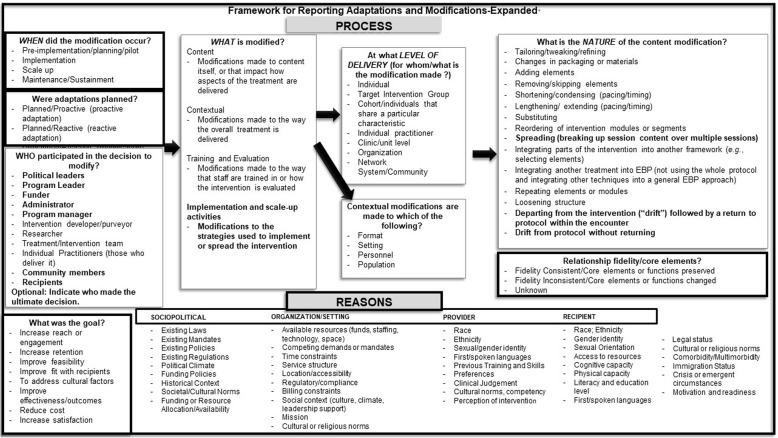
BACKGROUND: This paper describes the process and results of a refinement of a framework to characterize modifications to interventions. The original version did not fully capture several aspects of modification and adaptation that may be important to document and report. Additionally, the earlier framework did not include a way to differentiate cultural adaptation from adaptations made for other reasons. Reporting additional elements will allow for a more precise understanding of modifications, the process of modifying or adapting, and the relationship between different forms of modification and subsequent health and implementation outcomes. DISCUSSION: We employed a multifaceted approach to develop the updated FRAME involving coding documents identified through a literature review, rapid coding of qualitative interviews, and a refinement process informed by multiple stakeholders. The updated FRAME expands upon Stirman et al.'s original framework by adding components of modification to report: (1) when and how in the implementation process the modification was made, (2) whether the modification was planned/proactive (i.e., an adaptation) or unplanned/reactive, (3) who determined that the modification should be made, (4) what is modified, (5) at what level of delivery the modification is made, (6) type or nature of context or content-level modifications, (7) the extent to which the modification is fidelity-consistent, and (8) the reasons for the modification, including (a) the intent or goal of the modification (e.g., to reduce costs) and (b) contextual factors that influenced the decision. Methods of using the framework to assess modifications are outlined, along with their strengths and weaknesses, and considerations for research to validate these measurement strategies. CONCLUSION: The updated FRAME includes consideration of when and how modifications occurred, whether it was planned or unplanned, relationship to fidelity, and reasons and goals for modification. This tool that can be used to support research on the timing, nature, goals and reasons for, and impact of modifications to evidence-based interventions.
Overview
CoChat Summary
TL;DR
This paper refines the FRAME (Framework for Reporting Adaptations and Modifications-Enhanced) to better document how, when, why, and by whom evidence-based interventions are modified. It expands the original framework to capture planned vs. unplanned changes, timing across implementation phases, fidelity consistency, and cultural and contextual reasons for modification.
Key findings
- The updated FRAME adds 8 reporting aspects: timing in the implementation process, planned/proactive vs. unplanned/reactive, who decided, what was modified, level of delivery, type/nature of modifications, fidelity consistency, and reasons/goals for modification.
- The authors’ refinement process used multiple data sources: coding literature identified through a review, rapid coding of qualitative interviews with 55 mental health providers and administrators, and stakeholder feedback.
- The literature review process examined a total of 170 individual articles describing adaptations to interventions, with a “stop rule” that halted article review after no new aspects were found in 10 original sources from each additional systematic review.
- The paper explicitly adds cultural adaptation as a distinct reason for modification and specifies goals such as improving feasibility, acceptability, reach/engagement, fit, reducing costs, improving clinical outcomes, or aligning with cultural values, norms, or priorities.
Methods
- Pragmatic, multifaceted framework refinement combining literature review, qualitative interview data, and stakeholder consultation.
- Literature review and snowballing of published frameworks, reviews, and articles on adaptations/modifications; qualitative rapid coding of interview responses from 55 providers/administrators.
- Data from both sources were consolidated, collapsed into subcategories by consensus among the three authors, and then presented to stakeholder groups for further refinement.
Limitations
- The paper states it did not use a systematic review or traditional thematic analysis; it says these approaches did not align with the project goals.
- The authors note that comprehensively cataloging modifications may be difficult in some contexts, especially when an intervention has not been exhaustively described and tested; this is a limitation of applying FRAME in practice, not of the paper’s own analysis.
- The paper also says the feasibility of using a comprehensive framework will vary across research and applied settings, and that further evaluation of different ways to use FRAME is needed.
Model-written summary. Check it against the paper before relying on it.
Integrity signals
Registry
Cites
Statistics
Figures
Verification
Claims the paper makes
20 Valid · 4 Not valid · 4 Not checked · 42 Own results and interpretations
Some cited sources support this claim and some don’t — read each source’s verdict below.
In the paper
“Further, we recognized that other aspects of reporting that may be important for improving understanding of modification and its impact, such as when in the implementation process the modification was made, were also not included [28–31].”
§ The FRAME: an expanded framework for reporting adaptations and modifications to evidence-based interventions > Background
What the sources say
- Disputedcites [28] Rabin B, McCreight M, Glasgow R, editors. Systematic multi-method documentation of adaptations in five health system interventions. Implementation Sci 2018;13. sourceExperimental — accuracy not yet measured
The Methods > Adaptation Framework section says the original Stirman framework was expanded to include when adaptations were made. But the framework presented in this cited paper itself includes a WHEN category for the stage of the project at which an adaptation occurred. Thus, this source does not support the claim that this aspect was absent from the prior frameworks cited; it documents one that included it. (LLM, conf=0.87)
Checked by a reasoning model — may be wrong.
- Partly supportedcites [29] Escoffery C Lebow-Skelley E Udelson H Böing EA Wood R Fernandez ME A scoping study of frameworks for adapting public health evidence-based interventions Transl Behav Med 2018 9 1 1 10 PMC6305563 29346635 sourceExperimental — accuracy not yet measured
The Discussion (Implications for future research; page unavailable) says adaptations should be documented to better understand their impact and calls for reporting guidelines. But the paper does not establish that the reviewed frameworks omitted reporting when, during implementation, a modification was made; its Introduction notes that a taxonomy of adaptation timing had been developed. (LLM, conf=0.80)
- Could not verifycites [30] Brown CH Curran G Palinkas LA Aarons GA Wells KB Jones L An overview of research and evaluation designs for dissemination and implementation Annu Rev Public Health 2017 38 1 22 28384085 PMC5384265 sourceExperimental — accuracy not yet measured
The Introduction (page unavailable) describes adaptations during preparation and implementation, and the Between-Site Designs section describes changing an implementation strategy if it fails. Neither passage addresses whether prior frameworks included reporting when a modification was made. Searches for modification timing and reporting found no passage that settles that claim. (LLM, conf=0.69)
- Could not verifycites [31] Ramsay JE, Janevic MR, Hogan CK, Edwards DL, Connell CM. Using the replicating effective programs framework to adapt a heart health intervention. Health Promot Pract. 2018. PMC6476690 29759012 sourceExperimental — accuracy not yet measured
The Background says adaptation processes are often poorly documented, and the Discussion (REP Framework: Limitations) says REP lacks explicit options for making certain modifications. Neither passage says prior frameworks omitted reporting when in implementation a modification was made; searches for that timing and reporting point found no such statement. (LLM, conf=0.72)
hedged- Asserted: passes — The authors put it forward as true.
- Checkable: passes — It can be checked against evidence.
- Load-bearing: passes — The paper’s conclusions depend on it.
- Based: passes — The paper gives a reason why it holds.
- Disputed
Every source the paper cites for this claim was checked and supports it.
In the paper
“Stirman and colleagues previously developed a Framework for Modification and Adaptations [16].”
§ The FRAME: an expanded framework for reporting adaptations and modifications to evidence-based interventions > Background
What the sources say
- Supportedcites [16] Stirman SW Miller CJ Toder K Calloway A Development of a framework and coding system for modifications and adaptations of evidence-based interventions Implementation Sci. 2013 8 65 PMC3686699 23758995 source
The paper’s Abstract (Methods) says the authors developed a system for classifying modifications to interventions, and the Background describes the intended framework. This supports identifying the work as the framework developed by Stirman and colleagues. (LLM, conf=0.94)
plain- Asserted: passes — The authors put it forward as true.
- Checkable: passes — It can be checked against evidence.
- Load-bearing: passes — The paper’s conclusions depend on it.
- Based: passes — The paper gives a reason why it holds.
- Supported
The cited sources support only part of this claim — read each source’s verdict below.
In the paper
“Without understanding forms of modification that occur, the systematic evaluation of processes and strategies that lead to more and less successful implementation may be hindered [2, 17–19].”
§ The FRAME: an expanded framework for reporting adaptations and modifications to evidence-based interventions > Background
What the sources say
- Supportedcites [2] Stirman SW Gutner C Edmunds J Evans AC Beidas R Relationships between clinician-level attributes and fidelity-consistent and fidelity-inconsistent modifications to an evidence-based psychotherapy Implementation Sci. 2015 10 1 115 PMC4534152 26268633 source
The Discussion says it is important to differentiate types of modifications and that measuring them and monitoring outcomes are necessary to understand their impact. The paper also links identifying factors associated with modifications to understanding how to improve evidence-based treatment delivery. This supports the citing sentence’s hedged point about evaluating implementation strategies. (LLM, conf=0.88)
- Supportedcites [17] Baumann AA Powell BJ Kohl PL Tabak RG Penalba V Proctor EK Cultural adaptation and implementation of evidence-based parent-training: a systematic review and critique of guiding evidence Child Youth Serv Rev 2015 53 113 120 25960585 PMC4419735 source
The Discussion (page unavailable) calls for documenting what was adapted and how, and says that identifying the diversity of adaptations helps researchers examine intervention impact. The Implementation section (page unavailable) says frameworks enable systematic evaluation and that evaluating outcomes helps identify which implementation strategies work best. Together, these passages support the claim's hedged point that failing to understand modifications may hinder such evaluation. (LLM, conf=0.86)
- Not checked — no full text of the sourcecites [18] Glasziou P Altman DG Bossuyt P Boutron I Clarke M Julious S Reducing waste from incomplete or unusable reports of biomedical research Lancet. 2014 383 9913 267 276 24411647 source
- Partly supportedcites [19] Baumann AA Domenech Rodríguez MM Amador NG Forgatch MS Parra-Cardona JR Parent management training-Oregon model (PMTO™) in Mexico City: integrating cultural adaptation activities in an implementation model Clin Psychol: Sci and Pract. 2014 21 1 32 47 PMC4457334 26052184 sourceExperimental — accuracy not yet measured
In “Implementation and Cultural Adaptation” (page unavailable), the paper says most implementation frameworks do not make adaptation explicit and calls for adaptation to be planned and evaluated throughout implementation. The Discussion (page unavailable) also stresses documenting adaptations so researchers can evaluate them. It does not explicitly say that failing to understand forms of modification hinders systematic comparison of strategies leading to more versus less successful implementation. (LLM, conf=0.78)
hedgedstates a possible cause- Asserted: passes — The authors put it forward as true.
- Checkable: passes — It can be checked against evidence.
- Load-bearing: passes — The paper’s conclusions depend on it.
- Based: passes — The paper gives a reason why it holds.
- Supported
The cited sources support only part of this claim — read each source’s verdict below.
In the paper
“The process, nature, and outcomes of modifications to evidence-based programs/practices (EBPs) have often not been well documented, despite considerable recent interest in the field of implementation science [5, 6].”
§ The FRAME: an expanded framework for reporting adaptations and modifications to evidence-based interventions > Background
What the sources say
- Partly supportedcites [5] von Thiele Schwarz U Förberg U Sundell K Hasson H Colliding ideals–an interview study of how intervention researchers address adherence and adaptations in replication studies BMC Med Res Methodol 2018 18 1 36 29739337 PMC5941334 sourceExperimental — accuracy not yet measured
The Background (page unavailable) says interventions are seldom described well enough to determine adaptations, and the Discussion says many adaptations are left out of journal reports. This supports the claim about poor documentation of modifications, but the paper does not establish that their outcomes are often poorly documented or explicitly characterize the degree of recent interest across implementation science. (LLM, conf=0.83)
- Not checked — no full text of the sourcecites [6] Sundell K Beelmann A Hasson H von Thiele Schwarz U Novel programs, international adoptions, or contextual adaptations? Meta-analytical results from German and Swedish intervention research J Clin Child Adolesc Psychol 2016 45 6 784 796 25864716 source
plain- Asserted: passes — The authors put it forward as true.
- Checkable: passes — It can be checked against evidence.
- Load-bearing: passes — The paper’s conclusions depend on it.
- Based: passes — The paper gives a reason why it holds.
- Partly supported
The cited sources support only part of this claim — read each source’s verdict below.
In the paper
“In fact, modifications that focus on increasing the fit of the EBPs with the target population can lead to improved engagement, acceptability, and clinical outcomes, particularly when working with minority populations [8–10].”
§ The FRAME: an expanded framework for reporting adaptations and modifications to evidence-based interventions > Background
What the sources say
- Not checked — no full text of the sourcecites [8] Steinka-Fry KT Tanner-Smith EE Dakof GA Henderson C Culturally sensitive substance use treatment for racial/ethnic minority youth: a meta-analytic review J Subst Abus Treat 2017 75 22 37 28237051 source
- Partly supportedcites [9] Rathod S Gega L Degnan A Pikard J Khan T Husain N The current status of culturally adapted mental health interventions: a practice-focused review of meta-analyses Neuropsychiatr Dis Treat 2018 14 165 178 29379289 PMC5757988 sourceExperimental — accuracy not yet measured
The Results (Cultural factors as moderators of effect of adapted interventions; page unavailable) report that some culturally adapted interventions had greater clinical effects, including when adaptations addressed patients’ cultural values and beliefs. The Introduction links a lack of cultural adaptation to poor uptake among minority populations. The paper does not establish improved acceptability or directly show improved engagement from these modifications, and its Conclusion says the effective components and populations remain uncertain. (LLM, conf=0.84)
- Not checked — no full text of the sourcecites [10] Bernal GE, Domenech Rodríguez MM. Cultural adaptations: tools for evidence-based practice with diverse populations: American Psychological Association; 2012. source
plainstates a cause- Asserted: passes — The authors put it forward as true.
- Checkable: passes — It can be checked against evidence.
- Load-bearing: unclear — It is unclear whether the paper’s conclusions depend on it.
- Based: passes — The paper gives a reason why it holds.
11 more claims · 6 with their cited sources checked
Create a free account to see all 70 claims and to verify the 3 references still open.
- It may state two separate claims as one. 26
- Probably not a substantial claim. 45
Claims other papers make about this one
Each is checked against this paper’s own text: does it say what the citing paper says it does?
The cited source says what the claim attributes to it.
In the citing paper
“Published guidance highlights the importance of Adapting the innovation [76], and the updated CFIR notes the importance of adapting the setting as well [77].”
From The updated consolidated framework for implementation research based on user feedback (2022) · cites this paper as [76]
The cited source says what the claim attributes to it.
In the citing paper
“Retrospective in nature, this study provides guidance in evaluating the implementation of a newborn care package but is limited in providing more in-depth instruction on systematic detail on modifications and adaptations to tailor interventions for this setting (79–81).”
The cited source says what the claim attributes to it.
In the citing paper
“Interviews will capture any adaptations to the ICU-PAUSE tool based on the FRAME method, such as the timing, participants, and nature of each modification [20].”
From Improving Communication in Intensive Care Unit to Ward Transitions: Protocol for Multisite National Implementation of the ICU-PAUSE Handoff Tool (2023) · cites this paper as [20]
The cited source says what the claim attributes to it.
In the citing paper
“Adaptations will be noted and codified using the Framework for Reporting Adaptations and Modifications-Expanded (FRAME) method of tracking adaptations in our postimplementation interviews [20].”
From Improving Communication in Intensive Care Unit to Ward Transitions: Protocol for Multisite National Implementation of the ICU-PAUSE Handoff Tool (2023) · cites this paper as [20]
Citations
Cites
Damschroder, L. J., Aron, D. C., Keith, R. E., Kirsh, S. R., Alexander, J. A., & Lowery, J. C. (2009) · Implementation Science · doi:10.1186/1748-5908-4-50 · Cited by 14,496
The social determinants of health: It’s time to consider the causes of the causes
Braveman, P., & Gottlieb, L. (2014) · Public Health Reports® · doi:10.1177/00333549141291s206 · Cited by 3,861
Advancing a Conceptual Model of Evidence-Based Practice Implementation in Public Service Sectors
Aarons, G. A., Hurlburt, M., & Horwitz, S. M. (2011) · Administration and Policy in Mental Health and Mental Health Services Research · doi:10.1007/s10488-010-0327-7 · Cited by 3,240
Implementation strategies: recommendations for specifying and reporting
Proctor, E. K., Powell, B. J., & McMillen, J. C. (2013) · Implementation Science · doi:10.1186/1748-5908-8-139 · Cited by 2,585
The dynamic sustainability framework: addressing the paradox of sustainment amid ongoing change
Chambers, D. A., Glasgow, R. E., & Stange, K. C. (2013) · Implementation Science · doi:10.1186/1748-5908-8-117 · Cited by 1,724
Wiltsey Stirman, S., Kimberly, J., Cook, N., Calloway, A., Castro, F., & Charns, M. (2012) · Implementation Science · doi:10.1186/1748-5908-7-17 · Cited by 1,355
Reducing waste from incomplete or unusable reports of biomedical research
Glasziou, P., Altman, D. G., Bossuyt, P., Boutron, I., Clarke, M., Julious, S., Michie, S., Moher, D., & Wager, E. (2014) · The Lancet · doi:10.1016/s0140-6736(13)62228-x · Cited by 1,319
The Cultural Adaptation of Prevention Interventions: Resolving Tensions Between Fidelity and Fit
Castro, F. G., Barrera, M., & Martinez, C. R. (2004) · Prevention Science · doi:10.1023/b:prev.0000013980.12412.cd · Cited by 1,228
Bernal, G., Bonilla, J., & Bellido, C. (1995) · Journal of Abnormal Child Psychology · doi:10.1007/bf01447045 · Cited by 1,120
The Sustainability of Evidence-Based Interventions and Practices in Public Health and Health Care
Shelton, R. C., Cooper, B. R., & Stirman, S. W. (2018) · Annual Review of Public Health · doi:10.1146/annurev-publhealth-040617-014731 · Cited by 806
Self-citation
Research works printed but not linked: 2
- Rabin B, McCreight M, Glasgow R, editors. Systematic multi-method documentation of adaptations in five health system interventions. Implementation Sci 2018;13. · DOI · Paper page
- Rogers EM. Diffusion of innovations: New York The Free Press, A Division of Simon & Schuster, Inc; 2010.
Cited by
The updated consolidated framework for implementation research based on user feedback
Damschroder, L. J., Reardon, C. M., Widerquist, M. A. O., & Lowery, J. (2022) · Implementation Science · doi:10.1186/s13012-022-01245-0 · Cited by 4,452
“Published guidance highlights the importance of Adapting the innovation [76], and the updated CFIR notes the importance of adapting the setting as well [77].”
BackgroundDamschroder, L. J., Reardon, C. M., Opra Widerquist, M. A., & Lowery, J. (2022) · Implementation Science · doi:10.1186/s13012-021-01181-5 · Cited by 784
“In a critique by Ilot et al. they recognized that when EBIs are not sustained, the result is a “waste of time, financial resources and leadership effort at a time of economic austerity” [18].”
BackgroundInfluentialAdapting interventions to new contexts—The ADAPT guidance
Moore, G., Campbell, M., Copeland, L., Craig, P., Movsisyan, A., Hoddinott, P., Littlecott, H., O’Cathain, A., Pfadenhauer, L., Rehfuess, E., et al. (2021) · BMJ · doi:10.1136/bmj.n1679 · Cited by 511
The FRAME-IS: a framework for documenting modifications to implementation strategies in healthcare
Miller, C. J., Barnett, M. L., Baumann, A. A., Gutner, C. A., & Wiltsey-Stirman, S. (2021) · Implementation Science · doi:10.1186/s13012-021-01105-3 · Cited by 490
“The FRAME-IS is based on the FRAME, the development of which is described in detail elsewhere [10, 26] Briefly, the FRAME is a framework for tracking modifications to EBPs focused on what to adapt, alongside a related adaptation framework blending the content and processes of adaptation [27, 28].”
BackgroundMethodInfluentialSelf-citationReframing implementation science to address inequities in healthcare delivery
Baumann, A. A., & Cabassa, L. J. (2020) · BMC Health Services Research · doi:10.1186/s12913-020-4975-3 · Cited by 461
Self-citationShelton, R. C., Chambers, D. A., & Glasgow, R. E. (2020) · Frontiers in Public Health · doi:10.3389/fpubh.2020.00134 · Cited by 448
“Investigators also increasingly recognize the need for a dynamic conceptualization of sustainability, in light of complex “real-world” contexts in which EBIs are delivered that require responsiveness, capacity building, and adaptation of EBIs (10, 11, 16).”
BackgroundClarity out of chaos: Use of theory in implementation research
Damschroder, L. J. (2020) · Psychiatry Research · doi:10.1016/j.psychres.2019.06.036 · Cited by 422
Movsisyan, A., Arnold, L., Evans, R., Hallingberg, B., Moore, G., O’Cathain, A., Pfadenhauer, L. M., Segrott, J., & Rehfuess, E. (2019) · Implementation Science · doi:10.1186/s13012-019-0956-5 · Cited by 331
Stover, A. M., Haverman, L., van Oers, H. A., Greenhalgh, J., Potter, C. M., On behalf of the ISOQOL PROMs/PREMs in Clinical Practice Implementation Science Work Group, Ahmed, S., Greenhalgh, J., Gibbons, E., Haverman, L., et al. (2021) · Quality of Life Research · doi:10.1007/s11136-020-02564-9 · Cited by 308
Kirk, M. A., Moore, J. E., Wiltsey Stirman, S., & Birken, S. A. (2020) · Implementation Science · doi:10.1186/s13012-020-01021-y · Cited by 254
Self-citationRevisiting concepts of evidence in implementation science
Brownson, R. C., Shelton, R. C., Geng, E. H., & Glasgow, R. E. (2022) · Implementation Science · doi:10.1186/s13012-022-01201-y · Cited by 201
Lyon, A. R., Munson, S. A., Renn, B. N., Atkins, D. C., Pullmann, M. D., Friedman, E., & Areán, P. A. (2019) · JMIR Research Protocols · doi:10.2196/14990 · Cited by 187
Spanhel, K., Balci, S., Feldhahn, F., Bengel, J., Baumeister, H., & Sander, L. B. (2021) · npj Digital Medicine · doi:10.1038/s41746-021-00498-1 · Cited by 178
Dopp, A. R., Parisi, K. E., Munson, S. A., & Lyon, A. R. (2020) · Implementation Science Communications · doi:10.1186/s43058-020-00020-w · Cited by 169
Miller, C. J., Wiltsey‐Stirman, S., & Baumann, A. A. (2020) · Journal of Community Psychology · doi:10.1002/jcop.22279 · Cited by 138
“A framework for cataloguing adaptations was recently developed, entitled the Framework for Reporting Adaptations and Modifications – Expanded (Wiltsey-Stirman et al., 2019), itself based on earlier work (Stirman, Miller, Toder, & Calloway, 2013).”
BackgroundMethodSelf-citationShelton, R. C., Lee, M., Brotzman, L., Wolfenden, L., Nathan, N., & Wainberg, M. L. (2020) · International Journal of Behavioral Medicine · doi:10.1007/s12529-020-09848-x · Cited by 163
“, content, contextual), reasons for modifications, and studying how such adaptations improve or detract from the effectiveness of an EBI, as well as their relationship with D&I outcomes [97, 98].”
BackgroundMethodPerera, C., Salamanca-Sanabria, A., Caballero-Bernal, J., Feldman, L., Hansen, M., Bird, M., Hansen, P., Dinesen, C., Wiedemann, N., & Vallières, F. (2020) · Conflict and Health · doi:10.1186/s13031-020-00290-0 · Cited by 165
“Furthermore, it is important to document the adaptation process to monitor changes that may affect fidelity [60].”
Backgroundvon Thiele Schwarz, U., Aarons, G. A., & Hasson, H. (2019) · BMC Health Services Research · doi:10.1186/s12913-019-4668-y · Cited by 134
Wang, D. Y., Wong, E. L., Nilsén, P., Chung, V. C., Tian, Y., & Yeoh, E. (2023) · Implementation Science · doi:10.1186/s13012-023-01296-x · Cited by 175
Glasgow, R. E., Battaglia, C., McCreight, M., Ayele, R. A., & Rabin, B. A. (2020) · Frontiers in Public Health · doi:10.3389/fpubh.2020.00194 · Cited by 121
“It is also well-documented that context also changes over time (28, 29), that adaptations occur with or without guidance and in ways that are either intervention congruent or not (27, 30), and that sustainment of outcomes almost always requires adaptations (31).”
BackgroundMethodInfluentialThe Lancet Psychiatry Commission: transforming mental health implementation research
McGinty, E. E., Alegria, M. M., Beidas, R. S., Braithwaite, J., Kola, L., LESLIE, D. L., Moise, N., Mueller, B., Pincus, H. A., Shidhaye, R. R., et al. (2024) · The Lancet Psychiatry · doi:10.1016/s2215-0366(24)00040-3 · Cited by 148
The Importance of Mental Models in Implementation Science
Holtrop, J. S., Scherer, L. D., Matlock, D. D., Glasgow, R. E., & Green, L. A. (2021) · Frontiers in Public Health · doi:10.3389/fpubh.2021.680316 · Cited by 138
“Figure 3 does not completely address the issue of adaptation explicitly; however, we acknowledge that mental model issues often are part of adaptations as learning occurs through development (56).”
BackgroundRabin, B. A., Cakici, J. A., Golden, C. A., Estabrooks, P. A., Glasgow, R. E., & Gaglio, B. (2022) · Implementation Science · doi:10.1186/s13012-022-01234-3 · Cited by 129
Reilly, K. L., Kennedy, S., Porter, G., & Estabrooks, P. (2020) · Frontiers in Public Health · doi:10.3389/fpubh.2020.00430 · Cited by 102
Miller, C. J., Adjognon, O. L., Brady, J. E., Dichter, M. E., & Iverson, K. M. (2021) · Implementation Research and Practice · doi:10.1177/26334895211039894 · Cited by 138
“referred to as “drift” in the sustainability literature) (Stirman et al., 2019).”
BackgroundSelf-citationHurwitz, S., Garman‐McClaine, B., & Carlock, K. (2021) · Autism · doi:10.1177/13623613211035935 · Cited by 132
Gertner, A. K., Franklin, J., Roth, I., Cruden, G., Haley, A. D., Finley, E. P., Hamilton, A. B., Palinkas, L. A., & Powell, B. J. (2021) · Implementation Research and Practice · doi:10.1177/2633489521992743 · Cited by 114
“…that collaborative approaches to ethnography may be especially valuable for studying adaptations to interventions and implementation strategies (Stirman et al., 2019), “mechanisms” by which implementation strategies succeed or fail (Lewis et al., 2018, 2020; Powell et al., 2019; Zuckerman et…”
Advancing healthcare equity through dissemination and implementation science
Baumann, A. A., Shelton, R. C., Kumanyika, S., & Haire-Joshu, D. L. (2023) · Health Services Research · doi:10.1111/1475-6773.14175 · Cited by 116
“81 Adaptation is central to achieving equity as an “ ongoing process of assessing needs, correcting historical inequities, and creating conditions for optimal outcomes by members of all social identity groups.”
BackgroundSelf-citationMovsisyan, A., Arnold, L., Copeland, L., Evans, R., Littlecott, H., Moore, G., O’Cathain, A., Pfadenhauer, L., Segrott, J., & Rehfuess, E. (2021) · Health Research Policy and Systems · doi:10.1186/s12961-020-00668-9 · Cited by 79
Sangraula, M., Kohrt, B. A., Ghimire, R., Shrestha, P., Luitel, N. P., van’t Hof, E., Dawson, K., & Jordans, M. J. D. (2021) · Global Mental Health · doi:10.1017/gmh.2021.5 · Cited by 78
“We created a matrix before the start of the adaptation process based on the FRAME approach for documentation (Wiltsey Stirman et al., 2019): (1) the eight broad dimensions from EVM, (2) implementation strategy (what exactly should be changed in the intervention material), (3) rationale for change…”
MethodNooraie, R. Y., Kwan, B. M., Cohn, E. G., AuYoung, M., Roberts, M. C., Adsul, P., & Shelton, R. C. (2020) · Journal of Clinical and Translational Science · doi:10.1017/cts.2020.10 · Cited by 75
“For example, the Framework for Reporting Adaptations and ModificationsEnhanced has been refined [27] to provide more context around cultural adaptations and modifications to EBIs, including who was involved in making the decisions for modifications (e.”
MethodDay, S., Laver, K., Jeon, Y., Radford, K. A., & Low, L. (2023) · Dementia · doi:10.1177/14713012231192360 · Cited by 93
“FRAME was developed to support the systematic reporting of modi fi cations to evidence-based interventions during intervention adaptation or implementation (Stirman et al., 2013; Wiltsey Stirman et al., 2019).”
BackgroundMethodImplementing Improvements: Opportunities to Integrate Quality Improvement and Implementation Science
Tyler, A. N., & Glasgow, R. E. (2021) · Hospital Pediatrics · doi:10.1542/hpeds.2020-002246 · Cited by 76
Grounding implementation science in health equity for cancer prevention and control
Adsul, P., Chambers, D., Brandt, H. M., Fernández, M. E., Ramanadhan, S., Torres, E., Leeman, J., Baquero, B. I., Fleisher, L. G., Escoffery, C., et al. (2022) · Implementation Science Communications · doi:10.1186/s43058-022-00311-4 · Cited by 72
Lyon, A. R., Koerner, K., & Chung, J. (2020) · Implementation Research and Practice · doi:10.1177/2633489520932924 · Cited by 73
“Extant frameworks tend to describe or document modifications (Rabin et al., 2018; Stirman et al., 2019), but no methods exist to assess intraintervention implementation determinants or to inform prospective adaptation.”
BackgroundRocque, G. B., Dent, D. N., Ingram, S. A., Caston, N. E., Thigpen, H. B., Lalor, F. R., Jamy, O. H., Giri, S., Azuero, A., Young Pierce, J., et al. (2022) · JCO Oncology Practice · doi:10.1200/op.22.00360 · Cited by 62
Woodside, J. V., Young, I. S., & McKinley, M. C. (2022) · British Journal Of Nutrition · doi:10.1017/s0007114522001945 · Cited by 90
Rhodes, E., Damio, G., LaPlant, H. W., Trymbulak, W., Crummett, C., Surprenant, R., & Pérez‐Escamilla, R. (2021) · International Journal for Equity in Health · doi:10.1186/s12939-021-01408-3 · Cited by 85
“continuous community input: The BHP approach of co-designing programming and ensuring the fit of the intervention with the community’s needs and contexts may improve community engagement, acceptability of programming, and clinical outcomes [40].”
BackgroundParker, L. J., Marx, K. A., Nkimbeng, M., Johnson, E., Koeuth, S., Gaugler, J. E., & Gitlin, L. N. (2023) · The Gerontologist · doi:10.1093/geront/gnac120 · Cited by 60
Strengthening methods for tracking adaptations and modifications to implementation strategies
Haley, A. D., Powell, B. J., Walsh‐Bailey, C., Krancari, M., Gruß, I., Shea, C. M., Bunce, A., Marino, M., Frerichs, L., Lich, K. H., et al. (2021) · BMC Medical Research Methodology · doi:10.1186/s12874-021-01326-6 · Cited by 69
“” Modification encompasses a broad range of changes to strategies including adaptations, additions, and unanticipated, iterative changes that emerged naturally throughout the implementation process [20].”
BackgroundMethodInfluentialBreathett, K. K., Lewsey, S. C., Brownell, N. K., Enright, K. J., Evangelista, L. S., Ibrahim, N. E., Iturrizaga, J. C., Matlock, D. D., Ogunniyi, M. O., Sterling, M. R., et al. (2024) · Circulation · doi:10.1161/cir.0000000000001231 · Cited by 67
“39 Implementation strategies for health equity must address social determinants of health, that is, the nonclinical factors influencing health outcomes.”
BackgroundChlebowski, C., Hurwich‐Reiss, E., Wright, B., & Brookman-Frazee, L. I. (2019) · Journal of Community Psychology · doi:10.1002/jcop.22296 · Cited by 66
Hunt, K., Wyke, S., Bunn, C., Donnachie, C., Reid, N., & Gray, C. M. (2020) · International Journal of Environmental Research and Public Health · doi:10.3390/ijerph17020584 · Cited by 62
Zielinski, M. J., Allison, M. K., Brinkley‐Rubinstein, L., Curran, G. M., Zaller, N. D., & Kirchner, J. A. E. (2020) · Health & Justice · doi:10.1186/s40352-020-00122-6 · Cited by 56
Strategies to adapt and implement health system guidelines and recommendations: a scoping review
Breneol, S., Curran, J., Marten, R., Minocha, K., Johnson, C., Wong, H., Langlois, É. V., Wozney, L., Vélez, C. M., Cassidy, C. E., et al. (2022) · Health Research Policy and Systems · doi:10.1186/s12961-022-00865-8 · Cited by 78
From spreading to embedding innovation in health care: Implications for theory and practice
Scarbrough, H., & Kyratsis, Y. (2021) · Health Care Management Review · doi:10.1097/hmr.0000000000000323 · Cited by 71
“Adapting—intentionally modifying the innovation to improve its effectiveness—has been widely highlighted within the implementation perspective as an important ingredient in achieving successful outcomes (Stirman et al., 2019).”
BackgroundInfluentialMielke, J., Leppla, L., Valenta, S., Zullig, L. L., Zúñiga, F., Staudacher, S., Teynor, A., & Geest, S. D. (2022) · Implementation Science Communications · doi:10.1186/s43058-022-00354-7 · Cited by 56
Implementation Reporting Recommendations for School-Based Mindfulness Programs
Baelen, R. N., Gould, L. F., Felver, J. C., Schussler, D. L., & Greenberg, M. T. (2022) · Mindfulness · doi:10.1007/s12671-022-01997-2 · Cited by 56
“Moving forward, documenting adaptations can allow for testing their relationship to integrity and competence, as well as provide a better understanding of QOI and program effectiveness (Stirman et al., 2019).”
BackgroundEsmail, L. C., Barasky, R. J., Mittman, B. S., & Hickam, D. H. (2020) · Journal of General Internal Medicine · doi:10.1007/s11606-020-06093-6 · Cited by 59
Advancing Health Equity Efforts to Reduce Obesity: Changing the Course
Kumanyika, S. (2022) · Annual Review of Nutrition · doi:10.1146/annurev-nutr-092021-050805 · Cited by 59
Guerin, R. J., Glasgow, R. E., Tyler, A. N., Rabin, B. A., & Huebschmann, A. G. (2022) · Safety Science · doi:10.1016/j.ssci.2022.105763 · Cited by 63
“A current area for exploration in D & I science includes using systematic frameworks (e.g., Stirman et al., 2019; Stirman et al., 2013) to plan for, capture and characterize adaptations of implementation strategies and/or interventions during the implementation process (Escoff-ery et al., 2019;…”
MethodPyatak, E. A., Carandang, K. M., Collins, C. R., & Carlson, M. E. (2022) · American Journal of Occupational Therapy · doi:10.5014/ajot.2022.049269 · Cited by 70
Chambers, D. (2023) · Frontiers in Health Services · doi:10.3389/frhs.2023.1204138 · Cited by 59
“Through conceptual advances like the Dynamic Adaptation Process (2), several iterations of the Framework for Reporting Adaptations and Modifications to Evidence-based Interventions (FRAME) (3, 4), and systematic reviews of adaptation research (5, 6), we have seen new recognition of the complexity and nuance of improvi…”
MethodMerle, J. L., Thayer, A. J., Larson, M. F., Pauling, S., Cook, C. R., Rios, J. A., McGinnis, J. L., & Sullivan, M. M. (2021) · Journal of School Psychology · doi:10.1016/j.jsp.2021.11.005 · Cited by 63
A pilot study comparing tools for tracking implementation strategies and treatment adaptations
Walsh‐Bailey, C., Palazzo, L. G., Jones, S. M. W., Mettert, K. D., Powell, B. J., Stirman, S. W., Lyon, A. R., Rohde, P., & Lewis, C. C. (2021) · Implementation Research and Practice · doi:10.1177/26334895211016028 · Cited by 50
“Although adapting treatment is considered one of 73 + implementation strategies(11), a 2013 review of treatment adaptations (12) and a resulting framework illustrates a host of complexities that would not be captured by these two existing methods (13).”
BackgroundMethodInfluentialSelf-citationTrinkley, K. E., Ho, P. M., Glasgow, R. E., & Huebschmann, A. G. (2022) · Academic Medicine · doi:10.1097/acm.0000000000004801 · Cited by 48
Lopez, C. J., Edwards, B., Langelier, D. M., Chang, E. K., Chafranskaia, A., & Jones, J. M. (2021) · Archives of Physical Medicine and Rehabilitation · doi:10.1016/j.apmr.2021.02.002 · Cited by 42
Sun, L., Booth, A., & Sworn, K. (2024) · Implementation Science · doi:10.1186/s13012-024-01375-7 · Cited by 42
“These factors, including religion [58], ethics [39, 56], legislation [30, 35, 39, 44, 54, 58, 59, 64], norms or regulations [7, 21, 35, 38, 49, 54, 56, 58], and policies [6, 7, 9, 21, 35, 37–39, 44, 50, 51, 54, 56, 57, 59], play a critical role in shaping health outcomes and addressing health-care…”
BackgroundInfluentialAlio, A. P., Dillion, T., Hartman, S. G., Johnson, T., Turner, S., Bullock, S., & Dozier, A. M. (2022) · Maternal and Child Health Journal · doi:10.1007/s10995-022-03422-5 · Cited by 57
Implementation of Parenting Programs in Real-World Community Settings: A Scoping Review
Pinto, R., Canário, C., Leijten, P. H. O., López, M. J. R., & Cruz, O. (2023) · Clinical Child and Family Psychology Review · doi:10.1007/s10567-023-00465-0 · Cited by 61
“Despite an increasing amount of literature recognizing that program adaptation is inevitable (Chambers & Norton, 2016; Dur-lak, 2015; Wiltsey Stirman et al., 2019), our knowledge about what, how, and when adaptations occur and how practitioners balance them with fidelity during the implementation…”
Lyon, A. R., Connors, E. H., Lawson, G. M., Nadeem, E., & Owens, J. S. (2024) · School Mental Health · doi:10.1007/s12310-024-09731-0 · Cited by 60
“While implementation of EBP in schools has the potential to support equity, all implementation processes carry risks of maintaining or inadvertently exacerbating inequities (Liu et al., 2019), which necessitates attention.”
InfluentialAifah, A. A., Okeke, N. L., Rentrope, C. R., Schexnayder, J. K., Bloomfield, G. S., Bosworth, H. B., Grover, K. K., Hileman, C. O., Muiruri, C., Oakes, M. M., et al. (2020) · Progress in Cardiovascular Diseases · doi:10.1016/j.pcad.2020.02.013 · Cited by 47
Methods for capturing and analyzing adaptations: implications for implementation research
Holtrop, J. S., Gurfinkel, D., Nederveld, A., Phimphasone‐Brady, P., Hosokawa, P. W., Rubinson, C., Waxmonsky, J. A., & Kwan, B. M. (2022) · Implementation Science · doi:10.1186/s13012-022-01218-3 · Cited by 48
Community health promotion programs for older adults: What helps and hinders implementation
Sims‐Gould, J., Franke, T., Lusina‐Furst, S., & McKay, H. A. (2019) · Health Science Reports · doi:10.1002/hsr2.144 · Cited by 60
“Adaptation to context is critical to effective implementation at scale-up.(41,42) Community-based organizations can struggle to find personnel”
BackgroundStanton, M. C., Ali, S., & the SUSTAIN Center Team (2022) · Implementation Research and Practice · doi:10.1177/26334895211064250 · Cited by 50
“…adaptation, or the process of modifying an evidence-based intervention to better fi t participant ’ s experiences, needs, and preferences based on culture and/or locality (Stirman et al., 2019), while maintaining theoretical congruence to the intervention ’ s core components (Castro & Yasui, 2017).”
InfluentialCulturally adapted CBT – the evolution of psychotherapy adaptation frameworks and evidence
Naeem, F., Sajid, S., Naz, S., & Phiri, P. (2023) · The Cognitive Behaviour Therapist · doi:10.1017/s1754470x2300003x · Cited by 57
Renko, E., Knittle, K. P., Palsola, M., Lintunen, T., & Hankonen, N. E. (2020) · BMC Public Health · doi:10.1186/s12889-020-09653-x · Cited by 57
“The FRAME: an expanded framework for reporting adaptations and modifications to evidence-based interventions.”
BackgroundInfluentialLewis, C. C., Mettert, K., & Lyon, A. R. (2021) · Implementation Research and Practice · doi:10.1177/2633489521994197 · Cited by 38
Quiñones, A. R., Mitchell, S. L., Jackson, J., Aranda, M., Dilworth‐Anderson, P., McCarthy, E. P., & Hinton, L. (2020) · Journal of the American Geriatrics Society · doi:10.1111/jgs.16614 · Cited by 43
DuBay, M. F. (2022) · American Journal of Speech-Language Pathology · doi:10.1044/2022_ajslp-21-00239 · Cited by 44
Ryan, N., Vieira, D. L., Gyamfi, J., Ojo, T., Shelley, D., Ogedegbe, O., Iwelunmor, J., & Peprah, E. K. (2022) · Implementation Science Communications · doi:10.1186/s43058-021-00236-4 · Cited by 49
“To develop our tool, a list of new items and items from existing tools were combined, including elements from the TIDieR checklist [21], StaRI checklist [20], MMAT tool [23], implementation outcomes taxonomy [8], and FRAME framework [22].”
BackgroundMethodSmith, J. D., Norton, W. E., Mitchell, S. A., Cronin, C. M., Hassett, M. J., Ridgeway, J. L., Garcia, S. F., Osarogiagbon, R. U., Dizon, D. S., Austin, J. D., et al. (2023) · Implementation Science Communications · doi:10.1186/s43058-023-00529-w · Cited by 42
“Data collection methods included an adaptations worksheet, for use in real time, based on Stirman et al.’s [5] expanded Framework for Reporting Adaptations and Modifications to Evidence-based interventions (FRAME), with additional components from the Reach, Effectiveness, Adoption, Implementation,…”
MethodFirm, yet flexible: a fidelity debate paper with two case examples
Albers, B., Verweij, L., Blum, K., Oesch, S., Schultes, M.-T., Clack, L., & Naef, R. (2024) · Implementation Science · doi:10.1186/s13012-024-01406-3 · Cited by 37
Gesell, S. B., Bettger, J. P., Lawrence, R. H., Li, J., Hoffman, J. M., Lutz, B. J., Grudzen, C. R., Johnson, A. M., Krishnan, J. A., Hsu, L. L.-Y., et al. (2021) · Medical Care · doi:10.1097/mlr.0000000000001591 · Cited by 41
Glasgow, R. E., Knoepke, C. E., Magid, D. J., Grunwald, G. K., Glorioso, T. J., Waughtal, J., Marrs, J. C., Bull, S. S., & Ho, P. M. (2021) · Trials · doi:10.1186/s13063-021-05453-9 · Cited by 42
“Adaptations will be assessed using a modified FRAME adaptation model [37].”
MethodGray, S. M., Franke, T., Sims‐Gould, J., & McKay, H. A. (2022) · BMC Public Health · doi:10.1186/s12889-022-13547-5 · Cited by 46
Miech, E. J., Freitag, M. B., Evans, R. R., Burns, J., Wiitala, W. L., Annis, A., Raffa, S. D., Spohr, S. A., & Damschroder, L. J. (2021) · BMC Health Services Research · doi:10.1186/s12913-021-06774-w · Cited by 39
McCarthy, M. S., Motta, L. U., Nunnery, M. A., Gilmartin, H., Kelley, L. R., Wills, A., Leonard, C., Jones, C. D., & Rabin, B. A. (2021) · Implementation Science · doi:10.1186/s13012-021-01126-y · Cited by 37
“TNP was designed around four core intervention components that remained constant across sites: [15] assess patient discharge readiness at the bedside, [1] engage with primary care providers and PACT clinics to make them aware of their patients’ admission, [2] coordinate a PCP follow-up appointment for the veteran with…”
BackgroundMethodInfluentialEisman, A. B., Kim, B., Salloum, R. G., Shuman, C. J., & Glasgow, R. E. (2022) · Frontiers in Public Health · doi:10.3389/fpubh.2022.959567 · Cited by 48
Chapman, A., Rankin, N. M., Jongebloed, H., Yoong, S. L., White, V., Livingston, P. M., Hutchinson, A. M., & Ugalde, A. (2023) · Systematic Reviews · doi:10.1186/s13643-023-02285-3 · Cited by 36
Juckett, L., Bunger, A. C., Jarrott, S. E., Dabelko‐Schoeny, H., Krok‐Schoen, J. L., Poling, R. M., Mion, L. C., & Tucker, S. (2020) · The Gerontologist · doi:10.1093/geront/gnaa133 · Cited by 38
Pineda, R. G., Kellner, P., Guth, R. M., Gronemeyer, A., & Smith, J. R. (2023) · Journal of Perinatology · doi:10.1038/s41372-023-01655-y · Cited by 44
Magaña, S., Dababnah, S., Xu, Y., Torres, M. G., Rieth, S. R., Corsello, C. M., Rangel, E., Brookman-Frazee, L. I., & Vanegas, S. B. (2021) · International review of research in developmental disabilities · doi:10.1016/bs.irrdd.2021.07.005 · Cited by 47
Edmunds, S. R., Frost, K. M., Sheldrick, R. C., Bravo, A., Straiton, D., Pickard, K. E., Grim, V., Drahota, A., Kuhn, J., Azad, G. F., et al. (2022) · Autism · doi:10.1177/13623613211064431 · Cited by 36
“Attention to key components is growing in the field of implementation science, indicated by recommendations to categorize adaptations as fidelity consistent or inconsistent (Wiltsey-Stirman et al., 2019) and to employ standardized tools to describe how an intervention was delivered and/or adapted post hoc (e.”
BackgroundUrquhart, R., Kendell, C., Cornelissen, E., Powell, B. J., Madden, L. L., Kissmann, G., Richmond, S. A., & Bender, J. L. (2021) · BMJ Open · doi:10.1136/bmjopen-2020-042503 · Cited by 32
Kramer-Gmeiner, F., Labudek, S. E., Jansen, C.-P., Nerz, C., Fleig, L., Clemson, L. M., Becker, C., & Schwenk, M. (2020) · Pilot and Feasibility Studies · doi:10.1186/s40814-019-0539-x · Cited by 36
“There are also other frameworks, such as FRAME [61] in order to refine interventions which could be used in further studies.”
MethodGeorgiadis, C., Peris, T. S., & Comer, J. S. (2020) · Evidence-Based Practice in Child and Adolescent Mental Health · doi:10.1080/23794925.2020.1796550 · Cited by 32
Jeukens‐Visser, M., Koldewijn, K., Leemhuis, A. G., Flierman, M., Nollet, F., & Wolf, M. (2020) · Infant Mental Health Journal · doi:10.1002/imhj.21902 · Cited by 37
Guerin, R. J., Harden, S. M., Rabin, B. A., Rohlman, D. S., Cunningham, T. R., TePoel, M. R. W., Parish, M., & Glasgow, R. E. (2021) · International Journal of Environmental Research and Public Health · doi:10.3390/ijerph182111050 · Cited by 41
Kukhareva, P., Weir, C. R., Fiol, G. D., Aarons, G. A., Taft, T., Schlechter, C. R., Reese, T. J., Curran, R. L., Nanjo, C. J., Borbolla, D. A., et al. (2022) · Journal of Biomedical Informatics · doi:10.1016/j.jbi.2022.104014 · Cited by 53
Geng, E., Mody, A., & Powell, B. J. (2023) · Annual Review of Public Health · doi:10.1146/annurev-publhealth-051920-124515 · Cited by 45
Fischer, R. D., Bailey, Y., Shankar, M., Safaeinili, N., Karl, J. A., Daly, A., Johnson, F. N., Winter, T. J., Arahanga‐Doyle, H., Fox, R., et al. (2024) · Clinical Psychology Review · doi:10.1016/j.cpr.2024.102425 · Cited by 50
Gimbel, S., Mocumbi, A. O., Ásbjörnsdóttir, K., Coutinho, J., Andela, L., Cebola, B. R., Craine, H., Crocker, J., Hicks, L., Holte, S., et al. (2020) · Implementation Science · doi:10.1186/s13012-020-0973-4 · Cited by 35
Courtnage, T., Bates, N. E., Armstrong, A. A., Seitz, M. K., Weitzman, T. S., & Fann, J. R. (2020) · Psycho-Oncology · doi:10.1002/pon.5582 · Cited by 36
Preparing Nursing Contexts for Evidence‐Based Practice Implementation: Where Should We Go From Here?
Cassidy, C. E., Flynn, R., & Shuman, C. J. (2021) · Worldviews on Evidence-Based Nursing · doi:10.1111/wvn.12487 · Cited by 40
Venturo‐Conerly, K. E., Eisenman, D., Wasil, A. R., Singla, D. R., & Weisz, J. R. (2022) · Journal of the American Academy of Child & Adolescent Psychiatry · doi:10.1016/j.jaac.2022.12.005 · Cited by 42
Dickson, K. S., Lind, T., Jobin, A., Kinnear, M., Lok, H., & Brookman-Frazee, L. I. (2021) · Administration and Policy in Mental Health and Mental Health Services Research · doi:10.1007/s10488-021-01144-4 · Cited by 32
Dickson, K. S., Lind, T., Jobin, A., Kinnear, M., Lok, H., & Brookman-Frazee, L. I. (2021) · Administration and Policy in Mental Health and Mental Health Services Research · doi:10.1007/s10488-021-01133-7 · Cited by 36
“A number of adaptation frameworks and methods have been developed for classifying the types of modifications and adaptations to existing EBIs (Escoffery et al., 2018; Rabin et al., 2018; Stirman et al., 2019).”
MethodGustafson, P. E., Lambert, M. V., Bartholomew, K., Ratima, M. M., Aziz, Y. H. A., Kremer, L. J., Fusheini, A., Carswell, P., BROWN, R. M. A., Priest, P. C., et al. (2024) · International Journal for Equity in Health · doi:10.1186/s12939-023-02087-y · Cited by 41
Kim, J. J., Brookman-Frazee, L. I., Barnett, M. L., Tran, M., Kuckertz, M., Yu, S. H., & Lau, A. S. (2020) · Journal of Community Psychology · doi:10.1002/jcop.22333 · Cited by 36
Metadata
- Authors
- Wiltsey Stirman, S., Baumann, A. A., & Miller, C. J.
- Affiliations
- Washington University in St. Louis (US)
- Harvard University (US)
- Venue
- Implementation Science
- Published
- 2019-06-06
- Volume
- 14
- Issue
- 1
- Pages
- 58-58
- ISSN
- 1748-5908 (ISSN-L)
- PMC
- PMC6554895
- OpenAlex
- W2948736612
- Semantic Scholar
- 56ebee1f12bc4d774af4af45ec6d2283838708f6
- Cited by
- 1,329
- References
- 56
- Citations by year
- 2026: 207 · 2025: 206 · 2024: 230 · 2023: 245 · 2022: 188 · 2021: 163 · 2020: 79 · 2019: 8
- FWCI
- 149.04
- Type
- journal article
- Language
- en
- Open access
- gold
- doi.org
- Licence
- cc-by
- creativecommons.org/licenses/by/4.0/ (tdm)
- creativecommons.org/licenses/by/4.0/ (vor)
- Locations
- Implementation Science (publishedVersion, cc-by)
- PubMed Central (publishedVersion, cc-by)
- PubMed (publishedVersion)
- DOAJ (DOAJ: Directory of Open Access Journals) (submittedVersion, cc-by-sa)
- Funders
- National Institute of Mental Health (R01 MH 106506, U01HL133994-03S, UL1TR00234, R01HG009351, U24HL136790-02, 5R25MH08091607)
- Quality Enhancement Research Initiative (QUE 15-289)
- Topics
- Health Sciences › Health Professions › General Health Professions › Health Policy Implementation Science
- Social Sciences › Public Administration › Evaluation and Performance Assessment
- Health Sciences › Medicine › Public Health, Environmental and Occupational Health › Clinical practice guidelines implementation
- Keywords
- FRAME framework, intervention adaptation, cultural adaptation, reporting framework, implementation fidelity, implementation outcomes, evidence-based interventions
- MeSH terms
- Clinical Competence, Delivery of Health Care, Humans, Psychotherapy, Organizational Culture, Evidence-Based Medicine, Clinical Coding
About these checks
Registry, retraction, Cites and statistics results are computed, not judged, with one exception: a printed reference that no index lists is read once by a model before it counts as a citation error. Claims are extracted by a model and kept only when their quote appears verbatim in the text; each cited source is then checked, with a model’s help, for whether it says what the claim relies on. Those verdicts can be wrong — read the claim’s quote and the cited source before relying on one.
The claim verdicts this report counts are experimental: their accuracy is not yet measured.
A language model drew the claims from the paper on 2026-10-10, under version 3 of the claim definition (model deepseek-v4.1-flash, prompt extract-v3).
A second model labelled each claim on 2026-10-10 (model jev-1.13-20260917, definition revision gold-guideline-v0.2).
Cited sources are checked with a language model’s help (gpt-6-sol).
Statistics and arithmetic are recomputed, not judged.
Confidence bands are shown only for fields calibrated on our annotated test set. None is calibrated yet, so no band is shown.
What counts as a claim ›How we measure confidence ›How we check this ›
Are you an author, or do you see a problem with this page? Request a review
Data sources
Bibliographic data: Semantic Scholar, OpenAlex, Crossref.
Contains information from the Semantic Scholar Academic Graph Datasets, made available under the ODC Attribution License (ODC-BY 1.0).
Semantic Scholar’s data is described in: Kinney, R., et al. (2023). The Semantic Scholar Open Data Platform. arXiv:2301.10140.
