

The DOI matches its Crossref record; 150 of the 151 references it cites were found in a registry or an index.
Genetics ignite focus on microglial inflammation in Alzheimer’s disease
Open accessAbstract
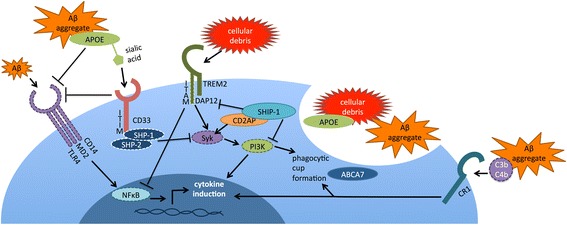
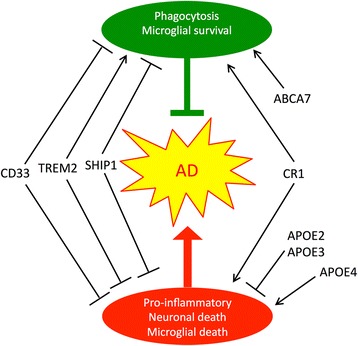
In the past five years, a series of large-scale genetic studies have revealed novel risk factors for Alzheimer's disease (AD). Analyses of these risk factors have focused attention upon the role of immune processes in AD, specifically microglial function. In this review, we discuss interpretation of genetic studies. We then focus upon six genes implicated by AD genetics that impact microglial function: TREM2, CD33, CR1, ABCA7, SHIP1, and APOE. We review the literature regarding the biological functions of these six proteins and their putative role in AD pathogenesis. We then present a model for how these factors may interact to modulate microglial function in AD.
Overview
The claims and statistics of this paper haven’t been checked yet.
Run the check — free, no account needed. It reads the open-access text and checks the sources it cites.
Integrity signals
Registry
Cites
Statistics
Figures
Verification
Claims the paper makes
The claims and statistics of this paper haven’t been checked yet.
Run the check — free, no account needed. It reads the open-access text and checks the sources it cites.
Claims other papers make about this one
Each is checked against this paper’s own text: does it say what the citing paper says it does?
The source backs part of the claim, not all of it — or backs it for a different population, condition or comparison.
In the citing paper
“supports the idea of microglia playing a key role driving the pathogenesis in these diseases (Malik et al., 2015).”
From TET2 Regulates the Neuroinflammatory Response in Microglia (2019) · cites this paper as Malik et al., 2015
Experimental — accuracy not yet measuredThe cited source says what the claim attributes to it.
In the citing paper
“The identification of mutations in innate immunity-related genes that confer higher risk of developing neurodegenerative diseases ( TREM2 , CD33 , CR1 , etc.), supports the idea of microglia playing a key role driving the pathogenesis in these diseases (Malik et al., 2015).”
From TET2 Regulates the Neuroinflammatory Response in Microglia (2019) · cites this paper as Malik et al., 2015
Self-check
Percentages, sums and reported differences re-computed from the paper’s own numbers.
The self-check needs the paper’s full text.
Citations
Cites
Corder, E. H., Saunders, A. M., Strittmatter, W. J., Schmechel, D. E., Gaskell, P. C., Small, G. W., Roses, A. D., Haines, J. L., & Pericak-Vance, M. A. (1993) · Science · doi:10.1126/science.8346443 · Cited by 9,429
Neuroinflammation in Alzheimer's disease
Heneka, M. T., Carson, M. J., Khoury, J. E., Landreth, G. E., Brosseron, F., Feinstein, D. L., Jacobs, A. H., Wyss-Coray, T., Vitorica, J., Ransohoff, R. M., et al. (2015) · The Lancet Neurology · doi:10.1016/s1474-4422(15)70016-5 · Cited by 6,226
The M1 and M2 paradigm of macrophage activation: Time for reassessment
Martinez, F. O., & Gordon, S. (2014) · F1000Prime Reports · doi:10.12703/p6-13 · Cited by 4,689
Inflammation and Alzheimer’s disease
Akiyama, H. (2000) · Neurobiology of Aging · doi:10.1016/s0197-4580(00)00124-x · Cited by 4,514
Meta-Analysis of 74,046 Individuals Identifies 11 New Susceptibility Loci for Alzheimer’s Disease
(EADI), E. A. D. I., Lambert, J.-C., (GERAD), G. A. E. R. I. A. D., Alzheimer's Disease Genetic Consortium (ADGC), (CHARGE), C. F. H. A. A. R. I. G. E., Ibrahim-Verbaas, C. A., Harold, D., Naj, A. C., Sims, R., Bellenguez, C., et al. (2013) · Nature Genetics · doi:10.1038/ng.2802 · Cited by 4,336
Apolipoprotein E and Alzheimer disease: risk, mechanisms and therapy
Liu, C.-C., Kanekiyo, T., Xu, H., & Bu, G. (2013) · Nature Reviews Neurology · doi:10.1038/nrneurol.2012.263 · Cited by 3,459
Self-citationHarold, D., Abraham, R., Hollingworth, P., Sims, R., Gerrish, A., Hamshere, M. L., Pahwa, J. S., Moskvina, V., Dowzell, K., Williams, A., et al. (2009) · Nature Genetics · doi:10.1038/ng.440 · Cited by 3,326
TREM2 Variants in Alzheimer's Disease
Guerreiro, R., Wojtas, A., Bras, J., Carrasquillo, M., Rogaeva, E., Majounie, E., Cruchaga, C., Sassi, C., Kauwe, J. S. K., Younkin, S., et al. (2013) · New England Journal of Medicine · doi:10.1056/nejmoa1211851 · Cited by 3,020
Variant of TREM2 Associated with the Risk of Alzheimer's Disease
Jonsson, T., Stefansson, H., Steinberg, S., Jonsdottir, I., Jonsson, P. V., Snaedal, J., Bjornsson, S., Huttenlocher, J., Levey, A. I., Lah, J. J., et al. (2013) · New England Journal of Medicine · doi:10.1056/nejmoa1211103 · Cited by 2,558
Genome-wide association study identifies variants at CLU and CR1 associated with Alzheimer's disease
the European Alzheimer's Disease Initiative Investigators, Lambert, J.-C., Heath, S., Even, G., Campion, D., Sleegers, K., Hiltunen, M., Combarros, O., Zelenika, D., Bullido, M. J., et al. (2009) · Nature Genetics · doi:10.1038/ng.439 · Cited by 2,234
Research works printed but not linked: 6
- Guerreiro R, Hardy J. TREM2 and neurodegenerative disease. N Engl J Med. 2013;369:1569–70.
- Bird TD. TREM2 and neurodegenerative disease. N Engl J Med. 2013;369:1568.
- Rajagopalan P, Hibar DP, Thompson PM. TREM2 and neurodegenerative disease. N Engl J Med. 2013;369:1565–7.
- Bertram L, Parrado AR, Tanzi RE. TREM2 and neurodegenerative disease. N Engl J Med. 2013;369:1565.
- Jonsson T, Stefansson K. TREM2 and neurodegenerative disease. N Engl J Med. 2013;369:1568–9.
- Guerreiro R, Wojtas A, Bras J, Carrasquillo M, Rogaeva E, Majounie E, et al. TREM2 variants in Alzheimer’s disease. N Engl J Med. 2013;368:117–27. · DOI · Paper page
Cited by
Sorted by citations
Microglia in physiology and disease
Wolf, S. A., Boddeke, H. W. G. M., & Kettenmann, H. (2017) · Annual Review of Physiology · doi:10.1146/annurev-physiol-022516-034406 · Cited by 1,426
Molecular and cellular mechanisms underlying the pathogenesis of Alzheimer’s disease
Guo, T., Zhang, D., Zeng, Y., Huang, T. Y., Xu, H., & Zhao, Y. (2020) · Molecular Neurodegeneration · doi:10.1186/s13024-020-00391-7 · Cited by 994
New insights into the role of TREM2 in Alzheimer’s disease
Gratuze, M., Leyns, C. E. G., & Holtzman, D. M. (2018) · Molecular Neurodegeneration · doi:10.1186/s13024-018-0298-9 · Cited by 489
The role of astrocytes in amyloid production and Alzheimer's disease
Frost, G. R., & Li, Y. (2017) · Open Biology · doi:10.1098/rsob.170228 · Cited by 448
TREM2 in Neurodegenerative Diseases
Jay, T. R., von Saucken, V. E., & Landreth, G. E. (2017) · Molecular Neurodegeneration · doi:10.1186/s13024-017-0197-5 · Cited by 427
Metadata
- Authors
- Malik, M., Parikh, I., Vasquez, J. B., Smith, C., Tai, L., Bu, G., LaDu, M. J., Fardo, D. W., Rebeck, G. W., & Estus, S.
- Affiliations
- University of Kentucky (US)
- University of Illinois Chicago (US)
- Mayo Clinic (US)
- Georgetown University Medical Center (US)
- Corresponding author
- Estus, Steven
- ORCID
- Venue
- Molecular Neurodegeneration
- Published
- 2015-10-05
- Volume
- 10
- Issue
- 1
- Pages
- 52-52
- ISSN
- 1750-1326 (ISSN-L)
- PMC
- PMC4595327
- OpenAlex
- W2119581346
- Cited by
- 161
- References
- 151
- Citations by year
- 2026: 6 · 2025: 14 · 2024: 11 · 2023: 19 · 2022: 16 · 2021: 18 · 2020: 21 · 2019: 15 · 2018: 12 · 2017: 18 · 2016: 10 · 2015: 1
- FWCI
- 1.09
- Type
- journal article
- Language
- en
- Open access
- gold
- doi.org
- Locations
- Molecular Neurodegeneration (publishedVersion, cc-by)
- Europe PMC (PubMed Central) (publishedVersion, cc-by)
- PubMed Central (publishedVersion, cc-by)
- PubMed (publishedVersion)
- Rare & Special e-Zone (The Hong Kong University of Science and Technology) (submittedVersion)
- UKnowledge (University of Kentucky) (submittedVersion, cc-by)
- Funders
- National Institute on Aging (R01AG045775, K25AG043546, P01AG030128, R21AG048498, R21 AG044682, R21AG051233)
- BrightFocus Foundation (A2014210S)
- Topics
- Life Sciences › Neuroscience › Neurology › Neuroinflammation and Neurodegeneration Mechanisms
- Life Sciences › Neuroscience › Cellular and Molecular Neuroscience › Alzheimer's disease research and treatments
- Health Sciences › Medicine › Psychiatry and Mental health › Dementia and Cognitive Impairment Research
- Keywords
- Alzheimer's disease, microglial inflammation, genetic risk factors, TREM2, CD33, complement receptor 1, ABCA7, SHIP1, apolipoprotein E, microglial function, neuroinflammation, pathogenesis
- MeSH terms
- Alzheimer Disease, Animals, Humans, Inflammation, Risk Factors, Microglia, Genetic Predisposition to Disease, Polymorphism, Single Nucleotide
About these checks
Registry, retraction, Cites and statistics results are computed, not judged, with one exception: a printed reference that no index lists is read once by a model before it counts as a citation error. Claims are extracted by a model and kept only when their quote appears verbatim in the text; each cited source is then checked, with a model’s help, for whether it says what the claim relies on. Those verdicts can be wrong — read the claim’s quote and the cited source before relying on one.
Statistics and arithmetic are recomputed, not judged.
Confidence bands are shown only for fields calibrated on our annotated test set. None is calibrated yet, so no band is shown.
What counts as a claim ›How we measure confidence ›How we check this ›
Are you an author, or do you see a problem with this page? Request a review
