

The DOI matches its Crossref record; 228 of the 228 references it cites were found in a registry or an index.
The gut microbiome in Alzheimer’s disease: what we know and what remains to be explored
Open accessAbstract
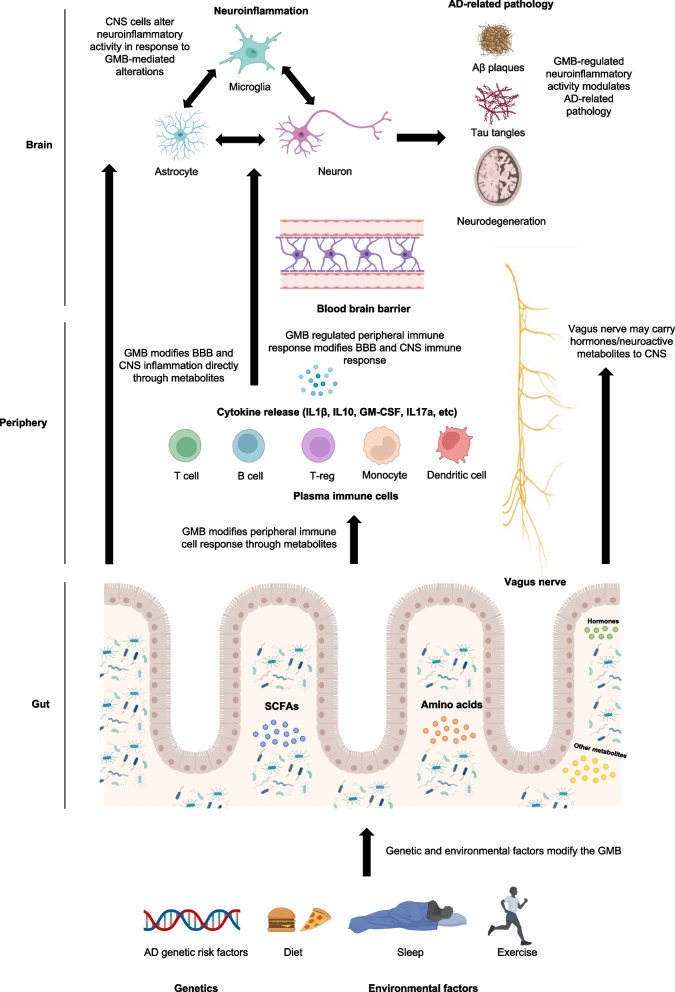
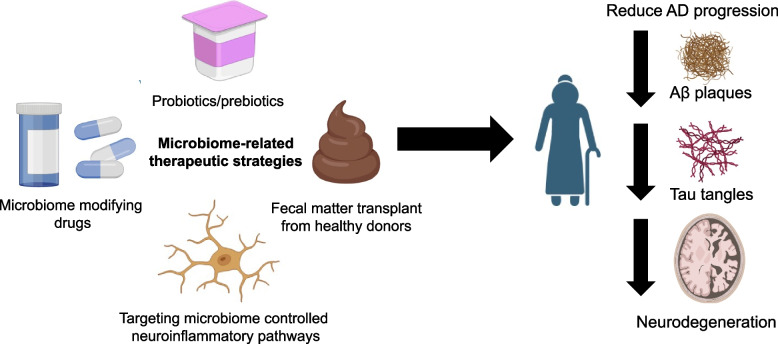
Alzheimer’s disease (AD), the most common cause of dementia, results in a sustained decline in cognition. There are currently few effective disease modifying therapies for AD, but insights into the mechanisms that mediate the onset and progression of disease may lead to new, effective therapeutic strategies. Amyloid beta oligomers and plaques, tau aggregates, and neuroinflammation play a critical role in neurodegeneration and impact clinical AD progression. The upstream modulators of these pathological features have not been fully clarified, but recent evidence indicates that the gut microbiome (GMB) may have an influence on these features and therefore may influence AD progression in human patients. In this review, we summarize studies that have identified alterations in the GMB that correlate with pathophysiology in AD patients and AD mouse models. Additionally, we discuss findings with GMB manipulations in AD models and potential GMB-targeted therapeutics for AD. Lastly, we discuss diet, sleep, and exercise as potential modifiers of the relationship between the GMB and AD and conclude with future directions and recommendations for further studies of this topic.
Overview
The claims and statistics of this paper haven’t been checked yet.
Run the check — free, no account needed. It reads the open-access text and checks the sources it cites.
Integrity signals
Registry
Cites
Statistics
Figures
Verification
Claims the paper makes
The claims and statistics of this paper haven’t been checked yet.
Run the check — free, no account needed. It reads the open-access text and checks the sources it cites.
Claims other papers make about this one
Each is checked against this paper’s own text: does it say what the citing paper says it does?
In the citing paper
“Gut microbiome alterations and intestinal barrier impairment have been observed in patients with MCI, AD, PD, and ALS patients.”
From Microbiota–gut–brain axis and its therapeutic applications in neurodegenerative diseases (2024) · cites this paper as [624]
Self-check
Percentages, sums and reported differences re-computed from the paper’s own numbers.
The self-check needs the paper’s full text.
Citations
Cites
Items 201–228 of 228
Martins, I. V. A., Rivers‐Auty, J., Allan, S. M., & Lawrence, C. B. (2016) · Journal of Alzheimer s Disease · doi:10.3233/jad-160640 · Cited by 70
Dietary prebiotics alter novel microbial dependent fecal metabolites that improve sleep
Thompson, R. S., Vargas, F., Dorrestein, P. C., Chichlowski, M., Berg, B. M., & Fleshner, M. (2020) · Scientific Reports · doi:10.1038/s41598-020-60679-y · Cited by 70
The amyloid hypothesis: let sleeping dogmas lie?
Bishop, G. M., & Robinson, S. R. (2002) · Neurobiology of Aging · doi:10.1016/s0197-4580(02)00050-7 · Cited by 67
Improvements in sleep indices during exam stress due to consumption of a Bifidobacterium longum
Moloney, G. M., Long-Smith, C. M., Murphy, A., Dorland, D., Hojabri, S. F., Ramirez, L. O., Marin, D. C., Bastiaanssen, T. F. S., Cusack, A.-M., Berding, K., et al. (2021) · Brain, Behavior, & Immunity - Health · doi:10.1016/j.bbih.2020.100174 · Cited by 67
Link, C. D. (2021) · Neuroscience Insights · doi:10.1177/26331055211018709 · Cited by 65
Association between the faecal short-chain fatty acid propionate and infant sleep
Heath, A. M., Haszard, J. J., Galland, B. C., Lawley, B., Rehrer, N. J., Drummond, L., Sims, I. M., Taylor, R. W., Otal, A., Taylor, B. J., et al. (2020) · European Journal of Clinical Nutrition · doi:10.1038/s41430-019-0556-0 · Cited by 64
Cuervo-Zanatta, D., Garcı́a-Mena, J., & Perez‐Cruz, C. (2021) · Journal of Alzheimer s Disease · doi:10.3233/jad-201367 · Cited by 62
Kristen, H., Santana, S., Sastre, I., Recuero, M., Bullido, M. J., & Aldudo, J. (2015) · Neurobiology of Aging · doi:10.1016/j.neurobiolaging.2015.06.014 · Cited by 61
The microbiome: A target for Alzheimer disease?
Seo, D.-O., Boros, B. D., & Holtzman, D. M. (2019) · Cell Research · doi:10.1038/s41422-019-0227-7 · Cited by 56
Nutrition, gut microbiota, and alzheimer’s disease
Romanenko, M., Kholin, V., Koliada, A., & Vaiserman, A. (2021) · Frontiers in Psychiatry · doi:10.3389/fpsyt.2021.712673 · Cited by 56
Ko, C., Fan, J., Hu, A., Su, H., Yang, J., Huang, L., Yan, F., Zhang, H., & Zeng, Y. (2019) · Brain and Behavior · doi:10.1002/brb3.1287 · Cited by 52
Chen, H.-F., Huang, C.-Q., You, C., Wang, Z.-R., & Si-qing, H. (2013) · Archives of Medical Research · doi:10.1016/j.arcmed.2013.01.002 · Cited by 48
Why does the Aβ peptide of Alzheimer share structural similarity with antimicrobial peptides?
Pastore, A., Raimondi, F., Rajendran, L., & Temussi, P. A. (2020) · Communications Biology · doi:10.1038/s42003-020-0865-9 · Cited by 48
Sleep EEG in Korsakoff's psychosis and Alzheimer's disease
Martin, P., Loewenstein, R. J., Kaye, W. H., Ebert, M. H., Weingartner, H., & Gillin, J. C. (1986) · Neurology · doi:10.1212/wnl.36.3.411 · Cited by 47
Salas, I. H., Weerasekera, A., Ahmed, T., Callaerts‐Vegh, Z., Himmelreich, U., D’Hooge, R., Balschun, D., Saido, T. C., Strooper, B. D., & Dotti, C. G. (2018) · Neurobiology of Disease · doi:10.1016/j.nbd.2018.02.001 · Cited by 46
Kunicki, S., Richardson, J., Mehta, P. D., Kim, K. S., & Zorychta, E. (1998) · Clinical Biochemistry · doi:10.1016/s0009-9120(98)00027-7 · Cited by 41
Boelen, E., Stassen, F. R. M., van der Ven, A. J. A. M., Lemmens, M. A. M., Steinbusch, H. P. J., Bruggeman, C. A., Schmitz, C., & Steinbusch, H. W. M. (2007) · Acta Neuropathologica · doi:10.1007/s00401-007-0252-3 · Cited by 41
Mazzei, G., Ikegami, R., Abolhassani, N., Haruyama, N., Sakumi, K., Saito, T., Saido, T. C., & Nakabeppu, Y. (2021) · Aging Cell · doi:10.1111/acel.13429 · Cited by 40
Impact of Gut Microbiome Manipulation in 5xFAD Mice on Alzheimer’s Disease-Like Pathology
Guilherme, M. D. S., Nguyen, V. T. T., Reinhardt, C., & Endres, K. (2021) · Microorganisms · doi:10.3390/microorganisms9040815 · Cited by 38
Sex-Dependent Effects of Intestinal Microbiome Manipulation in a Mouse Model of Alzheimer’s Disease
Kaur, H., Nookala, S., Singh, S., Mukundan, S., Nagamoto‐Combs, K., & Combs, C. K. (2021) · Cells · doi:10.3390/cells10092370 · Cited by 35
Gut microbiota composition is associated with narcolepsy type 1
Lecomte, A., Barateau, L., Pereira, P. A. B., Paulin, L. G., Auvinen, P., Scheperjans, F., & Dauvilliers, Y. A. (2020) · Neurology Neuroimmunology & Neuroinflammation · doi:10.1212/nxi.0000000000000896 · Cited by 34
Impact of the Age of Cecal Material Transfer Donors on Alzheimer’s Disease Pathology in 5xFAD Mice
Valeri, F., Guilherme, M. D. S., He, F., Stoye, N. M., Schwiertz, A., & Endres, K. (2021) · Microorganisms · doi:10.3390/microorganisms9122548 · Cited by 34
Yang, Y.-K., Peng, X.-D., Li, Y., Wang, Z., Changquan, H., Hui, W., & Liu, Q. (2013) · Journal of Investigative Medicine · doi:10.2310/jim.0b013e31829f91c0 · Cited by 33
Chen, Q., Huang, C.-Q., Hu, X., Li, S., & Zhang, X. (2013) · Journal of International Medical Research · doi:10.1177/0300060513476430 · Cited by 32
Fecal Microbiota Transplantation: A Microbiome Modulation Technique for Alzheimer’s Disease
Nandwana, V., & Debbarma, S. (2021) · Cureus · doi:10.7759/cureus.16503 · Cited by 30
Diet Patterns, the Gut Microbiome, and Alzheimer’s Disease
McGrattan, A., Stewart, C. J., Cassidy, A., Woodside, J. V., & McEvoy, C. T. (2022) · Journal of Alzheimer s Disease · doi:10.3233/jad-220205 · Cited by 25
147th Annual Meeting American Neurological Association
(2022) · Annals of Neurology · doi:10.1002/ana.26484 · Cited by 25
145th Annual Meeting American Neurological Association
(CSF), N. C. B. C. A. E. A. L. F. E. F. O. N. T. A. T. C. S. F., optic, M. A. T. C. N. C. N. C. I. A. T., & facial and auditory nerves. Recurrent paralysis of facial nerve is uncommon and has not been reported so far in association with neurosyphilis. (2020) · Annals of Neurology · doi:10.1002/ana.25865 · Cited by 19
Cited by
Sorted by citations
Microbiota–gut–brain axis and its therapeutic applications in neurodegenerative diseases
Loh, J. S., Mak, W. Q., Tan, L. K. S., Ng, C. X., Chan, H. H., Yeow, S. H., Foo, J. B., Ong, Y. S., How, C. W., & Khaw, K. Y. (2024) · Signal Transduction and Targeted Therapy · doi:10.1038/s41392-024-01743-1 · Cited by 1,193
Zhang, J., Zhang, Y., Wang, J., Xia, Y., Zhang, J., & Chen, L. (2024) · Signal Transduction and Targeted Therapy · doi:10.1038/s41392-024-01911-3 · Cited by 1,138
Emerging diagnostics and therapeutics for Alzheimer disease
Self, W. K., & Holtzman, D. M. (2023) · Nature Medicine · doi:10.1038/s41591-023-02505-2 · Cited by 381
Yang, J., Zhi, W., & Wang, L. (2024) · Molecules · doi:10.3390/molecules29122812 · Cited by 63
“…fl ammatory response and the hyperphosphorylation of tau protein via activation of the GSK-3 β pathway, ultimately leading to cognitive impairment [104]. astrocytes and microglia, which in turn induces an inflammatory response and the hyperphosphorylation of tau protein via activation of the GSK-3…”
BackgroundChandra, S., Di Meco, A., Dodiya, H. B., Popovic, J., Cuddy, L. K., Weigle, I. Q., Zhang, X., Sadleir, K., Sisodia, S. S., & Vassar, R. (2023) · Molecular Neurodegeneration · doi:10.1186/s13024-023-00635-2 · Cited by 58
Self-citation
Metadata
- Authors
- Chandra, S., Sisodia, S. S., & Vassar, R. J.
- Affiliations
- Northwestern University (US)
- University of Chicago (US)
- Corresponding author
- Vassar, Robert J.
- Venue
- Molecular Neurodegeneration
- Published
- 2023-02-01
- Volume
- 18
- Issue
- 1
- Pages
- 9-9
- ISSN
- 1750-1326 (ISSN-L)
- PMC
- PMC9889249
- OpenAlex
- W4318680477
- Cited by
- 278
- References
- 228
- Citations by year
- 2026: 56 · 2025: 100 · 2024: 84 · 2023: 38
- FWCI
- 7.37
- Type
- journal article
- Language
- en
- Open access
- gold
- doi.org
- Locations
- Molecular Neurodegeneration (publishedVersion, cc-by)
- PubMed Central (publishedVersion, cc-by)
- PubMed (publishedVersion)
- Knowledge@UChicago (University of Chicago) (submittedVersion, cc-by-nc-nd)
- DOAJ (DOAJ: Directory of Open Access Journals) (submittedVersion, cc-by-sa)
- University of Chicago (cc-by)
- Funders
- Good ventures foundation
- Topics
- Life Sciences › Biochemistry, Genetics and Molecular Biology › Molecular Biology › Gut microbiota and health
- Life Sciences › Neuroscience › Cellular and Molecular Neuroscience › Alzheimer's disease research and treatments
- Health Sciences › Medicine › Psychiatry and Mental health › Dementia and Cognitive Impairment Research
- Keywords
- Alzheimer's disease, gut microbiota, amyloid-beta, tau aggregates, neuroinflammation, neurodegeneration, gut-brain axis, microbiota-based therapy, diet, sleep, physical activity, mouse models of Alzheimer's disease
- MeSH terms
- Gastrointestinal Microbiome, Alzheimer Disease, Animals, Cognition, Disease Models, Animal, Humans, Amyloid beta-Peptides, Mice
About these checks
Registry, retraction, Cites and statistics results are computed, not judged, with one exception: a printed reference that no index lists is read once by a model before it counts as a citation error. Claims are extracted by a model and kept only when their quote appears verbatim in the text; each cited source is then checked, with a model’s help, for whether it says what the claim relies on. Those verdicts can be wrong — read the claim’s quote and the cited source before relying on one.
Statistics and arithmetic are recomputed, not judged.
Confidence bands are shown only for fields calibrated on our annotated test set. None is calibrated yet, so no band is shown.
What counts as a claim ›How we measure confidence ›How we check this ›
Are you an author, or do you see a problem with this page? Request a review
