

The DOI matches its Crossref record; 92 of the 95 references it cites were found in a registry or an index.
‘teen Mental Health First Aid’: a description of the program and an initial evaluation
Open accessAbstract
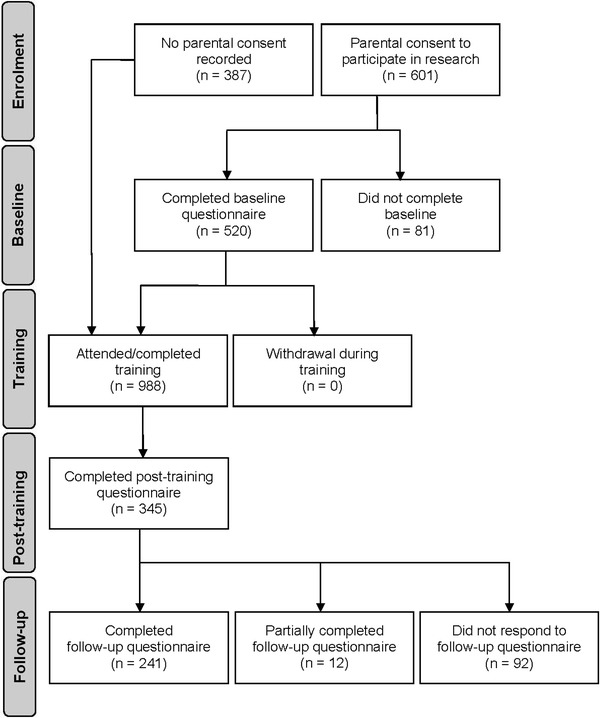
BACKGROUND: Many adolescents have poor mental health literacy, stigmatising attitudes towards people with mental illness, and lack skills in providing optimal Mental Health First Aid to peers. These could be improved with training to facilitate better social support and increase appropriate help-seeking among adolescents with emerging mental health problems. teen Mental Health First Aid (teen MHFA), a new initiative of Mental Health First Aid International, is a 3 × 75 min classroom based training program for students aged 15-18 years. METHODS: An uncontrolled pilot of the teen MHFA course was undertaken to examine the feasibility of providing the program in Australian secondary schools, to test relevant measures of student knowledge, attitudes and behaviours, and to provide initial evidence of program effects. RESULTS: Across four schools, 988 students received the teen MHFA program. 520 students with a mean age of 16 years completed the baseline questionnaire, 345 completed the post-test and 241 completed the three-month follow-up. Statistically significant improvements were found in mental health literacy, confidence in providing Mental Health First Aid to a peer, help-seeking intentions and student mental health, while stigmatising attitudes significantly reduced. CONCLUSIONS: teen MHFA appears to be an effective and feasible program for training high school students in Mental Health First Aid techniques. Further research is required with a randomized controlled design to elucidate the causal role of the program in the changes observed.
Overview
The claims and statistics of this paper haven’t been checked yet.
Run the check — free, no account needed. It reads the open-access text and checks the sources it cites.
Integrity signals
Registry
Cites
Statistics
Figures
Verification
Claims the paper makes
The claims and statistics of this paper haven’t been checked yet.
Run the check — free, no account needed. It reads the open-access text and checks the sources it cites.
Claims other papers make about this one
Each is checked against this paper’s own text: does it say what the citing paper says it does?
The source backs part of the claim, not all of it — or backs it for a different population, condition or comparison.
In the citing paper
“School administration issues, the difficulty of obtaining parental consent and attrition rates for the follow-up measures were one of the main difficulties regarding the implementation [93, 97, 102, 115].”
From What are the barriers, facilitators and interventions targeting help-seeking behaviours for common mental health problems in adolescents? A systematic review (2020) · cites this paper as [102]
Experimental — accuracy not yet measuredThe cited source says what the claim attributes to it.
In the citing paper
“Six classroom-based interventions addressing stigma were identified, two of which used psychoeducation to overcome myths regarding mental illness [101, 102] and four focused on providing interpersonal contact with people with mental health conditions in order to improve acceptance and increase help-seeking intentions [103–106].”
From What are the barriers, facilitators and interventions targeting help-seeking behaviours for common mental health problems in adolescents? A systematic review (2020) · cites this paper as [102]
Self-check
Percentages, sums and reported differences re-computed from the paper’s own numbers.
The self-check needs the paper’s full text.
Citations
Cites
Three Approaches to Qualitative Content Analysis
Hsieh, H.-F., & Shannon, S. E. (2005) · Qualitative Health Research · doi:10.1177/1049732305276687 · Cited by 44,601
KESSLER, R. C., ANDREWS, G., COLPE, L. J., HIRIPI, E., MROCZEK, D. K., NORMAND, S.-L. T., WALTERS, E. E., & ZASLAVSKY, A. M. (2002) · Psychological Medicine · doi:10.1017/s0033291702006074 · Cited by 10,327
Multiple imputation using chained equations: Issues and guidance for practice
White, I. R., Royston, P., & Wood, A. M. (2011) · Statistics in Medicine · doi:10.1002/sim.4067 · Cited by 9,792
The Transtheoretical Model of Health Behavior Change.
Prochaska, J. O., & Velicer, W. F. (1997) · American Journal of Health Promotion · doi:10.4278/0890-1171-12.1.38 · Cited by 7,782
Sterne, J. A. C., White, I. R., Carlin, J. B., Spratt, M., Royston, P., Kenward, M. G., Wood, A. M., & Carpenter, J. R. (2009) · BMJ · doi:10.1136/bmj.b2393 · Cited by 7,299
Screening for serious mental illness in the general population
Kessler, R. C., Barker, P. R., Colpe, L. J., Epstein, J. F., Gfroerer, J. C., Hiripi, E., Howes, M. J., Normand, S.-L. T., Manderscheid, R. W., Walters, E. E., et al. (2003) · Archives of General Psychiatry · doi:10.1001/archpsyc.60.2.184 · Cited by 5,692
Multilevel and Longitudinal Modeling Using Stata
Rabe-Hesketh, S., & Skrondal, A. (2005) · Biometrics · doi:10.1111/j.1541-0420.2006.00588_16.x · Cited by 4,626
Gulliver, A., Griffiths, K. M., & Christensen, H. (2010) · BMC Psychiatry · doi:10.1186/1471-244x-10-113 · Cited by 3,292
Mental health of young people: A global public-health challenge
Patel, V., Flisher, A. J., Hetrick, S., & McGorry, P. (2007) · The Lancet · doi:10.1016/s0140-6736(07)60368-7 · Cited by 3,126
Jorm, A. F., Korten, A. E., Jacomb, P. A., Christensen, H., Rodgers, B., & Pollitt, P. (1997) · Medical Journal of Australia · doi:10.5694/j.1326-5377.1997.tb140071.x · Cited by 2,585
Self-citationGlobal burden of disease in young people aged 10–24 years: a systematic analysis
Gore, F. M., Bloem, P. J., Patton, G. C., Ferguson, J., Joseph, V., Coffey, C., Sawyer, S. M., & Mathers, C. D. (2011) · The Lancet · doi:10.1016/s0140-6736(11)60512-6 · Cited by 2,301 · cited 1×
“Because of the important social, emotional and physical developmental goals that are achieved in this life stage, the onset of mental illness can be particularly debilitating and can lead to life-long burden and disability [13].”
BackgroundBoutron, I., Moher, D., Altman, D. G., Schulz, K. F., Ravaud, P., & for the CONSORT Group* (2008) · Annals of Internal Medicine · doi:10.7326/0003-4819-148-4-200802190-00008 · Cited by 2,292
Social support and patient adherence to medical treatment: a meta-analysis.
DiMatteo, M. R. (2004) · Health Psychology · doi:10.1037/0278-6133.23.2.207 · Cited by 2,107 · cited 1×
“Help-seeking studies in young people suggest that the decision to seek help, to engage in appropriate treatments and adhere to its course, are all heavily influenced by the attitudes and suggestions of the social network or peer group [14, 33, 35].”
BackgroundPublic conceptions of mental illness: labels, causes, dangerousness, and social distance.
Link, B. G., Phelan, J. C., Bresnahan, M., Stueve, A., & Pescosolido, B. A. (1999) · American Journal of Public Health · doi:10.2105/ajph.89.9.1328 · Cited by 1,949 · cited 1×
“Five items adapted for young people from the Social Distance Scale [26, 48] asked whether the participant would be happy to: (1) develop a close friendship with (John/ Jeanie); (2) Go out with (John/Jeanie) on the weekend; (3) go to (John/Jeanie)’s house; (4) invite (John/Jeanie) around to your house; (5) work on a pr…”
BackgroundYoung People’s Help-Seeking for Mental Health Problems
Rickwood, D., Deane, F. P., Wilson, C. J., & Ciarrochi, J. (2005) · Australian e-Journal for the Advancement of Mental Health · doi:10.5172/jamh.4.3.218 · Cited by 1,619
When and how do young people seek professional help for mental health problems?
Rickwood, D. J., Deane, F. P., & Wilson, C. J. (2007) · Medical Journal of Australia · doi:10.5694/j.1326-5377.2007.tb01334.x · Cited by 1,195
Noar, S. M., & Zimmerman, R. S. (2005) · Health Education Research · doi:10.1093/her/cyg113 · Cited by 793
Griffiths, K. M., Christensen, H., Jorm, A. F., Evans, K., & Groves, C. (2004) · British Journal of Psychiatry · doi:10.1192/bjp.185.4.342 · Cited by 789
Self-citationMultiple imputation: current perspectives
Kenward, M., & Carpenter, J. (2007) · Statistical Methods in Medical Research · doi:10.1177/0962280206075304 · Cited by 491
Hadlaczky, G., Hökby, S., Mkrtchian, A., Carli, V., & Wasserman, D. (2014) · International Review of Psychiatry · doi:10.3109/09540261.2014.924910 · Cited by 433
Mental health first aid training for high school teachers: a cluster randomized trial
Jorm, A. F., Kitchener, B. A., Sawyer, M. G., Scales, H., & Cvetkovski, S. (2010) · BMC Psychiatry · doi:10.1186/1471-244x-10-51 · Cited by 349
Self-citationDesire for Social Distance from People with Mental Disorders
Jorm, A. F., & Oh, E. (2009) · Australian & New Zealand Journal of Psychiatry · doi:10.1080/00048670802653349 · Cited by 336
Self-citationBurgess, P. M., Pirkis, J. E., Slade, T. N., Johnston, A. K., Meadows, G. N., & Gunn, J. M. (2009) · Australian & New Zealand Journal of Psychiatry · doi:10.1080/00048670902970858 · Cited by 318
Investing in youth mental health is a best buy
McGorry, P. D., Purcell, R., Hickie, I. B., & Jorm, A. F. (2007) · Medical Journal of Australia · doi:10.5694/j.1326-5377.2007.tb01326.x · Cited by 304
Self-citationClinical staging: a heuristic model for psychiatry and youth mental health
McGorry, P. D., Purcell, R., Hickie, I. B., Yung, A. R., Pantelis, C., & Jackson, H. J. (2007) · The Medical Journal of Australia · doi:10.5694/j.1326-5377.2007.tb01335.x · Cited by 293
Research on Mental Health Literacy: What we know and what we Still Need to know
Jorm, A. F., Barney, L. J., Christensen, H. M., Highet, N. J., Kelly, C., & Kitchener, B. A. (2005) · Australian & New Zealand Journal of Psychiatry · doi:10.1080/j.1440-1614.2006.01734.x · Cited by 290
Self-citationWei, Y., Hayden, J. A., Kutcher, S., Zygmunt, A., & McGrath, P. (2013) · Early Intervention in Psychiatry · doi:10.1111/eip.12010 · Cited by 290
Kitchener, B. A., & Jorm, A. F. (2004) · BMC Psychiatry · doi:10.1186/1471-244x-4-23 · Cited by 266
Self-citationMENTAL ILLNESS STIGMA AND CARE SEEKING
Cooper, A., Corrigan, P. W., & Watson, A. C. (2003) · The Journal of Nervous and Mental Disease · doi:10.1097/01.nmd.0000066157.47101.22 · Cited by 262
Mental Health First aid Training: Review of Evaluation Studies
Kitchener, B. A., & Jorm, A. F. (2006) · Australian & New Zealand Journal of Psychiatry · doi:10.1080/j.1440-1614.2006.01735.x · Cited by 258
Self-citationApplying health behavior theory to multiple behavior change: Considerations and approaches
Noar, S. M., Chabot, M., & Zimmerman, R. S. (2007) · Preventive Medicine · doi:10.1016/j.ypmed.2007.08.001 · Cited by 241
Jorm, A. F., & Wright, A. (2008) · The British Journal of Psychiatry · doi:10.1192/bjp.bp.107.039404 · Cited by 240
Self-citationAbsenteeism and Truancy: Risk, Protection, and Best Practice Implications for School Social Workers
Teasley, M. L. (2004) · Children & Schools · doi:10.1093/cs/26.2.117 · Cited by 220 · cited 1×
“mental health problems were less likely to engage in the training and research program or were not present for the administration of the final questionnaire, given higher rates of absenteeism and truancy in students with mental illness [70].”
BackgroundPinto, M. D., Logsdon, M. C., & Myers, J. A. (2011) · Social Science & Medicine · doi:10.1016/j.socscimed.2011.04.006 · Cited by 213
Where to seek help for a mental disorder?
Jorm, A. F., Wright, A., & Morgan, A. J. (2007) · The Medical Journal of Australia · doi:10.5694/j.1326-5377.2007.tb01415.x · Cited by 207
Self-citationMental Health First Aid: an international programme for early intervention
Kitchener, B. A., & Jorm, A. F. (2008) · Early Intervention in Psychiatry · doi:10.1111/j.1751-7893.2007.00056.x · Cited by 206
Self-citationJorm, A. F., Wright, A., & Morgan, A. J. (2007) · Early Intervention in Psychiatry · doi:10.1111/j.1751-7893.2007.00012.x · Cited by 198
Self-citationMental health first aid manual
Kitchener, B. A., & Jorm, A. F. (2002) · Cited by 192
Self-citationBrowne, M. A. O., Wells, J. E., Scott, K. M., & McGee, M. A. (2006) · Australian & New Zealand Journal of Psychiatry · doi:10.1080/j.1440-1614.2006.01905.x · Cited by 191
Youth mental health first aid: a description of the program and an initial evaluation
Kelly, C., Mithen, J., Fischer, J. A., Kitchener, B. A., Jorm, A. F., Lowe, A. J., & Scanlan, C. (2011) · International Journal of Mental Health Systems · doi:10.1186/1752-4458-5-4 · Cited by 177
Self-citationPerry, Y., Petrie, K., Buckley, H., Cavanagh, L., Clarke, D., Winslade, M., Hadzi‐Pavlovic, D., Manicavasagar, V., & Christensen, H. (2014) · Journal of Adolescence · doi:10.1016/j.adolescence.2014.08.001 · Cited by 167
Jorm, A. F., & Wright, A. (2007) · Australian & New Zealand Journal of Psychiatry · doi:10.1080/00048670701449179 · Cited by 159 · cited 1×
“Similar studies have also found that adolescents score higher on measures of desired social distance from individuals with mental illness, and are more likely to believe that mental illness is a personal weakness, than adults [27].”
ResultSelf-citationYap, M. B. H., Wright, A., & Jorm, A. F. (2011) · Social Psychiatry and Psychiatric Epidemiology · doi:10.1007/s00127-010-0300-5 · Cited by 151
Self-citationRoss, A., Kelly, C., & Jorm, A. F. (2014) · BMC Psychiatry · doi:10.1186/s12888-014-0241-8 · Cited by 146
Self-citationLabeling of mental disorders and stigma in young people
Wright, A., Jorm, A. F., & Mackinnon, A. J. (2011) · Social Science & Medicine · doi:10.1016/j.socscimed.2011.06.015 · Cited by 140
Self-citationYap, M. B. H., Reavley, N. J., & Jorm, A. F. (2012) · Journal of Affective Disorders · doi:10.1016/j.jad.2012.11.014 · Cited by 139
Self-citationEsters, I. G., Cooker, P. G., & Ittenbach, R. F. (1998) · PubMed · Cited by 138
Randomised trial of impact of school mental-health programme in rural Rawalpindi, Pakistan
Rahman, A., Mubbashar, M. H., Gater, R. A., & Goldberg, D. (1998) · The Lancet · doi:10.1016/s0140-6736(98)02381-2 · Cited by 138
Yap, M. B. H., Mackinnon, A. J., Reavley, N. J., & Jorm, A. F. (2014) · International Journal of Methods in Psychiatric Research · doi:10.1002/mpr.1433 · Cited by 135
Self-citationHealth Promotion in Context: The Effects of Significant Others on Health Behavior Change
Zimmerman, R. S., & Connor, C. (1989) · Health Education Quarterly · doi:10.1177/109019818901600108 · Cited by 130
First aid for depression: A Delphi consensus study with consumers, carers and clinicians
Langlands, R. L., Jorm, A. F., Kelly, C. M., & Kitchener, B. A. (2008) · Journal of Affective Disorders · doi:10.1016/j.jad.2007.05.004 · Cited by 115
Self-citationEducating Young People about Mental Health and Mental Illness: Evaluating a School - Based Programme
Rickwood, D., Cavanagh, S., Curtis, L., & Sakrouge, R. (2004) · International Journal of Mental Health Promotion · doi:10.1080/14623730.2004.9721941 · Cited by 111
Langlands, R. L., Jorm, A. F., Kelly, C., & Kitchener, B. A. (2007) · Schizophrenia Bulletin · doi:10.1093/schbul/sbm099 · Cited by 111
Self-citationNoting a Landmark Achievement: Mental Health First Aid Training Reaches 1% of Australian Adults
Jorm, A. F., & Kitchener, B. A. (2011) · Australian & New Zealand Journal of Psychiatry · doi:10.3109/00048674.2011.594785 · Cited by 111
Self-citationLam, A. Y. K., Jorm, A. F., & Wong, D. F. (2010) · International Journal of Mental Health Systems · doi:10.1186/1752-4458-4-18 · Cited by 102
Self-citationPierce, D., Liaw, S.-T., Dobell, J., & Anderson, R. (2010) · International Journal of Mental Health Systems · doi:10.1186/1752-4458-4-10 · Cited by 100
Multilevel and Longitudinal Modeling Using Stata (3rd Edition), Vol II
Rabe‐Hesketh, S., & Skrondal, A. (2012) · Cited by 98
An analysis of the re-test artefact in longitudinal studies of psychiatric symptoms and personality
Jorm, A. F., Duncan‐Jones, P., & Scott, R. (1989) · Psychological Medicine · doi:10.1017/s0033291700012514 · Cited by 98
Self-citationJorm, A. F., Kitchener, B. A., & Mugford, S. K. (2005) · BMC Psychiatry · doi:10.1186/1471-244x-5-43 · Cited by 95
Self-citationKelly, C., Jorm, A. F., & Kitchener, B. A. (2010) · BMC Psychiatry · doi:10.1186/1471-244x-10-49 · Cited by 93
Self-citationReavley, N. J., & Jorm, A. F. (2011) · Australian & New Zealand Journal of Psychiatry · doi:10.3109/00048674.2011.614215 · Cited by 91
Self-citationHart, L., Jorm, A. F., Kanowski, L. G., Kelly, C. M., & Langlands, R. L. (2009) · BMC Psychiatry · doi:10.1186/1471-244x-9-47 · Cited by 85
Self-citationYap, M. B. H., & Jorm, A. F. (2012) · Psychiatry Research · doi:10.1016/j.psychres.2011.10.004 · Cited by 84
Self-citationKanowski, L., Jorm, A. F., & Hart, L. (2009) · International Journal of Mental Health Systems · doi:10.1186/1752-4458-3-10 · Cited by 80
Self-citationTowards a new paradigm of care: the International Declaration on Youth Mental Health
Coughlan, H., Cannon, M., Shiers, D., Power, P., Barry, C., Bates, T., Birchwood, M., Buckley, S., Chambers, D., Davidson, S., et al. (2013) · Early Intervention in Psychiatry · doi:10.1111/eip.12048 · Cited by 77
Minas, H., Colucci, E., & Jorm, A. F. (2009) · International Journal of Mental Health Systems · doi:10.1186/1752-4458-3-19 · Cited by 74
Self-citationYap, M. B. H., & Jorm, A. F. (2011) · Journal of Affective Disorders · doi:10.1016/j.jad.2011.05.039 · Cited by 68
Self-citationYap, M. B. H., Wright, A., & Jorm, A. F. (2011) · Psychiatry Research · doi:10.1016/j.psychres.2011.01.014 · Cited by 66
Self-citationKelly, C., Jorm, A. F., Kitchener, B. A., & Langlands, R. L. (2008) · BMC Psychiatry · doi:10.1186/1471-244x-8-62 · Cited by 64
Self-citationKingston, A. H., Jorm, A. F., Kitchener, B. A., Hides, L. M., Kelly, C. M., Morgan, A. J., Hart, L., & Lubman, D. I. (2009) · BMC Psychiatry · doi:10.1186/1471-244x-9-79 · Cited by 64
Self-citationFoliaki, S. A., Kokaua, J., Schaaf, D., & Tukuitonga, C. (2006) · Australian & New Zealand Journal of Psychiatry · doi:10.1080/j.1440-1614.2006.01912.x · Cited by 61
Wright, A., Jorm, A. F., & Mackinnon, A. J. (2011) · Social Psychiatry and Psychiatric Epidemiology · doi:10.1007/s00127-011-0399-z · Cited by 60
Self-citationRoss, A., Hart, L., Jorm, A. F., Kelly, C. M., & Kitchener, B. A. (2012) · Early Intervention in Psychiatry · doi:10.1111/j.1751-7893.2011.00331.x · Cited by 57
Self-citationMason, R. J., Hart, L., Rossetto, A., & Jorm, A. F. (2015) · Psychiatry Research · doi:10.1016/j.psychres.2015.03.036 · Cited by 56
Self-citationLabels Used by Young People to Describe Mental Disorders: Factors Associated with Their Development
Wright, A., & Jorm, A. F. (2009) · Australian & New Zealand Journal of Psychiatry · doi:10.1080/00048670903179129 · Cited by 55
Self-citationEvaluation of mental health first aid training in a diverse community setting
Morawska, A., Fletcher, R., Pope, S. M., Heathwood, E., Anderson, E., & McAuliffe, C. E. (2012) · International Journal of Mental Health Nursing · doi:10.1111/j.1447-0349.2012.00844.x · Cited by 55
Development of mental health first aid guidelines for panic attacks: a Delphi study
Kelly, C., Jorm, A. F., & Kitchener, B. A. (2009) · BMC Psychiatry · doi:10.1186/1471-244x-9-49 · Cited by 54
Self-citationFirst Aid for Eating Disorders
Hart, L., Jorm, A. F., Paxton, S. J., Kelly, C. M., & Kitchener, B. A. (2009) · Eating Disorders · doi:10.1080/10640260903210156 · Cited by 53
Self-citationYoung Adults' Support Strategies when Peers Disclose Suicidal Intent
Dunham, K. T. (2004) · Suicide and Life-Threatening Behavior · doi:10.1521/suli.34.1.56.27773 · Cited by 44
King, K. A., Vidourek, R. A., & Strader, J. L. (2008) · Suicide and Life-Threatening Behavior · doi:10.1521/suli.2008.38.5.608 · Cited by 41
Hart, L., Jorm, A. F., Paxton, S. J., & Cvetkovski, S. (2012) · Early Intervention in Psychiatry · doi:10.1111/j.1751-7893.2012.00345.x · Cited by 40
Self-citationHossain, D., Gorman, D., & Eley, R. M. (2009) · Australasian Psychiatry · doi:10.1080/10398560902948365 · Cited by 35
Towards the appropriate use of diagnostic imaging
Mendelson, R. M., & Murray, C. P. J. (2007) · Medical Journal of Australia · doi:10.5694/j.1326-5377.2007.tb01105.x · Cited by 35
Hart, L., Bourchier, S. J., Jorm, A. F., Kanowski, L. G., Kingston, A. H., Stanley, D., & Lubman, D. I. (2010) · BMC Psychiatry · doi:10.1186/1471-244x-10-78 · Cited by 33
Self-citationMental health first aid for eating disorders: pilot evaluation of a training program for the public
Hart, L., Jorm, A. F., & Paxton, S. J. (2012) · BMC Psychiatry · doi:10.1186/1471-244x-12-98 · Cited by 32
Self-citationde Bruin, W. B., & Fischhoff, B. (2000) · AIDS Education and Prevention · doi:10.1521/aeap.2000.12.3.187 · Cited by 22
Youth Mental Health First Aid: A manual for adults assisting young people
Kelly, C. M., Kitchener, B. A., & Jorm, A. F. (2013) · Cited by 22
Self-citationStudent Recognition of and Response to Suicidal Peers
Lawrence, M. T., & Ureda, J. R. (1990) · Suicide and Life-Threatening Behavior · doi:10.1111/j.1943-278x.1990.tb00099.x · Cited by 20
Yap, M. B. H., Reavley, N. J., & Jorm, A. F. (2013) · Epidemiology and Psychiatric Sciences · doi:10.1017/s2045796013000607 · Cited by 20
Self-citationCollege students' perceived confidence in mental health help-seeking
Vidourek, R. A., King, K. A., Nabors, L., Lynch, A., & Merianos, A. L. (2014) · International Journal of Mental Health Promotion · doi:10.1080/14623730.2014.892257 · Cited by 18
teen Mental Health First Aid: A manual for young people helping their friends
Hart, L. M. ‘., Kelly, C. M., Kitchener, B. A., & Jorm, A. F. (2012) · Cited by 11
Self-citationTarquini, S. J. (2010) · Digital Commons - University of South Florida (University of South Florida) · Cited by 1
Research works printed but not linked: 2
- Kitchener BA, Jorm AF, Kelly CM. Mental Health First Aid Manual. 3rd ed. Melbourne: Mental Health First Aid Australia; 2013.
- Kitchener BA, Jorm AF, Kelly CM. Mental Health First Aid Manual. 2nd ed. Melbourne: Mental Health First Aid Australia; 2010.
Cited by
Sorted by citations
Aguirre Velasco, A., Cruz, I. S. S., Billings, J., Jimenez, M., & Rowe, S. (2020) · BMC Psychiatry · doi:10.1186/s12888-020-02659-0 · Cited by 736
“School administration issues, the difficulty of obtaining parental consent and attrition rates for the follow-up measures were one of the main difficulties regarding the implementation [93, 97, 102, 115].”
Designing and scaling up integrated youth mental health care
McGorry, P. D., Mei, C., Chanen, A., Hodges, C., Alvarez‐Jimenez, M., & Killackey, E. (2022) · World Psychiatry · doi:10.1002/wps.20938 · Cited by 546
Mansfield, R., Patalay, P., & Humphrey, N. (2020) · BMC Public Health · doi:10.1186/s12889-020-08734-1 · Cited by 149
Lindow, J. C., Hughes, J. L., South, C. C., Minhajuddin, A., Gutierrez, L., Bannister, E., Trivedi, M. H., & Byerly, M. (2020) · Journal of Adolescent Health · doi:10.1016/j.jadohealth.2020.01.006 · Cited by 138
Promotion of Mental Health Literacy in Adolescents: A Scoping Review
Nobre, J. R., Oliveira, A. P., Monteiro, F., Sequeira, C., & Ferré‐Grau, C. (2021) · International Journal of Environmental Research and Public Health · doi:10.3390/ijerph18189500 · Cited by 142
Metadata
- Authors
- Hart, L. M., Mason, R. J., Kelly, C. M., Cvetkovski, S., & Jorm, A. F.
- Affiliations
- The University of Melbourne (AU)
- Deakin University (AU)
- Corresponding author
- Jorm, Anthony F.
- Venue
- International Journal of Mental Health Systems
- Published
- 2016-01-19
- Volume
- 10
- Issue
- 1
- Pages
- 3-3
- ISSN
- 1752-4458 (ISSN-L)
- PMC
- PMC4717562
- OpenAlex
- W2105757610
- Cited by
- 118
- References
- 95
- Citations by year
- 2026: 7 · 2025: 7 · 2024: 8 · 2023: 11 · 2022: 11 · 2021: 21 · 2020: 20 · 2019: 12 · 2018: 11 · 2017: 5 · 2016: 4
- FWCI
- 16.77
- Type
- journal article
- Language
- en
- Open access
- gold
- doi.org
- Licence
- cc-by
- Locations
- International Journal of Mental Health Systems (publishedVersion, cc-by)
- PubMed Central (publishedVersion, cc-by)
- PubMed (publishedVersion)
- Figshare (submittedVersion, cc-by)
- Minerva Access (University of Melbourne) (submittedVersion, cc-by)
- La Trobe University (cc-by)
- Funders
- beyondblue
- National Health and Medical Research Council (1059785)
- Topics
- Health Sciences › Medicine › Psychiatry and Mental health › Mental Health Treatment and Access
- Health Sciences › Medicine › Public Health, Environmental and Occupational Health › School Health and Nursing Education
- Social Sciences › Psychology › Clinical Psychology › Suicide and Self-Harm Studies
- Keywords
- mental health first aid training, adolescents, mental health literacy, mental health stigma, help-seeking intentions, peer support, high school students, program feasibility, student mental health
About these checks
Registry, retraction, Cites and statistics results are computed, not judged, with one exception: a printed reference that no index lists is read once by a model before it counts as a citation error. Claims are extracted by a model and kept only when their quote appears verbatim in the text; each cited source is then checked, with a model’s help, for whether it says what the claim relies on. Those verdicts can be wrong — read the claim’s quote and the cited source before relying on one.
Statistics and arithmetic are recomputed, not judged.
Confidence bands are shown only for fields calibrated on our annotated test set. None is calibrated yet, so no band is shown.
What counts as a claim ›How we measure confidence ›How we check this ›
Are you an author, or do you see a problem with this page? Request a review
