

Barriers and potential solutions for effective integration of depression care into non-communicable diseases clinics in Malawi: a qualitative end-point evaluation of the SHARP randomized controlled trial
Open accessThe DOI matches its Crossref record; 53 of the 53 references it cites were found in a registry or an index.
Abstract
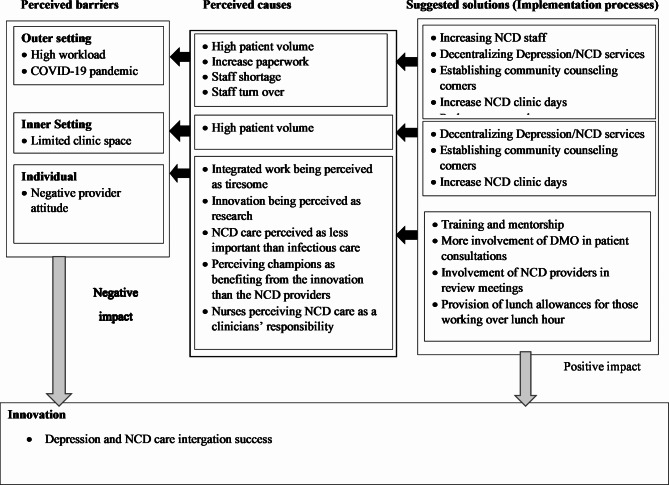
BACKGROUND: The sub-Saharan African Regional Partnership for mental health and capacity building (SHARP) study was a clinic-randomized trial of two implementation strategies for integrating depression screening and treatment into non-communicable diseases' (NCD) clinics in Malawi between 2019 and 2022. We report on the barriers to implementing depression care integration at SHARP study sites and potential solutions. METHODS: N = 39 in-depth interviews with participants from all ten sites were conducted, recorded, transcribed, coded in NVivo 12 and analyzed by qualitative experts. We used thematic analysis to identify implementation challenges and potential solutions. The Consolidated Framework for Implementation Research helped to develop guides and organize the results. RESULTS: Outer setting barriers included high workload (due to high patient volume, increased paperwork, shortage of staff), the effects of coronavirus disease 2019 (COVID-19) pandemic, staff turnover and negative provider attitudes. Limited clinic space arose as an inner setting barrier. Workload can be overcome by increasing the number of NCD personnel, decentralizing the depression/NCD services and integrating mental health and NCD documents (implementation process). The COVID-19 pandemic presented unique challenges including fear of interpersonal contact and changes in scheduling staff that were difficult to overcome in the short term. To deal with the effects of staff turnover, participants identified the need for continuous depression training to new providers. Lobbying for more rooms from leadership can address concerns of limited space. To reduce negative provider attitudes, participants urged facility leadership to make themselves available for consultations and mentorship and to provide continuous learning opportunities such as refresher trainings. CONCLUSION: The experience in the SHARP study highlights the need for a culture of continuous learning and adaptation in healthcare settings, enabling the development of strategies to overcome evolving challenges. Planning for the integration of mental health and NCD care should extend beyond immediate challenges and consider long-term goals and sustainability. TRIAL REGISTRATION: This study reports part of the findings from the endpoint evaluation of the SHARP clinical trial that is registered at ClinicalTrials.gov, NCT03711786 first posted 20,181,018.
Overview
The claims and statistics of this paper haven’t been checked yet.
Free: it reads the open-access text and checks the first 5 claims that cite a source we can check. Create a free account to check every claim.
Integrity signals
Registry
Cites
Statistics
Figures
Verification
Claims the paper makes
The claims and statistics of this paper haven’t been checked yet.
Free: it reads the open-access text and checks the first 5 claims that cite a source we can check. Create a free account to check every claim.
Claims other papers make about this one
Each is checked against this paper’s own text: does it say what the citing paper says it does?
The source backs part of the claim, not all of it — or backs it for a different population, condition or comparison.
In the citing paper
“while in Malawi similar decentralised system weaknesses contribute to inconsistent follow‐up and fragmented care pathways [59].”
From Treatment Experiences of Individuals With Co-Occurring Mental Health and Substance Use Disorders and Perspectives of Mental Health Workers in Ashanti Region, Ghana (2026) · cites this paper as [59]
Experimental — accuracy not yet measured
Self-check
Percentages, sums and reported differences re-computed from the paper’s own numbers.
The self-check needs the paper’s full text.
Citations
Cites
Damschroder, L. J., Aron, D. C., Keith, R. E., Kirsh, S. R., Alexander, J. A., & Lowery, J. C. (2009) · Implementation Science · doi:10.1186/1748-5908-4-50 · Cited by 14,496 · cited 1×
“The CFIR is useful for evaluations of implementation programs because of its ability to classify implementation determinants at multiple levels, and to illustrate the connections between them [30, 31].”
Palinkas, L. A., Horwitz, S. M., Green, C. A., Wisdom, J. P., Duan, N., & Hoagwood, K. (2015) · Administration and Policy in Mental Health and Mental Health Services Research · doi:10.1007/s10488-013-0528-y · Cited by 12,038
Content analysis and thematic analysis: Implications for conducting a qualitative descriptive study
Vaismoradi, M., Turunen, H., & Bondas, T. (2013) · Nursing & Health Sciences · doi:10.1111/nhs.12048 · Cited by 8,327
The Patient Health Questionnaire-2: Validity of a Two-Item Depression Screener
Kroenke, K., Spitzer, R. L., & Williams, J. B. W. (2003) · Medical Care · doi:10.1097/01.mlr.0000093487.78664.3c · Cited by 6,359
Whiteford, H. A., Degenhardt, L., Rehm, J., Baxter, A. J., Ferrari, A. J., Erskine, H. E., Charlson, F. J., Norman, R. E., Flaxman, A. D., Johns, N., et al. (2013) · The Lancet · doi:10.1016/s0140-6736(13)61611-6 · Cited by 6,006
The updated consolidated framework for implementation research based on user feedback
Damschroder, L. J., Reardon, C. M., Widerquist, M. A. O., & Lowery, J. (2022) · Implementation Science · doi:10.1186/s13012-022-01245-0 · Cited by 4,452 · cited 6×
“The CFIR is useful for evaluations of implementation programs because of its ability to classify implementation determinants at multiple levels, and to illustrate the connections between them [30, 31].”
InfluentialEnhancing the quality and credibility of qualitative analysis.
(1999) · PubMed Central · Cited by 4,133
Thematic analysis of qualitative data: AMEE Guide No. 131
Kiger, M. E., & Varpio, L. (2020) · Medical Teacher · doi:10.1080/0142159x.2020.1755030 · Cited by 3,787
The PHQ-15: Validity of a New Measure for Evaluating the Severity of Somatic Symptoms
Kroenke, K., Spitzer, R. L., & Williams, J. B. W. (2002) · Psychosomatic Medicine · doi:10.1097/00006842-200203000-00008 · Cited by 3,298
Wang, P. S., Aguilar-Gaxiola, S., Alonso, J., Angermeyer, M. C., Borges, G., Bromet, E. J., Bruffaerts, R., de Girolamo, G., de Graaf, R., Gureje, O., et al. (2007) · The Lancet · doi:10.1016/s0140-6736(07)61414-7 · Cited by 1,655
The experiences of health-care providers during the COVID-19 crisis in China: a qualitative study
Liu, Q., Luo, D., Haase, J. E., Guo, Q., Wang, X. Q., Liu, S., Xia, L., Liu, Z., Yang, J., & Yang, B. X. (2020) · The Lancet Global Health · doi:10.1016/s2214-109x(20)30204-7 · Cited by 1,552
Qualitative methods in implementation research: An introduction
Hamilton, A. B., & Finley, E. P. (2019) · Psychiatry Research · doi:10.1016/j.psychres.2019.112516 · Cited by 1,315
Assarroudi, A., Heshmati Nabavi, F., Armat, M. R., Ebadi, A., & Vaismoradi, M. (2018) · Journal of Research in Nursing · doi:10.1177/1744987117741667 · Cited by 1,252
The inconvenient truth about convenience and purposive samples
Andrade, C. (2021) · Indian Journal of Psychological Medicine · doi:10.1177/0253717620977000 · Cited by 1,110
Damschroder, L. J., & Lowery, J. C. (2013) · Implementation Science · doi:10.1186/1748-5908-8-51 · Cited by 734
Wandersman, A., Chien, V. H., & Katz, J. (2012) · American Journal of Community Psychology · doi:10.1007/s10464-012-9509-7 · Cited by 422 · cited 1×
“The SHARP study used multiple training and mentorship implementation strategies that are widely used globally to build health workforce capacity and to adopt new interventions effectively and efficiently [17, 18].”
Strengthening health systems resilience. Key concepts and strategies
Thomas, S., Sagan, A., Larkin, J., Cylus, J., Figueras, J., & Karanikolos, M. (2020) · Europe PMC (PubMed Central) · doi:10.13140/rg.2.2.17429.35041 · Cited by 387
Chibanda, D., Mesu, P., Kajawu, L., Cowan, F., Araya, R., & Abas, M. A. (2011) · BMC Public Health · doi:10.1186/1471-2458-11-828 · Cited by 319 · cited 2×
“…as “expert” peer or lay psychosocial counselors in the NCD clinics as part of the Friendship Bench (FB) task shifting intervention − a psychological intervention model that originated in Zimbabwe to increase access to psychosocial counseling in the presence of a health work-force shortage [19, 20].”
Qualitative research: what it is and what it is not
Denny, E., & Weckesser, A. (2018) · BJOG An International Journal of Obstetrics & Gynaecology · doi:10.1111/1471-0528.15198 · Cited by 155
Chinman, M., Hunter, S. B., Ebener, P., Paddock, S. M., Stillman, L., Imm, P., & Wandersman, A. (2008) · American Journal of Community Psychology · doi:10.1007/s10464-008-9163-2 · Cited by 154 · cited 1×
“In addition, the service providers should be trained and followed with technical assistance [48].”
Whiteford, H. A., Ferrari, A. J., Degenhardt, L., Feigin, V., & Vos, T. (2016) · Disease Control Priorities, Third Edition (Volume 4): Mental, Neurological, and Substance Use Disorders · doi:10.1596/978-1-4648-0426-7_ch2 · Cited by 137
Stopping pandemics before they start: Lessons learned from SARS-CoV-2
Edwards, A. M., Baric, R. S., Saphire, E. O., & Ulmer, J. B. (2022) · Science · doi:10.1126/science.abn1900 · Cited by 109
The Consolidated Framework for Implementation Research (CFIR)
Damschroder, L. J., Reardon, C. M., & Lowery, J. C. (2020) · Handbook on Implementation Science · doi:10.4337/9781788975995.00011 · Cited by 77
Emergency preparedness: What is the future?
Herstein, J. J., Schwedhelm, M. M., Vasa, A. M., Biddinger, P. D., & Hewlett, A. L. (2021) · Antimicrobial Stewardship & Healthcare Epidemiology · doi:10.1017/ash.2021.190 · Cited by 71
Ray, M. L., Wilson, M. M., Wandersman, A., Meyers, D. C., & Katz, J. (2012) · American Journal of Community Psychology · doi:10.1007/s10464-012-9526-6 · Cited by 68
Udedi, M. M. (2014) · PubMed Central · Cited by 67
Self-citationKamvura, T. T., Dambi, J. M., Chiriseri, E., Turner, J., Verhey, R., & Chibanda, D. (2022) · BMC Nursing · doi:10.1186/s12912-022-00841-1 · Cited by 65
Alamo, S., Wabwire-Mangen, F., Kenneth, E., Sunday, P., Laga, M., & Colebunders, R. L. (2012) · AIDS Patient Care and STDs · doi:10.1089/apc.2011.0279 · Cited by 62
Myers, B., Petersen-Williams, P., van der Westhuizen, C., Lund, C., Lombard, C., Joska, J. A., Levitt, N. S., Butler, C., Naledi, T., Milligan, P., et al. (2019) · BMJ Open · doi:10.1136/bmjopen-2018-024277 · Cited by 62 · cited 1×
“…or members of the community is feasible and has shown to produce similar results compared to counseling provided by professional counselors at health facilities in patients with comorbid of metal health problems and that of chronic diseases in both resource worth and constraints countries [42, 43].”
Udedi, M., Stockton, M. A., Kulisewa, K., Hosseinipour, M. C., Gaynes, B. N., Mphonda, S. M., Mwagomba, B. M., Mazenga, A. C., & Pence, B. W. (2018) · BMC Health Services Research · doi:10.1186/s12913-018-3388-z · Cited by 57
Self-citationHenke, R. M., Chou, A. F., Chanin, J. C., Zides, A. B., & Scholle, S. H. (2008) · Implementation Science · doi:10.1186/1748-5908-3-40 · Cited by 53
Wall, J. T., Kaiser, B. N., Friis-Healy, E. A., Ayuku, D., & Puffer, E. S. (2020) · International Journal of Mental Health Systems · doi:10.1186/s13033-020-00343-0 · Cited by 52
Fernando, S., Brown, T., Datta, K., Chidhanguro, D., Tavengwa, N. V., Chandna, J., Munetsi, E., Dzapasi, L., Nyachowe, C., Mutasa, B., et al. (2021) · Cambridge Prisms Global Mental Health · doi:10.1017/gmh.2021.32 · Cited by 46
Gureje, O., Seedat, S., Kola, L., Appiah-Poku, J., Othieno, C., Harris, B., Makanjuola, V., Price, L. N., Ayinde, O. O., & Esan, O. (2019) · Epidemiology and Psychiatric Sciences · doi:10.1017/s2045796018000707 · Cited by 42
Adams, J. L., Almond, M. L. G., Ringo, E. J., Shangali, W. H., & Sikkema, K. J. (2012) · The International Journal of Psychiatry in Medicine · doi:10.2190/pm.43.2.a · Cited by 38
Evaluation of the HIV lay counselling and testing profession in South Africa
Mwisongo, A., Mehlomakhulu, V., Mohlabane, N., Peltzer, K., Mthembu, J., & van Rooyen, H. (2015) · BMC Health Services Research · doi:10.1186/s12913-015-0940-y · Cited by 36
Zimba, C. C., Akiba, C. F., Matewere, M., Thom, A., Udedi, M. M., Masiye, J., Kulisewa, K., Go, V. F.-L., Hosseinipour, M. C., Gaynes, B. N., et al. (2021) · International Journal of Mental Health Systems · doi:10.1186/s13033-021-00480-0 · Cited by 35
Self-citationThe mental health consumer movement and peer providers in Israel
Moran, G. S. (2018) · Epidemiology and Psychiatric Sciences · doi:10.1017/s2045796018000173 · Cited by 30
Udedi, M. M., Pence, B. W., Stewart, R. C., & Muula, A. S. (2020) · International Journal of Mental Health Systems · doi:10.1186/s13033-020-00413-3 · Cited by 30
Self-citationNaslund, J. A., Kalha, J., Restivo, J. L., Amarreh, I., Callands, T. A., Chen, H., Gómez–Restrepo, C., Hamoda, H. M., Kapoor, A., Levkoff, S. E., et al. (2021) · Asian Journal of Psychiatry · doi:10.1016/j.ajp.2021.102557 · Cited by 29
Self-citationGaynes, B. N., Akiba, C. F., Hosseinipour, M. C., Kulisewa, K., Amberbir, A., Udedi, M. M., Zimba, C. C., Masiye, J., Crampin, A. C., Amarreh, I., et al. (2020) · Psychiatric Services · doi:10.1176/appi.ps.202000003 · Cited by 27
Self-citationKrishnan, A., Amarchand, R., Saraf, D., Mathur, P., Shukla, D., & Nath, L. (2015) · WHO South-East Asia Journal of Public Health · doi:10.4103/2224-3151.206682 · Cited by 25
Udedi, M. M., Stockton, M. A., Kulisewa, K., Hosseinipour, M. C., Gaynes, B. N., Mphonda, S. M., & Pence, B. W. (2019) · BMC Public Health · doi:10.1186/s12889-019-7132-3 · Cited by 25
Self-citationPence, B. W., Gaynes, B. N., Udedi, M. M., Kulisewa, K., Zimba, C. C., Akiba, C. F., Dussault, J. M., Akello, H., Malava, J., Crampin, A. C., et al. (2024) · The Lancet Global Health · doi:10.1016/s2214-109x(23)00592-2 · Cited by 24
Self-citationLimits of neoliberalism: HIV, COVID-19, and the importance of healthcare systems in Malawi
Zhou, A. (2021) · Global Public Health · doi:10.1080/17441692.2021.1940237 · Cited by 23
Schwarz, D., Dhungana, S. K., Kumar, A., Acharya, B., Agrawal, P. K. B., Aryal, A., Baum, A., Choudhury, N., Citrin, D., Dangal, B., et al. (2020) · Trials · doi:10.1186/s13063-020-4063-3 · Cited by 22
Akiba, C. F., Go, V. F.-L., Mwapasa, V., Hosseinipour, M. C., Gaynes, B. N., Amberbir, A., Udedi, M. M., & Pence, B. W. (2019) · International Journal of Mental Health Systems · doi:10.1186/s13033-019-0327-2 · Cited by 20
Self-citationAkiba, C. F., Zimba, C. C., Thom, A., Matewere, M., Go, V. F.-L., Pence, B. W., Gaynes, B. N., & Masiye, J. (2020) · BMC Psychiatry · doi:10.1186/s12888-020-02657-2 · Cited by 15
Self-citationA Mixed-Methods Process Evaluation: Integrating Depression Treatment Into HIV Care in Malawi
Stockton, M. A., Minnick, C. E., Kulisewa, K., Mphonda, S. M., Hosseinipour, M. C., Gaynes, B. N., Maselko, J., Pettifor, A. E., Go, V. F.-L., Udedi, M. M., et al. (2021) · Global Health Science and Practice · doi:10.9745/ghsp-d-20-00607 · Cited by 15
Self-citationYanguela, J., Pence, B. W., Udedi, M. M., Banda, J. C., Kulisewa, K., Zimba, C. C., Malava, J., Akiba, C. F., Dussault, J. M., Morrison, A. M., et al. (2024) · The Lancet Global Health · doi:10.1016/s2214-109x(23)00597-1 · Cited by 12
Self-citationSansbury, G. M., Pence, B. W., Zimba, C. C., Yanguela, J., Landrum, K. R., Matewere, M., Mbota, M., Malava, J., Tikhiwa, H. A., Morrison, A. M., et al. (2023) · BMC Health Services Research · doi:10.1186/s12913-023-10344-7 · Cited by 11
Self-citationAhmed, J., Nothem, A., Mostel, J. L., Ciceron, A. C., Nuñez, L., Raobela, O., Raoiliarison, A. P., Lankhulani, S., Munthali, J., Cissoko, M., et al. (2024) · American Journal of Tropical Medicine and Hygiene · doi:10.4269/ajtmh.23-0488 · Cited by 7
SARS-CoV-2 (COVID-19) and the lessons learned from global pandemic
Acquilla, S. D., Sibal, B., Shukla, H., Mathews, S., Rai, G., & Lakhanpaul, M. (2021) · Indian Journal of Public Health · doi:10.4103/ijph.ijph_1759_21 · Cited by 3
Cited by
Darko, G., Anokye, G. A., Yinzooya, Y. M., & Agengre, T. (2026) · Health Expectations · doi:10.1111/hex.70801
“In South Africa, irregular out-reach due to resource constraints weakens early intervention capacity [58], while in Malawi similar decentralised system weaknesses contribute to inconsistent follow‐up and fragmented care pathways [59].”
Recognition of depression by nurses in primary healthcare in Zimbabwe: Cross-sectional study
Muduma, S., Kaiyo-Utete, M., Senter, Z., Machando, D., Hallgren, K. A., Williams, E. C., Chibanda, D., Abas, M., Mavunganidze, P., Thornicroft, G., et al. (2026) · Cambridge Prisms Global Mental Health · doi:10.1017/gmh.2026.10130
Saputra, W. A., Susbiyani, A., & Supeni, R. E. (2025) · Journal of Economic Bussines and Accounting (COSTING) · doi:10.31539/mtnekt12
EMPLOYEE SELF SERVICE (ESS) SEBAGAI PENDEKATAN STRATEGIS DIGITALISASI PROSES HR i
Tarwiji, R. M. (2025) · Journal of Economic Bussines and Accounting (COSTING) · doi:10.31539/6fv3bx81
Metadata
- Authors
- Zimba, C. C., Malava, J. K., Mbota, M., Matewere, M., Akello, H., Akiba, C. F., Landrum, K. R., Morrison, A., Go, V., Hosseinipour, M. C., Gaynes, B. N., Udedi, M., Masiye, J., & Pence, B. W.
- Affiliations
- University of North Carolina System (US)
- Malawi Epidemiology and Intervention Research Unit (MW)
- RTI International (US)
- University of North Carolina at Chapel Hill (US)
- Ministry of Health (MW)
- Corresponding author
- Zimba, Chifundo Colleta
- ORCID
- Venue
- International Journal of Mental Health Systems
- Published
- 2025-03-06
- Volume
- 19
- Issue
- 1
- Pages
- 8-8
- ISSN
- 1752-4458 (ISSN-L)
- PMC
- PMC11884183
- OpenAlex
- W4408206727
- Cited by
- 1
- References
- 52
- Citations by year
- 2026: 1
- FWCI
- 1.26
- Type
- journal article
- Language
- en
- Open access
- gold
- doi.org
- Licence
- cc-by-nc-nd
- creativecommons.org/licenses/by-nc-nd/4.0 (tdm)
- creativecommons.org/licenses/by-nc-nd/4.0 (vor)
- Locations
- International Journal of Mental Health Systems (publishedVersion, cc-by-nc-nd)
- PubMed Central (publishedVersion, cc-by-nc-nd)
- PubMed (publishedVersion)
- Carolina Digital Repository (University of North Carolina at Chapel Hill) (submittedVersion, cc-by-nc-nd)
- DOAJ (DOAJ: Directory of Open Access Journals) (submittedVersion, cc-by-sa)
- UNC Libraries
- Funders
- National Institute of Mental Health (U19MH113202-01)
- National Institute of Heath (U19MH113202-04S1)
- Topics
- Health Sciences › Health Professions › General Health Professions › Health Policy Implementation Science
- Health Sciences › Medicine › Psychiatry and Mental health › Mental Health Treatment and Access
- Social Sciences › Psychology › Clinical Psychology › Psychiatric care and mental health services
- Keywords
- depression screening, implementation barriers, Consolidated Framework for Implementation Research, COVID-19 pandemic impact on healthcare, employee turnover, provider attitudes, workload, continuous learning, Malawi
About these checks
Registry, retraction, Cites and statistics results are computed, not judged, with one exception: a printed reference that no index lists is read once by a model before it counts as a citation error. Claims are extracted by a model and kept only when their quote appears verbatim in the text; each cited source is then checked, with a model’s help, for whether it says what the claim relies on. Those verdicts can be wrong — read the claim’s quote and the cited source before relying on one.
Statistics and arithmetic are recomputed, not judged.
Confidence bands are shown only for fields calibrated on our annotated test set. None is calibrated yet, so no band is shown.
What counts as a claim ›How we measure confidence ›How we check this ›
Are you an author, or do you see a problem with this page? Request a review
Data sources
Bibliographic data: Semantic Scholar, OpenAlex, Crossref.
Contains information from the Semantic Scholar Academic Graph Datasets, made available under the ODC Attribution License (ODC-BY 1.0).
Semantic Scholar’s data is described in: Kinney, R., et al. (2023). The Semantic Scholar Open Data Platform. arXiv:2301.10140.
