

The importance of familial risk factors in children with ADHD: direct and indirect effects of family adversity, parental psychopathology and parenting practices on externalizing symptoms
Open accessThe DOI matches its Crossref record; 51 of the 51 references it cites were found in a registry or an index.
Abstract
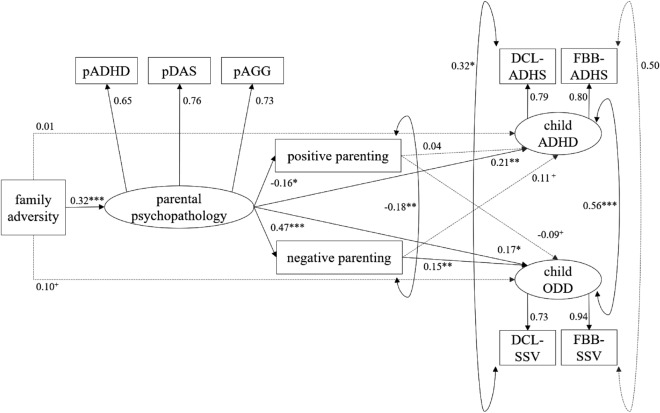
Background: Children experiencing unfavorable family circumstances have an increased risk of developing externalizing symptoms. The present study examines the direct, indirect and total effects of family adversity, parental psychopathology, and positive and negative parenting practices on symptoms of attention-deficit/hyperactivity disorder (ADHD) and oppositional defiant disorder (ODD) in children with ADHD. Methods: Data from 555 children (M = 8.9 years old, 80.5% boys) who participated in a multicenter study on the treatment of ADHD (ESCAschool) were analyzed using structural equation modeling (SEM). Results: The SEM analyses revealed that (a) family adversity and parental psychopathology are associated with both child ADHD and ODD symptoms while negative parenting practices are only related to child ODD symptoms; (b) family adversity is only indirectly associated with child ADHD and ODD symptoms, via parental psychopathology and negative parenting practices; (c) the detrimental effect of negative parenting practices on child ADHD and ODD symptoms is stronger in girls than in boys (multi-sample SEM); (d) there are no significant associations between positive parenting practices and child ADHD or ODD symptoms. Conclusions: Family adversity, parental psychopathology, and negative parenting practices should be routinely assessed by clinicians and considered in treatment planning. Trial registration (18th December 2015): German Clinical Trials Register (DRKS) DRKS00008973.
Overview
The claims and statistics of this paper haven’t been checked yet.
Free: it reads the open-access text and checks the first 5 claims that cite a source we can check. Create a free account to check every claim.
Integrity signals
Registry
Cites
Statistics
Figures
Verification
Claims the paper makes
The claims and statistics of this paper haven’t been checked yet.
Free: it reads the open-access text and checks the first 5 claims that cite a source we can check. Create a free account to check every claim.
Self-check
Percentages, sums and reported differences re-computed from the paper’s own numbers.
The self-check needs the paper’s full text.
Citations
Cites
Diagnostic and Statistical Manual of Mental Disorders
American Psychiatric Association (2013) · doi:10.1176/appi.books.9780890425596 · Cited by 116,369
lavaan : An R Package for Structural Equation Modeling
Rosseel, Y. (2012) · Journal of Statistical Software · doi:10.18637/jss.v048.i02 · Cited by 27,955
Lovibond, P. F., & Lovibond, S. H. (1995) · Behaviour Research and Therapy · doi:10.1016/0005-7967(94)00075-u · Cited by 14,523 · cited 1×
“Parental symptoms of depression, anxiety and stress (pDAS) were assessed using the German short version (DASS-21; [40]) of the Depression Anxiety and Stress Scales (DASS; [37]).”
MethodStructural Equation Modelling: Guidelines for Determining Model Fit
Hooper, D., Coughlan, J., & Mullen, M. R. (2008) · Dublin Institute of Technology · doi:10.21427/d7cf7r · Cited by 8,746
Polanczyk, G. V., Salum, G. A., Sugaya, L. S., Caye, A., & Rohde, L. A. (2015) · Journal of Child Psychology and Psychiatry · doi:10.1111/jcpp.12381 · Cited by 3,990 · cited 1×
“6% of children and adolescents worldwide [45].”
Goodman, S. H., & Gotlib, I. H. (1999) · Psychological Review · doi:10.1037/0033-295x.106.3.458 · Cited by 2,493 · cited 1×
“Besides genetic factors, several other processes that may be involved in the intergenerational transmission of psychopathology have been discussed [13, 23].”
BackgroundThe Prevalence of DSM-IV Attention-Deficit/Hyperactivity Disorder: A Meta-Analytic Review
Willcutt, E. G. (2012) · Neurotherapeutics · doi:10.1007/s13311-012-0135-8 · Cited by 2,160 · cited 1×
“Both disorders are significantly more common in boys than in girls [16, 58].”
BackgroundFaraone, S. V., Banaschewski, T., Coghill, D., Zheng, Y., Biederman, J., Bellgrove, M. A., Newcorn, J. H., Gignac, M., Al Saud, N. M., Manor, I., et al. (2021) · Neuroscience & Biobehavioral Reviews · doi:10.1016/j.neubiorev.2021.01.022 · Cited by 1,545 · cited 1×
“It is assumed that genetic and environmental risk factors accumulate to cause both of these externalizing disorders [2, 21].”
BackgroundSelf-citationPinquart, M. (2017) · Developmental psychology · doi:10.1037/dev0000295 · Cited by 1,339 · cited 5×
“The effects of family adversity, parental psychopathology, and negative parenting practices on child externalizing symptoms were small and broadly in line with previous study findings [11, 13, 36, 43, 44].”
BackgroundResultInfluentialGenetics of attention deficit hyperactivity disorder
Faraone, S. V., & Larsson, H. (2019) · Molecular Psychiatry · doi:10.1038/s41380-018-0070-0 · Cited by 1,338 · cited 1×
“The heritability of ADHD is estimated to be higher (about 74%) than that of ODD (about 61% [14, 22]).”
BackgroundADHD Comorbidity Findings From the MTA Study: Comparing Comorbid Subgroups
JENSEN, P. S., HINSHAW, S. P., KRAEMER, H. C., LENORA, N., NEWCORN, J. H., ABIKOFF, H. B., MARCH, J. S., ARNOLD, L. E., CANTWELL, D. P., CONNERS, C. K., et al. (2001) · Journal of the American Academy of Child & Adolescent Psychiatry · doi:10.1097/00004583-200102000-00009 · Cited by 974 · cited 1×
“Approximately half of children and adolescents diagnosed with ADHD are also affected by ODD [15, 33].”
BackgroundConnell, A. M., & Goodman, S. H. (2002) · Psychological Bulletin · doi:10.1037/0033-2909.128.5.746 · Cited by 943 · cited 4×
“Besides genetic factors, several other processes that may be involved in the intergenerational transmission of psychopathology have been discussed [13, 23].”
BackgroundResultInfluentialSix Theories of Child Development: Revised Formulations and Current Issues
Vasta, R. (1992) · Medical Entomology and Zoology · Cited by 852
Attainment and Adjustment in Two Geographical Areas: I—The Prevalence of Psychiatric Disorder
Rutter, M., Cox, A., Tupling, C., Berger, M., & Yule, W. (1975) · British Journal of Psychiatry · doi:10.1192/bjp.126.6.493 · Cited by 770
A Family Process Model of Economic Hardship and Adjustment of Early Adolescent Boys
Conger, R. D., Conger, K. J., Elder, G. H., Lorenz, F. O., Simons, R. L., & Whitbeck, L. B. (1992) · Child Development · doi:10.1111/j.1467-8624.1992.tb01644.x · Cited by 768 · cited 3×
“This finding is also in line with the assumptions of the family stress model [12].”
BackgroundResultInfluentialBryant, F. B., & Smith, B. D. (2001) · Journal of Research in Personality · doi:10.1006/jrpe.2000.2302 · Cited by 594 · cited 2×
“Parental aggression (pAGG) was assessed using the Aggression Questionnaire (AQ-12) by Bryant and Smith [8] in its German version [25].”
MethodOppositional Defiant Disorder and Conduct Disorder: A Review of the Past 10 Years, Part II
BURKE, J. D., LOEBER, R., & BIRMAHER, B. (2002) · Journal of the American Academy of Child & Adolescent Psychiatry · doi:10.1097/00004583-200211000-00009 · Cited by 571 · cited 1×
“, socioeconomic status or parenting behaviors) have been found to be linked to the severity of ADHD symptoms and oppositional, aggressive, and nonsocial behaviors [9, 46, 50].”
BackgroundBiederman, J. (1995) · Archives of General Psychiatry · doi:10.1001/archpsyc.1995.03950180050007 · Cited by 480 · cited 1×
“[4, 5] demonstrated that regardless of a child’s gender, the risk of developing ADHD and comorbid symptoms increased with an increasing number of family risk factors.”
BackgroundNilges, P., & Essau, C. (2015) · Der Schmerz · doi:10.1007/s00482-015-0019-z · Cited by 473
Socioeconomic Status and Child Development: A Meta-Analysis
Letourneau, N. L., Duffett-Leger, L., Levac, L., Watson, B., & Young-Morris, C. (2013) · Journal of Emotional and Behavioral Disorders · doi:10.1177/1063426611421007 · Cited by 457
Piotrowska, P. J., Stride, C. B., Croft, S. E., & Rowe, R. (2015) · Clinical Psychology Review · doi:10.1016/j.cpr.2014.11.003 · Cited by 299
Biederman, J., Faraone, S. V., & Monuteaux, M. C. (2002) · American Journal of Psychiatry · doi:10.1176/appi.ajp.159.9.1556 · Cited by 290
A Parent Practices Scale and Its Relation to Parent and Child Mental Health
STRAYHORN, J. M., & WEIDMAN, C. S. (1988) · Journal of the American Academy of Child & Adolescent Psychiatry · doi:10.1097/00004583-198809000-00016 · Cited by 280
Solantaus, T., Leinonen, J., & Punamäki, R.-L. (2004) · Developmental Psychology · doi:10.1037/0012-1649.40.3.412 · Cited by 263 · cited 1×
“Several studies provided further evidence that family financial burden exacerbates child symptoms through increased depressive symptoms of the parents and a negative influence on parenting behavior [41, 47, 53, 56].”
BackgroundGoodman, S. H., Simon, H. F. M., Shamblaw, A. L., & Kim, C. Y. (2020) · Clinical Child and Family Psychology Review · doi:10.1007/s10567-020-00322-4 · Cited by 215 · cited 1×
“Among these, parenting behavior has been shown to be directly associated with child externalizing behaviors [43] and to mediate the association between parental psychopathology and child externalizing behaviors [3, 6, 24].”
BackgroundPachter, L. M., Auinger, P., Palmer, R., & Weitzman, M. (2006) · Pediatrics · doi:10.1542/peds.2005-1784 · Cited by 201
Rowe, R., Maughan, B., Pickles, A., Costello, E. J., & Angold, A. (2002) · Journal of Child Psychology and Psychiatry · doi:10.1111/1469-7610.00027 · Cited by 176 · cited 1×
“, socioeconomic status or parenting behaviors) have been found to be linked to the severity of ADHD symptoms and oppositional, aggressive, and nonsocial behaviors [9, 46, 50].”
BackgroundADHD and Psychiatric Comorbidity: Functional Outcomes in a School-Based Sample of Children
Cuffe, S. P., Visser, S. N., Holbrook, J. R., Danielson, M. L., Geryk, L. L., Wolraich, M. L., & McKeown, R. E. (2020) · Journal of Attention Disorders · doi:10.1177/1087054715613437 · Cited by 175 · cited 1×
“Approximately half of children and adolescents diagnosed with ADHD are also affected by ODD [15, 33].”
BackgroundParent–teacher agreement on ADHD symptoms across development.
Narad, M. E., Garner, A. A., Peugh, J. L., Tamm, L., Antonini, T. N., Kingery, K. M., Simon, J. O., & Epstein, J. N. (2015) · Psychological Assessment · doi:10.1037/a0037864 · Cited by 167 · cited 1×
“Future studies should additionally obtain a teacher’s rating to provide as complete a picture as possible [38].”
BackgroundThe association between parent-reported and observed parenting: A multi-level meta-analysis.
Hendriks, A. M., der Giessen, D. V., Stams, G. J. J. M., & Overbeek, G. J. (2018) · Psychological Assessment · doi:10.1037/pas0000500 · Cited by 152 · cited 1×
“Moreover, in view of evidence of a low correspondence between parental self-report and observational measures of parenting practices [29], in future studies, it would be valuable to include observations of parenting in order to rule out the suggestion that the purported associations between parental psychopathology an…”
BackgroundCoolidge, F. L., Thede, L. L., & Young, S. E. (2000) · Developmental Neuropsychology · doi:10.1207/s15326942dn1703_1 · Cited by 137 · cited 2×
“The heritability of ADHD is estimated to be higher (about 74%) than that of ODD (about 61% [14, 22]).”
BackgroundResultDemmer, D. H., Hooley, M., Sheen, J., McGillivray, J. A., & Lum, J. A. G. (2017) · Journal of Abnormal Child Psychology · doi:10.1007/s10802-016-0170-8 · Cited by 130 · cited 1×
“Both disorders are significantly more common in boys than in girls [16, 58].”
BackgroundKennedy, M., Kreppner, J., Knights, N., Kumsta, R., Maughan, B., Golm, D., Rutter, M., Schlotz, W., & Sonuga‐Barke, E. J. S. (2016) · Journal of Child Psychology and Psychiatry · doi:10.1111/jcpp.12576 · Cited by 106 · cited 1×
“, exposure to toxins, extreme deprivation or traumatic brain injury early in life [10, 34, 54].”
BackgroundHanisch, C., Hautmann, C., Plück, J., Eichelberger, I., & Döpfner, M. (2013) · Journal of Child Psychology and Psychiatry · doi:10.1111/jcpp.12177 · Cited by 103
Self-citationShaffer, A. E., Lindhiem, O. J., Kolko, D. J., & Trentacosta, C. J. (2012) · Research on Child and Adolescent Psychopathology · doi:10.1007/s10802-012-9670-3 · Cited by 101
ADHD, CD, and ODD: Systematic review of genetic and environmental risk factors
Azeredo, A., Moreira, D., & Barbosa, F. (2018) · Research in Developmental Disabilities · doi:10.1016/j.ridd.2017.12.010 · Cited by 100 · cited 1×
“It is assumed that genetic and environmental risk factors accumulate to cause both of these externalizing disorders [2, 21].”
BackgroundEconomic Disadvantage and Young Children’s Emotional and Behavioral Problems: Mechanisms of Risk
Rijlaarsdam, J., Stevens, G. W. J. M., van der Ende, J., Hofman, A., Jaddoe, V. W. V., Mackenbach, J. P., Verhulst, F. C., & Tiemeier, H. (2013) · Journal of Abnormal Child Psychology · doi:10.1007/s10802-012-9655-2 · Cited by 99 · cited 2×
“The strengths of the associations among these familial factors in the present study are comparable with previous study findings based on the family stress model [41, 47, 56].”
BackgroundResultParental Psychopathology in Families of Children with ADHD: A Meta-analysis
Cheung, K., & Theule, J. (2016) · Journal of Child and Family Studies · doi:10.1007/s10826-016-0499-1 · Cited by 89 · cited 3×
“The effects of family adversity, parental psychopathology, and negative parenting practices on child externalizing symptoms were small and broadly in line with previous study findings [11, 13, 36, 43, 44].”
BackgroundResultNaumann, S., Bertram, H., Kuschel, A., Heinrichs, N., Hahlweg, K., & Döpfner, M. (2010) · Diagnostica · doi:10.1026/0012-1924/a000018 · Cited by 82
Self-citationFamily Environment in Attention Deficit Hyperactivity, Oppositional Defiant and Conduct Disorders
Rey, J. M., Walter, G., Plapp, J. M., & Denshire, E. (2000) · Australian & New Zealand Journal of Psychiatry · doi:10.1046/j.1440-1614.2000.00735.x · Cited by 51 · cited 1×
“, socioeconomic status or parenting behaviors) have been found to be linked to the severity of ADHD symptoms and oppositional, aggressive, and nonsocial behaviors [9, 46, 50].”
BackgroundDöpfner, M., Hautmann, C., Dose, C., Banaschewski, T., Becker, K., Brandeis, D., Holtmann, M., Jans, T., Jenkner, C., Millenet, S., et al. (2017) · BMC Psychiatry · doi:10.1186/s12888-017-1433-9 · Cited by 49 · cited 2×
“Participants and procedure This study used data drawn from the ESCAschool study (Evidence-based, Stepped Care of ADHD in schoolaged children; [18]), a multicenter trial encompassing nine study sites in Germany (Cologne, Essen, Göttingen, Hamm, Mainz, Mannheim, Marburg, Tübingen, Würzburg).”
BackgroundMethodSelf-citationBreaux, R. P., Brown, H. R., & Harvey, E. A. (2017) · Journal of Abnormal Child Psychology · doi:10.1007/s10802-016-0213-1 · Cited by 43 · cited 1×
“Among these, parenting behavior has been shown to be directly associated with child externalizing behaviors [43] and to mediate the association between parental psychopathology and child externalizing behaviors [3, 6, 24].”
BackgroundChen, M.-H., Pan, T.-L., Wang, P.-W., Hsu, J.-W., Huang, K.-L., Su, T.-P., Li, C.-T., Lin, W.-C., Tsai, S.-J., Chen, T.-J., et al. (2019) · The Journal of Clinical Psychiatry · doi:10.4088/jcp.18m12612 · Cited by 43 · cited 1×
“, exposure to toxins, extreme deprivation or traumatic brain injury early in life [10, 34, 54].”
BackgroundPerepletchikova, F., & Kazdin, A. E. (2004) · Journal of Child and Family Studies · doi:10.1023/b:jcfs.0000044723.45902.70 · Cited by 35 · cited 1×
“Negative parenting (nPAR) was measured using a short version of the Negative-Inept Parenting Scale (NIP) from the Assessment of Positive and Negative Parenting (FPNE; [30],, which was developed on the basis of the Management of Children’s Behavior Scale (MCBS, [42]).”
MethodStojanovski, S., Felsky, D., Viviano, J. D., Shahab, S., Bangali, R., Burton, C. L., Devenyi, G. A., O’Donnell, L. J., Szatmari, P., Chakravarty, M. M., et al. (2019) · Biological Psychiatry · doi:10.1016/j.biopsych.2018.06.024 · Cited by 35 · cited 1×
“, exposure to toxins, extreme deprivation or traumatic brain injury early in life [10, 34, 54].”
BackgroundJendreizik, L. T., von Wirth, E., & Döpfner, M. (2022) · Journal of Attention Disorders · doi:10.1177/10870547221132793 · Cited by 35 · cited 1×
“The finding that negative parenting practices have more impact on children’s externalizing behaviors than do positive parenting practices is also consistent with previous study findings [19, 28, 32, 43].”
ResultSelf-citationGranero, R., Louwaars, L., & Ezpeleta, L. (2015) · Frontiers in Psychology · doi:10.3389/fpsyg.2015.01412 · Cited by 34 · cited 1×
“, [27]), although conflicting evidence has also been reported [43].”
BackgroundBellina, M., Grazioli, S., Garzitto, M., Mauri, M., Rosi, E., Molteni, M., Brambilla, P., & Nobile, M. (2020) · BMC Psychiatry · doi:10.1186/s12888-020-02778-8 · Cited by 33
Family Material Hardship and Chinese Adolescents’ Problem Behaviors: A Moderated Mediation Analysis
Sun, W., Li, D., Zhang, W., Bao, Z., & Wang, Y. (2015) · PLoS ONE · doi:10.1371/journal.pone.0128024 · Cited by 32 · cited 2×
“The strengths of the associations among these familial factors in the present study are comparable with previous study findings based on the family stress model [41, 47, 56].”
BackgroundResultThöne, A., Görtz‐Dorten, A., Altenberger, P., Dose, C., Geldermann, N., Hautmann, C., Jendreizik, L. T., Treier, A., von Wirth, E., Banaschewski, T., et al. (2020) · Frontiers in Psychology · doi:10.3389/fpsyg.2020.01840 · Cited by 32
Self-citationDose, C., Hautmann, C., Bürger, M., Schürmann, S., & Döpfner, M. (2020) · European Child & Adolescent Psychiatry · doi:10.1007/s00787-020-01565-w · Cited by 23 · cited 1×
“The finding that negative parenting practices have more impact on children’s externalizing behaviors than do positive parenting practices is also consistent with previous study findings [19, 28, 32, 43].”
ResultSelf-citation
Research works printed but not linked: 2
- Görtz-Dorten A Thöne A-K Döpfner M Interview-Leitfäden zum Diagnostik-System für psychische Störungen nach DSM-5 für Kinder-und Jugendliche (DISYPS-ILF) 2022 Hogrefe
- Rösler M Retz-Junginger P Retz W Stieglitz R Homburger ADHS-Skalen für Erwachsene 2008 Hogrefe
Cited by
Inci Izmir, S. B., Aktan, Z. D., & Ercan, E. S. (2024) · Journal of Attention Disorders · doi:10.1177/10870547241267379 · Cited by 10
“Jendreizik et al. (2022) stated that there are relationships between family stress, parent’s psychopathology, and negative parenting practices of children with ADHD + ODD.”
Girma, D., Abita, Z., Adugna, A., Alie, M. S., Shifera, N., & Abebe, G. F. (2024) · PLoS ONE · doi:10.1371/journal.pone.0307173 · Cited by 7
Walenista, W., Izydorczyk, B., Lipowska, M., & Sitnik‐Warchulska, K. (2025) · Developmental Neuropsychology · doi:10.1080/87565641.2025.2540813 · Cited by 2
“…life (Weber & Waldrop, 2000), or it may be an effect of socioeconomic disadvantage where living with other family members in the same household is due to the inability of young families to maintain an independent household and the need to share space with many people (Jendreizik et al., 2022).”
Mazurek, C., Barry, T. D., & Fisher, K. (2024) · Child Neuropsychology · doi:10.1080/09297049.2024.2375804 · Cited by 2
“…association contrasts with some prior findings demonstrating family dysfunction to relate to increased aggression in adolescents (Pérez-Fuentes et al., 2019) and greater ADHD/ ODD symptom severity in school-aged children (Jendreizik et al., 2022) and children and adolescents (Pires et al., 2013).”
Stevenson, J. (2023) · Springer eBooks · doi:10.1007/978-3-031-45787-6_9 · Cited by 1
Metadata
- Authors
- Jendreizik, L. T., Hautmann, C., von Wirth, E., Dose, C., Thöne, A.-K., Treier, A.-K., Banaschewski, T., Becker, K., Brandeis, D., Geissler, J., Hebebrand, J., Hohmann, S., Holtmann, M., Huss, M., Jans, T., Kaiser, A., Millenet, S., Poustka, L., Schneider, P., & Döpfner, M.
- Affiliations
- University of Cologne (DE)
- Heidelberg University (DE)
- Philipps University of Marburg (DE)
- University of Zurich (CH)
- Universitätsklinikum Würzburg (DE)
- Essen University Hospital (DE)
- LWL-Universitätsklinik Hamm (DE)
- University Medical Center of the Johannes Gutenberg University Mainz (DE)
- Universitätsmedizin Göttingen (DE)
- Universitätsklinikum Tübingen (DE)
- Corresponding author
- Jendreizik, Lea Teresa
- ORCID
- Jendreizik, Lea Teresa
- Hautmann, Christopher
- von Wirth, Elena
- Dose, Christina
- Thöne, Ann-Kathrin
- Treier, Anne-Katrin
- Banaschewski, Tobias
- Becker, Katja
- Geissler, Julia
- Hebebrand, Johannes
- Hohmann, Sarah
- Holtmann, Martin
- Huss, Michael
- Jans, Thomas
- Kaiser, Anna
- Millenet, Sabina
- Poustka, Luise
- Schneider, Priska
- Döpfner, Manfred
- Venue
- Child and Adolescent Psychiatry and Mental Health
- Published
- 2022-12-02
- Volume
- 16
- Issue
- 1
- Pages
- 96-96
- ISSN
- 1753-2000 (ISSN-L)
- PMC
- PMC9717533
- OpenAlex
- W4311103825
- Cited by
- 12
- References
- 51
- Citations by year
- 2026: 1 · 2025: 4 · 2024: 5 · 2023: 2
- FWCI
- 1.79
- Type
- journal article
- Language
- en
- Open access
- gold
- doi.org
- Licence
- cc-by
- creativecommons.org/licenses/by/4.0 (tdm)
- creativecommons.org/licenses/by/4.0 (vor)
- Locations
- Child and Adolescent Psychiatry and Mental Health (publishedVersion, cc-by)
- PubMed Central (publishedVersion, cc-by)
- PubMed (publishedVersion)
- Kölner Universitäts PublikationsServer (Universität zu Köln) (publishedVersion)
- Zurich Open Repository and Archive (University of Zurich) (acceptedVersion, cc-by)
- Kölner Universitäts PublikationsServer (Universität zu Köln) (acceptedVersion)
- Informationszentrum Lebenswissenschaften (ZB MED) (submittedVersion, cc-by)
- DOAJ (DOAJ: Directory of Open Access Journals) (submittedVersion, cc-by-sa)
- GoeScholar The Publication Server of the Georg-August-Universität Göttingen (Georg-August-Universität Göttingen) (submittedVersion, cc-by)
- Repository for Publications and Research Data (ETH Zurich) (submittedVersion, cc-by)
- Zurich Open Repository and Archive (University of Zurich) (submittedVersion, cc-by)
- ETH Zürich Research Collection
- Zurich Open Repository and Archive (University of Zurich)
- Funders
- Bundesministerium für Bildung und Forschung (01EE1408B)
- Universitätsklinikum Köln
- Topics
- Health Sciences › Medicine › Psychiatry and Mental health › Attention Deficit Hyperactivity Disorder
- Social Sciences › Psychology › Clinical Psychology › Child and Adolescent Psychosocial and Emotional Development
- Social Sciences › Psychology › Clinical Psychology › Child Abuse and Trauma
- Keywords
- attention deficit hyperactivity disorder, oppositional defiant disorder, family adversity, parental psychopathology, parenting practices, negative parenting, externalizing problems, family risk factors, children, sex differences
About these checks
Registry, retraction, Cites and statistics results are computed, not judged, with one exception: a printed reference that no index lists is read once by a model before it counts as a citation error. Claims are extracted by a model and kept only when their quote appears verbatim in the text; each cited source is then checked, with a model’s help, for whether it says what the claim relies on. Those verdicts can be wrong — read the claim’s quote and the cited source before relying on one.
Statistics and arithmetic are recomputed, not judged.
Confidence bands are shown only for fields calibrated on our annotated test set. None is calibrated yet, so no band is shown.
What counts as a claim ›How we measure confidence ›How we check this ›
Are you an author, or do you see a problem with this page? Request a review
Data sources
Bibliographic data: Semantic Scholar, OpenAlex, Crossref.
Contains information from the Semantic Scholar Academic Graph Datasets, made available under the ODC Attribution License (ODC-BY 1.0).
Semantic Scholar’s data is described in: Kinney, R., et al. (2023). The Semantic Scholar Open Data Platform. arXiv:2301.10140.
