

Interleukin-17 induced by cumulative mild stress promoted depression-like behaviors in young adult mice
Open accessThe DOI matches its Crossref record; 63 of the 63 references it cites were found in a registry or an index.
Abstract
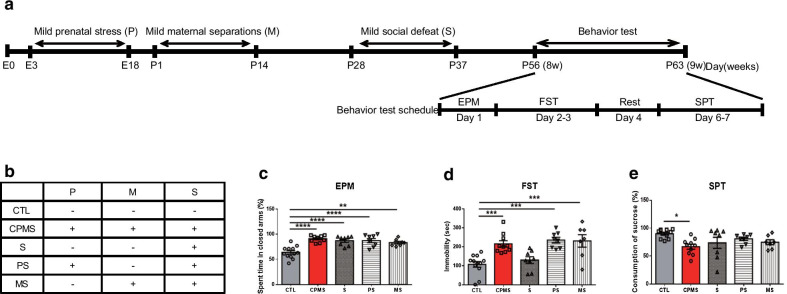
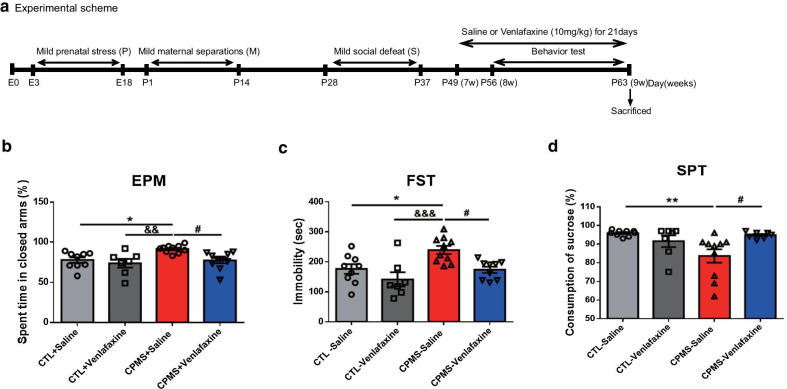
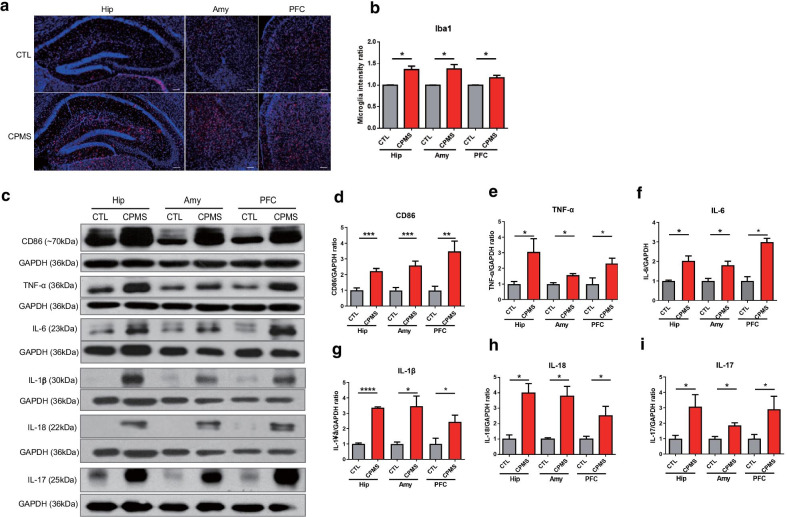
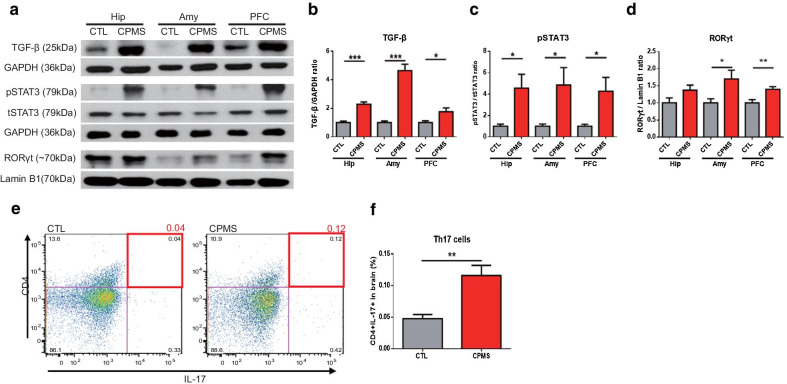
The number of young adult patients with major depression, one of the most common mental disorders, is gradually increasing in modern society. Stressful experiences in early life are considered one of the risk factors for chronic depressive symptoms, along with an abnormal inflammatory response in later life. Although increased inflammatory activity has been identified in patients with depression, the cause of long-lasting depressive states is still unclear. To identify the effects of cumulative mild stress in brain development periods, we generated a young adult depression mouse model exposed to cumulative mild stress (CPMS; cumulative mild prenatal stress, mild maternal separation, and mild social defeat) to mimic early life adversities. CPMS mice exhibited more long-lasting anxiety and depression-like behaviors than groups exposed to single or double combinations of mild stress in young adult age. Using the molecular works, we found that inflammatory cytokines, especially interleukin (IL)-17, upregulated microglial activation in the hippocampus, amygdala, and prefrontal cortex of CPMS mice. In the brains of CPMS mice, we also identified changes in the T helper (Th)-17 cell population as well as differentiation. Finally, anti-IL-17 treatment rescued anxiety and depression-like behavior in CPMS mice. In conclusion, we found that cumulative mild stress promoted long-lasting depressive symptoms in CPMS mice through the upregulation of IL-17. We suggest that the CPMS model may be useful to study young adult depression and expect that IL-17 may be an important therapeutic target for depression in young adults.
Overview
The claims and statistics of this paper haven’t been checked yet.
Free: it reads the open-access text and checks the first 5 claims that cite a source we can check. Create a free account to check every claim.
Integrity signals
Registry
Cites
Statistics
Figures
Verification
Claims the paper makes
The claims and statistics of this paper haven’t been checked yet.
Free: it reads the open-access text and checks the first 5 claims that cite a source we can check. Create a free account to check every claim.
Claims other papers make about this one
Each is checked against this paper’s own text: does it say what the citing paper says it does?
The source backs part of the claim, not all of it — or backs it for a different population, condition or comparison.
In the citing paper
“The sustained activation of the IL-17 pathway in chronic social defeat stress conditions suggests a maladaptive neuroimmune response, which may underlie the persistent behavioral changes observed”
From Comparative Analysis of HPA-Axis Dysregulation and Dynamic Molecular Mechanisms in Acute Versus Chronic Social Defeat Stress (2025) · cites this paper as [47]
Experimental — accuracy not yet measured
Self-check
Percentages, sums and reported differences re-computed from the paper’s own numbers.
The self-check needs the paper’s full text.
Citations
Cites
Ivanov, I. I., McKenzie, B. S., Zhou, L., Tadokoro, C. E., Lepelley, A., Lafaille, J. J., Cua, D. J., & Littman, D. R. (2006) · Cell · doi:10.1016/j.cell.2006.07.035 · Cited by 5,145
Kessler, R. C., & Üstün, T. B. (2004) · International Journal of Methods in Psychiatric Research · doi:10.1002/mpr.168 · Cited by 4,771
Behavioral despair in mice: a primary screening test for antidepressants.
Porsolt, R. D., Bertin, A., & Jalfre, M. (1977) · PubMed · Cited by 4,063
Zhou, L., Ivanov, I. I., Spolski, R., Min, R., Shenderov, K., Egawa, T., Levy, D. E., Leonard, W. J., & Littman, D. R. (2007) · Nature Immunology · doi:10.1038/ni1488 · Cited by 2,141
Willner, P., Towell, A., Sampson, D., Sophokleous, S., & Muscat, R. (1987) · Psychopharmacology · doi:10.1007/bf00187257 · Cited by 1,993
The effects of childhood maltreatment on brain structure, function and connectivity
Teicher, M. H., Samson, J. A., Anderson, C. M., & Ohashi, K. (2016) · Nature Reviews Neuroscience · doi:10.1038/nrn.2016.111 · Cited by 1,856 · cited 1×
“Thus, cumulative mild stress throughout the growth process can alter emotional regulation, metabolism, and immune systems [37].”
BackgroundIL-21 initiates an alternative pathway to induce proinflammatory TH17 cells
Korn, T., Bettelli, E., Gao, W., Awasthi, A., Jäger, A., Strom, T. B., Oukka, M., & Kuchroo, V. K. (2007) · Nature · doi:10.1038/nature05970 · Cited by 1,848
Masten, A. S., & Cicchetti, D. (2010) · Development and Psychopathology · doi:10.1017/s0954579410000222 · Cited by 1,800
T Helper 17 Lineage Differentiation Is Programmed by Orphan Nuclear Receptors RORα and RORγ
Yang, X. O., Pappu, B. P., Nurieva, R., Akimzhanov, A., Kang, H. S., Chung, Y., Ma, L., Shah, B., Panopoulos, A. D., Schluns, K. S., et al. (2008) · Immunity · doi:10.1016/j.immuni.2007.11.016 · Cited by 1,605 · cited 1×
“This transcription factor promotes the expression of RAR-related orphan receptor γt (RORγt) [19, 20].”
BackgroundNormal development of brain circuits
Tau, G. Z., & Peterson, B. S. (2010) · Neuropsychopharmacology · doi:10.1038/npp.2009.115 · Cited by 1,391
Cited by
Items 101–116 of 116
Daray, F. M., Grendas, L., Arena, Á., Tifner, V., Casiani, R. Á., Olaviaga, A., Chiapella, L., Vazquez, G., Penna, M., Hunter, F., et al. (2023) · Research Square · doi:10.21203/rs.3.rs-3346140/v1
Li, H., Xie, F., Cui, X., & Shen, G. (2026) · Functional & Integrative Genomics · doi:10.1007/s10142-026-01817-z · Cited by 1
“The pro-inflammatory Blocking IL-17 signaling alleviates depression symptoms in mice (Kim et al. 2021).”
CD4+ T cell dysregulation in major depressive disorder is associated with sleep disturbance
Gao, Y., Lei, Z., Ren, Y., Zhan, X., Chen, Z., Guo, Z., Zhou, Z., Ma, X., & Li, P. (2026) · Frontiers in Psychiatry · doi:10.3389/fpsyt.2026.1763750
Lin, W.-C., Huang, W. C., Hsu, J.-W., Chen, L.-C., Bai, Y., Tsai, S., & Chen, M. (2026) · Journal of Affective Disorders · doi:10.1016/j.jad.2026.121562
Chen, Y., Zhang, Y., Huang, X., Luo, X., & Wang, H. (2026) · Dermatologic Therapy · doi:10.1155/dth/9878608
dos Santos, P. F., da Mota, R., de Sá, Y. A. P. J., Hogaboam, C. M., Castro-Faria-Neto, H. C., & Carvalho, V. F. (2026) · NeuroImmunoModulation · doi:10.1159/000551742
Kim, J., Ko, G., Kim, J.-H., & Chang, K. (2026) · Translational Psychiatry · doi:10.1038/s41398-026-04149-5
Self-citationLu, Z., Yang, Q., Hu, S., Wu, H., Lu, L., Shao, Y., Ye, B., Li, L. L., Li, Z., Li, R., et al. (2026) · Cytokine · doi:10.1016/j.cyto.2026.157175
Barbetti, M., Carnevali, L., & Sgoifo, A. (2026) · Stress · doi:10.1080/10253890.2026.2684153
Shin, C.-H., Jin, S.-M., Hwang, D.-J., Nam, M.-H., Yun, H.-D., Kim, Y., Lee, J.-Y., & Seo, Y. (2026) · International Journal of Molecular Sciences · doi:10.3390/ijms27146277
Acute Interleukin 17A and Cortisol Responses to the Maastricht Acute Stress Test in Healthy AdultsPreprint
Herhaus, B., Jürgens, L., Moehler, M., Conrad, R., & Petrowski, K. (2026) · medRxiv · doi:10.64898/2026.07.23.26358762
Kim, L. Y., Renna, M. E., Shrout, M. R., Sheridan, J. F., Wesolowski, R., Noonan, A. M., Reinbolt, R. E., Malarkey, W. B., Kiecolt‐Glaser, J. K., & Madison, A. A. (2026) · Brain Behavior and Immunity · doi:10.1016/j.bbi.2026.106925
Zheng, Y., Chen, X., Li, L., Wen, J., Qiu, R., Hao, M., & Chen, C. (2026) · Food Bioscience · doi:10.1016/j.fbio.2026.109790
Zhang, S., Zeng, Z.-L., Lin, X.-E., Ran, J., Wang, Q., Yang, J.-B., Wu, Y., & Lin, N.-X. (2026) · Current Medical Science · doi:10.1007/s11596-026-00226-4
Mazaheri, M., Radahmadi, M., Hosseini-Nasab, F., & Eskandari, N. (2026) · IBRO Neuroscience Reports · doi:10.1016/j.ibneur.2026.10.009
Metadata
- Authors
- Kim, J., Suh, Y.-H., & Chang, K.-A.
- Affiliations
- Gachon University (KR)
- Corresponding author
- Chang, Keun-A
- Venue
- Molecular Brain
- Published
- 2021-01-13
- Volume
- 14
- Issue
- 1
- Pages
- 11-11
- ISSN
- 1756-6606 (ISSN-L)
- PMC
- PMC7805143
- OpenAlex
- W3120285757
- Cited by
- 116
- References
- 63
- Citations by year
- 2026: 21 · 2025: 21 · 2024: 17 · 2023: 25 · 2022: 25 · 2021: 7
- FWCI
- 6.15
- Type
- journal article
- Language
- en
- Open access
- gold
- doi.org
- Licence
- cc-by
- creativecommons.org/licenses/by/4.0/ (tdm)
- creativecommons.org/licenses/by/4.0/ (vor)
- Locations
- Molecular Brain (publishedVersion, cc-by)
- PubMed Central (publishedVersion, cc-by)
- PubMed (publishedVersion)
- DOAJ (DOAJ: Directory of Open Access Journals) (submittedVersion, cc-by-sa)
- Funders
- National Research Foundation of Korea (2016M3C7A1914451, 2020M3A9E4104384)
- Topics
- Life Sciences › Neuroscience › Biological Psychiatry › Tryptophan and brain disorders
- Life Sciences › Neuroscience › Behavioral Neuroscience › Stress Responses and Cortisol
- Life Sciences › Neuroscience › Neurology › Neuroinflammation and Neurodegeneration Mechanisms
- Keywords
- IL-17, childhood adversity, depression-like behavior, anxiety-like behavior, Th17 cells, microglial activation, neuroinflammation, maternal separation, social defeat, prenatal stress, young adult depression, hippocampus, amygdala, prefrontal cortex
- MeSH terms
- Aging, Animals, Anxiety, Behavior, Animal, Cell Differentiation, Depression, Female, Inflammation, Male, Mice, Inbred C57BL, Models, Biological, Stress, Psychological, Up-Regulation, Cytokines, Microglia, Inflammation Mediators, Interleukin-17, Mice, Th17 Cells
About these checks
Registry, retraction, Cites and statistics results are computed, not judged, with one exception: a printed reference that no index lists is read once by a model before it counts as a citation error. Claims are extracted by a model and kept only when their quote appears verbatim in the text; each cited source is then checked, with a model’s help, for whether it says what the claim relies on. Those verdicts can be wrong — read the claim’s quote and the cited source before relying on one.
Statistics and arithmetic are recomputed, not judged.
Confidence bands are shown only for fields calibrated on our annotated test set. None is calibrated yet, so no band is shown.
What counts as a claim ›How we measure confidence ›How we check this ›
Are you an author, or do you see a problem with this page? Request a review
Data sources
Bibliographic data: Semantic Scholar, OpenAlex, Crossref.
Contains information from the Semantic Scholar Academic Graph Datasets, made available under the ODC Attribution License (ODC-BY 1.0).
Semantic Scholar’s data is described in: Kinney, R., et al. (2023). The Semantic Scholar Open Data Platform. arXiv:2301.10140.
