

Mesenchymal stromal cells as vehicles of tetravalent bispecific Tandab (CD3/CD19) for the treatment of B cell lymphoma combined with IDO pathway inhibitor d-1-methyl-tryptophan
Open accessThe DOI matches its Crossref record; 47 of the 47 references it cites were found in a registry or an index.
Abstract
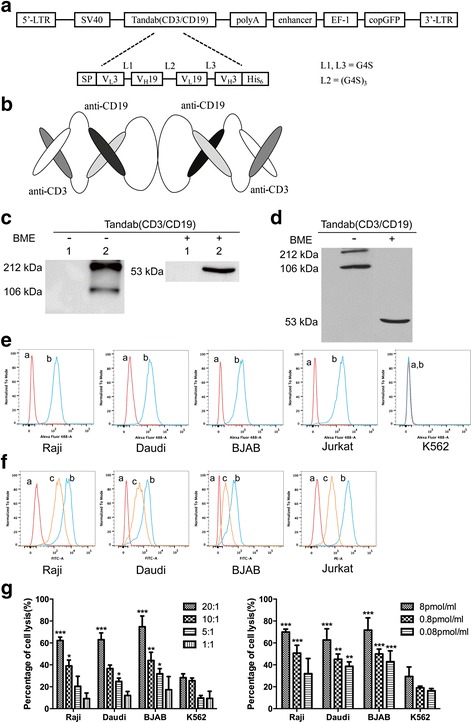
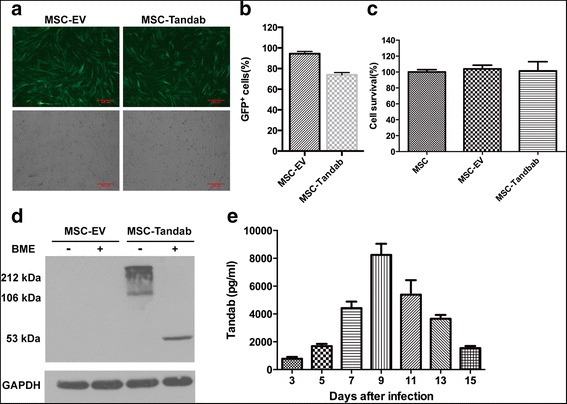
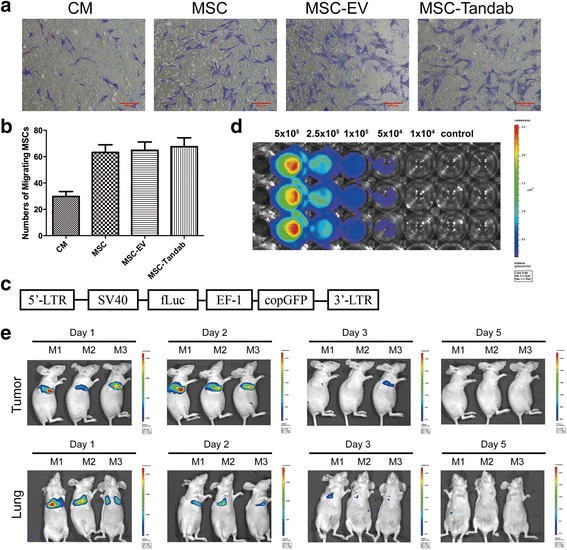
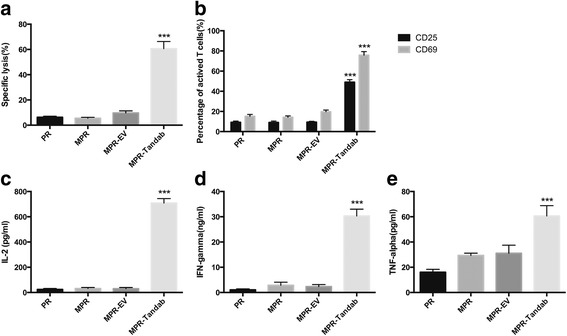
BACKGROUND: Although blinatumomab, a bispecific T cell engaging antibody, exhibits high clinical response rates in patients with relapsed or refractory B-precursor acute lymphoblastic leukemia (B-ALL) and B cell non-Hodgkin's lymphoma (B-NHL), it still has some limitations because of its short half-life. Mesenchymal stromal cells (MSCs) represent an attractive approach for delivery of therapeutic agents to cancer sites owing to their tropism towards tumors, but their immunosuppression capabilities, especially induced by indoleamine 2,3-dioxygenase (IDO), should also be taken into consideration. METHODS: Human umbilical cord-derived MSCs (UC-MSCs) were genetically modified to secrete Tandab (CD3/CD19), a tetravalent bispecific tandem diabody with two binding sites for CD3 and two for CD19. The tropism of MSCs towards Raji cells in vitro was determined by migration assays, and the homing property of MSCs in vivo was analyzed with firefly luciferase-labeled MSCs (MSC-Luc) by bioluminescent imaging (BLI). The cytotoxicity of T cells induced by MSC-secreting Tandab (CD3/CD19) was detected in vitro and in vivo in combination with D-1-methyl-tryptophan (D-1MT), an IDO pathway inhibitor. RESULTS: The purified Tandab (CD3/CD19) was functional with high-binding capability both for CD3-positive cells and CD19-positive cells and was able to induce specific lysis of CD19-positive cell lines (Raji, Daudi, and BJAB) in the presence of T cells. Additionally, results from co-culture killing experiments demonstrated that Tandab (CD3/CD19) secreted from MSCs was also effective. Then, we confirmed that D-1MT could enhance the cytotoxicity of T cells triggered by MSC-Tandab through reversing T cell anergy with down-regulation of CD98 and Jumonji and restoring the proliferation capacity of T cells. Furthermore, MSC-Luc could selectively migrate to tumor site in a BALB/c nude mouse model with Raji cells. And mice injected with MSC-Tandab in combination with D-1MT significantly inhibited the tumor growth. CONCLUSIONS: These results suggest that UC-MSCs releasing Tandab (CD3/CD19) is an efficient therapeutic tool for the treatment of B cell lymphoma when combined with D-1MT.
Overview
The claims and statistics of this paper haven’t been checked yet.
Free: it reads the open-access text and checks the first 5 claims that cite a source we can check. Create a free account to check every claim.
Integrity signals
Registry
Cites
Statistics
Figures
Verification
Claims the paper makes
The claims and statistics of this paper haven’t been checked yet.
Free: it reads the open-access text and checks the first 5 claims that cite a source we can check. Create a free account to check every claim.
Claims other papers make about this one
Each is checked against this paper’s own text: does it say what the citing paper says it does?
The source backs part of the claim, not all of it — or backs it for a different population, condition or comparison.
In the citing paper
“In a recent animal study, human umbilical cord-derived MSCs were genetically modified to produce a bispecific Ab (Tandab CD3/CD19) against B cell lymphoma and inhibited cancer cell proliferation [128].”
From Mesenchymal stromal cells for bone sarcoma treatment: Roadmap to clinical practice (2019) · cites this paper as [128]
Experimental — accuracy not yet measured
Self-check
Percentages, sums and reported differences re-computed from the paper’s own numbers.
The self-check needs the paper’s full text.
Citations
Cites
Uyttenhove, C., Pilotte, L., Théate, I., Stroobant, V., Colau, D., Parmentier, N., Boon, T., & Van den Eynde, B. J. (2003) · Nature Medicine · doi:10.1038/nm934 · Cited by 2,305 · cited 1×
“Although IDO is known to be overexpressed in several human cancers, including prostate, breast, brain, and hematologic malignancies [46], it is not detectable in Raji cells even with the stimulation of IFN-γ [47].”
BackgroundMeisel, R., Zibert, A., Laryea, M., Göbel, U., Däubener, W., & Dilloo, D. (2004) · Blood · doi:10.1182/blood-2003-11-3909 · Cited by 1,646
Frumento, G., Rotondo, R., Tonetti, M., Damonte, G., Benatti, U., & Ferrara, G. B. (2002) · The Journal of Experimental Medicine · doi:10.1084/jem.20020121 · Cited by 1,133 · cited 1×
“By depleting tryptophan locally and accumulation of its metabolites such as kynurenine and quinolinic acid, which could interact the aryl hydrocarbon receptor (AHR) on T cells, IDO seems to block the proliferation of T cells and inhibit T cell activity [18, 19].”
Background"Diabodies": small bivalent and bispecific antibody fragments.
Holliger, P., Prospero, T., & Winter, G. (1993) · Proceedings of the National Academy of Sciences · doi:10.1073/pnas.90.14.6444 · Cited by 874 · cited 1×
“The concept of dimerizing scFv fragments having a short peptide linker between the domains to create two antigen-binding sites pointing in opposite directions [27] was extended to single-chain molecules containing four antibody variable domains [8].”
BackgroundStudeny, M., Marini, F. C., Dembinski, J. L., Zompetta, C., Cabreira-Hansen, M., Bekele, B. N., Champlin, R. E., & Andreeff, M. (2004) · JNCI Journal of the National Cancer Institute · doi:10.1093/jnci/djh299 · Cited by 842 · cited 1×
“Mesenchymal stromal cells (MSCs) are attractive cellular vehicles for the therapy of malignant diseases as they have the ability to migrate into tumors and track microscopic metastasis [10, 11].”
BackgroundTryptophan Catabolism in Cancer: Beyond IDO and Tryptophan Depletion
Platten, M., Wick, W., & Van den Eynde, B. J. (2012) · Cancer Research · doi:10.1158/0008-5472.can-12-0569 · Cited by 703 · cited 1×
“It has been revealed that indoleamine 2,3-dioxygenase (IDO), the first and rate-limiting enzyme in the degradation of tryptophan [16], plays a role in human MSCs to regulate immunity in tumor microenvironment [17].”
BackgroundHow mesenchymal stem cells interact with tissue immune responses
Shi, Y., Su, J., Roberts, A. I., Shou, P., Rabson, A. B., & Ren, G. (2012) · Trends in Immunology · doi:10.1016/j.it.2011.11.004 · Cited by 633 · cited 1×
“However, it has been reported that various factors are believed to be involved in the mechanisms of MSC-mediated immunosuppression, including inducible nitric oxide synthase (iNOS), IDO, tumor necrosis factor-inducible gene 6 (TSG6), CC-chemokine ligand 2 (CCL2), IL-10, and prostaglandin E2 (PGE2) [45].”
BackgroundAntibody-modified T cells: CARs take the front seat for hematologic malignancies
Maus, M. V., Grupp, S. A., Porter, D. L., & June, C. H. (2014) · Blood · doi:10.1182/blood-2013-11-492231 · Cited by 616
Bispecific T-Cell Engaging Antibodies for Cancer Therapy
Baeuerle, P. A., & Reinhardt, C. (2009) · Cancer Research · doi:10.1158/0008-5472.can-09-0547 · Cited by 592 · cited 1×
“approach depends on T cell recruitment via bispecific antibodies (bsAbs) [36] which bind one arm to T cell activation domain and bind the other arm to a tumorassociated antigen on the target cell.”
BackgroundBrüggemann, M., Raff, T., Flohr, T., Gökbuget, N., Nakao, M., Droese, J., Lüschen, S., Pott, C., Ritgen, M., Scheuring, U., et al. (2006) · Blood · doi:10.1182/blood-2005-07-2708 · Cited by 537 · cited 2×
“(TIF 9594 kb) Abbreviations AHR: Aryl hydrocarbon receptor; B-ALL: B-precursor acute lymphoblastic leukemia; BiTE: Bispecific T cell engager; BLI: Bioluminescent imaging; BNHL: B cell non-Hodgkin’s lymphoma; BrdU: Bromodeoxyuridine; bsAbs: Bispecific antibodies; CAR: Chimeric antigen receptor; CM: Culture medium; D-1M…”
Background
Cited by
Mesenchymal Stem Cell Immunomodulation: Mechanisms and Therapeutic Potential
Song, N., Scholtemeijer, M., & Shah, K. (2020) · Trends in Pharmacological Sciences · doi:10.1016/j.tips.2020.06.009 · Cited by 948
Challenges and advances in clinical applications of mesenchymal stromal cells
Zhou, T., Yuan, Z., Weng, J., Pei, D., Du, X., He, C., & Lai, P. (2021) · Journal of Hematology & Oncology · doi:10.1186/s13045-021-01037-x · Cited by 712
“MSCs loaded with degradable budesonide-containing MPs exhibited fourfold increase in IDO activity in vitro compared to MSCs without being pre-treated with budesonide [104].”
BackgroundZhuang, W.-Z., Lin, Y.-H., Su, L.-J., Wu, M.-S., Jeng, H.-Y., Chang, H.-C., Huang, Y.-H., & Ling, T.-Y. (2021) · Journal of Biomedical Science · doi:10.1186/s12929-021-00725-7 · Cited by 258
Challenges and strategies for next-generation bispecific antibody-based antitumor therapeutics
Li, H., Er Saw, P., & Song, E. (2020) · Cellular & Molecular Immunology · doi:10.1038/s41423-020-0417-8 · Cited by 200
Redirecting T cells to hematological malignancies with bispecific antibodies
Velasquez, M. P., Bonifant, C. L., & Gottschalk, S. (2018) · Blood · doi:10.1182/blood-2017-06-741058 · Cited by 172
“18 against CD19-positive lymphoma in a xenograft model.(92) MSCs may themselves be immunosuppressive and therefore, engineering of alternate immune effectors with good fitness may additionally improve potency.”
Background
Metadata
- Authors
- Zhang, X., Yang, Y., Zhang, L., Lu, Y., Zhang, Q., Fan, D., Zhang, Y., Zhang, Y., Ye, Z., & Xiong, D.
- Affiliations
- Chinese Academy of Medical Sciences & Peking Union Medical College (CN)
- Corresponding author
- Zhang, Yizhi
- Zhang, Yanjun
- Xiong, Dongsheng
- ORCID
- Venue
- Journal of Hematology & Oncology
- Published
- 2017-02-23
- Volume
- 10
- Issue
- 1
- Pages
- 56-56
- ISSN
- 1756-8722 (ISSN-L)
- PMC
- PMC5322661
- OpenAlex
- W2591391056
- Semantic Scholar
- 1c442fe1caa683b262f13e91272f0aafb1925dce
- Cited by
- 89
- References
- 47
- Citations by year
- 2026: 3 · 2025: 11 · 2024: 2 · 2023: 7 · 2022: 17 · 2021: 18 · 2020: 14 · 2019: 7 · 2018: 6 · 2017: 4
- FWCI
- 4.87
- Type
- journal article
- Language
- en
- Open access
- gold
- doi.org
- Licence
- cc-by
- Locations
- Journal of Hematology & Oncology (publishedVersion, cc-by)
- PubMed Central (publishedVersion, cc-by)
- PubMed (publishedVersion)
- DOAJ (DOAJ: Directory of Open Access Journals) (submittedVersion, cc-by-sa)
- Funders
- National Natural Science Foundation of China (30971291, 81400176, 81572993)
- National Science and Technology Major Project of China (2012zx09102301-015)
- CAMS Initiative for Innovative Medicine (2016-I2M-1-007, 2016-I2M-3-013)
- Topics
- Life Sciences › Biochemistry, Genetics and Molecular Biology › Cell Biology › Mesenchymal stem cell research
- Health Sciences › Medicine › Oncology › CAR-T cell therapy research
- Life Sciences › Biochemistry, Genetics and Molecular Biology › Biotechnology › Bacterial Cancer Therapy
- Keywords
- mesenchymal stem cells, B-cell lymphoma, B-cell non-Hodgkin lymphoma, indoleamine 2,3-dioxygenase inhibition, tumor tropism, tumor homing, T cell anergy, CD98, tumor growth inhibition, adoptive immunotherapy, T cell cytotoxicity, immunosuppressive tumor microenvironment
- MeSH terms
- Animals, Antibodies, Neoplasm, Antibody-Dependent Cell Cytotoxicity, Cell Line, Humans, T-Lymphocytes, Tryptophan, Lymphoma, B-Cell, CD3 Complex, Antibodies, Bispecific, Antigens, CD19, K562 Cells, Cell Line, Tumor, Indoleamine-Pyrrole 2,3,-Dioxygenase, Mice, Single-Chain Antibodies, HEK293 Cells, Mesenchymal Stem Cells, Heterografts
About these checks
Registry, retraction, Cites and statistics results are computed, not judged, with one exception: a printed reference that no index lists is read once by a model before it counts as a citation error. Claims are extracted by a model and kept only when their quote appears verbatim in the text; each cited source is then checked, with a model’s help, for whether it says what the claim relies on. Those verdicts can be wrong — read the claim’s quote and the cited source before relying on one.
Statistics and arithmetic are recomputed, not judged.
Confidence bands are shown only for fields calibrated on our annotated test set. None is calibrated yet, so no band is shown.
What counts as a claim ›How we measure confidence ›How we check this ›
Are you an author, or do you see a problem with this page? Request a review
Data sources
Bibliographic data: Semantic Scholar, OpenAlex, Crossref.
Contains information from the Semantic Scholar Academic Graph Datasets, made available under the ODC Attribution License (ODC-BY 1.0).
Semantic Scholar’s data is described in: Kinney, R., et al. (2023). The Semantic Scholar Open Data Platform. arXiv:2301.10140.
