

Targeting the Wnt/β-catenin signaling pathway in cancer
Open accessThe DOI matches its Crossref record; 166 of the 166 references it cites were found in a registry or an index.
Abstract
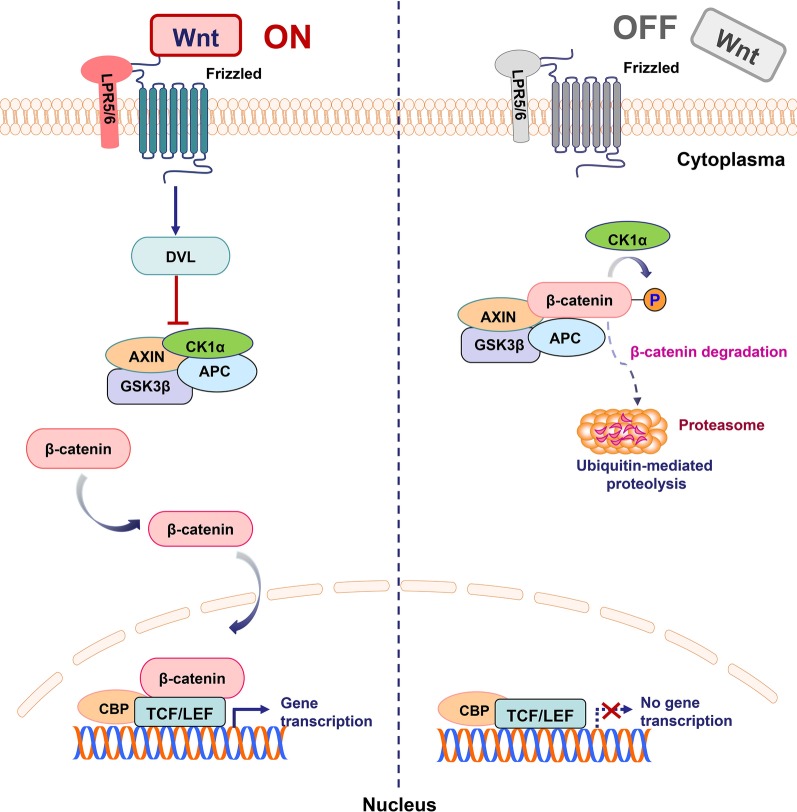
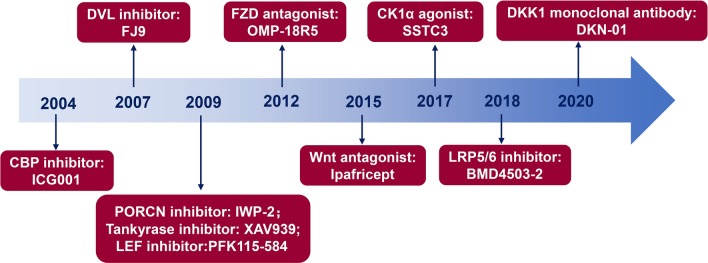
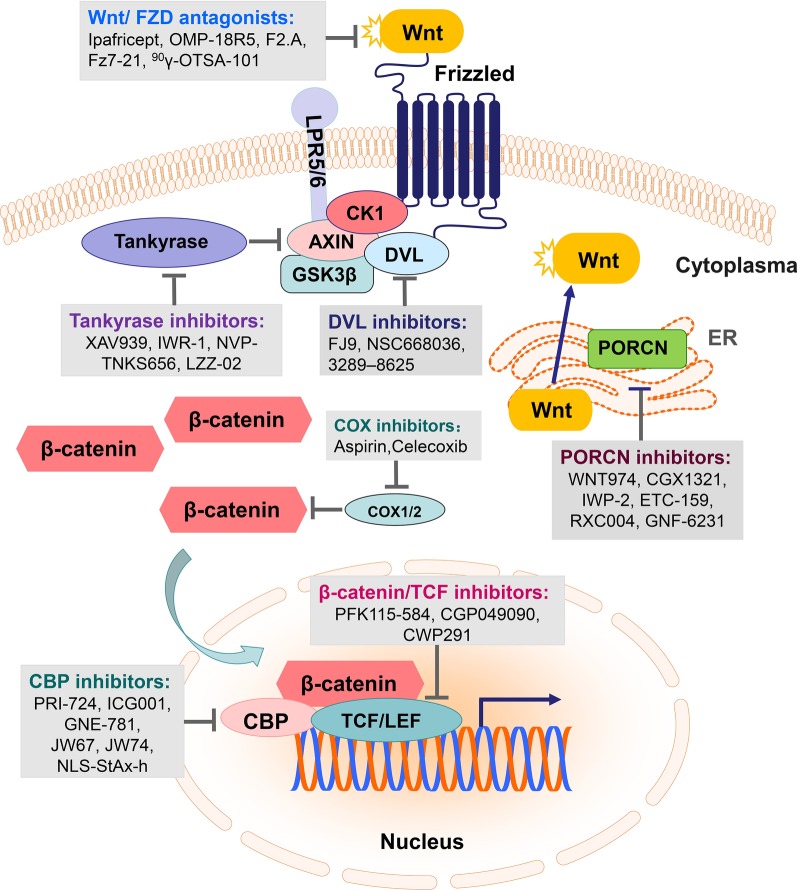
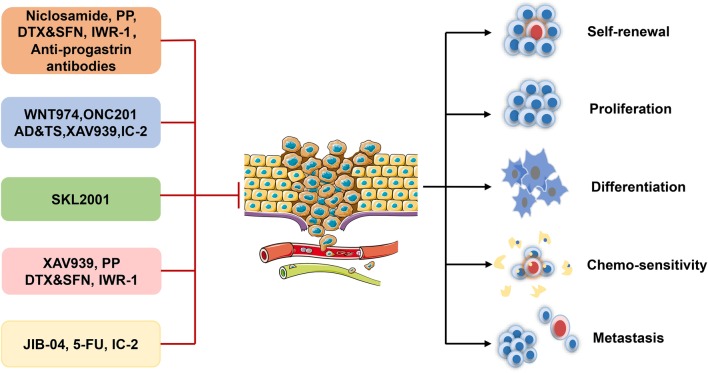
The aberrant Wnt/β-catenin signaling pathway facilitates cancer stem cell renewal, cell proliferation and differentiation, thus exerting crucial roles in tumorigenesis and therapy response. Accumulated investigations highlight the therapeutic potential of agents targeting Wnt/β-catenin signaling in cancer. Wnt ligand/ receptor interface, β-catenin destruction complex and TCF/β-catenin transcription complex are key components of the cascade and have been targeted with interventions in preclinical and clinical evaluations. This scoping review aims at outlining the latest progress on the current approaches and perspectives of Wnt/β-catenin signaling pathway targeted therapy in various cancer types. Better understanding of the updates on the inhibitors, antagonists and activators of Wnt/β-catenin pathway rationalizes innovative strategies for personalized cancer treatment. Further investigations are warranted to confirm precise and secure targeted agents and achieve optimal use with clinical benefits in malignant diseases.
Overview
The claims and statistics of this paper haven’t been checked yet.
Free: it reads the open-access text and checks the first 5 claims that cite a source we can check. Create a free account to check every claim.
Integrity signals
Registry
Cites
Statistics
Figures
Verification
Claims the paper makes
The claims and statistics of this paper haven’t been checked yet.
Free: it reads the open-access text and checks the first 5 claims that cite a source we can check. Create a free account to check every claim.
Claims other papers make about this one
Each is checked against this paper’s own text: does it say what the citing paper says it does?
The source backs part of the claim, not all of it — or backs it for a different population, condition or comparison.
In the citing paper
“The Wnt/β-catenin pathway is a well-established oncogenic driver in numerous cancers, including ccRCC, where its aberrant activation is linked to tumor initiation and progression [30–32].”
From PPP1R18-mediated activation of Wnt/β-catenin and EMT is dependent on ERK signaling in clear cell renal cell carcinoma (2026) · cites this paper as [30]
Experimental — accuracy not yet measured
Self-check
Percentages, sums and reported differences re-computed from the paper’s own numbers.
The self-check needs the paper’s full text.
Citations
Cites
2 retracted
Razak, S., Afsar, T., Almajwal, A. M., et al. (2019) · Cell & Bioscience · doi:10.1186/s13578-019-0277-z · Cited by 43
RetractedWu, L., He, S., He, Y., Wang, X., & Lu, L. (2018) · Medical Science Monitor · doi:10.12659/msm.910742 · Cited by 14
Self-citationRetractedWnt/β-Catenin Signaling, Disease, and Emerging Therapeutic Modalities
Nusse, R., & Clevers, H. (2017) · Cell · doi:10.1016/j.cell.2017.05.016 · Cited by 4,342
Tankyrase inhibition stabilizes axin and antagonizes Wnt signalling
Huang, S.-M. A., Mishina, Y. M., Liu, S., Cheung, A., Stegmeier, F., Michaud, G. A., Charlat, O., Wiellette, E., Zhang, Y., Wiessner, S., et al. (2009) · Nature · doi:10.1038/nature08356 · Cited by 2,037
Self-citationCan we safely target the WNT pathway?
Kahn, M. (2014) · Nature Reviews Drug Discovery · doi:10.1038/nrd4233 · Cited by 1,034
Targeting the Wnt/beta-catenin pathway in cancer: Update on effectors and inhibitors
Krishnamurthy, N., & Kurzrock, R. (2018) · Cancer Treatment Reviews · doi:10.1016/j.ctrv.2017.11.002 · Cited by 1,026
Targeting cancer stem cells by inhibiting Wnt, Notch, and Hedgehog pathways
Takebe, N., Harris, P. J., Warren, R. Q., & Ivy, S. P. (2011) · Nature Reviews Clinical Oncology · doi:10.1038/nrclinonc.2010.196 · Cited by 992
Wnt Induces LRP6 Signalosomes and Promotes Dishevelled-Dependent LRP6 Phosphorylation
Bilić, J., Huang, Y.-L., Davidson, G., Zimmermann, T., Cruciat, C.-M., Bienz, M., & Niehrs, C. (2007) · Science · doi:10.1126/science.1137065 · Cited by 934
The m6A reader YTHDF1 promotes ovarian cancer progression via augmenting EIF3C translation
Liu, T., Wei, Q., Jin, J., Luo, Q., Liu, Y., Yang, Y., Cheng, C., Li, L., Pi, J., Si, Y., et al. (2020) · Nucleic Acids Research · doi:10.1093/nar/gkaa048 · Cited by 746
The Roles of APC and Axin Derived from Experimental and Theoretical Analysis of the Wnt Pathway
Lee, E., Salic, A., Krüger, R., Heinrich, R., & Kirschner, M. W. (2003) · PLoS Biology · doi:10.1371/journal.pbio.0000010 · Cited by 708
Research works printed but not linked: 1
- Amado N Predes D Fonseca B Cerqueira D Reis A Dudenhoeffer A Borges H Mendes F Abreu J Isoquercitrin suppresses colon cancer cell growth in vitro by targeting the Wnt/β-catenin signaling pathway J Biol Chem 2014 289 51 35456 35467 10.1074/jbc.M114.621599 25359775 PMC4271231 · DOI
Cited by
Items 1,001–1,002 of 1,002
Insights into the molecular roles of FOXR2 in the pathology of primary pediatric brain tumors
Gharbaran, R. (2023) · Critical Reviews in Oncology/Hematology · doi:10.1016/j.critrevonc.2023.104188 · Cited by 3
Ji, X., Yun, Y., Zhu, Z., Wu, T., Ruan, M., Fan, Y., & Zhang, Q. (2026) · Cancer Cell International · doi:10.1186/s12935-026-04266-7
“The Wnt/β-catenin pathway is a well-established oncogenic driver in numerous cancers, including ccRCC, where its aberrant activation is linked to tumor initiation and progression [30–32].”
Metadata
- Authors
- Zhang, Y., & Wang, X.
- Affiliations
- Shandong University (CN)
- Corresponding author
- Wang, Xin
- Venue
- Journal of Hematology & Oncology
- Published
- 2020-12
- Volume
- 13
- Issue
- 1
- Pages
- 165-165
- ISSN
- 1756-8722 (ISSN-L)
- PMC
- PMC7716495
- OpenAlex
- W3108389912
- Semantic Scholar
- 0d7942a68a143e7bb071bb09cce214062907f1cc
- Cited by
- 1,431
- References
- 165
- Citations by year
- 2026: 140 · 2025: 298 · 2024: 363 · 2023: 312 · 2022: 238 · 2021: 79 · 2020: 1
- FWCI
- 15.17
- Type
- journal article
- Language
- en
- Open access
- gold
- doi.org
- Licence
- cc-by
- creativecommons.org/licenses/by/4.0/ (tdm)
- creativecommons.org/licenses/by/4.0/ (vor, 3 d)
- Locations
- Journal of Hematology & Oncology (publishedVersion, cc-by)
- PubMed Central (publishedVersion, cc-by)
- PubMed (publishedVersion)
- DOAJ (DOAJ: Directory of Open Access Journals) (submittedVersion, cc-by-sa)
- Funders
- National Natural Science Foundation of China (No.82000195)
- National Natural Science Foundation (No. 81270598, No. 81473486, No. 81770210)
- Key Research and Development Program of Shandong Province (No.2018CXGC1213)
- Technology Development Projects of Shandong Province (No. 2017GSF18189)
- Taishan Scholars Program of Shandong Province (No.tsqn201909184)
- Academic promotion programme of Shandong First Medical University (2020RC007)
- Shandong Provincial Hospital Youth Talent Plan
- Shandong Provincial Hospital Research Incubation Fund
- Topics
- Life Sciences › Biochemistry, Genetics and Molecular Biology › Molecular Biology › Wnt/β-catenin signaling in development and cancer
- Health Sciences › Medicine › Oncology › Colorectal Cancer Treatments and Studies
- Life Sciences › Biochemistry, Genetics and Molecular Biology › Molecular Biology › Hedgehog Signaling Pathway Studies
- Keywords
- Wnt/β-catenin signaling, cancer stem cells, targeted cancer therapy, β-catenin destruction complex, Wnt inhibitors, precision oncology, carcinogenesis
- MeSH terms
- Animals, Antineoplastic Agents, Humans, Neoplasms, Neoplastic Stem Cells, Wnt Proteins, beta Catenin, Molecular Targeted Therapy, Wnt Signaling Pathway
About these checks
Registry, retraction, Cites and statistics results are computed, not judged, with one exception: a printed reference that no index lists is read once by a model before it counts as a citation error. Claims are extracted by a model and kept only when their quote appears verbatim in the text; each cited source is then checked, with a model’s help, for whether it says what the claim relies on. Those verdicts can be wrong — read the claim’s quote and the cited source before relying on one.
Statistics and arithmetic are recomputed, not judged.
Confidence bands are shown only for fields calibrated on our annotated test set. None is calibrated yet, so no band is shown.
What counts as a claim ›How we measure confidence ›How we check this ›
Are you an author, or do you see a problem with this page? Request a review
Data sources
Bibliographic data: Semantic Scholar, OpenAlex, Crossref.
Contains information from the Semantic Scholar Academic Graph Datasets, made available under the ODC Attribution License (ODC-BY 1.0).
Semantic Scholar’s data is described in: Kinney, R., et al. (2023). The Semantic Scholar Open Data Platform. arXiv:2301.10140.
