

Novel therapies emerging in oncology to target the TGF‐β pathway
Open accessThe DOI matches its Crossref record; 140 of the 142 references it cites were found in a registry or an index.
Abstract
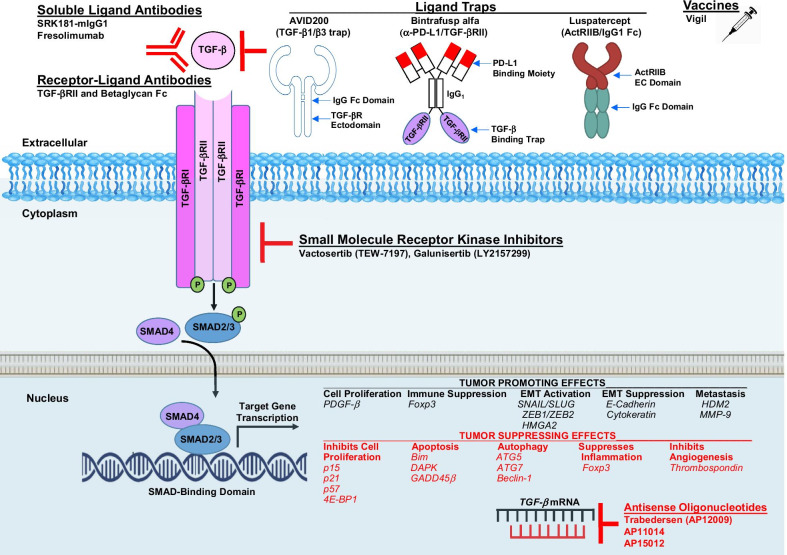
The TGF-β signaling pathway governs key cellular processes under physiologic conditions and is deregulated in many pathologies, including cancer. TGF-β is a multifunctional cytokine that acts in a cell- and context-dependent manner as a tumor promoter or tumor suppressor. As a tumor promoter, the TGF-β pathway enhances cell proliferation, migratory invasion, metastatic spread within the tumor microenvironment and suppresses immunosurveillance. Collectively, the pleiotropic nature of TGF-β signaling contributes to drug resistance, tumor escape and undermines clinical response to therapy. Based upon a wealth of preclinical studies, the TGF-β pathway has been pharmacologically targeted using small molecule inhibitors, TGF-β-directed chimeric monoclonal antibodies, ligand traps, antisense oligonucleotides and vaccines that have been now evaluated in clinical trials. Here, we have assessed the safety and efficacy of TGF-β pathway antagonists from multiple drug classes that have been evaluated in completed and ongoing trials. We highlight Vactosertib, a highly potent small molecule TGF-β type 1 receptor kinase inhibitor that is well-tolerated with an acceptable safety profile that has shown efficacy against multiple types of cancer. The TGF-β ligand traps Bintrafusp alfa (a bifunctional conjugate that binds TGF-β and PD-L1), AVID200 (a computationally designed trap of TGF-β receptor ectodomains fused to an Fc domain) and Luspatercept (a recombinant fusion that links the activin receptor IIb to IgG) offer new ways to fight difficult-to-treat cancers. While TGF-β pathway antagonists are rapidly emerging as highly promising, safe and effective anticancer agents, significant challenges remain. Minimizing the unintentional inhibition of tumor-suppressing activity and inflammatory effects with the desired restraint on tumor-promoting activities has impeded the clinical development of TGF-β pathway antagonists. A better understanding of the mechanistic details of the TGF-β pathway should lead to more effective TGF-β antagonists and uncover biomarkers that better stratify patient selection, improve patient responses and further the clinical development of TGF-β antagonists.
Overview
The claims and statistics of this paper haven’t been checked yet.
Free: it reads the open-access text and checks the first 5 claims that cite a source we can check. Create a free account to check every claim.
Integrity signals
Registry
Cites
Statistics
Figures
Verification
Claims the paper makes
The claims and statistics of this paper haven’t been checked yet.
Free: it reads the open-access text and checks the first 5 claims that cite a source we can check. Create a free account to check every claim.
Claims other papers make about this one
Each is checked against this paper’s own text: does it say what the citing paper says it does?
The source backs part of the claim, not all of it — or backs it for a different population, condition or comparison.
In the citing paper
“AVID200, a ligand trap for TGF‐β1 and TGF‐β3, showed anti‐tumor activity in mouse models [164] and feasibility in clinics in patients with advanced solid‐state tumors in a phase 1 clinical trial (NCT03834662) [165].”
From Tumor microenvironment signaling and therapeutics in cancer progression (2023) · cites this paper as [164]
Experimental — accuracy not yet measuredThe source backs part of the claim, not all of it — or backs it for a different population, condition or comparison.
In the citing paper
“Hyperactivated TGF-β signaling was associated with the poor response to α-PD-1/PD-L1, and blocking TGF-β significantly improved the efficacy of α-PD-1/PD-L1 [299–302].”
From Combination strategies with PD-1/PD-L1 blockade: current advances and future directions (2022) · cites this paper as [302]
Experimental — accuracy not yet measured
Self-check
Percentages, sums and reported differences re-computed from the paper’s own numbers.
The self-check needs the paper’s full text.
Citations
Cites
Chen, W., Jin, W., Hardegen, N., Lei, K.-J., Li, L., Marinos, N., McGrady, G., & Wahl, S. M. (2003) · The Journal of Experimental Medicine · doi:10.1084/jem.20030152 · Cited by 4,699
Massagué, J. (2008) · Cell · doi:10.1016/j.cell.2008.07.001 · Cited by 3,907
Massagué, J. (2012) · Nature Reviews Molecular Cell Biology · doi:10.1038/nrm3434 · Cited by 3,128
Role of Transforming Growth Factor β in Human Disease
Blobe, G. C., Schiemann, W. P., & Lodish, H. F. (2000) · New England Journal of Medicine · doi:10.1056/nejm200005043421807 · Cited by 2,427
Transforming Growth Factor-β Signaling in Immunity and Cancer
Batlle, E., & Massagué, J. (2019) · Immunity · doi:10.1016/j.immuni.2019.03.024 · Cited by 2,366
The evolving landscape of biomarkers for checkpoint inhibitor immunotherapy
Havel, J. J., Chowell, D., & Chan, T. A. (2019) · Nature Reviews Cancer · doi:10.1038/s41568-019-0116-x · Cited by 2,286 · cited 1×
“Immune markers Checkpoint inhibitor-based immunotherapies that target cytotoxic T lymphocyte antigen 4 (CTLA4) or the programmed cell death 1 (PD1) pathway have achieved impressive success in the treatment of different cancer types, but only a subset of patients derive clinical benefit [63].”
BackgroundMassagué, J. (2000) · Nature Reviews Molecular Cell Biology · doi:10.1038/35043051 · Cited by 1,899
TGF-ß Signaling in Fibroblasts Modulates the Oncogenic Potential of Adjacent Epithelia
Bhowmick, N. A., Chytil, A., Plieth, D., Gorska, A. E., Dumont, N., Shappell, S., Washington, M. K., Neilson, E. G., & Moses, H. L. (2004) · Science · doi:10.1126/science.1090922 · Cited by 1,401
TGF-β directly targets cytotoxic T cell functions during tumor evasion of immune surveillance
Thomas, D. A., & Massagué, J. (2005) · Cancer Cell · doi:10.1016/j.ccr.2005.10.012 · Cited by 1,355
TGFβ: the molecular Jekyll and Hyde of cancer
Bierie, B., & Moses, H. L. (2006) · Nature Reviews Cancer · doi:10.1038/nrc1926 · Cited by 1,267
Research works printed but not linked: 4
- Tang J Gifford CC Samarakoon R Higgins PJ Deregulation of negative controls on TGF-β1 signaling in tumor progression Cancers (Basel) 2018 10 6 159 10.3390/cancers10060159.PMID:29799477;PMCID:PMC6025439 PMC6025439 29799477 · DOI · Paper page
- Lee KW Park YS Ahn JB Rha SY Kim HK Lee PY Ryu MH Lee J Lee JK Hwang S Safety and anti-tumor activity of the transforming growth factor beta receptor I kinase inhibitor, vactosertib, in combination with pembrolizumab in patients with metastatic colorectal or gastric cancer J Immunother Cancer 2020 8 Suppl. 3 A358
- Han JY Pyo KH Kim JH Xin CF Lee JK Hwang S Kim SJ Cho BC Cho BC Safety and anti-tumor activity of the transforming growth factor beta receptor I kinase inhibitor, vactosertib, in combination with durvalumab in patients with advanced non-small cell lung cancer (NSCLC) J Immunother Cancer 2020 8 Suppl. 3 A388
- Yap TBC, Massard C. First-in-human phase 1 dose-escalation trial of the potent and selective next generation transforming growth factor-β receptor type 1 (TGF-βR1) inhibitor LY3200882 in patients with advanced cancer. In Proceedings from the 2018 SITC annual meeting. 2018; Abstract 030.
Cited by
Items 401–454 of 454
Sugatani, T., Yeo, K., Campioli, M. A., Fujimoto, H., & Civitelli, R. (2025) · bioRxiv (Cold Spring Harbor Laboratory) · doi:10.1101/2025.10.22.683948
Lenferink, A. E. G., Zwaagstra, J. C., Baardsnes, J., Delafosse, L., Parat, M., Iqbal, U., Lessard, E., Haqqani, A. S., Jezierski, A., Abu-Thuraia, A., et al. (2025) · Frontiers in Oncology · doi:10.3389/fonc.2025.1648779 · Cited by 1
Martinho, J. D. O., Castanhole-Nunes, M. M. U., Henrique, T., Kawasaki‐Oyama, R. S., Serafim, V., Possebon, V. S., Pavarino, É. C., & Goloni‐Bertollo, E. M. (2025) · Current Signal Transduction Therapy · doi:10.2174/0115743624377722251010100301
LAMC2 promotes gallbladder carcinoma metastasis through the TGF-β pathway
Xu, M., Zhang, Y., Feng, H., Shang, T., Chen, Y., Liu, E., Lin, Y., Pan, Y., Zhou, Y., Feng, X., et al. (2025) · Cancer Cell International · doi:10.1186/s12935-025-04123-z
Yi, M., Niu, M., Wu, Y., Ge, H., Jiao, D., Zhu, S., Zhang, J., Yan, Y., Zhou, P., Chu, Q., et al. (2022) · Figshare · doi:10.6084/m9.figshare.21303575
Yi, M., Niu, M., Wu, Y., Ge, H., Jiao, D., Zhu, S., Zhang, J., Yan, Y., Zhou, P., Chu, Q., et al. (2022) · Figshare · doi:10.6084/m9.figshare.21303590
Yi, M., Niu, M., Wu, Y., Ge, H., Jiao, D., Zhu, S., Zhang, J., Yan, Y., Zhou, P., Chu, Q., et al. (2022) · Figshare · doi:10.6084/m9.figshare.21303563
Yi, M., Niu, M., Wu, Y., Ge, H., Jiao, D., Zhu, S., Zhang, J., Yan, Y., Zhou, P., Chu, Q., et al. (2022) · Figshare · doi:10.6084/m9.figshare.21303557
Guo, Y., Wang, Z., Zhou, H., Pan, H., Han, W., Deng, Y., Li, Q., Xue, J., Ge, X., Wang, S., et al. (2024) · Figshare · doi:10.6084/m9.figshare.26704773
Guo, Y., Wang, Z., Zhou, H., Pan, H., Han, W., Deng, Y., Li, Q., Xue, J., Ge, X., Wang, S., et al. (2024) · Figshare · doi:10.6084/m9.figshare.26704767
Yi, M., Niu, M., Wu, Y., Ge, H., Jiao, D., Zhu, S., Zhang, J., Yan, Y., Zhou, P., Chu, Q., et al. (2022) · Figshare · doi:10.6084/m9.figshare.21303569
Guo, Y., Wang, Z., Zhou, H., Pan, H., Han, W., Deng, Y., Li, Q., Xue, J., Ge, X., Wang, S., et al. (2024) · Figshare · doi:10.6084/m9.figshare.26704761
Yi, M., Niu, M., Wu, Y., Ge, H., Jiao, D., Zhu, S., Zhang, J., Yan, Y., Zhou, P., Chu, Q., et al. (2022) · Figshare · doi:10.6084/m9.figshare.21303581
Niu, M., Yi, M., Wu, Y., Lyu, L., He, Q., Yang, R., Zeng, L., Shi, J. Y., Zhang, J., Zhou, P., et al. (2024) · Figshare · doi:10.6084/m9.figshare.26610165
Yi, M., Niu, M., Wu, Y., Ge, H., Jiao, D., Zhu, S., Zhang, J., Yan, Y., Zhou, P., Chu, Q., et al. (2022) · Figshare · doi:10.6084/m9.figshare.21303560
Yi, M., Niu, M., Wu, Y., Ge, H., Jiao, D., Zhu, S., Zhang, J., Yan, Y., Zhou, P., Chu, Q., et al. (2022) · Figshare · doi:10.6084/m9.figshare.21303566
Liu, D., Zhou, J., Wang, Y., Li, M., Jiang, H., Liu, Y., Yin, X., Ge, M., Xiang, X., Ying, J., et al. (2022) · Figshare · doi:10.6084/m9.figshare.21393828
Yi, M., Niu, M., Wu, Y., Ge, H., Jiao, D., Zhu, S., Zhang, J., Yan, Y., Zhou, P., Chu, Q., et al. (2022) · Figshare · doi:10.6084/m9.figshare.21303548
Yi, M., Niu, M., Wu, Y., Ge, H., Jiao, D., Zhu, S., Zhang, J., Yan, Y., Zhou, P., Chu, Q., et al. (2022) · Figshare · doi:10.6084/m9.figshare.21303578
Guo, Y., Wang, Z., Zhou, H., Pan, H., Han, W., Deng, Y., Li, Q., Xue, J., Ge, X., Wang, S., et al. (2024) · Figshare · doi:10.6084/m9.figshare.25584037
Guo, Y., Wang, Z., Zhou, H., Pan, H., Han, W., Deng, Y., Li, Q., Xue, J., Ge, X., Wang, S., et al. (2024) · Figshare · doi:10.6084/m9.figshare.26704758
Guo, Y., Wang, Z., Zhou, H., Pan, H., Han, W., Deng, Y., Li, Q., Xue, J., Ge, X., Wang, S., et al. (2024) · Figshare · doi:10.6084/m9.figshare.25583896
Zhang, T., Xia, W., Song, X., Mao, Q., Huang, X., Chen, B., Liang, Y., Wang, H., Chen, Y., Yu, X., et al. (2022) · Figshare · doi:10.6084/m9.figshare.20517240
Yi, M., Niu, M., Wu, Y., Ge, H., Jiao, D., Zhu, S., Zhang, J., Yan, Y., Zhou, P., Chu, Q., et al. (2022) · Figshare · doi:10.6084/m9.figshare.21303572
Zhang, T., Xia, W., Song, X., Mao, Q., Huang, X., Chen, B., Liang, Y., Wang, H., Chen, Y., Yu, X., et al. (2022) · Figshare · doi:10.6084/m9.figshare.20517237
Yi, M., Niu, M., Wu, Y., Ge, H., Jiao, D., Zhu, S., Zhang, J., Yan, Y., Zhou, P., Chu, Q., et al. (2022) · Figshare · doi:10.6084/m9.figshare.21303554
Guo, Y., Wang, Z., Zhou, H., Pan, H., Han, W., Deng, Y., Li, Q., Xue, J., Ge, X., Wang, S., et al. (2024) · Figshare · doi:10.6084/m9.figshare.26704770
Guo, Y., Wang, Z., Zhou, H., Pan, H., Han, W., Deng, Y., Li, Q., Xue, J., Ge, X., Wang, S., et al. (2024) · Figshare · doi:10.6084/m9.figshare.26704764
Yi, M., Niu, M., Wu, Y., Ge, H., Jiao, D., Zhu, S., Zhang, J., Yan, Y., Zhou, P., Chu, Q., et al. (2022) · Figshare · doi:10.6084/m9.figshare.21303587
Yi, M., Niu, M., Wu, Y., Ge, H., Jiao, D., Zhu, S., Zhang, J., Yan, Y., Zhou, P., Chu, Q., et al. (2022) · Figshare · doi:10.6084/m9.figshare.21303584
Yi, M., Niu, M., Wu, Y., Ge, H., Jiao, D., Zhu, S., Zhang, J., Yan, Y., Zhou, P., Chu, Q., et al. (2022) · Figshare · doi:10.6084/m9.figshare.21303551
Identification and biological evaluation of benzimidazole-based compounds as novel TGFβR1 inhibitors
Tseng, H.-J., Wu, Y.-W., Chen, Y.-L., Lin, T. E., Fang-Chin, Y.-T., Wu, Y.-L., Sung, T.-Y., Yen, S., Hsieh, J.-H., Hsu, K., et al. (2026) · Journal of Enzyme Inhibition and Medicinal Chemistry · doi:10.1080/14756366.2025.2600746
Modulation of TGF-Β Signaling to Enhance Irinotecan Cytotoxicity in Colorectal Cancer
Ay, E. N., Sarıman, M., & Acar, M. (2026) · Harran Üniversitesi Tıp Fakültesi Dergisi · doi:10.35440/hutfd.1622831
Bertrand‐Chapel, A. (2021) · theses.fr (ABES) · doi:10.70675/6f1078b7z94d3z4096z85a9z40b435cd6a59
Activin receptor-like kinase 5 (ALK5) inhibitors: a patent review (2013-present)
Huang, X., Yu, C.-Q., Wang, X., Guo, Z., & Jin, C.-H. (2026) · Expert Opinion on Therapeutic Patents · doi:10.1080/13543776.2026.2660906
Aiello, I., Hokama, G., Ceci, A., Senna, C. A., Golombek, D. A., Paladino, N., & Finkielstein, C. V. (2026) · bioRxiv (Cold Spring Harbor Laboratory) · doi:10.64898/2026.04.20.719725
Tomassen, M. L., Pronk, C. E., Deutsch, É., Verhoeff, J. J. C., Slotman, B. J., van Laarhoven, H. W. M., Bahce, I., Al‐Mamgani, A., de Gruijl, T. D., Senan, S., et al. (2026) · European Journal of Cancer · doi:10.1016/j.ejca.2026.116820
Lee, J. M., Kim, K. T., Lee, C., & Hwang, H. S. (2026) · Pharmaceutics · doi:10.3390/pharmaceutics18060668
Chemoimmunotherapeutic sealants for postsurgical adjuvant therapy of malignant tumors
Tang, X., 汪建荣, Chen, L., (58882), Y. Z., Cao, L., Sun, H., & Zhong, Z. (2026) · Journal of Controlled Release · doi:10.1016/j.jconrel.2026.115068
Yang, M., Chen, Y., Lai, S., Liang, X., Cai, J., Weng, K., Lin, W., & Zhang, W. M. (2026) · Oncogene · doi:10.1038/s41388-026-03843-4
Park, J., Choi, J., & Sheen, Y. Y. (2026) · Radiology and Oncology · doi:10.2478/raon-2026-0034
haokun, Y., & Nian, X. (2026) · Molecular Biology Reports · doi:10.1007/s11033-026-12187-x
Advances in Immunotherapy for Intrahepatic Cholangiocarcinoma
Qi, H., Pan, J., & Wu, H. (2026) · International Journal of Molecular Sciences · doi:10.3390/ijms27146228
Ay, E. N., Yücel, O., Yıldırım, E., Akyüz, S., Emik, S., & Deniz, G. (2026) · BioNanoScience · doi:10.1007/s12668-026-02708-0
Paul, B. M., Kannan, G., Arunachalam, K., & Thangaraj, P. (2026) · Inflammopharmacology · doi:10.1007/s10787-026-02346-8
Rudoy, A. S. (2026) · Экспериментальная и клиническая гастроэнтерология · doi:10.31146/1682-8658-ecg-240-8-138-148
Li, D., Wang, X., Lu, S., Li, L., Su, Y., Wang, X., Li, Y., Lang, J., & Zhou, J. (2026) · Frontiers in Immunology · doi:10.3389/fimmu.2026.1869222
Translational insights and clinical challenges of targeting cancer stem cells
Ahmed, M., Al-Haidari, A., Agarwal, S., Sun, J., Hammarlund, E. U., Rönnstrand, L., Pienta, K. J., Tatlı, Ö., & Kazi, J. U. (2026) · Signal Transduction and Targeted Therapy · doi:10.1038/s41392-026-02887-y · Cited by 2
Peng, Z., Wang, J., Zhang, Y., Li, H., Zhao, Q., Zhu, X., Wei, S., Chen, Y., Yang, W., Yao, J., et al. (2026) · Journal of Clinical Oncology · doi:10.1200/jco-25-02933
Xiang, Z., Li, J., Xu, Y., Xu, C., Li, S., Zheng, S., Yang, Z., Wei, X., & Xu, X. (2026) · Signal Transduction and Targeted Therapy · doi:10.1038/s41392-026-03059-8 · Cited by 1
Leng, C., Fang, Y., Qiu, W., Li, X., Sun, X., Lu, Y., Lv, J., & Qi, W. (2026) · Journal of Cancer Research and Therapeutics · doi:10.4103/jcrt.jcrt_2467_25
Ding, L., Staskiewicz, A., Kao, J., & Wang, X. (2026) · Frontiers in Pharmacology · doi:10.3389/fphar.2026.1960752
Ay, E. N., Akyüz, S., Kokoglu, A., Deniz, G., & Kaleağasıoğlu, F. (2026) · Cumhuriyet Science Journal · doi:10.17776/csj.1972130
Metadata
- Authors
- Kim, B.-G., Malek, E., Choi, S. H., Ignatz-Hoover, J. J., & Driscoll, J. J.
- Affiliations
- Case Comprehensive Cancer Center (US)
- University Hospitals Cleveland Medical Center (US)
- Corresponding author
- Driscoll, James J.
- Venue
- Journal of Hematology & Oncology
- Published
- 2021-04-06
- Volume
- 14
- Issue
- 1
- Pages
- 55-55
- ISSN
- 1756-8722 (ISSN-L)
- PMC
- PMC8022551
- OpenAlex
- W3149714833
- Semantic Scholar
- dd92222ac2ab56f4a0904d33ecb1b62c63f76d17
- Cited by
- 453
- References
- 142
- Citations by year
- 2026: 45 · 2025: 99 · 2024: 111 · 2023: 77 · 2022: 100 · 2021: 21
- FWCI
- 8.10
- Type
- journal article
- Language
- en
- Open access
- gold
- doi.org
- Licence
- cc-by
- creativecommons.org/licenses/by/4.0 (tdm)
- creativecommons.org/licenses/by/4.0 (vor)
- Locations
- Journal of Hematology & Oncology (publishedVersion, cc-by)
- PubMed Central (publishedVersion, cc-by)
- PubMed (publishedVersion)
- DOAJ (DOAJ: Directory of Open Access Journals) (submittedVersion, cc-by-sa)
- Funders
- National Cancer Institute (K12CA076917)
- National Institute of Allergy and Infectious Diseases (R01AI139141)
- Topics
- Life Sciences › Biochemistry, Genetics and Molecular Biology › Molecular Biology › TGF-β signaling in diseases
- Life Sciences › Biochemistry, Genetics and Molecular Biology › Molecular Biology › Kruppel-like factors research
- Health Sciences › Medicine › Oncology › Cancer Immunotherapy and Biomarkers
- Keywords
- TGF-beta signaling, TGF-beta antagonists, vactosertib, bintrafusp alfa, AVID200, luspatercept, small molecule inhibitors, chimeric monoclonal antibody, antisense oligonucleotides, cancer immunotherapy, tumor microenvironment, drug resistance, clinical trials, patient selection biomarkers
- MeSH terms
- Humans, Medical Oncology, Signal Transduction, Transforming Growth Factor beta
About these checks
Registry, retraction, Cites and statistics results are computed, not judged, with one exception: a printed reference that no index lists is read once by a model before it counts as a citation error. Claims are extracted by a model and kept only when their quote appears verbatim in the text; each cited source is then checked, with a model’s help, for whether it says what the claim relies on. Those verdicts can be wrong — read the claim’s quote and the cited source before relying on one.
Statistics and arithmetic are recomputed, not judged.
Confidence bands are shown only for fields calibrated on our annotated test set. None is calibrated yet, so no band is shown.
What counts as a claim ›How we measure confidence ›How we check this ›
Are you an author, or do you see a problem with this page? Request a review
Data sources
Bibliographic data: Semantic Scholar, OpenAlex, Crossref.
Contains information from the Semantic Scholar Academic Graph Datasets, made available under the ODC Attribution License (ODC-BY 1.0).
Semantic Scholar’s data is described in: Kinney, R., et al. (2023). The Semantic Scholar Open Data Platform. arXiv:2301.10140.
