

Novel therapies emerging in oncology to target the TGF‐β pathway
Open accessThe DOI matches its Crossref record; 140 of the 142 references it cites were found in a registry or an index.
Abstract
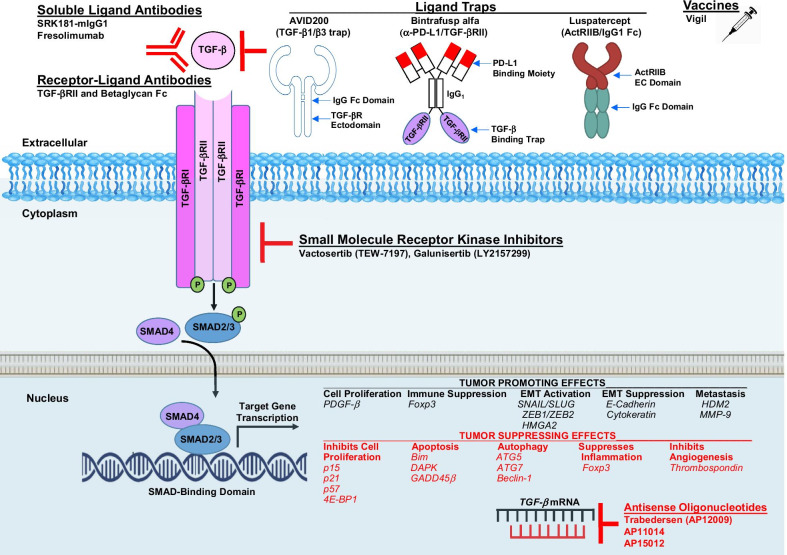
The TGF-β signaling pathway governs key cellular processes under physiologic conditions and is deregulated in many pathologies, including cancer. TGF-β is a multifunctional cytokine that acts in a cell- and context-dependent manner as a tumor promoter or tumor suppressor. As a tumor promoter, the TGF-β pathway enhances cell proliferation, migratory invasion, metastatic spread within the tumor microenvironment and suppresses immunosurveillance. Collectively, the pleiotropic nature of TGF-β signaling contributes to drug resistance, tumor escape and undermines clinical response to therapy. Based upon a wealth of preclinical studies, the TGF-β pathway has been pharmacologically targeted using small molecule inhibitors, TGF-β-directed chimeric monoclonal antibodies, ligand traps, antisense oligonucleotides and vaccines that have been now evaluated in clinical trials. Here, we have assessed the safety and efficacy of TGF-β pathway antagonists from multiple drug classes that have been evaluated in completed and ongoing trials. We highlight Vactosertib, a highly potent small molecule TGF-β type 1 receptor kinase inhibitor that is well-tolerated with an acceptable safety profile that has shown efficacy against multiple types of cancer. The TGF-β ligand traps Bintrafusp alfa (a bifunctional conjugate that binds TGF-β and PD-L1), AVID200 (a computationally designed trap of TGF-β receptor ectodomains fused to an Fc domain) and Luspatercept (a recombinant fusion that links the activin receptor IIb to IgG) offer new ways to fight difficult-to-treat cancers. While TGF-β pathway antagonists are rapidly emerging as highly promising, safe and effective anticancer agents, significant challenges remain. Minimizing the unintentional inhibition of tumor-suppressing activity and inflammatory effects with the desired restraint on tumor-promoting activities has impeded the clinical development of TGF-β pathway antagonists. A better understanding of the mechanistic details of the TGF-β pathway should lead to more effective TGF-β antagonists and uncover biomarkers that better stratify patient selection, improve patient responses and further the clinical development of TGF-β antagonists.
Overview
The claims and statistics of this paper haven’t been checked yet.
Free: it reads the open-access text and checks the first 5 claims that cite a source we can check. Create a free account to check every claim.
Integrity signals
Registry
Cites
Statistics
Figures
Verification
Claims the paper makes
The claims and statistics of this paper haven’t been checked yet.
Free: it reads the open-access text and checks the first 5 claims that cite a source we can check. Create a free account to check every claim.
Claims other papers make about this one
Each is checked against this paper’s own text: does it say what the citing paper says it does?
The source backs part of the claim, not all of it — or backs it for a different population, condition or comparison.
In the citing paper
“AVID200, a ligand trap for TGF‐β1 and TGF‐β3, showed anti‐tumor activity in mouse models [164] and feasibility in clinics in patients with advanced solid‐state tumors in a phase 1 clinical trial (NCT03834662) [165].”
From Tumor microenvironment signaling and therapeutics in cancer progression (2023) · cites this paper as [164]
Experimental — accuracy not yet measuredThe source backs part of the claim, not all of it — or backs it for a different population, condition or comparison.
In the citing paper
“Hyperactivated TGF-β signaling was associated with the poor response to α-PD-1/PD-L1, and blocking TGF-β significantly improved the efficacy of α-PD-1/PD-L1 [299–302].”
From Combination strategies with PD-1/PD-L1 blockade: current advances and future directions (2022) · cites this paper as [302]
Experimental — accuracy not yet measured
Self-check
Percentages, sums and reported differences re-computed from the paper’s own numbers.
The self-check needs the paper’s full text.
Citations
Cites
Chen, W., Jin, W., Hardegen, N., Lei, K.-J., Li, L., Marinos, N., McGrady, G., & Wahl, S. M. (2003) · The Journal of Experimental Medicine · doi:10.1084/jem.20030152 · Cited by 4,699
Massagué, J. (2008) · Cell · doi:10.1016/j.cell.2008.07.001 · Cited by 3,907
Massagué, J. (2012) · Nature Reviews Molecular Cell Biology · doi:10.1038/nrm3434 · Cited by 3,128
Role of Transforming Growth Factor β in Human Disease
Blobe, G. C., Schiemann, W. P., & Lodish, H. F. (2000) · New England Journal of Medicine · doi:10.1056/nejm200005043421807 · Cited by 2,427
Transforming Growth Factor-β Signaling in Immunity and Cancer
Batlle, E., & Massagué, J. (2019) · Immunity · doi:10.1016/j.immuni.2019.03.024 · Cited by 2,366
The evolving landscape of biomarkers for checkpoint inhibitor immunotherapy
Havel, J. J., Chowell, D., & Chan, T. A. (2019) · Nature Reviews Cancer · doi:10.1038/s41568-019-0116-x · Cited by 2,286 · cited 1×
“Immune markers Checkpoint inhibitor-based immunotherapies that target cytotoxic T lymphocyte antigen 4 (CTLA4) or the programmed cell death 1 (PD1) pathway have achieved impressive success in the treatment of different cancer types, but only a subset of patients derive clinical benefit [63].”
BackgroundMassagué, J. (2000) · Nature Reviews Molecular Cell Biology · doi:10.1038/35043051 · Cited by 1,899
TGF-ß Signaling in Fibroblasts Modulates the Oncogenic Potential of Adjacent Epithelia
Bhowmick, N. A., Chytil, A., Plieth, D., Gorska, A. E., Dumont, N., Shappell, S., Washington, M. K., Neilson, E. G., & Moses, H. L. (2004) · Science · doi:10.1126/science.1090922 · Cited by 1,401
TGF-β directly targets cytotoxic T cell functions during tumor evasion of immune surveillance
Thomas, D. A., & Massagué, J. (2005) · Cancer Cell · doi:10.1016/j.ccr.2005.10.012 · Cited by 1,355
TGFβ: the molecular Jekyll and Hyde of cancer
Bierie, B., & Moses, H. L. (2006) · Nature Reviews Cancer · doi:10.1038/nrc1926 · Cited by 1,267
TGFβ signalling: a complex web in cancer progression
Ikushima, H., & Miyazono, K. (2010) · Nature Reviews Cancer · doi:10.1038/nrc2853 · Cited by 1,173
Fantini, M. C., Becker, C., Monteleone, G., Pallone, F., Galle, P. R., & Neurath, M. F. (2004) · The Journal of Immunology · doi:10.4049/jimmunol.172.9.5149 · Cited by 1,135
TGF-β and immune cells: an important regulatory axis in the tumor microenvironment and progression
Yang, L., Pang, Y., & Moses, H. L. (2010) · Trends in Immunology · doi:10.1016/j.it.2010.04.002 · Cited by 1,023
Emerging Frontiers in Drug Delivery
Tibbitt, M. W., Dahlman, J. E., & Langer, R. (2016) · Journal of the American Chemical Society · doi:10.1021/jacs.5b09974 · Cited by 975
Gorelik, L., & Flavell, R. A. (2000) · Immunity · doi:10.1016/s1074-7613(00)80170-3 · Cited by 962
Antisense oligonucleotides: basic concepts and mechanisms.
Dias, N., & Stein, C. A. (2002) · PubMed · Cited by 948
Deactivation of macrophages by transforming growth factor-β
Tsunawaki, S., Sporn, M., Ding, A., & Nathan, C. (1988) · Nature · doi:10.1038/334260a0 · Cited by 861
The Balance of Th17 versus Treg Cells in Autoimmunity
Lee, G. R. (2018) · International Journal of Molecular Sciences · doi:10.3390/ijms19030730 · Cited by 857
The regulation of TGFβ signal transduction
Moustakas, A., & Heldin, C.-H. (2009) · Development · doi:10.1242/dev.030338 · Cited by 832
Regulatory T cells suppress tumor-specific CD8 T cell cytotoxicity through TGF-β signals in vivo
Chen, M.-L., Pittet, M. J., Gorelik, L., Flavell, R. A., Weissleder, R., von Boehmer, H., & Khazaie, K. (2005) · Proceedings of the National Academy of Sciences · doi:10.1073/pnas.0408197102 · Cited by 806
Tzavlaki, K., & Moustakas, A. (2020) · Biomolecules · doi:10.3390/biom10030487 · Cited by 796
Transforming growth factor-β in T-cell biology
Gorelik, L., & Flavell, R. A. (2002) · Nature Reviews Immunology · doi:10.1038/nri704 · Cited by 792
Castriconi, R., Cantoni, C., Della Chiesa, M., Vitale, M., Marcenaro, E., Conte, R., Biassoni, R., Bottino, C., Moretta, L., & Moretta, A. (2003) · Proceedings of the National Academy of Sciences · doi:10.1073/pnas.0730640100 · Cited by 726
Signaling Receptors for TGF-β Family Members
Heldin, C.-H., & Moustakas, A. (2016) · Cold Spring Harbor Perspectives in Biology · doi:10.1101/cshperspect.a022053 · Cited by 711
Indoleamine 2,3-dioxygenase is a signaling protein in long-term tolerance by dendritic cells
Pallotta, M. T., Orabona, C., Volpi, C., Vacca, C., Belladonna, M. L., Bianchi, R., Servillo, G., Brunacci, C., Calvitti, M., Bicciato, S., et al. (2011) · Nature Immunology · doi:10.1038/ni.2077 · Cited by 703
Kloss, C. C., Lee, J., Zhang, A., Chen, F., Melenhorst, J. J., Lacey, S. F., Maus, M. V., Fraietta, J. A., Zhao, Y., & June, C. H. (2018) · Molecular Therapy · doi:10.1016/j.ymthe.2018.05.003 · Cited by 648
Rook, A. H., Kehrl, J. H., Wakefield, L. M., Roberts, A. B., Sporn, M. B., Burlington, D. B., Lane, H. C., & Fauci, A. S. (1986) · The Journal of Immunology · doi:10.4049/jimmunol.136.10.3916 · Cited by 570
Lahn, M., Herbertz, S., Sawyer, J. S., Stauber, A. J., Gueorguieva, I., Driscoll, K. E., Estrem, S. T., Cleverly, A. L., Desaiah, D., Guba, S. C., et al. (2015) · Drug Design, Development and Therapy · doi:10.2147/dddt.s86621 · Cited by 554
Luspatercept in Patients with Lower-Risk Myelodysplastic Syndromes
Fenaux, P., Platzbecker, U., Mufti, G. J., Garcia-Manero, G., Buckstein, R., Santini, V., Díez-Campelo, M., Finelli, C., Cazzola, M., Ilhan, O., et al. (2020) · New England Journal of Medicine · doi:10.1056/nejmoa1908892 · Cited by 550
Lee, J.-C., Lee, K.-M., Kim, D.-W., & Heo, D. S. (2004) · The Journal of Immunology · doi:10.4049/jimmunol.172.12.7335 · Cited by 549
Morris, J. C., Tan, A. R., Olencki, T. E., Shapiro, G. I., Dezube, B. J., Reiss, M., Hsu, F. J., Berzofsky, J. A., & Lawrence, D. P. (2014) · PLoS ONE · doi:10.1371/journal.pone.0090353 · Cited by 487 · cited 1×
“Seven patients showed partial response, four developed reversible cutaneous keratoacanthomas and SCCs, and one patient acquired hyperkeratosis as unwanted side effects [106].”
BackgroundLaouar, Y., Sutterwala, F. S., Gorelik, L., & Flavell, R. A. (2005) · Nature Immunology · doi:10.1038/ni1197 · Cited by 451
Blockade of TGF-β inhibits mammary tumor cell viability, migration, and metastases
Muraoka, R. S., Dumont, N., Ritter, C. A., Dugger, T. C., Brantley, D. M., Chen, J., Easterly, E., Roebuck, L. R., Ryan, S., Gotwals, P. J., et al. (2002) · Journal of Clinical Investigation · doi:10.1172/jci0215234 · Cited by 415
Uhl, M., Aulwurm, S., Wischhusen, J., Weiler, M., Ma, J. Y., Almirez, R., Mangadu, R., Liu, Y.-W., Platten, M., Herrlinger, U., et al. (2004) · Cancer Research · doi:10.1158/0008-5472.can-04-1013 · Cited by 414
TGF-β inhibition via CRISPR promotes the long-term efficacy of CAR T cells against solid tumors
Tang, N., Cheng, C., Zhang, X., Qiao, M., Li, N., Mu, W., Wei, X.-F., Han, W., & Wang, H. (2020) · JCI Insight · doi:10.1172/jci.insight.133977 · Cited by 413
Strauss, J., Heery, C. R., Schlom, J., Madan, R. A., Cao, L., Kang, Z., Lamping, E., Marté, J. L., Donahue, R. N., Grenga, I., et al. (2018) · Clinical Cancer Research · doi:10.1158/1078-0432.ccr-17-2653 · Cited by 406
Gleave, M. E., & Monia, B. P. (2005) · Nature Reviews Cancer · doi:10.1038/nrc1631 · Cited by 384
Constam, D. B., Philipp, J., Malipiero, U. V., ten Dijke, P., Schachner, M., & Fontana, A. (1992) · The Journal of Immunology · doi:10.4049/jimmunol.148.5.1404 · Cited by 373
Nemunaitis, J., Dillman, R. O., Schwarzenberger, P. O., Senzer, N., Cunningham, C., Cutler, J., Tong, A., Kumar, P., Pappen, B., Hamilton, C., et al. (2006) · Journal of Clinical Oncology · doi:10.1200/jco.2005.05.5335 · Cited by 367
Arteaga, C. L., Hurd, S. D., Winnier, A. R., Johnson, M. D., Fendly, B. M., & Forbes, J. T. (1993) · Journal of Clinical Investigation · doi:10.1172/jci116871 · Cited by 359
Valentine, R., Dawson, C. W., Hu, C., Shah, K. M., Owen, T. J., Date, K. L., Maia, S. P., Shao, J., Arrand, J. R., Young, L. S., et al. (2010) · Molecular Cancer · doi:10.1186/1476-4598-9-1 · Cited by 353
Takimoto, T., Wakabayashi, Y., Sekiya, T., Inoue, N., Morita, R., Ichiyama, K., Takahashi, R., Asakawa, M., Muto, G., Mori, T., et al. (2010) · The Journal of Immunology · doi:10.4049/jimmunol.0904100 · Cited by 340
Tojo, M., Hamashima, Y., Hanyu, A., Kajimoto, T., Saitoh, M., Miyazono, K., Node, M., & Imamura, T. (2005) · Cancer Science · doi:10.1111/j.1349-7006.2005.00103.x · Cited by 339
Melisi, D., Ishiyama, S., Sclabas, G. M., Fleming, J. B., Xia, Q., Tortora, G., Abbruzzese, J. L., & Chiao, P. J. (2008) · Molecular Cancer Therapeutics · doi:10.1158/1535-7163.mct-07-0337 · Cited by 323
TGF- downregulates the activating receptor NKG2D on NK cells and CD8+ T cells in glioma patients
Crane, C. A., Han, S. J., Barry, J. J., Ahn, B. J., Lanier, L. L., & Parsa, A. T. (2010) · Neuro-Oncology · doi:10.1093/neuonc/nop009 · Cited by 322
TGF-β: Guardian of T Cell Function
Oh, S. A., & Li, M. O. (2013) · The Journal of Immunology · doi:10.4049/jimmunol.1301843 · Cited by 318
Melisi, D., Garcia-Carbonero, R., Macarulla, T., Pezet, D., Deplanque, G., Fuchs, M., Trojan, J., Oettle, H., Kozloff, M., Cleverly, A., et al. (2018) · British Journal of Cancer · doi:10.1038/s41416-018-0246-z · Cited by 294
Giaccone, G., Bazhenova, L. A., Nemunaitis, J., Tan, M., Juhász, E., Ramlau, R., van den Heuvel, M. M., Lal, R., Kloecker, G. H., Eaton, K. D., et al. (2015) · European Journal of Cancer · doi:10.1016/j.ejca.2015.07.035 · Cited by 279
Yu, J., Wei, M., Becknell, B., Trotta, R., Liu, S., Boyd, Z., Jaung, M. S., Blaser, B. W., Sun, J., Benson, D. M., et al. (2006) · Immunity · doi:10.1016/j.immuni.2006.03.016 · Cited by 279
Sad, S., & Mosmann, T. R. (1994) · The Journal of Immunology · doi:10.4049/jimmunol.153.8.3514 · Cited by 274
Clinical development of therapies targeting TGFβ: current knowledge and future perspectives
Ciardiello, D., Elez, E., Tabernero, J., & Seoane, J. (2020) · Annals of Oncology · doi:10.1016/j.annonc.2020.07.009 · Cited by 265
Arwert, E. N., Harney, A. S., Entenberg, D., Wang, Y., Sahai, E., Pollard, J. W., & Condeelis, J. S. (2018) · Cell Reports · doi:10.1016/j.celrep.2018.04.007 · Cited by 263
Nam, J.-S., Terabe, M., Mamura, M., Kang, M.-J., Chae, H., Stuelten, C., Kohn, E., Tang, B., Sabzevari, H., Anver, M. R., et al. (2008) · Cancer Research · doi:10.1158/0008-5472.can-08-0215 · Cited by 233
Ahmadzadeh, M., & Rosenberg, S. A. (2005) · The Journal of Immunology · doi:10.4049/jimmunol.174.9.5215 · Cited by 225
Martin, C. J., Datta, A., Littlefield, C., Kalra, A., Chapron, C., Wawersik, S., Dagbay, K. B., Brueckner, C. T., Nikiforov, A., Danehy, F. T., et al. (2020) · Science Translational Medicine · doi:10.1126/scitranslmed.aay8456 · Cited by 224 · cited 2×
“Selective inhibition of TGF-β1 activation overcomes primary resistance to checkpoint blockade therapy by altering tumor immune landscape [65].”
BackgroundTGF-β-RI Kinase Inhibitor SD-208 Reduces the Development and Progression of Melanoma Bone Metastases
Mohammad, K. S., Javelaud, D., Fournier, P. G. J., Niewolna, M., McKenna, C. R., Peng, X. H., Duong, V., Dunn, L. K., Mauviel, A., & Guise, T. A. (2011) · Cancer Research · doi:10.1158/0008-5472.can-10-2651 · Cited by 221
TGF-β in T Cell Biology: Implications for Cancer Immunotherapy
Dahmani, A., & Delisle, J.-S. (2018) · Cancers · doi:10.3390/cancers10060194 · Cited by 214
Paz-Ares, L., Kim, T. M., Vicente, D., Felip, E., Lee, D. H., Lee, K. H., Lin, C.-C., Flor, M. J., Di Nicola, M., Alvarez, R. M., et al. (2020) · Journal of Thoracic Oncology · doi:10.1016/j.jtho.2020.03.003 · Cited by 205
Targeted tumor therapy with the TGF-β2 antisense compound AP 12009
SCHLINGENSIEPEN, K., SCHLINGENSIEPEN, R., STEINBRECHER, A., HAU, P., BOGDAHN, U., FISCHERBLASS, B., & JACHIMCZAK, P. (2006) · Cytokine & Growth Factor Reviews · doi:10.1016/j.cytogfr.2005.09.002 · Cited by 195
Molecular Pathways: Targeting the TGF-β Pathway for Cancer Therapy
Smith, A. L., Robin, T. P., & Ford, H. L. (2012) · Clinical Cancer Research · doi:10.1158/1078-0432.ccr-11-3224 · Cited by 193
The Discovery and Early Days of TGF-β: A Historical Perspective
Moses, H. L., Roberts, A. B., & Derynck, R. (2016) · Cold Spring Harbor Perspectives in Biology · doi:10.1101/cshperspect.a021865 · Cited by 192
Bandyopadhyay, A., Agyin, J. K., Wang, L., Tang, Y., Lei, X., Story, B. M., Cornell, J. E., Pollock, B. H., Mundy, G. R., & Sun, L.-Z. (2006) · Cancer Research · doi:10.1158/0008-5472.can-05-3565 · Cited by 185
Friedman, E. D., Gold, L. I., Klimstra, D., Zeng, Z., Winawer, S. J., & Cohen, A. M. (1995) · PubMed · Cited by 182
Ehata, S., Hanyu, A., Fujime, M., Katsuno, Y., Fukunaga, E., Goto, K., Ishikawa, Y., Nomura, K., Yokoo, H., Shimizu, T., et al. (2007) · Cancer Science · doi:10.1111/j.1349-7006.2006.00357.x · Cited by 180
Dumitriu, I. E., Dunbar, D. R., Howie, S. E., Sethi, T., & Gregory, C. D. (2009) · The Journal of Immunology · doi:10.4049/jimmunol.0712671 · Cited by 171
A Perspective on the Development of TGF-β Inhibitors for Cancer Treatment
Huynh, L., Hipolito, C., & ten Dijke, P. (2019) · Biomolecules · doi:10.3390/biom9110743 · Cited by 171
Ganapathy, V., Ge, R., Grazioli, A., Xie, W., Banach-Petrosky, W., Kang, Y., Lonning, S., McPherson, J., Yingling, J. M., Biswas, S., et al. (2010) · Molecular Cancer · doi:10.1186/1476-4598-9-122 · Cited by 168
TGF-beta signalling in colon carcinogenesis
Lampropoulos, P., Zizi-Sermpetzoglou, A., Rizos, S., Kostakis, A. I., Nikiteas, N. I., & Papavassiliou, A. G. (2011) · Cancer Letters · doi:10.1016/j.canlet.2011.09.041 · Cited by 167
Cutting Edge: Autocrine TGF-β Sustains Default Tolerogenesis by IDO-Competent Dendritic Cells
Belladonna, M. L., Volpi, C., Bianchi, R., Vacca, C., Orabona, C., Pallotta, M. T., Boon, L., Gizzi, S., Fioretti, M. C., Grohmann, U., et al. (2008) · The Journal of Immunology · doi:10.4049/jimmunol.181.8.5194 · Cited by 164
Lee, Y. S., Park, J. S., Kim, J. H., Jung, S. M., Lee, J. Y., Kim, S., & Park, S. H. (2011) · Nature Communications · doi:10.1038/ncomms1469 · Cited by 163
Jin, C. H., Krishnaiah, M., Sreenu, D., Subrahmanyam, V. B., Rao, K. S., Lee, H. J., Park, S.-J., Park, H.-J., Lee, K., Sheen, Y. Y., et al. (2014) · Journal of Medicinal Chemistry · doi:10.1021/jm500115w · Cited by 162
Matsuyama, S., Iwadate, M., Kondo, M., Saitoh, M., Hanyu, A., Shimizu, K., Aburatani, H., Mishima, H. K., Imamura, T., Miyazono, K., et al. (2003) · PubMed · Cited by 158
TGF-β Signaling in Myeloid Cells Is Required for Tumor Metastasis
Pang, Y., Gara, S. K., Achyut, B. R., Li, Z., Yan, H. H., Day, C.-P., Weiss, J. M., Trinchieri, G., Morris, J. C., & Yang, L. (2013) · Cancer Discovery · doi:10.1158/2159-8290.cd-12-0527 · Cited by 157
Blocking TGF-β Signaling To Enhance The Efficacy Of Immune Checkpoint Inhibitor
Bai, X., Yi, M., Jiao, Y., Chu, Q., & Wu, K. (2019) · OncoTargets and Therapy · doi:10.2147/ott.s224013 · Cited by 153
Hong, S., Lim, S., Li, A. G., Lee, C., Lee, Y. S., Lee, E., Park, S. H., Wang, X., & Kim, S. (2007) · Nature Immunology · doi:10.1038/ni1451 · Cited by 146
Therapeutic Targeting of Integrin αvβ6 in Breast Cancer
Moore, K. M., Thomas, G. J., Duffy, S. W., Warwick, J., Gabe, R., Chou, P., Ellis, I. O., Green, A. R., Haider, S., Brouilette, K., et al. (2014) · JNCI: Journal of the National Cancer Institute · doi:10.1093/jnci/dju169 · Cited by 145
Transforming growth factor betas and their signaling receptors in human hepatocellular carcinoma
Abou-Shady, M. A., Baer, H. U., Friess, H., Berberat, P. O., Zimmermann, A., Graber, H. U., Gold, L. I., Korc, M., & Büchler, M. W. (1999) · The American Journal of Surgery · doi:10.1016/s0002-9610(99)00012-4 · Cited by 143
Näslund‐Koch, C., Nordestgaard, B. G., & Bojesen, S. E. (2016) · Journal of Clinical Oncology · doi:10.1200/jco.2015.63.3594 · Cited by 141
Antitumor activity of a recombinant soluble betaglycan in human breast cancer xenograft.
Bandyopadhyay, A. M., López‐Casillas, F., Malik, S. N., Montiel-Hernández, J. L., Mendoza, V., Yang, J., & Sun, L. (2002) · PubMed · Cited by 140
TGF-β in pancreatic cancer initiation and progression: two sides of the same coin
Shen, W., Tao, G.-Q., Zhang, Y., Cai, B., Sun, J., & Tian, Z.-Q. (2017) · Cell & Bioscience · doi:10.1186/s13578-017-0168-0 · Cited by 140
Subramanian, G., Schwarz, R. E., Higgins, L., McEnroe, G., Chakravarty, S., Dugar, S., & Reiss, M. (2004) · Cancer Research · doi:10.1158/0008-5472.can-04-0018 · Cited by 138
TGF-β Inhibition Restores Terminal Osteoblast Differentiation to Suppress Myeloma Growth
Takeuchi, K., Abe, M., Hiasa, M., Oda, A., Amou, H., Kido, S., Harada, T., Tanaka, O., Miki, H., Nakamura, S., et al. (2010) · PLoS ONE · doi:10.1371/journal.pone.0009870 · Cited by 137
T Cell Surveillance of Oncogene-Induced Prostate Cancer Is Impeded by T Cell-Derived TGF-β1 Cytokine
Donkor, M. K., Sarkar, A., Savage, P. A., Franklin, R. A., Johnson, L. K., Jungbluth, A. A., Allison, J. P., & Li, M. O. (2011) · Immunity · doi:10.1016/j.immuni.2011.04.019 · Cited by 130
Ramalingam, R., Larmonier, C. B., Thurston, R. D., Midura-Kiela, M. T., Zheng, S. G., Ghishan, F. K., & Kiela, P. R. (2012) · The Journal of Immunology · doi:10.4049/jimmunol.1201029 · Cited by 130
Savage-Dunn, C. (2005) · WormBook · doi:10.1895/wormbook.1.22.1 · Cited by 125
Human monocytes and macrophages regulate immune tolerance via integrin αvβ8–mediated TGFβ activation
Kelly, A., Gunaltay, S., McEntee, C. P., Shuttleworth, E. E., Smedley, C., Houston, S. A., Fenton, T. M., Levison, S., Mann, E. R., & Travis, M. A. (2018) · Journal of Experimental Medicine · doi:10.1084/jem.20171491 · Cited by 124
EW-7197, a Novel ALK-5 Kinase Inhibitor, Potently Inhibits Breast to Lung Metastasis
Son, J. Y., Park, S.-Y., Kim, S., Lee, S. J., Park, S.-A., Kim, M.-J., Kim, S. W., Kim, D., Nam, J., & Sheen, Y. Y. (2014) · Molecular Cancer Therapeutics · doi:10.1158/1535-7163.mct-13-0903 · Cited by 116
Papaspyridonos, M., Matei, I., Huang, Y., do Rosario Andre, M., Brazier-Mitouart, H., Waite, J. C., Chan, A. S., Kalter, J., Ramos, I., Wu, Q., et al. (2015) · Nature Communications · doi:10.1038/ncomms7840 · Cited by 116
Rodón, J., Carducci, M., Sepulveda-Sánchez, J. M., Azaro, A., Calvo, E., Seoane, J., Braña, I., Sicart, E., Gueorguieva, I., Cleverly, A., et al. (2015) · Investigational New Drugs · doi:10.1007/s10637-014-0192-4 · Cited by 108
Kovacs, R. J., Maldonado, G., Azaro, A., Fernández, M. S., Romero, F. L., Sepulveda-Sánchez, J. M., Corretti, M., Carducci, M., Dolan, M., Gueorguieva, I., et al. (2015) · Cardiovascular Toxicology · doi:10.1007/s12012-014-9297-4 · Cited by 108 · cited 1×
“The protocol was applied to patients with glioma, and serious cardiac toxicity was not observed [84].”
MethodTolcher, A. W., Berlin, J. D., Cosaert, J., Kauh, J., Chan, E., Piha-Paul, S. A., Amaya, A., Tang, S., Driscoll, K., Kimbung, R., et al. (2017) · Cancer Chemotherapy and Pharmacology · doi:10.1007/s00280-017-3245-5 · Cited by 105
Wolfraim, L. A., Walz, T. M., James, Z., Fernandez, T., & Letterio, J. J. (2004) · The Journal of Immunology · doi:10.4049/jimmunol.173.5.3093 · Cited by 102
Fujiwara, Y., Nokihara, H., Yamada, Y., Yamamoto, N., Sunami, K., Utsumi, H., Asou, H., Takahashi, O., Ogasawara, K., Gueorguieva, I., et al. (2015) · Cancer Chemotherapy and Pharmacology · doi:10.1007/s00280-015-2895-4 · Cited by 102
The Antisense Oligonucleotide Trabedersen (AP 12009) for the Targeted Inhibition of TGF-β2
Jaschinski, F., Rothhammer-Hampl, T., Jachimczak, P., Seitz, C. M., Schneider, A., & Schlingensiepen, K. (2011) · Current Pharmaceutical Biotechnology · doi:10.2174/138920111798808266 · Cited by 102
Lee, C., Lee, W., Cho, S. K., & Park, S. (2018) · International Journal of Molecular Sciences · doi:10.3390/ijms19030869 · Cited by 101
Śledzińska, A., Hemmers, S., Mair, F., Gorka, O., Ruland, J., Fairbairn, L., Nissler, A., Müller, W., Waisman, A., Becher, B., et al. (2013) · PLoS Biology · doi:10.1371/journal.pbio.1001674 · Cited by 100
Lin, T.-H., Shao, Y.-Y., Chan, S.-Y., Huang, C.-Y., Hsu, C.-H., & Cheng, A.-L. (2015) · Clinical Cancer Research · doi:10.1158/1078-0432.ccr-14-1954 · Cited by 99
Oh, J., Barve, M. A., Matthews, C. M., Koon, E. C., Heffernan, T. P., Fine, B. A., Grosen, E. A., Bergman, M. K., Fleming, E. L., DeMars, L. R., et al. (2016) · Gynecologic Oncology · doi:10.1016/j.ygyno.2016.09.018 · Cited by 96
SMAD7 is a prognostic marker in patients with colorectal cancer
Boulay, J., Mild, G., Lowy, A., Reuter, J., Lagrange, M., Terracciano, L., Laffer, U., Herrmann, R., & Rochlitz, C. (2003) · International Journal of Cancer · doi:10.1002/ijc.10908 · Cited by 94
Eberlein, C. A., Kendrew, J., McDaid, K., Alfred, A., Kang, J., Jacobs, V. N., Ross, S. J., Rooney, C., Smith, N. R., Rinkenberger, J. L., et al. (2012) · Oncogene · doi:10.1038/onc.2012.460 · Cited by 91
Shinto, O., Yashiro, M., Kawajiri, H., Shimizu, K., Shimizu, T., Miwa, A., & Hirakawa, K. (2010) · British Journal of Cancer · doi:10.1038/sj.bjc.6605561 · Cited by 90
Connolly, E. C., Saunier, E. F., Quigley, D., Luu, M. T., De Sapio, A., Hann, B., Yingling, J. M., & Akhurst, R. J. (2011) · Cancer Research · doi:10.1158/0008-5472.can-10-2941 · Cited by 82
The role of TGFβ in hematopoiesis and myeloid disorders
Bataller, Á., Bravo, G. M., Soltysiak, K. A., & Garcia‐Manero, G. (2019) · Leukemia · doi:10.1038/s41375-019-0420-1 · Cited by 79
Gueorguieva, I., Cleverly, A. L., Stauber, A., Pillay, N. S., Rodon, J. A., Miles, C. P., Yingling, J. M., & Lahn, M. M. (2014) · British Journal of Clinical Pharmacology · doi:10.1111/bcp.12256 · Cited by 78
Deregulation of Negative Controls on TGF-β1 Signaling in Tumor Progression
Tang, J., Gifford, C., Samarakoon, R., & Higgins, P. (2018) · Cancers · doi:10.3390/cancers10060159 · Cited by 77
Lindley, L. E., & Briegel, K. J. (2010) · Biochemical and Biophysical Research Communications · doi:10.1016/j.bbrc.2010.07.138 · Cited by 76
Gr‐1+CD11b+ cells are responsible for tumor promoting effect of TGF‐β in breast cancer progression
Li, Z., Pang, Y., Gara, S. K., Achyut, B. R., Heger, C., Goldsmith, P. K., Lonning, S., & Yang, L. (2012) · International Journal of Cancer · doi:10.1002/ijc.27572 · Cited by 73
Yoon, J., Jung, S. M., Park, S. H., Kato, M., Yamashita, T., Lee, I., Sudo, K., Nakae, S., Han, J. S., Kim, O., et al. (2013) · EMBO Molecular Medicine · doi:10.1002/emmm.201302524 · Cited by 71
Jung, S. Y., Hwang, S., Clarke, J. M., Bauer, T. M., Keedy, V. L., Lee, H., Park, N., Kim, S.-J., & Lee, J. I. (2020) · Investigational New Drugs · doi:10.1007/s10637-019-00835-y · Cited by 69 · cited 4×
“A first-in-human phase I dose escalation study investigated the safety, tolerability and pharmacokinetics of Vactosertib in patients with advanced, refractory solid tumors (NCT02160106) [70, 71].”
BackgroundMethodInfluentialSim, W. J., Iyengar, P. V., Lama, D., Lui, S. K. L., Ng, H. C., Haviv-Shapira, L., Domany, E., Kappei, D., Tan, T. Z., Saei, A., et al. (2019) · Nature Communications · doi:10.1038/s41467-019-12241-2 · Cited by 67
Fjellbirkeland, L., Cambier, S., Broaddus, V. C., Hill, A. C., Brunetta, P. G., Dolganov, G., Jablons, D. M., & Nishimura, S. L. (2003) · American Journal Of Pathology · doi:10.1016/s0002-9440(10)63681-4 · Cited by 66
Jayaraman, P., Parikh, F., Newton, J. M., Hanoteau, A., Rivas, C. H., Krupar, R., Rajapakshe, K., Pathak, R. R., Kanthaswamy, K., MacLaren, C., et al. (2018) · OncoImmunology · doi:10.1080/2162402x.2018.1490853 · Cited by 66
Treatment of malignant gliomas with TGF-β2 antisense oligonucleotides
Hau, P., Jachimczak, P., & Bogdahn, U. (2009) · Expert Review of Anticancer Therapy · doi:10.1586/era.09.138 · Cited by 65
Lateral signaling enhances TGF-β response complexity
Byfield, S. D. (2004) · Trends in Cell Biology · doi:10.1016/j.tcb.2004.01.001 · Cited by 64
Park, C., Min, K. N., Son, J., Park, S.-Y., Nam, J., Kim, D., & Sheen, Y. Y. (2014) · Cancer Letters · doi:10.1016/j.canlet.2014.05.006 · Cited by 59
Yoon, J., Jung, S. M., Park, S. H., Kato, M., Yamashita, T., Lee, I., Sudo, K., Nakae, S., Han, J. S., Kim, O., et al. (2014) · EMBO Molecular Medicine · doi:10.1002/emmm.201470040 · Cited by 56
Intravital Imaging Illuminates Transforming Growth Factor β Signaling Switches during Metastasis
Giampieri, S., Pinner, S., & Sahai, E. (2010) · Cancer Research · doi:10.1158/0008-5472.can-10-0466 · Cited by 54
Jakowlew, S. B., Mathias, A., Chung, P., & Moody, T. W. (1995) · PubMed · Cited by 54
Takimoto, T., Wakabayashi, Y., Sekiya, T., Inoue, N., Morita, R., Ichiyama, K., Takahashi, R., Asakawa, M., Muto, G., Mori, T., et al. (2010) · The Journal of Immunology · doi:10.4049/jimmunol.1090121 · Cited by 54
Small RNAs and Non-Small Cell Lung Cancer
Tong, A. (2006) · Current Molecular Medicine · doi:10.2174/156652406776894554 · Cited by 51
Li, Z., Zhang, L., Zhang, H.-R., Tian, G., Tian, J., Mao, X., Jia, Z., Meng, Z., Zhao, L., Yin, Z., et al. (2014) · Asian Pacific Journal of Cancer Prevention · doi:10.7314/apjcp.2014.15.13.5181 · Cited by 50
Melisi, D., García‐Carbonero, R., Macarulla, T. M., Pezet, D., Deplanque, G., Fuchs, M., Trojan, J., Oettle, H., Kozloff, M. F., Cleverly, A., et al. (2016) · Journal of Clinical Oncology · doi:10.1200/jco.2016.34.15_suppl.4019 · Cited by 45
Low-dose paclitaxel modulates tumour fibrosis in gastric cancer
Tsukada, T., Fushida, S., HARADA, S., Terai, S., Yagi, Y., Kinoshita, J., Oyama, K., Tajima, H., Ninomiya, I., Fujimura, T., et al. (2013) · International Journal of Oncology · doi:10.3892/ijo.2013.1801 · Cited by 44
Parente, P., Parcesepe, P., Covelli, C., Olivieri, N., Remo, A., Pancione, M., Latiano, T. P., Graziano, P., Maiello, E., & Giordano, G. (2018) · Gastroenterology Research and Practice · doi:10.1155/2018/7530619 · Cited by 40
Novel Oncogenic Protein Kinase Inhibitors for Cancer Therapy
Sawyer, T. (2004) · Current Medicinal Chemistry-Anti-Cancer Agents · doi:10.2174/1568011043352830 · Cited by 37
Jung, S. Y., Yug, J. S., Clarke, J. M., Bauer, T. M., Keedy, V. L., Hwang, S.-J., Kim, S., Chung, E. K., & Lee, J. I. (2019) · Cancer Chemotherapy and Pharmacology · doi:10.1007/s00280-019-03979-z · Cited by 34
Lee, G. T., Hong, J. H., Mueller, T. J., Watson, J. A., Kwak, C. H., Sheen, Y. Y., Kim, D., Kim, S., & Kim, I. Y. (2008) · The Journal of Urology · doi:10.1016/j.juro.2008.08.008 · Cited by 28
Abstract 955: LY3200882, a novel, highly selective TGFβRI small molecule inhibitor
Pei, H., Parthasarathy, S., Joseph, S., McMillen, W., Xu, X., Castaneda, S., Inigo, I., Britt, K., Anderson, B., Zhao, G., et al. (2017) · Cancer Research · doi:10.1158/1538-7445.am2017-955 · Cited by 28
Faivre, S. J., Santoro, A., Gane, E. J., Kelley, R. K., Ollivier‐Hourmand, I., Assénat, E., Gueorguieva, I., Cleverly, A., Desaiah, D., Lahn, M., et al. (2016) · Journal of Clinical Oncology · doi:10.1200/jco.2016.34.15_suppl.4070 · Cited by 27
Klett, H., Jürgensen, L., Most, P., Busch, M., Günther, F., Dobreva, G. D., Leuschner, F., Hassel, D., Busch, H. S., & Boerries, M. (2018) · Biomolecules · doi:10.3390/biom9010011 · Cited by 21
Watanabe, Y., Iwamura, A., Shimada, Y. J., Wakai, K., Tamakoshi, A., & Iso, H. (2016) · EBioMedicine · doi:10.1016/j.ebiom.2016.09.001 · Cited by 16
Gordon, M. S., Ilaria, R. L., de Alwis, D. P., Mendelson, D. S., McKane, S. W., Wagner, M. M. F., Look, K. Y., & LoRusso, P. M. (2012) · Cancer Chemotherapy and Pharmacology · doi:10.1007/s00280-012-1917-8 · Cited by 13
Lee, J.-C., Ahn, Y., Kim, D., & Heo, D. S. (2004) · Journal of Immunotherapy · doi:10.1097/00002371-200411000-00182 · Cited by 11
O'Connor‐McCourt, M. D., Tremblay, G., Lenferink, A. E. G., Sulea, T. I., Zwaagstra, J. C., & Koropatnick, J. D. (2018) · Cancer Research · doi:10.1158/1538-7445.am2018-1759 · Cited by 11
Malek, E., Kim, B., Valent, J. N., Driscoll, J. J., Caimi, P. F., Kim, S., Lima, M. J. G. D., & Letterio, J. J. (2018) · Blood · doi:10.1182/blood-2018-99-112449 · Cited by 8
Serum transforming growth factor beta 1 levels in multiple myeloma patients.
Çoşkun, H. Ş., İlhan, O., Özcan, M., Ayaz, S., Dalva, K., Üstün, C., & Arat, M. (2006) · PubMed · Cited by 6
Malek, E., Hwang, S.-J., Lima, M. J. G. D., Caimi, P. F., Gallogly, M. M., Metheny, L. L., Otegbeye, F., Tomlinson, B. K., Boughan, K. M., Cooper, B., et al. (2019) · Blood · doi:10.1182/blood-2019-126728 · Cited by 6
Birrer, M. J., Mileshkin, L., Fujiwara, K., Ray-Coquard, I., Alexandre, J., Okamoto, A., Mirza, M. R., Gulley, J. L., Jehl, G., Ramage, S., et al. (2020) · Annals of Oncology · doi:10.1016/j.annonc.2020.08.1018 · Cited by 6
Aluri, S., Bachiashvili, K., Budhathoki, A., Bhagat, T. D., Choudhary, G. S., Gordon, S. A. K., Ramachandra, N., Pradhan, K., Maqbool, S. B., Shastri, A., et al. (2019) · Blood · doi:10.1182/blood-2019-127561 · Cited by 5
Lee, K., Park, Y. S., Ahn, J. B., Lee, J. K., Ryu, J., Oh, B., Ock, C., Hwang, S.-J., Hahm, K. B., Kim, S., et al. (2020) · Regular and Young Investigator Award Abstracts · doi:10.1136/jitc-2020-sitc2020.0332 · Cited by 5
Research works printed but not linked: 4
- Tang J Gifford CC Samarakoon R Higgins PJ Deregulation of negative controls on TGF-β1 signaling in tumor progression Cancers (Basel) 2018 10 6 159 10.3390/cancers10060159.PMID:29799477;PMCID:PMC6025439 PMC6025439 29799477 · DOI · Paper page
- Lee KW Park YS Ahn JB Rha SY Kim HK Lee PY Ryu MH Lee J Lee JK Hwang S Safety and anti-tumor activity of the transforming growth factor beta receptor I kinase inhibitor, vactosertib, in combination with pembrolizumab in patients with metastatic colorectal or gastric cancer J Immunother Cancer 2020 8 Suppl. 3 A358
- Han JY Pyo KH Kim JH Xin CF Lee JK Hwang S Kim SJ Cho BC Cho BC Safety and anti-tumor activity of the transforming growth factor beta receptor I kinase inhibitor, vactosertib, in combination with durvalumab in patients with advanced non-small cell lung cancer (NSCLC) J Immunother Cancer 2020 8 Suppl. 3 A388
- Yap TBC, Massard C. First-in-human phase 1 dose-escalation trial of the potent and selective next generation transforming growth factor-β receptor type 1 (TGF-βR1) inhibitor LY3200882 in patients with advanced cancer. In Proceedings from the 2018 SITC annual meeting. 2018; Abstract 030.
Cited by
Combination strategies with PD-1/PD-L1 blockade: current advances and future directions
Yi, M., Zheng, X., Niu, M., Zhu, S., Ge, H., & Wu, K. (2022) · Molecular Cancer · doi:10.1186/s12943-021-01489-2 · Cited by 1,445
Targeting TGF-β signal transduction for fibrosis and cancer therapy
Peng, D., Fu, M., Wang, M., Wei, Y., & Wei, X. (2022) · Molecular Cancer · doi:10.1186/s12943-022-01569-x · Cited by 1,065
Overcoming TGFβ-mediated immune evasion in cancer
Tauriello, D. V. F., Sancho, E., & Batlle, E. (2022) · Nature Reviews Cancer · doi:10.1038/s41568-021-00413-6 · Cited by 377
Tumor microenvironment signaling and therapeutics in cancer progression
Goenka, A., Khan, F., Verma, B., Sinha, P., Dmello, C. C., Jogalekar, M. P., Gangadaran, P., & Ahn, B. (2023) · Cancer Communications · doi:10.1002/cac2.12416 · Cited by 323
Transforming growth factor–β1 in regulatory T cell biology
Moreau, J. M., Velegraki, M., Bolyard, C., Rosenblum, M. D., & Li, Z. (2022) · Science Immunology · doi:10.1126/sciimmunol.abi4613 · Cited by 243
Metadata
- Authors
- Kim, B.-G., Malek, E., Choi, S. H., Ignatz-Hoover, J. J., & Driscoll, J. J.
- Affiliations
- Case Comprehensive Cancer Center (US)
- University Hospitals Cleveland Medical Center (US)
- Corresponding author
- Driscoll, James J.
- Venue
- Journal of Hematology & Oncology
- Published
- 2021-04-06
- Volume
- 14
- Issue
- 1
- Pages
- 55-55
- ISSN
- 1756-8722 (ISSN-L)
- PMC
- PMC8022551
- OpenAlex
- W3149714833
- Cited by
- 453
- References
- 142
- Citations by year
- 2026: 45 · 2025: 99 · 2024: 111 · 2023: 77 · 2022: 100 · 2021: 21
- FWCI
- 8.10
- Type
- journal article
- Language
- en
- Open access
- gold
- doi.org
- Licence
- cc-by
- creativecommons.org/licenses/by/4.0 (tdm)
- creativecommons.org/licenses/by/4.0 (vor)
- Locations
- Journal of Hematology & Oncology (publishedVersion, cc-by)
- PubMed Central (publishedVersion, cc-by)
- PubMed (publishedVersion)
- DOAJ (DOAJ: Directory of Open Access Journals) (submittedVersion, cc-by-sa)
- Funders
- National Cancer Institute (K12CA076917)
- National Institute of Allergy and Infectious Diseases (R01AI139141)
- Topics
- Life Sciences › Biochemistry, Genetics and Molecular Biology › Molecular Biology › TGF-β signaling in diseases
- Life Sciences › Biochemistry, Genetics and Molecular Biology › Molecular Biology › Kruppel-like factors research
- Health Sciences › Medicine › Oncology › Cancer Immunotherapy and Biomarkers
- Keywords
- TGF-beta signaling, TGF-beta antagonists, vactosertib, bintrafusp alfa, AVID200, luspatercept, small molecule inhibitors, chimeric monoclonal antibody, antisense oligonucleotides, cancer immunotherapy, tumor microenvironment, drug resistance, clinical trials, patient selection biomarkers
- MeSH terms
- Humans, Medical Oncology, Signal Transduction, Transforming Growth Factor beta
About these checks
Registry, retraction, Cites and statistics results are computed, not judged, with one exception: a printed reference that no index lists is read once by a model before it counts as a citation error. Claims are extracted by a model and kept only when their quote appears verbatim in the text; each cited source is then checked, with a model’s help, for whether it says what the claim relies on. Those verdicts can be wrong — read the claim’s quote and the cited source before relying on one.
Statistics and arithmetic are recomputed, not judged.
Confidence bands are shown only for fields calibrated on our annotated test set. None is calibrated yet, so no band is shown.
What counts as a claim ›How we measure confidence ›How we check this ›
Are you an author, or do you see a problem with this page? Request a review
Data sources
Bibliographic data: Semantic Scholar, OpenAlex, Crossref.
Contains information from the Semantic Scholar Academic Graph Datasets, made available under the ODC Attribution License (ODC-BY 1.0).
Semantic Scholar’s data is described in: Kinney, R., et al. (2023). The Semantic Scholar Open Data Platform. arXiv:2301.10140.
