

Regorafenib enhances anti-PD1 immunotherapy efficacy in murine colorectal cancers and their combination prevents tumor regrowth
Open accessThe DOI matches its Crossref record; 50 of the 50 references it cites were found in a registry or an index.
Abstract
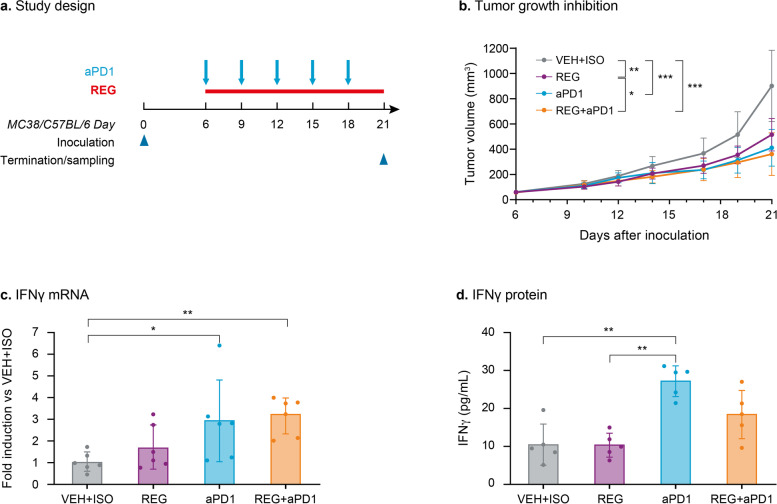
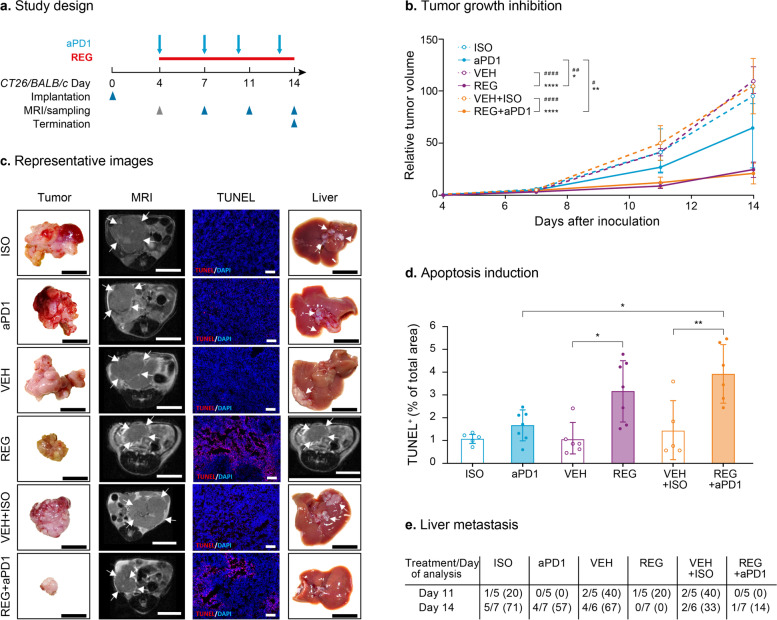
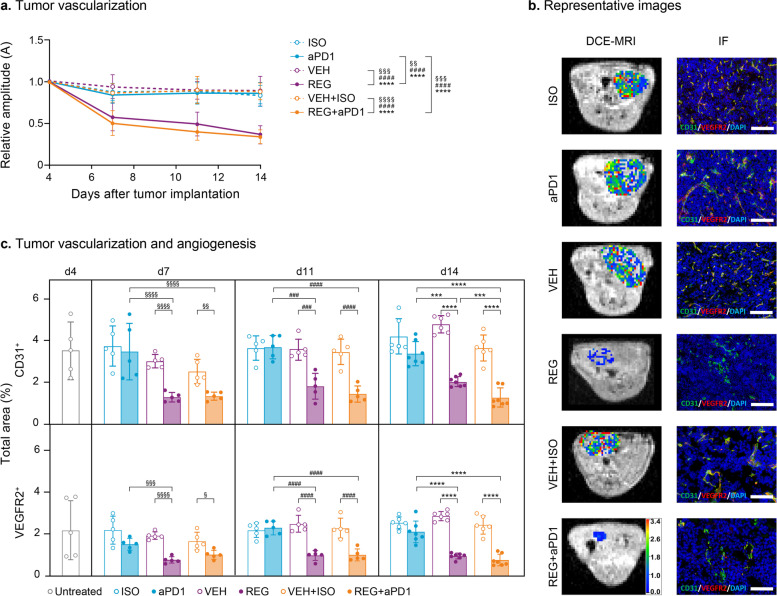
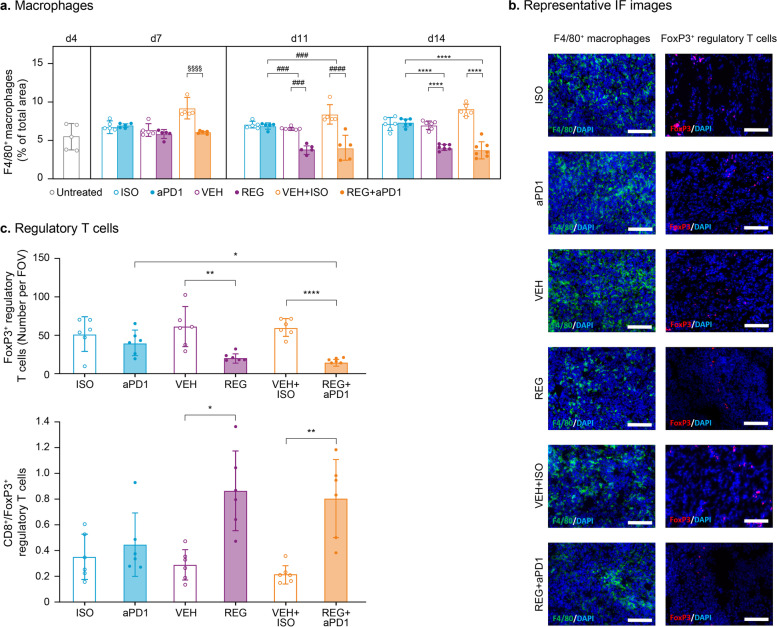
Background: Patients with advanced colorectal cancer (CRC) have a poor prognosis. Combinations of immunotherapies and anti-angiogenic agents are currently being evaluated in clinical trials. In this study, the multikinase inhibitor regorafenib (REG) was combined with an anti-programmed cell death protein 1 (aPD1) antibody in syngeneic murine microsatellite-stable (MSS) CT26 and hypermutated MC38 colon cancer models to gain mechanistic insights into potential drug synergism. Methods: Growth and progression of orthotopic CT26 and subcutaneous MC38 colon cancers were studied under treatment with varying doses of REG and aPD1 alone or in combination. Sustained effects were studied after treatment discontinuation. Changes in the tumor microenvironment were assessed by dynamic contrast-enhanced MRI, and histological and molecular analyses. Results: In both models, REG and aPD1 combination therapy significantly improved anti-tumor activity compared with single agents. However, in the CT26 model, the additive benefit of aPD1 only became apparent after treatment cessation. The combination treatment efficiently prevented tumor regrowth and completely suppressed liver metastasis, whereas the anti-tumorigenic effects of REG alone were abrogated soon after drug discontinuation. During treatment, REG significantly reduced the infiltration of immunosuppressive macrophages and regulatory T (Treg) cells into the tumor microenvironment. aPD1 significantly enhanced intratumoral IFNγ levels. The drugs synergized to induce sustained M1 polarization and durable reduction of Treg cells, which can explain the sustained tumor suppression. Conclusions: This study highlights the synergistic immunomodulatory effects of REG and aPD1 combination therapy in mediating a sustained inhibition of colon cancer regrowth, strongly warranting clinical evaluation in CRC, including MSS tumors.
Overview
The claims and statistics of this paper haven’t been checked yet.
Free: it reads the open-access text and checks the first 5 claims that cite a source we can check. Create a free account to check every claim.
Integrity signals
Registry
Cites
Statistics
Figures
Verification
Claims the paper makes
The claims and statistics of this paper haven’t been checked yet.
Free: it reads the open-access text and checks the first 5 claims that cite a source we can check. Create a free account to check every claim.
Claims other papers make about this one
Each is checked against this paper’s own text: does it say what the citing paper says it does?
The cited source says what the claim attributes to it.
In the citing paper
“In addition, regorafenib also reduces TAMs by inhibiting the CSF-1R [331].”
From Drug Resistance in Colorectal Cancer: From Mechanism to Clinic (2022) · cites this paper as [331]
Self-check
Percentages, sums and reported differences re-computed from the paper’s own numbers.
The self-check needs the paper’s full text.
Citations
Cites
Bray, F., Ferlay, J., Soerjomataram, I., Siegel, R. L., Torre, L. A., & Jemal, A. (2018) · CA: A Cancer Journal for Clinicians · doi:10.3322/caac.21492 · Cited by 84,109
PD-1 and PD-L1 Immune Checkpoint Blockade to Treat Breast Cancer
Hartkopf, A. D., Taran, F.-A., Wallwiener, M., Walter, C. B., Krämer, B., Grischke, E.-M., & Brucker, S. Y. (2016) · Breast Care · doi:10.1159/000453569 · Cited by 30,845
Siegel, R. L., Miller, K. D., & Jemal, A. (2020) · CA: A Cancer Journal for Clinicians · doi:10.3322/caac.21590 · Cited by 20,444
The blockade of immune checkpoints in cancer immunotherapy
Pardoll, D. M. (2012) · Nature Reviews Cancer · doi:10.1038/nrc3239 · Cited by 13,838 · cited 1×
“effective in reactivating cytotoxic T cells [31].”
Mismatch repair deficiency predicts response of solid tumors to PD-1 blockade
Le, D. T., Durham, J. N., Smith, K. N., Wang, H., Bartlett, B. R., Aulakh, L. K., Lu, S., Kemberling, H., Wilt, C., Luber, B. S., et al. (2017) · Science · doi:10.1126/science.aan6733 · Cited by 6,645 · cited 1×
“This is in line with the better clinical responses to ICI monotherapy observed in patients with MSI/ dMMR CRCs compared with patients who have MSS/ pMMR CRC [38].”
ResultMacrophage activation and polarization: nomenclature and experimental guidelines
Murray, P. J., Allen, J. E., Biswas, S. K., Fisher, E. A., Gilroy, D. W., Goerdt, S., Gordon, S., Hamilton, J. A., Ivashkiv, L. B., Lawrence, T., et al. (2014) · Immunity · doi:10.1016/j.immuni.2014.06.008 · Cited by 6,337
A New Era of Systemic Therapy for Hepatocellular Carcinoma with Regorafenib and Lenvatinib
Kudo, M. (2017) · Liver Cancer · doi:10.1159/000462153 · Cited by 5,936
Bruix, J., Qin, S., Merle, P., Granito, A., Huang, Y.-H., Bodoky, G., Pracht, M., Yokosuka, O., Rosmorduc, O., Breder, V., et al. (2017) · The Lancet · doi:10.1016/s0140-6736(16)32453-9 · Cited by 3,653
ESMO consensus guidelines for the management of patients with metastatic colorectal cancer
Van Cutsem, E., Cervantes, A., Adam, R., Sobrero, A., Van Krieken, J. H., Aderka, D., Aranda Aguilar, E., Bardelli, A., Benson, A., Bodoky, G., et al. (2016) · Annals of Oncology · doi:10.1093/annonc/mdw235 · Cited by 3,421 · cited 1×
“For many years, the only approved firstand second-line treatment options for CRC were surgical interventions followed by chemotherapy regimens and combinations with antibodies against epidermal growth factor receptor (EGFR) or vascular endothelial growth factor (VEGF) if indicated [4].”
BackgroundTofts, P. S., Brix, G., Buckley, D. L., Evelhoch, J. L., Henderson, E., Knopp, M. V., Larsson, H. B. W., Lee, T.-Y., Mayr, N. A., Parker, G. J. M., et al. (1999) · Journal of Magnetic Resonance Imaging · doi:10.1002/(sici)1522-2586(199909)10:3<223::aid-jmri2>3.0.co;2-s · Cited by 3,143
Grothey, A., Cutsem, E. V., Sobrero, A., Siena, S., Falcone, A., Ychou, M., Humblet, Y., Bouché, O., Mineur, L., Barone, C., et al. (2013) · The Lancet · doi:10.1016/s0140-6736(12)61900-x · Cited by 2,895
PD-1 expression by tumour-associated macrophages inhibits phagocytosis and tumour immunity
Gordon, S. R., Maute, R. L., Dulken, B. W., Hutter, G., George, B. M., McCracken, M. N., Gupta, R., Tsai, J. M., Sinha, R., Corey, D., et al. (2017) · Nature · doi:10.1038/nature22396 · Cited by 2,247 · cited 3×
“PD1 was found to be expressed on intratumoral M2 macrophages and to dampen their phagocytic activity towards tumor cells [34].”
BackgroundResultInfluentialMacrophages and metabolism in the tumor microenvironment
Vitale, I., Manic, G., Coussens, L. M., Kroemer, G., & Galluzzi, L. (2019) · Cell Metabolism · doi:10.1016/j.cmet.2019.06.001 · Cited by 1,837 · cited 1×
“M2 macrophages secrete pro-tumorigenic, pro-angiogenic, and immunosuppressive factors such as IL10, TGFβ, and VEGFA; whereas M1 macrophages produce pro-inflammatory cytokines such as TNFα, IL1, IL12, and IFNγ, and reactive oxygen species, which prevent tumor growth [41].”
BackgroundKuipers, E. J., Grady, W. M., Lieberman, D., Seufferlein, T., Sung, J. J., Boelens, P. G., van de Velde, C. J. H., & Watanabe, T. (2015) · Nature Reviews Disease Primers · doi:10.1038/nrdp.2015.65 · Cited by 1,563
Single-Cell Analyses Inform Mechanisms of Myeloid-Targeted Therapies in Colon Cancer
Zhang, L., Li, Z., Skrzypczynska, K. M., Fang, Q., Zhang, W., O’Brien, S. A., He, Y., Wang, L., Zhang, Q., Kim, A., et al. (2020) · Cell · doi:10.1016/j.cell.2020.03.048 · Cited by 1,526
Demetri, G. D., Reichardt, P., Kang, Y.-K., Blay, J.-Y., Rutkowski, P., Gelderblom, H., Hohenberger, P., Leahy, M., von Mehren, M., Joensuu, H., et al. (2013) · The Lancet · doi:10.1016/s0140-6736(12)61857-1 · Cited by 1,406
Wilhelm, S. M., Dumas, J., Adnane, L., Lynch, M., Carter, C. A., Schütz, G., Thierauch, K., & Zopf, D. (2011) · International Journal of Cancer · doi:10.1002/ijc.25864 · Cited by 1,355 · cited 3×
“REG is an oral, Small-molecule inhibitor that potently blocks multiple protein kinases, including VEGF receptor (VEGFR) 1, 2, and 3, TIE2, KIT, RET, RAF1, BRAF, BRAFV600E, platelet-derived growth factor receptors, fibroblast growth factor receptor, and colony stimulating factor 1 receptor (CSF1R) [6, 7].”
BackgroundSelf-citationVEGF-A modulates expression of inhibitory checkpoints on CD8+ T cells in tumors
Voron, T., Colussi, O., Marcheteau, E., Pernot, S., Nizard, M., Pointet, A.-L., Latreche, S., Bergaya, S., Benhamouda, N., Tanchot, C., et al. (2015) · Journal of Experimental Medicine · doi:10.1084/jem.20140559 · Cited by 1,179 · cited 1×
“Nevertheless, REG, as a potent inhibitor of VEGFA-signaling, may further add to reactivation of T cells, not only by reducing Treg cells but also by preventing VEGFA-induced PD1 expression in cytotoxic T cells [43], although this contribution was not measurable in the context of total intratumoral IFNγ levels.”
BackgroundOvercoming T cell exhaustion in infection and cancer
Pauken, K. E., & Wherry, E. J. (2015) · Trends in Immunology · doi:10.1016/j.it.2015.02.008 · Cited by 1,171
Fukuoka, S., Hara, H., Takahashi, N., Kojima, T., Kawazoe, A., Asayama, M., Yoshii, T., Kotani, D., Tamura, H., Mikamoto, Y., et al. (2020) · Journal of Clinical Oncology · doi:10.1200/jco.19.03296 · Cited by 890 · cited 3×
“The most encouraging anti-tumor activity was observed in a phase Ib trial, in which the combination of REG and nivolumab showed an objective response rate of 33% in patients with MSS/pMMR CRC previously treated with at least two lines of therapy [23].”
BackgroundResultInfluentialTerme, M., Pernot, S., Marcheteau, E., Sandoval, F., Benhamouda, N., Colussi, O., Dubreuil, O., Carpentier, A. F., Tartour, E., & Taieb, J. (2013) · Cancer Research · doi:10.1158/0008-5472.can-12-2325 · Cited by 684 · cited 2×
“Other anti-angiogenic agents, such as the multi-tyrosine kinase inhibitor sunitinib or the anti-VEGFA antibody bevacizumab, have been shown to induce similar Treg cell-reducing effects in subcutaneous CT26 tumors and in the peripheral blood of patients with metastatic CRC [39].”
BackgroundPharmacokinetic Parameters in CNS Gd-DTPA Enhanced MR Imaging
Brix, G., Semmler, W., Port, R., Schad, L. R., Layer, G., & Lorenz, W. J. (1991) · Journal of Computer Assisted Tomography · doi:10.1097/00004728-199107000-00018 · Cited by 659
Deciphering and Reversing Tumor Immune Suppression
Motz, G. T., & Coukos, G. (2013) · Immunity · doi:10.1016/j.immuni.2013.07.005 · Cited by 598
Corbett, T. H., Griswold, D. P., Roberts, B. J., Peckham, J. C., & Schabel, F. M. (1975) · PubMed · Cited by 584
Immunomic, genomic and transcriptomic characterization of CT26 colorectal carcinoma
Castle, J. C., Loewer, M., Boegel, S., de Graaf, J., Bender, C., Tadmor, A. D., Boisguerin, V., Bukur, T., Sorn, P., Paret, C., et al. (2014) · BMC Genomics · doi:10.1186/1471-2164-15-190 · Cited by 384
Immunotherapy of colorectal cancer: Challenges for therapeutic efficacy
Ciardiello, D., Vitiello, P. P., Cardone, C., Martini, G., Troiani, T., Martinelli, E., & Ciardiello, F. (2019) · Cancer Treatment Reviews · doi:10.1016/j.ctrv.2019.04.003 · Cited by 304
Targeting immune checkpoints potentiates immunoediting and changes the dynamics of tumor evolution
Efremova, M., Rieder, D., Klepsch, V., Charoentong, P., Finotello, F., Hackl, H., Hermann-Kleiter, N., Löwer, M., Baier, G., Krogsdam, A., et al. (2018) · Nature Communications · doi:10.1038/s41467-017-02424-0 · Cited by 297
Abou-Elkacem, L., Arns, S., Brix, G., Gremse, F., Zopf, D., Kiessling, F., & Lederle, W. (2013) · Molecular Cancer Therapeutics · doi:10.1158/1535-7163.mct-12-1162 · Cited by 282
Self-citationAdvances in immunotherapy for colorectal cancer: a review
Golshani, G., & Zhang, Y. (2020) · Therapeutic Advances in Gastroenterology · doi:10.1177/1756284820917527 · Cited by 236
Dinaciclib induces immunogenic cell death and enhances anti-PD1-mediated tumor suppression
Hossain, D. M. S., Javaid, S., Cai, M., Zhang, C., Sawant, A., Hinton, M., Sathe, M., Grein, J., Blumenschein, W., Pinheiro, E. M., et al. (2018) · Journal of Clinical Investigation · doi:10.1172/jci94586 · Cited by 216 · cited 1×
“As previously reported [25, 36], aPD1 alone was more effective in MC38 tumors, which have a higher mutational load than CT26 tumors [25, 37].”
BackgroundZhong, W., Myers, J. S., Wang, F., Wang, K., Lucas, J., Rosfjord, E., Lucas, J., Hooper, A. T., Yang, S., Lemon, L. A., et al. (2020) · BMC Genomics · doi:10.1186/s12864-019-6344-3 · Cited by 184
Dhupkar, P., Gordon, N., Stewart, J., & Kleinerman, E. S. (2018) · Cancer Medicine · doi:10.1002/cam4.1518 · Cited by 183
Port, R. E., Knopp, M. V., Hoffmann, U., Milker-Zabel, S., & Brix, G. (1999) · Journal of Magnetic Resonance Imaging · doi:10.1002/(sici)1522-2586(199909)10:3<233::aid-jmri3>3.0.co;2-m · Cited by 175
Impact of l-Arginine Metabolism on Immune Response and Anticancer Immunotherapy
Kim, S.-H., Roszik, J., Grimm, E. A., & Ekmekçioglu, S. (2018) · Frontiers in Oncology · doi:10.3389/fonc.2018.00067 · Cited by 169
Schmieder, R., Hoffmann, J., Becker, M., Bhargava, A., Müller, T., Kahmann, N., Ellinghaus, P., Adams, R., Rosenthal, A., Thierauch, K., et al. (2014) · International Journal of Cancer · doi:10.1002/ijc.28669 · Cited by 138
Self-citationA colon tumor model for anticancer agent evaluation
Griswold, D. P., & Corbett, T. H. (2006) · Cancer · doi:10.1002/1097-0142(197512)36:6<2441::aid-cncr2820360627>3.0.co;2-p · Cited by 129
Wang, C., Chevalier, D., Saluja, J., Sandhu, J. S., Lau, C. P.-Y., & Fakih, M. (2020) · The Oncologist · doi:10.1634/theoncologist.2020-0161 · Cited by 107
Pharmacologic activity and pharmacokinetics of metabolites of regorafenib in preclinical models
Zopf, D., Fichtner, I., Bhargava, A., Steinke, W., Thierauch, K., Diefenbach, K., Wilhelm, S. M., Hafner, F., & Gerisch, M. (2016) · Cancer Medicine · doi:10.1002/cam4.883 · Cited by 104
Self-citationThird- or Later-line Therapy for Metastatic Colorectal Cancer: Reviewing Best Practice
Bekaii‐Saab, T., Kim, R. D., Kim, T. W., O’Connor, J. M., Strickler, J. H., Malka, D., Bianchi, A. S., Bi, F., Yamaguchi, K., Yoshino, T., et al. (2018) · Clinical Colorectal Cancer · doi:10.1016/j.clcc.2018.11.002 · Cited by 88
Arginine Metabolism and Its Potential in Treatment of Colorectal Cancer
Du, T., & Han, J. (2021) · Frontiers in Cell and Developmental Biology · doi:10.3389/fcell.2021.658861 · Cited by 78
Non-invasive assessment of vessel morphology and function in tumors by magnetic resonance imaging
Kiessling, F. M., Jugold, M., Woenne, E. C., & Brix, G. (2007) · European Radiology · doi:10.1007/s00330-006-0566-x · Cited by 71
Self-citationSupplementation of l ‐arginine boosts the therapeutic efficacy of anticancer chemoimmunotherapy
Satoh, Y., Kotani, H., Iida, Y., Taniura, T., Notsu, Y., & Harada, M. (2020) · Cancer Science · doi:10.1111/cas.14490 · Cited by 62
Li, J., Cong, L., Liu, J., Peng, L., Wang, J., Feng, A., Yue, J., Li, L., Wang, X., & Wang, X. (2020) · Frontiers in Oncology · doi:10.3389/fonc.2020.594125 · Cited by 54
Huynh, H. T., Ong, R., & Zopf, D. (2015) · Journal of Experimental & Clinical Cancer Research · doi:10.1186/s13046-015-0243-5 · Cited by 48
Self-citationSegal, N. H., Gada, P., Senzer, N., Gargano, M. A., Patchen, M. L., & Saltz, L. B. (2016) · Clinical Colorectal Cancer · doi:10.1016/j.clcc.2016.02.013 · Cited by 46
Kaufman, H. L., Schwartz, L. H., William, W. N., Sznol, M., Fahrbach, K. R., Xu, Y., Masson, E., & Vergara-Silva, A. L. (2018) · Journal of Cancer Research and Clinical Oncology · doi:10.1007/s00432-018-2738-x · Cited by 39
Ren, C., Mai, Z.-J., Jin, Y., He, M.-M., Wang, Z., Luo, H., Zhang, D., Wu, C.-Y., Wang, F., & Xu, R. (2020) · PubMed · Cited by 38
Update on systemic therapy for colorectal cancer: biologics take sides
Gbolahan, O. B., & O’Neil, B. H. (2019) · Translational Gastroenterology and Hepatology · doi:10.21037/tgh.2019.01.12 · Cited by 34
Wang, Z., Ye, C.-Y., Zhou, W., Wang, M., Dai, W.-P., Zheng, J., & Zang, Y. (2020) · OncoTargets and Therapy · doi:10.2147/ott.s265725 · Cited by 5
Abstract 3917: Potentiating effect of reovirus in anti-PD1 therapy in colorectal cancer
Augustine, T. A., Maitra, R., John, P., & Goel, S. (2018) · Cancer Research · doi:10.1158/1538-7445.am2018-3917 · Cited by 4
Cited by
Clinical management of metastatic colorectal cancer in the era of precision medicine
Ciardiello, F., Ciardiello, D., Martini, G., Napolitano, S., Tabernero, J., & Cervantes, A. (2022) · CA: A Cancer Journal for Clinicians · doi:10.3322/caac.21728 · Cited by 528
PD-1 and PD-L1 inhibitors in cold colorectal cancer: challenges and strategies
Lin, K. X., Istl, A. C., Quan, D., Skaro, A. I., Tang, E. S.-T., & Zheng, X. (2023) · Cancer Immunology Immunotherapy · doi:10.1007/s00262-023-03520-5 · Cited by 180
Drug Resistance in Colorectal Cancer: From Mechanism to Clinic
Wang, Q., Shen, X., Chen, G., & Du, J. (2022) · Cancers · doi:10.3390/cancers14122928 · Cited by 160
Advancements in combining targeted therapy and immunotherapy for colorectal cancer
Singh, M., Morris, V. K., Bandey, I. N., Hong, D. S., & Kopetz, S. (2024) · Trends in cancer · doi:10.1016/j.trecan.2024.05.001 · Cited by 156
Fakih, M., Raghav, K. P. S., Chang, D. Z., Larson, T., Cohn, A. L., Huyck, T. K., Cosgrove, D., Fiorillo, J. A., Tam, R., D’Adamo, D. R., et al. (2023) · EClinicalMedicine · doi:10.1016/j.eclinm.2023.101917 · Cited by 134
Metadata
- Authors
- Doleschel, D., Hoff, S., Koletnik, S., Rix, A., Zopf, D., Kiessling, F., & Lederle, W.
- Affiliations
- RWTH Aachen University (DE)
- Bayer (Germany) (DE)
- Fraunhofer Institute for Digital Medicine (DE)
- Corresponding author
- Zopf, Dieter
- Lederle, Wiltrud
- Venue
- Journal of Experimental & Clinical Cancer Research
- Published
- 2021-09-13
- Volume
- 40
- Issue
- 1
- Pages
- 288-288
- ISSN
- 0392-9078 (ISSN-L)
- 1756-9966
- PMC
- PMC8436536
- OpenAlex
- W3200675468
- Cited by
- 114
- References
- 49
- Citations by year
- 2026: 14 · 2025: 26 · 2024: 23 · 2023: 33 · 2022: 17 · 2021: 1
- FWCI
- 6.73
- Type
- journal article
- Language
- en
- Open access
- gold
- doi.org
- Licence
- cc-by
- creativecommons.org/licenses/by/4.0 (tdm)
- creativecommons.org/licenses/by/4.0 (vor)
- Locations
- Journal of Experimental & Clinical Cancer Research (publishedVersion, cc-by)
- PubMed Central (publishedVersion, cc-by)
- PubMed (publishedVersion)
- DOAJ (DOAJ: Directory of Open Access Journals) (submittedVersion, cc-by-sa)
- Publikationsdatenbank der Fraunhofer-Gesellschaft (Fraunhofer-Gesellschaft) (submittedVersion, other-oa)
- Informationszentrum Lebenswissenschaften (ZB MED) (submittedVersion, cc-by)
- Fraunhofer-Publica (Fraunhofer-Gesellschaft) (submittedVersion)
- RWTH Publications (RWTH Aachen) (submittedVersion, other-oa)
- RWTH Publications (RWTH Aachen)
- Funders
- Bayer
- RWTH Aachen University
- Topics
- Health Sciences › Medicine › Oncology › Cancer Immunotherapy and Biomarkers
- Health Sciences › Medicine › Oncology › Colorectal Cancer Treatments and Studies
- Health Sciences › Medicine › Oncology › Pancreatic and Hepatic Oncology Research
- Keywords
- regorafenib, anti-PD-1 therapy, colorectal cancer, combination therapy, multikinase inhibitor, tumor microenvironment, tumor regrowth, liver metastasis, regulatory T cells, M1 macrophage polarization, interferon-gamma, immunosuppressive macrophages, microsatellite stable tumors, hypermutated tumors, drug synergy, dynamic contrast-enhanced MRI
- MeSH terms
- Animals, Drug Synergism, Humans, Immunotherapy, Phenylurea Compounds, Pyridines, Colorectal Neoplasms, Cell Line, Tumor, Mice, Programmed Cell Death 1 Receptor
About these checks
Registry, retraction, Cites and statistics results are computed, not judged, with one exception: a printed reference that no index lists is read once by a model before it counts as a citation error. Claims are extracted by a model and kept only when their quote appears verbatim in the text; each cited source is then checked, with a model’s help, for whether it says what the claim relies on. Those verdicts can be wrong — read the claim’s quote and the cited source before relying on one.
Statistics and arithmetic are recomputed, not judged.
Confidence bands are shown only for fields calibrated on our annotated test set. None is calibrated yet, so no band is shown.
What counts as a claim ›How we measure confidence ›How we check this ›
Are you an author, or do you see a problem with this page? Request a review
Data sources
Bibliographic data: Semantic Scholar, OpenAlex, Crossref.
Contains information from the Semantic Scholar Academic Graph Datasets, made available under the ODC Attribution License (ODC-BY 1.0).
Semantic Scholar’s data is described in: Kinney, R., et al. (2023). The Semantic Scholar Open Data Platform. arXiv:2301.10140.
