

Resistance to anti-EGFR therapies in metastatic colorectal cancer: underlying mechanisms and reversal strategies
Open accessThe DOI matches its Crossref record; 155 of the 156 references it cites were found in a registry or an index, and 1 are not checked yet; 37 of the 185 sources its claims cite were checked for support.
Abstract
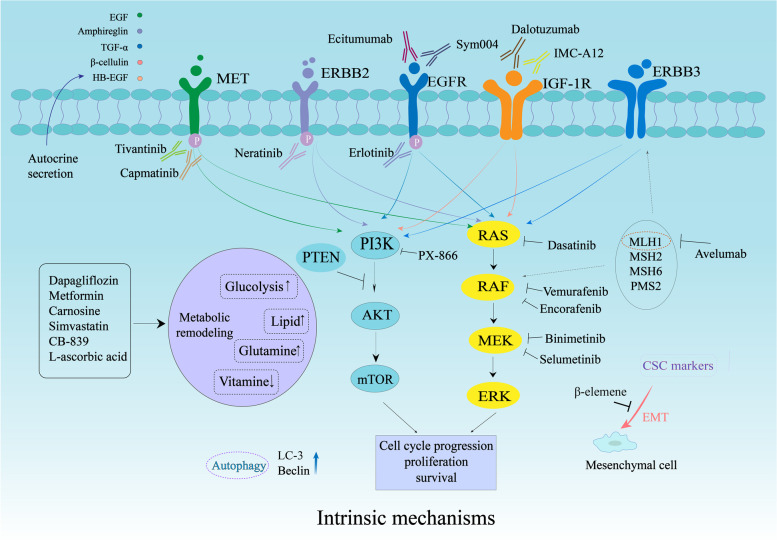
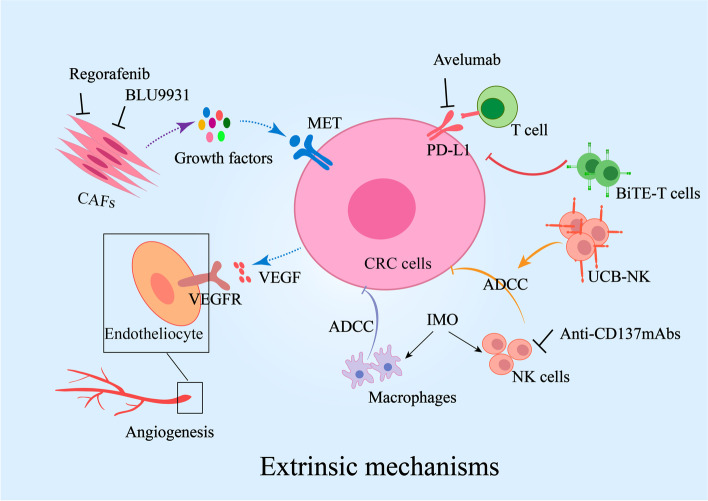
Cetuximab and panitumumab are monoclonal antibodies (mAbs) against epidermal growth factor receptor (EGFR) that are effective agents for metastatic colorectal cancer (mCRC). Cetuximab can prolong survival by 8.2 months in RAS wild-type (WT) mCRC patients. Unfortunately, resistance to targeted therapy impairs clinical use and efficiency. The mechanisms of resistance refer to intrinsic and extrinsic alterations of tumours. Multiple therapeutic strategies have been investigated extensively to overcome resistance to anti-EGFR mAbs. The intrinsic mechanisms include EGFR ligand overexpression, EGFR alteration,RAS/RAF/PI3K gene mutations, ERBB2/MET/IGF-1R activation, metabolic remodelling, microsatellite instability and autophagy. For intrinsic mechanisms, therapies mainly cover the following: new EGFR-targeted inhibitors, a combination of multitargeted inhibitors, and metabolic regulators. In addition, new cytotoxic drugs and small molecule compounds increase the efficiency of cetuximab. Extrinsic alterations mainly disrupt the tumour microenvironment, specifically immune cells, cancer-associated fibroblasts (CAFs) and angiogenesis. The directions include the modification or activation of immune cells and suppression of CAFs and anti-VEGFR agents. In this review, we focus on the mechanisms of resistance to anti-EGFR monoclonal antibodies (anti-EGFR mAbs) and discuss diverse approaches to reverse resistance to this therapy in hopes of identifying more mCRC treatment possibilities.
Verified 2026-10-06 · 1 reference not checked yet
Overview
CoChat Summary
TL;DR
This review summarizes intrinsic and extrinsic mechanisms of resistance to anti-EGFR monoclonal antibodies in metastatic colorectal cancer and discusses preclinical and clinical strategies to reverse that resistance. It emphasizes that resistance is driven by genetic alterations, compensatory signaling, metabolic remodeling, immune microenvironment changes, CAFs, and angiogenesis, with combination and multitargeted approaches showing the most promise.
Key findings
- Anti-EGFR mAbs benefit only a subset of mCRC patients: cetuximab plus FOLFIRI reduced progression risk by 15% and increased OS by 8.2 months in KRAS WT mCRC versus FOLFIRI alone, but clinical benefit in responders lasts only 8–10 months, and approximately 80% of responders develop resistance.
- Intrinsic resistance mechanisms include EGFR ligand overexpression, EGFR extracellular domain mutations (e.g., G465R, G465E, S468R, S492R), RAS/RAF/PI3K pathway mutations, ERBB2/MET/IGF-1R activation, metabolic remodeling, microsatellite instability, autophagy, CSCs, and EMT.
- Reversal strategies include new anti-EGFR antibodies (necitumumab, Sym004, GC1118, MM-151), multitargeted inhibitors, metabolic regulators, immune therapies, CAF suppression, and antiangiogenic agents. Notable reported results include encorafenib + binimetinib + cetuximab in BRAF V600E mCRC (ORR 26% vs 2%; mOS 9.0 vs 5.4 months), capmatinib + gefitinib in MET-amplified disease (ORR 47%), and tivantinib + cetuximab (ORR 9.8%, mPFS 2.6 months, mOS 9.2 months).
- Extrinsic resistance involves impaired ADCC, dysfunctional NK/T cells, CAF-secreted growth factors, and angiogenesis; avelumab + cetuximab in RAS WT acquired resistance gave mPFS 3.6 months and mOS 11.6 months, while regorafenib + cetuximab produced partial response in 1/17 and stable disease in 7/17 patients.
Methods
- Narrative review of published literature on mechanisms of resistance to anti-EGFR mAbs in mCRC and strategies to reverse resistance.
- Synthesizes preclinical and clinical evidence, including two summary tables: Table 1 for clinical trials and Table 2 for preclinical studies.
- No primary experimental data, systematic search strategy, or meta-analysis is described.
Limitations
- The paper does not state formal limitations.
- Evident from the text: as a review, it provides no new primary data, and conclusions depend on cited studies that include small, early-phase, case-report, and preclinical evidence.
- Evident from the text: several strategies show conflicting or negative results (e.g., vemurafenib studies, PX-866 plus cetuximab, selumetinib plus cetuximab, dalotuzumab/IMC-A12), and the paper notes that more clinical studies are needed for MEK inhibitors, new anti-EGFR mAbs, and cytotoxic agents before clinical application.
Model-written summary. Check it against the paper before relying on it.
Integrity signals
Registry
Cites
Statistics
Figures
Verification
Claims the paper makes
25 Valid · 2 Not valid · 105 Not checked · 21 Own results and interpretations
Some cited sources support this claim and some don’t — read each source’s verdict below.
In the paper
“EGFR somatic sequence changes, including G465R, G465E, S468R and S492R, located at the extracellular domains (ECDs) of the EGFR-mAb interaction interface, confer resistance to cetuximab and panitumumab by preventing mAb binding [10, 67, 68].”
§ Resistance to anti-EGFR therapies in metastatic colorectal cancer: underlying mechanisms and reversal strategies > Intrinsic mechanisms of resistance to targeted therapy and related strategies > EGFR ligands and EGFR
What the sources say
- Partly supportedcites [10] Bertotti A Papp E Jones S Adleff V Anagnostou V Lupo B Sausen M Phallen J Hruban CA Tokheim C The genomic landscape of response to EGFR blockade in colorectal cancer Nature. 2015 526 7572 263 267 10.1038/nature14969 26416732 PMC4878148 sourceExperimental — accuracy not yet measured
The paper’s discussion of EGFR ectodomain alterations and Extended Data Figure 2 identify G465R and G465E at the antibody-binding interface and link them to cetuximab resistance; it also reports poor panitumumab sensitivity for G465E tumorgrafts. But the paper says S492R-altered tumors remain sensitive to panitumumab, does not identify S468R in the passages retrieved, and describes impaired binding as a structural inference rather than demonstrating prevention of binding for all four changes. No page numbers are provided in our copy. (LLM, conf=0.90)
- Partly supportedcites [67] Van Emburgh BO Arena S Siravegna G Lazzari L Crisafulli G Corti G Mussolin B Baldi F Buscarino M Bartolini A Acquired RAS or EGFR mutations and duration of response to EGFR blockade in colorectal cancer Nat Commun 2016 7 13665 10.1038/ncomms13665 27929064 PMC5155160 sourceExperimental — accuracy not yet measured
The introductory passage says EGFR extracellular-domain variants impair anti-EGFR antibody binding, and the Discussion identifies mutations in the antibody-binding site as a resistance mechanism. The Results identify S492R in cells exposed to cetuximab. Our copy does not identify G465R, G465E, or S468R, or establish that each listed change prevents binding of both cetuximab and panitumumab. (LLM, conf=0.85)
- Disputedcites [68] Price T Ang A Boedigheimer M Kim TW Li J Cascinu S Ruff P Satya SA Thomas A Tjulandin S Frequency of S492R mutations in the epidermal growth factor receptor: analysis of plasma DNA from patients with metastatic colorectal cancer treated with panitumumab or cetuximab monotherapy Cancer Biol Ther 2020 21 10 891 898 10.1080/15384047.2020.1798695 33026965 PMC7583702 sourceExperimental — accuracy not yet measured
The Results (In vitro receptor binding and activity; page unavailable) show that panitumumab, but not cetuximab, bound to and inhibited S492R mutant EGFR. Thus the claim that S492R prevents binding and confers resistance to both antibodies contradicts this paper. The Discussion mentions G465R resistance to cetuximab, but the retrieved passages do not establish the claimed effects of G465E or S468R. (LLM, conf=0.90)
Checked by a reasoning model — may be wrong.
plainstates a cause- Asserted: passes — The authors put it forward as true.
- Checkable: passes — It can be checked against evidence.
- Load-bearing: passes — The paper’s conclusions depend on it.
- Based: passes — The paper gives a reason why it holds.
- Partly supported
At least one cited source doesn’t support this claim or points to a different paper, and none confirmed it — see the verdicts below.
In the paper
“The hotspot BRAF V600E mutation at codon 600 of exon 15 increases the activity of BRAF kinase by 130- to 700-fold [26, 93–95].”
§ Resistance to anti-EGFR therapies in metastatic colorectal cancer: underlying mechanisms and reversal strategies > Intrinsic mechanisms of resistance to targeted therapy and related strategies > Compensatory feedback loop signalling
What the sources say
- Not checked yetcites [26] Shinozaki E Yoshino T Yamazaki K Muro K Yamaguchi K Nishina T Yuki S Shitara K Bando H Mimaki S Clinical significance of BRAF non-V600E mutations on the therapeutic effects of anti-EGFR monoclonal antibody treatment in patients with pretreated metastatic colorectal cancer: the biomarker research for anti-EGFR monoclonal antibodies by comprehensive Cancer genomics (BREAC) study Br J Cancer 2017 117 10 1450 1458 10.1038/bjc.2017.308 28972961 PMC5680457 source
- Could not verifycites [93] Vinagre J Almeida A Populo H Batista R Lyra J Pinto V Coelho R Celestino R Prazeres H Lima L Frequency of TERT promoter mutations in human cancers Nat Commun 2013 4 2185 10.1038/ncomms3185 23887589 sourceExperimental — accuracy not yet measured
The Results section reports the presence of BRAF V600E in melanomas, but does not discuss its effect on BRAF kinase activity. Searches for exon 15, codon 600, and a 130- to 700-fold activity increase found no passage addressing those parts of the claim; page numbers were unavailable in our copy. (LLM, conf=0.76)
- Not checked yetcites [94] Pakneshan S Salajegheh A Smith RA Lam AK Clinicopathological relevance of BRAF mutations in human cancer Pathology. 2013 45 4 346 356 10.1097/PAT.0b013e328360b61d 23594689 source
- Disputedcites [95] Davies H Bignell GR Cox C Stephens P Edkins S Clegg S Teague J Woffendin H Garnett MJ Bottomley W Mutations of the BRAF gene in human cancer Nature. 2002 417 6892 949 954 10.1038/nature00766 12068308 sourceExperimental — accuracy not yet measured
The kinase assay in “letters to nature” (p. 3) reports that V599E BRAF had about 10.7-fold the basal kinase activity of wild-type BRAF, not 130- to 700-fold. The same page reports a 70- to 138-fold increase in cell transformation, which is a different measure from kinase activity. Our copy calls the mutation V599E. (LLM, conf=0.88)
Checked by a reasoning model — may be wrong.
plainstates a cause- Asserted: passes — The authors put it forward as true.
- Checkable: passes — It can be checked against evidence.
- Load-bearing: unclear — It is unclear whether the paper’s conclusions depend on it.
- Based: passes — The paper gives a reason why it holds.
The cited sources support only part of this claim — read each source’s verdict below.
In the paper
“Mutations in exons 2, 3 and 4 of KRAS and exons 2, 3, and 4 of NRAS are powerful predictors for cetuximab and panitumumab response in mCRC [81, 82].”
§ Resistance to anti-EGFR therapies in metastatic colorectal cancer: underlying mechanisms and reversal strategies > Intrinsic mechanisms of resistance to targeted therapy and related strategies > Compensatory feedback loop signalling
What the sources say
- Partly supportedcites [81] Bokemeyer C Köhne CH Ciardiello F Lenz HJ Heinemann V Klinkhardt U Beier F Duecker K van Krieken JH Tejpar S FOLFOX4 plus cetuximab treatment and RAS mutations in colorectal cancer Eur J Cancer 2015 51 10 1243 1252 10.1016/j.ejca.2015.04.007 25937522 PMC7508202 sourceExperimental — accuracy not yet measured
The Introduction reports poorer outcomes with KRAS exon 2 mutations for both cetuximab and panitumumab and cites evidence linking other RAS mutations to poorer panitumumab outcomes. But this paper directly studies cetuximab, not panitumumab, and its Results say the small subgroup with other RAS mutations did not permit a formal assessment of predictive effects; calling mutations across all the listed exons “powerful predictors” overstates its findings. Page numbers are not available in our copy. (LLM, conf=0.88)
- Partly supportedcites [82] Blons H Emile JF Le Malicot K Julié C Zaanan A Tabernero J Mini E Folprecht G Van Laethem JL Thaler J Prognostic value of KRAS mutations in stage III colon cancer: post hoc analysis of the PETACC8 phase III trial dataset Ann Oncol 2014 25 12 2378 2385 10.1093/annonc/mdu464 25294886 sourceExperimental — accuracy not yet measured
The Introduction (p. 2) says KRAS status predicts resistance to EGFR inhibitors in metastatic colorectal cancer. It does not establish the claimed predictive value for KRAS and NRAS mutations across exons 2, 3, and 4, or specifically address response to both cetuximab and panitumumab; the Discussion (p. 5) describes testing KRAS exon 2 and BRAF mutations for prognosis in stage III disease. (LLM, conf=0.88)
boostedstates an association- Asserted: passes — The authors put it forward as true.
- Checkable: passes — It can be checked against evidence.
- Load-bearing: passes — The paper’s conclusions depend on it.
- Based: passes — The paper gives a reason why it holds.
- Partly supported
The sources with a verdict support this claim; the rest weren’t checked yet, have no full text we could read, or their verdicts aren’t rated yet.
In the paper
“Gene mutations downstream of the EGFR signalling pathway, including RAS/RAF/MEK and PI3K/AKT/mTOR, significantly contribute to drug resistance [9–11].”
§ Resistance to anti-EGFR therapies in metastatic colorectal cancer: underlying mechanisms and reversal strategies > Background
What the sources say
- Not checked yetcites [9] Karapetis CS Khambata-Ford S Jonker DJ O'Callaghan CJ Tu D Tebbutt NC Simes RJ Chalchal H Shapiro JD Robitaille S K-ras mutations and benefit from cetuximab in advanced colorectal cancer N Engl J Med 2008 359 17 1757 1765 10.1056/NEJMoa0804385 18946061 source
- Supportedcites [10] Bertotti A Papp E Jones S Adleff V Anagnostou V Lupo B Sausen M Phallen J Hruban CA Tokheim C The genomic landscape of response to EGFR blockade in colorectal cancer Nature. 2015 526 7572 263 267 10.1038/nature14969 26416732 PMC4878148 source
The Abstract (Results passage) states that in KRAS wild-type CRC tumorgrafts, alterations in all genes known to be involved in EGFR therapeutic resistance — NRAS, BRAF V600E, MET, ERBB2, plus PIK3CA exon 20 and PTEN truncating/deletion alterations — were detected in cetuximab-resistant tumors, and that 'the enrichment of mutations in these pathways in the resistant tumorgrafts was statistically significant (p<0.001)' and 'alterations in any of these members may be sufficient to render cells insensitive to EGFR inhibition'. Extended Data Fig. 1 is titled 'EGFR signaling pathway genes involved in cetuximab resistance or sensitivity' and depicts members of the RAS and PI3K pathways, while Extended Data Fig. 4 shows ectopic expression of resistance-associated mutations (EGFR G465E, MAP2K1 K57N) inducing cetuximab resistance — supporting a causal contribution of RAS/RAF/MEK and PI3K pathway mutations to anti-EGFR antibody resistance. The pathway naming 'PI3K/AKT/mTOR' is a generic label; our copy documents PIK3CA/PTEN (and AKT signalling via IRS2) rather than MTOR mutations, which does not weaken the attributed point. (LLM, conf=0.85)
- Not checked yetcites [11] De Roock W Claes B Bernasconi D De Schutter J Biesmans B Fountzilas G Kalogeras KT Kotoula V Papamichael D Laurent-Puig P Effects of KRAS, BRAF, NRAS, and PIK3CA mutations on the efficacy of cetuximab plus chemotherapy in chemotherapy-refractory metastatic colorectal cancer: a retrospective consortium analysis Lancet Oncol. 2010 11 8 753 762 10.1016/S1470-2045(10)70130-3 20619739 source
plainstates a cause- Asserted: passes — The authors put it forward as true.
- Checkable: passes — It can be checked against evidence.
- Load-bearing: passes — The paper’s conclusions depend on it.
- Based: passes — The paper gives a reason why it holds.
Every source the paper cites for this claim was checked and supports it.
In the paper
“Progression-free survival (PFS) and OS of patients taking necitumumab plus mFOLFOX6 were comparable to those of the cetuximab and FOLFOX regimens [21].”
§ Resistance to anti-EGFR therapies in metastatic colorectal cancer: underlying mechanisms and reversal strategies > Intrinsic mechanisms of resistance to targeted therapy and related strategies > EGFR ligands and EGFR
What the sources say
- Supportedcites [21] Elez E Hendlisz A Delaunoit T Sastre J Cervantes A Varea R Chao G Wallin J Tabernero J Phase II study of necitumumab plus modified FOLFOX6 as first-line treatment in patients with locally advanced or metastatic colorectal cancer Br J Cancer 2016 114 4 372 380 10.1038/bjc.2015.480 26766738 PMC4815776 source
The Discussion explicitly states that OS and PFS with necitumumab plus mFOLFOX6 were comparable with those reported in previous studies of cetuximab combined with FOLFOX regimens. This is a cross-trial comparison, not a head-to-head finding. (LLM, conf=0.94)
plain- Asserted: passes — The authors put it forward as true.
- Checkable: passes — It can be checked against evidence.
- Load-bearing: unclear — It is unclear whether the paper’s conclusions depend on it.
- Based: passes — The paper gives a reason why it holds.
- Supported
106 more claims · 17 with their cited sources checked
Create a free account to see all 153 claims and to verify the 148 references still open.
- Probably not a substantial claim. 6
- It may state two separate claims as one. 38
Claims other papers make about this one
Each is checked against this paper’s own text: does it say what the citing paper says it does?
In the citing paper
“Progressive disease following anti-EGFR therapy may result from acquired resistance [45,46], which may result from any one of several causes [47].”
From Recent Advances in Therapeutic Strategies to Improve Colorectal Cancer Treatment (2024) · cites this paper as [47]
Self-check
Percentages, sums and reported differences re-computed from the paper’s own numbers.
Each contradiction between two passages listed here was confirmed by an independent check.
Rated minor: it would not touch a result — a value no result rests on, a p-value that stays on the same side of the significance level, or a conflict that is clerical, resolved elsewhere in the paper, or outside its own findings.
In the paper
§ Resistance to anti-EGFR therapies in metastatic colorectal cancer: underlying mechanisms and reversal strategies > Intrinsic mechanisms of resistance to targeted therapy and related strategies
“| Immunity therapy | CAFs | BLU9931 | Cell | Unselected | BLU9931 + cetuximab VS cetuximab | Sensitive VS insensitive | [58] |”
§ Resistance to anti-EGFR therapies in metastatic colorectal cancer: underlying mechanisms and reversal strategies > Extrinsic mechanisms of resistance to targeted therapy and related strategies > CAFs and inhibitors
“The combination of BLU9931,an FGFR4 inhibitor, with cetuximab presented profound antitumour activity compared to cetuximab alone [57]. Regorafenib, a multikinase inhibitor targeting FGFR, VEGF and PDGFR-β, was found to overcome cetuximab resistance in GEO-CR and SW48-CR cells in vitro and in vivo [58].”
Rated minor: it would not touch a result — a value no result rests on, a p-value that stays on the same side of the significance level, or a conflict that is clerical, resolved elsewhere in the paper, or outside its own findings.
In the paper
§ Resistance to anti-EGFR therapies in metastatic colorectal cancer: underlying mechanisms and reversal strategies > Intrinsic mechanisms of resistance to targeted therapy and related strategies
“| MET inhibitors | MET | Tivantinib | Phase II | mCRC | KRAS mutation | Tivantinib + cetuximab | ORR: 9.8%, mPFS: 2.6m,mOS:9.2m | [33] |”
§ Resistance to anti-EGFR therapies in metastatic colorectal cancer: underlying mechanisms and reversal strategies > References
“33. Rimassa L Bozzarelli S Pietrantonio F Cordio S Lonardi S Toppo L Zaniboni A Bordonaro R Di Bartolomeo M Tomasello G Phase II study of Tivantinib and Cetuximab in patients with KRAS wild-type metastatic colorectal Cancer with acquired resistance to EGFR inhibitors and emergence of MET overexpression:”
Rated minor: it would not touch a result — a value no result rests on, a p-value that stays on the same side of the significance level, or a conflict that is clerical, resolved elsewhere in the paper, or outside its own findings.
In the paper
§ Resistance to anti-EGFR therapies in metastatic colorectal cancer: underlying mechanisms and reversal strategies > Intrinsic mechanisms of resistance to targeted therapy and related strategies
“| MET inhibitors | MET | Capmatinib | Phase II | mCRC | MET amplification | Capmatinib + gefitinib | ORR: 47% | [34] |”
§ Resistance to anti-EGFR therapies in metastatic colorectal cancer: underlying mechanisms and reversal strategies > References
“34. Wu YL Zhang L Kim DW Liu X Lee DH Yang JC Ahn MJ Vansteenkiste JF Su WC Felip E Phase Ib/II study of Capmatinib (INC280) plus Gefitinib after failure of epidermal growth factor receptor (EGFR) inhibitor therapy in patients with EGFR-mutated, MET factor-dysregulated non-small-cell lung Cancer”
Rated minor: it would not touch a result — a value no result rests on, a p-value that stays on the same side of the significance level, or a conflict that is clerical, resolved elsewhere in the paper, or outside its own findings.
In the paper
§ Resistance to anti-EGFR therapies in metastatic colorectal cancer: underlying mechanisms and reversal strategies > Intrinsic mechanisms of resistance to targeted therapy and related strategies
“| New anti-EGFR mAbs | EGFR ECD | Sym004 | Phase I | mCRC | KRAS WT | Sym004 or investigator’s choice | mOS: 12.8m VS 7.3m | [22] |”
§ Resistance to anti-EGFR therapies in metastatic colorectal cancer: underlying mechanisms and reversal strategies > Intrinsic mechanisms of resistance to targeted therapy and related strategies > EGFR ligands and EGFR
“A multicentre, phase 2 clinical trial further confirmed that Sym004 improved the OS of anti-EGFR-refractory mCRC by 5.5 months [22].”
Rated minor: it would not touch a result — a value no result rests on, a p-value that stays on the same side of the significance level, or a conflict that is clerical, resolved elsewhere in the paper, or outside its own findings.
In the paper
§ Resistance to anti-EGFR therapies in metastatic colorectal cancer: underlying mechanisms and reversal strategies > Intrinsic mechanisms of resistance to targeted therapy and related strategies
“| IGF-1R inhibitors | IGF-1R | IMC-A12 | Phase II | mCRC | Unselected | IMC-A12 + cetuximab VS IMC-A12 | Non response | [36] |”
§ Resistance to anti-EGFR therapies in metastatic colorectal cancer: underlying mechanisms and reversal strategies > References
“36. Sclafani F Kim TY Cunningham D Kim TW Tabernero J Schmoll HJ Roh JK Kim SY Park YS Guren TK A randomized phase II/III study of Dalotuzumab in combination with Cetuximab and irinotecan”
2 more findings
Create a free account to see every finding of this check.
Citations
Cites
1 retracted
Targeting CD137 enhances the efficacy of cetuximab
Kohrt, H. E., Colevas, A. D., Houot, R., Weiskopf, K., Goldstein, M. J., Lund, P., Mueller, A., Sagiv-Barfi, I., Marabelle, A., Lira, R., et al. (2014) · Journal of Clinical Investigation · doi:10.1172/jci73014 · Cited by 160
RetractedBray, F., Ferlay, J., Soerjomataram, I., Siegel, R. L., Torre, L. A., & Jemal, A. (2018) · CA: A Cancer Journal for Clinicians · doi:10.3322/caac.21492 · Cited by 84,109
Mutations of the BRAF gene in human cancer
Davies, H., Bignell, G. R., Cox, C., Stephens, P., Edkins, S., Clegg, S., Teague, J., Woffendin, H., Garnett, M. J., Bottomley, W., et al. (2002) · Nature · doi:10.1038/nature00766 · Cited by 10,674
Improved survival with vemurafenib in melanoma with BRAF V600E mutation
Chapman, P. B., Hauschild, A., Robert, C., Haanen, J. B., Ascierto, P., Larkin, J., Dummer, R., Garbe, C., Testori, A., Maio, M., et al. (2011) · New England Journal of Medicine · doi:10.1056/nejmoa1103782 · Cited by 7,720
Cetuximab and Chemotherapy as Initial Treatment for Metastatic Colorectal Cancer
Van Cutsem, E., Köhne, C.-H., Hitre, E., Zaluski, J., Chang Chien, C.-R., Makhson, A., D'Haens, G., Pintér, T., Lim, R., Bodoky, G., et al. (2009) · New England Journal of Medicine · doi:10.1056/nejmoa0805019 · Cited by 3,877
K-ras Mutations and Benefit from Cetuximab in Advanced Colorectal Cancer
Karapetis, C. S., Khambata-Ford, S., Jonker, D. J., O'Callaghan, C. J., Tu, D., Tebbutt, N. C., Simes, R. J., Chalchal, H., Shapiro, J. D., Robitaille, S., et al. (2008) · New England Journal of Medicine · doi:10.1056/nejmoa0804385 · Cited by 3,622
Microsatellite Instability in Colorectal Cancer
Boland, C. R., & Goel, A. (2010) · Gastroenterology · doi:10.1053/j.gastro.2009.12.064 · Cited by 2,456
De Roock, W., Claes, B., Bernasconi, D., De Schutter, J., Biesmans, B., Fountzilas, G., Kalogeras, K. T., Kotoula, V., Papamichael, D., Laurent-Puig, P., et al. (2010) · The Lancet Oncology · doi:10.1016/s1470-2045(10)70130-3 · Cited by 2,144
Unresponsiveness of colon cancer to BRAF(V600E) inhibition through feedback activation of EGFR
Prahallad, A., Sun, C., Huang, S., Di Nicolantonio, F., Salazar, R., Zecchin, D., Beijersbergen, R. L., Bardelli, A., & Bernards, R. (2012) · Nature · doi:10.1038/nature10868 · Cited by 2,051
Van Cutsem, E., Köhne, C.-H., Láng, I., Folprecht, G., Nowacki, M. P., Cascinu, S., Shchepotin, I., Maurel, J., Cunningham, D., Tejpar, S., et al. (2011) · Journal of Clinical Oncology · doi:10.1200/jco.2010.33.5091 · Cited by 1,882
Cited by
Current and emerging therapeutic approaches for colorectal cancer: A comprehensive review
Kumar, A., Gautam, V., Sandhu, A., Rawat, K., Sharma, A., & Saha, L. (2023) · World Journal of Gastrointestinal Surgery · doi:10.4240/wjgs.v15.i4.495 · Cited by 272
Menyhárt, O., Fekete, J. T., & Győrffy, B. (2024) · International Journal of Molecular Sciences · doi:10.3390/ijms25158441 · Cited by 134
“Nevertheless, despite combination therapies, more than half of patients relapse to multidrug-resistant disease [13], and the mortality rate remains relatively high among CRC patients [3].”
BackgroundFerreira, A., Pereira, F., Reis, C., Oliveira, M., Sousa, M. J., & Preto, A. (2022) · Cells · doi:10.3390/cells11142183 · Cited by 100
Recent advances in access to overcome cancer drug resistance by nanocarrier drug delivery system
Sun, X., Zhao, P., Lin, J., Chen, K., & Shen, J. (2023) · Cancer Drug Resistance · doi:10.20517/cdr.2023.16 · Cited by 96
“Among them, the activating mutations of oncogenes such as EGFR, RAS, RAF, and PI3K are the key driving factors for many cancers([86-89]).”
BackgroundCracking the EGFR code: Cancer biology, resistance mechanisms, and future therapeutic frontiers
Du, Y.-F., Karatekin, F., Wang, W. K., Hong, W., & Gandhi, T. K. B. (2025) · Pharmacological Reviews · doi:10.1016/j.pharmr.2025.100076 · Cited by 115
Recent Advances in Therapeutic Strategies to Improve Colorectal Cancer Treatment
Gmeiner, W. H. (2024) · Cancers · doi:10.3390/cancers16051029 · Cited by 78
“Progressive disease following anti-EGFR therapy may result from acquired resistance [45,46], which may result from any one of several causes [47].”
BackgroundTargeting PI3K/AKT/mTOR signaling to overcome drug resistance in cancer
Tufail, M., Wan, W., Jiang, C., & Li, N. (2024) · Chemico-Biological Interactions · doi:10.1016/j.cbi.2024.111055 · Cited by 81
NF-κB pathway and angiogenesis: insights into colorectal cancer development and therapeutic targets
Bahrami, A., Khalaji, A., Najafi, M. B., Sadati, S., Raisi, A., Abolhassani, A., Eshraghi, R., Mahabady, M. K., Rahimian, N., & Mirzaei, H. (2024) · European journal of medical research · doi:10.1186/s40001-024-02168-w · Cited by 79
Zhang, Y. (2023) · Pharmacological Reviews · doi:10.1124/pharmrev.123.000906 · Cited by 74
“…KRAS, NRAS, BRAF, and PIK3CA; loss of PTEN; activation of VEGFR1 and IGF1R; amplification of HER2 and MET; mutation or methylation of EGFR; overexpression of EGFR ligand; and epithelial-mesenchymal transition (Van Emburgh et al., 2014; Bardelli and Siena, 2010; Zhou et al., 2021; Park et al., 2022).”
BackgroundBitar, S. A., El-Sabban, M. E., Doughan, S., & Abou-Kheir, W. G. (2023) · World Journal of Gastroenterology · doi:10.3748/wjg.v29.i9.1395 · Cited by 74
In vivo interaction screening reveals liver-derived constraints to metastasis
Borrelli, C., Roberts, M., Eletto, D., Hussherr, M., Fazilaty, H., Valenta, T., Lafzi, A., Kretz, J. A., Vinzoni, E. G., Karakatsani, A., et al. (2024) · Nature · doi:10.1038/s41586-024-07715-3 · Cited by 74
“Conversely, sgRNAs enriched in the proximity of metastases induced OE of epithelial growth factor ( Egf ), a known driver of metastatic CRC 15 , as well as other regulators of morphogenesis ( Gpc3 and Psen1 ), and several genes that are involved in axon guidance such as Plxnb2 , Nrp2 , Sema3b ,…”
BackgroundThe Warburg effect on radioresistance: Survival beyond growth
Kang, H., Kim, B., Park, J., Youn, H., & Youn, B. (2023) · Biochimica et Biophysica Acta (BBA) - Reviews on Cancer · doi:10.1016/j.bbcan.2023.188988 · Cited by 76
Racial and Ethnic Disparities in Early-Onset Colorectal Cancer Survival
Zaki, T. A., Liang, P. S., May, F. P., & Murphy, C. C. (2022) · Clinical Gastroenterology and Hepatology · doi:10.1016/j.cgh.2022.05.035 · Cited by 70
Li, Z., Yang, Z., Liu, W., Zhu, W., Yin, L., Han, Z., Xian, Y., Wen, J., Tang, H., Lin, X., et al. (2023) · Journal of Translational Medicine · doi:10.1186/s12967-023-04120-8 · Cited by 62
“Distant metastasis and drug-resistance are main cause of CRC-associated mortalities [3].”
BackgroundNanomedicines for Overcoming Cancer Drug Resistance
Hu, T., Gong, H., Xu, J., Huang, Y., Wu, F., & He, Z. (2022) · Pharmaceutics · doi:10.3390/pharmaceutics14081606 · Cited by 64
Saeed, A., Park, R., Pathak, H. B., Al-Bzour, A. N., Dai, J., Phadnis, M. A., Al-Rajabi, R. M. T., Kasi, A., Baranda, J. C., Sun, W., et al. (2024) · Nature Communications · doi:10.1038/s41467-024-45960-2 · Cited by 62
“Activated MET as well as integrinsignaling have been describedasa mechanism of resistanceto RTK inhibitor therapy including EGFR mAbs 61 – 63 .”
Anti‐angiogenesis in colorectal cancer therapy
Yang, Z., Zhang, X., Bai, X., Xi, X., Liu, W., & Zhong, W. (2024) · Cancer Science · doi:10.1111/cas.16063 · Cited by 57
Richiardone, E., Roumi, R. A., Lardinois, F., Giolito, M. V., Ambroise, J., Boidot, R., Drotleff, B., Ghesquière, B., Bellahcène, A., Bardelli, A., et al. (2024) · Cancer Letters · doi:10.1016/j.canlet.2024.217091 · Cited by 43
Manzi, J. L. L., Hoff, C. O., Ferreira, R., Pimentel, A., Datta, J., Livingstone, A. S., Vianna, R., & Abreu, P. (2023) · Cancers · doi:10.3390/cancers15113023 · Cited by 47
“Some non-targeted drugs showed positive results in these patients [86].”
BackgroundZheng, Y., Lou, S., Lu, J., Zheng, F., Tang, Y., Zhang, E.-J., Cui, S., & Zhao, H. (2024) · Cell Death and Disease · doi:10.1038/s41419-024-06848-7 · Cited by 39
Anti-EGFR Antibodies in the Management of Advanced Colorectal Cancer
Kasi, P. M., Afable, M. G., Herting, C. J., Lukanowski, M., & Jin, Z. (2023) · The Oncologist · doi:10.1093/oncolo/oyad262 · Cited by 47
“39 An anti-EGFR therapy leads to a rise in RAS -mutant clones, which decline upon its withdrawal, indicating that clonal evolution continues beyond clinical progression.”
BackgroundSignaling pathways in colorectal cancer: implications for the target therapies
Song, Y., Chen, M., Wei, Y., Ma, X., & Shi, H. (2024) · Molecular Biomedicine · doi:10.1186/s43556-024-00178-y · Cited by 46
“Various strategies, including new EGFR-targeted inhibitors, combination therapies, novel cytotoxic drugs, and metabolic regulators, have been employed to overcome this resistance [26].”
BackgroundKasprzak, A. (2023) · International Journal of Molecular Sciences · doi:10.3390/ijms24043665 · Cited by 44
Anti-PD-1 combined with targeted therapy: Theory and practice in gastric and colorectal cancer
Chen, Y., Bai, B., Ying, K., Pan, H., & Xie, B. (2022) · Biochimica et Biophysica Acta (BBA) - Reviews on Cancer · doi:10.1016/j.bbcan.2022.188775 · Cited by 42
CYpHER: catalytic extracellular targeted protein degradation with high potency and durable effect
Crook, Z. R., Sevilla, G. P., Young, P., Girard, E. J., Phi, T.-D., Howard, M. L., Price, J., Olson, J. M., & Nairn, N. W. (2024) · Nature Communications · doi:10.1038/s41467-024-52975-2 · Cited by 40
Anti-EGFR Therapy in Metastatic Colorectal Cancer: Identifying, Tracking, and Overcoming Resistance
Leite, L. F., Noronha, M. M., de Menezes, J. S. A., da Conceição, L. D., Almeida, L. F. C., Cappellaro, A. P., Belotto, M., Biachi de Castria, T., Peixoto, R. D., & Megid, T. B. C. (2025) · Cancers · doi:10.3390/cancers17172804 · Cited by 32
“Exploratory analyses of the randomized phase II PanaMa trial evaluated the role of negative hyperselection in maintenance therapy with panitumumab in patients with RAS wild-type mCRC [140].”
Ewieda, S. Y., Ahmed, E. M., Gohar, N. A., Sa, I., Essa, M. A., & Nemr, M. T. M. (2025) · Bioorganic Chemistry · doi:10.1016/j.bioorg.2025.109157 · Cited by 38
Tardito, S., Matis, S., Zocchi, M. R., Benelli, R., & Poggi, A. D. (2024) · International Journal of Molecular Sciences · doi:10.3390/ijms25137131 · Cited by 34
“Despite the efficacy of Cetuximab, it has been clear from the beginning that some patients do not respond to EGFR inhibition, and patients with an initial benefit could show frequent relapse [62,63].”
BackgroundInfluentialEl-Khoueiry, A. B., Saavedra, O., Thomas, J. S., Livings, C., Garralda, E., Hintzen, G., Kohlhas, L., Vanosmael, D., Koch, J., Rajkovic, E., et al. (2025) · Clinical Cancer Research · doi:10.1158/1078-0432.ccr-24-1991 · Cited by 28
“Clin Cancer Res; 31(7) April 1, 2025 1265 and progression after treatment discontinuation have been an issue in patients treated with these therapies (2, 23–25).”
Safaei, M., Khosravian, P., Kazemi, S., Mardani, G., Elahian, F., & Mirzaei, S. A. (2022) · Toxicology and Applied Pharmacology · doi:10.1016/j.taap.2022.115989 · Cited by 27
Translational Advances in Oncogene and Tumor-Suppressor Gene Research
Stojchevski, R., Sutanto, E. A., Sutanto, R., Hadzi‐Petrushev, N., Mladenov, M. I., Singh, S. P., Sinha, J. K., Ghosh, S., Yarlagadda, B., Singh, K. K., et al. (2025) · Cancers · doi:10.3390/cancers17061008 · Cited by 38
“Moreover, the use of antibody therapy extends to tumor suppressors, as treatments with pembrolizumab or nivolumab have been shown to restore T-cell functionality against tumors, compensating for the LOF mutations in tumor suppressors [231,233].”
Khan, M. S., Rehman, U., Alqahtani, T., Shmrany, H. A., Gupta, G., Goh, K. W., Sahebkar, A., & Kesharwani, P. (2025) · Molecular Cancer · doi:10.1186/s12943-025-02435-2 · Cited by 35
“Despite this, over 50% patients develop acquired multidrug-resistant CRC [3].”
MicroRNAs (miRNAs): Novel potential therapeutic targets in colorectal cancer
Ying, Y., Meng, W., & Wang, Z. (2022) · Frontiers in Oncology · doi:10.3389/fonc.2022.1054846 · Cited by 29
Geng, Y., Xia, W., Zheng, X., Chen, L., Zhou, Y., Feng, J., Yuan, Y., Zhang, M., Lu, J., Wei, S., et al. (2024) · APOPTOSIS · doi:10.1007/s10495-024-01986-x · Cited by 25
Therapeutic potential of cis-targeting bispecific antibodies
Oslund, R., Holland, P. M., Lesley, S. A., & Fadeyi, O. (2024) · Cell chemical biology · doi:10.1016/j.chembiol.2024.07.004 · Cited by 23
Targeting autophagy in colorectal cancer: An update on pharmacological small-molecule compounds
Li, Z., Si, W., Jin, W., Yuan, Z., Chen, Y., & Fu, L. (2022) · Drug Discovery Today · doi:10.1016/j.drudis.2022.05.011 · Cited by 24
Fatemi, M., Feng, E., Sharma, C., Azher, Z., Goel, T., Ramwala, O. A., Palisoul, S. M., Barney, R. E., Perreard, L., Kolling, F., et al. (2023) · Journal of Pathology Informatics · doi:10.1016/j.jpi.2023.100308 · Cited by 23
“A notable finding was that the GAT model predicted genes related to response to anti-EGFR therapy, as indicated in the pathway analysis.(57) Anti-EGFR (epidermal growth factor receptor) therapies, such as Cetuximab, are chimeric monoclonal antibodies widely used to curb colorectal cancer metastasis by blocking the act…”
BackgroundJun, an Oncological Foe or Friend?
Jafri, Z., Li, Y., Zhang, J., O’Meara, C. H., & Khachigian, L. M. (2025) · International Journal of Molecular Sciences · doi:10.3390/ijms26020555 · Cited by 25
Ewieda, S. Y., Ahmed, E. M., Halim, P. A., Ibrahim, S. G., Gouda, K. M., ABDALLA, M., Eltayb, W. A., & Nemr, M. T. M. (2026) · Bioorganic Chemistry · doi:10.1016/j.bioorg.2026.109486 · Cited by 26
Unraveling the complexities of colorectal cancer and its promising therapies – An updated review
Saha, S., Ghosh, S., Ghosh, S., Nandi, S., & Nayak, A. (2024) · International Immunopharmacology · doi:10.1016/j.intimp.2024.113325 · Cited by 30
Genetic, Epidemiological, Clinical, and Therapeutic Trajectories in Colon and Rectal Cancers
Capuozzo, M., Picone, C., Sabbatino, F., Santorsola, M., Caraglia, F., Iervolino, D., Sirica, R., Gualillo, O., Mauro, G. D., Castiello, R., et al. (2025) · Cancers · doi:10.3390/cancers17213438 · Cited by 29
“…tumors carrying constitutively active KRAS or NRAS signal downstream of EGFR and are therefore independent of receptor activation, explaining the primary resistance observed in randomized trials and meta-analyses that established the need for extended RAS testing prior to anti-EGFR therapy [30].”
Liu, Y., Tian, S., Yi, B., Feng, Z., Chu, T., Liu, J. H., Zhang, C., Zhang, S., & Wang, Y. (2022) · Frontiers in Oncology · doi:10.3389/fonc.2022.1046143 · Cited by 27
Djermane, R., Nieto, C., Vega, M. A., & del Valle, E. M. M. (2024) · Scientific Reports · doi:10.1038/s41598-024-80879-0 · Cited by 20
Ren, S.-N., Zhang, Z.-Y., Guo, R.-J., Wang, D., Chen, F., Chen, X., & Fang, X. (2023) · World Journal of Gastroenterology · doi:10.3748/wjg.v29.i13.1911 · Cited by 22
Cheng, Y., Chen, M., Yadav, V. K., Pikatan, N. W., Fong, I.-H., Kuo, K.-T., Yeh, C., & Tsai, J. (2025) · Translational Oncology · doi:10.1016/j.tranon.2025.102274 · Cited by 18
“The therapeutic effect of anti-EGFR mAbs typically diminishes after 8 – 10 months, with approximately 80 % of initially responsive patients developing resistance over time [2,3].”
Unveiling the tumor microenvironment in colorectal cancer therapeutic resistance
Han, J., Liang, W., & Li, K. (2026) · Frontiers in Cell and Developmental Biology · doi:10.3389/fcell.2025.1753180 · Cited by 21
“…mutations in KRAS, NRAS, and BRAF genes contribute to resistance to epidermal growth factor receptor (EGFR) targeted therapies, while microsatellite-stable (MSS) tumors often exhibit immune evasion, rendering immune checkpoint blockade (ICB) ineffective (Zhou et al., 2021; Lu et al., 2023).”
Agri-Food By-Products in Cancer: New Targets and Strategies
Sorrentino, C., Gisi, M. D., Gentile, G., Licitra, F., D’Angiolo, R., Giovannelli, P., Migliaccio, A., Castoria, G., & Donato, M. D. (2022) · Cancers · doi:10.3390/cancers14225517 · Cited by 17
“EGFR-targeted therapy still represents a big challenge in clinical oncology, mainly because of its intrinsic or acquired resistance, which often limits the efficacy of targeted therapies [204,205].”
BackgroundChemoresistance in pancreatic ductal adenocarcinoma: Overcoming resistance to therapy
Bhoopathi, P., Mannangatti, P., Das, S. K., Fisher, P. B., & Emdad, L. (2023) · Advances in cancer research · doi:10.1016/bs.acr.2023.02.010 · Cited by 20
Benmokhtar, S., Laraqui, A., Hilali, F., Bajjou, T., Zaitouni, S. E., Jafari, M., Baba, W., Elannaz, H., Lahlou, I. A., Chahdi, H., et al. (2024) · Clinical Medicine Insights Oncology · doi:10.1177/11795549241255651 · Cited by 21
Cutshaw, G., Joshi, N., Wen, X., Quam, E., Bogatcheva, G., Hassan, N. A., Uthaman, S., Waite, J. R., Sarkar, S., Singh, B., et al. (2024) · Angewandte Chemie International Edition · doi:10.1002/anie.202410919 · Cited by 23
Bhattacharya, S. (2023) · Critical Reviews in Oncology/Hematology · doi:10.1016/j.critrevonc.2023.103916 · Cited by 18
Zhou, Y., Tao, Q., Luo, C., Chen, J., Chen, G., & Sun, J. (2025) · Cancer Science · doi:10.1111/cas.70057 · Cited by 20
“The presently well-researched mechanisms of cetuximab resistance include gene mutations (KRAS/NRAS/BRAF), EGFR mutations, bypass activation (such as HER2 amplification), and alterations in downstream signaling pathways (such as PTEN loss or mutation) [24, 25].”
PSAT1 mediated EMT of colorectal cancer cells by regulating Pl3K/AKT signaling pathway
Wang, M., Zhang, H., Lu, Z., Su, W., Tan, Y., Wang, J., & Jia, X. (2024) · Journal of Cancer · doi:10.7150/jca.93789 · Cited by 17
“It is well-established within the medical literature that one of the primary drivers behind the mortality associated with CRC pertains to its propensity for distant invasion and metastasis [3].”
BackgroundThe interplay between gut bacteria and targeted therapies: implications for future cancer treatments
He, J., Chen, Y., Zhao, H., & Li, Y. (2025) · Molecular Medicine · doi:10.1186/s10020-025-01108-6 · Cited by 21
Green Tea Components: In Vitro and In Vivo Evidence for Their Anticancer Potential in Colon Cancer
Randisi, F., Perletti, G., Marras, E., & Gariboldi, M. B. (2025) · Cancers · doi:10.3390/cancers17040623 · Cited by 23
“Moreover, more than 50% of patients experience disease relapse due to the emergence of acquired multidrug resistance [21].”
Targeted anti-angiogenesis therapy for advanced osteosarcoma
Zhang, Q., Xia, Y., Wang, L., Wang, Y., Bao, Y., & Zhao, G. (2024) · Frontiers in Oncology · doi:10.3389/fonc.2024.1413213 · Cited by 20
Targeting adenosine enhances immunotherapy in MSS colorectal cancer with EGFRvIII mutation
Sun, F., Yao, F., Zeng, C., Zhao, Y., Liang, B., Li, S., Wang, Y., Wu, Q., Shi, Y., Yao, Z., et al. (2025) · Journal for ImmunoTherapy of Cancer · doi:10.1136/jitc-2024-010126 · Cited by 14
eIg-based bispecific T-cell engagers targeting EGFR: Format matters
Kühl, L., Schäfer, A. K., Kraft, S., Aschmoneit, N., Kontermann, R. E., & Seifert, O. (2023) · mAbs · doi:10.1080/19420862.2023.2183540 · Cited by 14
“For example, cetuximab is approved for metastatic colorectal cancer that is wild-type for the downstream signaling molecule KRAS.15,16 TCEs are capable of bypassing these intracellular resistance mechanisms, and several EGFR-targeting TCEs are currently being investigated in preclinical and clinical trials.6 Recent st…”
BackgroundRoles of endothelial cell specific molecule‑1 in tumor angiogenesis (Review)
Zhou, J., Zhou, P., Wang, J., & Song, J. Y. (2024) · Oncology Letters · doi:10.3892/ol.2024.14270 · Cited by 16
“…since ESM1 main‑ tains tumor angiogenesis through regulation of the EGFR signaling pathway, and rat sarcoma/rapidly accelerated fibrosarcoma/mitogen‑activated protein kinase kinase/ERK and PI3K/AKT are the main signaling pathways downstream of EGFR (55,61), ESM1 can also regulate these pathways.”
BackgroundSelf-citationNeural influences in colorectal cancer progression and therapeutic strategies
Zeng, Z., Cai, S., Ye, C., Li, T., Tian, Y., Liu, E., Cai, J., Yuan, X., Yang, H., Liang, Q., et al. (2025) · International Journal of Colorectal Disease · doi:10.1007/s00384-025-04887-w · Cited by 19
“At the same time, preliminary progress has been made in strategies to reverse anti-EGFR therapy resistance, including the development of new EGFR-targeted inhibitors, combination multi-target inhibitors, and metabolic modulators [81].”
Cho, Y. B., Kim, J. W., Heo, K., Kim, H. J., Yun, S., Lee, H. S., Shin, H. G., Shim, H., Yu, H., Kim, Y., et al. (2022) · Biomedicine & Pharmacotherapy · doi:10.1016/j.biopha.2022.113051 · Cited by 14
Gao, C., Hu, W., Zhao, J., Ni, X., & Xu, Y. (2022) · Pathology - Research and Practice · doi:10.1016/j.prp.2022.154227 · Cited by 15
Zhou, Z., Liu, Y., Wang, Y., Jiang, H., Chen, T., Zhu, Y., Fu, T., & Li, J. (2025) · Nature Communications · doi:10.1038/s41467-025-59098-2 · Cited by 13
“Althoughanti-RTKantibodiescouldblock ligandbinding,theyfail to inhibit the sustained downstream intracellular signaling pathways, which continue to activate signaling cascade and contribute to the development of resistance against the target therapy 8 .”
InfluentialTao, B., Yi, C., Ma, Y., Li, Y., Zhang, B., Geng, Y., Chen, Z., Ma, X., & Chen, J. (2023) · Biochemical Genetics · doi:10.1007/s10528-023-10591-7 · Cited by 14
“Additionally, targeted therapies are key components in the management of metastatic colorectal cancer (mCRC) (Vodenkova et al. 2020; Zhou et al. 2021).”
Receptor-Based Strategies for Overcoming Resistance in Cancer Therapy
Sah, N., Shaik, A. A., Acharya, G., Dunna, M., Silwal, A., Sharma, S., Khan, S. M., & Bagchi, S. (2024) · Receptors · doi:10.3390/receptors3040021 · Cited by 18
“These emerging therapies target specific receptors and signaling pathways, offering a more personalized approach to fighting against drug resistance, a major challenge in cancer therapy [119,120] and an obstacle to better patient outcomes.”
Fatemi, N., Mirbahari, S. N., Tierling, S., Sanjabi, F., Shahrivari, S., AmeliMojarad, M., AmeliMojarad, M., Rezaei, M. M., Nobaveh, P., Totonchi, M., et al. (2025) · Digestive Diseases and Sciences · doi:10.1007/s10620-024-08774-2 · Cited by 15
“Of these, bevacizumab specifically targets VEGF [11] and cetuximab and panitumumab act on EGFR [12].”
Precision medicine in colorectal cancer: genomics profiling and targeted treatment
Muhar, A. M., Velaro, A. J., Prananda, A. T., Nugraha, S. E., Halim, P., & Syahputra, R. A. (2025) · Frontiers in Pharmacology · doi:10.3389/fphar.2025.1532971 · Cited by 15
Khelwatty, S. A., Puvanenthiran, S., Seddon, A. M., Bagwan, I., Essapen, S., & Modjtahedi, H. (2025) · Cancers · doi:10.3390/cancers17172810 · Cited by 15
Application of single-cell RNA sequencing in head and neck squamous cell carcinoma
An, Z., Liu, W., Li, W., Wei, M., & An, C. (2023) · Chinese Journal of Cancer Research · doi:10.21147/j.issn.1000-9604.2023.04.01 · Cited by 13
Susanto, H., Firdaus, S. R. A., Sholeh, M., Endharti, A. T., Taufiq, A., Malek, N. A. N. N., & Permatasari, H. K. (2024) · Journal of Agriculture and Food Research · doi:10.1016/j.jafr.2024.101149 · Cited by 22
MET Oncogene Targeting for Cancer Immunotherapy
Lombardi, A. M., Sangiolo, D., & Vigna, E. (2024) · International Journal of Molecular Sciences · doi:10.3390/ijms25116109 · Cited by 15
Guernsey-Biddle, C., High, P. C., & Carmon, K. S. (2024) · Onco · doi:10.3390/onco4040019 · Cited by 14
Pharmacological Targeting of Epithelial-to-Mesenchymal Transition in Colorectal Cancer
Zafari, N., Velayati, M., Nassiri, M., Khazaei, M., Hassanian, S. M., Ferns, G. A., & Avan, A. (2022) · Current Pharmaceutical Design · doi:10.2174/1381612828666220728152350 · Cited by 13
Lawler, T., Parlato, L., & Andersen, S. W. (2023) · Cancer Causes & Control · doi:10.1007/s10552-023-01783-y · Cited by 21
“However, only 10–20% of metastatic CRC patients will benefit from EGFR inhibition [18].”
InfluentialSultan, M. H., Zhang, Q., Wang, Y., Xia, Y., & Jia, X. (2025) · International Journal of Molecular Medicine · doi:10.3892/ijmm.2025.5545 · Cited by 11
“Additionally, combining OVT with targeted therapies, such as anti‑angiogenic agents (including regorafenib) (145) or EGFR inhibitors (including cetuximab), enhances viral delivery and counteracts resistance mechanisms in the TME (146).”
Emerging nano-immunotherapeutic strategies achieve metastatic colorectal cancer precision therapy
Jiang, S., Zhang, Z., Mao, Y., Xia, X., Luo, J., Zhang, Y., & Yuan, Y. (2026) · Journal of Nanobiotechnology · doi:10.1186/s12951-025-03933-7 · Cited by 13
“mCRC represents a biologically and anatomically compartmentalized disease in which liver, peritoneal, and pulmonary metastases develop through distinct dissemination routes and give rise to unique immuno-suppressive niches [56–58].”
Katopodi, T., Petanidis, S., Grigoriadou, E., Anestakis, D., Charalampidis, C., Chatziprodromidou, I. P., Floros, G., Eskitzis, P., Zarogoulidis, P., Koulouris, C., et al. (2024) · Pharmaceutics · doi:10.3390/pharmaceutics16040455 · Cited by 12
“…factors In fact, the loss of HLA class I expression can result in secondary resistance to the BCG vaccine in bladder cancer, autologous virus-speci fi c T cell transfer in Merkel cell resistance to T cell-based immunotherapies, primarily ICI, adoptive cell transfer, and therapeutic vaccination [31].”
BackgroundAssessment of KRASG12C inhibitors for colorectal cancer
Piazza, G. A., Chandrasekaran, P., Maxuitenko, Y. Y., & Budhwani, K. I. (2024) · Frontiers in Oncology · doi:10.3389/fonc.2024.1412435 · Cited by 11
Zou, H., Tan, Y., Ren, X., Zhu, L., & Liu, Y. (2025) · Toxics · doi:10.3390/toxics13060480 · Cited by 10
“Consequently, EGFR is necessary for the development and progression of various tumors [26,27].”
Hintzen, G., Dulat, H. J., & Rajkovic, E. (2022) · Frontiers in Oncology · doi:10.3389/fonc.2022.892212 · Cited by 9
“Despite the effectiveness of these agents, however, several drawbacks have emerged, such as the development of drug resistance (26, 27).”
BackgroundPeng, Y., & Tan, J. (2023) · Frontiers in Bioscience-Landmark · doi:10.31083/j.fbl2808163 · Cited by 16
“The resistance to TKIs mediated by this process is independent of EGFR [73].”
BackgroundEpidermal Growth Factor Receptor (EGFR) Inhibitors Screened from Autodisplayed Fv-Antibody Library
Sung, J. S., Jung, J., Kim, T.-H., Kwon, S. K., Bae, H. E., Kang, M.-J., Jose, J., Lee, M., & Pyun, J. (2024) · Bioconjugate Chemistry · doi:10.1021/acs.bioconjchem.4c00256 · Cited by 9
Agostino, S. D., Padula, D. L., Rago, V., Gabriele, C., Conforti, F., Aprigliano, E., Urlandini, L., Parrotta, E. I., Lofaro, D., Vescio, F., et al. (2025) · Journal of Experimental & Clinical Cancer Research · doi:10.1186/s13046-025-03496-3 · Cited by 14
“Concurrently, the sustained activation of CAFs and the increase of ECM deposition might also contribute to therapy-resistance mechanisms through cancer cell insulation or drug retention [82–85].”
Zhu, H., Song, C., Li, J., Liu, Q., Liu, M., & Fu, L. (2023) · Medical Oncology · doi:10.1007/s12032-023-02127-1 · Cited by 8
Bondarev, N. A., Ivanenko, K. A., Khabusheva, E., Lebedev, T. D., Манухов, И. В., & Prassolov, V. (2022) · International Journal of Molecular Sciences · doi:10.3390/ijms232112807 · Cited by 9
Saadh, M. J., Rasulova, I., Almoyad, M. A. A., Kiasari, B. A., Ali, R. T., Rasheed, T., Faisal, A., Hussain, F., Jawad, M. J., Hani, T., et al. (2023) · Pathology - Research and Practice · doi:10.1016/j.prp.2023.154999 · Cited by 10
Wahoski, C. C., & Singh, B. (2024) · Cancers · doi:10.3390/cancers16132472 · Cited by 9
“1) [43,44].”
Backgroundde Moraes, F. C. A., Rodrigues, A. L. S. D. O., Priantti, J. N., Limachi-Choque, J., & Burbano, R. M. R. (2024) · Journal of Gastrointestinal Cancer · doi:10.1007/s12029-024-01128-1 · Cited by 11
Research progress on anti-inflammatory drugs for preventing colitis-associated colorectal cancer
Wang, T. Y., Huang, Y., Jiang, P., Yuan, X., Long, Q., Yan, X., Huang, Y., Wang, Z., & Li, C. (2024) · International Immunopharmacology · doi:10.1016/j.intimp.2024.113583 · Cited by 8
Ciappina, G., Toscano, E., Ottaiano, A., Capuozzo, M., Consolo, P., Maiorana, E., Carroccio, P., Franchina, T., Ieni, A., Mauro, A. D., et al. (2025) · International Journal of Molecular Sciences · doi:10.3390/ijms26052216 · Cited by 9
“This approach aims to optimize therapeutic efficacy by identifying and excluding patients harboring alternative biomarkers [6].”
Yazdi, S. A. M., Bakhshi, N., Nazar, E., Tabriz, H. M., & Gorji, R. (2022) · International Journal of Surgery Open · doi:10.1016/j.ijso.2022.100527 · Cited by 9
Overcoming EGFR Resistance in Metastatic Colorectal Cancer Using Vitamin C: A Review
Machmouchi, A., Chehade, L., Temraz, S. N., & Shamseddine, A. I. (2023) · Biomedicines · doi:10.3390/biomedicines11030678 · Cited by 8
“2 months and reduce the risk of progression by 15% in patients with KRAS wild type mCRC compared to FOLFIRI alone [10].”
MethodBioluminescence-based assays for quantifying endogenous protein interactions in live cells
Niles, A. L., Dibble, M., Machleidt, T., Martino, K., Swiatnicki, M., Vu, E. H., & Schwinn, M. K. (2025) · Journal of Biological Chemistry · doi:10.1016/j.jbc.2025.110454 · Cited by 7
Yee, E. J., McCarter, M. D., Vogel, J. D., Schulick, R. D., Lieu, C. H., & Lentz, R. W. (2025) · Current Oncology Reports · doi:10.1007/s11912-025-01725-8 · Cited by 8
“The treatment strategies to improve long-term outcomes [68].”
Preclinical assessment of genetically modified exosomes for colorectal cancer immunotherapy
Hoang, T. O., Zhang, L., Kim, S. H., Kao, G., Shen, K., Zhang, Z., Yu, P.-W., Lenz, H., & Zhang, Y. (2025) · Journal of Controlled Release · doi:10.1016/j.jconrel.2025.114425 · Cited by 9
Kashif, M. (2025) · Computational Biology and Chemistry · doi:10.1016/j.compbiolchem.2025.108349 · Cited by 11
The Use of Plant Viral Nanoparticles in Cancer Biotherapy—A Review
Komane, M. D., Kayoka‐Kabongo, P. N., & Rutkowska, D. A. (2025) · Viruses · doi:10.3390/v17020218 · Cited by 9
“Similarly, epidermal growth factor receptor (anti-EGFR) antibodies have been linked to PVNPs to target cancer cells with high amounts of EGFR to increase the effectiveness of drug delivery [54].”
Akbarzadeh-Khiavi, M., Farzi-Khajeh, H., Somi, M. H., Safary, A., Barar, J., Ansari, R. A., & Omidi, Y. (2022) · Colloids and Surfaces A Physicochemical and Engineering Aspects · doi:10.1016/j.colsurfa.2022.129890 · Cited by 10
Arora, P. K., Kumar, S., Bansal, S. K., & Sharma, P. C. (2023) · Oriental Journal Of Chemistry · doi:10.13005/ojc/390202 · Cited by 7
Decoding driver and phenotypic genes in cancer: Unveiling the essence behind the phenomenon
Liu, D., Liu, L., Zhang, X., Zhao, X., Li, X., Che, X., & Wu, G. (2025) · Molecular Aspects of Medicine · doi:10.1016/j.mam.2025.101358 · Cited by 6
Metadata
- Authors
- Zhou, J., Ji, Q., & Li, Q.
- Affiliations
- Shanghai University of Traditional Chinese Medicine (CN)
- Corresponding author
- Ji, Qing
- Li, Qi
- Venue
- Journal of Experimental & Clinical Cancer Research
- Published
- 2021-10-18
- Volume
- 40
- Issue
- 1
- Pages
- 328-328
- ISSN
- 0392-9078 (ISSN-L)
- 1756-9966
- PMC
- PMC8522158
- OpenAlex
- W3207379781
- Cited by
- 246
- References
- 156
- Citations by year
- 2026: 53 · 2025: 71 · 2024: 60 · 2023: 38 · 2022: 24
- FWCI
- 3.70
- Type
- journal article
- Language
- en
- Open access
- gold
- doi.org
- Licence
- cc-by
- creativecommons.org/licenses/by/4.0 (tdm)
- creativecommons.org/licenses/by/4.0 (vor)
- Locations
- Journal of Experimental & Clinical Cancer Research (publishedVersion, cc-by)
- PubMed Central (publishedVersion, cc-by)
- PubMed (publishedVersion)
- DOAJ (DOAJ: Directory of Open Access Journals) (submittedVersion, cc-by-sa)
- Funders
- national natural science foundation of china (81830120, 82074225)
- Topics
- Health Sciences › Medicine › Oncology › Colorectal Cancer Treatments and Studies
- Health Sciences › Medicine › Pulmonary and Respiratory Medicine › Lung Cancer Treatments and Mutations
- Health Sciences › Medicine › Oncology › HER2/EGFR in Cancer Research
- Keywords
- metastatic colorectal cancer, anti-EGFR monoclonal antibody, cetuximab, panitumumab, anti-EGFR therapy resistance, metabolic remodeling, microsatellite instability, autophagy, tumor microenvironment, cancer-associated fibroblasts, angiogenesis, immune cells, combination therapy
- MeSH terms
- Clinical Decision-Making, Drug Development, Animals, Antineoplastic Agents, Clinical Trials as Topic, Energy Metabolism, Gene Amplification, Humans, Ligands, Mutation, Neovascularization, Pathologic, Protein Binding, Colorectal Neoplasms, Signal Transduction, Treatment Outcome, Drug Resistance, Neoplasm, Disease Management, Protein Kinase Inhibitors, Microsatellite Instability, Molecular Targeted Therapy, Tumor Microenvironment, ErbB Receptors
About these checks
Registry, retraction, Cites and statistics results are computed, not judged, with one exception: a printed reference that no index lists is read once by a model before it counts as a citation error. Claims are extracted by a model and kept only when their quote appears verbatim in the text; each cited source is then checked, with a model’s help, for whether it says what the claim relies on. Those verdicts can be wrong — read the claim’s quote and the cited source before relying on one.
The claim verdicts this report counts are experimental: their accuracy is not yet measured.
A language model drew the claims from the paper on 2026-10-06, under version 3 of the claim definition (model deepseek-v4.1-flash, prompt extract-v3).
A second model labelled each claim on 2026-10-06 (model jev-1.13-20260917, definition revision gold-guideline-v0.2).
Cited sources are checked with a language model’s help (gpt-6-sol and qwen3.8-omni-flash).
Statistics and arithmetic are recomputed, not judged.
Confidence bands are shown only for fields calibrated on our annotated test set. None is calibrated yet, so no band is shown.
What counts as a claim ›How we measure confidence ›How we check this ›
Are you an author, or do you see a problem with this page? Request a review
Data sources
Bibliographic data: Semantic Scholar, OpenAlex, Crossref.
Contains information from the Semantic Scholar Academic Graph Datasets, made available under the ODC Attribution License (ODC-BY 1.0).
Semantic Scholar’s data is described in: Kinney, R., et al. (2023). The Semantic Scholar Open Data Platform. arXiv:2301.10140.
