

The DOI matches its Crossref record; 57 of the 57 references it cites were found in a registry or an index.
The effects of probiotic and selenium co-supplementation on parameters of mental health, hormonal profiles, and biomarkers of inflammation and oxidative stress in women with polycystic ovary syndrome
Open accessAbstract
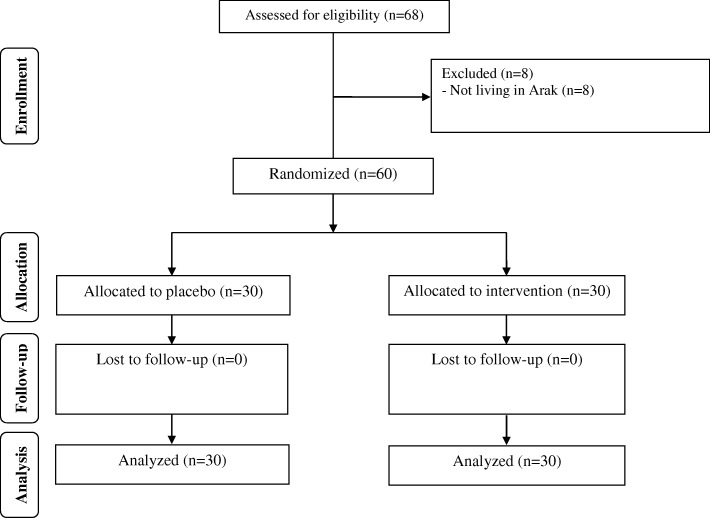
BACKGROUND: The aim of this study was to evaluate the effect of the co-administration of probiotic and selenium on parameters of mental health, hormonal profiles, and biomarkers of inflammation and oxidative stress in women with PCOS. Data on the effects of selenium and probiotic co-supplementation on mental health, hormonal and inflammatory parameters of patients with polycystic ovary syndrome (PCOS) are scarce. This investigation was carried out to evaluate the effects of selenium and probiotic co-supplementation on mental health, hormonal and inflammatory parameters in women with PCOS. METHODS: CFU/day probiotic plus 200 μg/day selenium supplements (n = 30) or placebo (n = 30) for 12 weeks. Hormonal and inflammatory parameters were measured at baseline and after the 12-week intervention. RESULTS: Probiotic and selenium co-supplementation resulted in a significant improvement in beck depression inventory (β - 0.76; 95% CI, - 1.26, - 0.26; P = 0.003), general health questionnaire scores (β - 1.15; 95% CI, - 1.97, - 0.32; P = 0.007) and depression anxiety and stress scale scores (β - 1.49; 95% CI, - 2.59, - 0.39; P = 0.009) compared with the placebo. Furthermore, probiotic and selenium co-supplementation significantly reduced total testosterone (β - 0.26 ng/mL; 95% CI, - 0.51, - 0.02; P = 0.03), hirsutism (β - 0.43; 95% CI, - 0.74, - 0.11; P = 0.008), high-sensitivity C-reactive protein (hs-CRP) (β - 0.58 mg/L; 95% CI, - 0.97, - 0.19; P = 0.004) and malondialdehyde (MDA) levels (β - 0.29 μmol/L; 95% CI, - 0.56, - 0.02; P = 0.03), and significantly increased total antioxidant capacity (TAC) (β + 84.76 mmol/L; 95% CI, + 48.08, + 121.44; P < 0.001) and total glutathione (GSH) levels (β + 26.78 μmol/L; 95% CI, + 4.33, + 49.23; P = 0.02) compared with the placebo. CONCLUSIONS: Overall, the co-administration of probiotic and selenium for 12 weeks to women with PCOS had beneficial effects on mental health parameters, serum total testosterone, hirsutism, hs-CRP, TAC, GSH and MDA levels. This study was prospectively registered in the Iranian website ( www.irct.ir ) for registration of clinical trials ( http://www.irct.ir : IRCT20170513033941N22). TRIAL REGISTRATION: IRCT20170513033941N22 .
Overview
The claims and statistics of this paper haven’t been checked yet.
Run the check — free, no account needed. It reads the open-access text and checks the sources it cites.
Integrity signals
Registry
Cites
Statistics
Figures
Verification
Claims the paper makes
The claims and statistics of this paper haven’t been checked yet.
Run the check — free, no account needed. It reads the open-access text and checks the sources it cites.
Claims other papers make about this one
Each is checked against this paper’s own text: does it say what the citing paper says it does?
In the citing paper
“The authors found that the supplemented group significantly improved the testosterone levels, hirsutism, high-sensitivity CRP levels, and the oxidative status measured by plasma malondialdehyde levels. They also showed significant differences in increasing total antioxidant status and glutathione in plasma compared to the placebo group [39].”
From Ketogenic Diet as Medical Prescription in Women with Polycystic Ovary Syndrome (PCOS) (2023) · cites this paper as [39]
Self-check
Percentages, sums and reported differences re-computed from the paper’s own numbers.
The self-check needs the paper’s full text.
Citations
Cites
1 retracted
Ahmadi, S., Jamilian, M., Karamali, M., Ebrahimi, M. T., Jafari, P., Taghizadeh, M., Memarzadeh, M. R., & Asemi, Z. (2017) · Human Fertility · doi:10.1080/14647273.2017.1283446 · Cited by 96
Self-citationRetractedAn inventory for measuring depression
BECK, A. T. (1961) · Archives of General Psychiatry · doi:10.1001/archpsyc.1961.01710120031004 · Cited by 38,032
The Ferric Reducing Ability of Plasma (FRAP) as a Measure of “Antioxidant Power”: The FRAP Assay
Benzie, I. F. F., & Strain, J. (1996) · Analytical Biochemistry · doi:10.1006/abio.1996.0292 · Cited by 23,027
(2004) · Fertility and Sterility · doi:10.1016/j.fertnstert.2003.10.004 · Cited by 9,050
Selective Cortical Undercutting As a Means of Modifying and Studying Frontal Lobe Function in Man
Scoville, W. B. (1949) · Journal of neurosurgery · doi:10.3171/jns.1949.6.1.0065 · Cited by 7,374
A scaled version of the General Health Questionnaire
Goldberg, D. P., & Hillier, V. F. (1979) · Psychological Medicine · doi:10.1017/s0033291700021644 · Cited by 5,639
Crawford, J. R., & Henry, J. D. (2004) · British Journal of Clinical Psychology · doi:10.1348/0144665031752934 · Cited by 2,957
Janero, D. R. (1990) · Free Radical Biology and Medicine · doi:10.1016/0891-5849(90)90131-2 · Cited by 2,735
Men at risk: occupation and male infertility.
Claman, P. (2004) · Fertility and Sterility · doi:10.1016/s0015-0282(03)01188-9 · Cited by 2,219
Polycystic Ovary Syndrome: Definition, Aetiology, Diagnosis and Treatment
Escobar-Morreale, H. F. (2018) · Nature Reviews Endocrinology · doi:10.1038/nrendo.2018.24 · Cited by 2,083
Antioxidant Properties of Probiotic Bacteria
Wang, Y., Wu, Y., Wang, Y., Xu, H., 梅小强, Yu, D., Wang, Y., & Li, W. (2017) · Nutrients · doi:10.3390/nu9050521 · Cited by 930
Lifestyle changes in women with polycystic ovary syndrome
Lim, S. S., Hutchison, S. K., Van Ryswyk, E., Norman, R. J., Teede, H. J., & Moran, L. J. (2019) · Cochrane Database of Systematic Reviews · doi:10.1002/14651858.cd007506.pub4 · Cited by 725
Murri, M., Luque‐Ramírez, M., Insenser, M. R., Ojeda, M. O., & Escobar-Morreale, H. F. (2013) · Human Reproduction Update · doi:10.1093/humupd/dms059 · Cited by 685
Circulating inflammatory markers in polycystic ovary syndrome: a systematic review and metaanalysis
Escobar-Morreale, H. F., Luque‐Ramírez, M., & González, F. (2010) · Fertility and Sterility · doi:10.1016/j.fertnstert.2010.11.036 · Cited by 538
González, F. (2012) · Steroids · doi:10.1016/j.steroids.2011.12.003 · Cited by 515
Dysbiosis of Gut Microbiota Associated with Clinical Parameters in Polycystic Ovary Syndrome
Liu, R., Zhang, C., Shi, Y., Zhang, F., Li, L., Wang, X., Ling, Y., Fu, H., Dong, W., Shen, J., et al. (2017) · Frontiers in Microbiology · doi:10.3389/fmicb.2017.00324 · Cited by 386
A simple and inexpensive automated technique for measurement of serum nitrite/nitrate
Tatsch, E., Bochi, G. V., Pereira, R. D. S., Kober, H., Agertt, V. A., de Campos, M. M. A., Gomes, P., Duarte, M. M. M. F., & Moresco, R. N. (2010) · Clinical Biochemistry · doi:10.1016/j.clinbiochem.2010.12.011 · Cited by 367
Association between polycystic ovary syndrome and gut microbiota
Guo, Y., Qi, Y., Yang, X., Zhao, L., Wen, S., Liu, Y., & Tang, L. (2016) · PLOS ONE · doi:10.1371/journal.pone.0153196 · Cited by 350
Roles of oxidative stress in polycystic ovary syndrome and cancers
Zuo, T., Zhu, M., & Xu, W. (2016) · Oxidative Medicine and Cellular Longevity · doi:10.1155/2016/8589318 · Cited by 319
Selenium and Inflammation: Underlying Anti-inflammatory Mechanisms
Duntas, L. H. (2009) · Hormone and Metabolic Research · doi:10.1055/s-0029-1220724 · Cited by 307
Lifestyle changes in women with polycystic ovary syndrome
Moran, L. J., Hutchison, S. K., Norman, R. J., & Teede, H. J. (2011) · Cochrane Database of Systematic Reviews · doi:10.1002/14651858.cd007506.pub3 · Cited by 292
Diamanti‐Kandarakis, E., Paterakis, T., Alexandraki, K., Piperi, C., Aessopos, A., Katsikis, I., Katsilambros, N. L., Kreatsas, G., & Panidis, D. (2006) · Human Reproduction · doi:10.1093/humrep/del003 · Cited by 262
Plasma glutathione in health and in patients with malignant disease.
Beutler, E., & Gelbart, T. (1985) · PubMed · Cited by 246
The Role of Antioxidant Enzymes in the Ovaries
Wang, S., He, G., Chen, M., Zuo, T., Xu, W., & Liu, X. (2017) · Oxidative Medicine and Cellular Longevity · doi:10.1155/2017/4371714 · Cited by 180
Huang, A., Brennan, K., & Azziz, R. (2009) · Fertility and Sterility · doi:10.1016/j.fertnstert.2008.12.138 · Cited by 176
Influence of Gut Microbiota on Subclinical Inflammation and Insulin Resistance
Carvalho, B. M., & Saad, M. J. A. (2013) · Mediators of Inflammation · doi:10.1155/2013/986734 · Cited by 166
Lei, M., Guo, C., Wang, D., Zhang, C., & Hua, L. (2017) · Beneficial Microbes · doi:10.3920/bm2016.0207 · Cited by 148
Jafarnejad, S., Saremi, S., Jafarnejad, F., & Arab, A. (2016) · Journal of Nutrition and Metabolism · doi:10.1155/2016/5190846 · Cited by 135
Effects of probiotic yogurt consumption on inflammatory biomarkers in patients with type 2 diabetes
Mohammad-Shahi, M., Veissi, M., Haidari, F., Shahbazian, H. B., Kaydani, G. A., & Mohammadi, F. (2014) · Europe PMC (PubMed Central) · doi:10.5681/bi.2014.007 · Cited by 124
Ju, W., Li, X.-T., Li, Z., Wu, G., Fu, X., Yang, X., Zhang, X. Q., & Gao, X. (2017) · Journal of Trace Elements in Medicine and Biology · doi:10.1016/j.jtemb.2017.04.009 · Cited by 117
Nido, S. A., Shituleni, S. A., Mengistu, B. M., Liu, Y., Alam Zeb, K. H. A. N., Gan, F., Kumbhar, S., & Huang, K. (2015) · Biological Trace Element Research · doi:10.1007/s12011-015-0552-8 · Cited by 114
González, F., Sia, C. L., Shepard, M. K., Rote, N. S., & Minium, J. (2012) · Human Reproduction · doi:10.1093/humrep/des320 · Cited by 107
Pan, C., Zhao, Y., Liao, S. F., Chen, F., Qin, S., Wu, X., Zhou, H., & Huang, K. (2011) · Journal of Agricultural and Food Chemistry · doi:10.1021/jf202014k · Cited by 104
Regulation of inflammation by selenium and selenoproteins: impact on eicosanoid biosynthesis
Mattmiller, S. A., Carlson, B. A., & Sordillo, L. M. (2013) · Journal of Nutritional Science · doi:10.1017/jns.2013.17 · Cited by 102
A Randomized, Placebo-Controlled Trial of Selenium Supplementation in Patients With Type 2 Diabetes
Faghihi, T., Radfar, M., Barmal, M., Amini, P., Qorbani, M., Abdollahi, M. R., & Larijani, B. A. (2013) · American Journal of Therapeutics · doi:10.1097/mjt.0b013e318269175f · Cited by 99
Gan, F., Chen, X., Liao, S. F., Lv, C., Ren, F., Ye, G., Pan, C., Huang, D. W., Shi, J., Shi, X., et al. (2014) · Journal of Agricultural and Food Chemistry · doi:10.1021/jf501065d · Cited by 98
Abedelahi, A., Salehnia, M., Allameh, A., & Davoodi, D. (2010) · Human Reproduction · doi:10.1093/humrep/deq002 · Cited by 98
Hajifaraji, M., Jahanjou, F., Abbasalizadeh, F., Aghamohammadzadeh, N., Abbasi, M. M., & Dolatkhah, N. (2018) · PubMed · doi:10.6133/apjcn.082017.03 · Cited by 97
Oxidative stress and cardiovascular complications in polycystic ovarian syndrome
Hyderali, B. N., & Mala, K. (2015) · European Journal of Obstetrics & Gynecology and Reproductive Biology · doi:10.1016/j.ejogrb.2015.05.005 · Cited by 96
West, S., Lashen, H., Bloigu, A., Franks, S., Puukka, K., Ruokonen, A., Jarvelin, M. R., Tapanainen, J. S., & Morin-Papunen, L. (2014) · Human Reproduction · doi:10.1093/humrep/deu200 · Cited by 94
Askari, G., Shoaei, T., Heidari‐Beni, M., Tehrani, H. G., Feizi, A., & Esmaillzadeh, A. (2015) · International Journal of Preventive Medicine · doi:10.4103/2008-7802.153866 · Cited by 94
Razavi, M., Jamilian, M., Kashan, Z. F., Heidar, Z., Mohseni, M., Ghandi, Y., Bagherian, T., & Asemi, Z. (2016) · Hormone and Metabolic Research · doi:10.1055/s-0035-1559604 · Cited by 91
Self-citationRazavi, M., Jamilian, M., Karamali, M., Bahmani, F., Aghadavod, E., & Asemi, Z. (2016) · Hormone and Metabolic Research · doi:10.1055/s-0042-104060 · Cited by 90
Self-citationNasri, K., Jamilian, M., Rahmani, E., Bahmani, F., Ebrahimi, M. T., & Asemi, Z. (2018) · BMC Endocrine Disorders · doi:10.1186/s12902-018-0248-0 · Cited by 89
Self-citationPlasma selenium levels in Turkish women with polycystic ovary syndrome
Coşkun, A., Arıkan, T. A., Kılınç, M., Arıkan, D. C., & Ekerbiçer, H. Ç. (2013) · European Journal of Obstetrics & Gynecology and Reproductive Biology · doi:10.1016/j.ejogrb.2013.01.021 · Cited by 69
Microbial Regulation of Glucose Metabolism and Insulin Resistance
Crommen, S., & Simon, M. (2017) · Genes · doi:10.3390/genes9010010 · Cited by 69
Subcutaneous adipose tissue topography and metabolic disturbances in polycystic ovary syndrome
Wehr, E., Möller, R., Horejsi, R., Giuliani, A., Kopera, D., Schweighofer, N., Groselj‐Strele, A., Pieber, T. R., & Obermayer-Pietsch, B. M. (2009) · Wiener klinische Wochenschrift · doi:10.1007/s00508-009-1162-2 · Cited by 64
Karamali, M., Eghbalpour, S., Rajabi, S., Jamilian, M., Bahmani, F., Ebrahimi, M. T., Keneshlou, F., Mirhashemi, S. M., Chamani, M., Gelougerdi, S. H., et al. (2018) · PubMed · Cited by 62
Self-citationGonzález, F. (2015) · Seminars in Reproductive Medicine · doi:10.1055/s-0035-1554918 · Cited by 60
Hosseinzadeh, F. M., Hosseinzadeh‐Attar, M. J., Yekaninejad, M. S., & Rashidi, B. H. (2016) · Journal of Trace Elements in Medicine and Biology · doi:10.1016/j.jtemb.2016.01.002 · Cited by 54
Cardiometabolic Features of Polycystic Ovary Syndrome: Role of Androgens
Cardozo, L. L. Y., Romero, D. G., & Reckelhoff, J. F. (2017) · Physiology · doi:10.1152/physiol.00030.2016 · Cited by 48
Atorvastatin Reduces Malondialdehyde Concentrations in Patients with Polycystic Ovary Syndrome
Sathyapalan, T., Shepherd, J., Coady, A., Kilpatrick, E. S., & Atkin, S. L. (2012) · The Journal of Clinical Endocrinology & Metabolism · doi:10.1210/jc.2012-2279 · Cited by 38
Mesdaghinia, E., Rahavi, A., Bahmani, F., Sharifi, N., & Asemi, Z. (2016) · Biological Trace Element Research · doi:10.1007/s12011-016-0911-0 · Cited by 38
Self-citationGut-Brain Axis and Metabolism in Polycystic Ovary Syndrome
Saydam, B. Ö., & Yıldız, B. O. (2016) · Current Pharmaceutical Design · doi:10.2174/1381612822666160715143933 · Cited by 37
Amiri, M., Golsorkhtabaramiri, M., Esmaeilzadeh, S., Ghofrani, F., Bijani, A., Ghorbani, L., & Delavar, M. A. (2014) · PubMed Central · Cited by 27
Antioxidant status and hormonal profile reflected by experimental feeding of probiotics
Ghoneim, M. A., & Moselhy, S. S. (2013) · Toxicology and Industrial Health · doi:10.1177/0748233713506768 · Cited by 26
Nettleton, J. A., Greany, K. A., Thomas, W. T. B., Wangen, K. E., Adlercreutz, H., & Kurzer, M. S. (2005) · The Journal of Alternative and Complementary Medicine · doi:10.1089/acm.2005.11.1067 · Cited by 22
Cited by
Sorted by citations
The impact of the gut microbiota on the reproductive and metabolic endocrine system
Qi, X., Yun, C., Pang, Y., & Qiao, J. (2021) · Gut Microbes · doi:10.1080/19490976.2021.1894070 · Cited by 587
Oxidative stress in oocyte aging and female reproduction
Wang, L., Tang, J., Wang, L., Tan, F., Song, H., Zhou, J., & Li, F. (2021) · Journal of Cellular Physiology · doi:10.1002/jcp.30468 · Cited by 537
Zhang, J., Sun, Z., Jiang, S., Bai, X., Ma, C., Peng, Q., Chen, K., Chang, H., Fang, T., & Zhang, H. (2019) · mSystems · doi:10.1128/msystems.00017-19 · Cited by 296
Polycystic ovary syndrome and mitochondrial dysfunction
Zhang, J., Bao, Y.-G., Zhou, X., & Zheng, L. (2019) · Reproductive Biology and Endocrinology · doi:10.1186/s12958-019-0509-4 · Cited by 273
Metabolic Syndrome and PCOS: Pathogenesis and the Role of Metabolites
Chen, W., & Pang, Y. (2021) · Metabolites · doi:10.3390/metabo11120869 · Cited by 228
Metadata
- Authors
- Jamilian, M., Mansury, S., Bahmani, F., Heidar, Z., Amirani, E., & Asemi, Z.
- Affiliations
- Arak University of Medical Sciences (IR)
- Kashan University of Medical Sciences (IR)
- Shahid Beheshti University (IR)
- Corresponding author
- Asemi, Zatollah
- Venue
- Journal of Ovarian Research
- Published
- 2018-09-14
- Volume
- 11
- Issue
- 1
- Pages
- 80-80
- ISSN
- 1757-2215 (ISSN-L)
- PMC
- PMC6137747
- OpenAlex
- W2889757990
- Cited by
- 156
- References
- 57
- Citations by year
- 2026: 17 · 2025: 24 · 2024: 21 · 2023: 25 · 2022: 25 · 2021: 23 · 2020: 8 · 2019: 12
- FWCI
- 11.53
- Type
- journal article
- Language
- en
- Open access
- gold
- doi.org
- Licence
- Locations
- Journal of Ovarian Research (publishedVersion, cc-by)
- Europe PMC (PubMed Central) (publishedVersion, cc-by)
- PubMed Central (publishedVersion, cc-by)
- PubMed (publishedVersion)
- DOAJ (DOAJ: Directory of Open Access Journals) (submittedVersion, cc-by-sa)
- Funders
- Arak University of Medical Sciences
- Topics
- Health Sciences › Medicine › Reproductive Medicine › Ovarian function and disorders
- Life Sciences › Agricultural and Biological Sciences › Food Science › Probiotics and Fermented Foods
- Health Sciences › Nursing › Nutrition and Dietetics › Selenium in Biological Systems
- Keywords
- polycystic ovary syndrome, probiotics, selenium supplementation, co-supplementation, mental health, depression, anxiety, testosterone, hirsutism, C-reactive protein, oxidative stress, malondialdehyde, lipid peroxidation, antioxidant enzymes, superoxide dismutase, glutathione peroxidase, GSH, glutathione disulfide, GSH/GSSG ratio, oxidative stress index, inflammatory markers
- MeSH terms
- Adolescent, Adult, Double-Blind Method, Female, Humans, Inflammation, Mental Health, Polycystic Ovary Syndrome, Selenium, Biomarkers, Oxidative Stress, Probiotics, Young Adult
About these checks
Registry, retraction, Cites and statistics results are computed, not judged, with one exception: a printed reference that no index lists is read once by a model before it counts as a citation error. Claims are extracted by a model and kept only when their quote appears verbatim in the text; each cited source is then checked, with a model’s help, for whether it says what the claim relies on. Those verdicts can be wrong — read the claim’s quote and the cited source before relying on one.
Statistics and arithmetic are recomputed, not judged.
Confidence bands are shown only for fields calibrated on our annotated test set. None is calibrated yet, so no band is shown.
What counts as a claim ›How we measure confidence ›How we check this ›
Are you an author, or do you see a problem with this page? Request a review
