

The DOI matches its Crossref record; 63 of the 65 references it cites were found in a registry or an index.
The efficacy and safety of prokinetic agents in critically ill patients receiving enteral nutrition: a systematic review and meta-analysis of randomized trials
Open accessAbstract
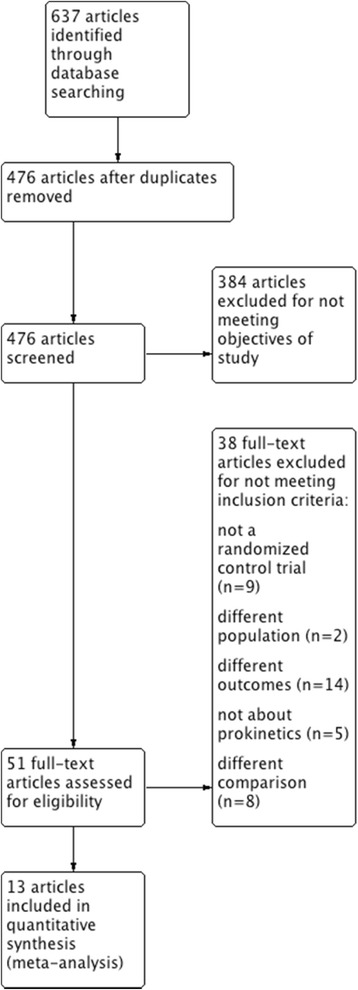
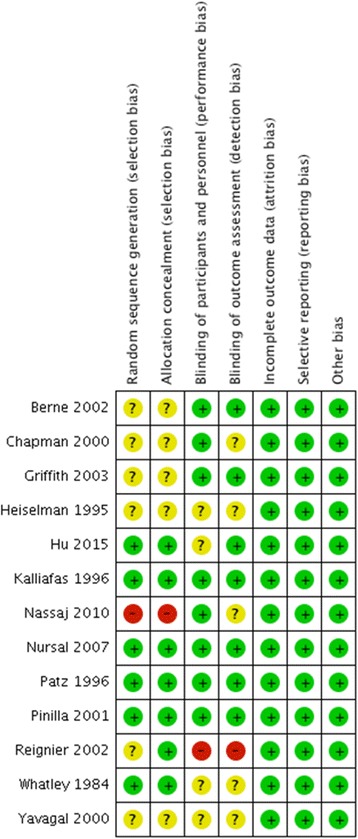
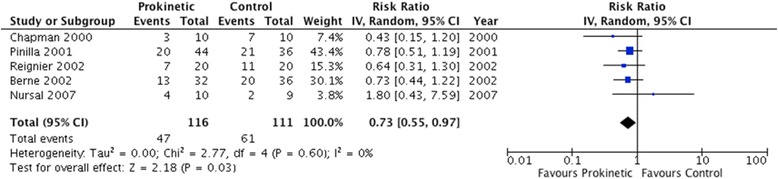
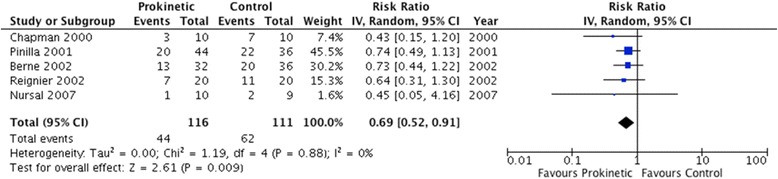
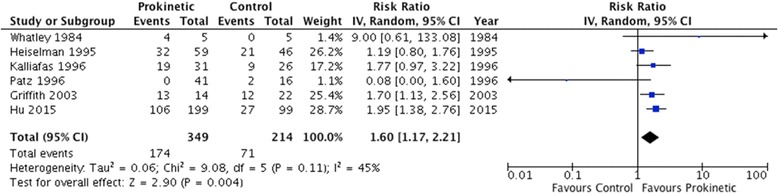
BACKGROUND: Intolerance to enteral nutrition is common in critically ill adults, and may result in significant morbidity including ileus, abdominal distension, vomiting and potential aspiration events. Prokinetic agents are prescribed to improve gastric emptying. However, the efficacy and safety of these agents in critically ill patients is not well-defined. Therefore, we conducted a systematic review and meta-analysis to determine the efficacy and safety of prokinetic agents in critically ill patients. METHODS: We searched MEDLINE, EMBASE, and Cochrane Library from inception up to January 2016. Eligible studies included randomized controlled trials (RCTs) of critically ill adults assigned to receive a prokinetic agent or placebo, and that reported relevant clinical outcomes. Two independent reviewers screened potentially eligible articles, selected eligible studies, and abstracted pertinent data. We calculated pooled relative risk (RR) for dichotomous outcomes and mean difference for continuous outcomes, with the corresponding 95 % confidence interval (CI). We assessed risk of bias using Cochrane risk of bias tool, and the quality of evidence using grading of recommendations assessment, development, and evaluation (GRADE) methodology. RESULTS: Thirteen RCTs (enrolling 1341 patients) met our inclusion criteria. Prokinetic agents significantly reduced feeding intolerance (RR 0.73, 95 % CI 0.55, 0.97; P = 0.03; moderate certainty), which translated to 17.3 % (95 % CI 5, 26.8 %) absolute reduction in feeding intolerance. Prokinetics also reduced the risk of developing high gastric residual volumes (RR 0.69; 95 % CI 0.52, 0.91; P = 0.009; moderate quality) and increased the success of post-pyloric feeding tube placement (RR 1.60, 95 % CI 1.17, 2.21; P = 0.004; moderate quality). There was no significant improvement in the risk of vomiting, diarrhea, intensive care unit (ICU) length of stay or mortality. Prokinetic agents also did not significantly increase the rate of diarrhea. CONCLUSION: There is moderate-quality evidence that prokinetic agents reduce feeding intolerance in critically ill patients compared to placebo or no intervention. However, the impact on other clinical outcomes such as pneumonia, mortality, and ICU length of stay is unclear.
Overview
The claims and statistics of this paper haven’t been checked yet.
Run the check — free, no account needed. It reads the open-access text and checks the sources it cites.
Integrity signals
Registry
Cites
Statistics
Figures

Verification
Claims the paper makes
The claims and statistics of this paper haven’t been checked yet.
Run the check — free, no account needed. It reads the open-access text and checks the sources it cites.
Claims other papers make about this one
Each is checked against this paper’s own text: does it say what the citing paper says it does?
The check wasn’t confident either way, so it gives no verdict — never disputed.
In the citing paper
“However, monitoring of established EN with continued measurements of GRV may not be necessary (112).”
From ESPEN guideline on clinical nutrition in the intensive care unit. (2019) · cites this paper as [112]
Experimental — accuracy not yet measured
Self-check
Percentages, sums and reported differences re-computed from the paper’s own numbers.
The self-check needs the paper’s full text.
Citations
Cites
Measuring inconsistency in meta-analyses
Higgins, J. P. T., Thompson, S. G., Deeks, J. J., & Altman, D. G. (2003) · BMJ · doi:10.1136/bmj.327.7414.557 · Cited by 63,139
Bias in meta-analysis detected by a simple, graphical test
Egger, M., Smith, G. D., Schneider, M., & Minder, C. (1997) · BMJ · doi:10.1136/bmj.315.7109.629 · Cited by 56,722
Meta-analysis in clinical trials
DerSimonian, R., & Laird, N. (1986) · Controlled Clinical Trials · doi:10.1016/0197-2456(86)90046-2 · Cited by 39,552
The Cochrane Collaboration's tool for assessing risk of bias in randomised trials
Higgins, J. P. T., Altman, D. G., Gotzsche, P. C., Juni, P., Moher, D., Oxman, A. D., Savovic, J., Schulz, K. F., Weeks, L., Sterne, J. A. C., et al. (2011) · BMJ · doi:10.1136/bmj.d5928 · Cited by 33,817
PRISMA-P Group, Moher, D., Shamseer, L., Clarke, M., Ghersi, D., Liberati, A., Petticrew, M., Shekelle, P., & Stewart, L. A. (2015) · Systematic Reviews · doi:10.1186/2046-4053-4-1 · Cited by 26,223
Dermyshi, E., Wang, Y., Yan, C., Hong, W., Qiu, G., Gong, X., & Zhang, T. (2017) · Neonatology · doi:10.1159/000454668 · Cited by 24,586
Changes of Intestinal Functions in Liver Cirrhosis
Fukui, H., & Wiest, R. (2016) · Inflammatory Intestinal Diseases · doi:10.1159/000444436 · Cited by 6,820
McClave, S. A., Taylor, B. E., Martindale, R. G., Warren, M. M., Johnson, D. R., Braunschweig, C., McCarthy, M. S., Davanos, E., Rice, T. W., Cresci, G. A., et al. (2016) · Journal of Parenteral and Enteral Nutrition · doi:10.1177/0148607115621863 · Cited by 3,982
Taylor, B. E., McClave, S. A., Martindale, R. G., Warren, M. M., Johnson, D. R., Braunschweig, C., McCarthy, M. S., Davanos, E., Rice, T. W., Cresci, G. A., et al. (2016) · Critical Care Medicine · doi:10.1097/ccm.0000000000001525 · Cited by 1,476
Heyland, D., Dhaliwal, R., Drover, J., Gramlich, L. M., & Dodek, P. (2003) · Journal of Parenteral and Enteral Nutrition · doi:10.1177/0148607103027005355 · Cited by 1,471
Kudsk, K. A., Croce, M. A., Fabian, T. C., Minard, G., Tolley, E. A., PORET, H. A., KUHL, M. R., & Brown, R. O. (1992) · Annals of Surgery · doi:10.1097/00000658-199205000-00013 · Cited by 1,149
TEN versus TPN following Major Abdominal Trauma—Reduced Septic Morbidity
Moore, F. A., Moore, E. E., Jones, T. N., McCroskey, B. L., & Peterson, V. M. (1989) · The Journal of Trauma: Injury, Infection, and Critical Care · doi:10.1097/00005373-198907000-00003 · Cited by 818
Total parenteral nutrition promotes bacterial translocation from the gut
Alverdy, J. C., Aoys, E., & Moss, G. S. (1989) · Journal of Critical Care · doi:10.1016/0883-9441(89)90136-6 · Cited by 737
Mentec, H., Dupont, H., Bocchetti, M., Cani, P., Ponche, F., & Bleichner, G. (2001) · Critical Care Medicine · doi:10.1097/00003246-200110000-00018 · Cited by 574
The dependence of paracetamol absorption on the rate of gastric emptying
Heading, R. C., Nimmo, J., Prescott, L. F., & Tothill, P. (1973) · British Journal of Pharmacology · doi:10.1111/j.1476-5381.1973.tb08339.x · Cited by 569
Total Parenteral Nutrition in the Critically Ill Patient
Heyland, D. K., MacDonald, S., Keefe, L., & Drover, J. (1998) · JAMA · doi:10.1001/jama.280.23.2013 · Cited by 532
Enteral nutrition-related gastrointestinal complications in critically ill patients
Montejo, J. C. (1999) · Critical Care Medicine · doi:10.1097/00003246-199908000-00006 · Cited by 449
Adam, S. K., & Batson, S. (1997) · Intensive Care Medicine · doi:10.1007/s001340050326 · Cited by 373
Enteral nutrition in the critically ill patient
Heyland, D. K., Cook, D. J., Winder, B., Brylowski, L., deMark, H. R. V., & Guyatt, G. H. (1995) · Critical Care Medicine · doi:10.1097/00003246-199506000-00010 · Cited by 324
Enteral versus parenteral feeding
Murphy, P., & Dashfield, A. (2012) · CRC Press eBooks · doi:10.1201/b13470-53 · Cited by 207
Gastric Emptying in Head-Injured Patients
Kao, C.-H., ChangLai, S.-P., Chieng, P., & Yen, T. (1998) · The American Journal of Gastroenterology · doi:10.1111/j.1572-0241.1998.00338.x · Cited by 200
Pinilla, J. C., Samphire, J., Arnold, C., Liu, L., & Thiessen, B. (2001) · Journal of Parenteral and Enteral Nutrition · doi:10.1177/014860710102500281 · Cited by 181
Booth, C. M., Heyland, D. K., & Paterson, W. G. (2002) · Critical Care Medicine · doi:10.1097/00003246-200207000-00005 · Cited by 180
Erythromycin improves gastric emptying in critically ill patients intolerant of nasogastric feeding
Chapman, M. J., Fraser, R. J., Kluger, M. T., Buist, M. D., & De Nichilo, D. J. (2000) · Critical Care Medicine · doi:10.1097/00003246-200007000-00026 · Cited by 163
Nguyen, N. Q., Chapman, M. J., Fraser, R. J., Bryant, L. K., & Holloway, R. H. (2007) · Critical Care Medicine · doi:10.1097/01.ccm.0000253410.36492.e9 · Cited by 162
The impact of admission diagnosis on gastric emptying in critically ill patients
Nguyen, N. Q., Ng, M. P., Chapman, M. J., Fraser, R. J., & Holloway, R. H. (2007) · Critical Care · doi:10.1186/cc5685 · Cited by 159
A model of gastric emptying using paracetamol absorption in intensive care patients
Tarling, M., Toner, C. C., Withington, P. S., BAXTER, M. K., Whelpton, R., & Goldhill, D. R. (1997) · Intensive Care Medicine · doi:10.1007/s001340050325 · Cited by 159
Effect of erythromycin on gastric motility in mechanically ventilated critically ill patients
Dive, A., Miesse, C., Galanti, L. M., Jamart, J., Evrard, P., González, M., & Installé, E. (1995) · Critical Care Medicine · doi:10.1097/00003246-199508000-00008 · Cited by 153
Prokinetic therapy for feed intolerance in critical illness: One drug or two?
Nguyen, N. Q., Chapman, M. J., Fraser, R. J., Bryant, L. K., Burgstad, C. M., & Holloway, R. H. (2007) · Critical Care Medicine · doi:10.1097/01.ccm.0000286397.04815.b1 · Cited by 149
Heyland, D. K., & Mandell, L. A. (1992) · CHEST Journal · doi:10.1378/chest.101.1.187 · Cited by 144
Manometric Diagnosis of Gastrointestinal Motility Disorders
Christensen, J. C. (1986) · Mayo Clinic Proceedings · doi:10.1016/s0025-6196(12)62645-7 · Cited by 138
Johannes, C. B., Varas‐Lorenzo, C., McQuay, L. J., Midkiff, K. D., & Fife, D. (2010) · Pharmacoepidemiology and Drug Safety · doi:10.1002/pds.2016 · Cited by 136
Effect of dopamine on gastrointestinal motility during critical illness
Dive, A., Foret, F., Jamart, J., Bulpa, P., & Installé, E. (2000) · Intensive Care Medicine · doi:10.1007/s001340051279 · Cited by 124 · cited 1×
“, narcotics, catecholamines), hyperglycemia, renal dysfunction, mechanical ventilation, or the disease process itself [1–5].”
BackgroundYavagal, D. R., Karnad, D. R., & Oak, J. L. (2000) · Critical Care Medicine · doi:10.1097/00003246-200005000-00025 · Cited by 123
MacLaren, R., Kiser, T. H., Fish, D. N., & Wischmeyer, P. E. (2008) · Journal of Parenteral and Enteral Nutrition · doi:10.1177/0148607108319803 · Cited by 117
Acosta, A. J., & Camilleri, M. (2014) · Gastroenterology Clinics of North America · doi:10.1016/j.gtc.2014.11.008 · Cited by 115
Berne, J. D., Norwood, S. H., McAuley, C. E., Vallina, V. L., Villareal, D., Weston, J., & McClarty, J. (2002) · The Journal of Trauma: Injury, Infection, and Critical Care · doi:10.1097/00005373-200209000-00004 · Cited by 112
Metoclopramide improves gastric motility in critically ill patients
Jooste, C. A., Mustoe, J. E., & Collee, G. (1999) · Intensive Care Medicine · doi:10.1007/s001340050881 · Cited by 111
MacLaren, R., Kuhl, D. A., Gervasio, J. M., Brown, R. O., Dickerson, R. N., Livingston, T. N., Swift, K., Headley, S., Kudsk, K. A., & Lima, J. J. (2000) · Critical Care Medicine · doi:10.1097/00003246-200002000-00025 · Cited by 104
Erythromycin and early enteral nutrition in mechanically ventilated patients
Reignier, J., Bensaid, S., Perrin-Gachadoat, D., Burdin, M., Boiteau, R., & Tenaillon, A. (2002) · Critical Care Medicine · doi:10.1097/00003246-200206000-00012 · Cited by 101
Alhazzani, W. A., Almasoud, A., Jaeschke, R., Lo, B., Sindi, A., Altayyar, S., & Fox‐Robichaud, A. (2013) · Critical Care · doi:10.1186/cc12806 · Cited by 87
Self-citationKalliafas, S., Choban, P. S., Ziegler, D. W., Drago, S., & Baum, L. F. (1996) · Journal of Parenteral and Enteral Nutrition · doi:10.1177/0148607196020006385 · Cited by 81
Heiselman, D., Hofer, T. F., & Vidovich, R. R. (1995) · CHEST Journal · doi:10.1378/chest.107.6.1686 · Cited by 78
When Does Metoclopramide Facilitate Transpyloric Intubation?
Whatley, K., Turner, W. W., Dey, M., Leonard, J., & Guthrie, M. (1984) · Journal of Parenteral and Enteral Nutrition · doi:10.1177/0148607184008006679 · Cited by 78
Barbey, J. T., Lazzara, R., & Zipes, D. P. (2002) · Journal of Cardiovascular Pharmacology and Therapeutics · doi:10.1177/107424840200700202 · Cited by 71
The gastropulmonary route of infection—Fact or fiction?
Tryba, M. (1991) · The American Journal of Medicine · doi:10.1016/0002-9343(91)90466-b · Cited by 66
Schoenenberger, R. A., Haefeli, W. E., Weiss, P., & Ritz, R. (1990) · BMJ · doi:10.1136/bmj.300.6736.1375 · Cited by 63
Parkman, H. P., Jacobs, M. R., Mishra, A. K., Hurdle, J. A., Sachdeva, P., Gaughan, J., & Krynetskiy, E. Y. (2010) · Digestive Diseases and Sciences · doi:10.1007/s10620-010-1472-2 · Cited by 60
Nosocomial pneumonia in the intubated patient: Role of gastric colonization
Craven, D. E., & Daschner, F. D. (1989) · European Journal of Clinical Microbiology & Infectious Diseases · doi:10.1007/bf01964119 · Cited by 59
Griffith, D. P., McNally, A., Battey, C. H., Forte, S. S., Cacciatore, A. M., Szeszycki, E. E., Bergman, G. F., Furr, C. E., Murphy, F., Galloway, J. R., et al. (2003) · Critical Care Medicine · doi:10.1097/00003246-200301000-00006 · Cited by 57
QT prolongation and recurrent “torsades de pointes” during erythromycin lactobionate infusion
Guélon, D., Bedock, B., Chartier, C., & Haberer, J. P. (1986) · The American Journal of Cardiology · doi:10.1016/0002-9149(86)90306-1 · Cited by 57
Hu, B., Ye, H., Sun, C., Zhang, Y., Lao, Z.-G., Wu, F., Liu, Z., Huang, L., Qu, C., Xian, L., et al. (2015) · Critical Care · doi:10.1186/s13054-015-0784-1 · Cited by 56
Weihrauch, T. R., Förster, C. F., & Krieglstein, J. (1979) · PubMed · Cited by 56
Goldhill, D. R., Toner, C. C., Tarling, M., Baxter, K., Withington, P. S., & Whelpton, R. (1997) · Critical Care Medicine · doi:10.1097/00003246-199703000-00013 · Cited by 55
Evaluation of gastric emptying in severe, burn-injured patients
Hu, O. Y., Ho, S., Wang, J.-J., HO, W., WANG, H.-J., & Lin, C.-Y. (1993) · Critical Care Medicine · doi:10.1097/00003246-199304000-00012 · Cited by 50
Promotility agents in the intensive care unit
Zaloga, G. P., & Marik, P. E. (2000) · Critical Care Medicine · doi:10.1097/00003246-200007000-00085 · Cited by 46
MacLaren, R., Patrick, W. D., Hall, R. I., Rocker, G. M., Whelan, G. J., & Lima, J. J. (2001) · Clinical Therapeutics · doi:10.1016/s0149-2918(00)89081-5 · Cited by 45
The effect of metoclopramide on gastric emptying in traumatic brain injury
Nursal, T. Z., Erdogan, B., Noyan, T., Çekinmez, M., Atalay, B. G., & Bilgin, N. (2007) · Journal of Clinical Neuroscience · doi:10.1016/j.jocn.2005.11.011 · Cited by 45
Dive, A., Miesse, C., Jamart, J., Evrard, P., Gonzalez, M., & Installé, E. (1994) · Clinical Nutrition · doi:10.1016/0261-5614(94)90053-1 · Cited by 39
Paz, H. L., Weinar, M., & Sherman, M. (1996) · Intensive Care Medicine · doi:10.1007/bf01700450 · Cited by 38
The relationship between gastric emptying of semisolids and paracetamol absorption.
Petring, O., Adelhøj, B., Ibsen, M., & Poulsen, H. E. (1986) · British Journal of Clinical Pharmacology · doi:10.1111/j.1365-2125.1986.tb02954.x · Cited by 36
Effect of dopamine on gastric motility in man: evidence for specific receptors
Lanfranchi, G. A., Marzio, L., Cortini, C., Trento, L., & Labò, G. (1978) · Springer eBooks · doi:10.1007/978-94-017-4389-1_18 · Cited by 36
Nassaji, M., Ghorbani, R., Frozeshfard, M., & Mesbahian, F. (2010) · Eastern Mediterranean Health Journal · doi:10.26719/2010.16.4.371 · Cited by 17
Research works printed but not linked: 5
- Barclay M, Fraser R, Tournadre J, et al. Small intestinal and gastric motility in patients in the intensive care unit following elective abdominal aortic aneurysm repair. Gastro. 1997;112:A694.
- Alverdy J, Aoys E, Moss G. TPN promotes bacterial translocation from the gut. Surgery. 1988;104(2):185–90.
- Dive A, Garrino M, Nizet H, et al. Gastric microbial overgrowth and retrograde colonization of the ventilated lung: effect of a digestive prokinetic therapy. 7th European Congress of Intensive Care Medicine. Insbrück, Austria: The International Symposium on Intensive Care and Emergency Medicine; June 14–17, 1994, pp 757.
- Calcroft R, Joynt G, Hung V. Gastric emptying in critically ill patients: a randomized, blinded, prospective comparison of metoclopramide with placebo. Intensive Care Med. 1997;23(Suppl):S138.
- MacLaren R, Hall R, Patrick W, et al. Cisapride versus metoclopramide for facilitating gastric emptying and tolerance to intragastric nutrition. Crit Care Med. 2000;28(Suppl):A104.
Cited by
Sorted by citations
Surviving Sepsis Campaign: International guidelines for management of sepsis and septic shock: 2016.
Rhodes, A., Evans, L. E., Alhazzani, W., Levy, M. M., Antonelli, M., Ferrer, R., Kumar, A., Sevransky, J. E., Sprung, C. L., Nunnally, M. E., et al. (2017) · Intensive Care Medicine · doi:10.1007/s00134-017-4683-6 · Cited by 6,621
Self-citationSurviving Sepsis Campaign: International guidelines for management of sepsis and septic shock: 2016.
Rhodes, A., Evans, L. E., Alhazzani, W., Levy, M. M., Antonelli, M., Ferrer, R., Kumar, A., Sevransky, J. E., Sprung, C. L., Nunnally, M. E., et al. (2017) · Critical Care Medicine · doi:10.1097/ccm.0000000000002255 · Cited by 3,652
Self-citationESPEN guideline on clinical nutrition in the intensive care unit.
Singer, P., Blaser, A. R., Berger, M. M., Alhazzani, W., Calder, P. C., Casaer, M. P., Hiesmayr, M., Mayer, K., Montejo, J. C., Pichard, C., et al. (2019) · Clinical Nutrition · doi:10.1016/j.clnu.2018.08.037 · Cited by 2,904
Self-citationWeiss, S. L., Peters, M. J., Alhazzani, W. A., Agus, M. S. D., Flori, H. R., Inwald, D. P., Nadel, S., Schlapbach, L. J., Tasker, R. C., Argent, A. C., et al. (2020) · Pediatric Critical Care Medicine · doi:10.1097/pcc.0000000000002198 · Cited by 1,304
Self-citationWeiss, S. L., Peters, M. J., Alhazzani, W. A., Agus, M. S. D., Flori, H. R., Inwald, D. P., Nadel, S., Schlapbach, L. J., Tasker, R. C., Argent, A. C., et al. (2020) · Intensive Care Medicine · doi:10.1007/s00134-019-05878-6 · Cited by 663
Self-citation
Metadata
- Authors
- Lewis, K., Alqahtani, Z., Mcintyre, L., Almenawer, S., Alshamsi, F., Rhodes, A., Evans, L., Angus, D. C., & Alhazzani, W.
- Affiliations
- McMaster University (CA)
- University of Ottawa (CA)
- United Arab Emirates University (AE)
- St George's Hospital (GB)
- New York University (US)
- University of Pittsburgh (US)
- St. Joseph’s Healthcare Hamilton (CA)
- Corresponding author
- Alhazzani, Waleed
- Venue
- Critical Care
- Published
- 2016-08-15
- Volume
- 20
- Issue
- 1
- Pages
- 259-259
- ISSN
- 1364-8535 (ISSN-L)
- PMC
- PMC4986344
- OpenAlex
- W2514961948
- Cited by
- 163
- References
- 65
- Citations by year
- 2026: 19 · 2025: 15 · 2024: 11 · 2023: 14 · 2022: 16 · 2021: 22 · 2020: 26 · 2019: 20 · 2018: 9 · 2017: 9 · 2016: 2
- FWCI
- 1.78
- Type
- journal article
- Language
- en
- Open access
- gold
- doi.org
- Licence
- cc-by
- Locations
- Critical Care (publishedVersion, cc-by)
- Europe PMC (PubMed Central) (publishedVersion, cc-by)
- PubMed Central (publishedVersion, cc-by)
- PubMed (publishedVersion)
- St George's Online Research Archive (St George's University of London) (acceptedVersion)
- uO Research (University of Ottawa) (submittedVersion, public-domain)
- Topics
- Health Sciences › Nursing › Nutrition and Dietetics › Clinical Nutrition and Gastroenterology
- Health Sciences › Medicine › Gastroenterology › Gastrointestinal motility and disorders
- Health Sciences › Medicine › Surgery › Enhanced Recovery After Surgery
- Keywords
- prokinetic agents, enteral nutrition, critically ill patients, feeding intolerance, gastric emptying, gastric residual volume, vomiting, diarrhea, ICU length of stay, mortality
- MeSH terms
- Diarrhea, Domperidone, Enteral Nutrition, Erythromycin, Gastric Emptying, Humans, Intensive Care Units, Length of Stay, Metoclopramide, Residual Volume, Vomiting, Chi-Square Distribution, Critical Illness, Dopamine Antagonists
About these checks
Registry, retraction, Cites and statistics results are computed, not judged, with one exception: a printed reference that no index lists is read once by a model before it counts as a citation error. Claims are extracted by a model and kept only when their quote appears verbatim in the text; each cited source is then checked, with a model’s help, for whether it says what the claim relies on. Those verdicts can be wrong — read the claim’s quote and the cited source before relying on one.
Statistics and arithmetic are recomputed, not judged.
Confidence bands are shown only for fields calibrated on our annotated test set. None is calibrated yet, so no band is shown.
What counts as a claim ›How we measure confidence ›How we check this ›
Are you an author, or do you see a problem with this page? Request a review
