

The DOI matches its Crossref record; 2 of the 2 references it cites were found in a registry or an index.
Sepsis is a preventable public health problem
Overview
The claims and statistics of this paper haven’t been checked yet.
Run the check — free, no account needed. It reads the open-access text and checks the sources it cites.
Integrity signals
Registry
Cites
Statistics
Figures
Verification
Claims the paper makes
The claims and statistics of this paper haven’t been checked yet.
Run the check — free, no account needed. It reads the open-access text and checks the sources it cites.
Claims other papers make about this one
Each is checked against this paper’s own text: does it say what the citing paper says it does?
The source backs part of the claim, not all of it — or backs it for a different population, condition or comparison.
In the citing paper
“survival of sepsis relies heavily on a three‐prong approach characterized by (a) early diagnosis, which is reliant on patient access to care and appropriate triaging (b) supportive treatment such as vasopressin to raise blood pressure, intravenous fluids, ventilation and pain management and (c) prevention of severe infections”
From On race, human variation, and who gets and dies of sepsis (2022) · cites this paper as Kempker et al., 2018
Experimental — accuracy not yet measuredIn the citing paper
“Of the three prongs prevention remains the most effective approach to mitigating sepsis”
From On race, human variation, and who gets and dies of sepsis (2022) · cites this paper as Kempker et al., 2018
Self-check
Percentages, sums and reported differences re-computed from the paper’s own numbers.
The self-check needs the paper’s full text.
Citations
Cites
Time to treatment and mortality during mandated emergency care for sepsis.
Seymour, C. W., Gesten, F., Prescott, H. C., Friedrich, M. E., Iwashyna, T. J., Phillips, G. S., Lemeshow, S., Osborn, T., Terry, K. M., & Levy, M. M. (2017) · New England Journal of Medicine · doi:10.1056/nejmoa1703058 · Cited by 2,225
Enhancing Recovery From Sepsis: A Review
Prescott, H. C., & Angus, D. C. (2018) · JAMA · doi:10.1001/jama.2017.17687 · Cited by 1,059 · cited 1×
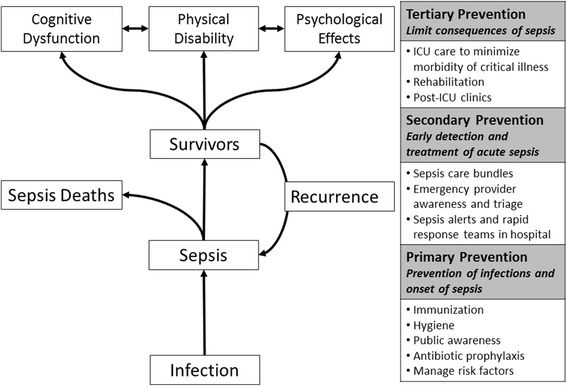
“This trajectory includes sepsis recurrence, longterm mortality, and long-term morbidity across domains of psychological, cognitive, and physical function [13, 14].”
Background
Research works printed but not linked: 7
- Wang HE, Donnelly JP, Griffin R, Levitan EB, Shapiro NI, Howard G, Safford MM. Derivation of novel risk prediction scores for community-acquired sepsis and severe sepsis. Crit Care Med. 2016;44:1285–94. · DOI
- Kempker JA, Magee MJ, Cegielski JP, Martin GS. Associations between vitamin D level and hospitalizations with and without an infection in a national cohort of medicare beneficiaries. Am J Epidemiol. 2016;183:920–9. · DOI
- Martin GS, Mannino DM, Eaton S, Moss M. The epidemiology of sepsis in the United States from 1979 through 2000. N Engl J Med. 2003;348:1546–54. · DOI · Paper page
- Kumar A, Roberts D, Wood KE, Light B, Parrillo JE, Sharma S, Suppes R, Feinstein D, Zanotti S, Taiberg L, Gurka D, Kumar A, Cheang M. Duration of hypotension before initiation of effective antimicrobial therapy is the critical determinant of survival in human septic shock. Crit Care Med. 2006;34:1589–96. · DOI · Paper page
- Miller RR 3rd, Dong L, Nelson NC, Brown SM, Kuttler KG, Probst DR, Allen TL, Clemmer TP, Intermountain Healthcare Intensive Medicine Clinical Program. Multicenter implementation of a severe sepsis and septic shock treatment bundle. Am J Respir Crit Care Med. 2013;188:77–82. · DOI
- Levy MM, Dellinger RP, Townsend SR, Linde-Zwirble WT, Marshall JC, Bion J, Schorr C, Artigas A, Ramsay G, Beale R, Parker MM, Gerlach H, Reinhart K, Silva E, Harvey M, Regan S, Angus DC. The Surviving Sepsis Campaign: results of an international guideline-based performance improvement program targeting severe sepsis. Intensive Care Med. 2010;36:222–31. · DOI · Paper page
- Wang HE, Moore JX, Donnelly JP, Levitan EB, Safford MM. Risk of acute coronary heart disease after sepsis hospitalization in the REasons for Geographic and Racial Differences in Stroke cohort. Clin Infect Dis. 2017;65:29–36. · DOI
Cited by
Sorted by citations
On race, human variation, and who gets and dies of sepsis
Brinkworth, J. F., & Shaw, J. G. (2022) · American Journal of Biological Anthropology · doi:10.1002/ajpa.24527 · Cited by 9
Metadata
- Authors
- Kempker, J. A., Wang, H. E., & Martin, G. S.
- Venue
- Critical Care
- Published
- 2018-05-06
- Volume
- 22
- Issue
- 1
- ISSN
- 1364-8535
- PMC
- PMC5936625
- Cited by
- 37
- References
- 2
- Language
- en
- Funders
- National Center for Advancing Translational Sciences (UL1 TR002378)
- National Institute of Nursing Research (R01-NR-012726)
About these checks
Registry, retraction, Cites and statistics results are computed, not judged, with one exception: a printed reference that no index lists is read once by a model before it counts as a citation error. Claims are extracted by a model and kept only when their quote appears verbatim in the text; each cited source is then checked, with a model’s help, for whether it says what the claim relies on. Those verdicts can be wrong — read the claim’s quote and the cited source before relying on one.
Statistics and arithmetic are recomputed, not judged.
Confidence bands are shown only for fields calibrated on our annotated test set. None is calibrated yet, so no band is shown.
What counts as a claim ›How we measure confidence ›How we check this ›
Are you an author, or do you see a problem with this page? Request a review
