

Prevalence of post-traumatic stress disorder symptoms in adult critical care survivors: a systematic review and meta-analysis
Open accessThe DOI matches its Crossref record; 79 of the 80 references it cites were found in a registry or an index.
Abstract
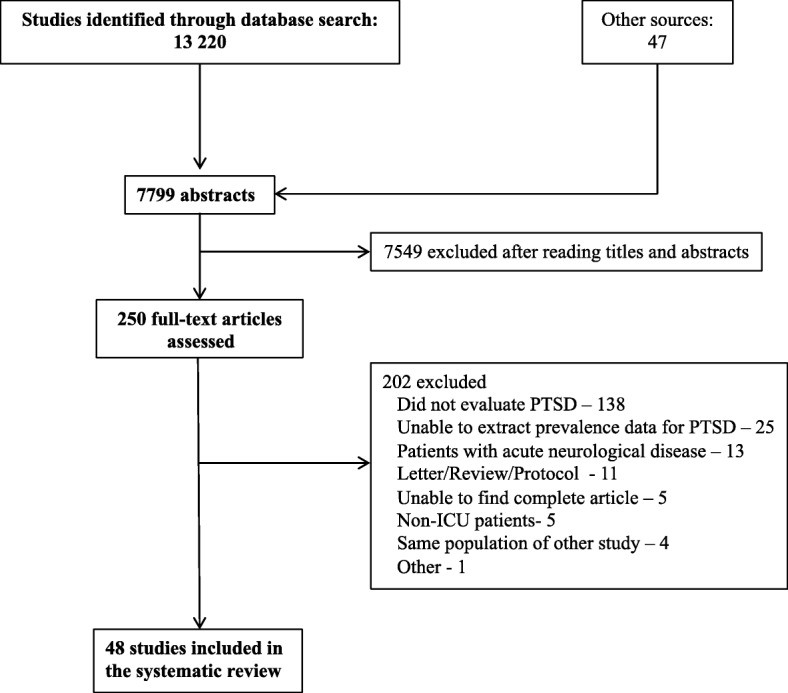
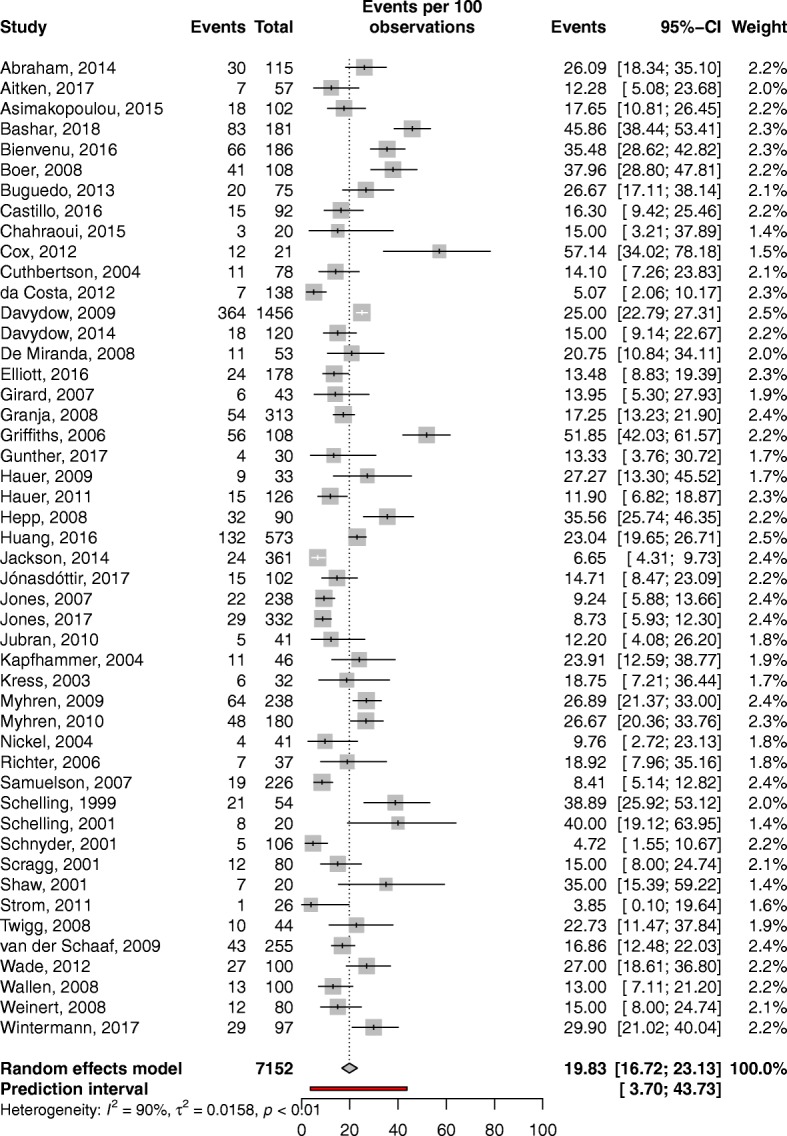
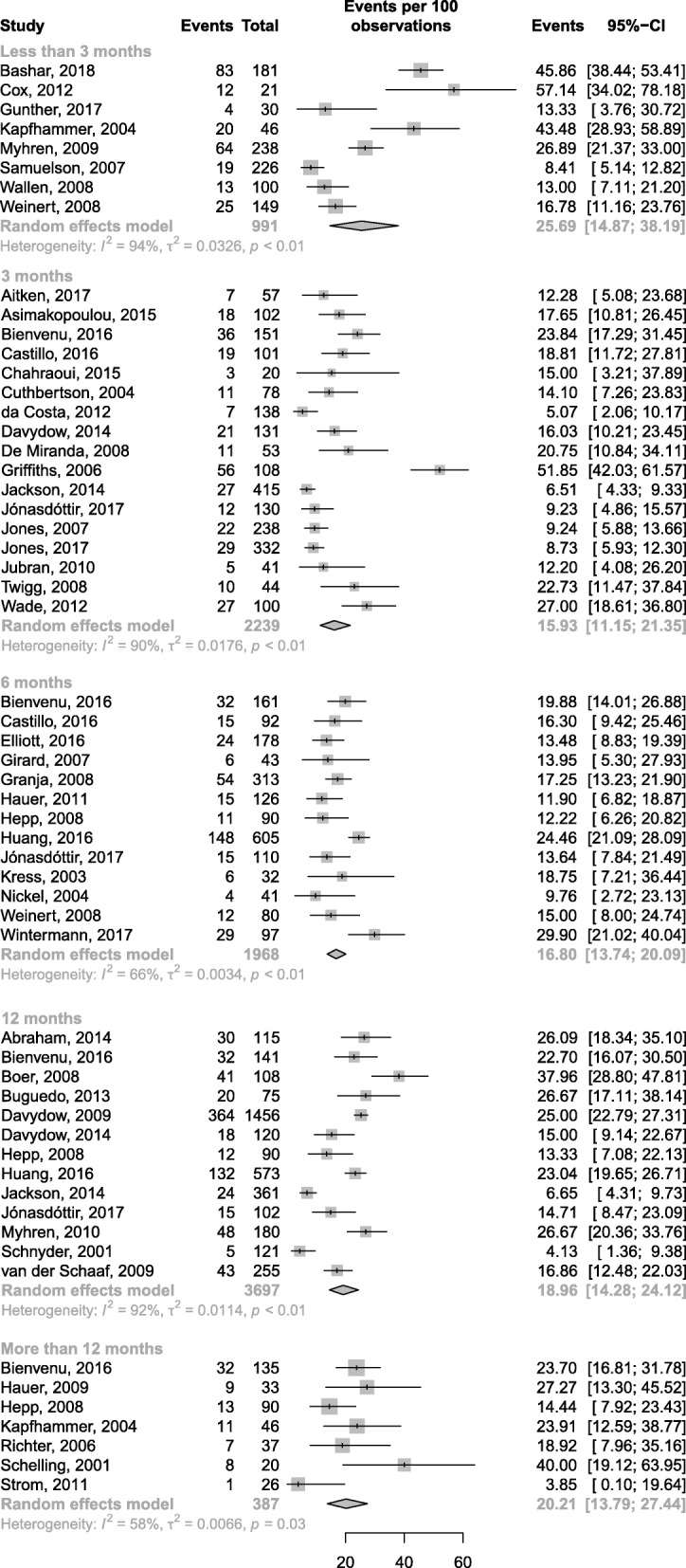
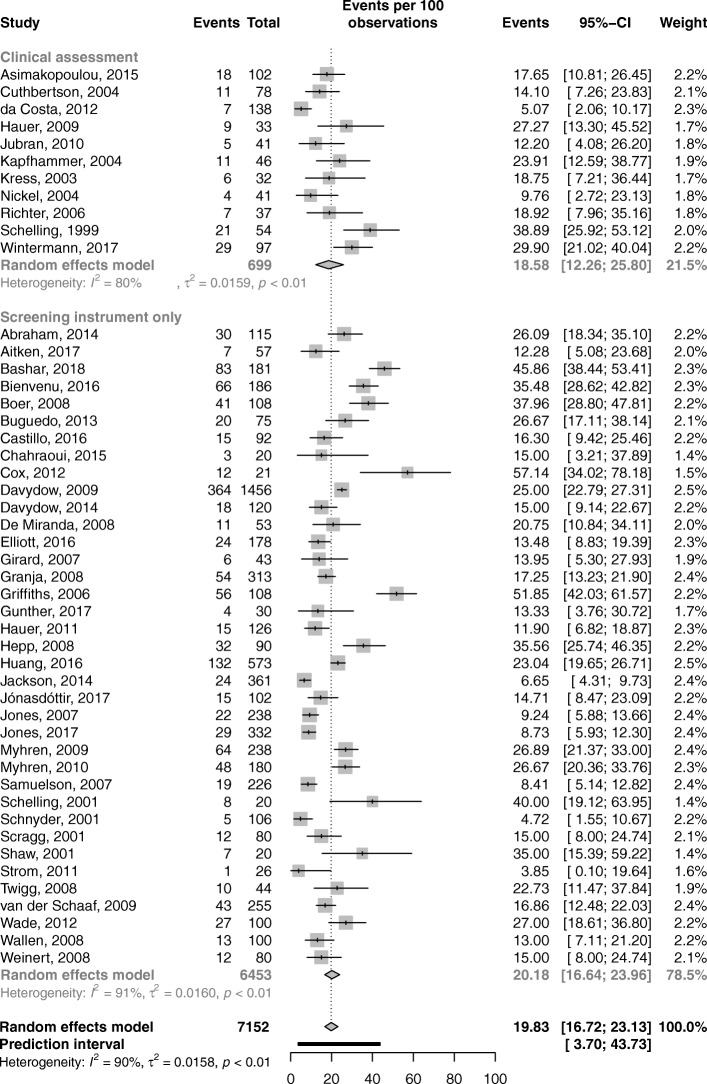
As more patients are surviving intensive care, mental health concerns in survivors have become a research priority. Among these, post-traumatic stress disorder (PTSD) can have an important impact on the quality of life of critical care survivors. However, data on its burden are conflicting. Therefore, this systematic review and meta-analysis aimed to evaluate the prevalence of PTSD symptoms in adult critical care patients after intensive care unit (ICU) discharge. We searched MEDLINE, EMBASE, LILACS, Web of Science, PsycNET, and Scopus databases from inception to September 2018. We included observational studies assessing the prevalence of PTSD symptoms in adult critical care survivors. Two reviewers independently screened studies and extracted data. Studies were meta-analyzed using a random-effects model to estimate PTSD symptom prevalence at different time points, also estimating confidence and prediction intervals. Subgroup and meta-regression analyses were performed to explore heterogeneity. Risk of bias was assessed using the Joanna Briggs Institute tool and the GRADE approach. Of 13,267 studies retrieved, 48 were included in this review. Overall prevalence of PTSD symptoms was 19.83% (95% confidence interval [CI], 16.72–23.13; I2 = 90%, low quality of evidence). Prevalence varied widely across studies, with a wide range of expected prevalence (from 3.70 to 43.73% in 95% of settings). Point prevalence estimates were 15.93% (95% CI, 11.15–21.35; I2 = 90%; 17 studies), 16.80% (95% CI, 13.74–20.09; I2 = 66%; 13 studies), 18.96% (95% CI, 14.28–24.12; I2 = 92%; 13 studies), and 20.21% (95% CI, 13.79–27.44; I2 = 58%; 7 studies) at 3, 6, 12, and > 12 months after discharge, respectively. PTSD symptoms may affect 1 in every 5 adult critical care survivors, with a high expected prevalence 12 months after discharge. ICU survivors should be screened for PTSD symptoms and cared for accordingly, given the potential negative impact of PTSD on quality of life. In addition, action should be taken to further explore the causal relationship between ICU stay and PTSD, as well as to propose early measures to prevent PTSD in this population. PROSPERO, CRD42017075124 , Registered 6 December 2017.
Overview
The claims and statistics of this paper haven’t been checked yet.
Free: it reads the open-access text and checks the first 5 claims that cite a source we can check. Create a free account to check every claim.
Integrity signals
Registry
Cites
Statistics
Figures
Verification
Claims the paper makes
The claims and statistics of this paper haven’t been checked yet.
Free: it reads the open-access text and checks the first 5 claims that cite a source we can check. Create a free account to check every claim.
Claims other papers make about this one
Each is checked against this paper’s own text: does it say what the citing paper says it does?
The source backs part of the claim, not all of it — or backs it for a different population, condition or comparison.
In the citing paper
“Prolonged exposure to stressful hospitalization, complex medical examination procedures, and worries about the difficulty of returning to normal life can lead to long-term psychological harm [44].”
From Mindfulness-based online intervention on mental health and quality of life among COVID-19 patients in China: an intervention design (2021) · cites this paper as [44]
Experimental — accuracy not yet measuredThe cited source says what the claim attributes to it.
In the citing paper
“The estimated psychological morbidity for Intensive Care Unit (ICU) survivors is 55%: with approximately 20%–30% experiencing PTSD; 46% depression, and 44% anxiety.1 –3”
From “It saved me”: A thematic analysis of experiences of psychological therapy following critical illness and intensive care (2024) · cites this paper as [2]
The check wasn’t confident either way, so it gives no verdict — never disputed.
In the citing paper
“The estimated psychological morbidity for Intensive Care Unit (ICU) survivors is 55%: with approximately 20%–30% experiencing PTSD; 46% depression, and 44% anxiety.1 –3”
From “It saved me”: A thematic analysis of experiences of psychological therapy following critical illness and intensive care (2024) · cites this paper as [2]
Experimental — accuracy not yet measuredThe check wasn’t confident either way, so it gives no verdict — never disputed.
In the citing paper
“The estimated psychological morbidity for Intensive Care Unit (ICU) survivors is 55%: with approximately 20%–30% experiencing PTSD; 46% depression, and 44% anxiety.1 –3”
From “It saved me”: A thematic analysis of experiences of psychological therapy following critical illness and intensive care (2024) · cites this paper as [2]
Experimental — accuracy not yet measured
Self-check
Percentages, sums and reported differences re-computed from the paper’s own numbers.
The self-check needs the paper’s full text.
Citations
Cites
Diagnostic and Statistical Manual of Mental Disorders
American Psychiatric Association (2013) · doi:10.1176/appi.books.9780890425596 · Cited by 116,369
Diagnostic and Statistical Manual of Mental Disorders
Williams, J. B. W., & First, M. (2013) · Encyclopedia of Social Work · doi:10.1093/acrefore/9780199975839.013.104 · Cited by 109,519
Preferred Reporting Items for Systematic Reviews and Meta-Analyses: the PRISMA statement
Moher, D., Liberati, A., Tetzlaff, J., Altman, D. G., & for the PRISMA Group (2009) · BMJ · doi:10.1136/bmj.b2535 · Cited by 83,823
Preferred reporting items for systematic reviews and meta-analyses: the PRISMA Statement.
(2009) · PubMed Central · Cited by 44,859
Wickham, H. (2016) · Use R! · doi:10.1007/978-3-319-24277-4 · Cited by 33,115
Liberati, A., Altman, D. G., Tetzlaff, J., Mulrow, C., Gøtzsche, P. C., Ioannidis, J. P. A., Clarke, M., Devereaux, P. J., Kleijnen, J., & Moher, D. (2009) · PLoS Medicine · doi:10.1371/journal.pmed.1000100 · Cited by 28,164
Liberati, A., Altman, D. G., Tetzlaff, J., Mulrow, C., Gotzsche, P. C., Ioannidis, J. P. A., Clarke, M., Devereaux, P. J., Kleijnen, J., & Moher, D. (2009) · BMJ · doi:10.1136/bmj.b2700 · Cited by 17,648
ggplot2: Elegant Graphics for Data Analysis
Wickham, H. (2009) · doi:10.1007/978-0-387-98141-3 · Cited by 14,447
GRADE guidelines: 3. Rating the quality of evidence
Balshem, H., Helfand, M., Schünemann, H. J., Oxman, A. D., Kunz, R., Brozek, J., Vist, G. E., Falck-Ytter, Y., Meerpohl, J., & Norris, S. (2011) · Journal of Clinical Epidemiology · doi:10.1016/j.jclinepi.2010.07.015 · Cited by 8,285
Munn, Z., Moola, S., Lisy, K., Riitano, D., & Tufanaru, C. (2015) · International Journal of Evidence-Based Healthcare · doi:10.1097/xeb.0000000000000054 · Cited by 3,131
Plea for routinely presenting prediction intervals in meta-analysis.
IntHout, J., Ioannidis, J. P. A., Rovers, M. M., & Goeman, J. J. (2016) · BMJ Open · doi:10.1136/bmjopen-2015-010247 · Cited by 2,264
Iorio, A., Spencer, F. A., Falavigna, M., Alba, C., Lang, E., Burnand, B., McGinn, T., Hayden, J., Williams, K., Shea, B., et al. (2015) · BMJ · doi:10.1136/bmj.h870 · Cited by 880
Self-citationPosttraumatic Stress Disorder in Critical Illness Survivors: A Metaanalysis*
Parker, A. M., Sricharoenchai, T., Raparla, S., Schneck, K. W., Bienvenu, O. J., & Needham, D. M. (2015) · Critical Care Medicine · doi:10.1097/ccm.0000000000000882 · Cited by 779
Posttraumatic stress disorder in general intensive care unit survivors: a systematic review
Davydow, D. S., Gifford, J. M., Desai, S. V., Needham, D. M., & Bienvenu, O. J. (2008) · General Hospital Psychiatry · doi:10.1016/j.genhosppsych.2008.05.006 · Cited by 676
Jackson, J. C., Pandharipande, P. P., Girard, T. D., Brummel, N. E., Thompson, J. L., Hughes, C. G., Pun, B. T., Vasilevskis, E. E., Morandi, A., Shintani, A. K., et al. (2014) · The Lancet Respiratory Medicine · doi:10.1016/s2213-2600(14)70051-7 · Cited by 673
The Long-term Psychological Effects of Daily Sedative Interruption on Critically Ill Patients
Kress, J. P., Gehlbach, B., Lacy, M., Pliskin, N., Pohlman, A. S., & Hall, J. B. (2003) · American Journal of Respiratory and Critical Care Medicine · doi:10.1164/rccm.200303-455oc · Cited by 646
Jones, C., Bäckman, C., Capuzzo, M., Egerod, I., Flaatten, H., Granja, C., Rylander, C., Griffiths, R. D., & the RACHEL group (2010) · Critical Care · doi:10.1186/cc9260 · Cited by 482
Epidemiology of posttraumatic stress disorder: prevalence, correlates and consequences
Atwoli, L., Stein, D. J., Koenen, K. C., & McLaughlin, K. A. (2015) · Current Opinion in Psychiatry · doi:10.1097/yco.0000000000000167 · Cited by 420
Myhren, H., Ekeberg, Ø., Tøien, K., Karlsson, S., & Stokland, O. (2010) · Critical Care · doi:10.1186/cc8870 · Cited by 341
Schelling, G., Briegel, J., Roozendaal, B., Stoll, C., Rothenhäusler, H.-B., & Kapfhammer, H.-P. (2001) · Biological Psychiatry · doi:10.1016/s0006-3223(01)01270-7 · Cited by 337
Kapfhammer, H. P., Rothenhäusler, H. B., Krauseneck, T., Stoll, C., & Schelling, G. (2004) · American Journal of Psychiatry · doi:10.1176/appi.ajp.161.1.45 · Cited by 335
Psychological problems following ICU treatment*
Scragg, P., Jones, A., & Fauvel, N. (2001) · Anaesthesia · doi:10.1046/j.1365-2044.2001.01714.x · Cited by 318
Impact of an intensive care unit diary on psychological distress in patients and relatives*
Garrouste-Orgeas, M., Coquet, I., Périer, A., Timsit, J.-F., Pochard, F., Lancrin, F., Philippart, F., Vesin, A., Bruel, C., Blel, Y., et al. (2012) · Critical Care Medicine · doi:10.1097/ccm.0b013e31824e1b43 · Cited by 296
Post-traumatic stress disorder after critical illness requiring general intensive care
Cuthbertson, B. H., Hull, A., Strachan, M., & Scott, J. (2004) · Intensive Care Medicine · doi:10.1007/s00134-003-2004-8 · Cited by 285
Girard, T. D., Shintani, A. K., Jackson, J. C., Gordon, S. M., Pun, B. T., Henderson, M. S., Dittus, R. S., Bernard, G. R., & Ely, E. (2007) · Critical Care · doi:10.1186/cc5708 · Cited by 283
Stoll, C., Kapfhammer, H. P., Rothenhäusler, H. B., Haller, M., Briegel, J., Schmidt, M., Krauseneck, T., Durst, K., & Schelling, G. (1999) · Intensive Care Medicine · doi:10.1007/s001340050932 · Cited by 278
Wade, D. M., Howell, D. C., Weinman, J. A., Hardy, R. J., Mythen, M. G., Brewin, C. R., Borja-Boluda, S., Matejowsky, C. F., & Raine, R. A. (2012) · Critical Care · doi:10.1186/cc11677 · Cited by 263
Schnyder, U., Moergeli, H., Klaghofer, R., & Buddeberg, C. (2001) · American Journal of Psychiatry · doi:10.1176/appi.ajp.158.4.594 · Cited by 255
Samuelson, K. A. M., Lundberg, D., & Fridlund, B. (2007) · Acta Anaesthesiologica Scandinavica · doi:10.1111/j.1399-6576.2007.01292.x · Cited by 227
The prevalence of post traumatic stress disorder in survivors of ICU treatment: a systematic review
Griffiths, J., Fortune, G., Barber, V., & Young, J. D. (2007) · Intensive Care Medicine · doi:10.1007/s00134-007-0730-z · Cited by 215
Schelling, G., Stoll, C., Kapfhammer, H.-P., Rothenhäusler, H.-B., Krauseneck, T., Durst, K., Haller, M., & Briegel, J. (1999) · Critical Care Medicine · doi:10.1097/00003246-199912000-00012 · Cited by 203
Morina, N., Stam, K., Pollet, T. V., & Priebe, S. (2018) · Journal of Affective Disorders · doi:10.1016/j.jad.2018.07.027 · Cited by 194
Pharmacological treatment of PTSD – Established and new approaches
Steckler, T., & Risbrough, V. (2012) · Neuropharmacology · doi:10.1016/j.neuropharm.2011.06.012 · Cited by 182 · cited 1×
“, antidepressants) may improve quality of life, as observed in PTSD associated with other stressful events [78].”
BackgroundGranja, C., Gomes, E., Amaro, A., Ribeiro, O., Jones, C., Carneiro, A., & Costa-Pereira, A. (2008) · Critical Care Medicine · doi:10.1097/ccm.0b013e318186a3e7 · Cited by 176
Posttraumatic Stress Disorder in Survivors of Acute Lung Injury
Bienvenu, O. J., Williams, J. B., Yang, A., Hopkins, R. O., & Needham, D. M. (2013) · CHEST Journal · doi:10.1378/chest.12-0908 · Cited by 165
Huang, M., Parker, A. M., Bienvenu, O. J., Dinglas, V. D., Colantuoni, E., Hopkins, R. O., & Needham, D. M. (2016) · Critical Care Medicine · doi:10.1097/ccm.0000000000001621 · Cited by 157 · cited 1×
“Iran [22], and 4 studies in which location was not reported [30, 41, 46, 57], all other studies (77%) were conducted in the USA or Europe.”
ResultJavidi, H., & Yadollahie, M. (2012) · Springer eBooks · doi:10.1007/springerreference_184673 · Cited by 153
de Miranda, S., Pochard, F., Chaize, M., Megarbane, B., Cuvelier, A., Bele, N., Gonzalez-Bermejo, J., Aboab, J., Lautrette, A., Lemiale, V., et al. (2011) · Critical Care Medicine · doi:10.1097/ccm.0b013e3181feb824 · Cited by 151
Davydow, D. S., Zatzick, Hough, C. L., & Katon, W. J. (2013) · General Hospital Psychiatry · doi:10.1016/j.genhosppsych.2012.12.005 · Cited by 141
TWIGG, E., HUMPHRIS, G., JONES, C., BRAMWELL, R., & GRIFFITHS, R. D. (2008) · Acta Anaesthesiologica Scandinavica · doi:10.1111/j.1399-6576.2007.01531.x · Cited by 140
van der Schaaf, M., Beelen, A., Dongelmans, D., Vroom, M., & Nollet, F. (2009) · Journal of Rehabilitation Medicine · doi:10.2340/16501977-0333 · Cited by 133
Bienvenu, O. J., Colantuoni, E., Mendez-Tellez, P. A., Shanholtz, C., Dennison-Himmelfarb, C. R., Pronovost, P. J., & Needham, D. M. (2015) · Critical Care Medicine · doi:10.1097/ccm.0000000000000752 · Cited by 128
Chahraoui, K., Laurent, A., Bioy, A., & Quenot, J. (2015) · Journal of Critical Care · doi:10.1016/j.jcrc.2015.02.016 · Cited by 126
Engelhard, I. M., Arntz, A., & Van den Hout, M. A. (2007) · British Journal of Clinical Psychology · doi:10.1348/014466507x206883 · Cited by 122
Myhren, H., Tøien, K., Ekeberg, Ø., Karlsson, S., Sandvik, L., & STOKLAND, O. (2009) · Intensive Care Medicine · doi:10.1007/s00134-009-1614-1 · Cited by 122
Post-ICU consequences of patient wakefulness and sedative exposure during mechanical ventilation
Weinert, C., & Sprenkle, M. D. (2007) · Intensive Care Medicine · doi:10.1007/s00134-007-0829-2 · Cited by 117
Hauer, D., Weis, F., Papassotiropoulos, A., Schmoeckel, M., Beiras-Fernandez, A., Lieke, J., Kaufmann, I., Kirchhoff, F., Vogeser, M., Roozendaal, B., et al. (2011) · Critical Care Medicine · doi:10.1097/ccm.0b013e318206bae6 · Cited by 115
Five-Year Trends of Critical Care Practice and Outcomes
Lilly, C. M., Swami, S., Liu, X., Riker, R. R., & Badawi, O. (2017) · CHEST Journal · doi:10.1016/j.chest.2017.06.050 · Cited by 113
Post-traumatic stress disorder after weaning from prolonged mechanical ventilation
Jubran, A., Lawm, G., Duffner, L. A., Collins, E. G., Lanuza, D. M., Hoffman, L. A., & Tobin, M. J. (2010) · Intensive Care Medicine · doi:10.1007/s00134-010-1972-8 · Cited by 105
Davydow, D. S., Zatzick, D., Rivara, F. P., Jurkovich, G. J., Wang, J., Roy‐Byrne, P., Katon, W. J., Hough, C. L., Kross, E. K., Fan, M.-Y., et al. (2009) · General Hospital Psychiatry · doi:10.1016/j.genhosppsych.2009.05.007 · Cited by 104
Temporal Trends in Incidence, Sepsis-Related Mortality, and Hospital-Based Acute Care After Sepsis
Meyer, N., Harhay, M. O., Small, D. S., Prescott, H. C., Bowles, K. H., Gaieski, D. F., & Mikkelsen, M. E. (2018) · Critical Care Medicine · doi:10.1097/ccm.0000000000002872 · Cited by 102
The Dutch Peritonitis Study Group, Boer, K. R., van Ruler, O., van Emmerik, A., Sprangers, M. A. G., de Rooij, S. E., Vroom, M. B., de Borgie, C. A. J. M., Boermeester, M. A., & Reitsma, J. B. (2008) · Intensive Care Medicine · doi:10.1007/s00134-007-0941-3 · Cited by 98
Long-term psychological effects of a no-sedation protocol in critically ill patients
Strøm, T., Stylsvig, M., & Toft, P. (2011) · Critical Care · doi:10.1186/cc10586 · Cited by 89
Jones, J. M., Williams, W. H., Jetten, J., Haslam, S. A., Harris, A., & Gleibs, I. H. (2012) · British Journal of Health Psychology · doi:10.1111/j.2044-8287.2012.02074.x · Cited by 78
McGiffin, J. N., Galatzer-Levy, I. R., & Bonanno, G. A. (2016) · Rehabilitation Psychology · doi:10.1037/rep0000073 · Cited by 76
van Ommeren, M., Saxena, S., & Saraceno, B. (2005) · BMJ · doi:10.1136/bmj.330.7501.1160 · Cited by 74
Post-traumatic stress disorder in serious accidental injury: 3-year follow-up study
Hepp, U., Moergeli, H., Buchi, S., Bruchhaus-Steinert, H., Kraemer, B., Sensky, T., & Schnyder, U. (2008) · British Journal of Psychiatry · doi:10.1192/bjp.bp.106.030569 · Cited by 74
Brück, E., Schandl, A., Bottai, M., & Sackey, P. (2018) · Journal of Intensive Care · doi:10.1186/s40560-017-0272-6 · Cited by 74
Griffiths, J., Gager, M., Alder, N. C., Fawcett, D. P., Waldmann, C. S., & Quinlan, J. (2006) · Intensive Care Medicine · doi:10.1007/s00134-005-0048-7 · Cited by 72
Nickel, M., Leiberich, P. K., Nickel, C., Tritt, K., Mitterlehner, F. O., Rother, W. K., & Loew, T. H. (2004) · Journal of Intensive Care Medicine · doi:10.1177/0885066604267684 · Cited by 68
Hauer, D., Weis, F. C., Krauseneck, T., Vogeser, M., Schelling, G., & Roozendaal, B. (2009) · Brain Research · doi:10.1016/j.brainres.2009.04.014 · Cited by 62
Incidence of Posttraumatic Stress Disorder After Prolonged Surgical Intensive Care Unit Treatment
Richter, J. C., Waydhas, C., & Pajonk, F. (2006) · Psychosomatics · doi:10.1176/appi.psy.47.3.223 · Cited by 61
Post-ICU psychological morbidity in very long ICU stay patients with ARDS and delirium
Bashar, F. R., Vahedian‐Azimi, A., Hajiesmaeili, M., Salesi, M., Farzanegan, B., Shojaei, S., Goharani, R., Madani, S. J., Moghaddam, K. G., Hatamian, S., et al. (2017) · Journal of Critical Care · doi:10.1016/j.jcrc.2017.08.034 · Cited by 61
Garrouste-Orgeas, M., Flahault, C., Fasse, L., Ruckly, S., Amdjar-Badidi, N., Argaud, L., Badie, J. C., Bazire, A., Bigé, N., Boulet, É., et al. (2017) · Trials · doi:10.1186/s13063-017-2283-y · Cited by 57 · cited 1×
“Also, evidence is emerging that an ICU diary—written by family members or ICU staff—may help patients fill in gaps in their memories, thus reducing the risk of PTSD development [42, 76, 77].”
BackgroundCox, C. E., Porter, L. S., Hough, C. L., White, D. B., Kahn, J. M., Carson, S. S., Tulsky, J. A., & Keefe, F. J. (2012) · Intensive Care Medicine · doi:10.1007/s00134-012-2567-3 · Cited by 56
Bugedo, G., Tobar, E., Aguirre, M., Gonzalez, H., Godoy, J., Lira, M. T., Lora, P., Encalada, E., Hernandez, A., Tomicic, V., et al. (2013) · Revista Brasileira de Terapia Intensiva · doi:10.5935/0103-507x.20130034 · Cited by 48
Symptoms of Acute Posttraumatic Stress Disorder After Intensive Care
Wallen, K., Chaboyer, W. P., Thalib, L., & Creedy, D. K. (2008) · American Journal of Critical Care · doi:10.4037/ajcc2008.17.6.534 · Cited by 45
Posttraumatic stress symptoms in intensive care patients: An exploration of associated factors.
Elliott, R., McKinley, S., Fien, M., & Elliott, D. (2016) · Rehabilitation Psychology · doi:10.1037/rep0000074 · Cited by 41
Aitken, L. M., Rattray, J. E., Kenardy, J. A., Hull, A. M., Ullman, A. J., Brocque, R. M. L., Mitchell, M. L., Davis, C., Castillo, M. I. A., & Macfarlane, B. (2016) · Journal of Critical Care · doi:10.1016/j.jcrc.2016.12.003 · Cited by 39
Jónasdóttir, R. J., Jónsdóttir, H., Gudmundsdottir, B., & Sigurdsson, G. H. (2018) · Intensive and Critical Care Nursing · doi:10.1016/j.iccn.2017.06.001 · Cited by 38
Roberts, M. B., Glaspey, L. J., Mazzarelli, A., Jones, C. W., Kilgannon, H. J., Trzeciak, S., & Roberts, B. W. (2018) · Critical Care Medicine · doi:10.1097/ccm.0000000000003222 · Cited by 37
Abraham, C. M., Obremskey, W. T., Song, Y., Jackson, J. C., Ely, E. W., & Archer, K. R. (2014) · Archives of Physical Medicine and Rehabilitation · doi:10.1016/j.apmr.2014.08.005 · Cited by 36
Posttraumatic Stress Disorder Phenomena After Critical Illness
Bienvenu, O. J., & Gerstenblith, T. A. (2017) · Critical Care Clinics · doi:10.1016/j.ccc.2017.03.006 · Cited by 36
Linguistic analysis to assess medically related posttraumatic stress symptoms
Shaw, R. J., Harvey, J. E., Nelson, K. L., Gunary, R., Kruk, H., & Steiner, H. (2001) · Psychosomatics · doi:10.1176/appi.psy.42.1.35 · Cited by 31
Risk Factors of Delayed Onset Posttraumatic Stress Disorder in Chronically Critically Ill Patients
Wintermann, G., Rosendahl, J., Weidner, K., Strauss, B. M., & Petrowski, K. (2017) · The Journal of Nervous and Mental Disease · doi:10.1097/nmd.0000000000000714 · Cited by 29
Posttraumatic Stress Disorder After Discharge From Intensive Care Units in Greater Athens Area
Asimakopoulou, E., & Madianos, M. G. (2015) · Journal of Trauma Nursing · doi:10.1097/jtn.0000000000000142 · Cited by 21
Castillo, M. I. A., Cooke, M. L., Macfarlane, B., & Aitken, L. M. (2015) · Australian Critical Care · doi:10.1016/j.aucc.2015.09.003 · Cited by 20
da Costa, J. B., Marcon, S. S., & Rossi, R. M. (2012) · Jornal Brasileiro de Psiquiatria · doi:10.1590/s0047-20852012000100004 · Cited by 19
The relation between skin conductance responses and recovery from symptoms of PTSD
Günther, A., Sackey, P., Bjärtå, A., & Schandl, A. R. (2017) · Acta Anaesthesiologica Scandinavica · doi:10.1111/aas.12890 · Cited by 2
Research works printed but not linked: 2
- Joanna Briggs Institute Joanna Briggs Institute reviewers’ manual: 2014 edition 2014 Australia The Joanna Briggs Institute
- Schwarzer G meta: an R package for meta-analysis R News 2007 7 40 45
Cited by
Barker, T. H., Migliavaca, C. B., Stein, C., Colpani, V., Falavigna, M., Aromataris, E., & Munn, Z. (2021) · BMC Medical Research Methodology · doi:10.1186/s12874-021-01381-z · Cited by 738
“Differences between subgroups can be compared and contrasted using the Chi(2) test, and an example of how this can be facilitated in practice can be observed in the work of Righy, Rosa [41].”
MethodSelf-citationSeptic-Associated Encephalopathy: a Comprehensive Review
Mazeraud, A., Righy, C., Bouchereau, E., Benghanem, S., Bozza, F. A., & Sharshar, T. (2020) · Neurotherapeutics · doi:10.1007/s13311-020-00862-1 · Cited by 328
Self-citationA Second Pandemic: Mental Health Spillover From the Novel Coronavirus (COVID-19)
Choi, K. R., Heilemann, M. V., Fauer, A., & Mead, M. (2020) · Journal of the American Psychiatric Nurses Association · doi:10.1177/1078390320919803 · Cited by 219
“Prolonged exposure to stressful environments, invasive procedures, and the perception of threats in an intensive care unit (ICU) can be experienced as traumatic, leading to long-term psychological harm (Righy et al., 2019).”
BackgroundTarsitani, L., Vassalini, P., Koukopoulos, A., Borrazzo, C., Alessi, F., Di Nicolantonio, C., Serra, R., Alessandri, F., Ceccarelli, G., Mastroianni, C. M., et al. (2021) · Journal of General Internal Medicine · doi:10.1007/s11606-021-06731-7 · Cited by 156
Neuropsychiatric Complications of COVID-19
Nakamura, Z. M., Nash, R. P., Laughon, S. L., & Rosenstein, D. L. (2021) · Current Psychiatry Reports · doi:10.1007/s11920-021-01237-9 · Cited by 165
Metadata
- Authors
- Righy, C., Rosa, R. G., da Silva, R. T. A., Kochhann, R., Migliavaca, C. B., Robinson, C. C., Teche, S. P., Teixeira, C., Bozza, F. A., & Falavigna, M.
- Affiliations
- Instituto Estadual do Cérebro Paulo Niemeyer (BR)
- Universidade Federal do Rio Grande do Sul (BR)
- Hospital Moinhos de Vento (BR)
- D’Or Institute for Research and Education (BR)
- ORCID
- Venue
- Critical Care
- Published
- 2019-06-11
- Volume
- 23
- Issue
- 1
- Pages
- 213-213
- ISSN
- 1364-8535 (ISSN-L)
- PMC
- PMC6560853
- OpenAlex
- W2953174290
- Cited by
- 319
- References
- 80
- Citations by year
- 2026: 39 · 2025: 45 · 2024: 61 · 2023: 39 · 2022: 47 · 2021: 62 · 2020: 23 · 2019: 2
- FWCI
- 6.02
- Type
- journal article
- Language
- en
- Open access
- gold
- doi.org
- Licence
- cc-by
- creativecommons.org/licenses/by/4.0/ (tdm)
- creativecommons.org/licenses/by/4.0/ (vor)
- Locations
- Critical Care (publishedVersion, cc-by)
- PubMed Central (publishedVersion, cc-by)
- PubMed (publishedVersion)
- LA Referencia (Red Federada de Repositorios Institucionales de Publicaciones Científicas) (publishedVersion, other-oa)
- Americanae (AECID Library) (submittedVersion, other-oa)
- Arca - Repositório Institucional da Fiocruz (submittedVersion, other-oa)
- DOAJ (DOAJ: Directory of Open Access Journals) (submittedVersion, cc-by-sa)
- Funders
- Ministério da Saúde
- Topics
- Health Sciences › Medicine › Critical Care and Intensive Care Medicine › Intensive Care Unit Cognitive Disorders
- Social Sciences › Psychology › Clinical Psychology › Posttraumatic Stress Disorder Research
- Health Sciences › Medicine › Critical Care and Intensive Care Medicine › Family and Patient Care in Intensive Care Units
- Keywords
- post-traumatic stress disorder, critical illness survivors, intensive care unit discharge, post-intensive care syndrome, PTSD screening, quality of life, adult ICU patients, heterogeneity of prevalence estimates
- MeSH terms
- Adult, Humans, Quality of Life, Stress Disorders, Post-Traumatic, Prevalence, Critical Illness, Survivors
About these checks
Registry, retraction, Cites and statistics results are computed, not judged, with one exception: a printed reference that no index lists is read once by a model before it counts as a citation error. Claims are extracted by a model and kept only when their quote appears verbatim in the text; each cited source is then checked, with a model’s help, for whether it says what the claim relies on. Those verdicts can be wrong — read the claim’s quote and the cited source before relying on one.
Statistics and arithmetic are recomputed, not judged.
Confidence bands are shown only for fields calibrated on our annotated test set. None is calibrated yet, so no band is shown.
What counts as a claim ›How we measure confidence ›How we check this ›
Are you an author, or do you see a problem with this page? Request a review
Data sources
Bibliographic data: Semantic Scholar, OpenAlex, Crossref.
Contains information from the Semantic Scholar Academic Graph Datasets, made available under the ODC Attribution License (ODC-BY 1.0).
Semantic Scholar’s data is described in: Kinney, R., et al. (2023). The Semantic Scholar Open Data Platform. arXiv:2301.10140.
