

Prognostic significance of FOXP3+ tumor-infiltrating lymphocytes in breast cancer depends on estrogen receptor and human epidermal growth factor receptor-2 expression status and concurrent cytotoxic T-cell infiltration
Open accessThe DOI matches its Crossref record; 48 of the 48 references it cites were found in a registry or an index.
Abstract
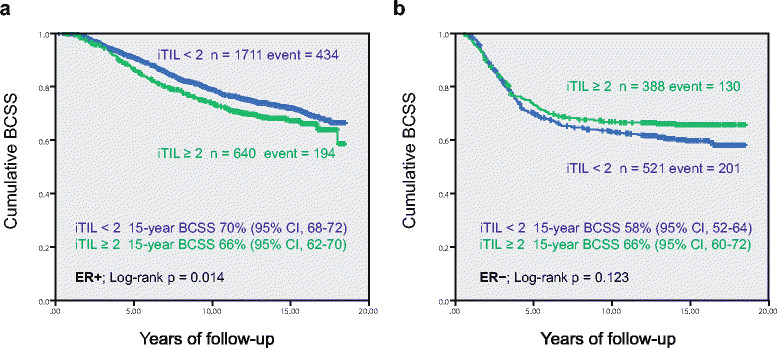
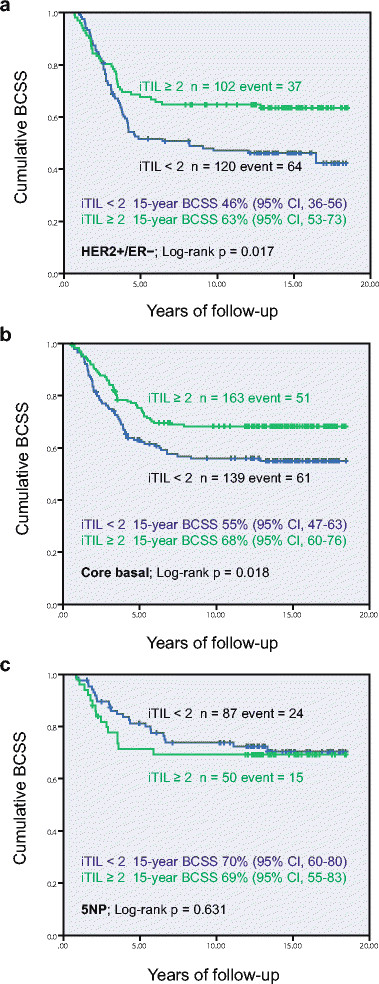
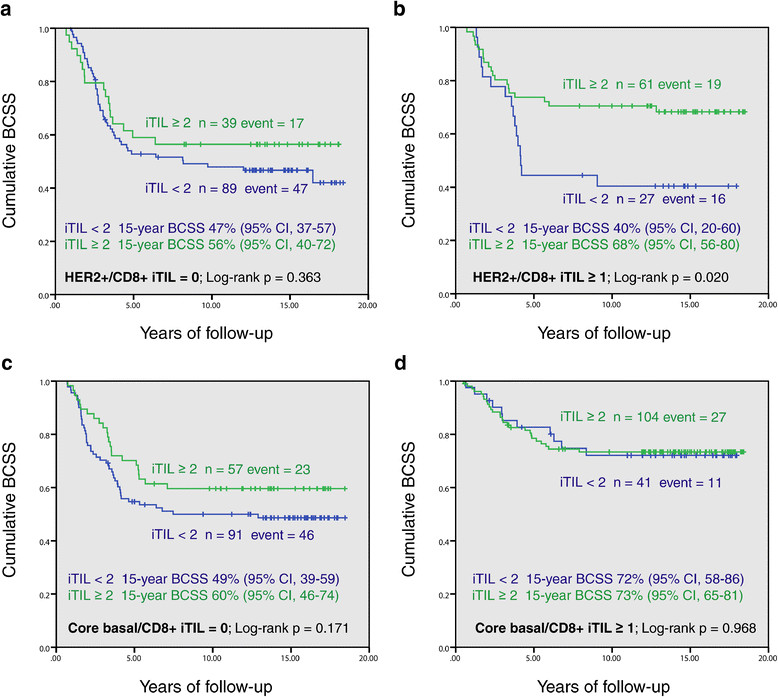
INTRODUCTION: The infiltration of FOXP3+ regulatory T cells into invasive tumors has been reported to be associated with survival in a variety of cancers. The prognostic significance of FOXP3+ tumor-infiltrating lymphocytes (TILs) in breast cancer, however, remains controversial. METHODS: FOXP3+ TILs were assessed by immunohistochemistry on tissue microarrays constructed from a well-defined cohort of 3,992 breast cancer patients linked to detailed demographic, biomarker, treatment and outcome data. Survival analyses were performed using the Kaplan-Meier function and Cox proportional hazards regression models to evaluate the association of FOXP3+ TILs with breast cancer-specific survival, stratified by intrinsic subtype and cytotoxic T-cell infiltration status (as defined by CD8 immunohistochemistry). RESULTS: The presence of high numbers of FOXP3+ TILs was significantly associated with young age, high grade, estrogen receptor (ER) negativity, concurrent CD8+ cytotoxic T-cell infiltration, and human epidermal growth factor receptor-2 positive (HER2+)/ER- and core basal subtypes. On multivariate survival analysis, a high level of FOXP3+ TILs was significantly associated with poor survival in ER+ breast cancers that lacked CD8+ T-cell infiltrates (hazard ratio (HR) = 1.30, 95% confidence interval (CI) = 1.02 to 1.66). However, in ER- breast cancers, FOXP3+ TILs were strongly associated with improved survival in the HER2+/ER- subgroup, particularly in those with co-existent CD8+ T-cell infiltrates (HR = 0.48, 95% CI = 0.23 to 0.98), for which the presence of high levels of FOXP3+ TILs was independent of standard clinical prognostic factors. CONCLUSIONS: FOXP3+ regulatory TILs are a poor prognostic indicator in ER+ breast cancer, but a favorable prognostic factor in the HER2+/ER- subtype. The prognostic value of FOXP3+ TILs in breast cancer differs depending on ER and HER2 expression status and CD8+ T-cell infiltration.
Overview
The claims and statistics of this paper haven’t been checked yet.
Free: it reads the open-access text and checks the first 5 claims that cite a source we can check. Create a free account to check every claim.
Integrity signals
Registry
Cites
Statistics
Figures
Verification
Claims the paper makes
The claims and statistics of this paper haven’t been checked yet.
Free: it reads the open-access text and checks the first 5 claims that cite a source we can check. Create a free account to check every claim.
Claims other papers make about this one
Each is checked against this paper’s own text: does it say what the citing paper says it does?
The source backs part of the claim, not all of it — or backs it for a different population, condition or comparison.
In the citing paper
“For instance, a substantial immunohistochemical study found that high-density Tregs had a better prognosis in the HER2+/ER− category of breast cancers, but only if accompanied by a high infiltration of CD8+ T cells [72].”
From Potential anti-tumor effects of regulatory T cells in the tumor microenvironment: a review (2024) · cites this paper as [72]
Experimental — accuracy not yet measured
Self-check
Percentages, sums and reported differences re-computed from the paper’s own numbers.
The self-check needs the paper’s full text.
Citations
Cites
The blockade of immune checkpoints in cancer immunotherapy
Pardoll, D. M. (2012) · Nature Reviews Cancer · doi:10.1038/nrc3239 · Cited by 13,838 · cited 1×
“This tumor-induced increase in FOXP3+ Tregs represents a potential barrier to attempts at cancer immunotherapy [4,5].”
Wolff, A. C., Hammond, M. E. H., Schwartz, J. N., Hagerty, K. L., Allred, D. C., Cote, R. J., Dowsett, M., Fitzgibbons, P. L., Hanna, W. M., Langer, A., et al. (2007) · Journal of Clinical Oncology · doi:10.1200/jco.2006.09.2775 · Cited by 4,434
Sakaguchi, S. (2005) · Nature Immunology · doi:10.1038/ni1178 · Cited by 2,669 · cited 1×
“This transcription factor plays an important role in the development and function of immune regulatory T cells (Tregs), and can be used as a specific biomarker for the identification of Tregs within an inflammatory infiltrate [2].”
Nielsen, T. O., Hsu, F. D., Jensen, K., Cheang, M., Karaca, G., Hu, Z., Hernandez-Boussard, T., Livasy, C., Cowan, D., Dressler, L., et al. (2004) · Clinical Cancer Research · doi:10.1158/1078-0432.ccr-04-0220 · Cited by 2,663
Self-citationKi67 Index, HER2 Status, and Prognosis of Patients With Luminal B Breast Cancer
Cheang, M. C. U., Chia, S. K., Voduc, D., Gao, D., Leung, S., Snider, J., Watson, M., Davies, S., Bernard, P. S., Parker, J. S., et al. (2009) · JNCI: Journal of the National Cancer Institute · doi:10.1093/jnci/djp082 · Cited by 2,249
Self-citationEffector Memory T Cells, Early Metastasis, and Survival in Colorectal Cancer
Pagès, F., Berger, A., Camus, M., Sanchez-Cabo, F., Costes, A., Molidor, R., Mlecnik, B., Kirilovsky, A., Nilsson, M., Damotte, D., et al. (2005) · New England Journal of Medicine · doi:10.1056/nejmoa051424 · Cited by 2,135 · cited 1×
“Conversely, other studies have found that FOXP3+ TILs correlate with favorable prognosis in colorectal, gastric, ovarian and head and neck carcinomas [11-15].”
Regulatory T cells, tumour immunity and immunotherapy
Zou, W. (2006) · Nature Reviews Immunology · doi:10.1038/nri1806 · Cited by 2,085
Wolff, A. C., Hammond, M. E. H., Hicks, D. G., Dowsett, M., McShane, L. M., Allison, K. H., Allred, D. C., Bartlett, J. M. S., Bilous, M., Fitzgibbons, P., et al. (2014) · Archives of Pathology and Laboratory Medicine · doi:10.5858/arpa.2013-0953-sa · Cited by 1,762
Immunological aspects of cancer chemotherapy
Zitvogel, L., Apetoh, L., Ghiringhelli, F., & Kroemer, G. (2008) · Nature Reviews Immunology · doi:10.1038/nri2216 · Cited by 1,712 · cited 1×
“Studies have reported that pre-existing immune responses may fortify the effect of chemotherapy [45,46].”
Tumor-Infiltrating CD8+Lymphocytes Predict Clinical Outcome in Breast Cancer
Mahmoud, S. M. A., Paish, E. C., Powe, D. G., Macmillan, R. D., Grainge, M. J., Lee, A. H. S., Ellis, I. O., & Green, A. R. (2011) · Journal of Clinical Oncology · doi:10.1200/jco.2010.30.5037 · Cited by 1,367
Cited by
Items 201–262 of 262
IMMUNE CHECKPOINT BLOCKADE IN BREAST CANCER THERAPY
Hromakova, I. А., Сорочан, П. П., Prokhach, N. E., Ponamarov, I. N., Hromakova, I. S., & Polozova, M. V. (2020) · International Medical Journal · doi:10.37436/2308-5274-2020-1-7 · Cited by 1
Tullberg, A. S., Sjöström, M., Niméus, E., Killander, F., Chang, S. L., Feng, F. Y.-C., Speers, C. W., Pierce, L. J., Kovács, A., Lundstedt, D., et al. (2023) · doi:10.1158/1078-0432.c.6605171.v2 · Cited by 1
Shenasa, E. (2025) · cIRcle (University of British Columbia) · doi:10.14288/1.0448576 · Cited by 1
Tumor Infiltrating Lymphocytes as a Prognostic and Predictive Biomarker in Breast Cancer
Janakiram, M., Khan, H., Fineberg, S., Zang, X., & Sparano, J. A. (2016) · Springer eBooks · doi:10.1007/978-3-319-41761-5_12 · Cited by 1
BIOLOGICAL FEATURES OF LYUMINAL В BREAST CANCER
Raybchikov, D. A., Titov, K. S., & Воротников, И. К. (2016) · Malignant tumours · doi:10.18027/2224-5057-2016-4-15-20 · Cited by 1
Alagizy, H. A., Aiad, H. A. S., Abdel-Wahed, M. M., Elshenawy, M. A., Abou-Sheishai, H., & El-Rebey, H. S. (2022) · The Egyptian Journal of Hospital Medicine · doi:10.21608/ejhm.2022.223165 · Cited by 1
Optimizing the treatment strategy of breast cancer
Qiu, S.-Q. (2019) · University of Groningen research database (University of Groningen / Centre for Information Technology)
Chen, Q., Shen, M., Yan, M., Han, X., Mu, S., Li, Y., Li, L., Wang, Y., Li, S., Li, T., et al. (2024) · Figshare · doi:10.6084/m9.figshare.26409925
Role of Tumor Microenvironment in Metastatic Breast Cancer
Kaçaroğlu, D., & Gürbüz, N. (2026) · Springer eBooks · doi:10.1007/978-981-95-3682-5_3
Triple-Negative and Basal-like Carcinoma
Dabbs, D. J. (2017) · Elsevier eBooks · doi:10.1016/b978-0-323-38961-7.00024-1
Shi, J., Geng, C., Li, Z., Ma, P., Zhang, X., & Cheng, M. (2023) · Research Square · doi:10.21203/rs.3.rs-3079798/v1
The impact of immune cells on the risk of breast cancer: a Mendelian randomization study
Zhang, N., Wang, H., Huang, Z., Shen, Z., Zhang, P., & Zhang, G. (2025) · Discover Oncology · doi:10.1007/s12672-025-04068-9
Tullberg, A. S., Sjöström, M., Niméus, E., Killander, F., Chang, S. L., Feng, F. Y.-C., Speers, C. W., Pierce, L. J., Kovács, A., Lundstedt, D., et al. (2023) · doi:10.1158/1078-0432.22725026.v1
Tumor-infiltrating Lymphocytes as Markers of the Antitumor Therapy Efficacy: Myth or Reality?
Kiselevskiy, M. V., Заботина, Т. Н., Артамонова, Е. В., Козлов, Н. А., Самойленко, И. В., Григорьевна, К. З., & Shubina, I. Z. (2022) · Interdisciplinary cancer research · doi:10.1007/16833_2022_59
Fontelles, C. C. (2016) · Digital Library of Theses and Dissertations (Universidade de São Paulo) · doi:10.11606/t.9.2016.tde-28092016-142616
EVALUATION OF T- REGULATORY CELLS IN BREAST CANCER.
Ali, O. S. M., Taweel, M. E., Gawad, I., & Gouda., E. (2017) · International Journal of Advanced Research · doi:10.21474/ijar01/3491
Hagone, S. D., Patil, B., Gupta, A. P., & Gangane, N. (2023) · I P Pavlov Russian Medical Biological Herald · doi:10.17816/pavlovj108478
Prognostic Value of Tumor-Infiltrating Lymphocytes in Triple-Negative Breast Cancer
Koo, S., Loh, K. W. J., Kamis, S., Iqbal, J., Dent, R. A., & Sim, Y. Y. (2015) · Current Breast Cancer Reports · doi:10.1007/s12609-015-0196-x
Ibrahim, B. B., Abulkheir, I. L. H., El-Sheikh, S. A.-E., Abulkasem, F. M., & Ismael, H. A. S. A. (2017) · Egyptian Journal of Pathology · doi:10.1097/01.xej.0000526545.25561.62
Trajković, M., Krasić, D., Stojanović, S., Ignjatović, A., Stojanović, M., & Pešić, P. (2023) · Acta stomatologica Naissi · doi:10.5937/asn2387533t
Chemotherapeutics as Immune Modulators for the Treatment of Triple-Negative Breast Cancer
Fines, C. B., Kelly, S., McCarthy, H. O., & Buckley, N. E. (2026) · Cancers · doi:10.3390/cancers18101537
den Eynden, G. G. G. M. V., Salgado, R., & Willard-Gallo, K. E. (2017) · Springer eBooks · doi:10.1007/978-3-319-39147-2_11
Tawfeik, A. M., Mora, A., Osman, A. A. F., Elsheikh, N., & Elrefaei, M. (2020) · Research Square · doi:10.21203/rs.2.17376/v2
Tawfeik, A. M., Mora, A., Osman, A. G. E.-D., El-Sheikh, N., & Elrefaei, M. (2019) · Research Square · doi:10.21203/rs.2.17376/v1
Immune biomarkers in breast cancer pathology specimens : characterization and clinical implications
Burugu, S. (2019) · cIRcle (University of British Columbia) · doi:10.14288/1.0379406
Sinn, H. (2025) · Cancer immunotherapy · doi:10.1007/13905_2025_50
Characterization of regulatory T cells populations in breast cancers
Fattori, S. (2023) · theses.fr (ABES) · doi:10.70675/1c177425zb8daz422fza46dz677464719c36
Big data analytics and cancer biology: lessons in taking science from the processor to the patient
Borcherding, N. C., Zhan, F., Tanas, M. R., Weigel, R. J., Zhang, W., & Dupuy, A. J. (2020) · doi:10.17077/etd.005280
Inflammatory Cells and Mediators in the Tumor Microenvironment of Breast Cancer
Allaoui, R. (2017) · Lund University Publications (Lund University)
Molecular Features of T Lymphocytes in the Immune Response Against Breast Cancer
Losurdo, A. (2023) · Open Research Online (The Open University) · doi:10.21954/ou.ro.00012511
Vynnychenko, О. І., Moskalenko, Y., & Moskalenko, R. (2024) · The Journal of V N Karazin Kharkiv National University series Medicine · doi:10.26565/2313-6693-2024-51-05
IMMUNOSUPPRESSIVE MECHANISMS IN THE TUMOR MICROENVIRONMENT MEDIATING RESISTANCE TO IMMUNOTHERAPY
Vick, S. C. (2019) · Carolina Digital Repository (University of North Carolina at Chapel Hill) · doi:10.17615/kp4y-f910
Pan, J.-W., Ragu, M. E., Chan, W.-Q., Hasan, S. N., Islam, T., Teoh, L.-Y., Jamaris, S., See, M.-H., Yip, C.-H., Rajadurai, P., et al. (2024) · Figshare · doi:10.6084/m9.figshare.26709932
Pan, J.-W., Ragu, M. E., Chan, W.-Q., Hasan, S. N., Islam, T., Teoh, L.-Y., Jamaris, S., See, M.-H., Yip, C.-H., Rajadurai, P., et al. (2024) · Figshare · doi:10.6084/m9.figshare.26709938
Pan, J.-W., Ragu, M. E., Chan, W.-Q., Hasan, S. N., Islam, T., Teoh, L.-Y., Jamaris, S., See, M.-H., Yip, C.-H., Rajadurai, P., et al. (2024) · Figshare · doi:10.6084/m9.figshare.26709935
Pan, J.-W., Ragu, M. E., Chan, W.-Q., Hasan, S. N., Islam, T., Teoh, L.-Y., Jamaris, S., See, M.-H., Yip, C.-H., Rajadurai, P., et al. (2024) · Figshare · doi:10.6084/m9.figshare.26709929
Wang, L., Sun, P., Xu, F., Zheng, Q., Jiang, K., Hong, R., & Wang, S. (2023) · Cancer Medicine · doi:10.1002/cam4.6896
El microambiente tumoral : Su influencia pronóstica y predictiva en el cáncer de mama HER2- negativo
Arqueros, C. (2021) · Tesis Doctorals en Xarxa (Consorci de Serveis Universitaris de Catalunya)
Immunity in Breast Cancer: Charting T cell evasion and exploring new targets for T cells
Hammerl, D. (2020) · RePub (Erasmus University Rotterdam)
Studying the value of prognostic and predictive biomarkers in breast cancer pathology
Oliveira, A. J. P. R. D. (2018) · Portuguese National Funding Agency for Science, Research and Technology (RCAAP Project by FCT) · doi:10.34626/99hb-3390
Rosa, M. D. O. L. D. (2024) · LA Referencia (Red Federada de Repositorios Institucionales de Publicaciones Científicas)
Breaking barriers: unraveling response mechanisms to immunotherapy in breast cancer
Blomberg, O. S. (2024) · Leiden Repository (Leiden University)
Cañete‐Portillo, S., Cubilla, A. L., Netto, G. J., & Chaux, A. (2025) · International Journal of Surgical Pathology · doi:10.1177/10668969251362475
PROGNOSTIC ROLE OF RESIDUAL TUMOR FEATURES IN HER2-NEGATIVE BREAST CANCER
Sivak, L. A., Lyalkin, S. A., Verovkina, N., & Шипко, А. Ф. (2023) · Experimental Oncology · doi:10.32471/exp-oncology.2312-8852.vol-44-no-3.18377
Safitri, D. A., Ghozali, A., & Kurnianda, J. (2023) · The Indonesia Journal of Cancer Control · doi:10.52830/inajcc.v1i2.47
Zhao, J., Pan, X., Wang, Z., Chen, Y., Liu, D., Shen, Y., Wei, X., Xu, C., Zhang, X., Hu, X., et al. (2024) · Figshare · doi:10.6084/m9.figshare.26341897
Zhao, J., Pan, X., Wang, Z., Chen, Y., Liu, D., Shen, Y., Wei, X., Xu, C., Zhang, X., Hu, X., et al. (2024) · Figshare · doi:10.6084/m9.figshare.26752132
Zhao, J., Pan, X., Wang, Z., Chen, Y., Liu, D., Shen, Y., Wei, X., Xu, C., Zhang, X., Hu, X., et al. (2024) · Figshare · doi:10.6084/m9.figshare.26752135
Zhao, J., Pan, X., Wang, Z., Chen, Y., Liu, D., Shen, Y., Wei, X., Xu, C., Zhang, X., Hu, X., et al. (2024) · Figshare · doi:10.6084/m9.figshare.26341948
Herrero-Vicent, C. (2019) · Repository of Digital Objects for Teaching Research and Culture (University of Valencia)
Verovkina, N., Сивак, Л. А., & Кротевич, М. С. (2017) · Oncology
Kavas, G., & Erdoğan, B. Ç. (2023) · Kocaeli Üniversitesi - AVESİS
Jääskeläinen, M. (2026) · UEF eRepo (University of Eastern Finland)
Metadata
- Authors
- Liu, S., Foulkes, W. D., Leung, S., Gao, D., Lau, S., Kos, Z., & Nielsen, T. O.
- Affiliations
- University of British Columbia (CA)
- McGill University Health Centre (CA)
- Corresponding author
- Nielsen, Torsten O
- Venue
- Breast Cancer Research
- Published
- 2014-09-06
- Volume
- 16
- Issue
- 5
- Pages
- 432-432
- ISSN
- 1465-5411 (ISSN-L)
- 1465-542X
- PMC
- PMC4303113
- OpenAlex
- W2155901347
- Semantic Scholar
- 51fe2bc6bc44659edd05ede56f172cee696d53aa
- Cited by
- 236
- References
- 48
- Citations by year
- 2026: 3 · 2025: 16 · 2024: 24 · 2023: 18 · 2022: 22 · 2021: 20 · 2020: 30 · 2019: 17 · 2018: 16 · 2017: 31 · 2016: 26 · 2015: 11 · 2014: 2
- FWCI
- 7.48
- Type
- journal article
- Language
- en
- Open access
- gold
- doi.org
- Licence
- cc-by
- creativecommons.org/licenses/by/4.0 (tdm)
- creativecommons.org/licenses/by/4.0 (vor)
- Locations
- Breast Cancer Research (publishedVersion, cc-by)
- PubMed Central (publishedVersion, cc-by)
- PubMed (publishedVersion)
- TSpace (University of Toronto) (submittedVersion)
- Funders
- Sanofi
- Susan G. Komen
- Michael Smith Health Research BC
- National Institutes of Health (5u01ca114722-05)
- National Cancer Institute (U01-CA114722)
- Topics
- Life Sciences › Biochemistry, Genetics and Molecular Biology › Cancer Research › Breast Cancer Treatment Studies
- Health Sciences › Medicine › Oncology › Cancer Immunotherapy and Biomarkers
- Life Sciences › Immunology and Microbiology › Immunology › T-cell and B-cell Immunology
- Keywords
- Foxp3+ regulatory T cells, tumor-infiltrating lymphocytes, breast cancer, prognostic factors, estrogen receptor status, HER2-positive breast cancer, CD8+ cytotoxic T lymphocytes, breast cancer-specific survival, breast cancer intrinsic subtypes, basal-like breast cancer, tumor immune microenvironment
- MeSH terms
- Adult, Aged, Aged, 80 and over, Breast Neoplasms, Female, Humans, Middle Aged, Prognosis, Receptors, Estrogen, T-Lymphocytes, Cytotoxic, Multivariate Analysis, Proportional Hazards Models, Lymphocytes, Tumor-Infiltrating, Erb-b2 Receptor Tyrosine Kinases, Receptor, ErbB-2, Forkhead Transcription Factors, Kaplan-Meier Estimate, Young Adult
About these checks
Registry, retraction, Cites and statistics results are computed, not judged, with one exception: a printed reference that no index lists is read once by a model before it counts as a citation error. Claims are extracted by a model and kept only when their quote appears verbatim in the text; each cited source is then checked, with a model’s help, for whether it says what the claim relies on. Those verdicts can be wrong — read the claim’s quote and the cited source before relying on one.
Statistics and arithmetic are recomputed, not judged.
Confidence bands are shown only for fields calibrated on our annotated test set. None is calibrated yet, so no band is shown.
What counts as a claim ›How we measure confidence ›How we check this ›
Are you an author, or do you see a problem with this page? Request a review
Data sources
Bibliographic data: Semantic Scholar, OpenAlex, Crossref.
Contains information from the Semantic Scholar Academic Graph Datasets, made available under the ODC Attribution License (ODC-BY 1.0).
Semantic Scholar’s data is described in: Kinney, R., et al. (2023). The Semantic Scholar Open Data Platform. arXiv:2301.10140.
