

Prognostic significance of FOXP3+ tumor-infiltrating lymphocytes in breast cancer depends on estrogen receptor and human epidermal growth factor receptor-2 expression status and concurrent cytotoxic T-cell infiltration
Open accessThe DOI matches its Crossref record; 48 of the 48 references it cites were found in a registry or an index.
Abstract
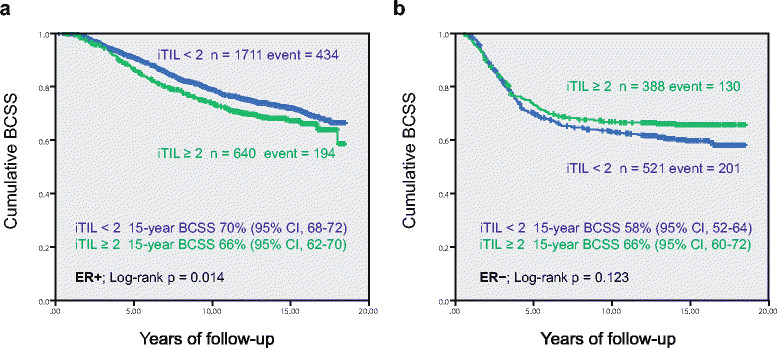
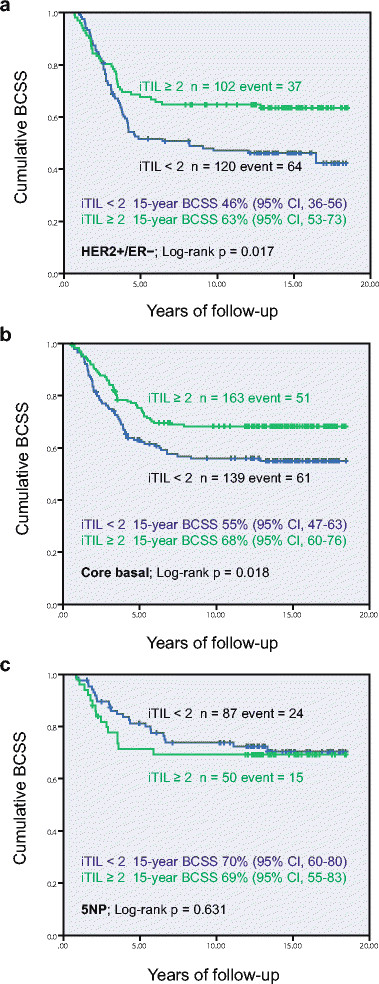
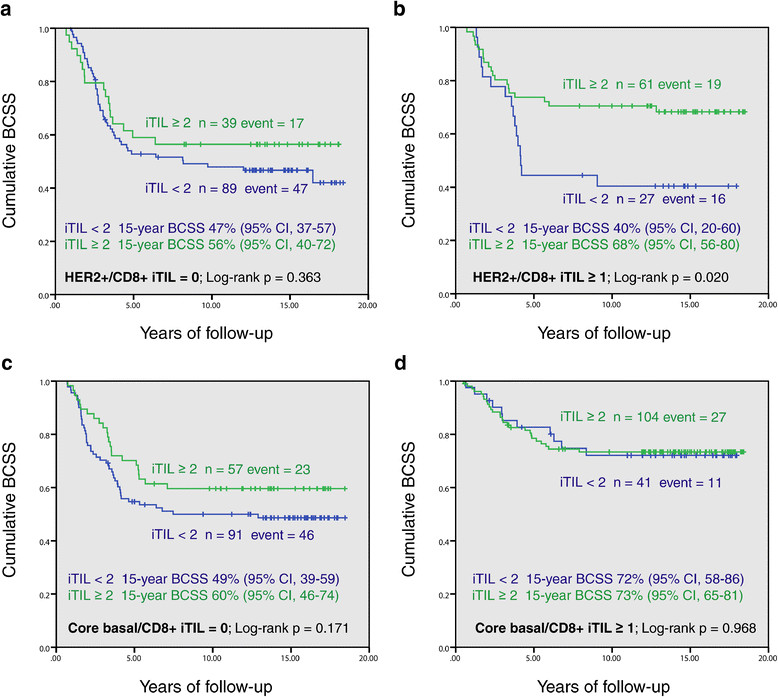
INTRODUCTION: The infiltration of FOXP3+ regulatory T cells into invasive tumors has been reported to be associated with survival in a variety of cancers. The prognostic significance of FOXP3+ tumor-infiltrating lymphocytes (TILs) in breast cancer, however, remains controversial. METHODS: FOXP3+ TILs were assessed by immunohistochemistry on tissue microarrays constructed from a well-defined cohort of 3,992 breast cancer patients linked to detailed demographic, biomarker, treatment and outcome data. Survival analyses were performed using the Kaplan-Meier function and Cox proportional hazards regression models to evaluate the association of FOXP3+ TILs with breast cancer-specific survival, stratified by intrinsic subtype and cytotoxic T-cell infiltration status (as defined by CD8 immunohistochemistry). RESULTS: The presence of high numbers of FOXP3+ TILs was significantly associated with young age, high grade, estrogen receptor (ER) negativity, concurrent CD8+ cytotoxic T-cell infiltration, and human epidermal growth factor receptor-2 positive (HER2+)/ER- and core basal subtypes. On multivariate survival analysis, a high level of FOXP3+ TILs was significantly associated with poor survival in ER+ breast cancers that lacked CD8+ T-cell infiltrates (hazard ratio (HR) = 1.30, 95% confidence interval (CI) = 1.02 to 1.66). However, in ER- breast cancers, FOXP3+ TILs were strongly associated with improved survival in the HER2+/ER- subgroup, particularly in those with co-existent CD8+ T-cell infiltrates (HR = 0.48, 95% CI = 0.23 to 0.98), for which the presence of high levels of FOXP3+ TILs was independent of standard clinical prognostic factors. CONCLUSIONS: FOXP3+ regulatory TILs are a poor prognostic indicator in ER+ breast cancer, but a favorable prognostic factor in the HER2+/ER- subtype. The prognostic value of FOXP3+ TILs in breast cancer differs depending on ER and HER2 expression status and CD8+ T-cell infiltration.
Overview
The claims and statistics of this paper haven’t been checked yet.
Free: it reads the open-access text and checks the first 5 claims that cite a source we can check. Create a free account to check every claim.
Integrity signals
Registry
Cites
Statistics
Figures
Verification
Claims the paper makes
The claims and statistics of this paper haven’t been checked yet.
Free: it reads the open-access text and checks the first 5 claims that cite a source we can check. Create a free account to check every claim.
Claims other papers make about this one
Each is checked against this paper’s own text: does it say what the citing paper says it does?
The source backs part of the claim, not all of it — or backs it for a different population, condition or comparison.
In the citing paper
“For instance, a substantial immunohistochemical study found that high-density Tregs had a better prognosis in the HER2+/ER− category of breast cancers, but only if accompanied by a high infiltration of CD8+ T cells [72].”
From Potential anti-tumor effects of regulatory T cells in the tumor microenvironment: a review (2024) · cites this paper as [72]
Experimental — accuracy not yet measured
Self-check
Percentages, sums and reported differences re-computed from the paper’s own numbers.
The self-check needs the paper’s full text.
Citations
Cites
The blockade of immune checkpoints in cancer immunotherapy
Pardoll, D. M. (2012) · Nature Reviews Cancer · doi:10.1038/nrc3239 · Cited by 13,838 · cited 1×
“This tumor-induced increase in FOXP3+ Tregs represents a potential barrier to attempts at cancer immunotherapy [4,5].”
Wolff, A. C., Hammond, M. E. H., Schwartz, J. N., Hagerty, K. L., Allred, D. C., Cote, R. J., Dowsett, M., Fitzgibbons, P. L., Hanna, W. M., Langer, A., et al. (2007) · Journal of Clinical Oncology · doi:10.1200/jco.2006.09.2775 · Cited by 4,434
Sakaguchi, S. (2005) · Nature Immunology · doi:10.1038/ni1178 · Cited by 2,669 · cited 1×
“This transcription factor plays an important role in the development and function of immune regulatory T cells (Tregs), and can be used as a specific biomarker for the identification of Tregs within an inflammatory infiltrate [2].”
Nielsen, T. O., Hsu, F. D., Jensen, K., Cheang, M., Karaca, G., Hu, Z., Hernandez-Boussard, T., Livasy, C., Cowan, D., Dressler, L., et al. (2004) · Clinical Cancer Research · doi:10.1158/1078-0432.ccr-04-0220 · Cited by 2,663
Self-citationKi67 Index, HER2 Status, and Prognosis of Patients With Luminal B Breast Cancer
Cheang, M. C. U., Chia, S. K., Voduc, D., Gao, D., Leung, S., Snider, J., Watson, M., Davies, S., Bernard, P. S., Parker, J. S., et al. (2009) · JNCI: Journal of the National Cancer Institute · doi:10.1093/jnci/djp082 · Cited by 2,249
Self-citationEffector Memory T Cells, Early Metastasis, and Survival in Colorectal Cancer
Pagès, F., Berger, A., Camus, M., Sanchez-Cabo, F., Costes, A., Molidor, R., Mlecnik, B., Kirilovsky, A., Nilsson, M., Damotte, D., et al. (2005) · New England Journal of Medicine · doi:10.1056/nejmoa051424 · Cited by 2,135 · cited 1×
“Conversely, other studies have found that FOXP3+ TILs correlate with favorable prognosis in colorectal, gastric, ovarian and head and neck carcinomas [11-15].”
Regulatory T cells, tumour immunity and immunotherapy
Zou, W. (2006) · Nature Reviews Immunology · doi:10.1038/nri1806 · Cited by 2,085
Wolff, A. C., Hammond, M. E. H., Hicks, D. G., Dowsett, M., McShane, L. M., Allison, K. H., Allred, D. C., Bartlett, J. M. S., Bilous, M., Fitzgibbons, P., et al. (2014) · Archives of Pathology and Laboratory Medicine · doi:10.5858/arpa.2013-0953-sa · Cited by 1,762
Immunological aspects of cancer chemotherapy
Zitvogel, L., Apetoh, L., Ghiringhelli, F., & Kroemer, G. (2008) · Nature Reviews Immunology · doi:10.1038/nri2216 · Cited by 1,712 · cited 1×
“Studies have reported that pre-existing immune responses may fortify the effect of chemotherapy [45,46].”
Tumor-Infiltrating CD8+Lymphocytes Predict Clinical Outcome in Breast Cancer
Mahmoud, S. M. A., Paish, E. C., Powe, D. G., Macmillan, R. D., Grainge, M. J., Lee, A. H. S., Ellis, I. O., & Green, A. R. (2011) · Journal of Clinical Oncology · doi:10.1200/jco.2010.30.5037 · Cited by 1,367
Bates, G. J., Fox, S. B., Han, C., Leek, R. D., Garcia, J. F., Harris, A. L., & Banham, A. H. (2006) · Journal of Clinical Oncology · doi:10.1200/jco.2006.05.9584 · Cited by 1,200
Cheang, M. C. U., Voduc, D., Bajdik, C., Leung, S., McKinney, S., Chia, S. K., Perou, C. M., & Nielsen, T. O. (2008) · Clinical Cancer Research · doi:10.1158/1078-0432.ccr-07-1658 · Cited by 1,195
Self-citationGao, Q., Qiu, S.-J., Fan, J., Zhou, J., Wang, X.-Y., Xiao, Y.-S., Xu, Y., Li, Y.-W., & Tang, Z.-Y. (2007) · Journal of Clinical Oncology · doi:10.1200/jco.2006.09.4565 · Cited by 1,110
Use of Archived Specimens in Evaluation of Prognostic and Predictive Biomarkers
Simon, R. M., Paik, S., & Hayes, D. F. (2009) · JNCI Journal of the National Cancer Institute · doi:10.1093/jnci/djp335 · Cited by 1,037
Biological Processes Associated with Breast Cancer Clinical Outcome Depend on the Molecular Subtypes
Desmedt, C., Haibe-Kains, B., Wirapati, P., Buyse, M., Larsimont, D., Bontempi, G., Delorenzi, M., Piccart, M., & Sotiriou, C. (2008) · Clinical Cancer Research · doi:10.1158/1078-0432.ccr-07-4756 · Cited by 828
Gobert, M., Treilleux, I., Bendriss-Vermare, N., Bachelot, T., Goddard-Leon, S., Arfi, V., Biota, C., Doffin, A. C., Durand, I., Olive, D., et al. (2009) · Cancer Research · doi:10.1158/0008-5472.can-08-2360 · Cited by 758 · cited 2×
“Most of the studies reporting that FOXP3+ TILs are an indicator of poor prognosis in breast cancer applied unstratified survival analyses [17,19] and might be expected to largely reflect the majority ER + population, possibly confounded by an opposite association in ER– cases.”
Prognostic Value of Tumor-Infiltrating CD4+ T-Cell Subpopulations in Head and Neck Cancers
Badoual, C., Hans, S., Rodriguez, J., Peyrard, S., Klein, C., Agueznay, N. E. H., Mosseri, V., Laccourreye, O., Bruneval, P., Fridman, W. H., et al. (2006) · Clinical Cancer Research · doi:10.1158/1078-0432.ccr-05-1886 · Cited by 598
Analysis of FOXP3 protein expression in human CD4+CD25+ regulatory T cells at the single-cell level
Roncador, G., Brown, P. J., Maestre, L., Hue, S., Martínez-Torrecuadrada, J. L., Ling, K.-L., Pratap, S., Toms, C., Fox, B. C., Cerundolo, V., et al. (2005) · European Journal of Immunology · doi:10.1002/eji.200526189 · Cited by 592
Teschendorff, A. E., Miremadi, A., Pinder, S. E., Ellis, I. O., & Caldas, C. (2007) · Genome Biology · doi:10.1186/gb-2007-8-8-r157 · Cited by 497
Mempel, T. R., Pittet, M. J., Khazaie, K., Weninger, W., Weissleder, R., von Boehmer, H., & von Andrian, U. H. (2006) · Immunity · doi:10.1016/j.immuni.2006.04.015 · Cited by 488
Joensuu, H., Bono, P., Kataja, V., Alanko, T., Kokko, R., Asola, R., Utriainen, T., Turpeenniemi-Hujanen, T., Jyrkkiö, S., Möykkynen, K., et al. (2009) · Journal of Clinical Oncology · doi:10.1200/jco.2008.21.4577 · Cited by 458
deLeeuw, R. J., Kost, S. E., Kakal, J. A., & Nelson, B. H. (2012) · Clinical Cancer Research · doi:10.1158/1078-0432.ccr-11-3216 · Cited by 437
Liu, S., Lachapelle, J., Leung, S., Gao, D., Foulkes, W. D., & Nielsen, T. O. (2012) · Breast Cancer Research · doi:10.1186/bcr3148 · Cited by 436
Self-citationPetersen, R. P., Campa, M. J., Sperlazza, J., Conlon, D., Joshi, M., Harpole, D. H., & Patz, E. F. (2006) · Cancer · doi:10.1002/cncr.22282 · Cited by 433
Frey, D. M., Droeser, R. A., Viehl, C. T., Zlobec, I., Lugli, A., Zingg, U., Oertli, D., Kettelhack, C., Terracciano, L., & Tornillo, L. (2010) · International Journal of Cancer · doi:10.1002/ijc.24989 · Cited by 333
Liu, F., Lang, R., Zhao, J., Zhang, X., Pringle, G. A., Fan, Y., Yin, D., Gu, F., Yao, Z., & Fu, L. (2011) · Breast Cancer Research and Treatment · doi:10.1007/s10549-011-1647-3 · Cited by 301
Chia, S., Norris, B., Speers, C., Cheang, M., Gilks, B., Gown, A. M., Huntsman, D., Olivotto, I. A., Nielsen, T. O., & Gelmon, K. (2008) · Journal of Clinical Oncology · doi:10.1200/jco.2007.15.8659 · Cited by 301
Self-citationWest, N. R., Kost, S. E., Martin, S. D., Milne, K., deLeeuw, R. J., Nelson, B. H., & Watson, P. H. (2013) · British Journal of Cancer · doi:10.1038/bjc.2012.524 · Cited by 268 · cited 2×
“A recent study, using a cohort of 175 estrogen receptor (ER)-negative breast cancers found that FOXP3+ TILs were positively correlated with the concurrent presence of CD8+ TILs, and were an independent good prognostic factor in ERnegative breast cancer [24].”
In situ immune response after neoadjuvant chemotherapy for breast cancer predicts survival
Ladoire, S., Mignot, G., Dabakuyo, S., Arnould, L., Apetoh, L., Rébé, C., Coudert, B., Martin, F., Bizollon, M. H., Vanoli, A., et al. (2011) · The Journal of Pathology · doi:10.1002/path.2866 · Cited by 226
Zlobec, I., Steele, R., Terracciano, L., Jass, J. R., & Lugli, A. (2007) · Journal of Clinical Pathology · doi:10.1136/jcp.2006.044537 · Cited by 225
Apetoh, L., Tesniere, A., Ghiringhelli, F., Kroemer, G., & Zitvogel, L. (2008) · Cancer Research · doi:10.1158/0008-5472.can-08-0427 · Cited by 218
Cheang, M. C. U., Treaba, D. O., Speers, C. H., Olivotto, I. A., Bajdik, C. D., Chia, S. K., Goldstein, L. C., Gelmon, K. A., Huntsman, D., Gilks, C. B., et al. (2006) · Journal of Clinical Oncology · doi:10.1200/jco.2005.05.4155 · Cited by 206
Self-citationAn evaluation of the clinical significance of FOXP3+ infiltrating cells in human breast cancer
Mahmoud, S. M. A., Paish, E. C., Powe, D. G., Macmillan, R. D., Lee, A. H. S., Ellis, I. O., & Green, A. R. (2011) · Breast Cancer Research and Treatment · doi:10.1007/s10549-010-0987-8 · Cited by 180
Yan, M., Jene, N., Byrne, D., Millar, E. K., O'Toole, S. A., McNeil, C. M., Bates, G. J., Harris, A. L., Banham, A. H., Sutherland, R. L., et al. (2011) · Breast Cancer Research · doi:10.1186/bcr2869 · Cited by 180
Haas, M., Dimmler, A., Hohenberger, W., Grabenbauer, G. G., Niedobitek, G., & Distel, L. V. (2009) · BMC Gastroenterology · doi:10.1186/1471-230x-9-65 · Cited by 154
Tumor-infiltrating lymphocytes, breast cancer subtypes and therapeutic efficacy
Loi, S. (2013) · OncoImmunology · doi:10.4161/onci.24720 · Cited by 152
Liu, S., Chia, S., Mehl, E., Leung, S. C. Y., Rajput, A. B., Cheang, M. C. U., & Nielsen, T. O. (2009) · Breast Cancer Research and Treatment · doi:10.1007/s10549-009-0318-0 · Cited by 141
Self-citationCalabrò, A., Beißbarth, T., Kuner, R., Stojanov, M., Benner, A., Asslaber, M., Ploner, F., Zatloukal, K., Samonigg, H., Poustka, A., et al. (2008) · Breast Cancer Research and Treatment · doi:10.1007/s10549-008-0105-3 · Cited by 137
High tissue density of FOXP3+ T cells is associated with clinical outcome in prostate cancer
Flammiger, A., Weisbach, L., Huland, H., Tennstedt, P., Simon, R., Minner, S. J. P., Bokemeyer, C., Sauter, G., Schlomm, T., & Trepel, M. (2012) · European Journal of Cancer · doi:10.1016/j.ejca.2012.11.035 · Cited by 135
Relationship Between Tumor Location and Relapse in 6,781 Women With Early Invasive Breast Cancer
Lohrisch, C. A., Jackson, J. S. H., Jones, A., Mates, D., & Olivotto, I. A. (2000) · Journal of Clinical Oncology · doi:10.1200/jco.2000.18.15.2828 · Cited by 129
Baker, K., Lachapelle, J., Zlobec, I., Bismar, T. A., Terracciano, L., & Foulkes, W. D. (2011) · Histopathology · doi:10.1111/j.1365-2559.2011.03846.x · Cited by 121
Self-citationde Kruijf, E. M., van Nes, J. G. H., Sajet, A., Tummers, Q. R. J. G., Putter, H., Osanto, S., Speetjens, F. M., Smit, V. T. H. B. M., Liefers, G. J., van de Velde, C. J. H., et al. (2010) · Clinical Cancer Research · doi:10.1158/1078-0432.ccr-09-1844 · Cited by 112
Teschendorff, A. E., & Caldas, C. (2008) · Breast Cancer Research · doi:10.1186/bcr2138 · Cited by 101
Prognostic impact of FOXP3 expression in triple-negative breast cancer
Lee, S. H., Cho, E. Y., Park, Y. H., Ahn, J. S., & Im, Y. (2012) · Acta Oncologica · doi:10.3109/0284186x.2012.731520 · Cited by 100
Li, J. F., Chu, Y. W., Wang, G. M., Zhu, T. Y., Rong, R. M., Hou, J., & Xu, M. (2009) · BJU International · doi:10.1111/j.1464-410x.2008.08151.x · Cited by 96
Intraepithelial T cells and tumor-associated macrophages in ovarian cancer patients.
Mhawech-Fauceglia, P. Y., Wang, D., Ali, L., Lele, S., Huba, M. A., Liu, S., & Odunsi, K. O. (2013) · Europe PMC (PubMed Central) · Cited by 73
Self-citationThe role of FOXP3 in the development and metastatic spread of breast cancer
Douglass, S. M., Ali, S., Meeson, A. P., Browell, D., & Kirby, J. A. (2012) · Cancer and Metastasis Reviews · doi:10.1007/s10555-012-9395-3 · Cited by 53
Aruga (2009) · Oncology Reports · doi:10.3892/or_00000434 · Cited by 44
Cited by
Salgado, R., Denkert, C., Demaria, S., Sirtaine, N., Klauschen, F., Pruneri, G., Wienert, S., Van den Eynden, G., Baehner, F. L., Penault-Llorca, F., et al. (2015) · Annals of Oncology · doi:10.1093/annonc/mdu450 · Cited by 3,113
Self-citationHendry, S., Salgado, R., Gevaert, T., Russell, P. A., John, T., Thapa, B., Christie, M., van de Vijver, K., Estrada, M. V., Gonzalez-Ericsson, P. I., et al. (2017) · Advances in Anatomic Pathology · doi:10.1097/pap.0000000000000161 · Cited by 799
Self-citationHendry, S., Salgado, R., Gevaert, T., Russell, P. A., John, T., Thapa, B., Christie, M., van de Vijver, K., Estrada, M. V., Gonzalez-Ericsson, P. I., et al. (2017) · Advances in Anatomic Pathology · doi:10.1097/pap.0000000000000162 · Cited by 709
Self-citationRegulatory T Cells Exhibit Distinct Features in Human Breast Cancer
Plitas, G., Konopacki, C., Wu, K., Bos, P. D., Morrow, M., Putintseva, E. V., Chudakov, D. M., & Rudensky, A. Y. (2016) · Immunity · doi:10.1016/j.immuni.2016.10.032 · Cited by 695
“Treg cells variably infiltrate human breast cancers and their frequency in the tumor microenvironment has clinical significance (Demir et al., 2013; Kim et al., 2014; Liu et al., 2011; Liu et al., 2014).”
Stanton, S. E., Adams, S., & Disis, M. L. (2016) · JAMA Oncology · doi:10.1001/jamaoncol.2016.1061 · Cited by 631
Metadata
- Authors
- Liu, S., Foulkes, W. D., Leung, S., Gao, D., Lau, S., Kos, Z., & Nielsen, T. O.
- Affiliations
- University of British Columbia (CA)
- McGill University Health Centre (CA)
- Corresponding author
- Nielsen, Torsten O
- Venue
- Breast Cancer Research
- Published
- 2014-09-06
- Volume
- 16
- Issue
- 5
- Pages
- 432-432
- ISSN
- 1465-5411 (ISSN-L)
- 1465-542X
- PMC
- PMC4303113
- OpenAlex
- W2155901347
- Cited by
- 236
- References
- 48
- Citations by year
- 2026: 3 · 2025: 16 · 2024: 24 · 2023: 18 · 2022: 22 · 2021: 20 · 2020: 30 · 2019: 17 · 2018: 16 · 2017: 31 · 2016: 26 · 2015: 11 · 2014: 2
- FWCI
- 7.48
- Type
- journal article
- Language
- en
- Open access
- gold
- doi.org
- Licence
- cc-by
- creativecommons.org/licenses/by/4.0 (tdm)
- creativecommons.org/licenses/by/4.0 (vor)
- Locations
- Breast Cancer Research (publishedVersion, cc-by)
- PubMed Central (publishedVersion, cc-by)
- PubMed (publishedVersion)
- TSpace (University of Toronto) (submittedVersion)
- Funders
- Sanofi
- Susan G. Komen
- Michael Smith Health Research BC
- National Institutes of Health (5u01ca114722-05)
- National Cancer Institute (U01-CA114722)
- Topics
- Life Sciences › Biochemistry, Genetics and Molecular Biology › Cancer Research › Breast Cancer Treatment Studies
- Health Sciences › Medicine › Oncology › Cancer Immunotherapy and Biomarkers
- Life Sciences › Immunology and Microbiology › Immunology › T-cell and B-cell Immunology
- Keywords
- Foxp3+ regulatory T cells, tumor-infiltrating lymphocytes, breast cancer, prognostic factors, estrogen receptor status, HER2-positive breast cancer, CD8+ cytotoxic T lymphocytes, breast cancer-specific survival, breast cancer intrinsic subtypes, basal-like breast cancer, tumor immune microenvironment
- MeSH terms
- Adult, Aged, Aged, 80 and over, Breast Neoplasms, Female, Humans, Middle Aged, Prognosis, Receptors, Estrogen, T-Lymphocytes, Cytotoxic, Multivariate Analysis, Proportional Hazards Models, Lymphocytes, Tumor-Infiltrating, Erb-b2 Receptor Tyrosine Kinases, Receptor, ErbB-2, Forkhead Transcription Factors, Kaplan-Meier Estimate, Young Adult
About these checks
Registry, retraction, Cites and statistics results are computed, not judged, with one exception: a printed reference that no index lists is read once by a model before it counts as a citation error. Claims are extracted by a model and kept only when their quote appears verbatim in the text; each cited source is then checked, with a model’s help, for whether it says what the claim relies on. Those verdicts can be wrong — read the claim’s quote and the cited source before relying on one.
Statistics and arithmetic are recomputed, not judged.
Confidence bands are shown only for fields calibrated on our annotated test set. None is calibrated yet, so no band is shown.
What counts as a claim ›How we measure confidence ›How we check this ›
Are you an author, or do you see a problem with this page? Request a review
Data sources
Bibliographic data: Semantic Scholar, OpenAlex, Crossref.
Contains information from the Semantic Scholar Academic Graph Datasets, made available under the ODC Attribution License (ODC-BY 1.0).
Semantic Scholar’s data is described in: Kinney, R., et al. (2023). The Semantic Scholar Open Data Platform. arXiv:2301.10140.
