

Methylation-dependent SOX9 expression mediates invasion in human melanoma cells and is a negative prognostic factor in advanced melanoma
Open accessThe DOI matches its Crossref record; 57 of the 57 references it cites were found in a registry or an index.
Abstract
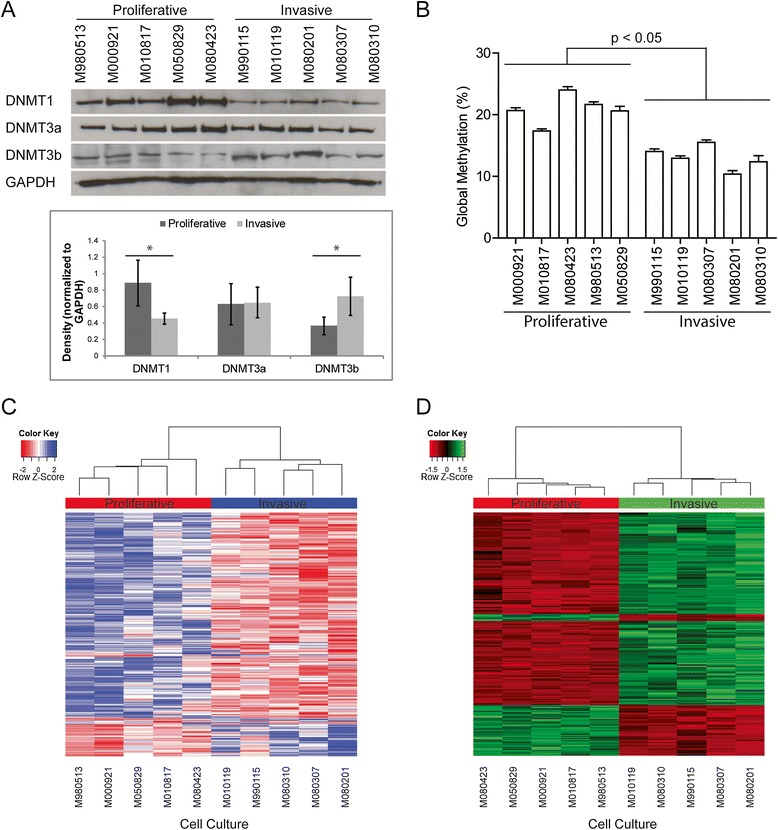
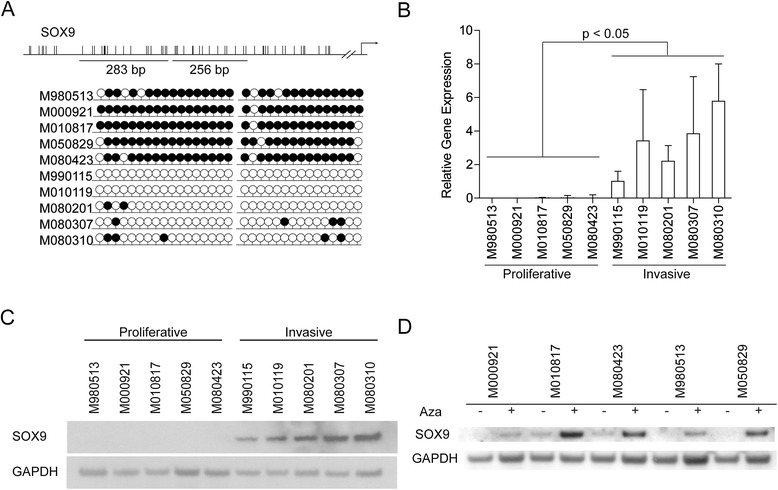
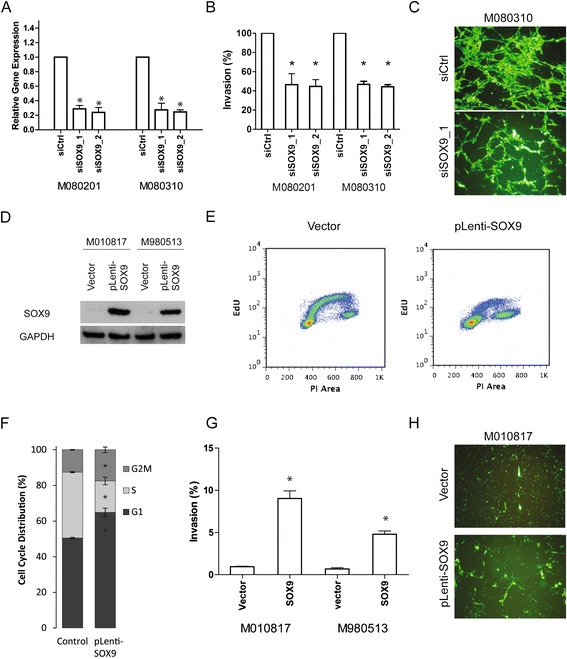
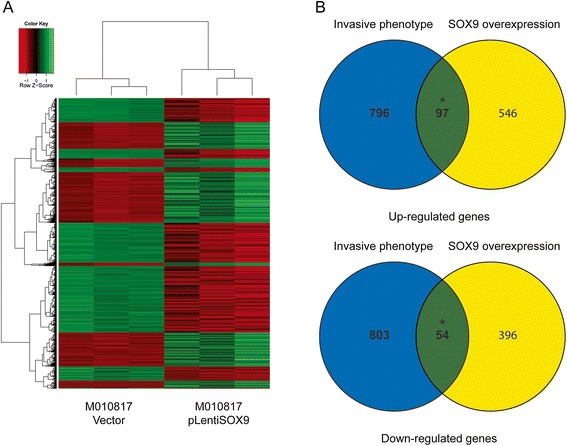
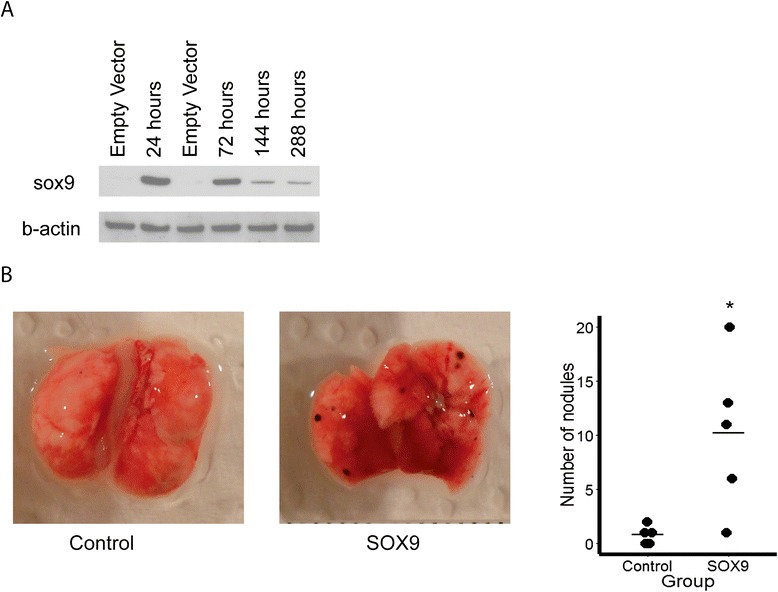
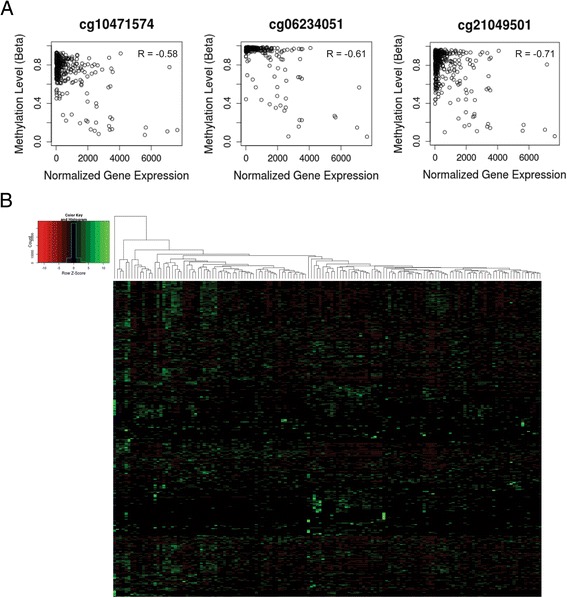
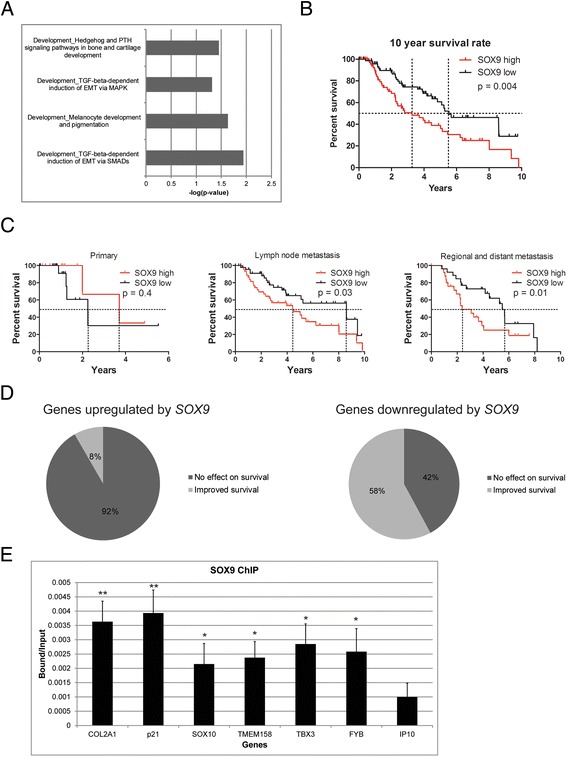
Background: Melanoma is the most fatal skin cancer displaying a high degree of molecular heterogeneity. Phenotype switching is a mechanism that contributes to melanoma heterogeneity by altering transcription profiles for the transition between states of proliferation/differentiation and invasion/stemness. As phenotype switching is reversible, epigenetic mechanisms, like DNA methylation, could contribute to the changes in gene expression. Results: Integrative analysis of methylation and gene expression datasets of five proliferative and five invasion melanoma cell cultures reveal two distinct clusters. SOX9 is methylated and lowly expressed in the highly proliferative group. SOX9 overexpression results in decreased proliferation but increased invasion in vitro. In a B16 mouse model, sox9 overexpression increases the number of lung metastases. Transcriptional analysis of SOX9-overexpressing melanoma cells reveals enrichment in epithelial to mesenchymal transition (EMT) pathways. Survival analysis of The Cancer Genome Atlas melanoma dataset shows that metastatic patients with high expression levels of SOX9 have significantly worse survival rates. Additional survival analysis on the targets of SOX9 reveals that most SOX9 downregulated genes have survival benefit for metastatic patients. Conclusions: Our genome-wide DNA methylation and gene expression study of 10 early passage melanoma cell cultures reveals two phenotypically distinct groups. One of the genes regulated by DNA methylation between the two groups is SOX9. SOX9 induces melanoma cell invasion and metastasis and decreases patient survival. A number of genes downregulated by SOX9 have a negative impact on patient survival. In conclusion, SOX9 is an important gene involved in melanoma invasion and negatively impacts melanoma patient survival.
Overview
The claims and statistics of this paper haven’t been checked yet.
Free: it reads the open-access text and checks the first 5 claims that cite a source we can check. Create a free account to check every claim.
Integrity signals
Registry
Cites
Statistics
Figures
Verification
Claims the paper makes
The claims and statistics of this paper haven’t been checked yet.
Free: it reads the open-access text and checks the first 5 claims that cite a source we can check. Create a free account to check every claim.
Claims other papers make about this one
Each is checked against this paper’s own text: does it say what the citing paper says it does?
The source backs part of the claim, not all of it — or backs it for a different population, condition or comparison.
In the citing paper
“This is reminiscent of melanoma cells displaying reduced SOX10 levels, which is associated with increased expression of SOX9, another factor involved in NC development, and increased invasiveness48,71.”
From Epigenetic control of melanoma cell invasiveness by the stem cell factor SALL4 (2021) · cites this paper as [71]
Experimental — accuracy not yet measured
Self-check
Percentages, sums and reported differences re-computed from the paper’s own numbers.
The self-check needs the paper’s full text.
Citations
Cites
Smyth, G. K. (2004) · Statistical Applications in Genetics and Molecular Biology · doi:10.2202/1544-6115.1027 · Cited by 11,829
limma: Linear Models for Microarray Data
Smyth, G. K. (2005) · Statistics for Biology and Health · doi:10.1007/0-387-29362-0_23 · Cited by 5,796 · cited 2×
“Differential expression was analyzed with voom from the limma package [53].”
MethodAryee, M. J., Jaffe, A. E., Corrada-Bravo, H., Ladd-Acosta, C., Feinberg, A. P., Hansen, K. D., & Irizarry, R. A. (2014) · Bioinformatics · doi:10.1093/bioinformatics/btu049 · Cited by 4,397 · cited 1×
“DNA methylation β-values were calculated by minfi [58].”
MethodA decade of exploring the cancer epigenome—biological and translational implications
Baylin, S. B., & Jones, P. A. (2011) · Nature Reviews Cancer · doi:10.1038/nrc3130 · Cited by 2,871 · cited 1×
“Aberrant DNA methylation is a mechanism known to cause tumorigenesis [20].”
BackgroundWeber, M., Davies, J. J., Wittig, D., Oakeley, E. J., Haase, M., Lam, W. L., & Schübeler, D. (2005) · Nature Genetics · doi:10.1038/ng1598 · Cited by 1,754 · cited 4×
“The MeDIP assay was performed as described [31].”
MethodInfluentialRoesch, A., Fukunaga-Kalabis, M., Schmidt, E. C., Zabierowski, S. E., Brafford, P. A., Vultur, A., Basu, D., Gimotty, P., Vogt, T., & Herlyn, M. (2010) · Cell · doi:10.1016/j.cell.2010.04.020 · Cited by 1,158 · cited 3×
“In an effort to elucidate the molecular mechanisms of melanoma progression, significant differences have been detected between melanoma cells from the same lesion [4,6,9].”
BackgroundIncreased methylation variation in epigenetic domains across cancer types
Hansen, K. D., Timp, W., Bravo, H. C., Sabunciyan, S., Langmead, B., McDonald, O. G., Wen, B., Wu, H., Liu, Y., Diep, D., et al. (2011) · Nature Genetics · doi:10.1038/ng.865 · Cited by 1,045 · cited 1×
“Global hypomethylation has been observed in many cancers, including melanoma, to decrease with progression of the disease [21-23].”
BackgroundMathelier, A., Zhao, X., Zhang, A. W., Parcy, F., Worsley-Hunt, R., Arenillas, D. J., Buchman, S., Chen, C.-Y., Chou, A., Ienasescu, H., et al. (2014) · Nucleic Acids Research · doi:10.1093/nar/gkt997 · Cited by 983 · cited 1×
“Primer sequences were designed around SOX9 binding motifs [55,56] from the transcription start site (TSS) to 3 KB upstream of the TSS.”
BackgroundSOX9 directly regulates the type-ll collagen gene
Bell, D. M., Leung, K. K. H., Wheatley, S. C., Ng, L. J., Zhou, S., Wing Ling, K., Har Sham, M., Koopman, P., Tam, P. P. L., & Cheah, K. S. E. (1997) · Nature Genetics · doi:10.1038/ng0697-174 · Cited by 933 · cited 1×
“The specificity of this assay was demonstrated by the enrichment of three known SOX9 target sequences, COL2A1 intron 1 [36], p21 [29], and SOX10 [37]), as compared to a non-target gene (IP10).”
ResultLoss of 5-hydroxymethylcytosine is an epigenetic hallmark of melanoma
Lian, C. G., Xu, Y., Ceol, C., Wu, F., Larson, A., Dresser, K., Xu, W., Tan, L., Hu, Y., Zhan, Q., et al. (2012) · Cell · doi:10.1016/j.cell.2012.07.033 · Cited by 789 · cited 1×
“Also, a recent study investigating 5-hydroxymethylation (5-hmC) in melanoma found a global decrease of 5-hmC was necessary for melanoma formation [46].”
Background
Cited by
Dependency of a therapy-resistant state of cancer cells on a lipid peroxidase pathway
Viswanathan, V. S., Ryan, M. J., Dhruv, H. D., Gill, S., Eichhoff, O. M., Seashore-Ludlow, B., Kaffenberger, S. D., Eaton, J. K., Shimada, K., Aguirre, A. J., et al. (2017) · Nature · doi:10.1038/nature23007 · Cited by 2,011
Self-citationPhenotype plasticity as enabler of melanoma progression and therapy resistance
Arozarena, I., & Wellbrock, C. (2019) · Nature Reviews Cancer · doi:10.1038/s41568-019-0154-4 · Cited by 381
Epigenetic drivers of tumourigenesis and cancer metastasis
Chatterjee, A., Rodger, E. J., & Eccles, M. R. (2018) · Seminars in Cancer Biology · doi:10.1016/j.semcancer.2017.08.004 · Cited by 328
Riesenberg, S., Groetchen, A., Siddaway, R., Bald, T., Reinhardt, J., Smorra, D., Kohlmeyer, J., Renn, M., Phung, B., Aymans, P., et al. (2015) · Nature Communications · doi:10.1038/ncomms9755 · Cited by 227
Aberrant DNA methylation in melanoma: biomarker and therapeutic opportunities
Micevic, G., Theodosakis, N., & Bosenberg, M. (2017) · Clinical Epigenetics · doi:10.1186/s13148-017-0332-8 · Cited by 165
“SOX9 expression has also been shown to be regulated by DNA methylation in melanoma, where it can regulate invasion, and predict poor survival [51].”
BackgroundA Sox2–Sox9 signalling axis maintains human breast luminal progenitor and breast cancer stem cells
Domenici, G., Aurrekoetxea-Rodríguez, I., Simões, B. M., Rábano, M., Lee, S. Y., Millán, J. S., Comaills, V., Oliemuller, E., López-Ruiz, J. A., Zabalza, I., et al. (2019) · Oncogene · doi:10.1038/s41388-018-0656-7 · Cited by 154
Gokhman, D., Nissim-Rafinia, M., Agranat-Tamir, L., Housman, G., García-Pérez, R., Lizano, E., Cheronet, O., Mallick, S., Nieves-Colón, M. A., Li, H., et al. (2017) · doi:10.1101/106955 · Cited by 144
Lan, T., Yuan, K., Yan, X., Xu, L., Liao, H., Hao, X., Wang, J., Liu, H., Chen, X., Xie, K., et al. (2019) · Cancer Research · doi:10.1158/0008-5472.can-18-4044 · Cited by 136
SOX9: An emerging driving factor from cancer progression to drug resistance
Panda, M., Tripathi, S. K., & Biswal, B. K. (2021) · Biochimica et Biophysica Acta (BBA) - Reviews on Cancer · doi:10.1016/j.bbcan.2021.188517 · Cited by 115
SOX9 in organogenesis: shared and unique transcriptional functions
Ming, Z., Vining, B., Bagheri‐Fam, S., & Harley, V. R. (2022) · Cellular and Molecular Life Sciences · doi:10.1007/s00018-022-04543-4 · Cited by 117
Rossi, A., Roberto, M., Panebianco, M., Botticelli, A., Mazzuca, F., & Marchetti, P. (2019) · European Journal of Pharmacology · doi:10.1016/j.ejphar.2019.172621 · Cited by 99
SOX9/miR-203a axis drives PI3K/AKT signaling to promote esophageal cancer progression
Wang, L., Zhang, Z., Yu, X., Li, Q., Wang, Q., Chang, A., Huang, X., Han, X., Song, Y., Hu, J., et al. (2019) · Cancer Letters · doi:10.1016/j.canlet.2019.10.004 · Cited by 97
Cooperation between melanoma cell states promotes metastasis through heterotypic cluster formation
Campbell, N. R., Rao, A., Hunter, M. V., Sznurkowska, M. K., Briker, L., Zhang, M., Baron, M., Heilmann, S., Deforet, M., Kenny, C., et al. (2021) · Developmental Cell · doi:10.1016/j.devcel.2021.08.018 · Cited by 89
Self-citationGuo, W., Zhu, L., Zhu, R., Chen, Q., Wang, Q., & Chen, J. (2019) · eLife · doi:10.7554/elife.44310 · Cited by 87
“, 2006); methylation-dependent SOX9 expression mediates invasion in human melanoma cells and is a negative prognostic factor in advanced melanoma (Cheng et al., 2015), and MGMT gene promoter methylation in metastatic CM is associated with longer survival (Cesinaro et al.”
BackgroundInflammation-Induced Plasticity in Melanoma Therapy and Metastasis
Hölzel, M., & Tüting, T. (2016) · Trends in Immunology · doi:10.1016/j.it.2016.03.009 · Cited by 85
Chatterjee, A., Stockwell, P. A., Ahn, A., Rodger, E. J., Leichter, A. L., & Eccles, M. R. (2016) · Oncotarget · doi:10.18632/oncotarget.14042 · Cited by 81
“Promoter-specific hypermethylation is associated with tumor suppressor gene silencing in cancer [9], and has been reported previously in several gene-specific melanoma methylation studies [3, 12, 13, 28, 29].”
BackgroundSOX9: The master regulator of cell fate in breast cancer
Jana, S., Krishna, B. M., Singhal, J., Horne, D. A., Awasthi, S., Salgia, R., & Singhal, S. S. (2020) · Biochemical Pharmacology · doi:10.1016/j.bcp.2019.113789 · Cited by 80
Melanoma Plasticity: Promoter of Metastasis and Resistance to Therapy
Huang, F., Santinon, F., González, R. E. F., & Rincon, S. V. D. (2021) · Frontiers in Oncology · doi:10.3389/fonc.2021.756001 · Cited by 76
“SOX9/SOX9 (33) TCF4/TCF4: b-catenin co-factor, inversely correlated with LEF1 (34)”
BackgroundMechanical confinement governs phenotypic plasticity in melanoma
Hunter, M. V., Joshi, E., Bowker, S., Montal, E. D., Ma, Y., Kim, Y. H., Yang, Z., Tuffery, L., Li, Z., Rosiek, E., et al. (2025) · Nature · doi:10.1038/s41586-025-09445-6 · Cited by 71
Richtig, G., Aigelsreiter, A., Schwarzenbacher, D., Ress, A. L., Adiprasito, J. B., Stiegelbauer, V., Höefler, G., Schauer, S., Kiesslich, T., Kornprat, P., et al. (2017) · PLoS ONE · doi:10.1371/journal.pone.0187814 · Cited by 62
Epigenetic silencing of TET2 and TET3 induces an EMT-like process in melanoma
Gong, F., Guo, Y., Niu, Y., Jin, J., Zhang, X., Shi, X., Zhang, L., Li, R., Chen, L., & Ma, R. Z. (2016) · Oncotarget · doi:10.18632/oncotarget.13324 · Cited by 56
“Additionally, the epigenetic silencing of SOX9 (SRY-Box 9) is responsible for the invasiveness of melanoma [7].”
BackgroundKim, B. R., de Laar, E. V., Cabanero, M., Tarumi, S., Hasenöder, S., Wang, D. Y. Q., Virtanen, C., Suzuki, T., Bandarchi, B., Sakashita, S., et al. (2016) · PLoS Biology · doi:10.1371/journal.pbio.1002581 · Cited by 58
Asada, K., Kaneko, S., Takasawa, K., Machino, H., Takahashi, S., Shinkai, N., Shimoyama, R., Komatsu, M., & Hamamoto, R. (2021) · Frontiers in Oncology · doi:10.3389/fonc.2021.666937 · Cited by 57
“On the other hand, epigenetic changes are dynamic in nature and may play an important role in determining the metastatic phenotype, and research in this area is only beginning to be evaluated (107, 108).”
BackgroundErvin, E.-H., French, R., Chang, C., & Pauklin, S. (2022) · Seminars in Cancer Biology · doi:10.1016/j.semcancer.2022.11.001 · Cited by 56
DNA hypermethylation is associated with invasive phenotype of malignant melanoma
Koroknai, V., Szász, I., Hernández‐Vargas, H., Fernández‐Jiménez, N., Cuenin, C., Herceg, Z., Vízkeleti, L., Ádány, R., Ecsedi, S., & Balázs, M. (2019) · Experimental Dermatology · doi:10.1111/exd.14047 · Cited by 55
Epigenetic basis and targeting of cancer metastasis
Banerjee, R., Smith, J., Eccles, M. R., Weeks, R. J., & Chatterjee, A. (2021) · Trends in cancer · doi:10.1016/j.trecan.2021.11.008 · Cited by 54
Role of extracellular matrix architecture and signaling in melanoma therapeutic resistance
Popovic, A., & Tartare‐Deckert, S. (2022) · Frontiers in Oncology · doi:10.3389/fonc.2022.924553 · Cited by 50
Cui, Y., Fang, W., Li, C., Tang, K., Zhang, J., Lei, Y., He, W., Peng, S., Kuang, M., Zhang, H., et al. (2018) · Clinical Cancer Research · doi:10.1158/1078-0432.ccr-18-2545 · Cited by 56
“Among these prognosis-related molecules, b-catenin and SOX9have been reported to be involved in development and stem cell differentiation in many previous studies (32, 33).”
BackgroundSOX9 is a dose-dependent metastatic fate determinant in melanoma
Yang, X., Liang, R., Liu, C., Liu, J. A., Cheung, M. P. L., Liu, X., Man, O. Y., Guan, X.-Y., Lung, H. L., & Cheung, M. C. H. (2019) · Journal of Experimental & Clinical Cancer Research · doi:10.1186/s13046-018-0998-6 · Cited by 51
Genetic and Genomic Pathways of Melanoma Development, Invasion and Metastasis
Motwani, J., & Eccles, M. R. (2021) · Genes · doi:10.3390/genes12101543 · Cited by 52
Identification of hub genes in hepatocellular carcinoma using integrated bioinformatic analysis
Hua, S., Ji, Z., Quan, Y., Zhan, M., Wang, H., Li, W., Li, Y., He, X., & Lu, L. (2020) · Aging · doi:10.18632/aging.102969 · Cited by 43
Raaijmakers, M. I. G., Widmer, D. S., Maudrich, M., Koch, T., Langer, A., Flace, A., Schnyder, C., Dummer, R., & Levesque, M. P. (2015) · Experimental Dermatology · doi:10.1111/exd.12683 · Cited by 45
Self-citationNajem, A., Soumoy, L., Sabbah, M., Krayem, M., Awada, A. H., Journé, F., & Ghanem, G. (2022) · Cells · doi:10.3390/cells11071157 · Cited by 40
“DNA methylation is another epigenetic mechanism that regulates the gene expression and thereby phenotypic plasticity in melanoma [57].”
BackgroundInfluentialEpigenetic control of melanoma cell invasiveness by the stem cell factor SALL4
Diener, J., Baggiolini, A., Pernebrink, M., Dalcher, D., Lerra, L., Cheng, P. F., Varum, S., Häusel, J., Stierli, S., Treier, M., et al. (2021) · Nature Communications · doi:10.1038/s41467-021-25326-8 · Cited by 34
Self-citationThe role of SOX family in cancer stem cell maintenance: With a focus on SOX2
Pouremamali, F., Vahedian, V., Hassani, N., Mirzaei, S., Pouremamali, A., Kazemzadeh, H., Faridvand, Y., Jafari-Gharabaghlou, D., Nouri, M., & Maroufi, N. F. (2022) · Pathology - Research and Practice · doi:10.1016/j.prp.2022.153783 · Cited by 36
Terranova, C. J., Tang, M., Maitituoheti, M., Raman, A. T., Ghosh, A. K., Schulz, J., Amin, S. B., Orouji, E., Tomczak, K. J., Sarkar, S., et al. (2021) · Cell Reports · doi:10.1016/j.celrep.2021.109410 · Cited by 45
Subhadarshini, S., Sahoo, S., Debnath, S., Somarelli, J. A., & Jolly, M. K. (2023) · Journal for ImmunoTherapy of Cancer · doi:10.1136/jitc-2023-006766 · Cited by 35
Carrasco‐García, E., Lopez, L., Moncho-Amor, V., Carazo, F., Aldaz, P., Collado, M., Bell, D. M., Gaafar, A., Karamitopoulou, E., Tzankov, A., et al. (2022) · Cancers · doi:10.3390/cancers14040916 · Cited by 29
Loss of p27Kip1 promotes metaplasia in the pancreasviathe regulation of Sox9 expression
Jeannot, P., Callot, C., Baer, R., Duquesnes, N., Guerra, C. E., Guillermet‐Guibert, J., Bachs, O., & Besson, A. (2015) · Oncotarget · doi:10.18632/oncotarget.5770 · Cited by 32
Systems analysis identifies miR-29b regulation of invasiveness in melanoma
Andrews, M. C., Cursons, J., Hurley, D., Anaka, M., Cebon, J. S., Behren, A., & Crampin, E. J. (2016) · Molecular Cancer · doi:10.1186/s12943-016-0554-y · Cited by 29
Epigenetics Regulates Antitumor Immunity in Melanoma
Chen, Y., Yi, X., Sun, N., Guo, W., & Li, C. (2022) · Frontiers in Immunology · doi:10.3389/fimmu.2022.868786 · Cited by 28
“In addition, integrative analysis reveals that SOX9 is methylated and lowly expressed in the highly proliferative group, and SOX9 overexpression results in decreased proliferation but increased invasion of melanoma cells (15).”
BackgroundYates, J., & Boeva, V. (2022) · Briefings in Bioinformatics · doi:10.1093/bib/bbab610 · Cited by 24
Tripathi, S. K., Sahoo, R. K., & Biswal, B. K. (2022) · Drug Discovery Today · doi:10.1016/j.drudis.2022.05.022 · Cited by 24
Cell state dependent effects of Bmal1 on melanoma immunity and tumorigenicity
Zhang, X., Pant, S. M., Ritch, C. C., Tang, H., Shao, H., Dweep, H., Gong, Y.-Y., Brooks, R. C., Brafford, P. A., Wolpaw, A. J., et al. (2024) · Nature Communications · doi:10.1038/s41467-024-44778-2 · Cited by 25
“Notably, Hif1 α or Sox9 expression in melanoma is associated with tumorigenesis 19,20 , suggesting their putative roles in Bmal1-dependent B16-F10 tumorigenesis.”
BackgroundRuan, H., Hu, S., Zhang, H. Y., Du, G., Li, X., Li, X., & Li, X. (2017) · Oncotarget · doi:10.18632/oncotarget.22635 · Cited by 24
“We can explain this result by SOX9’s ability to enhance prostate cancer (PCa) tumor growth, promote tumor cell proliferation, invasion and metastasis [31].”
BackgroundMetastatic melanoma moves on: translational science in the era of personalized medicine
Levesque, M. P., Cheng, P. F., Raaijmakers, M. I. G., Saltari, A., & Dummer, R. (2017) · Cancer and Metastasis Reviews · doi:10.1007/s10555-017-9658-0 · Cited by 26
Self-citationMicro RNA ‐622 is a novel mediator of tumorigenicity in melanoma by targeting Kirsten rat sarcoma
Dietrich, P., Kuphal, S., Spruß, T., Hellerbrand, C., & Bosserhoff, A. (2018) · Pigment Cell & Melanoma Research · doi:10.1111/pcmr.12698 · Cited by 35
“stem cell properties, EMT, and migration (Ashkenazi, Ortenberg, Besser, Schachter, & Markel, 2016; Cheng et al., 2015; Dynoodt et al., 2013).”
BackgroundPoźniak, J., Pedri, D., Landeloos, E., Herck, Y. V., Antoranz, A., Karras, P., Nowosad, A., Makhzami, S., Bervoets, G., Dewaele, M., et al. (2022) · bioRxiv (Cold Spring Harbor Laboratory) · doi:10.1101/2022.08.11.502598 · Cited by 23
Development of an IFNγ response‐related signature for predicting the survival of cutaneous melanoma
Hu, B., Wei, Q., Li, X., Ju, M., Wang, L., Zhou, C., Chen, L., Li, Z., Wei, M., He, M., et al. (2020) · Cancer Medicine · doi:10.1002/cam4.3438 · Cited by 25
ADCK2 Knockdown Affects the Migration of Melanoma Cells via MYL6
Vierthaler, M., Sun, Q., Wang, Y., Steinfass, T., Poelchen, J., Hielscher, T., Novak, D., Umansky, V., & Utikal, J. S. (2022) · Cancers · doi:10.3390/cancers14041071 · Cited by 19
Motwani, J., Rodger, E. J., Stockwell, P. A., Baguley, B. C., Macaulay, E. C., & Eccles, M. R. (2021) · Epigenomics · doi:10.2217/epi-2020-0440 · Cited by 22
Scrotal angiokeratoma (Fordyce): histopathological and ultrastructural findings.
Gioglio, L., Porta, C., Moroni, M., Nastasi, G., & Gangarossa, I. (1992) · PubMed · Cited by 18
PITX1 inhibits the growth and proliferation of melanoma cells through regulation of SOX family genes
Ohira, T., Nakagawa, S., Takeshita, J., Aburatani, H., & Kugoh, H. (2021) · Scientific Reports · doi:10.1038/s41598-021-97791-6 · Cited by 17
Zila, N., Bileck, A., Muqaku, B., Janker, L., Eichhoff, O. M., Cheng, P. F., Dummer, R., Levesque, M. P., Gerner, C., & Paulitschke, V. (2018) · Clinical Proteomics · doi:10.1186/s12014-018-9189-x · Cited by 17
Self-citationSOX9 suppresses colon cancer via inhibiting epithelial-mesenchymal transition and SOX2 induction
Feng, Y., Zhu, N., Bedi, K., Li, J., Perera, C. D., Green, M. E., Assarzadegan, N., Zhai, Y., Liu, Q., Baladandayuthapani, V., et al. (2025) · Journal of Clinical Investigation · doi:10.1172/jci184115 · Cited by 16
“DNA methylation of SOX9 gene upstream regions has been documented in several cancer types, including bladder cancer (30), cervical cancer (31), and melanoma (32), and SOX9 expression can be silenced by SOX9 DNA methylation in bladder (30) and melanoma models (32).”
Diverse functions of SOX9 in liver development and homeostasis and hepatobiliary diseases
Shang, T., Jiang, T., Cui, X., Pan, Y., Feng, X., Dong, L., & Wang, H. (2023) · Genes & Diseases · doi:10.1016/j.gendis.2023.03.035 · Cited by 15
“93,94 Post-transcriptional regulation of SOX9 expression: MicroRNAs, LncRNAs, and circRNAs MicroRNAs (miRNAs) are endogenous, short non-coding, single-stranded RNAs that induce either translation blockade or mRNA degradation by binding to the complementary 3 0 -untranslated region (3 0 -UTR) of…”
BackgroundLattmann, E., Deng, T., Walser, M., Widmer, P., Rexha-Lambert, C., Prasad, V. R., Eichhoff, O. M., Daube, M., Dummer, R., Levesque, M. P., et al. (2022) · PLoS Biology · doi:10.1371/journal.pbio.3001317 · Cited by 13
Self-citationRubatto, M., Borriello, S., Sciamarrelli, N., Pala, V., Tonella, L., Ribero, S., & Quaglino, P. (2023) · Melanoma Research · doi:10.1097/cmr.0000000000000926 · Cited by 14
“Various studies have suggested that SOX9 promoter methylation leads to its silencing, which promotes cell invasion and metastatic potential, ultimately decreasing the survival rate of patients with melanoma [63].”
BackgroundMelanoma's next top model, it is in the air
Widmer, D. S., Eichhoff, O. M., Dummer, R., & Levesque, M. P. (2015) · Experimental Dermatology · doi:10.1111/exd.12757 · Cited by 13
Self-citationMicroRNA-32 functions as a tumor suppressor and directly targets EZH2 in uveal melanoma
B, Y., Song, D., Nie, R., & Mu, G. (2016) · Genetics and Molecular Research · doi:10.4238/gmr.15027935 · Cited by 13
“EZH2 is not the only miR-32 target dysregulated in melanoma; other functional targets of miR-32, such as PTEN and SOX9, also modulate melanoma pathogenesis (Cheng et al., 2015; Sun et al., 2015b).”
BackgroundRetractedLiu, L., Wen, G., Zhang, Z., Li, Y., Xie, M., Zhao, C., Yao, C., Luo, C., Wu, Z., Wang, W., et al. (2021) · The FASEB Journal · doi:10.1096/fj.202002814rr · Cited by 12
Comparing the genomes of cutaneous melanoma tumors to commercially available cell lines
Luebker, S. A., Zhang, W., & Koepsell, S. A. (2017) · Oncotarget · doi:10.18632/oncotarget.22928 · Cited by 11
“One mechanism maintaining the proliferative and invasive phenotypes in cell culture is through SOX9 promoter methylation which leads to the proliferative phenotype by expression, and the overexpression of SOX9 promotes the invasive phenotype in a mouse model [32].”
BackgroundKurtović, M., Piteša, N., Bartoniček, N., Ozretić, P., Musani, V., Čonkaš, J., Petrić, T., King, C., & Sabol, M. (2022) · Cancers · doi:10.3390/cancers14184540 · Cited by 11
“Thus far, 8 out of 21 GLI targets we chose to validate— KRT16, S100A9, SOX9, BIRC7, EBI3, FLG, SAMMSON and SPRY2—were already implicated in melanoma pathogenesis [34,46,47,51,52,64,79,81,82,87,101,120].”
BackgroundPan-cancer analyses reveal IGSF10 as an immunological and prognostic biomarker
Zhou, Y., Gao, M., Jing, Y., & Wang, X. (2023) · Frontiers in Genetics · doi:10.3389/fgene.2022.1032382 · Cited by 10
“Previous researches have proven that aberrant methylation is relate to tumorigenesis and immune evasion of tumors (Cheng et al., 2015; Jung et al., 2019; Zhao et al., 2020).”
BackgroundTatti-Bugaeva, O., Maliniemi, P., Prestvik, W. S., Leivo, E., Kluger, N., Salava, A., Virtanen, S., Jäntti, K., Saksela, O., Lehti, K., et al. (2023) · Acta Dermato Venereologica · doi:10.2340/actadv.v103.298 · Cited by 8
“Notably, NAV3 was recently shown to be a downstream target of SOX9 (31), which, in turn, has been shown to induce melanoma cell invasion and metastasis (32).”
BackgroundBecklin, K. L., Draper, G. M., Madden, R. A., Kluesner, M. G., Koga, T., Huang, M., Weiss, W. A., Spector, L. G., Largaespada, D. A., Moriarity, B. S., et al. (2022) · The CRISPR Journal · doi:10.1089/crispr.2022.0032 · Cited by 8
“133,134 When considering CRISPRi/ a systems it should be considered that effect can take up to 7 h for full activation/repression of your target gene, and in settings of transient delivery, the desired effect will remain stable for 48 h dropping to baseline after 5–6 days post-electroporation.”
Elevated NR2F1 underlies the persistence of invasive disease after treatment of BRAF-mutant melanoma
Tiago, M., Purwin, T. J., Stefanski, C. D., da Silva, R. O., Fane, M. E., Chhabra, Y., Haj, J. I., Teh, J. L. F., Kadamb, R., Cai, W., et al. (2025) · Journal of Clinical Investigation · doi:10.1172/jci178446 · Cited by 6
“NR2F1 overexpression is reported to upregulate SOX9 through RAR-β (27); SOX9 overexpression has been linked to the promotion of migration, metastasis, and resistance to targeted therapy in melanoma (59, 60).”
SOX9: an important factor in regulating breast cancer
Wang, Y., Chu, J., Huang, L., & Qian, M. (2025) · European journal of medical research · doi:10.1186/s40001-025-02730-0 · Cited by 6
“Several studies have found that higher SOX9 levels have been linked to worse outcomes in patients with prostate cancer [48], melanoma [49], colorectal cancer, BC, and glioma [50], while low SOX9 expression has been linked to worse outcomes in people with gastric cancer [51].”
Harmony in chaos: understanding cancer through the lenses of developmental biology
Lent, J. V., & Baggiolini, A. (2024) · Molecular Oncology · doi:10.1002/1878-0261.13594 · Cited by 5
Conway, K., Edmiston, S. N., Vondras, A. M., Reiner, A., Corcoran, D. L., Shen, R., Parrish, E., Hao, H., Lin, L., Kenney, J. M., et al. (2024) · JCO Precision Oncology · doi:10.1200/po-24-00375 · Cited by 5
Ullah, M. A., Islam, N. N., Sarkar, B., Araf, Y., Zohora, U. S., & Rahman, M. S. (2022) · Human Gene · doi:10.1016/j.humgen.2022.201043 · Cited by 6
SOX9 Up-Regulation Can Change Survival and Anticancer Resistance in Different Cancer Type
Al-Saadi, N., & Al-hraishawi, H. (2023) · Journal of Biomedicine and Biochemistry · doi:10.57238/jbb.2023.7047.1043 · Cited by 5
“DNA alterations in the SOX9 gene have been proposed as a potential predictive biomarker in cancer treatment [19,29].”
BackgroundBivalent and Broad Chromatin Domains Regulate Pro-metastatic Drivers in MelanomaPreprint
Terranova, C. J., Tang, M., Maitituoheti, M., Raman, A. T., Schulz, J., Amin, S. B., Orouji, E., Tomczak, K. J., Sarkar, S., Oba, J., et al. (2019) · bioRxiv (Cold Spring Harbor Laboratory) · doi:10.1101/721480 · Cited by 5
Lin, Z., & Yang, L. (2024) · Scientific Reports · doi:10.1038/s41598-023-50614-2 · Cited by 5
Nishimura, Y., Ryo, E., Inoue, S., Kawazu, M., Ueno, T., Namikawa, K., Takahashi, A., Ogata, D., Yoshida, A., Yamazaki, N., et al. (2023) · JID Innovations · doi:10.1016/j.xjidi.2023.100229 · Cited by 4
Turna, S., & Demokan, S. (2026) · Frontiers in Oncology · doi:10.3389/fonc.2026.1788808 · Cited by 3
“While genetic alterations contribute to clonal selection and tumor evolution, accumulating evidence indicates that epigenetic plasticity, rather than fi xed genetic mutations alone, serves as a central and dynamic driver of metastatic progression (5 – 7).”
Cui, Y., Tang, C., Guo, J., Sun, Y., & Ke, Z. (2023) · Journal of Cancer · doi:10.7150/jca.87722 · Cited by 3
“SOX9, Wnt2b and β-catenin have been reported in many previous studies [20-22].”
ResultSOX9 negatively regulates the RLR antiviral signaling by targeting MAVS
Jiang, X., & Xu, L. (2022) · Virus Genes · doi:10.1007/s11262-022-01886-9 · Cited by 3
Meng, X., Yang, D., Zhang, B., Zhang, T., Zheng, Z., & Zhao, Y. (2024) · World Journal of Gastrointestinal Oncology · doi:10.4251/wjgo.v16.i7.3097 · Cited by 2
“Similar functions were observed for PC and SOX9 genes[41,42].”
TFIIH kinase CDK7 antagonizes phenotype switching and emergence of drug tolerance in melanomaPreprint
Berico, P., Cigrang, M., Braun, C., Davidson, G., Sandoz, J., Gras, S. L., Peyresaubes, F., Robles, C. M. G., Egly, J., Compe, E., et al. (2020) · bioRxiv (Cold Spring Harbor Laboratory) · doi:10.1101/2020.09.24.311431 · Cited by 2
Anselmi, M., Francesconi, M., Triulzi, T., Bernardo, G., Noci, V. L., Bianchi, F., Castagnoli, L., Arnaboldi, F., Gagliano, N., Pupa, S. M., et al. (2026) · Frontiers in Immunology · doi:10.3389/fimmu.2026.1698412 · Cited by 1
“Indeed, given the context-dependent role of KLF4 in melanoma and the established link of SOX9 with invasive programs and phenotype switching (46, 47), this pattern may re fl ect a selective rebalancing of melanoma cell-state regulators toward a more adaptive and plastic con fi guration.”
Melanoma cell states define therapeutic vulnerabilities in a multimodal single-cell atlasPreprint
Levesque, M. P., Wegmann, R., Chevrier, S., Lehmann, K.-V., Prummer, M., Tusup, M., Gut, G., Casanova, R., Kuipers, J., Lischetti, U., et al. (2026) · Research Square · doi:10.21203/rs.3.rs-9413884/v1 · Cited by 2
Self-citationVoronkova, M. A. (2019) · The Research Repository @ WVU (West Virginia University) · doi:10.33915/etd.4075
Effern, M. (2019) · bonndoc (University of Bonn)
Kramer, E. T., Godoy, P. M., & Kaufman, C. K. (2022) · bioRxiv (Cold Spring Harbor Laboratory) · doi:10.1101/2022.12.05.519210
Targeting transcriptional addiction in cutaneous melanoma
Cigrang, M. (2023) · theses.fr (ABES) · doi:10.70675/32a61798z3cd7z4cd8za2acza750367acaf5
Identifying in vivo genetic dependencies of melanocyte and melanoma development
Perlee, S. C., Ma, Y., Hunter, M. V., Swanson, J. B., Cruz, N. M., Ming, Z., Xia, J., Lionnet, T., McGrail, M., & White, R. M. (2025) · eLife · doi:10.7554/elife.100257.3
THE CLINICAL SIGNIFICANCE OF SOX9 GENE IN DIFFERENT CANCER TYPES:AN IN-SILICO ANALYSIS
Yavaş, E. S., Aktaş, S. H., Efendioğlu, G., & Akın, D. F. (2024) · Eskişehir Teknik Üniversitesi Bilim ve Teknoloji Dergisi - C Yaşam Bilimleri Ve Biyoteknoloji · doi:10.18036/estubtdc.1312624
Identifying in vivo genetic dependencies of melanocyte and melanoma developmentPreprint
Perlee, S. C., Ma, Y., Hunter, M. V., Swanson, J. B., Ming, Z., Xia, J., Lionnet, T., McGrail, M. A., & White, R. M. (2024) · eLife · doi:10.7554/elife.100257.1
Identifying in vivo genetic dependencies of melanocyte and melanoma developmentPreprint
Perlee, S. C., Ma, Y., Hunter, M. V., Swanson, J. B., Cruz, N. M., Ming, Z., Xia, J., Lionnet, T., McGrail, M. A., & White, R. M. (2025) · eLife · doi:10.7554/elife.100257
“In melanoma, the DepMap has identified SOX10 as the top in vitro genetic dependency necessary for tumor cell proliferation, suggesting it acts as a lineage-specific onco-gene ( Tsherniak et al., 2017 ; Shakhova et al., 2015 ).”
InfluentialRôle du métabolisme du céramide dans la dédifférenciation du mélanome induite par le TNF
Dufau, C. (2022) · theses.fr (ABES) · doi:10.70675/bb57f4daz823dz47d5zbc4fz992c243e466b
Identifying in vivo genetic dependencies of melanocyte and melanoma developmentPreprint
Perlee, S. C., Ma, Y., Hunter, M. V., Swanson, J. B., Cruz, N. M., Ming, Z., Xia, J., Lionnet, T., McGrail, M. A., & White, R. M. (2025) · eLife · doi:10.7554/elife.100257.2
Identification and validation of three risk models in skin melanoma based on bioinformatics analysisPreprint
Yang, R., Li, S., Wang, X., Li, J., Pi, X., Wang, Z., Yang, X., Chen, Z., Chen, X., & Zhou, S. (2023) · Research Square · doi:10.21203/rs.3.rs-2772317/v1
On the origin of melanoma targeted therapy resistance
Raaijmakers, M. I. G. (2017) · Zurich Open Repository and Archive (University of Zurich) · doi:10.5167/uzh-204950
Self-citationMethylation changes of gallbladder DNA during the formation of gallstones
Xu, H., Hu, J., Liu, J., Wang, R., Peng, J., Liu, P., Yao, J., & Cao, B. (2026) · Epigenomics · doi:10.1080/17501911.2025.2610614
Abou‐Hamad, J., Delisle, S., Garland, B., Hersi, M., Cook, D. P., & Sabourin, L. A. (2026) · Biochimica et Biophysica Acta (BBA) - Molecular Cell Research · doi:10.1016/j.bbamcr.2026.120118
Role of SoxE transcription factors in development and disease
Lawrence, M., & Schlosser, G. (2026) · Developmental Dynamics · doi:10.1002/dvdy.70130
Epigenetic regulation of gene expression during melanocyte and melanoma development
Laurette, P. (2016) · theses.fr (ABES) · doi:10.70675/b22b69c4z85a0z409czaccczc882ea46e923
Metadata
- Authors
- Cheng, P. F., Shakhova, O., Widmer, D. S., Eichhoff, O. M., Zingg, D., Frommel, S. C., Belloni, B., Raaijmakers, M. I., Goldinger, S. M., Santoro, R., Hemmi, S., Sommer, L., Dummer, R., & Levesque, M. P.
- Affiliations
- University of Zurich (CH)
- Corresponding author
- Levesque, Mitchell P
- ORCID
- Venue
- Genome Biology
- Published
- 2015-02-22
- Volume
- 16
- Issue
- 1
- Pages
- 42-42
- ISSN
- 1465-6906 (ISSN-L)
- PMC
- PMC4378455
- OpenAlex
- W2112182696
- Cited by
- 100
- References
- 57
- Citations by year
- 2026: 8 · 2025: 6 · 2024: 8 · 2023: 10 · 2022: 17 · 2021: 12 · 2020: 6 · 2019: 11 · 2018: 3 · 2017: 7 · 2016: 7 · 2015: 4
- FWCI
- 3.04
- Type
- journal article
- Language
- en
- Open access
- gold
- doi.org
- Licence
- cc-by
- creativecommons.org/licenses/by/4.0 (tdm)
- creativecommons.org/licenses/by/4.0 (vor)
- Locations
- Genome biology (publishedVersion, cc-by)
- Europe PMC (PubMed Central) (publishedVersion, cc-by)
- PubMed Central (publishedVersion, cc-by)
- PubMed (publishedVersion)
- Zurich Open Repository and Archive (University of Zurich) (acceptedVersion, cc-by)
- Zurich Open Repository and Archive (University of Zurich) (submittedVersion, cc-by)
- Zurich Open Repository and Archive (University of Zurich)
- Funders
- National Science Foundation
- Schweizerischer Nationalfonds zur Förderung der Wissenschaftlichen Forschung
- Eidgenössische Technische Hochschule Zürich
- Topics
- Life Sciences › Biochemistry, Genetics and Molecular Biology › Molecular Biology › Epigenetics and DNA Methylation
- Life Sciences › Biochemistry, Genetics and Molecular Biology › Molecular Biology › Melanoma and MAPK Pathways
- Health Sciences › Medicine › Oncology › Cancer Cells and Metastasis
- Keywords
- melanoma, SOX9, DNA methylation, epigenetic regulation, tumor invasion, metastasis, epithelial-mesenchymal transition, phenotypic switching, lung metastasis, patient survival, prognostic factors, melanoma cell lines
- MeSH terms
- Aged, Animals, Female, Humans, Male, Melanoma, Middle Aged, Neoplasm Invasiveness, Neoplasm Staging, Prognosis, Skin Neoplasms, Signal Transduction, Gene Expression Regulation, Neoplastic, Survival Analysis, DNA Methylation, Cell Line, Tumor, Cell Proliferation, Mice, SOX9 Transcription Factor, Epithelial-Mesenchymal Transition
About these checks
Registry, retraction, Cites and statistics results are computed, not judged, with one exception: a printed reference that no index lists is read once by a model before it counts as a citation error. Claims are extracted by a model and kept only when their quote appears verbatim in the text; each cited source is then checked, with a model’s help, for whether it says what the claim relies on. Those verdicts can be wrong — read the claim’s quote and the cited source before relying on one.
Statistics and arithmetic are recomputed, not judged.
Confidence bands are shown only for fields calibrated on our annotated test set. None is calibrated yet, so no band is shown.
What counts as a claim ›How we measure confidence ›How we check this ›
Are you an author, or do you see a problem with this page? Request a review
Data sources
Bibliographic data: Semantic Scholar, OpenAlex, Crossref.
Contains information from the Semantic Scholar Academic Graph Datasets, made available under the ODC Attribution License (ODC-BY 1.0).
Semantic Scholar’s data is described in: Kinney, R., et al. (2023). The Semantic Scholar Open Data Platform. arXiv:2301.10140.
