

Comparative analyses of CTCF and BORIS occupancies uncover two distinct classes of CTCF binding genomic regions
Open accessThe DOI matches its Crossref record; 82 of the 82 references it cites were found in a registry or an index.
Abstract
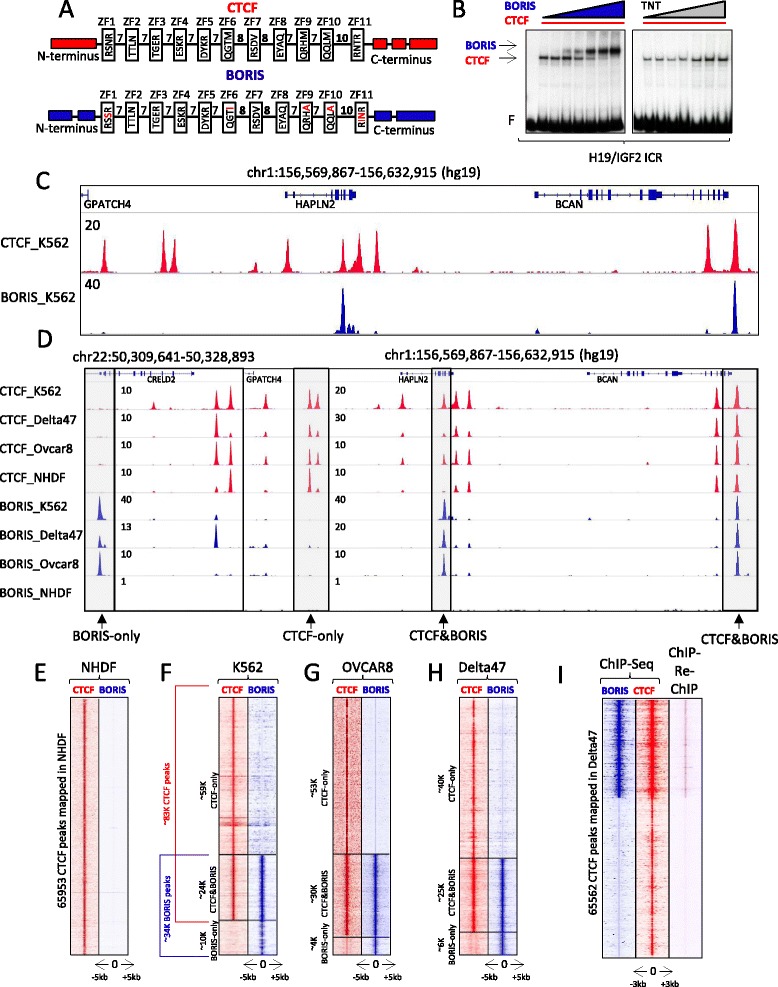
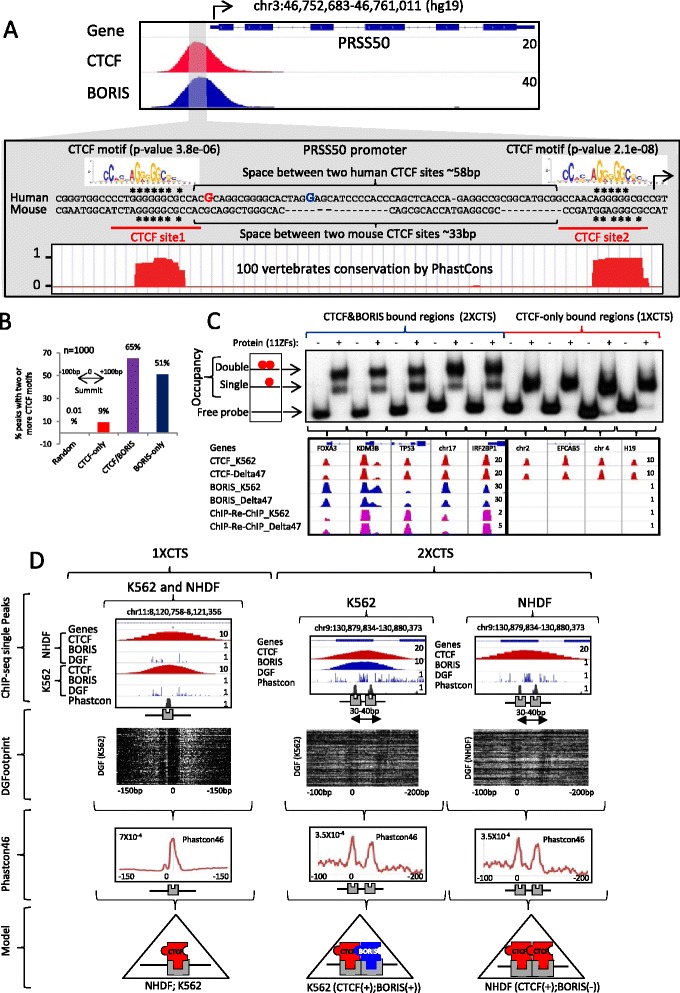
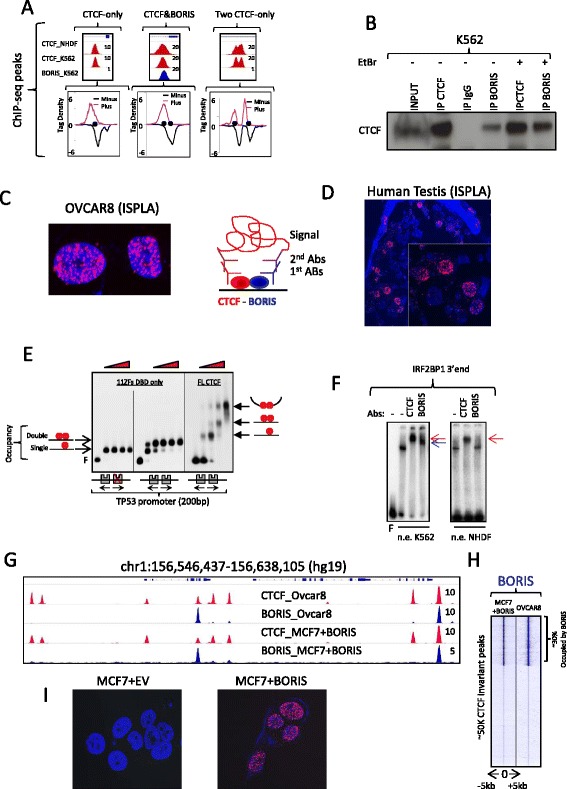
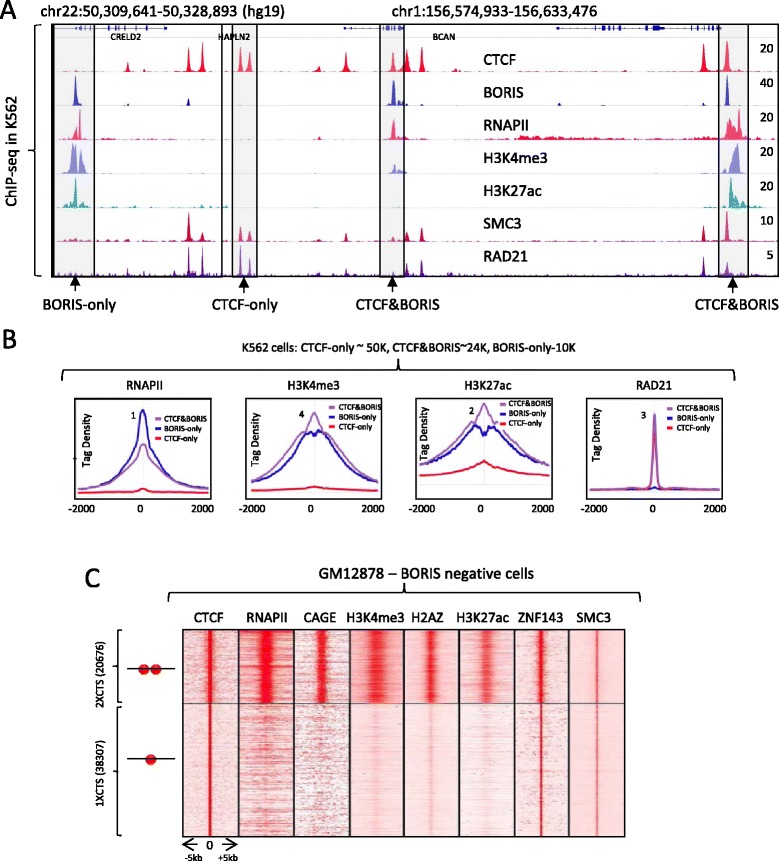
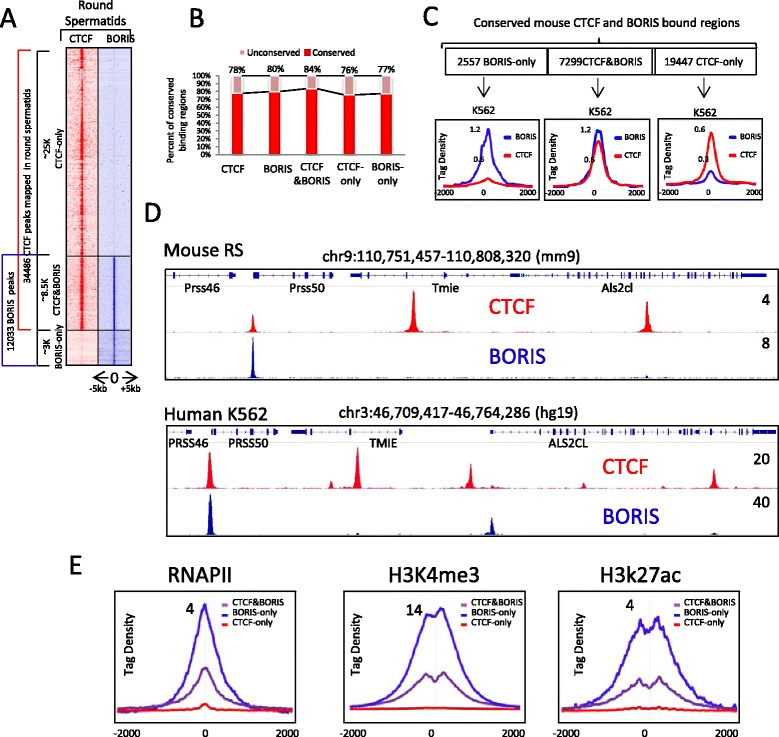
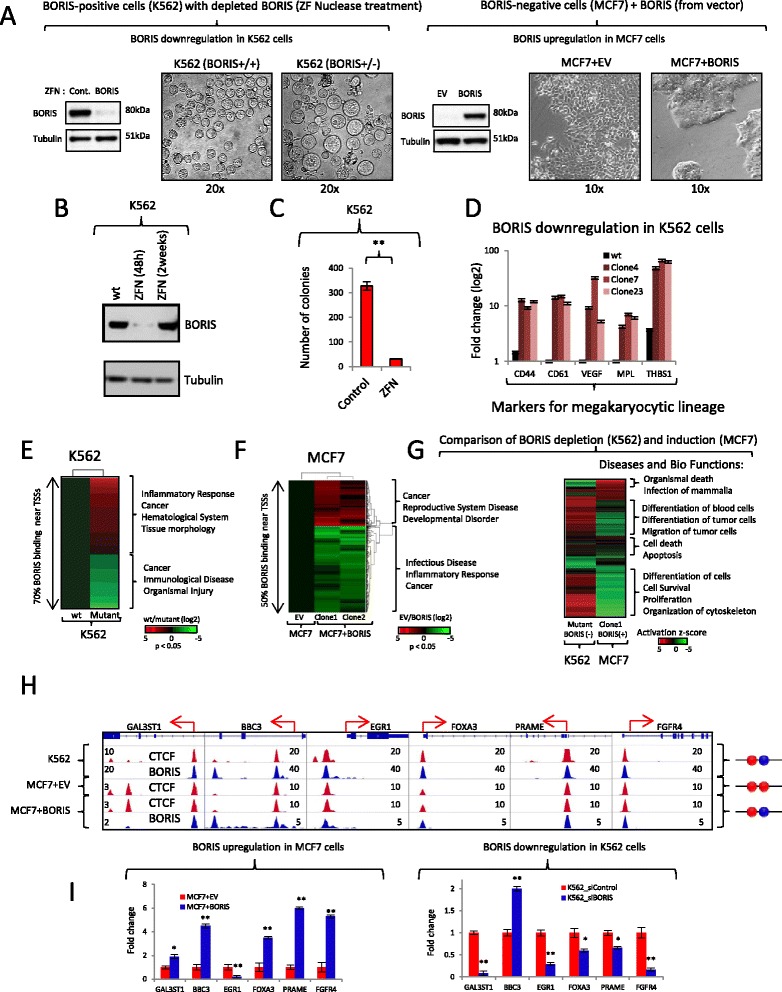
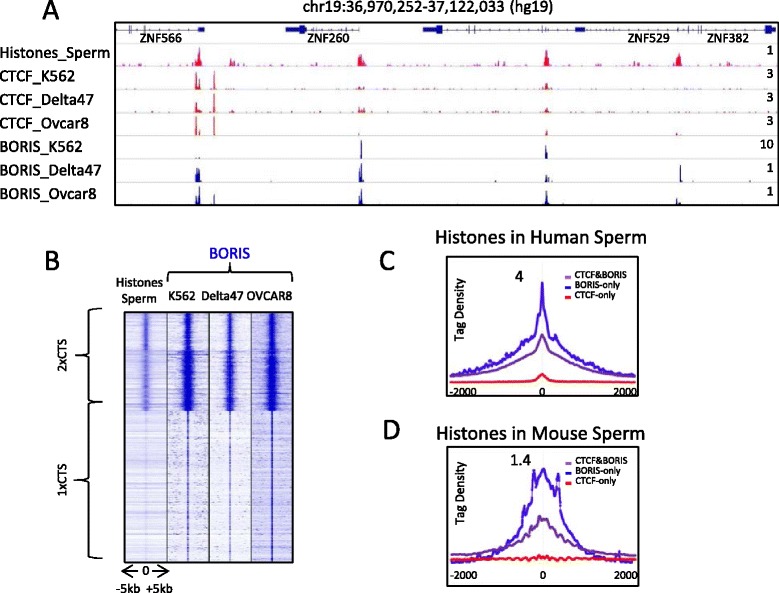
BACKGROUND: CTCF and BORIS (CTCFL), two paralogous mammalian proteins sharing nearly identical DNA binding domains, are thought to function in a mutually exclusive manner in DNA binding and transcriptional regulation. RESULTS: Here we show that these two proteins co-occupy a specific subset of regulatory elements consisting of clustered CTCF binding motifs (termed 2xCTSes). BORIS occupancy at 2xCTSes is largely invariant in BORIS-positive cancer cells, with the genomic pattern recapitulating the germline-specific BORIS binding to chromatin. In contrast to the single-motif CTCF target sites (1xCTSes), the 2xCTS elements are preferentially found at active promoters and enhancers, both in cancer and germ cells. 2xCTSes are also enriched in genomic regions that escape histone to protamine replacement in human and mouse sperm. Depletion of the BORIS gene leads to altered transcription of a large number of genes and the differentiation of K562 cells, while the ectopic expression of this CTCF paralog leads to specific changes in transcription in MCF7 cells. CONCLUSIONS: We discover two functionally and structurally different classes of CTCF binding regions, 2xCTSes and 1xCTSes, revealed by their predisposition to bind BORIS. We propose that 2xCTSes play key roles in the transcriptional program of cancer and germ cells.
Overview
The claims and statistics of this paper haven’t been checked yet.
Free: it reads the open-access text and checks the first 5 claims that cite a source we can check. Create a free account to check every claim.
Integrity signals
Registry
Cites
Statistics
Figures
Verification
Claims the paper makes
The claims and statistics of this paper haven’t been checked yet.
Free: it reads the open-access text and checks the first 5 claims that cite a source we can check. Create a free account to check every claim.
Claims other papers make about this one
Each is checked against this paper’s own text: does it say what the citing paper says it does?
The cited source says what the claim attributes to it.
In the citing paper
“Promoters of affected genes were not specifically enriched for tandem CTCF sites compared to their occurrence in CTCF ChIP-seq peaks genome-wide (around 1/3 of peaks have multiple CTCF motifs (Pugacheva et al., 2015)).”
From Targeted Degradation of CTCF Decouples Local Insulation of Chromosome Domains from Genomic Compartmentalization (2017) · cites this paper as Pugacheva et al., 2015
Self-check
Percentages, sums and reported differences re-computed from the paper’s own numbers.
The self-check needs the paper’s full text.
Citations
Cites
BEDTools: a flexible suite of utilities for comparing genomic features
Quinlan, A. R., & Hall, I. M. (2010) · Bioinformatics · doi:10.1093/bioinformatics/btq033 · Cited by 27,437
Ultrafast and memory-efficient alignment of short DNA sequences to the human genome.
Langmead, B., Trapnell, C., Pop, M., & Salzberg, S. L. (2009) · Genome Biology · doi:10.1186/gb-2009-10-3-r25 · Cited by 21,849 · cited 1×
“Sequences generated by the Illumina genome analyzer (36 and 50 bp reads) were aligned against either the human (build hg19) or mouse (build mm9) genome using the Bowtie program [73].”
MethodModel-based Analysis of ChIP-Seq (MACS)
Zhang, Y., Liu, T., Meyer, C. A., Eeckhoute, J., Johnson, D. S., Bernstein, B. E., Nusbaum, C., Myers, R. M., Brown, M., Li, W., et al. (2008) · Genome Biology · doi:10.1186/gb-2008-9-9-r137 · Cited by 18,386 · cited 4×
“After MACS, we applied the Peak Splitter algorithm (part of MACS) to call sub-peaks and summits of peaks and improve peak resolution.”
MethodInfluentialRobinson, J. T., Thorvaldsdóttir, H., Winckler, W., Guttman, M., Lander, E. S., Getz, G., & Mesirov, J. P. (2011) · Nature Biotechnology · doi:10.1038/nbt.1754 · Cited by 15,390 · cited 1×
“The ChIP-seq data were visualized using the Integrative Genomics Viewer (IGV) [75].”
MethodMEME SUITE: tools for motif discovery and searching
Bailey, T. L., Boden, M., Buske, F. A., Frith, M., Grant, C. E., Clementi, L., Ren, J., Li, W. W., & Noble, W. S. (2009) · Nucleic Acids Research · doi:10.1093/nar/gkp335 · Cited by 10,648 · cited 1×
“Position weight matrices for CTCF and BORIS bound regions were searched using Multiple EM for Motif Elicitation (MEME) software [78].”
MethodThe Human Genome Browser at UCSC
Kent, W. J., Sugnet, C. W., Furey, T. S., Roskin, K. M., Pringle, T. H., Zahler, A. M., & Haussler, A. D. (2002) · Genome Research · doi:10.1101/gr.229102 · Cited by 10,400
High-Resolution Profiling of Histone Methylations in the Human Genome
Barski, A., Cuddapah, S., Cui, K., Roh, T.-Y., Schones, D. E., Wang, Z., Wei, G., Chepelev, I., & Zhao, K. (2007) · Cell · doi:10.1016/j.cell.2007.05.009 · Cited by 6,845
Topological domains in mammalian genomes identified by analysis of chromatin interactions
Dixon, J. R., Selvaraj, S., Yue, F., Kim, A., Li, Y., Shen, Y., Hu, M., Liu, J. S., & Ren, B. (2012) · Nature · doi:10.1038/nature11082 · Cited by 6,829 · cited 1×
“CTCF in the organization of chromatin architecture [7, 22].”
BackgroundSelf-citationSuper-enhancers in the control of cell identity and disease
Hnisz, D., Abraham, B. J., Lee, T. I., Lau, A., Saint-André, V., Sigova, A. A., Hoke, H. A., & Young, R. A. (2013) · Cell · doi:10.1016/j.cell.2013.09.053 · Cited by 3,662 · cited 2×
“The list of super enhancers (742) was adopted from [41].”
BackgroundMethodCancer/testis antigens, gametogenesis and cancer
Simpson, A. J. G., Caballero, O. L., Jungbluth, A., Chen, Y.-T., & Old, L. J. (2005) · Nature Reviews Cancer · doi:10.1038/nrc1669 · Cited by 1,582
Cited by
Nora, E. P., Goloborodko, A., Valton, A.-L., Gibcus, J. H., Uebersohn, A., Abdennur, N., Dekker, J., Mirny, L. A., & Bruneau, B. G. (2017) · Cell · doi:10.1016/j.cell.2017.05.004 · Cited by 1,709
“Promoters of affected genes were not specifically enriched for tandem CTCF sites compared to their occurrence in CTCF ChIP-seq peaks genome-wide (around 1/3 of peaks have multiple CTCF motifs (Pugacheva et al., 2015)).”
CTCF Binding Polarity Determines Chromatin Looping
de Wit, E., Vos, E. S. M., Holwerda, S. J. B., Valdes-Quezada, C., Verstegen, M. J. A. M., Teunissen, H., Splinter, E., Wijchers, P. J., Krijger, P. H. L., & de Laat, W. (2015) · Molecular Cell · doi:10.1016/j.molcel.2015.09.023 · Cited by 641
“We attribute this finding to the frequent close linear juxtaposition of divergent CTCF sites (Pugacheva et al., 2015).”
BackgroundChromatin States in Mouse Sperm Correlate with Embryonic and Adult Regulatory Landscapes
Jung, Y. H., Sauria, M. E. G., Lyu, X., Cheema, M. S., Ausio, J., Taylor, J., & Corces, V. G. (2017) · Cell Reports · doi:10.1016/j.celrep.2017.01.034 · Cited by 289
“A total of 35,978 CTCF sites has been mapped in round spermatids (Pugacheva et al., 2015).”
InfluentialCTCF mediates chromatin looping via N-terminal domain-dependent cohesin retention
Pugacheva, E. M., Kubo, N., Loukinov, D., Tajmul, M., Kang, S., Kovalchuk, A. L., Strunnikov, A. V., Zentner, G. E., Ren, B., & Lobanenkov, V. V. (2020) · Proceedings of the National Academy of Sciences · doi:10.1073/pnas.1911708117 · Cited by 220
“We previously found that BORIS preferentially binds to a specific subset of genomic regions consisting of clustered CTCF binding motifs (termed 2xCTSes) as putative BORIS homodimers (BORIS-only sites) or as a heterodimer with CTCF (CTCF&BORIS sites) (47, 58).”
BackgroundResultInfluentialSelf-citationMolecular basis of CTCF binding polarity in genome folding
Nora, E. P., Caccianini, L., Fudenberg, G., So, K., Kameswaran, V., Nagle, A., Uebersohn, A., Hajj, B., Saux, A. L., Coulon, A., et al. (2020) · Nature Communications · doi:10.1038/s41467-020-19283-x · Cited by 213
Gu, C., Liu, S., Wu, Q., Zhang, L., & Guo, F. (2019) · Cell Research · doi:10.1038/s41422-018-0125-4 · Cited by 179
Canzio, D., Nwakeze, C. L., Horta, A., Rajkumar, S. M., Coffey, E. L., Duffy, E. E., Duffié, R., Monahan, K., O’Keeffe, S., Simon, M. D., et al. (2019) · Cell · doi:10.1016/j.cell.2019.03.008 · Cited by 175
Acute depletion of CTCF directly affects MYC regulation through loss of enhancer–promoter looping
Hyle, J., Zhang, Y., Wright, S., Xu, B., Shao, Y., Easton, J., Tian, L., Feng, R., Xu, P., & Li, C. (2019) · Nucleic Acids Research · doi:10.1093/nar/gkz462 · Cited by 139
“Previously (59), it was observed that CTCF and BORIS (CTCFL) could co-occupy a specific subset of regulatory elements consisting of clustered CTCF-binding motifs (termed 2XCTSes) mainly located at active promoters and enhancers.”
BackgroundThe three-dimensional genome: principles and roles of long-distance interactions
Rowley, M. J., & Corces, V. G. (2016) · Current Opinion in Cell Biology · doi:10.1016/j.ceb.2016.01.009 · Cited by 124
“Analysis of the distribution of BORIS and CTCF in the same cells enabled examination of occupancy at clustered sites [28].”
InfluentialBORIS promotes chromatin regulatory interactions in treatment-resistant cancer cells
Debruyne, D. N., Dries, R., Sengupta, S., Seruggia, D., Gao, Y., Sharma, B., Huang, H., Moreau, L. A., McLane, M., Day, D. S., et al. (2019) · Nature · doi:10.1038/s41586-019-1472-0 · Cited by 139
Analysis of Hi-C data using SIP effectively identifies loops in organisms from C. elegans to mammals
Rowley, M. J., Poulet, A., Nichols, M. H., Bixler, B. J., Sanborn, A. L., Brouhard, E. A., Hermetz, K., Linsenbaum, H., Csankovszki, G., Lieberman Aiden, E., et al. (2020) · Genome Research · doi:10.1101/gr.257832.119 · Cited by 111
“To test this, we examined published CTCFL ChIP-seq data in K562 cells (Pugacheva et al. 2015) and compared its presence at loop anchors to that of CTCF.”
BackgroundMethodInfluentialPulikkan, J. A., Hegde, M. B., Ahmad, H. M., Belaghzal, H., Illendula, A., Yu, J., O’Hagan, K., Ou, J., Müller‐Tidow, C., Wolfe, S. A., et al. (2018) · Cell · doi:10.1016/j.cell.2018.05.048 · Cited by 97
RB/E2F1 as a Master Regulator of Cancer Cell Metabolism in Advanced Disease
Mandigo, A. C., Yuan, W., Xu, K., Gallagher, P., Pang, A., Guan, Y. F., Shafi, A. A., Thangavel, C., Sheehan, B., Bogdan, D., et al. (2021) · Cancer Discovery · doi:10.1158/2159-8290.cd-20-1114 · Cited by 91
Spatial patterns of CTCF sites define the anatomy of TADs and their boundaries
Nanni, L., Ceri, S., & Logie, C. (2020) · Genome Biology · doi:10.1186/s13059-020-02108-x · Cited by 88
CTCF driven TERRA transcription facilitates completion of telomere DNA replication
Beishline, K., Vladimirova, O. V., Tutton, S., Wang, Z., Deng, Z., & Lieberman, P. M. (2017) · Nature Communications · doi:10.1038/s41467-017-02212-w · Cited by 91
Debaugny, R. E., & Skok, J. A. (2020) · Current Opinion in Genetics & Development · doi:10.1016/j.gde.2020.02.021 · Cited by 92
“Owing to the similarity in their DNA binding regions, CTCFL has the ability to bind and compete with CTCF at a subset of its binding sites [37,38].”
BackgroundIn vivo binding of PRDM9 reveals interactions with noncanonical genomic sites
Grey, C., Clément, J. A. J., Buard, J., Leblanc, B., Gut, I. G., Gut, M. O., Duret, L., & de Massy, B. (2017) · Genome Research · doi:10.1101/gr.217240.116 · Cited by 85
3D chromatin architecture and transcription regulation in cancer
Deng, S., Feng, Y., & Pauklin, S. (2022) · Journal of Hematology & Oncology · doi:10.1186/s13045-022-01271-x · Cited by 82
Singh, S., Narayanan, S. P., Biswas, K., Gupta, A., Ahuja, N., Yadav, S., Panday, R. K., Samaiya, A., Sharan, S. K., & Shukla, S. (2017) · Proceedings of the National Academy of Sciences · doi:10.1073/pnas.1708447114 · Cited by 76
“Having demonstrated the relationship between BORIS binding, Pol II enrichment, and PKM exon 10 inclusion, it was essential to exclude the possibility of additional factors responsible for Pol II enrichment and alternative splicing of PKM. PKM exon 10 contains two sequences that are similar to the consensus BORIS bindi…”
BackgroundMethodInfluentialThe Interplay Between Replacement and Retention of Histones in the Sperm Genome
Torres-Flores, U., & Hernández‐Hernández, A. (2020) · Frontiers in Genetics · doi:10.3389/fgene.2020.00780 · Cited by 80
CTCF as a regulator of alternative splicing: new tricks for an old player
Alharbi, A. B., Schmitz, U., Bailey, C. G., & Rasko, J. E. J. (2021) · Nucleic Acids Research · doi:10.1093/nar/gkab520 · Cited by 85
“Knowing that CTCF and its testis-specific paralogue CTCF-like (CTCFL)/BORIS have some mutual genomic occupancy (137), a new role for BORIS in AS regulation may also warrant further investigation.”
BackgroundSelf-citationDefining the relative and combined contribution of CTCF and CTCFL to genomic regulation
Nishana, M., Ha, C. J., Rodriguez-Hernaez, J., Ranjbaran, A., Chio, E., Nora, E. P., Badri, S., Kloetgen, A., Bruneau, B. G., Tsirigos, A., et al. (2020) · Genome biology · doi:10.1186/s13059-020-02024-0 · Cited by 82
“CTCFL has the ability to bind to and compete with CTCF at a subset of its binding sites, owing to the similarity in the DNA binding region [10, 35].”
BackgroundResultInfluentialChang, L.-H., Ghosh, S., Papale, A., Luppino, J. M., Miranda, M., Piras, V., Degrouard, J., Edouard, J., Poncelet, M., Lecouvreur, N., et al. (2023) · Nature Communications · doi:10.1038/s41467-023-41265-y · Cited by 62
Acute depletion of CTCF rewires genome-wide chromatin accessibility
Xu, B., Wang, H., Wright, S., Hyle, J. W., Zhang, Y., Shao, Y., Niu, M., Fan, Y., Rosikiewicz, W., Djekidel, M. N., et al. (2021) · Genome biology · doi:10.1186/s13059-021-02466-0 · Cited by 73
BORIS: a key regulator of cancer stemness
Soltanian, S., & Dehghani, H. (2018) · Cancer Cell International · doi:10.1186/s12935-018-0650-8 · Cited by 56
Targeting CTCFL/BORIS for the immunotherapy of cancer
Loukinov, D. I. (2018) · Cancer Immunology Immunotherapy · doi:10.1007/s00262-018-2251-8 · Cited by 44
Self-citationBORIS/CTCFL promotes a switch from a proliferative towards an invasive phenotype in melanoma cells
Janssen, S. M., Moscona, R., Elchebly, M., Papadakis, A. I., Redpath, M., Wang, H., Rubin, E., van Kempen, L. C. L. T., & Spatz, A. (2020) · Cell Death Discovery · doi:10.1038/s41420-019-0235-x · Cited by 42
Hillman, J. C., Pugacheva, E. M., Barger, C. J., Sribenja, S., Rosario, S. R., Albahrani, M., Truskinovsky, A. M., Stablewski, A. B., Liu, S., Loukinov, D. I., et al. (2019) · Molecular Cancer Research · doi:10.1158/1541-7786.mcr-19-0310 · Cited by 40
“Mol Cancer Res; 17(10) October 2019 Molecular Cancer Research2054 Ectopic BORIS expression modulates expression of cancerassociated genes and pathways During spermatogenesis, BORIS acts as a transcriptional regulator of several essential testis-specific genes, Gal3st and Prss50 (15, 20).”
BackgroundMethodSelf-citationIchiyanagi, T., Katoh, H., Mori, Y., Hirafuku, K., Boyboy, B. A. G., Kawase, M., & Ichiyanagi, K. (2021) · Molecular Biology and Evolution · doi:10.1093/molbev/msab033 · Cited by 39
“ChIP-seq data for CTCF in liver (GSM4579731), for CTCF and ADNP in ES cells (GSE125129) (Kaaij et al. 2019), and for CTCF and CFCFL in round spermatids (GSM1817673 and GSM1817674) (Pugacheva et al. 2015) were obtained from Gene Expression Omnibus (GEO).”
MethodCTCF contributes in a critical way to spermatogenesis and male fertility
Hernández‐Hernández, A., Lilienthal, I., Fukuda, N., Galjart, N., & Höög, C. (2016) · Scientific Reports · doi:10.1038/srep28355 · Cited by 45
“Genomic coordinates for the promoters (defined as plus/minus 2 Kb around the TSS 17,18 ) and enhancers (defined as 2–20 Kb upstream of the TSS 17 ) from the down-regulated, up-regulated (in the Ctcf -cKO testis) and genome-wide coding genes were based on the mouse mm9 assembly (July 2007 Build 37…”
InfluentialCrespo, M., Damont, A., Blanco, M., Lastrucci, E., Kennani, S. E., Ialy‐Radio, C., Khattabi, L. E., Terrier, S., Louwagie, M., Kieffer‐Jaquinod, S., et al. (2020) · Nucleic Acids Research · doi:10.1093/nar/gkaa163 · Cited by 46
“The following ChIP-seq datasets were processed: H3K4me1 and H3K4me3 from GSE49621 (44), pan crotonylation from GSE32663 and GSE69946 (5) (45), H3K27ac from GSE107398 (46), BORIS and CTCF from GSE70764 (47), BRD4 from GSE56526 (48), SLY from PRJNA275694 (39), SOX30 from GSE107644 (49) and H3.”
BackgroundMethodNuclease Footprints in Sperm Project Past and Future Chromatin Regulatory Events
Johnson, G. D., Jodar, M., Piqué-Regi, R., & Krawetz, S. A. (2016) · Scientific Reports · doi:10.1038/srep25864 · Cited by 38
Pugacheva, E. M., Teplyakov, E., Wu, Q., Li, J., Chen, C., Meng, C., Liu, J., Robinson, S., Loukinov, D., Boukaba, A., et al. (2016) · Epigenetics & Chromatin · doi:10.1186/s13072-016-0084-2 · Cited by 36
“BORIS was also confirmed to be incorporated into transcription regulation in K562 and to be required for its self-renewal [55].”
BackgroundMethodResultInfluentialSelf-citationChoudhury, S. R., Ashby, C., Tytarenko, R. G., Bauer, M., Wang, Y., Deshpande, S., Den, J., Schinke, C., Zangari, M., Thanendrarajan, S., et al. (2020) · Journal of Hematology & Oncology · doi:10.1186/s13045-020-00933-y · Cited by 37
The combined action of CTCF and its testis-specific paralog BORIS is essential for spermatogenesis
Rivero-Hinojosa, S., Pugacheva, E. M., Kang, S., Méndez-Catalá, C. F., Kovalchuk, A. L., Strunnikov, A. V., Loukinov, D. I., Lee, J. T., & Lobanenkov, V. V. (2021) · Nature Communications · doi:10.1038/s41467-021-24140-6 · Cited by 38
Self-citationCTCF: A misguided jack-of-all-trades in cancer cells
Segueni, J., & Noordermeer, D. (2022) · Computational and Structural Biotechnology Journal · doi:10.1016/j.csbj.2022.05.044 · Cited by 34
“A closely-related paralogue, CTCFL or BORIS (Brother of Regulator of Imprinted Sites) is present in spermatocytes, where it binds a subset of CTCF sites in the genome [37,38].”
BackgroundGarikapati, K. R., Patel, N., Makani, V. K. K., Cilamkoti, P., Bhadra, U., & Bhadra, M. P. (2017) · Biochemical and Biophysical Research Communications · doi:10.1016/j.bbrc.2017.01.066 · Cited by 32
CTCF and Its Multi-Partner Network for Chromatin Regulation
Moral‐Morales, A. D., Salgado-Albarrán, M., Sánchez-Pérez, Y., Wenke, N. K., Baumbach, J., & Soto‐Reyes, E. (2023) · Cells · doi:10.3390/cells12101357 · Cited by 32
Wiz binds active promoters and CTCF-binding sites and is required for normal behaviour in the mouse
Isbel, L., Prokopuk, L., Wu, H., Daxinger, L., Oey, H., Spurling, A., Lawther, A. J., Hale, M. W., & Whitelaw, E. (2016) · eLife · doi:10.7554/elife.15082 · Cited by 32
“Competitive binding with CTCF and the closely related BORIS has been demonstrated (Pugacheva et al., 2015).”
BackgroundMatthews, B. J., & Waxman, D. J. (2020) · Epigenetics & Chromatin · doi:10.1186/s13072-020-00350-y · Cited by 35
Choice of binding sites for CTCFL compared to CTCF is driven by chromatin and by sequence preference
Bergmaier, P., Weth, O., Dienstbach, S., Boettger, T., Galjart, N., Mernberger, M., Bartkuhn, M., & Renkawitz, R. (2018) · Nucleic Acids Research · doi:10.1093/nar/gky483 · Cited by 28
“Some functional differences regarding the two proteins have been identified, for instance it seems that only CTCF binds components of the Cohesin complex like Smc1 in mouse (12) or RAD21 in human (13).”
BackgroundResultInfluentialEctopic expression of meiotic cohesin generates chromosome instability in cancer cell line
Boukaba, A., Liu, J., Ward, C., Wu, Q., Arnaoutov, A., Liang, J., Pugacheva, E. M., Dasso, M., Lobanenkov, V. V., Esteban, M. A., et al. (2022) · Proceedings of the National Academy of Sciences · doi:10.1073/pnas.2204071119 · Cited by 27
“Anti-BORIS monoclonal Abs were generated in our previous work (10).”
MethodSelf-citationŁaźniewski, M., Dawson, W., Rusek, A. M., & Plewczyński, D. (2018) · Seminars in Cell and Developmental Biology · doi:10.1016/j.semcdb.2018.08.003 · Cited by 25
“The primary role of the YY1 protein is associated with short-range promoter-enhancer contacts, while CTCFL (also called BORIS), a homologue of CTCF, recognizes the same DNA sequences but its expression is restricted to germ cells and a subset of cancer [12].”
BackgroundYu, X., Wu, C., Bhavanasi, D., Wang, H., Gregory, B. D., & Huang, J. Y. (2017) · Blood Advances · doi:10.1182/bloodadvances.2016003384 · Cited by 25
Discovering a binary CTCF code with a little help from BORIS
Lobanenkov, V. V., & Zentner, G. E. (2017) · Nucleus · doi:10.1080/19491034.2017.1394536 · Cited by 24
“A rather strict limitation on the total length of 2xCTSes (<100 bp between adjacent motifs) suggests that this relatively short spacing may be required for the proximityinduced dimerization shown to occur in vitro.(26) Additionally, a restricted spacer length might be important for exclusion of a single nucleosome bet…”
BackgroundMethodSelf-citationCTCF: an R/bioconductor data package of human and mouse CTCF binding sites
Dozmorov, M. G., Mu, W., Davis, E. S., Lee, S. A., Triche, T. J., Phanstiel, D. H., & Love, M. I. (2022) · Bioinformatics Advances · doi:10.1093/bioadv/vbac097 · Cited by 19
NeuronMotif: Deciphering cis-regulatory codes by layer-wise demixing of deep neural networks
Zheng, W., Hua, K., Wei, L., Ma, S., Jiang, R., Zhang, X., Li, Y., Wong, W. H., & Wang, X. (2023) · Proceedings of the National Academy of Sciences · doi:10.1073/pnas.2216698120 · Cited by 23
“For example, CN 1130 in L10 of DD-10 represents a soft CTCF homodimer with an approximately 58 bp interval that plays important roles in the transcriptional process of cancer and germ cell development (37) (Fig.”
Rivero-Hinojosa, S., Kang, S., Lobanenkov, V. V., & Zentner, G. E. (2017) · Scientific Reports · doi:10.1038/srep41279 · Cited by 24
Self-citationTowards a predictive model of chromatin 3D organization
Xu, C., & Corces, V. G. (2015) · Seminars in Cell and Developmental Biology · doi:10.1016/j.semcdb.2015.11.013 · Cited by 19
“These doublets of CTCF motifs are preferentially found at promoters and enhancers and are normally occupied by CTCF, but are co-occupied by CTCF and BORIS in germ and tumor cells [54].”
CGGBP1 regulates CTCF occupancy at repeats
Patel, D., Patel, M., Datta, S., & Singh, U. (2019) · Epigenetics & Chromatin · doi:10.1186/s13072-019-0305-6 · Cited by 16
Tomikawa, J., Takada, S., Okamura, K., Terao, M., Ogata‐Kawata, H., Akutsu, H., Tanaka, S., Hata, K., & Nakabayashi, K. (2019) · Nucleic Acids Research · doi:10.1093/nar/gkz1034 · Cited by 22
“Binding motifs of the insulator DNA-binding proteins, CTCF and CTCF-L (BORIS) (27,28), were also enriched among the TS- and ES-specific FAIRE peaks.”
BackgroundNarita, T., Kilic, S., Higashijima, Y., Scherer, N. M., Pappas, G., Maskey, E., & Choudhary, C. (2025) · Nature Genetics · doi:10.1038/s41588-025-02404-x · Cited by 27
“Unlike CTCF, BORIS cannot anchor cohesin loops but binds many CTCF-occupied sites, showing a preference for promoters over distal regions 59,60 .”
Pugacheva, E. M., Bhatt, D. N., Rivero-Hinojosa, S., Tajmul, M., Fedida, L. M., Price, E., Ji, Y. J., Loukinov, D. I., Strunnikov, A. V., Ren, B., et al. (2024) · Genome biology · doi:10.1186/s13059-024-03175-0 · Cited by 18
“Conversely, the downregulation of BORIS expression in BORIS-positive cancer cells results in either cell death and differentiation [22] or in a less tumorigenic phenotype [21, 26].”
BackgroundMethodInfluentialSelf-citationTajmul, M., Bhatt, D. N., Ruje, L., Price, E., Ji, Y. J., Loukinov, D. I., Teif, V. B., Lobanenkov, V. V., & Pugacheva, E. M. (2025) · Nucleic Acids Research · doi:10.1093/nar/gkaf587 · Cited by 19
Self-citationThe Bromodomain Containing 8 (BRD8) transcriptional network in human lung epithelial cells
Browne, J. A., NandyMazumdar, M., Paranjapye, A., Leir, S., & Harris, A. (2021) · Molecular and Cellular Endocrinology · doi:10.1016/j.mce.2021.111169 · Cited by 18
“Although BORIS/CTCFL can bind and compete with CTCF at a subset of sites (Pugacheva et al., 2015; Sleutels et al., 2012) it is of very low abundance in both Calu-3 and 16HBE14o- cells, so CTCF is likely the main protein occupying these motifs in this cellular context.”
BackgroundVoutsadakis, I. A. (2018) · Microarrays · doi:10.3390/ht7040030 · Cited by 14
“The two paralogues have also been reported to cooperate in binding on tandem sites and thus it is possible that CTCF binding facilitates preferential CTCFL binding in an adjacent site [16].”
BackgroundBTApep-TAT peptide inhibits ADP-ribosylation of BORIS to induce DNA damage in cancer
Zhang, Y., Fang, M., Li, S., Xu, H., Ren, J., Tu, L., Zuo, B., Yao, W., & Liang, G. (2022) · Molecular Cancer · doi:10.1186/s12943-022-01621-w · Cited by 12
CTCFL regulates the PI3K-Akt pathway and it is a target for personalized ovarian cancer therapy
Salgado-Albarrán, M., Späth, J., González‐Barrios, R., Baumbach, J., & Soto‐Reyes, E. (2022) · npj Systems Biology and Applications · doi:10.1038/s41540-022-00214-z · Cited by 15
“CTCFL and CTCF using publicly available ChIP-seq data from Pugacheva et al.(11), where six genes (Fig.”
InfluentialDefining the relative and combined contribution of CTCF and CTCFL to genomic regulationPreprint
Nishana, M., Ha, C. J., Rodriguez-Hernaez, J., Ranjbaran, A., Chio, E., Nora, E. P., Badri, S., Kloetgen, A., Bruneau, B. G., Tsirigos, A., et al. (2019) · bioRxiv (Cold Spring Harbor Laboratory) · doi:10.1101/2019.12.14.874560 · Cited by 12
Makani, V. K. K., Mendonza, J. J., Edathara, P. M., Yerramsetty, S., & Bhadra, M. P. (2021) · Free Radical Biology and Medicine · doi:10.1016/j.freeradbiomed.2021.09.010 · Cited by 10
Factors that determine cell type–specific CTCF binding in health and disease
Do, C., & Skok, J. A. (2024) · Current Opinion in Genetics & Development · doi:10.1016/j.gde.2024.102244 · Cited by 11
Zhang, Y., Song, Y., Li, C. R., Ren, J., Fang, M., Fang, J., & Wang, X. (2020) · Oncology Letters · doi:10.3892/ol.2020.12114 · Cited by 11
An updated catalog of CTCF variants associated with neurodevelopmental disorder phenotypes
Price, E., Fedida, L. M., Pugacheva, E. M., Ji, Y. J., Loukinov, D. I., & Lobanenkov, V. V. (2023) · Frontiers in Molecular Neuroscience · doi:10.3389/fnmol.2023.1185796 · Cited by 9
“CCCTC-binding factor (CTCF) is a DNA-binding protein, equipped with 11 zinc fingers (ZFs) which facilitate its binding to thousands of sites across the genome (Lobanenkov et al., 1990; Splinter et al., 2006; Kim et al., 2007; Wendt et al., 2008; Pugacheva et al., 2015; Lobanenkov and Zentner, 2018).”
BackgroundSelf-citationThe Diverging Routes of BORIS and CTCF: An Interactomic and Phylogenomic Analysis
Jabbari, K., Heger, P., Sharma, R., & Wiehe, T. (2018) · Life · doi:10.3390/life8010004 · Cited by 11
“Notice that interactions missing in Cytoscape (CTCF-BORIS [14] and BORIS-TAF7L [32]) are not considered here, but they are included in Figure 3.”
BackgroundLu, J., Li, W., & Tang, F. (2025) · Nature Structural & Molecular Biology · doi:10.1038/s41594-025-01604-7 · Cited by 10
“…previous studies have shown that CCCTC-binding factor (CTCF) and its male germ-cell-specific paralog, BORIS (CTCFL), could form heterodimers and co-occupy clustered CTCF motifs (termed 2xCTSes), which play important roles in regulating the gene expression programs during spermatogenesis 71,72 .”
Three Dimensional Organization of the Nucleus: adding DNA sequences to the big picture
Gilbert, D. M., & Fraser, P. (2015) · Genome biology · doi:10.1186/s13059-015-0751-9 · Cited by 10
“and germ cells [25].”
Kadota, M., Yamaguchi, K., Hara, Y., & Kuraku, S. (2020) · Scientific Reports · doi:10.1038/s41598-020-71602-w · Cited by 8
What is known so far about bull sperm protamination: a review
Nagaki, C. A. P., Hamilton, T. R. D. S., & Assumpção, M. E. O. D. (2022) · Animal Reproduction · doi:10.1590/1984-3143-ar2021-0109 · Cited by 7
“The mechanisms involved in histone retention are still poorly elucidated, but it is believed that some histones with post-transcriptional modifications (PTM) can evade replacement by the action of transcription factors such as BORIS (Brother of the Regulator of Imprinted Sites) and CTCF (CCCTC-binding factor) while ge…”
BackgroundTong, X., Gao, Y., & Su, Z. (2024) · PeerJ · doi:10.7717/peerj.18240 · Cited by 7
“Bergmaier et al. suggested that CTCFL, which binds less strongly, may require the presence of an additional CTCF molecule nearby to stabilize its binding ( Bergmaier et al., 2018 ; Pugacheva et al., 2015 ).”
BackgroundTeplyakov, E., Wu, Q., Liu, J., Pugacheva, E. M., Loukinov, D., Boukaba, A., Lobanenkov, V. V., & Strunnikov, A. V. (2017) · Oncotarget · doi:10.18632/oncotarget.20627 · Cited by 7
“K562 cells are chronic myeloid leukemia (CML) cells are dependent on BORIS, which is normally tightly repressed in soma [33], for the proliferation and self-renewal of stemness.”
BackgroundMethodInfluentialSelf-citationA Therapeutic Vaccine Targeting Rat BORIS (CTCFL) for the Treatment of Rat Breast Cancer Tumors
Loukinov, D. I., Anderson, A. L., Mkrtichyan, M., Ghochikyan, A., Rivero-Hinojosa, S., Tucker, J. A., Lobanenkov, V. V., Agadjanyan, M. G., & Nelson, E. L. (2023) · International Journal of Molecular Sciences · doi:10.3390/ijms24065976 · Cited by 7
Self-citationSperm histone mediated epigenetic inheritance
Singh, B., Singh, R. K., Chaturvedi, M. M., & Purohit, J. S. (2025) · Biology of Reproduction · doi:10.1093/biolre/ioaf187 · Cited by 6
CTCFL expression is associated with cerebral vascular abnormalities
Satı, L., Soygur, B., Goksu, E. T., Başsorgun, C. İ., & McGrath, J. M. (2021) · Tissue and Cell · doi:10.1016/j.tice.2021.101528 · Cited by 4
Rao, G. K., Makani, V. K. K., Mendonza, J. J., Edathara, P. M., Patel, N., Ramakrishna, M., Cilamkoti, P., Phukon, J. C., Jose, J., Bhadra, U., et al. (2021) · FEBS Journal · doi:10.1111/febs.16309 · Cited by 6
Akhtar, S., Akhter, N., Talat, A., Alharbi, R., Sindi, A. A. A., Klufah, F., Alyahyawi, H. E., Alruwetei, A. M., Ahmad, A., Zamzami, M. A., et al. (2023) · Oncotarget · doi:10.18632/oncotarget.28442 · Cited by 5
A unified model of gene expression control by cohesin and CTCFPreprint
Narita, T., Kilic, S., Higashijima, Y., Pappas, G., Maskey, E., & Choudhary, C. (2024) · bioRxiv (Cold Spring Harbor Laboratory) · doi:10.1101/2024.11.29.625887 · Cited by 4
Spermiogenesis alterations in the absence of CTCF revealed by single cell RNA sequencing
Torres-Flores, U., Díaz-Espinosa, F., López-Santaella, T., Rebollar‐Vega, R., Vázquez-Jiménez, A., Taylor, I., Ortiz-Hernández, R., Echeverría, O. M., Vázquez‐Nin, G. H., Gutiérrez‐Ruíz, M. C., et al. (2023) · Frontiers in Cell and Developmental Biology · doi:10.3389/fcell.2023.1119514 · Cited by 3
“Furthermore, ectopic expression of BORIS in BORIS negative cells has been shown to produce the exchange of chromatin bound CTCF homodimers by CTCF/BORIS heterodimers (Pugacheva et al., 2015).”
BackgroundLiu, X., Wei, H., Zhang, Q., Zhang, N., Wu, Q., & Xu, C. (2024) · Nature Communications · doi:10.1038/s41467-024-55403-7 · Cited by 3
“Thetandemorientationof two adjacent CTCF motifs are highly frequent in both cell lines 28 (Fig.”
Loss of ATRX suppresses anti-tumor immunity
Diaz, A. A. (2022) · Neuro-Oncology · doi:10.1093/neuonc/noac059 · Cited by 4
Cancer-testis antigen expression in canine melanoma and healthy tissues
Hindriks, E., Bergmann, W., Ruiz, A. M., Maria, R. D., Zandvliet, M. M. J. M., Sijts, A. J. A. M., & Broere, F. (2025) · Veterinary Immunology and Immunopathology · doi:10.1016/j.vetimm.2025.110946 · Cited by 4
Activation of the Androgen Receptor gene by BORIS/CTCFL in prostate cancer cellsPreprint
Hari‐Gupta, Y., Kita, G.-X., Farrar, D., & Klenova, E. M. (2017) · bioRxiv (Cold Spring Harbor Laboratory) · doi:10.1101/195875 · Cited by 2
“It is therefore expected that BORIS and CTCF have the ability to bind to similar sequences supported by the genome-wide ChIP-Seq data [12], however recent studies revealed more complex patterns in BORIS binding [13].”
BackgroundNeuronMotif: Deciphering transcriptional cis-regulatory codes from deep neural networksPreprint
Zheng, W., Hua, K., Wei, L., Ma, S., Jiang, R., Li, Y., Wong, W. H., & Wang, X. (2021) · bioRxiv (Cold Spring Harbor Laboratory) · doi:10.1101/2021.02.10.430606 · Cited by 2
“For example, an AN in DeepSEA represents the soft CTCF homodimer with around 58 bp interval that play important roles in the transcriptional process of cancer and germ cells development 28 (Fig.”
BackgroundPrice, E., Pugacheva, E. M., Bhatt, D. N., Ji, Y. J., Yeboah, S., Scott, A., Loukinov, D. I., & Lobanenkov, V. V. (2025) · bioRxiv (Cold Spring Harbor Laboratory) · doi:10.64898/2025.12.24.696438 · Cited by 2
Self-citationADNP regulates chromatin architecture and lineage fidelity during neural differentiation
Wulfridge, P., Rell, N., Doherty, J. K., Fang, K.-C., Lynskey, M. L., & Sarma, K. (2026) · PLoS Genetics · doi:10.1371/journal.pgen.1012081 · Cited by 4
Transcriptome signatures for the identification of bevacizumab responders in ovarian cancer
Zolotareva, O. I., Legler, K., Tsoy, O. V., Esteve, A., Sergushichev, A., Sukhov, V., Baumbach, J., Eylmann, K., Qi, M., Alawi, M., et al. (2026) · Genome Medicine · doi:10.1186/s13073-026-01727-6 · Cited by 2
“In the UKE dataset, embryonic stem cell markers SOX2, POU5F1, and MYC were not differentially expressed in patients stratified by bicluster 84.”
Key roles of CCCTC-binding factor in cancer evolution and development
Li, Z., Zhou, X., Cai, S., Fan, J., Wei, Z., Chen, Y., & Cao, G. (2021) · Exploration of Medicine · doi:10.37349/emed.2021.00068 · Cited by 1
“Interestingly, BORIS/CTCF heterodimeric sites are enriched in both cancer and germ when the promotors and enhancers of cells are activated [78].”
BackgroundThe function of brother of the regulator of imprinted sites in cancer development
Zhou, S., Li, L., Zhang, M., Qin, Y., & Li, B. (2022) · Cancer Gene Therapy · doi:10.1038/s41417-022-00556-0 · Cited by 1
“Some genes can be switched from silenced to activated when CTCF alone is replaced by BORIS and CTCF cooccupied [17].”
BackgroundCTCF-anchored chromatin loop dynamics during human meiosis
Kaiser, V. B., & Semple, C. A. M. (2025) · BMC Biology · doi:10.1186/s12915-025-02181-3 · Cited by 1
“…models, it would be desirable to obtain ChIP-seq data of CTCF within individual spermatogenesis cell types in humans, especially since some CTCF-binding sites may be occupied by its meiosis-specific paralogue (BORIS/CTCFL), which does not interact with cohesin [69] but occupies a subset (~ 12”
Chromosome instability induced by mutations in TAD anchors leads to tumors
Luchnik, A. N. (2021) · Genome Instability & Disease · doi:10.1007/s42764-021-00050-1 · Cited by 1
““Zipper locks” for to begin and to end fastening, as we assured from previous section, are located at Topo2A/B heterodimers sandwiched (locked) between two CTCF target sites (CTS) within TAD anchors.”
BackgroundMethodInfluentialPatel, B. V., & Hotaling, J. M. (2018) · Elsevier eBooks · doi:10.1016/b978-0-12-812501-4.00022-5 · Cited by 1
Chromatin: A Semi-Structured Polymer
Dawson, W., Łaźniewski, M., & Plewczyński, D. (2018) · Elsevier eBooks · doi:10.1016/b978-0-12-809633-8.20240-9 · Cited by 1
The CTCF Anatomy of Topologically Associating DomainsPreprint
Nanni, L., Wang, C., Manders, F., Groh, L. A., Haro, P., Oldenkamp, R., Ceri, S., & Logie, C. (2019) · bioRxiv (Cold Spring Harbor Laboratory) · doi:10.1101/746610 · Cited by 1
LR-DNase: Predicting TF binding from DNase-seq dataPreprint
van der Velde, A., Purcaro, M. J., Noble, W. S., & Weng, Z. (2016) · bioRxiv (Cold Spring Harbor Laboratory) · doi:10.1101/082594
“The insulator binding protein CTCF and its ortholog CTCFL (also named BORIS) share a conserved zinc-finger DNA binding domain and, as a consequence, recognize the same motif (22, 38).”
BackgroundKenter, A. L. (2019) · Faculty Opinions – Post-Publication Peer Review of the Biomedical Literature · doi:10.3410/f.727626056.793558059
Hillman, J. C., Pugacheva, E. M., Barger, C. J., Sribenja, S., Rosario, S. R., Albahrani, M., Truskinovsky, A. M., Stablewski, A. B., Liu, S., Loukinov, D. I., et al. (2023) · doi:10.1158/1541-7786.22512804.v1
Self-citationAdditional file 7 of Acute depletion of CTCF rewires genome-wide chromatin accessibility
Xu, B., Wang, H., Wright, S., Hyle, J. W., Zhang, Y., Shao, Y., Niu, M., Fan, Y., Rosikiewicz, W., Djekidel, M. N., et al. (2021) · Figshare · doi:10.6084/m9.figshare.16435840
Additional file 6 of Acute depletion of CTCF rewires genome-wide chromatin accessibility
Xu, B., Wang, H., Wright, S., Hyle, J. W., Zhang, Y., Shao, Y., Niu, M., Fan, Y., Rosikiewicz, W., Djekidel, M. N., et al. (2021) · Figshare · doi:10.6084/m9.figshare.16435837
Additional file 2 of Acute depletion of CTCF rewires genome-wide chromatin accessibility
Xu, B., Wang, H., Wright, S., Hyle, J. W., Zhang, Y., Shao, Y., Niu, M., Fan, Y., Rosikiewicz, W., Djekidel, M. N., et al. (2021) · Figshare · doi:10.6084/m9.figshare.16435825
Additional file 5 of Acute depletion of CTCF rewires genome-wide chromatin accessibility
Xu, B., Wang, H., Wright, S., Hyle, J. W., Zhang, Y., Shao, Y., Niu, M., Fan, Y., Rosikiewicz, W., Djekidel, M. N., et al. (2021) · Figshare · doi:10.6084/m9.figshare.16435834
Metadata
- Authors
- Pugacheva, E. M., Rivero-Hinojosa, S., Espinoza, C. A., Méndez-Catalá, C. F., Kang, S., Suzuki, T., Kosaka-Suzuki, N., Robinson, S., Nagarajan, V., Ye, Z., Boukaba, A., Rasko, J. E. J., Strunnikov, A. V., Loukinov, D., Ren, B., & Lobanenkov, V. V.
- Affiliations
- National Institutes of Health (US)
- University of California San Diego (US)
- Ludwig Cancer Research (US)
- Guangzhou Institutes of Biomedicine and Health (CN)
- The University of Sydney (AU)
- Ludwig Cancer Research (BE)
- Corresponding author
- Ren, Bing
- Lobanenkov, Victor V.
- ORCID
- Venue
- Genome biology
- Published
- 2015-08-14
- Volume
- 16
- Issue
- 1
- Pages
- 161-161
- ISSN
- 1465-6906 (ISSN-L)
- 1474-760X
- PMC
- PMC4562119
- OpenAlex
- W2163068365
- Cited by
- 110
- References
- 82
- Citations by year
- 2026: 5 · 2025: 9 · 2024: 6 · 2023: 9 · 2022: 10 · 2021: 14 · 2020: 17 · 2019: 10 · 2018: 10 · 2017: 11 · 2016: 6 · 2015: 3
- FWCI
- 4.34
- Type
- journal article
- Language
- en
- Open access
- gold
- doi.org
- Licence
- cc-by
- creativecommons.org/licenses/by/4.0/ (tdm)
- creativecommons.org/licenses/by/4.0/ (vor)
- Locations
- Genome biology (publishedVersion, cc-by)
- Europe PMC (PubMed Central) (publishedVersion, cc-by)
- PubMed Central (publishedVersion, cc-by)
- PubMed (publishedVersion)
- eScholarship (California Digital Library) (submittedVersion)
- eScholarship (California Digital Library) (submittedVersion, cc-by)
- Funders
- Division of Intramural Research, National Institute of Allergy and Infectious Diseases (ᅟ)
- Ludwig Institute for Cancer Research, California Institute of Regenerative Medicine (RN2-00905)
- National Institutes of Health (P50 GM085764-03 and U01 ES017166)
- Cancer Council NSW (RG11-12; RG14-05; RG14-09)
- Topics
- Life Sciences › Biochemistry, Genetics and Molecular Biology › Molecular Biology › Genomics and Chromatin Dynamics
- Life Sciences › Biochemistry, Genetics and Molecular Biology › Molecular Biology › Epigenetics and DNA Methylation
- Life Sciences › Biochemistry, Genetics and Molecular Biology › Molecular Biology › Chromatin Remodeling and Cancer
- Keywords
- CTCF, BORIS, CTCFL, CTCF binding motifs, transcriptional regulation, enhancers, promoter, sperm chromatin, germ cells, cancer cells, MCF-7 cells
- MeSH terms
- CCCTC-Binding Factor, Animals, Binding Sites, Cell Line, Chromatin, DNA, DNA-Binding Proteins, Enhancer Elements, Genetic, Humans, Male, Neoplasms, Promoter Regions, Genetic, Protein Binding, Repressor Proteins, Spermatids, Spermatozoa, Transcription, Genetic, Genome, K562 Cells, Mice, Nucleotide Motifs
About these checks
Registry, retraction, Cites and statistics results are computed, not judged, with one exception: a printed reference that no index lists is read once by a model before it counts as a citation error. Claims are extracted by a model and kept only when their quote appears verbatim in the text; each cited source is then checked, with a model’s help, for whether it says what the claim relies on. Those verdicts can be wrong — read the claim’s quote and the cited source before relying on one.
Statistics and arithmetic are recomputed, not judged.
Confidence bands are shown only for fields calibrated on our annotated test set. None is calibrated yet, so no band is shown.
What counts as a claim ›How we measure confidence ›How we check this ›
Are you an author, or do you see a problem with this page? Request a review
Data sources
Bibliographic data: Semantic Scholar, OpenAlex, Crossref.
Contains information from the Semantic Scholar Academic Graph Datasets, made available under the ODC Attribution License (ODC-BY 1.0).
Semantic Scholar’s data is described in: Kinney, R., et al. (2023). The Semantic Scholar Open Data Platform. arXiv:2301.10140.
