

Comparative analyses of CTCF and BORIS occupancies uncover two distinct classes of CTCF binding genomic regions
Open accessThe DOI matches its Crossref record; 82 of the 82 references it cites were found in a registry or an index.
Abstract
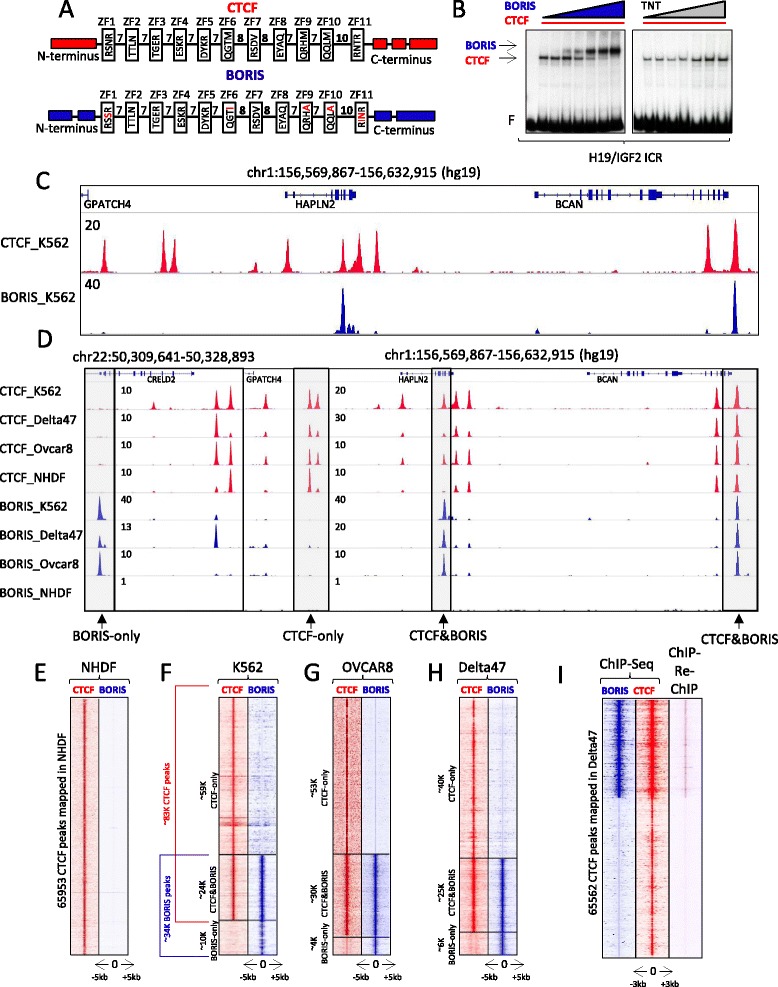
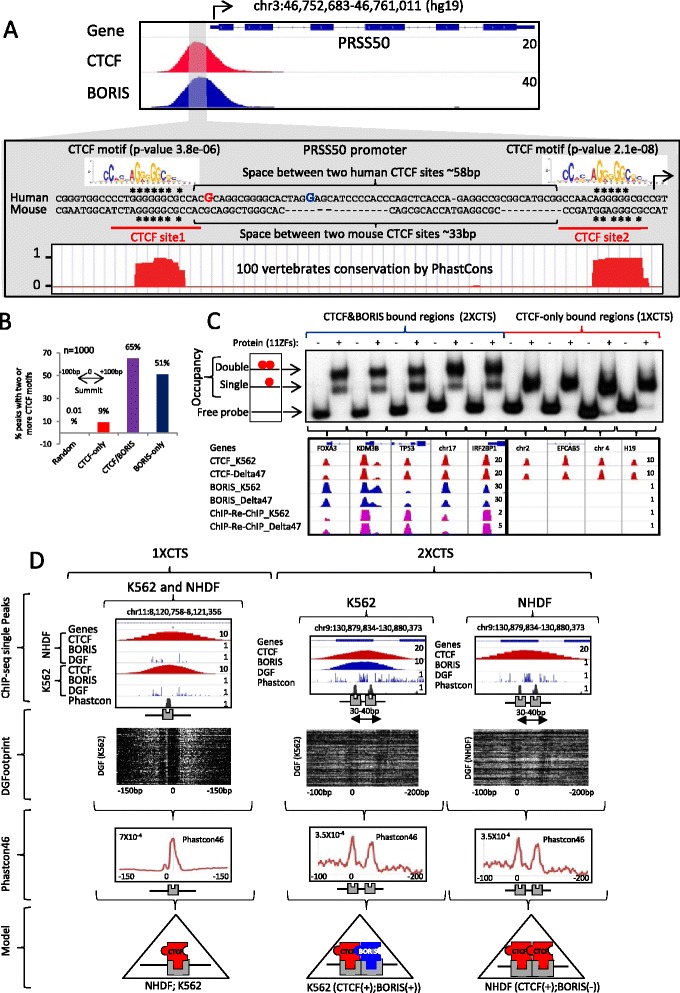
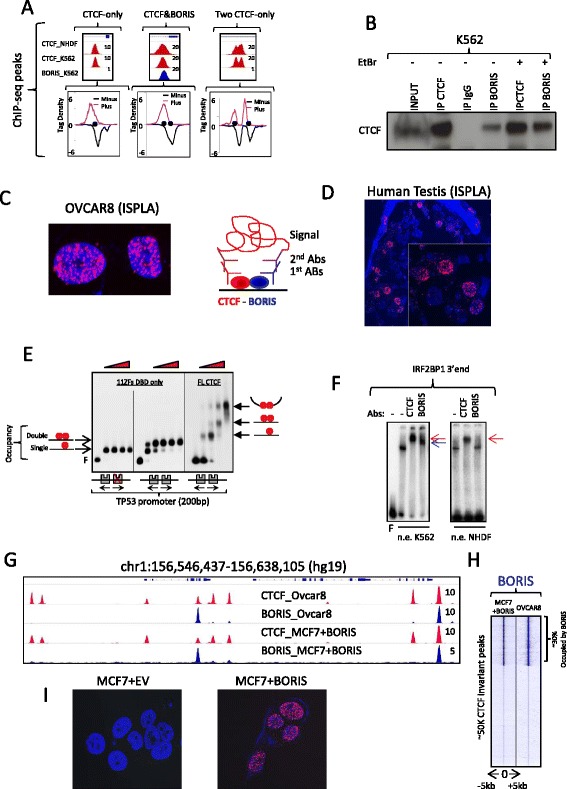
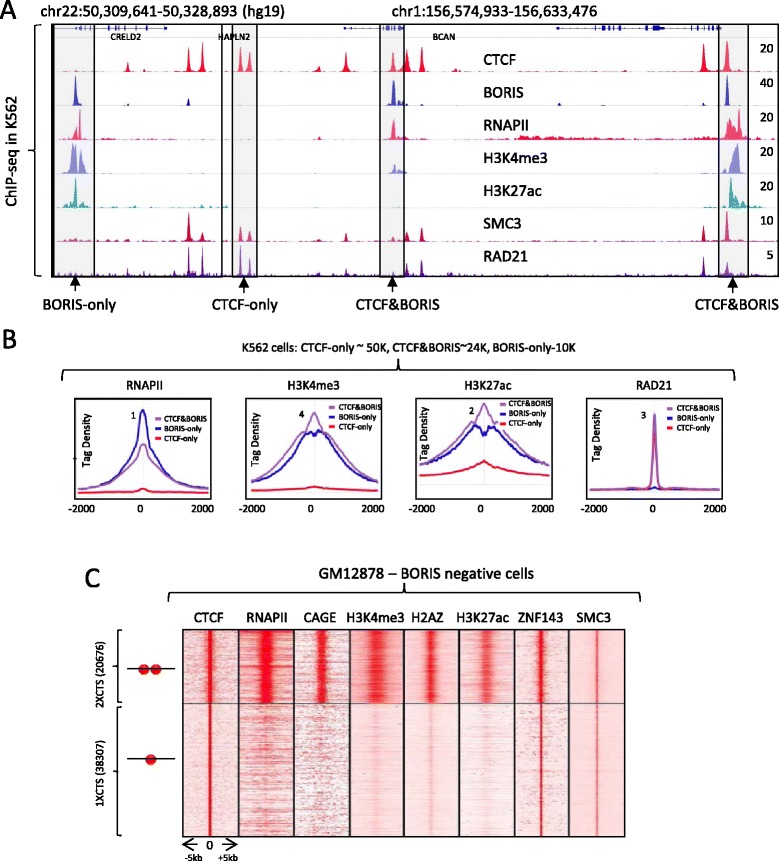
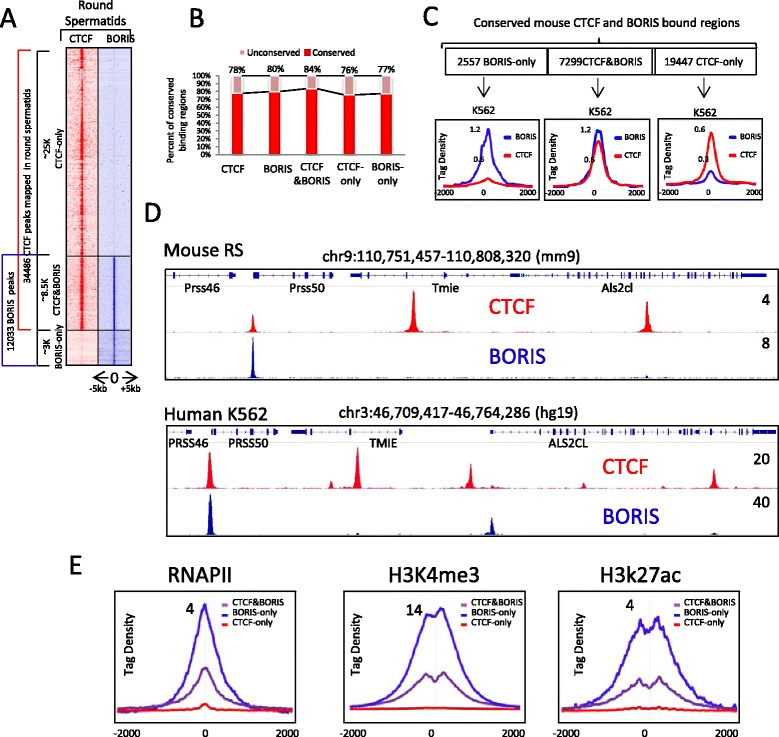
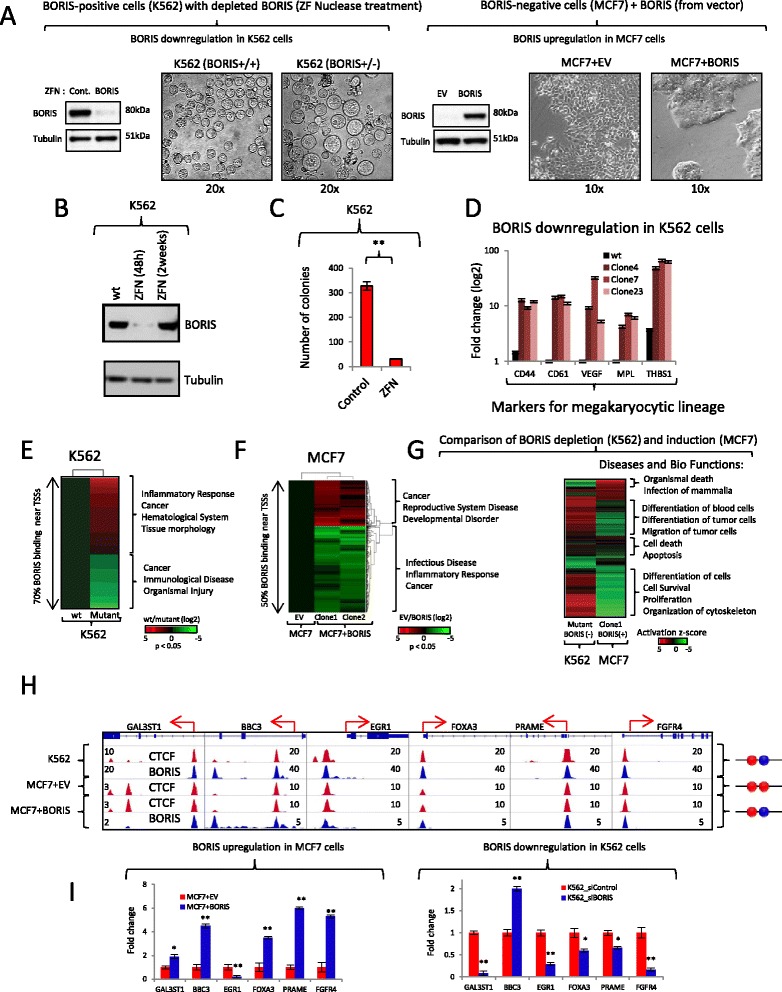
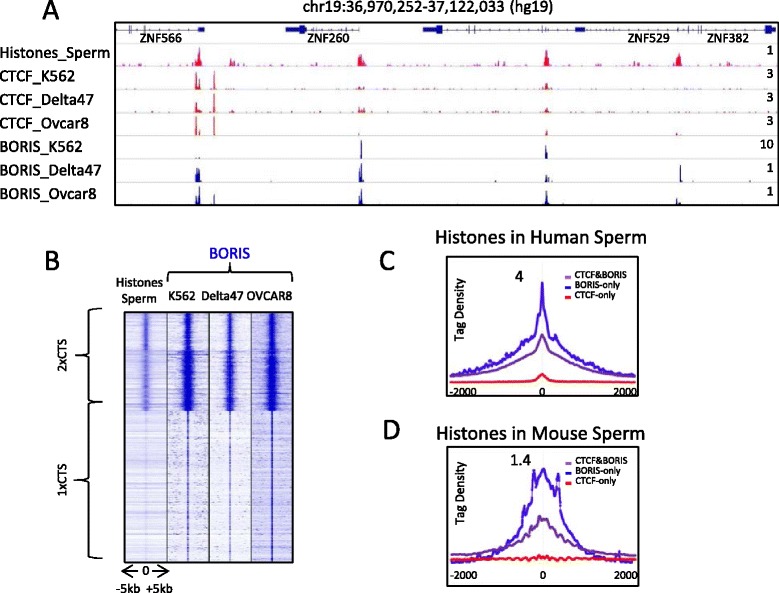
BACKGROUND: CTCF and BORIS (CTCFL), two paralogous mammalian proteins sharing nearly identical DNA binding domains, are thought to function in a mutually exclusive manner in DNA binding and transcriptional regulation. RESULTS: Here we show that these two proteins co-occupy a specific subset of regulatory elements consisting of clustered CTCF binding motifs (termed 2xCTSes). BORIS occupancy at 2xCTSes is largely invariant in BORIS-positive cancer cells, with the genomic pattern recapitulating the germline-specific BORIS binding to chromatin. In contrast to the single-motif CTCF target sites (1xCTSes), the 2xCTS elements are preferentially found at active promoters and enhancers, both in cancer and germ cells. 2xCTSes are also enriched in genomic regions that escape histone to protamine replacement in human and mouse sperm. Depletion of the BORIS gene leads to altered transcription of a large number of genes and the differentiation of K562 cells, while the ectopic expression of this CTCF paralog leads to specific changes in transcription in MCF7 cells. CONCLUSIONS: We discover two functionally and structurally different classes of CTCF binding regions, 2xCTSes and 1xCTSes, revealed by their predisposition to bind BORIS. We propose that 2xCTSes play key roles in the transcriptional program of cancer and germ cells.
Overview
The claims and statistics of this paper haven’t been checked yet.
Free: it reads the open-access text and checks the first 5 claims that cite a source we can check. Create a free account to check every claim.
Integrity signals
Registry
Cites
Statistics
Figures
Verification
Claims the paper makes
The claims and statistics of this paper haven’t been checked yet.
Free: it reads the open-access text and checks the first 5 claims that cite a source we can check. Create a free account to check every claim.
Claims other papers make about this one
Each is checked against this paper’s own text: does it say what the citing paper says it does?
The cited source says what the claim attributes to it.
In the citing paper
“Promoters of affected genes were not specifically enriched for tandem CTCF sites compared to their occurrence in CTCF ChIP-seq peaks genome-wide (around 1/3 of peaks have multiple CTCF motifs (Pugacheva et al., 2015)).”
From Targeted Degradation of CTCF Decouples Local Insulation of Chromosome Domains from Genomic Compartmentalization (2017) · cites this paper as Pugacheva et al., 2015
Self-check
Percentages, sums and reported differences re-computed from the paper’s own numbers.
The self-check needs the paper’s full text.
Citations
Cites
BEDTools: a flexible suite of utilities for comparing genomic features
Quinlan, A. R., & Hall, I. M. (2010) · Bioinformatics · doi:10.1093/bioinformatics/btq033 · Cited by 27,437
Ultrafast and memory-efficient alignment of short DNA sequences to the human genome.
Langmead, B., Trapnell, C., Pop, M., & Salzberg, S. L. (2009) · Genome Biology · doi:10.1186/gb-2009-10-3-r25 · Cited by 21,849 · cited 1×
“Sequences generated by the Illumina genome analyzer (36 and 50 bp reads) were aligned against either the human (build hg19) or mouse (build mm9) genome using the Bowtie program [73].”
MethodModel-based Analysis of ChIP-Seq (MACS)
Zhang, Y., Liu, T., Meyer, C. A., Eeckhoute, J., Johnson, D. S., Bernstein, B. E., Nusbaum, C., Myers, R. M., Brown, M., Li, W., et al. (2008) · Genome Biology · doi:10.1186/gb-2008-9-9-r137 · Cited by 18,386 · cited 4×
“After MACS, we applied the Peak Splitter algorithm (part of MACS) to call sub-peaks and summits of peaks and improve peak resolution.”
MethodInfluentialRobinson, J. T., Thorvaldsdóttir, H., Winckler, W., Guttman, M., Lander, E. S., Getz, G., & Mesirov, J. P. (2011) · Nature Biotechnology · doi:10.1038/nbt.1754 · Cited by 15,390 · cited 1×
“The ChIP-seq data were visualized using the Integrative Genomics Viewer (IGV) [75].”
MethodMEME SUITE: tools for motif discovery and searching
Bailey, T. L., Boden, M., Buske, F. A., Frith, M., Grant, C. E., Clementi, L., Ren, J., Li, W. W., & Noble, W. S. (2009) · Nucleic Acids Research · doi:10.1093/nar/gkp335 · Cited by 10,648 · cited 1×
“Position weight matrices for CTCF and BORIS bound regions were searched using Multiple EM for Motif Elicitation (MEME) software [78].”
MethodThe Human Genome Browser at UCSC
Kent, W. J., Sugnet, C. W., Furey, T. S., Roskin, K. M., Pringle, T. H., Zahler, A. M., & Haussler, A. D. (2002) · Genome Research · doi:10.1101/gr.229102 · Cited by 10,400
High-Resolution Profiling of Histone Methylations in the Human Genome
Barski, A., Cuddapah, S., Cui, K., Roh, T.-Y., Schones, D. E., Wang, Z., Wei, G., Chepelev, I., & Zhao, K. (2007) · Cell · doi:10.1016/j.cell.2007.05.009 · Cited by 6,845
Topological domains in mammalian genomes identified by analysis of chromatin interactions
Dixon, J. R., Selvaraj, S., Yue, F., Kim, A., Li, Y., Shen, Y., Hu, M., Liu, J. S., & Ren, B. (2012) · Nature · doi:10.1038/nature11082 · Cited by 6,829 · cited 1×
“CTCF in the organization of chromatin architecture [7, 22].”
BackgroundSelf-citationSuper-enhancers in the control of cell identity and disease
Hnisz, D., Abraham, B. J., Lee, T. I., Lau, A., Saint-André, V., Sigova, A. A., Hoke, H. A., & Young, R. A. (2013) · Cell · doi:10.1016/j.cell.2013.09.053 · Cited by 3,662 · cited 2×
“The list of super enhancers (742) was adopted from [41].”
BackgroundMethodCancer/testis antigens, gametogenesis and cancer
Simpson, A. J. G., Caballero, O. L., Jungbluth, A., Chen, Y.-T., & Old, L. J. (2005) · Nature Reviews Cancer · doi:10.1038/nrc1669 · Cited by 1,582
CTCF: Master Weaver of the Genome
Phillips, J. E., & Corces, V. G. (2009) · Cell · doi:10.1016/j.cell.2009.06.001 · Cited by 1,552 · cited 3×
“CTCF, a highly conserved DNA binding protein, serves as a global organizer of chromatin architecture [1].”
BackgroundThe long-range interaction landscape of gene promoters
Sanyal, A., Lajoie, B. R., Jain, G., & Dekker, J. (2012) · Nature · doi:10.1038/nature11279 · Cited by 1,489
A map of the cis-regulatory sequences in the mouse genome
Shen, Y., Yue, F., McCleary, D. F., Ye, Z., Edsall, L., Kuan, S., Wagner, U., Dixon, J., Lee, L., Lobanenkov, V. V., et al. (2012) · Nature · doi:10.1038/nature11243 · Cited by 1,361 · cited 1×
“With the advance of next-generation sequencing techniques, CTCF binding sites have been identified across fly, mouse, and human genomes [14, 16, 17].”
Self-citationDistinctive chromatin in human sperm packages genes for embryo development
Hammoud, S. S., Nix, D. A., Zhang, H., Purwar, J., Carrell, D. T., & Cairns, B. R. (2009) · Nature · doi:10.1038/nature08162 · Cited by 1,320
Li, G., Ruan, X., Auerbach, R. K., Sandhu, K. S., Zheng, M., Wang, P., Poh, H. M., Goh, Y., Lim, J., Zhang, J., et al. (2012) · Cell · doi:10.1016/j.cell.2011.12.014 · Cited by 1,232 · cited 1×
“The latter is an intriguing option, as the potential role of BORIS in three-dimensional folding of chromatin had never been >possibility we cross-referenced our ChIP-seq data with a published RNAPII ChIA-PET study where 30,000 K562-specific loops were mapped in BORIS-positive cells (K562) versus BORIS-negative cells (…”
MethodCohesin mediates transcriptional insulation by CCCTC-binding factor
Wendt, K. S., Yoshida, K., Itoh, T., Bando, M., Koch, B., Schirghuber, E., Tsutsumi, S., Nagae, G., Ishihara, K., Mishiro, T., et al. (2008) · Nature · doi:10.1038/nature06634 · Cited by 1,193
Architectural protein subclasses shape 3D organization of genomes during lineage commitment
Phillips-Cremins, J. E., Sauria, M. E. G., Sanyal, A., Gerasimova, T. I., Lajoie, B. R., Bell, J. S. K., Ong, C.-T., Hookway, T. A., Guo, C., Sun, Y., et al. (2013) · Cell · doi:10.1016/j.cell.2013.04.053 · Cited by 1,187 · cited 1×
“CTCF in the organization of chromatin architecture [7, 22].”
BackgroundThe protein CTCF is required for the enhancer blocking activity of vertebrate insulators
Bell, A. C., West, A. G., & Felsenfeld, G. (1999) · Cell · doi:10.1016/s0092-8674(00)81967-4 · Cited by 1,101
Analysis of the Vertebrate Insulator Protein CTCF-Binding Sites in the Human Genome
Kim, T. H., Abdullaev, Z. K., Smith, A. D., Ching, K. A., Loukinov, D. I., Green, R. D., Zhang, M. Q., Lobanenkov, V. V., & Ren, B. (2007) · Cell · doi:10.1016/j.cell.2006.12.048 · Cited by 1,033 · cited 2×
“Reflecting the multitude of CTCF functions, CTSes were found to be associated with the genomic regions engaged in long-range chromatin interactions, including enhancers [19], promoters [14], insulators [20] and boundary elements [8].”
BackgroundSelf-citationControl of cell identity genes occurs in insulated neighborhoods in mammalian chromosomes
Dowen, J. M., Fan, Z. P., Hnisz, D., Ren, G., Abraham, B. J., Zhang, L. N., Weintraub, A. S., Schuijers, J., Lee, T. I., Zhao, K., et al. (2014) · Cell · doi:10.1016/j.cell.2014.09.030 · Cited by 884 · cited 1×
“insulate promoters from enhancers [23], to mediate imprinting of mammalian genes [24], to control V(D)J”
BackgroundRepressive and active histone methylation mark distinct promoters in human and mouse spermatozoa
Brykczynska, U., Hisano, M., Erkek, S., Ramos, L., Oakeley, E. J., Roloff, T. C., Beisel, C., Schübeler, D., Stadler, M. B., & Peters, A. H. F. M. (2010) · Nature Structural & Molecular Biology · doi:10.1038/nsmb.1821 · Cited by 680 · cited 1×
“The regions that retained histones have been reported to be essential for the expression of genes related to early zygotic activation [47, 48, 50].”
BackgroundCuddapah, S., Jothi, R., Schones, D. E., Roh, T.-Y., Cui, K., & Zhao, K. (2009) · Genome Research · doi:10.1101/gr.082800.108 · Cited by 637 · cited 1×
“Reflecting the multitude of CTCF functions, CTSes were found to be associated with the genomic regions engaged in long-range chromatin interactions, including enhancers [19], promoters [14], insulators [20] and boundary elements [8].”
BackgroundCTCF-mediated functional chromatin interactome in pluripotent cells
Handoko, L., Xu, H., Li, G., Ngan, C. Y., Chew, E., Schnapp, M., Lee, C. W. H., Ye, C., Ping, J. L. H., Mulawadi, F., et al. (2011) · Nature Genetics · doi:10.1038/ng.857 · Cited by 622 · cited 2×
“were shown to connect enhancers with promoters [19], to”
BackgroundCTCF is a uniquely versatile transcription regulator linked to epigenetics and disease
Ohlsson, R., Renkawitz, R., & Lobanenkov, V. (2001) · Trends in Genetics · doi:10.1016/s0168-9525(01)02366-6 · Cited by 591 · cited 1×
“The CTCF, a multifunctional protein itself [12], employs variable combinations of 11 ZFs to bind a wide range of DNA sequences, which form an extensive array of motifs [13, 56].”
Self-citationWidespread plasticity in CTCF occupancy linked to DNA methylation
Wang, H., Maurano, M. T., Qu, H., Varley, K. E., Gertz, J., Pauli, F., Lee, K., Canfield, T., Weaver, M., Sandstrom, R., et al. (2012) · Genome Research · doi:10.1101/gr.136101.111 · Cited by 588 · cited 1×
“The genome-wide studies helped defined the DNA binding specificity of CTCF, known as CTCF target sites (CTSes) [1, 13, 18].”
BackgroundLobanenkov, V. V., Nicolas, R. H., Adler, V., Paterson, H., Klenova, E. M., Polotskaja, A. V., & Goodwin, G. H. (1990) · PubMed · Cited by 492
Self-citationBaniahmad, A., Steiner, C., Köhne, A. C., & Renkawitz, R. (1990) · Cell · doi:10.1016/0092-8674(90)90532-j · Cited by 467
CEAS: cis-regulatory element annotation system
Shin, H., Liu, T., Manrai, A. K., & Liu, X. S. (2009) · Bioinformatics · doi:10.1093/bioinformatics/btp479 · Cited by 461
Kanduri, C., Pant, V., Loukinov, D., Pugacheva, E., Qi, C.-F., Wolffe, A., Ohlsson, R., & Lobanenkov, V. V. (2000) · Current Biology · doi:10.1016/s0960-9822(00)00597-2 · Cited by 444
Self-citationseqMINER: an integrated ChIP-seq data interpretation platform
Ye, T., Krebs, A. R., Choukrallah, M.-A., Keime, C., Plewniak, F., Davidson, I., & Tora, L. (2011) · Nucleic Acids Research · doi:10.1093/nar/gkq1287 · Cited by 417
Sequence-Specific Packaging of DNA in Human Sperm Chromatin
Gatewood, J. M., Cook, G. R., Balhorn, R., Bradbury, E. M., & Schmid, C. W. (1987) · Science · doi:10.1126/science.3576213 · Cited by 383
Loukinov, D. I., Pugacheva, E., Vatolin, S., Pack, S. D., Moon, H., Chernukhin, I., Mannan, P., Larsson, E., Kanduri, C., Vostrov, A. A., et al. (2002) · Proceedings of the National Academy of Sciences · doi:10.1073/pnas.092123699 · Cited by 377 · cited 7×
“could be aberrantly activated in cancers [27, 35, 38].”
BackgroundInfluentialSelf-citationMolecular determinants of nucleosome retention at CpG-rich sequences in mouse spermatozoa
Erkek, S., Hisano, M., Liang, C.-Y., Gill, M., Murr, R., Dieker, J., Schübeler, D., Vlag, J. V. D., Stadler, M. B., & Peters, A. H. F. M. (2013) · Nature Structural & Molecular Biology · doi:10.1038/nsmb.2599 · Cited by 367 · cited 2×
“For that we used a published data set of MNase footprints mapped in human and mouse sperm [49, 50].”
BackgroundMethodCTCF-binding sites flank CTG/CAG repeats and form a methylation-sensitive insulator at the DM1 locus
Filippova, G. N., Thienes, C. P., Penn, B. H., Cho, D. H., Hu, Y. J., Moore, J. M., Klesert, T. R., Lobanenkov, V. V., & Tapscott, S. J. (2001) · Nature Genetics · doi:10.1038/ng570 · Cited by 332
Self-citationThe Structural Organization of Sperm Chromatin
Wykes, S. M., & Krawetz, S. A. (2003) · Journal of Biological Chemistry · doi:10.1074/jbc.m304545200 · Cited by 330
A Genome-wide Map of CTCF Multivalency Redefines the CTCF Code
Nakahashi, H., Kwon, K.-R. K., Resch, W., Vian, L., Dose, M., Stavreva, D., Hakim, O., Pruett, N., Nelson, S., Yamane, A., et al. (2013) · Cell Reports · doi:10.1016/j.celrep.2013.04.024 · Cited by 315 · cited 2×
“The CTCF, a multifunctional protein itself [12], employs variable combinations of 11 ZFs to bind a wide range of DNA sequences, which form an extensive array of motifs [13, 56].”
BackgroundSelf-citationArpanahi, A., Brinkworth, M., Iles, D., Krawetz, S. A., Paradowska, A., Platts, A. E., Saida, M., Steger, K., Tedder, P., & Miller, D. (2009) · Genome Research · doi:10.1101/gr.094953.109 · Cited by 301 · cited 1×
“The regions that retained histones have been reported to be essential for the expression of genes related to early zygotic activation [47, 48, 50].”
BackgroundLavery, D. J., & Schibler, U. (1993) · Genes & Development · doi:10.1101/gad.7.10.1871 · Cited by 300
CTCF-binding elements mediate control of V(D)J recombination
Guo, C., Yoon, H. S., Franklin, A., Jain, S., Ebert, A., Cheng, H.-L., Hansen, E., Despo, O., Bossen, C., Vettermann, C., et al. (2011) · Nature · doi:10.1038/nature10495 · Cited by 277 · cited 1×
“recombination [25], and to organize the major histocom-”
BackgroundKlenova, E. M., Morse, H. C., Ohlsson, R., & Lobanenkov, V. V. (2002) · Seminars in Cancer Biology · doi:10.1016/s1044-579x(02)00060-3 · Cited by 276 · cited 2×
“The fact that CTCF and BORIS share a virtually identical DNA binding domain and are co-expressed in at least two environments, in germ and cancer cells [13], raises the question of whether they bind competitively or cooperatively at a given DNA sequence [13, 27, 38].”
BackgroundSelf-citationCTCF, a Candidate Trans -Acting Factor for X-Inactivation Choice
Chao, W., Huynh, K. D., Spencer, R. J., Davidow, L. S., & Lee, J. T. (2002) · Science · doi:10.1126/science.1065982 · Cited by 262
High-Resolution Mapping of Chromatin Packaging in Mouse Embryonic Stem Cells and Sperm
Carone, B. R., Hung, J.-H., Hainer, S. J., Chou, M.-T., Carone, D. M., Weng, Z., Fazzio, T. G., & Rando, O. J. (2014) · Developmental Cell · doi:10.1016/j.devcel.2014.05.024 · Cited by 255
Mouse sperm chromatin proteins: quantitative isolation and partial characterization
Balhorn, R., Gledhill, B. L., & Wyrobek, A. J. (1977) · Biochemistry · doi:10.1021/bi00637a021 · Cited by 248
CTCF is conserved from Drosophila to humans and confers enhancer blocking of the Fab‐8 insulator
Moon, H., Filippova, G., Loukinov, D., Pugacheva, E., Chen, Q., Smith, S. T., Munhall, A., Grewe, B., Bartkuhn, M., Arnold, R., et al. (2005) · EMBO reports · doi:10.1038/sj.embor.7400334 · Cited by 243 · cited 4×
“Further analyses of a subset of CTCF targets uncovered the corresponding presence of either one or two CTSes within the probes [32, 51].”
BackgroundInfluentialSelf-citationA Multipotential Leukemia Cell Line (K-562) of Human Origin
Lozzio, B. B., Lozzio, C. B., Bamberger, E. G., & Feliu, A. S. (1981) · Experimental Biology and Medicine · doi:10.3181/00379727-166-41106 · Cited by 242 · cited 1×
“The latter was a distinct possibility, as it is known that the K562 cell line can be differentiated into either erythroid or megakaryocytic lineages [42].”
BackgroundChromatin-to-nucleoprotamine transition is controlled by the histone H2B variant TH2B
Montellier, E., Boussouar, F., Rousseaux, S., Zhang, K., Buchou, T., Fenaille, F., Shiota, H., Debernardi, A., Héry, P., Curtet, S., et al. (2013) · Genes & Development · doi:10.1101/gad.220095.113 · Cited by 235 · cited 1×
“Those regions also could correlate with testisspecific histones that escape histone-to-protamine replacement in mature sperm [71].”
BackgroundChapter 2 Separation of Spermatogenic Cells and Nuclei from Rodent Testes
Meistrich, M. L. (1977) · Methods in Cell Biology · doi:10.1016/s0091-679x(08)60207-1 · Cited by 209
Hong, J. A., Kang, Y., Abdullaev, Z., Flanagan, P. T., Pack, S. D., Fischette, M. R., Adnani, M. T., Loukinov, D. I., Vatolin, S., Risinger, J. I., et al. (2005) · Cancer Research · doi:10.1158/0008-5472.can-05-0823 · Cited by 197 · cited 1×
“The published examples of two closely spaced CTSes, as we now know, include alternative BORIS promoters [34], mouse KvDMR1 imprinting locus [52], BAX promoter [53], enhancers of the murine Igh locus [54], and others [55].”
BackgroundSelf-citationMajumder, P., Gomez, J. A., Chadwick, B. P., & Boss, J. M. (2008) · The Journal of Experimental Medicine · doi:10.1084/jem.20071843 · Cited by 179
Does CTCF mediate between nuclear organization and gene expression?
Ohlsson, R., Lobanenkov, V., & Klenova, E. (2010) · BioEssays · doi:10.1002/bies.200900118 · Cited by 167
Self-citationControl of embryonic stem cell lineage commitment by core promoter factor, TAF3
Liu, Z., Scannell, D. R., Eisen, M. B., & Tjian, R. (2011) · Cell · doi:10.1016/j.cell.2011.08.005 · Cited by 167
Garrett, F. E., Emelyanov, A. V., Sepúlveda, M. A., Flanagan, P. T., Volpi, S. A., Li, F., Loukinov, D., Eckhardt, L. A., Lobanenkov, V. V., & Birshtein, B. K. (2005) · Molecular and Cellular Biology · doi:10.1128/mcb.25.4.1511-1525.2005 · Cited by 153 · cited 1×
“The published examples of two closely spaced CTSes, as we now know, include alternative BORIS promoters [34], mouse KvDMR1 imprinting locus [52], BAX promoter [53], enhancers of the murine Igh locus [54], and others [55].”
BackgroundSelf-citationGardiner-Garden, M., Ballesteros, M., Gordon, M., & Tam, P. P. L. (1998) · Molecular and Cellular Biology · doi:10.1128/mcb.18.6.3350 · Cited by 150
Pant, V., Kurukuti, S., Pugacheva, E., Shamsuddin, S., Mariano, P., Renkawitz, R., Klenova, E., Lobanenkov, V., & Ohlsson, R. (2004) · Molecular and Cellular Biology · doi:10.1128/mcb.24.8.3497-3504.2004 · Cited by 147 · cited 1×
“The capacity of CTCF–DNA complexes to form loops via protein dimerization as originally described for the H19-IFG2 imprinted locus [21] has been confirmed genome-wide by threedimensional approaches, solidifying the key role of * Correspondence: biren@ucsd.”
BackgroundSelf-citationLee, B.-K., Bhinge, A. A., Battenhouse, A., McDaniell, R. M., Liu, Z., Song, L., Ni, Y., Birney, E., Lieb, J. D., Furey, T. S., et al. (2012) · Genome Research · doi:10.1101/gr.127597.111 · Cited by 142
Loss of Maternal CTCF Is Associated with Peri-Implantation Lethality of Ctcf Null Embryos
Moore, J. M., Rabaia, N. A., Smith, L. E., Fagerlie, S., Gurley, K., Loukinov, D., Disteche, C. M., Collins, S. J., Kemp, C. J., Lobanenkov, V. V., et al. (2012) · PLoS ONE · doi:10.1371/journal.pone.0034915 · Cited by 138 · cited 2×
“The homozygous deletion of CTCF in mice showed early embryonic lethality at the periimplantation stage [37].”
BackgroundResultSelf-citationPittoggi, C., Renzi, L., Zaccagnini, G., Cimini, D., Degrassi, F., Giordano, R., Magnano, A. R., Lorenzini, R., Lavia, P., & Spadafora, C. (1999) · Journal of Cell Science · doi:10.1242/jcs.112.20.3537 · Cited by 138
Cell growth inhibition by the multifunctional multivalent zinc-finger factor CTCF.
Rasko, J. E. J., Klenova, E. M., León, J., Filippova, G. N., Loukinov, D. I., Vatolin, S., Robinson, A. F., Hu, Y. J., Ulmer, J., Ward, M. D., et al. (2001) · PubMed · Cited by 123
Self-citationPugacheva, E. M., Tiwari, V. K., Abdullaev, Z., Vostrov, A. A., Flanagan, P. T., Quitschke, W. W., Loukinov, D. I., OHLSSON, R. I., & Lobanenkov, V. V. (2005) · Human Molecular Genetics · doi:10.1093/hmg/ddi089 · Cited by 123 · cited 3×
“) and CTCF or BORIS monoclonal or polyclonal antibodies (characterized and described by us [29, 32, 39]), precipitated chromatin was then washed, de-crosslinked, and digested with proteinase K.”
BackgroundMethodSelf-citationAllele-Specific Binding of CTCF to the Multipartite Imprinting Control Region KvDMR1
Fitzpatrick, G. V., Pugacheva, E. M., Shin, J.-Y., Abdullaev, Z., Yang, Y., Khatod, K. A., Lobanenkov, V. V., & Higgins, M. J. (2007) · Molecular and Cellular Biology · doi:10.1128/mcb.02036-06 · Cited by 120 · cited 2×
“The published examples of two closely spaced CTSes, as we now know, include alternative BORIS promoters [34], mouse KvDMR1 imprinting locus [52], BAX promoter [53], enhancers of the murine Igh locus [54], and others [55].”
BackgroundSelf-citationHawkins, R. D., Hon, G. C., Yang, C., Antosiewicz‐Bourget, J., Lee, L. K., Ngo, Q.-M., Klugman, S. A., Ching, K. A., Edsall, L., Ye, Z., et al. (2011) · Cell Research · doi:10.1038/cr.2011.146 · Cited by 115 · cited 1×
“Reflecting the multitude of CTCF functions, CTSes were found to be associated with the genomic regions engaged in long-range chromatin interactions, including enhancers [19], promoters [14], insulators [20] and boundary elements [8].”
BackgroundSelf-citationHan, L., Lee, D., & Szabó, P. E. (2008) · Molecular and Cellular Biology · doi:10.1128/mcb.01361-07 · Cited by 109 · cited 1×
“insulate promoters from enhancers [23], to mediate imprinting of mammalian genes [24], to control V(D)J”
BackgroundSuzuki, T., Kosaka-Suzuki, N., Pack, S., Shin, D., Yoon, J., Abdullaev, Z., Pugacheva, E. M., Morse, H. C., Loukinov, D. I., & Lobanenkov, V. V. (2010) · Molecular and Cellular Biology · doi:10.1128/mcb.01093-09 · Cited by 105 · cited 6×
“To date, established BORIS functions are limited to the transcriptional activation or repression of some germline and cancer-related genes [29, 30, 32].”
BackgroundMethodResultInfluentialSelf-citationThe Evolution of Epigenetic Regulators CTCF and BORIS/CTCFL in Amniotes
Hore, T. A., Deakin, J. E., & Marshall Graves, J. A. (2008) · PLoS Genetics · doi:10.1371/journal.pgen.1000169 · Cited by 105
Renaud, S., Pugacheva, E. M., Delgado, M. D., Braunschweig, R., Abdullaev, Z., Loukinov, D., Benhattar, J., & Lobanenkov, V. (2007) · Nucleic Acids Research · doi:10.1093/nar/gkm896 · Cited by 99 · cited 1×
“The published examples of two closely spaced CTSes, as we now know, include alternative BORIS promoters [34], mouse KvDMR1 imprinting locus [52], BAX promoter [53], enhancers of the murine Igh locus [54], and others [55].”
BackgroundSelf-citationThyroid hormone‐regulated enhancer blocking: cooperation of CTCF and thyroid hormone receptor
Lutz, M., Burke, L. J., LeFevre, P., Myers, F. A., Thorne, A. W., Crane‐Robinson, C., Bonifer, C., Filippova, G. N., Lobanenkov, V. V., & Renkawitz, R. (2003) · The EMBO Journal · doi:10.1093/emboj/cdg147 · Cited by 97
Self-citationChernukhin, I. V., Shamsuddin, S., Robinson, A. F., Carne, A. F., Paul, A., El-Kady, A. I., Lobanenkov, V. V., & Klenova, E. M. (2000) · Journal of Biological Chemistry · doi:10.1074/jbc.m001538200 · Cited by 97
Self-citationSleutels, F., Soochit, W., Bartkuhn, M., Heath, H., Dienstbach, S., Bergmaier, P., Franke, V., Rosa-Garrido, M., van de Nobelen, S., Caesar, L., et al. (2012) · Epigenetics & Chromatin · doi:10.1186/1756-8935-5-8 · Cited by 96
The Human Enhancer Blocker CTC-binding Factor Interacts with the Transcription Factor Kaiso
Defossez, P.-A., Kelly, K. F., Filion, G. J. P., Pérez-Torrado, R., Magdinier, F., Menoni, H., Nordgaard, C. L., Daniel, J. M., & Gilson, E. (2005) · Journal of Biological Chemistry · doi:10.1074/jbc.m510802200 · Cited by 87
The Structural Complexity of the Human BORIS Gene in Gametogenesis and Cancer
Pugacheva, E. M., Suzuki, T., Pack, S., Kosaka-Suzuki, N., Yoon, J., Vostrov, A. A., Barsov, E. V., Strunnikov, A. V., Morse, H. C., Loukinov, D. I., et al. (2010) · PLoS ONE · doi:10.1371/journal.pone.0013872 · Cited by 73
Self-citationGenome wide ChIP-chip analyses reveal important roles for CTCF in Drosophila genome organization
Smith, S. T., Wickramasinghe, P., Olson, A., Loukinov, D., Lin, L., Deng, J., Xiong, Y., Rux, J., Sachidanandam, R., Sun, H., et al. (2009) · Developmental Biology · doi:10.1016/j.ydbio.2008.12.039 · Cited by 73
Self-citationMajumder, P., & Boss, J. M. (2010) · Molecular and Cellular Biology · doi:10.1128/mcb.00327-10 · Cited by 73 · cited 1×
“patibility complex (MHC) class II genes [26].”
BORIS in human cancers – A review
Martin‐Kleiner, I. (2011) · European Journal of Cancer · doi:10.1016/j.ejca.2011.09.009 · Cited by 72
Quitschke, W. W., Taheny, M. J., Fochtmann, L. J., & Vostrov, A. A. (2000) · Nucleic Acids Research · doi:10.1093/nar/28.17.3370 · Cited by 53 · cited 1×
“Pichia CTCF was obtained from AAVostrov [82].”
Ferrand, N., Gnanapragasam, A., Dorothee, G., Redeuilh, G., Larsen, A. K., & Sabbah, M. (2014) · PLoS ONE · doi:10.1371/journal.pone.0087878 · Cited by 44 · cited 1×
“A similar phenotype was described in MCF7 cells upon loss of WISP2 (Wnt-1-induced signaling protein-2) expression [43].”
BackgroundKosaka-Suzuki, N., Suzuki, T., Pugacheva, E. M., Vostrov, A. A., Morse, H. C., Loukinov, D. I., & Lobanenkov, V. V. (2011) · Journal of Biological Chemistry · doi:10.1074/jbc.m111.243576 · Cited by 42 · cited 10×
“The existence of these clustered sites was demonstrated in our previous work on EMSA mapping of CTCF binding [32, 51].”
BackgroundInfluentialSelf-citationExpression of the Epigenetic factor BORIS (CTCFL) in the Human Genome
de Necochea-Campion, R., Ghochikyan, A., Josephs, S. F., Zacharias, S., Woods, E. J., Karimi‐Busheri, F., Alexandrescu, D. T., Chen, C.-S., Agadjanyan, M. G., & Carrier, E. (2011) · Journal of Translational Medicine · doi:10.1186/1479-5876-9-213 · Cited by 34
A Novel Mechanism for CTCF in the Epigenetic Regulation of Bax in Breast Cancer Cells
Méndez-Catalá, C. F., Gretton, S., Vostrov, A. A., Pugacheva, E. M., Farrar, D., Ito, Y., Docquier, F., Kita, G.-X., Murrell, A., Lobanenkov, V. V., et al. (2013) · Neoplasia · doi:10.1593/neo.121948 · Cited by 32 · cited 1×
“The published examples of two closely spaced CTSes, as we now know, include alternative BORIS promoters [34], mouse KvDMR1 imprinting locus [52], BAX promoter [53], enhancers of the murine Igh locus [54], and others [55].”
BackgroundSelf-citationWidespread Expression of BORIS/CTCFL in Normal and Cancer Cells
Jones, T. A., Ogunkolade, B.-W., Szary, J., Aarum, J., Mumin, M., Patel, S. A., Pieri, C. A., & Sheer, D. (2011) · PLoS ONE · doi:10.1371/journal.pone.0022399 · Cited by 22 · cited 1×
“The reliable detection of untagged/ native BORIS protein is particularly challenging due to the lack of reliable commercial antibodies, which is exemplified by the false positive detection of BORIS expression in somatic tissues [64].”
BackgroundGomes, A. L. C., Abeel, T., Peterson, M., Azizi, E., Lyubetskaya, A., Carvalho, L. E., & Galagan, J. E. (2014) · Genome Research · doi:10.1101/gr.161711.113 · Cited by 18 · cited 1×
“3a) directly supports CTCF and BORIS interaction at 2xCTSes [40].”
BackgroundTang, J., & Chen, Y. (2006) · PROTEOMICS · doi:10.1002/pmic.200600256 · Cited by 17 · cited 1×
“Moreover, the presence of CTCF protein in mouse and human sperm has been reported previously [70].”
BackgroundSaida, M., Iles, D., Elnefati, A., Brinkworth, M. H., & Miller, D. (2011) · Reproduction · doi:10.1530/rep-10-0536 · Cited by 17
Cited by
Nora, E. P., Goloborodko, A., Valton, A.-L., Gibcus, J. H., Uebersohn, A., Abdennur, N., Dekker, J., Mirny, L. A., & Bruneau, B. G. (2017) · Cell · doi:10.1016/j.cell.2017.05.004 · Cited by 1,709
“Promoters of affected genes were not specifically enriched for tandem CTCF sites compared to their occurrence in CTCF ChIP-seq peaks genome-wide (around 1/3 of peaks have multiple CTCF motifs (Pugacheva et al., 2015)).”
CTCF Binding Polarity Determines Chromatin Looping
de Wit, E., Vos, E. S. M., Holwerda, S. J. B., Valdes-Quezada, C., Verstegen, M. J. A. M., Teunissen, H., Splinter, E., Wijchers, P. J., Krijger, P. H. L., & de Laat, W. (2015) · Molecular Cell · doi:10.1016/j.molcel.2015.09.023 · Cited by 641
“We attribute this finding to the frequent close linear juxtaposition of divergent CTCF sites (Pugacheva et al., 2015).”
BackgroundChromatin States in Mouse Sperm Correlate with Embryonic and Adult Regulatory Landscapes
Jung, Y. H., Sauria, M. E. G., Lyu, X., Cheema, M. S., Ausio, J., Taylor, J., & Corces, V. G. (2017) · Cell Reports · doi:10.1016/j.celrep.2017.01.034 · Cited by 289
“A total of 35,978 CTCF sites has been mapped in round spermatids (Pugacheva et al., 2015).”
InfluentialCTCF mediates chromatin looping via N-terminal domain-dependent cohesin retention
Pugacheva, E. M., Kubo, N., Loukinov, D., Tajmul, M., Kang, S., Kovalchuk, A. L., Strunnikov, A. V., Zentner, G. E., Ren, B., & Lobanenkov, V. V. (2020) · Proceedings of the National Academy of Sciences · doi:10.1073/pnas.1911708117 · Cited by 220
“We previously found that BORIS preferentially binds to a specific subset of genomic regions consisting of clustered CTCF binding motifs (termed 2xCTSes) as putative BORIS homodimers (BORIS-only sites) or as a heterodimer with CTCF (CTCF&BORIS sites) (47, 58).”
BackgroundResultInfluentialSelf-citationMolecular basis of CTCF binding polarity in genome folding
Nora, E. P., Caccianini, L., Fudenberg, G., So, K., Kameswaran, V., Nagle, A., Uebersohn, A., Hajj, B., Saux, A. L., Coulon, A., et al. (2020) · Nature Communications · doi:10.1038/s41467-020-19283-x · Cited by 213
Metadata
- Authors
- Pugacheva, E. M., Rivero-Hinojosa, S., Espinoza, C. A., Méndez-Catalá, C. F., Kang, S., Suzuki, T., Kosaka-Suzuki, N., Robinson, S., Nagarajan, V., Ye, Z., Boukaba, A., Rasko, J. E. J., Strunnikov, A. V., Loukinov, D., Ren, B., & Lobanenkov, V. V.
- Affiliations
- National Institutes of Health (US)
- University of California San Diego (US)
- Ludwig Cancer Research (US)
- Guangzhou Institutes of Biomedicine and Health (CN)
- The University of Sydney (AU)
- Ludwig Cancer Research (BE)
- Corresponding author
- Ren, Bing
- Lobanenkov, Victor V.
- ORCID
- Venue
- Genome biology
- Published
- 2015-08-14
- Volume
- 16
- Issue
- 1
- Pages
- 161-161
- ISSN
- 1465-6906 (ISSN-L)
- 1474-760X
- PMC
- PMC4562119
- OpenAlex
- W2163068365
- Cited by
- 110
- References
- 82
- Citations by year
- 2026: 5 · 2025: 9 · 2024: 6 · 2023: 9 · 2022: 10 · 2021: 14 · 2020: 17 · 2019: 10 · 2018: 10 · 2017: 11 · 2016: 6 · 2015: 3
- FWCI
- 4.34
- Type
- journal article
- Language
- en
- Open access
- gold
- doi.org
- Licence
- cc-by
- creativecommons.org/licenses/by/4.0/ (tdm)
- creativecommons.org/licenses/by/4.0/ (vor)
- Locations
- Genome biology (publishedVersion, cc-by)
- Europe PMC (PubMed Central) (publishedVersion, cc-by)
- PubMed Central (publishedVersion, cc-by)
- PubMed (publishedVersion)
- eScholarship (California Digital Library) (submittedVersion)
- eScholarship (California Digital Library) (submittedVersion, cc-by)
- Funders
- Division of Intramural Research, National Institute of Allergy and Infectious Diseases (ᅟ)
- Ludwig Institute for Cancer Research, California Institute of Regenerative Medicine (RN2-00905)
- National Institutes of Health (P50 GM085764-03 and U01 ES017166)
- Cancer Council NSW (RG11-12; RG14-05; RG14-09)
- Topics
- Life Sciences › Biochemistry, Genetics and Molecular Biology › Molecular Biology › Genomics and Chromatin Dynamics
- Life Sciences › Biochemistry, Genetics and Molecular Biology › Molecular Biology › Epigenetics and DNA Methylation
- Life Sciences › Biochemistry, Genetics and Molecular Biology › Molecular Biology › Chromatin Remodeling and Cancer
- Keywords
- CTCF, BORIS, CTCFL, CTCF binding motifs, transcriptional regulation, enhancers, promoter, sperm chromatin, germ cells, cancer cells, MCF-7 cells
- MeSH terms
- CCCTC-Binding Factor, Animals, Binding Sites, Cell Line, Chromatin, DNA, DNA-Binding Proteins, Enhancer Elements, Genetic, Humans, Male, Neoplasms, Promoter Regions, Genetic, Protein Binding, Repressor Proteins, Spermatids, Spermatozoa, Transcription, Genetic, Genome, K562 Cells, Mice, Nucleotide Motifs
About these checks
Registry, retraction, Cites and statistics results are computed, not judged, with one exception: a printed reference that no index lists is read once by a model before it counts as a citation error. Claims are extracted by a model and kept only when their quote appears verbatim in the text; each cited source is then checked, with a model’s help, for whether it says what the claim relies on. Those verdicts can be wrong — read the claim’s quote and the cited source before relying on one.
Statistics and arithmetic are recomputed, not judged.
Confidence bands are shown only for fields calibrated on our annotated test set. None is calibrated yet, so no band is shown.
What counts as a claim ›How we measure confidence ›How we check this ›
Are you an author, or do you see a problem with this page? Request a review
Data sources
Bibliographic data: Semantic Scholar, OpenAlex, Crossref.
Contains information from the Semantic Scholar Academic Graph Datasets, made available under the ODC Attribution License (ODC-BY 1.0).
Semantic Scholar’s data is described in: Kinney, R., et al. (2023). The Semantic Scholar Open Data Platform. arXiv:2301.10140.
