

Interaction between the microbiome and TP53 in human lung cancer
Open accessThe DOI matches its Crossref record; 55 of the 55 references it cites were found in a registry or an index.
Abstract
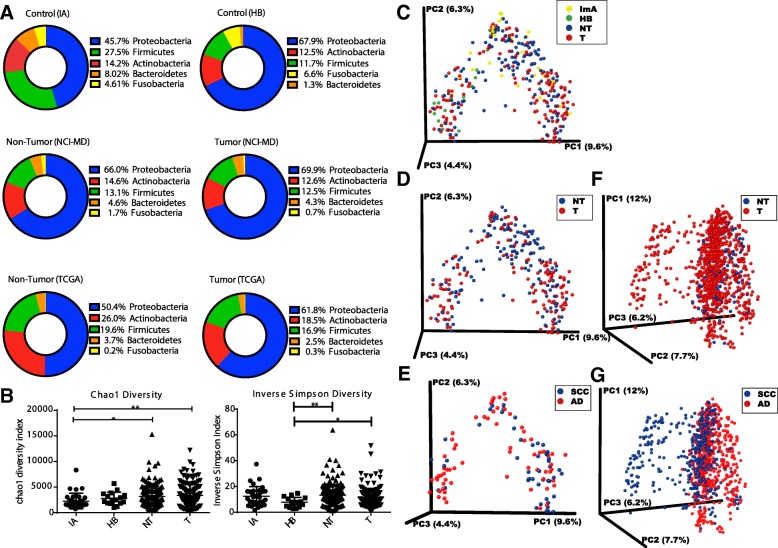
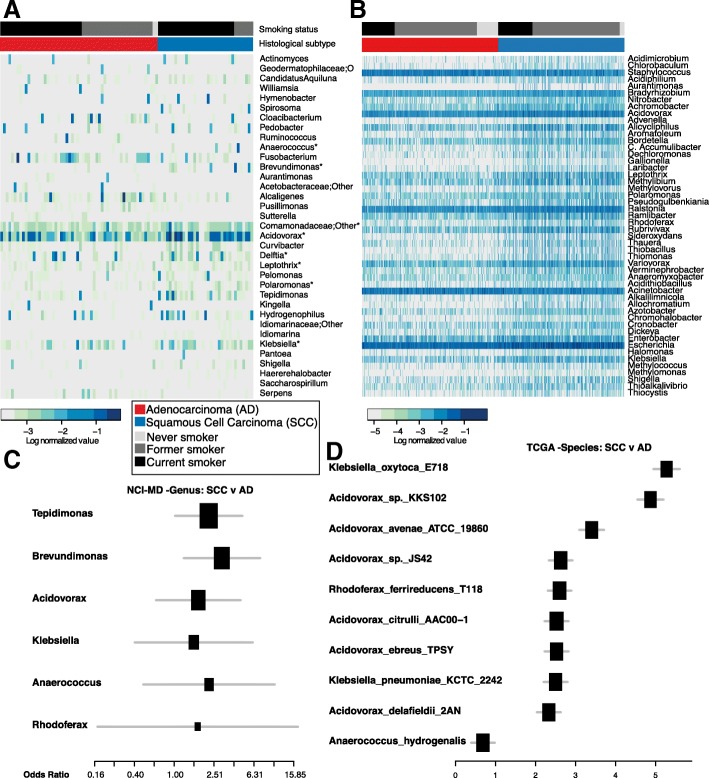
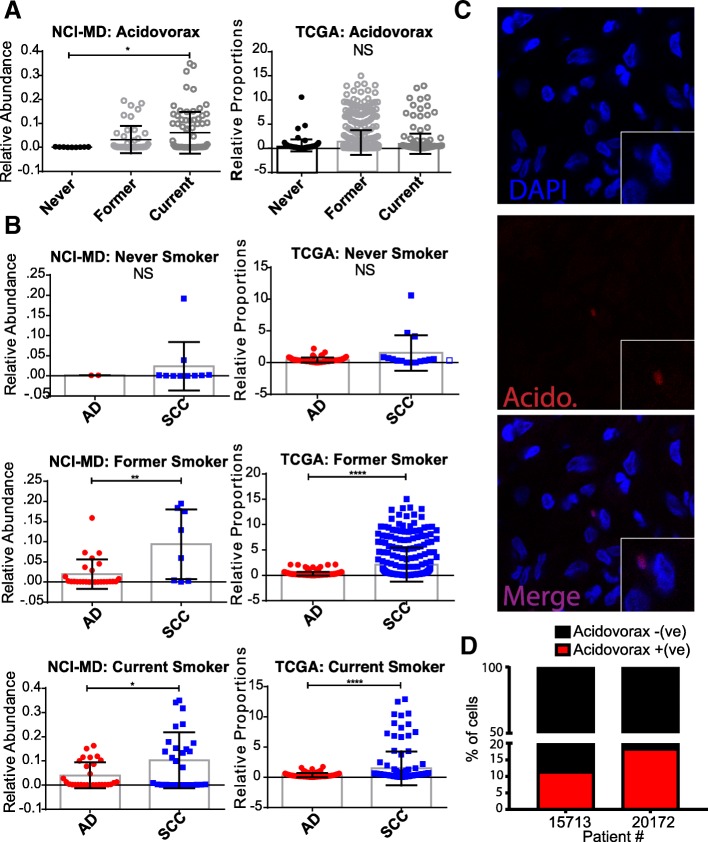
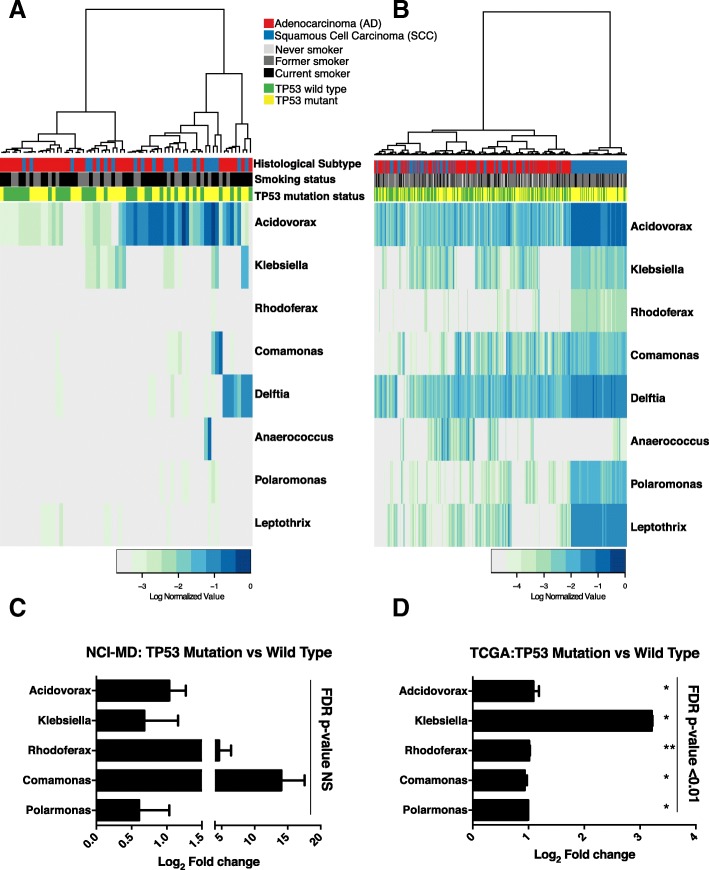
Background: Lung cancer is the leading cancer diagnosis worldwide and the number one cause of cancer deaths. Exposure to cigarette smoke, the primary risk factor in lung cancer, reduces epithelial barrier integrity and increases susceptibility to infections. Herein, we hypothesize that somatic mutations together with cigarette smoke generate a dysbiotic microbiota that is associated with lung carcinogenesis. Using lung tissue from 33 controls and 143 cancer cases, we conduct 16S ribosomal RNA (rRNA) bacterial gene sequencing, with RNA-sequencing data from lung cancer cases in The Cancer Genome Atlas serving as the validation cohort. Results: Overall, we demonstrate a lower alpha diversity in normal lung as compared to non-tumor adjacent or tumor tissue. In squamous cell carcinoma specifically, a separate group of taxa are identified, in which Acidovorax is enriched in smokers. Acidovorax temporans is identified within tumor sections by fluorescent in situ hybridization and confirmed by two separate 16S rRNA strategies. Further, these taxa, including Acidovorax , exhibit higher abundance among the subset of squamous cell carcinoma cases with TP53 mutations, an association not seen in adenocarcinomas. Conclusions: The results of this comprehensive study show both microbiome-gene and microbiome-exposure interactions in squamous cell carcinoma lung cancer tissue. Specifically, tumors harboring TP53 mutations, which can impair epithelial function, have a unique bacterial consortium that is higher in relative abundance in smoking-associated tumors of this type. Given the significant need for clinical diagnostic tools in lung cancer, this study may provide novel biomarkers for early detection.
Overview
The claims and statistics of this paper haven’t been checked yet.
Free: it reads the open-access text and checks the first 5 claims that cite a source we can check. Create a free account to check every claim.
Integrity signals
Registry
Cites
Statistics
Figures
Verification
Claims the paper makes
The claims and statistics of this paper haven’t been checked yet.
Free: it reads the open-access text and checks the first 5 claims that cite a source we can check. Create a free account to check every claim.
Claims other papers make about this one
Each is checked against this paper’s own text: does it say what the citing paper says it does?
The source backs part of the claim, not all of it — or backs it for a different population, condition or comparison.
In the citing paper
“it is also important to use mechanical tissue shearing in the DNA isolation protocol to ensure the complete recovery of DNA from within the cell wall of Gram-positive bacteria—a step not included in most standard DNA isolation protocols (6, 7).”
From The human tumor microbiome is composed of tumor type–specific intracellular bacteria (2020) · cites this paper as [6]
Experimental — accuracy not yet measuredThe cited source says what the claim attributes to it.
In the citing paper
“Intratumor bacteria have been reported in many tumor types (2-19)”
From The human tumor microbiome is composed of tumor type–specific intracellular bacteria (2020) · cites this paper as [6]
Self-check
Percentages, sums and reported differences re-computed from the paper’s own numbers.
The self-check needs the paper’s full text.
Citations
Cites
QIIME allows analysis of high-throughput community sequencing data
Caporaso, J. G., Kuczynski, J., Stombaugh, J., Bittinger, K., Bushman, F. D., Costello, E. K., Fierer, N., Peña, A. G., Goodrich, J. K., Gordon, J. I., et al. (2010) · Nature Methods · doi:10.1038/nmeth.f.303 · Cited by 34,887
(1968) · American Association of Industrial Nurses Journal · doi:10.1177/216507996801601208 · Cited by 8,798
Kozich, J. J., Westcott, S. L., Baxter, N. T., Highlander, S. K., & Schloss, P. D. (2013) · Applied and Environmental Microbiology · doi:10.1128/aem.01043-13 · Cited by 7,112
Comprehensive genomic characterization of squamous cell lung cancers
The Cancer Genome Atlas Research Network (2012) · Nature · doi:10.1038/nature11404 · Cited by 3,994
Commensal Bifidobacterium promotes antitumor immunity and facilitates anti–PD-L1 efficacy
Sivan, A., Corrales, L., Hubert, N., Williams, J. B., Aquino-Michaels, K., Earley, Z. M., Benyamin, F. W., Man Lei, Y., Jabri, B., Alegre, M.-L., et al. (2015) · Science · doi:10.1126/science.aac4255 · Cited by 3,888
Kostic, A. D., Chun, E., Robertson, L., Glickman, J. N., Gallini, C. A., Michaud, M., Clancy, T. E., Chung, D. C., Lochhead, P., Hold, G. L., et al. (2013) · Cell Host & Microbe · doi:10.1016/j.chom.2013.07.007 · Cited by 2,718
Rubinstein, M. R., Wang, X., Liu, W., Hao, Y., Cai, G., & Han, Y. W. (2013) · Cell Host & Microbe · doi:10.1016/j.chom.2013.07.012 · Cited by 2,476
Disordered Microbial Communities in Asthmatic Airways
Hilty, M., Burke, C., Pedro, H., Cardenas, P., Bush, A., Bossley, C., Davies, J., Ervine, A., Poulter, L., Pachter, L., et al. (2010) · PLoS ONE · doi:10.1371/journal.pone.0008578 · Cited by 1,824
Wu, S., Rhee, K.-J., Albesiano, E., Rabizadeh, S., Wu, X., Yen, H.-R., Huso, D. L., Brancati, F. L., Wick, E., McAllister, F., et al. (2009) · Nature Medicine · doi:10.1038/nm.2015 · Cited by 1,812
Escherichia coli Induces DNA Double-Strand Breaks in Eukaryotic Cells
Nougayrède, J.-P., Homburg, S., Taieb, F., Boury, M., Brzuszkiewicz, E., Gottschalk, G., Buchrieser, C., Hacker, J., Dobrindt, U., & Oswald, E. (2006) · Science · doi:10.1126/science.1127059 · Cited by 1,188
Research works printed but not linked: 1
- Sequence read archive. http://www.ncbi.nlm.nih.gov/bioproject/320383.
Cited by
Items 101–200 of 495
Jiang, M., Yang, Z., Dai, J., Wu, T., Jiao, Z., Yu, Y., Kang, N., Chen, W., & Yang, A. (2023) · MedComm · doi:10.1002/mco2.376 · Cited by 39
Differential flora in the microenvironment of lung tumor and paired adjacent normal tissues
Mao, Q., Ma, W., Wang, Z., Liang, Y., Zhang, T., Yang, Y., Xia, W., Jiang, F., Hu, J., & Xu, L. (2020) · Carcinogenesis · doi:10.1093/carcin/bgaa044 · Cited by 39
Metatranscriptomic Analysis of Human Lung Metagenomes from Patients with Lung Cancer
Chang, Y., Hsu, M.-H., Tu, S.-J., Yen, J.-C., Lee, Y.-T., Fang, H., & Chang, J. (2021) · Genes · doi:10.3390/genes12091458 · Cited by 39
“Over the last decade, a number of studies have investigated the microbiome of cancer patients, including patients with oral [4], lung [5], stomach, esophageal [6], pancreatic [7], intestinal [8], and prostate [9] cancers.”
BackgroundProbing the tumor micro(b)environment
Atreya, C. E., & Turnbaugh, P. J. (2020) · Science · doi:10.1126/science.abc1464 · Cited by 39
Hu, Y., Yu, J., Wang, Q., Zhang, L., Chen, X., Cao, Y., Zhao, J., Xu, Y., Jiang, D., Wang, Y., et al. (2020) · Molecular Therapy — Oncolytics · doi:10.1016/j.omto.2020.01.010 · Cited by 38
“The tumor suppressor p53 plays an essential role in the cell cycle, DNA repair, and apoptosis and is the most commonly mutated gene in lung cancer; p53 is frequently inactivated by mutations or deletions during the process of EMT, although the underlying mechanism is not clear.(11,12)”
BackgroundFighting Cancer with Bacteria and Their Toxins
Trivanović, D., Pavelić, K., & Peršurić, Ž. (2021) · International Journal of Molecular Sciences · doi:10.3390/ijms222312980 · Cited by 39
“Acidovorax, Klebsiella, Rhodoferax, Anaerococcus Lung cancer vs health lung tissue Significantly higher abundance of in SCC than in adenocarcinoma [36]”
BackgroundConvergent alteration of lung tissue microbiota and tumor cells in lung cancer
Dong, H., Tan, Q., Xu, Y., Zhu, Y., Yao, Y., Wang, Y., Li, C., Li, H., Zhang, G., Xiong, Y., et al. (2021) · iScience · doi:10.1016/j.isci.2021.103638 · Cited by 39
McLean, A. E. B., Kao, S. C.-H., Barnes, D. J., WONG, K. K. H., Scolyer, R. A., Cooper, W. A., & Kohonen‐Corish, M. R. J. (2022) · Lung Cancer · doi:10.1016/j.lungcan.2022.01.011 · Cited by 38
A clinicians’ review of the respiratory microbiome
Campbell, C. D., Barnett, C. R., & Sulaiman, I. (2022) · Breathe · doi:10.1183/20734735.0161-2021 · Cited by 38
Influence of Microbiota on Tumor Immunotherapy
Yu, X., Li, W., Li, Z., Wu, Q., & Sun, S. (2024) · International Journal of Biological Sciences · doi:10.7150/ijbs.91771 · Cited by 37
“In particular, they detected an abundance of the Acidovorax genus in lung biopsy specimens from individuals with squamous cell carcinoma, along with the further enrichment of a comparable taxon in lung biopsies of patients with squamous cell carcinoma and TP53 mutations [225].”
BackgroundMicrobial dysbiosis and epigenetics modulation in cancer development – A chemopreventive approach
Haque, S., Raina, R., Afroze, N., Hussain, A., Alsulimani, A., Singh, V., Mishra, B. N., Kaul, S., & Kharwar, R. N. (2021) · Seminars in Cancer Biology · doi:10.1016/j.semcancer.2021.06.024 · Cited by 38
Exploration of lung mycobiome in the patients with non-small-cell lung cancer
Zhao, Y., Yi, J., Xiang, J., Jia, W. P., Chen, A., Chen, L., Zheng, L., Zhou, W. H., Wu, M., Yu, Z., et al. (2023) · BMC Microbiology · doi:10.1186/s12866-023-02790-4 · Cited by 37
Yu, H., Du, Y., He, Y., Sun, Y., Li, J., Jia, B., Chen, J., Peng, X., An, T., Li, J., et al. (2025) · Cell Host & Microbe · doi:10.1016/j.chom.2025.06.013 · Cited by 36
Yuan, X., Wang, Z., Li, C., Lv, K., Tian, G., Tang, M., Ji, L., & Yang, J. (2022) · Frontiers in Microbiology · doi:10.3389/fmicb.2022.1007831 · Cited by 35
Haldar, S., Jadhav, S. R., Gulati, V., Beale, D. J., Balkrishna, A., Varshney, A., Palombo, E. A., Karpe, A. V., & Shah, R. (2023) · FEMS Microbiology Ecology · doi:10.1093/femsec/fiad103 · Cited by 36
“Epithelial cell m utations wer e found to lead to lung microbiome dysbiosis in patients diagnosed with squamous cell carcinoma (Greathouse et al. 2018 ).”
Thapa, R., Magar, A. T., Shrestha, J., Panth, N., Idrees, S., Sadaf, T., Bashyal, S., Elwakil, B. H., Sugandhi, V. V., Rojekar, S. V., et al. (2024) · MedComm · doi:10.1002/mco2.70018 · Cited by 34
Harnessing the microbiome for cancer therapy
Hajjar, R., Mars, R. A. T., & Kashyap, P. (2026) · Nature Reviews Microbiology · doi:10.1038/s41579-025-01268-6 · Cited by 34
The microbiome of lung cancer tissue and its association with pathological and clinical parameters.
Kim, O., Choi, B.-Y., Kim, D. K., Kim, N. H., Rho, J. K., Sul, W. J., & Lee, S. W. (2022) · PubMed Central · Cited by 36
Characterizing microbiota and metabolomics analysis to identify candidate biomarkers in lung cancer
Liu, B., Li, Y., Suo, L., Zhang, W., Cao, H., Wang, R., Luan, J., Xiaofeng, Y., Dong, L., Wang, W., et al. (2022) · Frontiers in Oncology · doi:10.3389/fonc.2022.1058436 · Cited by 34
“Moreover, studies had demonstrated a lower alpha diversity of lung microbiota in LC patients compared with that in patients with non-lung cancer (10).”
ResultZheng, L., Xu, J., Sai, B., Zhu, Y., Wang, L., Yin, N., Yu, F., Zhou, W. H., Wu, M., Tang, J., et al. (2020) · Frontiers in Oncology · doi:10.3389/fonc.2020.531131 · Cited by 33
Exploring the role of respiratory microbiome in lung cancer: A systematic review
Perrone, F., Belluomini, L., Mazzotta, M., Bianconi, M., Noia, V. D., Meacci, F., Montrone, M., Pignataro, D., Prelaj, A., Rinaldi, S., et al. (2021) · Critical Reviews in Oncology/Hematology · doi:10.1016/j.critrevonc.2021.103404 · Cited by 33
Masuhiro, K., Tamiya, M., Fujimoto, K., Koyama, S., Naito, Y., Osa, A., Hirai, T., Suzuki, H., Okamoto, N., Shiroyama, T., et al. (2022) · JCI Insight · doi:10.1172/jci.insight.157915 · Cited by 33
Tumor Microbiome in Nasopharyngeal Carcinoma and Its Association With Prognosis
Zhong, G., Wei, W., Liao, W., Wang, R., Peng, Y., Zhou, Y., Huang, X., Xian, S., Peng, S., Zhang, Z., et al. (2022) · Frontiers in Oncology · doi:10.3389/fonc.2022.859721 · Cited by 33
“Lung squamous cell carcinoma with TP53 mutations possesses a specific bacterial consortium, and Acidovorax had a particularly higher abundance in smoking-related lung cancers (7).”
BackgroundAwareness of intratumoral bacteria and their potential application in cancer treatment
Liang, Y., Li, Q., Liu, Y., Guo, Y., & Li, Q. (2023) · Discover Oncology · doi:10.1007/s12672-023-00670-x · Cited by 33
Human Microbiome and Its Medical Applications
Zhang, Y., Zhou, L., Xia, J., Dong, C., & Luo, X. (2022) · Frontiers in Molecular Biosciences · doi:10.3389/fmolb.2021.703585 · Cited by 32
“In squamous cell carcinoma, a group of taxa including Acidovorax and Klebsiella were enriched more significantly in patients carrying the TP53 mutation, indicating that microbiome-genome factors played an important role in tumorigenesis (Greathouse et al., 2018).”
BackgroundIntratumoral microbiota: new frontiers in tumor immunity
Zhang, Z., Liao, Y., & Tang, D. (2022) · Carcinogenesis · doi:10.1093/carcin/bgac063 · Cited by 32
Untangling the web of intratumor microbiota in lung cancer
Liu, W. L., Xu, J., Pi, Z., Chen, Y., Jiang, G., Wan, Y., & Mao, W. (2023) · Biochimica et Biophysica Acta (BBA) - Reviews on Cancer · doi:10.1016/j.bbcan.2023.189025 · Cited by 31
Advancements in understanding tumor‑resident bacteria and their application in cancer therapy
Luo, Y., Huang, X., Wang, R., Lin, Y., Sun, J., Li, K., Wang, D. Y., Yan, Y., & Qiao, Y. (2025) · Military Medical Research · doi:10.1186/s40779-025-00623-1 · Cited by 31
“Additionally, genotypic variations in cancer cells may influence microbial preferences, reflecting a complex interplay between host genetics and microbial selection [14, 15, 21, 93].”
Translocation and Dissemination of Gut Bacteria after Severe Traumatic Brain Injury
Yang, W., Yuan, Q., Li, Z., Du, Z., Wu, G., Yu, J., & Hu, J. (2022) · Microorganisms · doi:10.3390/microorganisms10102082 · Cited by 31
“Another study found that non-tumor adjacent or tumor tissue had higher alpha diversity than normal lung [32].”
BackgroundDuttagupta, S., Hakozaki, T., Routy, B., & Messaoudene, M. (2023) · Current Oncology · doi:10.3390/curroncol30110681 · Cited by 31
“In squamous cell carcinoma cases, Greathouse and colleagues noted that patients with tumors harboring the epithelial-function-impairing TP53 mutations have a unique bacterial composition rich with certain taxa, including Acidovorax , the genus which is typically enriched in smokers [53].”
BackgroundA Critical Review on the Role of Probiotics in Lung Cancer Biology and Prognosis
Ashique, S., Mishra, N., Garg, A., Kumar, N., Khan, Z., Mohanto, S., Chellappan, D. K., Farid, A., & Taghizadeh‐Hesary, F. (2024) · Archivos de Bronconeumología · doi:10.1016/j.arbres.2024.04.030 · Cited by 30
Xia, X., Chen, J., Cheng, Y., Chen, F., Lu, H., Liu, J., Wang, L., Pu, F., Wang, Y., Liu, H., et al. (2022) · Frontiers in Cellular and Infection Microbiology · doi:10.3389/fcimb.2022.1024867 · Cited by 31
“Recent evidence suggests that dysbiosis of the lung microbiota may modulate the risk of malignancy at multiple levels (Greathouse et al., 2018).”
BackgroundThe human microbiome: A promising target for lung cancer treatment
Sun, Y. H., Wen, M., Liu, Y., Wang, Y., Jing, P., Gu, Z., Jiang, T., & Wang, W. (2023) · Frontiers in Immunology · doi:10.3389/fimmu.2023.1091165 · Cited by 30
“Acidovorax is enriched in SCC with TP53 mutations, but not in AC (90).”
BackgroundMicrobiomes, Their Function, and Cancer: How Metatranscriptomics Can Close the Knowledge Gap
Aitmanaitė, L., Širmonaitis, K., & Russo, G. (2023) · International Journal of Molecular Sciences · doi:10.3390/ijms241813786 · Cited by 30
“In particular, a specific association was reported between Acidovarax and SCC patients, strongly mediated by smoking status [115], and between Capnocytophaga with AC patients [124].”
BackgroundMoné, Y., Earl, J. P., Król, J. E., Ahmed, A., Sen, B., Ehrlich, G. D., & Lapides, J. R. (2023) · Frontiers in Cellular and Infection Microbiology · doi:10.3389/fcimb.2023.1123228 · Cited by 30
“…using the Paci fi c Biosciences (PacBio) single-molecule real-time (SMRT) sequencing technology (Paci fi c Biosciences, Menlo Park, CA, USA) to obtain the full-length 16S ribosomal RNA (rRNA) gene sequences as previously described (Earl et al., 2018; Greathouse et al., 2018; Socarras et al., 2021).”
Self-citationThe intratumoural microbiota in cancer: new insights from inside
An, Y., Zhang, W., Liu, T., Wang, B., & Cao, H. (2021) · Biochimica et Biophysica Acta (BBA) - Reviews on Cancer · doi:10.1016/j.bbcan.2021.188626 · Cited by 29
Intratumoural microbiota: from theory to clinical application
Ji, H., Jiang, Z., Wei, C., Ma, Y., Zhao, J., Wang, F., Zhao, B., Wang, D., & Tang, D. (2023) · Cell Communication and Signaling · doi:10.1186/s12964-023-01134-z · Cited by 29
Guan, S.-W., Lin, Q., Wu, X., & Yu, H. (2023) · Journal of Translational Medicine · doi:10.1186/s12967-023-04411-0 · Cited by 29
“In LUSC, certain microbial species were more abundant in TP53-mutated tumors, indicating a possible association between TP53 mutations and tumor microbial enrichment [78].”
BackgroundSputum Microbiome Composition in Patients with Squamous Cell Lung Carcinoma
Baranova, E. D., Druzhinin, V. G., Matskova, L. V., Сергеевич, Д. П., Volobaev, V. P., Minina, V. I., Викторович, Л. А., & Titov, V. A. (2022) · Life · doi:10.3390/life12091365 · Cited by 28
“In general, the sputum microbiota in men with lung cancer had a significant decrease in beta diversity, which is consistent with the results of previous studies [13,21,33,34].”
ResultIntratumor microbiota: a novel tumor component
Gong, Y., Huang, X., Wang, M., & Liang, X. (2023) · Journal of Cancer Research and Clinical Oncology · doi:10.1007/s00432-023-04576-7 · Cited by 28
“According to one study that used both primary lung tissue samples and a validation cohort from The Cancer Genome Atlas (TCGA), Proteobacteria were found to be more abundant in the lung cancer microbiome overall, with increased Acidovorax (phylum Proteobacteria) abundance specifically found in squamous cell carcinoma w…”
MethodLi, Y., Ma, A., Johnson, W. E., Eng, C., De, S., Jiang, S., Li, Z., Spakowicz, D. J., & Ma, Q. (2025) · Nature Methods · doi:10.1038/s41592-025-02807-y · Cited by 27
The Microbiome’s Influence on Head and Neck Cancers
Dorobisz, K., Dorobisz, T. A., & Zatoński, T. (2023) · Current Oncology Reports · doi:10.1007/s11912-022-01352-7 · Cited by 27
Garg, S., Sharma, N., Bharmjeet, & Das, A. (2023) · Cancer Reports · doi:10.1002/cnr2.1892 · Cited by 27
Microbiota in tumors: new factor influencing cancer development
Jiang, H., Li, L., Bao, Y., Cao, X., & Ma, L. (2024) · Cancer Gene Therapy · doi:10.1038/s41417-024-00833-0 · Cited by 27
“In comparison to lung adenocarcinoma, squamous cell carcinoma of the lung harbors a more diverse intratumoral microbiome, with higher relative abundances of Acidovorax , Klebsiella , and Anaerococcus [73].”
Targeting mutant p53 in cancer: the latest insights
Agostino, S. D., Fontemaggi, G., Strano, S., Blandino, G., & D’Orazi, G. (2019) · Journal of Experimental & Clinical Cancer Research · doi:10.1186/s13046-019-1302-0 · Cited by 27
Targeting the Tumor Microbiota in Cancer Therapy Basing on Nanomaterials
Niu, Y., Feng, J., Ma, J., Xiao, T., & Yuan, W. (2025) · Exploration · doi:10.1002/exp.20210185 · Cited by 27
“Among them, Acidovorax is more abundant in smokers [5].”
McKeon, M. G., Gallant, J., Kim, Y. J., & Das, S. R. (2022) · Cancers · doi:10.3390/cancers14133120 · Cited by 26
Zhang, K., He, C., Qiu, Y., Li, X., Hu, J., & Fu, B. (2023) · Journal of Evidence Based Dental Practice · doi:10.1016/j.jebdp.2023.101897 · Cited by 26
Kim, G., Park, C.-H., Yoon, Y. K., Park, D., Lee, J. E., Lee, D., Sun, P., Park, S., Yun, C., Kang, D. H., et al. (2024) · Scientific Reports · doi:10.1038/s41598-024-52296-w · Cited by 26
“In the alpha-diversity analysis, evenness, observed features, and Shannon index were significantly higher in lung cancer patients than in benign lung disease patients, which is similar to previous findings 18,33,34 .”
ResultThe Composition Alteration of Respiratory Microbiota in Lung Cancer
Zheng, X. E., Sun, X., Liu, Q., Huang, Y., & Yuan, Y. (2020) · Cancer Investigation · doi:10.1080/07357907.2020.1732405 · Cited by 27
“Bacteroidetes, Proteobacteria, and Firmicutes have also been identified by various research groups, though with different relative abundances (21,23,25).”
BackgroundA Multi-Omics Study of Familial Lung Cancer: Microbiome and Host Gene Expression Patterns
Chen, Y., Huang, Y., Ding, X., Yang, Z., He, L. M., Ning, M., Yang, Z., He, D., Yang, L., Liu, Z., et al. (2022) · Frontiers in Immunology · doi:10.3389/fimmu.2022.827953 · Cited by 27
“Other groups also reported increased microbiome richness and diversity in cancer tissue (23, 25).”
BackgroundResultInfluentialXu, K., Motiwala, Z. Y., Corona‐Avila, I., Makhanasa, D., Alkahalifeh, L., & Khan, M. W. (2025) · Technology in Cancer Research & Treatment · doi:10.1177/15330338251331960 · Cited by 25
“Acidovorax, Klebsiella, and Anaerococcus are relatively abundant in squamous cell carcinoma, 58 whereas Acinetobacter, Brevundimonas, and Propionibacterium increase in adenocarcinomas.”
Self-citationWu, W., Jiao, X., Song, W.-X., Wu, P., Xiao, P.-Q., Huang, X.-F., Wang, K., & Zhan, S. (2023) · Frontiers in Endocrinology · doi:10.3389/fendo.2023.1187882 · Cited by 26
“malignant cells to anticancer drugs, especially those that induce DNA damage (82) and TP53 mutations are more common than average in LUSC (83).”
BackgroundAnkudavičius, V., Nikitina, D., Lukoševičius, R., Tilinde, D., Šaltenienė, V., Poškienė, L., Miliauskas, S., Skiecevičienė, J., Žemaitis, M., & Kupčinskas, J. (2024) · International Journal of Molecular Sciences · doi:10.3390/ijms25042323 · Cited by 25
“Previous studies indicated that NSCLC patients’ gut–lung microbiome composition varies according to aging; smoking; COPD; the histological type, stage, and grade of lung cancer; and the PD-L1 expression levels on tumor cells [16,32,40].”
BackgroundLiu, W. L., Pi, Z., Wang, X., Shang, C., Song, C., Wang, R., He, Z., Zhang, X., Wan, Y., & Mao, W. (2024) · Critical Reviews in Oncology/Hematology · doi:10.1016/j.critrevonc.2024.104322 · Cited by 25
The Interaction Between the Microbiome and Tumors
Zong, Y., Zhou, Y., Liao, B., Liao, M., Shi, Y., Yu, W., Huang, Y., Zhou, X., Cheng, L., & Ren, B. (2021) · Frontiers in Cellular and Infection Microbiology · doi:10.3389/fcimb.2021.673724 · Cited by 25
“Guerrero-Preston et al. (2016) found that head and neck squamous cell carcinomas patients exhibited a significant loss in diversity ofmicrobiota in the saliva.”
BackgroundCheng, J., Zhou, L., & Wang, H. (2024) · Frontiers in Cellular and Infection Microbiology · doi:10.3389/fcimb.2024.1296295 · Cited by 24
“Acidovorax was also found to be more prevalent in lung cancer tissue from TP53-mutated squamous cell carcinoma patients, according to K Leigh Greathouse et al. (Greathouse et al., 2018).”
BackgroundResultStone, J. K., von Muhlinen, N., Zhang, C., Robles, A. I., Flis, A. L., Vega-Valle, E., Miyanaga, A., Matsumoto, M., Greathouse, K. L., Cooks, T., et al. (2024) · Oncogenesis · doi:10.1038/s41389-024-00513-6 · Cited by 24
“Our group identi fi ed Acidovorax temperans as enriched in lung cancer which led us to hypothesize that A. temperans may play a functional role in lung cancer development [13].”
BackgroundMethodInfluentialSelf-citationGreathouse, K. L., Stone, J. K., Vargas, A. J., Choudhury, A., Padgett, R. N., White, J. R., Jung, A., & Harris, C. C. (2024) · Scientific Reports · doi:10.1038/s41598-023-48862-3 · Cited by 23
Self-citationShen, W., Tang, D., Wan, P., Peng, Z., Sun, M., Guo, X., & Liu, R. (2022) · Applied Microbiology and Biotechnology · doi:10.1007/s00253-022-11921-2 · Cited by 23
The impact of microbiome dysbiosis on T cell function within the tumor microenvironment (TME)
DiPalma, M. P., & Blattman, J. N. (2023) · Frontiers in Cell and Developmental Biology · doi:10.3389/fcell.2023.1141215 · Cited by 24
“Several cancers, including breast, lung, ovarian, colorectal, melanoma, brain, prostate, and bone, have exhibited the presence of specific microbial species contributing to a dysbiotic state within tumor tissue (Sfanos et al., 2008; Apostolou et al., 2011; Castellarin et al., 2012; Thompson et al., 2017; Costantini et…”
BackgroundPolinário, G., Primo, L. M. D. G., Rosa, M. A. B. C., Marin-Dett, F. H., Barbugli, P. A., Roque‐Borda, C. A., & Pavan, F. R. (2023) · Frontiers in Microbiology · doi:10.3389/fmicb.2023.1183247 · Cited by 23
Bano, Y., Shrivastava, A., Shukla, P. K., Chaudhary, A. A., Khan, S.-U.-D., & Khan, S. (2024) · Critical Reviews in Microbiology · doi:10.1080/1040841x.2024.2324864 · Cited by 23
“…characterize the bacterial community in the complex human-like samples (erb-Downward et al. 2011; liu et al. 2018a; Scheiermann and Klinman 2017; greathouse et al. 2018). the microbial kingdom such as bacteria, archaea, viruses, fungi, or protists has characterized highly conserved genomic…”
Agents of cancer immunosurveillance: HSPs and dsDNA
Nayak, D. A., & Binder, R. J. (2022) · Trends in Immunology · doi:10.1016/j.it.2022.03.004 · Cited by 23
Bacterial DNA involvement in carcinogenesis
Yangyanqiu, W., & Han, S. (2022) · Frontiers in Cellular and Infection Microbiology · doi:10.3389/fcimb.2022.996778 · Cited by 22
“These same observations were validated in the TCGA dataset (AD = 485, SCC = 489) (Mann − Whitney FDR corrected P value 0.05).”
InfluentialMicrobial Biomarkers for Lung Cancer: Current Understandings and Limitations
Huang, J., & Huang, J. (2022) · Journal of Clinical Medicine · doi:10.3390/jcm11247298 · Cited by 23
“Interestingly, these studies also reported that the presence of Acidovorax is highly associated with TP53 mutations in lung cancers [39,73,92].”
BackgroundMethodInfluentialDistinct respiratory microbiota associates with lung cancer clinicopathological characteristics
Zheng, X., Lu, X., & Hu, Y. (2023) · Frontiers in Oncology · doi:10.3389/fonc.2023.847182 · Cited by 22
“, increased Proteobacteria and decreased Firmicutes and Fusobacterium were observed in lung cancer tissues compared with non-cancer population control lung tissues (24).”
BackgroundNon-immune cell components in tumor microenvironment influencing lung cancer Immunotherapy
Zhang, J., Liu, S., Chen, X., Xu, X., & Xu, F. (2023) · Biomedicine & Pharmacotherapy · doi:10.1016/j.biopha.2023.115336 · Cited by 22
The application of multi-omics in the respiratory microbiome: Progresses, challenges and promises
Gao, J., Yi, X., & Wang, Z. (2023) · Computational and Structural Biotechnology Journal · doi:10.1016/j.csbj.2023.10.016 · Cited by 22
“Through a 16 S rRNA gene sequencing on the lung tissue from lung cancer patients along with the RNA-sequencing data from the Cancer Genome Atlas as validation, Greathouse et al. demonstrated an association between Acidovorax and lung squamous cell carcinoma with TP53 mutations [109].”
MethodCheng, W., He, L., Ren, W., Yue, T., Xie, X., Sun, J., Chen, X., Wu, Z., Li, F., & Piao, J. (2023) · Nano TransMed · doi:10.1016/j.ntm.2023.100008 · Cited by 22
Li, J., Li, Y., Zhou, L., Li, H., Wan, T., Tang, J. H., Zhou, L., Xie, H., & Wang, L. (2024) · Virulence · doi:10.1080/21505594.2024.2313410 · Cited by 22
“Conversely, changes in the abundance and composition of microorganisms at specific sites under diseased conditions can also lead to further disease progression, and can serve as potential biomarkers of disease [25].”
BackgroundYang, K., Wang, S. L., Ding, Z., Zhang, K., Zhu, W., Wang, H., Pan, M., Li, X., Wang, H., & Yu, Z. (2024) · Frontiers in Cellular and Infection Microbiology · doi:10.3389/fcimb.2024.1397989 · Cited by 23
Elucidating cellular origins and TME dynamic evolution in NSCLC through multi-omics technologies
Chao, N. N., & Zhang, L. (2025) · Biochimica et Biophysica Acta (BBA) - Reviews on Cancer · doi:10.1016/j.bbcan.2025.189425 · Cited by 22
Intratumoral microbiota remodeling of the tumor microenvironment impact solid tumor immunotherapy
Jia, J., Gao, W., Wang, C., Liu, L., Li, Y., Sun, Z., Yang, C., Chen, Y., Yu, H., & Cheng, Y. (2025) · Cell Death and Disease · doi:10.1038/s41419-025-08211-w · Cited by 21
Comprehensive analysis of microbiota signature across 32 cancer types
Yang, X., An, H., He, Y., Fu, G., & Jiang, Z. (2023) · Frontiers in Oncology · doi:10.3389/fonc.2023.1127225 · Cited by 22
Methionine-producing tumor micro(be) environment fuels growth of solid tumors
Vega, A. A., Marshall, E. A., Noonan, A. J. C., Filho, F. S. L., Yang, J., Stewart, G. L., Johnson, F. D., Vucic, E. A., Pewarchuk, M. E., Shah, P. P., et al. (2023) · Cellular Oncology · doi:10.1007/s13402-023-00832-7 · Cited by 21
“There have been very few studies of microbial lung tumor microbiomes, and these have primarily focussed on describing bacterial diversity in cancer subtypes [15, 32, 45].”
InfluentialZhang, H., Liu, C., Wang, S., Wang, Q., Xu, F., Jiang, H., Li, X., Luo, C., Zhang, L., Hou, F., et al. (2024) · eLife · doi:10.7554/elife.95453.3 · Cited by 21
The bacterial microbiota of Hunner lesion interstitial cystitis/bladder pain syndrome
Nickel, J. C., Ehrlich, G. D., Król, J. E., Ahmed, A., Sen, B., Bhat, A., Mell, J. C., Doiron, R. C., Kelly, K., & Earl, J. P. (2021) · British Journal of Urology · doi:10.1111/bju.15519 · Cited by 21
Self-citationReliable detection of Host-Microbe Signatures in cancer using PRISM
Ghaddar, B., Blaser, M. J., & De, S. (2026) · Cancer Cell · doi:10.1016/j.ccell.2026.01.007 · Cited by 20
SARS-CoV-2 Infection and Lung Cancer: Potential Therapeutic Modalities
Gupta, I., Rizeq, B. R., Elkord, E., Vranić, S., & Moustafa, A. A. (2020) · Cancers · doi:10.3390/cancers12082186 · Cited by 20
Crosstalk between the lung microbiome and lung cancer
Meng, Y., Mao, Y., Tang, Z., Qiu, X., Bajinka, O., Tan, Y., & Song, Z. (2023) · Microbial Pathogenesis · doi:10.1016/j.micpath.2023.106062 · Cited by 21
The role of extratumoral and intratumoral microorganisms in cancer immunotherapy
Du, Y., Liu, L., Ma, W., Yan, W., Mao, W., Du, Y., Cui, K., Pu, Y., Li, Z., Sansonetti, P. J., et al. (2023) · The Innovation Life · doi:10.59717/j.xinn-life.2023.100016 · Cited by 21
Zhou, Y., Zeng, H., Liu, K., Pan, H., Wang, B., Zhu, M., Wang, J., Wang, H., Chen, H., Shen, D., et al. (2023) · BMC Microbiology · doi:10.1186/s12866-023-02882-1 · Cited by 20
“The human microbiota is dynamic and influenced by geography, diet, host genes, and other factors, but there are core taxa and functions that remain similar across individuals [9, 26].”
BackgroundDissection of intratumor microbiome–host interactions at the single-cell level in lung cancer
Ma, Y.-J., Sun, Y., Wang, L., Xu, W., Fan, X., Ding, J., Heeschen, C., Wu, W., Zheng, X., & Liu, N. (2024) · hLife · doi:10.1016/j.hlife.2024.09.001 · Cited by 20
“Furthermore, it was observed that the Klebsiella , Comamonas , Acidovorax , Polaro-monas , and Rhodoferax genera are more commonly detected in small-cell carcinoma (SCC) rather than adenocarcinoma [17].”
Cancer-Type-Specific Bacteria: Freeloaders or Partners?
Greathouse, K. L., Stone, J. K., & Harris, C. C. (2020) · Cancer Cell · doi:10.1016/j.ccell.2020.06.017 · Cited by 20
Self-citationLung Tissue Microbiome Is Associated With Clinical Outcomes of Idiopathic Pulmonary Fibrosis
Yoon, H., Moon, S.-J., & Song, J. W. (2021) · Frontiers in Medicine · doi:10.3389/fmed.2021.744523 · Cited by 20
“However, in studies of lung tissue microbiome of other diseases, it is common to use normal tissue of lung cancer tissue as normal control (49, 50).”
BackgroundCirculating Bacterial DNA as Plasma Biomarkers for Lung Cancer Early Detection
Zhou, H., Liao, J., Leng, Q., Chinthalapally, M., Dhilipkannah, P., & Jiang, F. (2023) · Microorganisms · doi:10.3390/microorganisms11030582 · Cited by 20
“High levels of Acidovorax were found in lung squamous cell carcinoma tissues with p53 mutations [3].”
BackgroundKim, D.-J., Yu, Y., Jung, K. S., Kim, Y. H., & Kim, J. (2023) · Cancer Research and Treatment · doi:10.4143/crt.2023.330 · Cited by 19
“are abundant in lung cancer patients who smoked [38], and Fusobacterium nucleatum may promote metastasis of colorectal cancer [39].”
Han, W., Wang, N., Han, M., Liu, X., Sun, T., & Xu, J. (2023) · Cancer Medicine · doi:10.1002/cam4.6503 · Cited by 19
Shi, S., Chu, Y., Liu, H., Yu, L., Sun, D., Yang, J., Tian, G., Ji, L., Zhang, C., & Lu, X. (2024) · Microbial Cell · doi:10.15698/mic2024.02.813 · Cited by 19
Xin, H., Zou, J., Sun, R., Hu, Z., Chen, Z., Luo, C., Zhou, Z., Wang, P., Li, J., Yu, S., et al. (2024) · Journal of Gastroenterology · doi:10.1007/s00535-024-02090-2 · Cited by 19
“Many types of tumors have been characterized by their unique microbiome [7, 22–25].”
Enterobacteria impair host p53 tumor suppressor activity through mRNA destabilization
Aschtgen, M., Fragkoulis, K., Sanz, G., Normark, S. J., Selivanova, G., Henriques‐Normark, B., & Peuget, S. (2022) · Oncogene · doi:10.1038/s41388-022-02238-5 · Cited by 19
“In line with this hypothesis, recent metagenomics analysis of lung cancer microbiota have shown significant differences in bacterial populations associated with p53 wild-type versus p53-mutant tumors [61].”
ResultImpact of the Lung Microbiota on Development and Progression of Lung Cancer
Belaïd, A., Roméo, B., Rignol, G., Benzaquen, J., Audoin, T., Vouret‐Craviari, V., Brest, P., Varraso, R., von Bergen�, M., Marquette, C., et al. (2024) · Cancers · doi:10.3390/cancers16193342 · Cited by 18
Dissimilarity of Airway and Lung Tissue Microbiota in Smokers Undergoing Surgery for Lung Cancer
Reinhold, L., Möllering, A., Wallis, S., Palade, E., Schäfer, K., Drömann, D., Rupp, J., Graspeuntner, S., & Dalhoff, K. (2020) · Microorganisms · doi:10.3390/microorganisms8060794 · Cited by 18
“suggested a role of microbiota in carcinogenesis, describing an interaction between smoking, smoking-related TP53 mutations in lung cells and microbiota that are enriched in this environment [13].”
BackgroundAzulay, E. E., Cooks, T., & Elkabets, M. (2020) · Cancer Immunology Immunotherapy · doi:10.1007/s00262-019-02450-5 · Cited by 18
Self-citationBourbonne, V., Geier, M., Schick, U., & Lucia, F. (2022) · Biomedicines · doi:10.3390/biomedicines10061237 · Cited by 17
Wang, H., Hu, J., Wu, J., Ji, P., Shang, A., & Li, D. (2022) · Cancers · doi:10.3390/cancers14215394 · Cited by 17
“Numerous studies have focused on the distinctions between microbiome in tumor tissues and the function of intratumor or tumor-associated bacteria [11,12].”
BackgroundLung microbiome: an emerging player in lung cancer pathogenesis and progression
Karvela, A., Veloudiou, O.-Z., Karachaliou, A., Kloukina, T., Gomatou, G., & Kotteas, E. A. (2023) · Clinical & Translational Oncology · doi:10.1007/s12094-023-03139-z · Cited by 17
Oral Microbiota and Carcinogenesis: Exploring the Systemic Impact of Oral Pathogens
Nikolić, N., Pucar, A., Tomić, U., Petrović, S., Mihailović, Đ., Jovanović, A., & Radunović, M. (2025) · Pathogens · doi:10.3390/pathogens14121233 · Cited by 16
Su, K., Gao, Y., & He, J. (2023) · Translational Lung Cancer Research · doi:10.21037/tlcr-23-231 · Cited by 16
“Differences in microbiome diversity between lung tumors and matched non-malignant specimens have also been reported; however, these results were inconsistent between different studies (24,30,31).”
Metadata
- Authors
- Greathouse, K. L., White, J. R., Vargas, A. J., Bliskovsky, V. V., Beck, J. A., von Muhlinen, N., Polley, E. C., Bowman, E. D., Khan, M. A., Robles, A. I., Cooks, T., Ryan, B. M., Padgett, N., Dzutsev, A. H., Trinchieri, G., Pineda, M. A., Bilke, S., Meltzer, P. S., Hokenstad, A. N., Stickrod, T. M., Walther-Antonio, M. R., Earl, J. P., Mell, J. C., Krol, J. E., Balashov, S. V., Bhat, A. S., Ehrlich, G. D., Valm, A., Deming, C., Conlan, S., Oh, J., Segre, J. A., & Harris, C. C.
- Affiliations
- National Institutes of Health (US)
- Resphera Biosciences (US)
- Mayo Clinic (US)
- Drexel University (US)
- Jackson Laboratory (US)
- Corresponding author
- Harris, Curtis C.
- ORCID
- Greathouse, K. Leigh
- White, James R.
- Beck, Jessica A.
- Polley, Eric C.
- Bowman, Elise D.
- Robles, Ana I.
- Cooks, Tomer
- Ryan, Bríd M.
- Trinchieri, Giorgio
- Pineda, Marbin A.
- Bilke, Sven
- Meltzer, Paul S.
- Walther-Antonio, Marina R.
- Earl, Joshua P.
- Mell, Joshua C.
- Bhat, Archana S.
- Ehrlich, Garth D.
- Valm, Alex
- Conlan, Sean
- Oh, Julia
- Harris, Curtis C.
- Venue
- Genome Biology
- Published
- 2018-08-24
- Volume
- 19
- Issue
- 1
- Pages
- 123-123
- ISSN
- 1465-6906 (ISSN-L)
- 1474-760X
- PMC
- PMC6109311
- OpenAlex
- W2888696120
- Cited by
- 446
- References
- 55
- Citations by year
- 2026: 39 · 2025: 83 · 2024: 70 · 2023: 68 · 2022: 72 · 2021: 56 · 2020: 41 · 2019: 16
- FWCI
- 10.05
- Type
- journal article
- Language
- en
- Update notices
- correction (2020-02-20)
- Open access
- gold
- doi.org
- Licence
- cc-by
- creativecommons.org/licenses/by/4.0/ (tdm)
- creativecommons.org/licenses/by/4.0/ (vor)
- Locations
- Genome biology (publishedVersion, cc-by)
- Europe PMC (PubMed Central) (publishedVersion, other-oa)
- PubMed Central (publishedVersion, cc-by)
- PubMed (publishedVersion)
- DOAJ (DOAJ: Directory of Open Access Journals) (submittedVersion, cc-by-sa)
- The Mouseion at the JAXlibrary (Jackson Laboratory) (submittedVersion, cc-by)
- Funders
- National Cancer Institute (Intramural)
- Topics
- Life Sciences › Biochemistry, Genetics and Molecular Biology › Molecular Biology › Gut microbiota and health
- Health Sciences › Dentistry › Periodontics › Oral microbiology and periodontitis research
- Life Sciences › Biochemistry, Genetics and Molecular Biology › Cancer Research › Cancer Genomics and Diagnostics
- Keywords
- lung cancer, microbiome, TP53 mutation, squamous cell carcinoma, cigarette smoking, bacterial dysbiosis, lung carcinogenesis, epithelial barrier integrity, lung adenocarcinoma, alpha diversity, early diagnosis biomarkers
- MeSH terms
- Smokers, Adult, Aged, Female, Humans, Lung Neoplasms, Male, Middle Aged, Mutation, Reproducibility of Results, Tumor Suppressor Protein p53, Neoplasms, Squamous Cell, Proteobacteria, Comamonadaceae, Biodiversity, Microbiota
About these checks
Registry, retraction, Cites and statistics results are computed, not judged, with one exception: a printed reference that no index lists is read once by a model before it counts as a citation error. Claims are extracted by a model and kept only when their quote appears verbatim in the text; each cited source is then checked, with a model’s help, for whether it says what the claim relies on. Those verdicts can be wrong — read the claim’s quote and the cited source before relying on one.
Statistics and arithmetic are recomputed, not judged.
Confidence bands are shown only for fields calibrated on our annotated test set. None is calibrated yet, so no band is shown.
What counts as a claim ›How we measure confidence ›How we check this ›
Are you an author, or do you see a problem with this page? Request a review
Data sources
Bibliographic data: Semantic Scholar, OpenAlex, Crossref.
Contains information from the Semantic Scholar Academic Graph Datasets, made available under the ODC Attribution License (ODC-BY 1.0).
Semantic Scholar’s data is described in: Kinney, R., et al. (2023). The Semantic Scholar Open Data Platform. arXiv:2301.10140.
