

Interaction between the microbiome and TP53 in human lung cancer
Open accessThe DOI matches its Crossref record; 55 of the 55 references it cites were found in a registry or an index.
Abstract
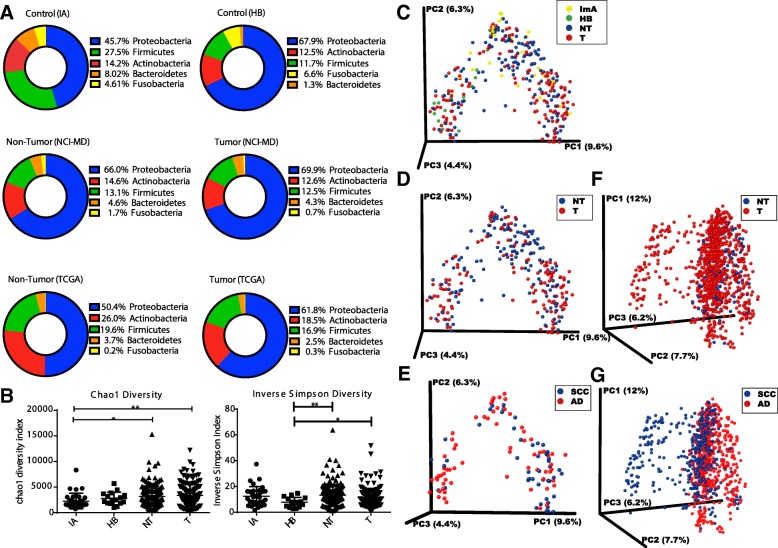
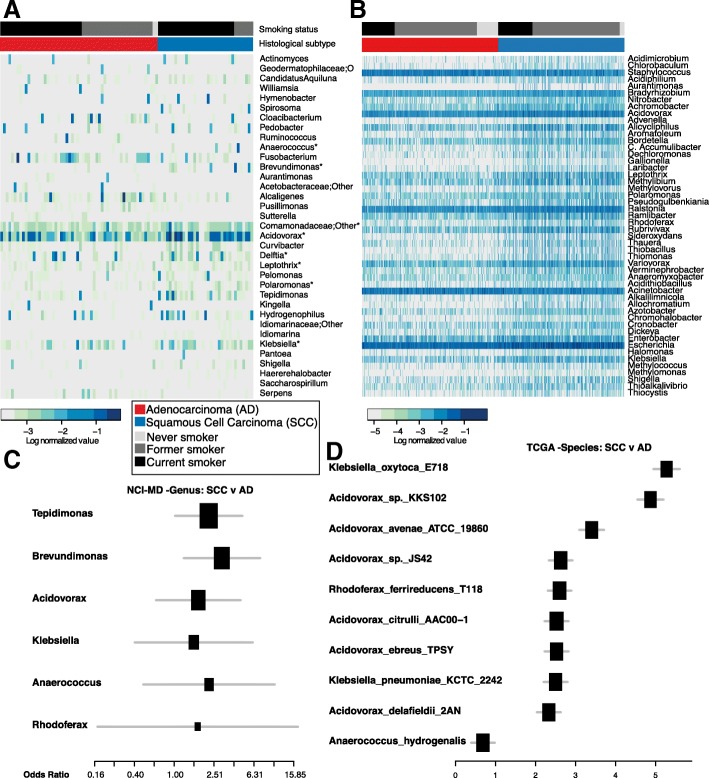
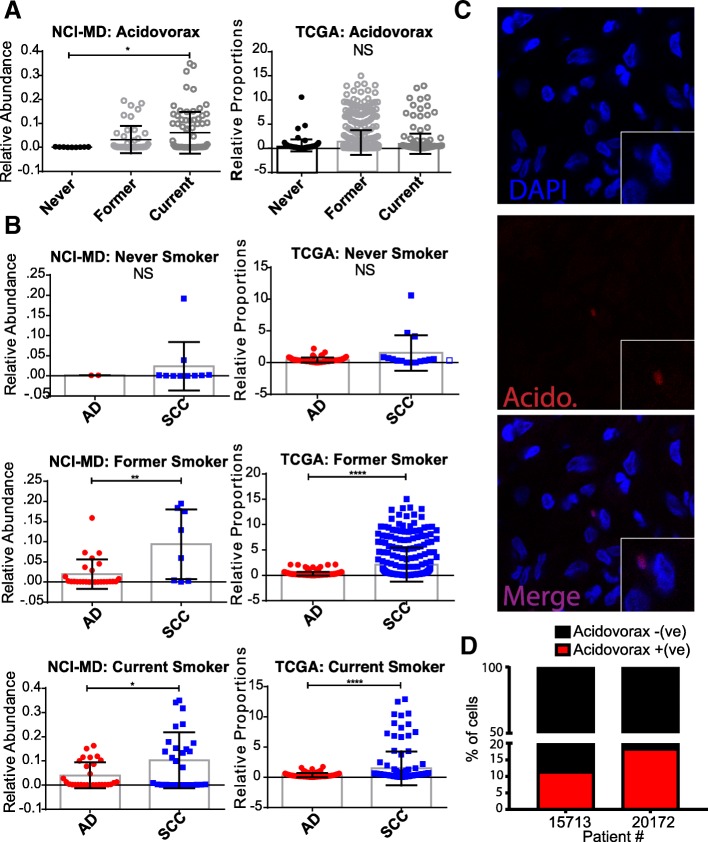
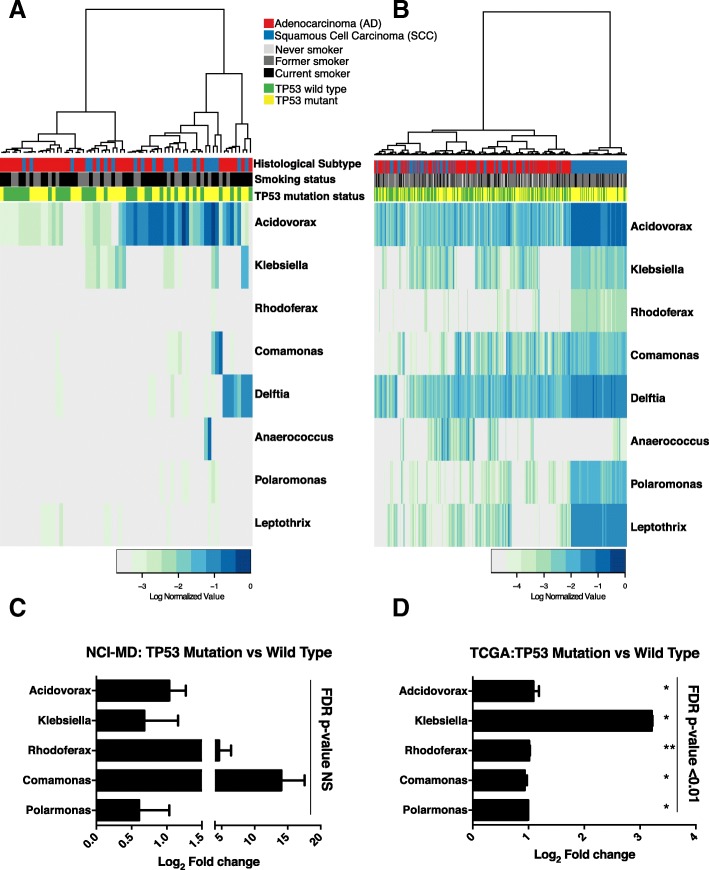
Background: Lung cancer is the leading cancer diagnosis worldwide and the number one cause of cancer deaths. Exposure to cigarette smoke, the primary risk factor in lung cancer, reduces epithelial barrier integrity and increases susceptibility to infections. Herein, we hypothesize that somatic mutations together with cigarette smoke generate a dysbiotic microbiota that is associated with lung carcinogenesis. Using lung tissue from 33 controls and 143 cancer cases, we conduct 16S ribosomal RNA (rRNA) bacterial gene sequencing, with RNA-sequencing data from lung cancer cases in The Cancer Genome Atlas serving as the validation cohort. Results: Overall, we demonstrate a lower alpha diversity in normal lung as compared to non-tumor adjacent or tumor tissue. In squamous cell carcinoma specifically, a separate group of taxa are identified, in which Acidovorax is enriched in smokers. Acidovorax temporans is identified within tumor sections by fluorescent in situ hybridization and confirmed by two separate 16S rRNA strategies. Further, these taxa, including Acidovorax , exhibit higher abundance among the subset of squamous cell carcinoma cases with TP53 mutations, an association not seen in adenocarcinomas. Conclusions: The results of this comprehensive study show both microbiome-gene and microbiome-exposure interactions in squamous cell carcinoma lung cancer tissue. Specifically, tumors harboring TP53 mutations, which can impair epithelial function, have a unique bacterial consortium that is higher in relative abundance in smoking-associated tumors of this type. Given the significant need for clinical diagnostic tools in lung cancer, this study may provide novel biomarkers for early detection.
Overview
The claims and statistics of this paper haven’t been checked yet.
Free: it reads the open-access text and checks the first 5 claims that cite a source we can check. Create a free account to check every claim.
Integrity signals
Registry
Cites
Statistics
Figures
Verification
Claims the paper makes
The claims and statistics of this paper haven’t been checked yet.
Free: it reads the open-access text and checks the first 5 claims that cite a source we can check. Create a free account to check every claim.
Claims other papers make about this one
Each is checked against this paper’s own text: does it say what the citing paper says it does?
The source backs part of the claim, not all of it — or backs it for a different population, condition or comparison.
In the citing paper
“it is also important to use mechanical tissue shearing in the DNA isolation protocol to ensure the complete recovery of DNA from within the cell wall of Gram-positive bacteria—a step not included in most standard DNA isolation protocols (6, 7).”
From The human tumor microbiome is composed of tumor type–specific intracellular bacteria (2020) · cites this paper as [6]
Experimental — accuracy not yet measuredThe cited source says what the claim attributes to it.
In the citing paper
“Intratumor bacteria have been reported in many tumor types (2-19)”
From The human tumor microbiome is composed of tumor type–specific intracellular bacteria (2020) · cites this paper as [6]
Self-check
Percentages, sums and reported differences re-computed from the paper’s own numbers.
The self-check needs the paper’s full text.
Citations
Cites
QIIME allows analysis of high-throughput community sequencing data
Caporaso, J. G., Kuczynski, J., Stombaugh, J., Bittinger, K., Bushman, F. D., Costello, E. K., Fierer, N., Peña, A. G., Goodrich, J. K., Gordon, J. I., et al. (2010) · Nature Methods · doi:10.1038/nmeth.f.303 · Cited by 34,887
(1968) · American Association of Industrial Nurses Journal · doi:10.1177/216507996801601208 · Cited by 8,798
Kozich, J. J., Westcott, S. L., Baxter, N. T., Highlander, S. K., & Schloss, P. D. (2013) · Applied and Environmental Microbiology · doi:10.1128/aem.01043-13 · Cited by 7,112
Comprehensive genomic characterization of squamous cell lung cancers
The Cancer Genome Atlas Research Network (2012) · Nature · doi:10.1038/nature11404 · Cited by 3,994
Commensal Bifidobacterium promotes antitumor immunity and facilitates anti–PD-L1 efficacy
Sivan, A., Corrales, L., Hubert, N., Williams, J. B., Aquino-Michaels, K., Earley, Z. M., Benyamin, F. W., Man Lei, Y., Jabri, B., Alegre, M.-L., et al. (2015) · Science · doi:10.1126/science.aac4255 · Cited by 3,888
Kostic, A. D., Chun, E., Robertson, L., Glickman, J. N., Gallini, C. A., Michaud, M., Clancy, T. E., Chung, D. C., Lochhead, P., Hold, G. L., et al. (2013) · Cell Host & Microbe · doi:10.1016/j.chom.2013.07.007 · Cited by 2,718
Rubinstein, M. R., Wang, X., Liu, W., Hao, Y., Cai, G., & Han, Y. W. (2013) · Cell Host & Microbe · doi:10.1016/j.chom.2013.07.012 · Cited by 2,476
Disordered Microbial Communities in Asthmatic Airways
Hilty, M., Burke, C., Pedro, H., Cardenas, P., Bush, A., Bossley, C., Davies, J., Ervine, A., Poulter, L., Pachter, L., et al. (2010) · PLoS ONE · doi:10.1371/journal.pone.0008578 · Cited by 1,824
Wu, S., Rhee, K.-J., Albesiano, E., Rabizadeh, S., Wu, X., Yen, H.-R., Huso, D. L., Brancati, F. L., Wick, E., McAllister, F., et al. (2009) · Nature Medicine · doi:10.1038/nm.2015 · Cited by 1,812
Escherichia coli Induces DNA Double-Strand Breaks in Eukaryotic Cells
Nougayrède, J.-P., Homburg, S., Taieb, F., Boury, M., Brzuszkiewicz, E., Gottschalk, G., Buchrieser, C., Hacker, J., Dobrindt, U., & Oswald, E. (2006) · Science · doi:10.1126/science.1127059 · Cited by 1,188
Research works printed but not linked: 1
- Sequence read archive. http://www.ncbi.nlm.nih.gov/bioproject/320383.
Cited by
Inflammation and cancer: triggers, mechanisms, and consequences
Greten, F. R., & Grivennikov, S. I. (2019) · Immunity · doi:10.1016/j.immuni.2019.06.025 · Cited by 3,806
“, 2017) and recent studies highlight the role of lung microbiota in induction of inflammation and tumorigenesis (Greathouse et al., 2018; Jin et al., 2019).”
BackgroundThe human tumor microbiome is composed of tumor type–specific intracellular bacteria
Nejman, D., Livyatan, I., Fuks, G., Gavert, N., Zwang, Y., Geller, L. T., Rotter-Maskowitz, A., Weiser, R., Mallel, G., Gigi, E., et al. (2020) · Science · doi:10.1126/science.aay9189 · Cited by 2,464
Self-citationThe microbiome and human cancer
Sepich-Poore, G. D., Zitvogel, L., Straussman, R., Hasty, J., Wargo, J. A., & Knight, R. (2021) · Science · doi:10.1126/science.abc4552 · Cited by 1,332
RETRACTED ARTICLE: Microbiome analyses of blood and tissues suggest cancer diagnostic approach
Poore, G. D., Kopylova, E., Zhu, Q., Carpenter, C., Fraraccio, S., Wandro, S., Kosciolek, T., Janssen, S., Metcalf, J., Song, S. J., et al. (2020) · Nature · doi:10.1038/s41586-020-2095-1 · Cited by 989
RetractedThe dynamic lung microbiome in health and disease
Natalini, J. G., Singh, S., & Segal, L. N. (2023) · Nature Reviews Microbiology · doi:10.1038/s41579-022-00821-x · Cited by 523
Tumor initiation and early tumorigenesis: molecular mechanisms and interventional targets
Zhang, S., Xiao, X., Yi, Y., Wang, X., Zhu, L., Shen, Y., Lin, D., & Wu, C. (2024) · Signal Transduction and Targeted Therapy · doi:10.1038/s41392-024-01848-7 · Cited by 399
“…) Escherichia coli ( E. 201 – 203 In other tumor types, there are also some cues that microbiota is involved in tumor formation, such as Streptococcus anginosus ( S. anginosus ) in gastric cancer, 204 Acidovorax species in lung squamous cell carcinoma, 205 and Bacteroides fragilis in breast cancer.”
BackgroundLower Airway Dysbiosis Affects Lung Cancer Progression
Tsay, J.-C. J., Wu, B. G., Sulaiman, I., Gershner, K., Schluger, R., Li, Y., Yie, T.-A., Meyn, P., Olsen, E., Perez, L., et al. (2021) · Cancer Discovery · doi:10.1158/2159-8290.cd-20-0263 · Cited by 322
“16, 20), including the p53 mutation pathway (21).”
BackgroundUnexpected guests in the tumor microenvironment: microbiome in cancer
Wong-Rolle, A., Wei, H. K., Zhao, C., & Jin, C. (2021) · Protein & Cell · doi:10.1007/s13238-020-00813-8 · Cited by 313
Targeting the gut microbiota for cancer therapy
Fernandes, M. R., Aggarwal, P., Costa, R. G. F., Cole, A. M., & Trinchieri, G. (2022) · Nature Reviews Cancer · doi:10.1038/s41568-022-00513-x · Cited by 290
Self-citationIntratumoural microbiota: a new frontier in cancer development and therapy
Cao, Y., Xia, H., Tan, X., Shi, C., Ma, Y., Meng, D., Zhou, M., Lv, Z., Wang, S., & Jin, Y. (2024) · Signal Transduction and Targeted Therapy · doi:10.1038/s41392-023-01693-0 · Cited by 253
“37 In adenocarcinomas , Acinetobacter , Brevundimonas , and Propionibacterium were more abundant.”
BackgroundThe Influence of Lung Microbiota on Lung Carcinogenesis, Immunity, and Immunotherapy
Ramírez-Labrada, A. G., Isla, D., Artal, A., Arias, M., Rezusta, A., Pardo, J., & Gálvez, E. M. (2020) · Trends in Cancer · doi:10.1016/j.trecan.2019.12.007 · Cited by 233
“Lung epithelial cells with mutations in TP53 due to tobacco smoke are invaded by species that take advantage of the new microenvironment, suggesting that these bacteria could act as promoters in lung tumorigenesis [17].”
BackgroundAdvancing to the era of cancer immunotherapy
Wang, Y., Wang, M., Wu, H., & Xu, R. (2021) · Cancer Communications · doi:10.1002/cac2.12178 · Cited by 214
Role of lung and gut microbiota on lung cancer pathogenesis
Zhao, Y., Liu, Y., Li, S., Peng, Z., Liu, X., Chen, J., & Zheng, X. (2021) · Journal of Cancer Research and Clinical Oncology · doi:10.1007/s00432-021-03644-0 · Cited by 212
Microbiota in Tumors: From Understanding to Application
Xie, Y., Xie, F., Zhou, X., Zhang, L., Yang, B., Huang, J., Wang, F., Yan, H., Zeng, L., Zhang, L., et al. (2022) · Advanced Science · doi:10.1002/advs.202200470 · Cited by 209
The coming decade in precision oncology: six riddles
Wahida, A., Buschhorn, L., Fröhling, S., Jost, P. J., Schneeweiss, A., Lichter, P., & Kurzrock, R. (2023) · Nature Reviews Cancer · doi:10.1038/s41568-022-00529-3 · Cited by 205
“*BCR-ABL is found almost exclusively in leukaemia; however, a case report of it in glioblastoma has been published 133 . suppressing depending on the local flora 92,93 .”
Chronic obstructive pulmonary disease (COPD) and lung cancer: common pathways for pathogenesis
Parris, B. A., O’Farrell, H. E., Fong, K. M., & Yang, I. A. (2019) · Journal of Thoracic Disease · doi:10.21037/jtd.2019.10.54 · Cited by 194
“Another recent study demonstrated the unique bacterial signature in patients with lung tumours harbouring TP53 mutations (168).”
BackgroundThe lung microbiome: progress and promise
Whiteside, S. A., McGinniss, J. E., & Collman, R. G. (2021) · Journal of Clinical Investigation · doi:10.1172/jci150473 · Cited by 183
The Microbiome in Lung Cancer Tissue and Recurrence-Free Survival
Peters, B. A., Hayes, R. B., Goparaju, C., Reid, C., Pass, H. I., & Ahn, J. (2019) · Cancer Epidemiology, Biomarkers & Prevention · doi:10.1158/1055-9965.epi-18-0966 · Cited by 180
“Veillonellaceae in lung tumor compared with normal lung tissue, which has been observed bymany (8–13), but not all (14) studies comparing lung cancer cases to controls.”
BackgroundCurrent understanding of the intratumoral microbiome in various tumors
Xue, C., Chu, Q., Zheng, Q., Yuan, X., Su, Y., Bao, Z., Lu, J., & Li, L. (2023) · Cell Reports Medicine · doi:10.1016/j.xcrm.2022.100884 · Cited by 135
“– Greathouse et al.58 (Continued on next page) 1 2 C e ll R e p o rts M e d ic in e 4 , 1 0 0 8 8 4 , J a n u a ry 1 7 , 2 0 2 3 R e v ie w ll O P E N A C C E S S Table 2.”
BackgroundInfluentialMicrobiome dysbiosis in lung cancer: from composition to therapy
Liu, N., Ma, Q., Ge, Y., Yi, C., Wei, L., Tan, J.-C., Chu, Q., Li, J., Zhang, P., & Wang, H. (2020) · npj Precision Oncology · doi:10.1038/s41698-020-00138-z · Cited by 159
Ma, J., Huang, L., Hu, D., Zeng, S., Han, Y., & Shen, H. (2021) · Journal of Experimental & Clinical Cancer Research · doi:10.1186/s13046-021-02128-w · Cited by 153
The microbiome and cancer for clinicians
Picardo, S. L., Coburn, B. A., & Hansen, A. R. (2019) · Critical Reviews in Oncology/Hematology · doi:10.1016/j.critrevonc.2019.06.004 · Cited by 151
Zhu, Z., Cai, J., Hou, W., Xu, K., Wu, X., Song, Y., Bai, C., Mo, Y.-Y., & Zhang, Z. (2023) · Gut Microbes · doi:10.1080/19490976.2023.2166700 · Cited by 133
Bajinka, O., Simbilyabo, L., Tan, Y., Jabang, J. N., & Saleem, S. A. (2021) · Critical Reviews in Microbiology · doi:10.1080/1040841x.2021.1960483 · Cited by 140
The characterization of lung microbiome in lung cancer patients with different clinicopathology.
Huang, D., Su, X.-F., Yuan, M., Zhang, S., He, J., Deng, Q., Qiu, W., Dong, H., & Cai, S. (2019) · Europe PMC (PubMed Central) · Cited by 142
Mechanisms Contributing to the Comorbidity of COPD and Lung Cancer
Forder, A., Zhuang, R., Souza, V. G. P., Brockley, L. J., Pewarchuk, M. E., Telkar, N., Stewart, G. L., Benard, K., Marshall, E. A., Reis, P. P., et al. (2023) · International Journal of Molecular Sciences · doi:10.3390/ijms24032859 · Cited by 136
An overview of cancer health disparities: new approaches and insights and why they matter
Minas, T. Z., Kiely, M., Ajao, A., & Ambs, S. (2021) · Carcinogenesis · doi:10.1093/carcin/bgaa121 · Cited by 115
The Cancer Microbiome: Recent Highlights and Knowledge Gaps
Knippel, R. J., Drewes, J. L., & Sears, C. L. (2021) · Cancer Discovery · doi:10.1158/2159-8290.cd-21-0324 · Cited by 110
“Microbial signals in cancer are likely highly confounded by the heterogeneity of cancer combined with observations that single bacterial species-oncogene interactions modify cancer biology (20,66), making well-defined cancer microbiome ‘signatures’ difficult to classify or detect.”
BackgroundLung microbiome and coronavirus disease 2019 (COVID-19): Possible link and implications
Khatiwada, S., & Subedi, A. (2020) · Human Microbiome Journal · doi:10.1016/j.humic.2020.100073 · Cited by 109
“Recent evidence shows that lung microbiome is altered in lung cancer, and the microbiome can influence cancer development and progression [30,31].”
Jin, J., Gan, Y., Liu, H., Wang, Z., Yuan, J., Deng, T., Zhou, Y., Zhu, Y., Zhu, H. L., Yang, S., et al. (2019) · Lung Cancer · doi:10.1016/j.lungcan.2019.08.022 · Cited by 108
Cell fate regulation governed by p53: Friends or reversible foes in cancer therapy
Song, B., Yang, P., & Zhang, S. (2024) · 癌症:英文版 · doi:10.1002/cac2.12520 · Cited by 109
Host-Microbiome Interaction in Lung Cancer
Dong, Q., Chen, E. S., Zhao, C. N., & Jin, C. (2021) · Frontiers in Immunology · doi:10.3389/fimmu.2021.679829 · Cited by 102
“found that Granulicatella adiacens and six other opportunistic pathogens were more common in spontaneous sputum samples from lung cancer patients (34); Greathouse and colleagues demonstrated a correlation between Acidovorax genus and squamous cell carcinoma, and identified a specific group of taxa enriched in smokers…”
BackgroundThe human microbiome and cancer: a diagnostic and therapeutic perspective
Kandalai, S., Li, H., Zhang, N., Peng, H., & Zheng, Q. (2023) · Cancer Biology & Therapy · doi:10.1080/15384047.2023.2240084 · Cited by 101
“Further, the presence of genera Acidovorax, Klebsiella, Rhodoferax, Comamonas, and Polarmonas was highly associated with p53 mutations.(63) Researchers have seen increases in members of the Proteobacteria phylum in lung cancer patients, but the significance of this association varies by study.”
BackgroundThe microbiome and lung cancer
Maddi, A., Sabharwal, A., Violante, T., Manuballa, S., Genco, R. J., Patnaik, S. K., & Yendamuri, S. (2019) · Journal of Thoracic Disease · doi:10.21037/jtd.2018.12.88 · Cited by 101
“(77) examined the presence of a lung tissue microbiome in 33 patients without lung cancer and 142 patients with lung cancer and found a distinct lung microbiome in patients with lung cancer.”
BackgroundTherapeutic Targeting of the Respiratory Microbiome
Chotirmall, S. H., Bogaert, D., Chalmers, J. D., Cox, M. J., Hansbro, P. M., Huang, Y. J., Molyneaux, P. L., O’Dwyer, D. N., Pragman, A. A., Rogers, G. B., et al. (2022) · American Journal of Respiratory and Critical Care Medicine · doi:10.1164/rccm.202112-2704pp · Cited by 99
Profiling of tumour-associated microbiota in human hepatocellular carcinoma
Komiyama, S., Yamada, T., Takemura, N., Kokudo, N., Hase, K., & Kawamura, Y. I. (2021) · Scientific Reports · doi:10.1038/s41598-021-89963-1 · Cited by 96
Gut Microbiota and Bone Diseases: A Growing Partnership
Chen, Y., Wang, X., Zhang, C., Liu, Z., Li, C., & Ren, Z. (2022) · Frontiers in Microbiology · doi:10.3389/fmicb.2022.877776 · Cited by 96
Goto, T. (2022) · Seminars in Cancer Biology · doi:10.1016/j.semcancer.2022.07.006 · Cited by 96
Microbiome epidemiology and association studies in human health
VanEvery, H., Franzosa, E. A., Nguyen, L. H., & Huttenhower, C. (2022) · Nature Reviews Genetics · doi:10.1038/s41576-022-00529-x · Cited by 94
Zhang, Z., Yang, J., Feng, Q., Chen, B., Li, M., Liang, C., Li, M. K., Li, Z., Xu, Q., Zhang, L., et al. (2019) · Frontiers in Microbiology · doi:10.3389/fmicb.2019.01439 · Cited by 92
Zhou, A., Yuan, Y., Yang, M., Huang, Y., Li, X., Li, S., Yang, S., & Tang, B. (2022) · Frontiers in Cellular and Infection Microbiology · doi:10.3389/fcimb.2022.832672 · Cited by 90
Chau, J., Yadav, M., Liu, B., Furqan, M., Dai, Q., Shahi, S., Gupta, A., Mercer, K. N., Eastman, E., Hejleh, T. A., et al. (2021) · BMC Cancer · doi:10.1186/s12885-021-08530-z · Cited by 73
“In addition to development of lung cancer and poor response to ICI, Proteobacteria has been correlated with lower incidence of irAEs [56, 57].”
BackgroundImplications of the Immune Landscape in COPD and Lung Cancer: Smoking Versus Other Causes
Taucher, E., Mykoliuk, I., Lindenmann, J., & Smolle-Jüettner, F.-M. (2022) · Frontiers in Immunology · doi:10.3389/fimmu.2022.846605 · Cited by 86
Intratumor microbiome in cancer progression: current developments, challenges and future trends
Liu, J., & Zhang, Y. (2022) · Biomarker Research · doi:10.1186/s40364-022-00381-5 · Cited by 80
“Chronically high ROS levels can outpace the host DNA repair, and finally results in DNA damage and mutations [38, 88].”
BackgroundRole of Lung Microbiome in Innate Immune Response Associated With Chronic Lung Diseases
Paudel, K. R., Dharwal, V., Patel, V. K., Galvão, I., Wadhwa, R., Malyla, V., Shen, S., Budden, K. F., Hansbro, N. G., Vaughan, A., et al. (2020) · Frontiers in Medicine · doi:10.3389/fmed.2020.00554 · Cited by 84
“Comamonas, Rhodoferax, Acidovorax, Polarmonas, and Klebsiella are often observed in squamous cell carcinoma (SCC) but not adenocarcinoma (133).”
BackgroundResultInfluentialInfluence of gut and intratumoral microbiota on the immune microenvironment and anti-cancer therapy
Chen, Y., Liu, B., Wei, Y., & Kuang, D.-M. (2021) · Pharmacological Research · doi:10.1016/j.phrs.2021.105966 · Cited by 73
Smoking-induced microbial dysbiosis in health and disease
Shapiro, H., Goldenberg, K., Ratiner, K., & Elinav, E. (2022) · Clinical Science · doi:10.1042/cs20220175 · Cited by 83
Alterations of lung microbiota in patients with non-small cell lung cancer
Zeng, W., Zhao, C., Yu, M., Chen, H., Pan, Y., Wang, Y., Bao, H., Ma, H., & Ma, S. (2022) · Bioengineered · doi:10.1080/21655979.2022.2045843 · Cited by 81
“showed that the α-diversity of the microbiota was higher in primary or recurrent lung cancer than in normal lung tissue [23,24].”
BackgroundThe human lung microbiome—A hidden link between microbes and human health and diseases
Yi, X., Gao, J., & Wang, Z. (2022) · iMeta · doi:10.1002/imt2.33 · Cited by 80
“Greathouse et al. [81] showed that increased lung Acidovorax was associated with the TP53 mutation.”
BackgroundPatnaik, S. K., Gomez, E. C., Kannisto, E. D., Punnanitinont, A., Dhillon, S. S., Liu, S., & Yendamuri, S. (2020) · Journal of Thoracic and Cardiovascular Surgery · doi:10.1016/j.jtcvs.2020.01.104 · Cited by 80
Healy, C., Munoz-Wolf, N., Strydom, J., Faherty, L., Williams, N. C., Kenny, S., Donnelly, S. C., & Cloonan, S. M. (2021) · Respiratory Research · doi:10.1186/s12931-021-01722-y · Cited by 78
“Higher IL-6 levels in lung cancer patients [428] may be associated with the upregulation of hepcidin, resulting in decreased iron influx and induced cancer-related anaemia [429]. miR-20a, upregulated in non-small cell lung cancer (NSCLC), and can negatively regulate FPN, which may promote proliferation of cancer cells…”
BackgroundInfluentialShaikh, F. Y., Gills, J. J., & Sears, C. L. (2019) · EBioMedicine · doi:10.1016/j.ebiom.2019.08.076 · Cited by 77
Microbiota Biomarkers for Lung Cancer
Leng, Q., Holden, V. K., Deepak, J., Todd, N. W., & Jiang, F. (2021) · Diagnostics · doi:10.3390/diagnostics11030407 · Cited by 76
“For example, Acidovorax was especially abundant in patients with TP53 mutation-positive lung SCC specimens [8].”
BackgroundHuman Gut Microbiota in Health and Selected Cancers
Sędzikowska, A., & Szablewski, L. (2021) · International Journal of Molecular Sciences · doi:10.3390/ijms222413440 · Cited by 78
Human Lung Microbiome on the Way to Cancer
Kovaleva, O. V., Romashin, D. D., Zborovskaya, I. B., Давыдов, М. М., Сергеевич, Ш. М., & Gratchev, A. N. (2019) · Journal of Immunology Research · doi:10.1155/2019/1394191 · Cited by 76
“Acidovorax rates prevail in smokers’ samples [20].”
BackgroundMicrobiota dysbiosis in lung cancer: evidence of association and potential mechanisms
Xu, N., Wang, L., Li, C., Ding, C., Li, C., Fan, W., Chen, C., & Gu, B. (2020) · Translational Lung Cancer Research · doi:10.21037/tlcr-20-156 · Cited by 76
The Role of The Tumor Microbiome in Tumor Development and Its Treatment
Chen, Y., Wu, F., Wu, P., Xing, H., & Ma, T. (2022) · Frontiers in Immunology · doi:10.3389/fimmu.2022.935846 · Cited by 77
“This may be because tumors carrying TP53 mutations can impair epithelial function (18).”
BackgroundThe oncogenic roles of bacterial infections in development of cancer
Eyvazi, S., Vostakolaei, M. A., Dilmaghani, A., Borumandi, O., Hejazi, M. S., Kahroba, H., & Tarhriz, V. (2020) · Microbial Pathogenesis · doi:10.1016/j.micpath.2020.104019 · Cited by 75
The effect of the intratumoral microbiome on tumor occurrence, progression, prognosis and treatment
Gao, F., Yu, B., Rao, B., Sun, Y. H., Yu, J., Wang, D., Cui, G., & Ren, Z. (2022) · Frontiers in Immunology · doi:10.3389/fimmu.2022.1051987 · Cited by 71
“Acidovorax (70) Induces tumorigenesis via mutations in the tumor suppressor TP53 (70)”
BackgroundInfluentialZhou, Z., Wang, J., Wang, J., Yang, S., Wang, R., Zhang, G., Li, Z., Shi, R., Wang, Z., & Lu, Q. (2024) · Molecular Cancer · doi:10.1186/s12943-024-02047-2 · Cited by 73
The composition of lung microbiome in lung cancer: a systematic review and meta-analysis
Najafi, S., Abedini, F., Jamalkandi, S. A., Shariati, P., Ahmadi, A., & Fesharaki, M. G. (2021) · BMC Microbiology · doi:10.1186/s12866-021-02375-z · Cited by 70
Wang, Y., Li, Y., Lin, Y., Cao, C.-Y., Chen, D., Huang, X., Li, C., Xu, H., Lai, H., Chen, H., et al. (2025) · Cell Death Discovery · doi:10.1038/s41420-025-02413-z · Cited by 70
“Some intratumoral microbes in squamous cell carcinoma caused epithelial TP53 mutations [196].”
Airway Microbiota as a Modulator of Lung Cancer
Goto, T. (2020) · International Journal of Molecular Sciences · doi:10.3390/ijms21093044 · Cited by 70
Circulating microbiome DNA as biomarkers for early diagnosis and recurrence of lung cancer
Chen, H., Ma, Y., Xu, J., Wang, W., Lu, H., Quan, C., Yang, F., Lu, Y., Wu, H., & Qiu, M. (2024) · Cell Reports Medicine · doi:10.1016/j.xcrm.2024.101499 · Cited by 68
Tango, C. N., Seo, S., Kwon, M., Lee, D.-O., Chang, H. K., & Kim, M. K. (2020) · Scientific Reports · doi:10.1038/s41598-020-66607-4 · Cited by 68
Microbiome dysbiosis and epigenetic modulations in lung cancer: From pathogenesis to therapy
Khan, F. H., Bhat, B. A., Sheikh, B. A., Tariq, L., Padmanabhan, R., Verma, J. P., Shukla, A. C., Dowlati, A., & Abbas, A. (2021) · Seminars in Cancer Biology · doi:10.1016/j.semcancer.2021.07.005 · Cited by 65
Gut Microbiota in Lung Cancer: Where Do We Stand?
Georgiou, K. E., Marinov, B. I., Farooqi, A. A., & Gazouli, M. (2021) · International Journal of Molecular Sciences · doi:10.3390/ijms221910429 · Cited by 65
“Additionally, besides tumor involvement, the impact of cancer therapy on the pathogenic microbiome is also increasing [96].”
BackgroundThe tumor microbiome in cancer progression: mechanisms and therapeutic potential
Zhang, W., Xiang, Y., Ren, H., Liu, Y., Wang, Q., Ran, M., Zhou, W., Lu, T., Zheng, X., Qiao, C., et al. (2025) · Molecular Cancer · doi:10.1186/s12943-025-02403-w · Cited by 64
“In LSCC, TP53 gene mutations were associated with an increased abundance of Acidovo-rax [128].”
Tumor microbiome: roles in tumor initiation, progression, and therapy
Zhang, S., Huang, J., Jiang, Z., Tong, H., Ma, X., & Liu, Y. (2025) · Molecular Biomedicine · doi:10.1186/s43556-025-00248-9 · Cited by 63
Streptococcus Pneumoniae Promotes Lung Cancer Development and Progression
Li, N., Zhou, H., Holden, V. K., Deepak, J., Dhilipkannah, P., Todd, N. W., Stass, S. A., & Jiang, F. (2022) · iScience · doi:10.1016/j.isci.2022.105923 · Cited by 62
“showed that Acidovorax was abundant in TP53 mutation-positive lung SCC specimens.(17) Tsay et al.”
BackgroundBiofilm and Cancer: Interactions and Future Directions for Cancer Therapy
Choi, E., Murray, B., & Choi, S. (2023) · International Journal of Molecular Sciences · doi:10.3390/ijms241612836 · Cited by 62
“Contrary to a once-believed medical dogma that cancer tissue is sterile, a growing body of evidence has demonstrated the presence of bacteria in various cancerous tumors, including breast, lung, and CRC [27,65,66].”
BackgroundRole of the Microbiota in Lung Cancer: Insights on Prevention and Treatment
Pizzo, F., Maroccia, Z., Ferri, I. H., & Fiorentini, C. (2022) · International Journal of Molecular Sciences · doi:10.3390/ijms23116138 · Cited by 61
“Many studies have observed reduced alpha diversity, enrichment in specific bacterial taxa, and higher bacterial density associated with lung cancer [78].”
BackgroundResultIntratumoral Microbiota as a Target for Advanced Cancer Therapeutics
Peng, F., Hu, M., Su, Z., Hu, L., Guo, L., & Yang, K. (2024) · Advanced Materials · doi:10.1002/adma.202405331 · Cited by 62
Rodriguez, R. M., Hernandez, B. Y., Menor, M., Deng, Y., & Khadka, V. S. (2020) · Computational and Structural Biotechnology Journal · doi:10.1016/j.csbj.2020.03.003 · Cited by 61
“Greathouse et al. (2018) examined the lung microbiome association with TP53 mutation using 16S rRNA methods and confirmed findings with TCGA lung cancer data [27].”
MethodKovaleva, O. V., Алексеевна, П. П., Rashidova, M. A., Samoilova, D. V., Petrenko, A., Zborovskaya, I. B., Mochalnikova, V. V., Kataev, V., Khlopko, Y. A., Plotnikov, A. O., et al. (2020) · Biomedicines · doi:10.3390/biomedicines8090349 · Cited by 60
Borozan, I., Zaidi, S. H., Harrison, T. A., Phipps, A. I., Zheng, J., Lee, S., Trinh, Q. M., Steinfelder, R. S., Adams, J., Banbury, B. L., et al. (2022) · Cancer Epidemiology, Biomarkers & Prevention · doi:10.1158/1055-9965.epi-21-0463 · Cited by 57
“nucleatum with existing mutation data for the same colorectal tumors (21).”
BackgroundJiang, S., Ma, W., Ma, C., Zhang, Z., Zhang, W., & Zhang, J. (2024) · Gut Microbes · doi:10.1080/19490976.2024.2341717 · Cited by 57
The onco-immunological implications of Fusobacterium nucleatum in breast cancer
van der Merwe, M., van Niekerk, G., Botha, A., & Engelbrecht, A. (2021) · Immunology Letters · doi:10.1016/j.imlet.2021.02.007 · Cited by 56
Lung and Gut Microbiota as Potential Hidden Driver of Immunotherapy Efficacy in Lung Cancer
Carbone, C., Piro, G., Noia, V. D., D’Argento, E., Vita, E., Ferrara, M. G., Pilotto, S., Milella, M., Cammarota, G., Gasbarrini, A., et al. (2019) · Mediators of Inflammation · doi:10.1155/2019/7652014 · Cited by 56
“A comparative analysis of 142 LC patients and 33 healthy controls reveals a distinct lung microbiome profile associated with tumor tissue [57].”
BackgroundThe Role of the Microbiome in Cancer and Therapy Efficacy: Focus on Lung Cancer
Halley, A., Leonetti, A., Gregori, A., Tiseo, M., Deng, D., Giovannetti, E., & Peters, G. J. (2020) · Anticancer Research · doi:10.21873/anticanres.14484 · Cited by 56
Zhang, M., Zhang, Y., Sun, Y., Wang, S., Liang, H. S., & Han, Y. (2022) · Journal of Healthcare Engineering · doi:10.1155/2022/5466853 · Cited by 54
Calabrese, F., Lunardi, F., Pezzuto, F., Fortarezza, F., Vuljan, S. E., Marquette, C., & Hofman, P. M. (2019) · Journal of Clinical Medicine · doi:10.3390/jcm8030414 · Cited by 53
Inhalable GSH-Triggered Nanoparticles to Treat Commensal Bacterial Infection in In Situ Lung Tumors
Ma, Z., Wang, H., Shi, Z., Yan, F., Li, Q., Chen, J., Cui, Z., Zhang, Y., Jin, X., Jia, Y., et al. (2023) · ACS Nano · doi:10.1021/acsnano.2c12165 · Cited by 53
Intratumoral bacteria are an important “accomplice” in tumor development and metastasis
Wang, G., He, X., & Wang, Q. (2022) · Biochimica et Biophysica Acta (BBA) - Reviews on Cancer · doi:10.1016/j.bbcan.2022.188846 · Cited by 52
Distinct bronchial microbiome precedes clinical diagnosis of lung cancer
Marshall, E. A., Filho, F. S. L., Sin, D. D., Lam, S. C., Leung, J. M., & Lam, W. L. (2022) · Molecular Cancer · doi:10.1186/s12943-022-01544-6 · Cited by 51
Microbiome in cancer progression and therapy
Andreeva, N., Gabbasova, R. R., & Grivennikov, S. I. (2020) · Current Opinion in Microbiology · doi:10.1016/j.mib.2020.09.001 · Cited by 49
Core Microbiota in Central Lung Cancer With Streptococcal Enrichment as a Possible Diagnostic Marker
Bello, S., Vengoechea, J. J., Alonso, M. P., Figueredo, A. L., Mincholé, E., Rezusta, A., Gambó, P., Pastor, J. M., Galeano, J., & del Campo, R. (2020) · Archivos de Bronconeumología · doi:10.1016/j.arbres.2020.05.034 · Cited by 49
Microbes in lung cancer initiation, treatment, and outcome: Boon or bane?
Guo, H., Zhao, L., Zhu, J., Chen, P., Wang, H., Jiang, M., Liu, X., Sun, H., Zhao, W., Zheng, Z., et al. (2021) · Seminars in Cancer Biology · doi:10.1016/j.semcancer.2021.05.025 · Cited by 50
The Lung Microbiota and Lung Cancer: A Growing Relationship
Zerdan, M. B., Kassab, J. T., Meouchy, P., Haroun, E., Nehme, R., Zerdan, M. B., Fahed, G., Petrosino, M., Dutta, D., & Graziano, S. L. (2022) · Cancers · doi:10.3390/cancers14194813 · Cited by 49
“Acidovorax [50,51] Lung tissues A marked presence in squamous cell carcinoma patients compared with adenocarcinoma.”
BackgroundFu, Y., Li, J., Cai, W., Huang, Y., Liu, X., Ma, Z., Tang, Z., Bian, X., Zheng, J., Jiang, J., et al. (2024) · Acta Pharmaceutica Sinica B · doi:10.1016/j.apsb.2023.11.018 · Cited by 48
Hong, H., Wang, Y., Menard, M. A., Buckley, J. A., Zhou, L., Volpicelli‐Daley, L. A., Standaert, D. G., Qin, H., & Benveniste, E. N. (2024) · Journal of Neuroinflammation · doi:10.1186/s12974-024-03210-8 · Cited by 47
“Dot and violin plots were generated with sc.pl.dotplot and sc.pl.violin functions in Scanpy (1.9.1) [47] using annotated h5ad files exported from Partek workflow.”
InfluentialThe metabolic dialogue between intratumoural microbes and cancer: implications for immunotherapy
Situ, Y., Zhang, P., Zhang, C., Jiang, A., Zhang, N., Zhu, L., Mou, W., Liu, Z., Wong, H. Z. H., Zhang, J., et al. (2025) · eBioMedicine · doi:10.1016/j.ebiom.2025.105708 · Cited by 45
Zhou, X., Ji, L., Ma, Y., Tian, G., Lv, K., & Yang, J. (2023) · Microbiology Spectrum · doi:10.1128/spectrum.03738-22 · Cited by 43
“in lung squamous cell carcinoma and strongly associated with prognostic survival of lung squamous carcinoma patients, suggesting that Acidovorax and Comamonas are specific for lung SCC with TP53 mutations (26, 44, 45).”
BackgroundTracing Lung Cancer Risk Factors Through Mutational Signatures in Never-Smokers
Landi, M. T., Synnott, N. C., Rosenbaum, J., Zhang, T., Zhu, B., Shi, J., Wei, Z., Kebede, M., Sang, J., Choi, J., et al. (2020) · American Journal of Epidemiology · doi:10.1093/aje/kwaa234 · Cited by 43
“Another study found a distinct lung microbiome in patients with lung cancer and particular genomic changes (71).”
BackgroundHuang, D., He, J., Su, X. F., Wen, Y. N., Zhang, S. J., Liu, L. Y., Zhao, H., Ye, C. P., Wu, J. H., Cai, S., et al. (2022) · Thoracic Cancer · doi:10.1111/1759-7714.14340 · Cited by 42
“4 Accumulating studies have suggested that the airway microbiota of lung cancer 1 patients was significantly different from healthy or benign control [4-11], suggesting 2 that airway microbiota may contribute to the development of lung cancer or be 3 affected during the progression of lung cancer.”
BackgroundCore Microbiota in Central Lung Cancer With Streptococcal Enrichment as a Possible Diagnostic Marker
Bello, S., Vengoechea, J. J., Alonso, M. P., Figueredo, A. L., Mincholé, E., Rezusta, A., Gambó, P., Pastor, J. M., Galeano, J., & del Campo, R. (2021) · Archivos de Bronconeumología · doi:10.1016/j.arbr.2020.05.017 · Cited by 42
Wong, L. M., Shende, N., Li, W. T., Castaneda, G., Apostol, L., Chang, E. Y., & Ongkeko, W. M. (2020) · Cancers · doi:10.3390/cancers12061447 · Cited by 41
“analyzed TCGA LUSC and LUAD data to discern the combinatorial effects of somatic mutations and smoking while adjusting for age and gender as co-variates, but the study did not identify microbes associated with age and gender [22].”
MethodLiao, K., Wen, J., Liu, Z., Zhang, B., Zhang, X., Fu, Y., Zhang, W., Hu, H., Ai, K., Zhu, W., et al. (2025) · Ageing Research Reviews · doi:10.1016/j.arr.2025.102820 · Cited by 40
Microbiome as an Immunological Modifier
Kumar, M., Singh, P., Murugesan, S., Vétizou, M., McCulloch, J. A., Badger, J. H., Trinchieri, G., & Khodor, S. A. (2019) · Methods in molecular biology · doi:10.1007/978-1-4939-9773-2_27 · Cited by 40
Self-citationLathe, R., Schultek, N. M., Balin, B. J., Ehrlich, G. D., Alberi, L. A., Perry, G. L., Breitschwerdt, E. B., Corry, D. B., Doty, R. L., Rissman, R. A., et al. (2023) · Alzheimer s & Dementia · doi:10.1002/alz.13076 · Cited by 39
“53,142,149,150 The general method for 16S pan-domain analyses reported by Earl et al. 142 was able to accurately characterize highly complex polymicrobial specimens containing hundreds of different species present at molar input levels that vary by morethanthreeordersofmagnitude.”
BackgroundMethodSelf-citation
Metadata
- Authors
- Greathouse, K. L., White, J. R., Vargas, A. J., Bliskovsky, V. V., Beck, J. A., von Muhlinen, N., Polley, E. C., Bowman, E. D., Khan, M. A., Robles, A. I., Cooks, T., Ryan, B. M., Padgett, N., Dzutsev, A. H., Trinchieri, G., Pineda, M. A., Bilke, S., Meltzer, P. S., Hokenstad, A. N., Stickrod, T. M., Walther-Antonio, M. R., Earl, J. P., Mell, J. C., Krol, J. E., Balashov, S. V., Bhat, A. S., Ehrlich, G. D., Valm, A., Deming, C., Conlan, S., Oh, J., Segre, J. A., & Harris, C. C.
- Affiliations
- National Institutes of Health (US)
- Resphera Biosciences (US)
- Mayo Clinic (US)
- Drexel University (US)
- Jackson Laboratory (US)
- Corresponding author
- Harris, Curtis C.
- ORCID
- Greathouse, K. Leigh
- White, James R.
- Beck, Jessica A.
- Polley, Eric C.
- Bowman, Elise D.
- Robles, Ana I.
- Cooks, Tomer
- Ryan, Bríd M.
- Trinchieri, Giorgio
- Pineda, Marbin A.
- Bilke, Sven
- Meltzer, Paul S.
- Walther-Antonio, Marina R.
- Earl, Joshua P.
- Mell, Joshua C.
- Bhat, Archana S.
- Ehrlich, Garth D.
- Valm, Alex
- Conlan, Sean
- Oh, Julia
- Harris, Curtis C.
- Venue
- Genome Biology
- Published
- 2018-08-24
- Volume
- 19
- Issue
- 1
- Pages
- 123-123
- ISSN
- 1465-6906 (ISSN-L)
- 1474-760X
- PMC
- PMC6109311
- OpenAlex
- W2888696120
- Cited by
- 446
- References
- 55
- Citations by year
- 2026: 39 · 2025: 83 · 2024: 70 · 2023: 68 · 2022: 72 · 2021: 56 · 2020: 41 · 2019: 16
- FWCI
- 10.05
- Type
- journal article
- Language
- en
- Update notices
- correction (2020-02-20)
- Open access
- gold
- doi.org
- Licence
- cc-by
- creativecommons.org/licenses/by/4.0/ (tdm)
- creativecommons.org/licenses/by/4.0/ (vor)
- Locations
- Genome biology (publishedVersion, cc-by)
- Europe PMC (PubMed Central) (publishedVersion, other-oa)
- PubMed Central (publishedVersion, cc-by)
- PubMed (publishedVersion)
- DOAJ (DOAJ: Directory of Open Access Journals) (submittedVersion, cc-by-sa)
- The Mouseion at the JAXlibrary (Jackson Laboratory) (submittedVersion, cc-by)
- Funders
- National Cancer Institute (Intramural)
- Topics
- Life Sciences › Biochemistry, Genetics and Molecular Biology › Molecular Biology › Gut microbiota and health
- Health Sciences › Dentistry › Periodontics › Oral microbiology and periodontitis research
- Life Sciences › Biochemistry, Genetics and Molecular Biology › Cancer Research › Cancer Genomics and Diagnostics
- Keywords
- lung cancer, microbiome, TP53 mutation, squamous cell carcinoma, cigarette smoking, bacterial dysbiosis, lung carcinogenesis, epithelial barrier integrity, lung adenocarcinoma, alpha diversity, early diagnosis biomarkers
- MeSH terms
- Smokers, Adult, Aged, Female, Humans, Lung Neoplasms, Male, Middle Aged, Mutation, Reproducibility of Results, Tumor Suppressor Protein p53, Neoplasms, Squamous Cell, Proteobacteria, Comamonadaceae, Biodiversity, Microbiota
About these checks
Registry, retraction, Cites and statistics results are computed, not judged, with one exception: a printed reference that no index lists is read once by a model before it counts as a citation error. Claims are extracted by a model and kept only when their quote appears verbatim in the text; each cited source is then checked, with a model’s help, for whether it says what the claim relies on. Those verdicts can be wrong — read the claim’s quote and the cited source before relying on one.
Statistics and arithmetic are recomputed, not judged.
Confidence bands are shown only for fields calibrated on our annotated test set. None is calibrated yet, so no band is shown.
What counts as a claim ›How we measure confidence ›How we check this ›
Are you an author, or do you see a problem with this page? Request a review
Data sources
Bibliographic data: Semantic Scholar, OpenAlex, Crossref.
Contains information from the Semantic Scholar Academic Graph Datasets, made available under the ODC Attribution License (ODC-BY 1.0).
Semantic Scholar’s data is described in: Kinney, R., et al. (2023). The Semantic Scholar Open Data Platform. arXiv:2301.10140.
